Tuesday, April 21, 2026

Army Contracting Command Accelerates Hypersonic Weapon Fielding

Speed defines the Army's long-range hypersonic weapon, Dark Eagle. But long before the system moves at hypersonic velocity, precision behind the scenes makes that speed possible. 
 
U.S. Army Contracting Command Redstone Arsenal awarded a $2.7 billion production contract March 31, supporting Dark Eagle, marking a major milestone achieved ahead of an accelerated fiscal year 2026 fielding timeline. 
 
Getting there was anything but routine. 
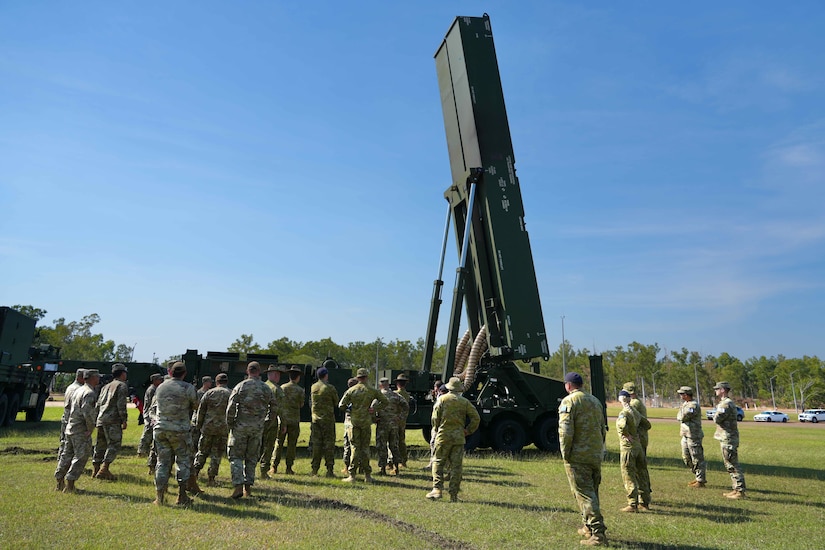
More than two dozen people in camouflage military uniforms stand in a field around a large military weapons system that is pointing in the air.

At the command, a six-person team of contracting and pricing professionals played a central role in navigating a compressed schedule, evolving requirements and complex negotiations to support one of the Army's top modernization priorities. 
 
"This acquisition was different from a typical contract because it was a joint effort between the Army and Navy, and [it] combined both research and development and production under a single effort," said Paul Daugherty, command contracting officer. "The accelerated timeline compressed proposal reviews, revisions and contractor counterproposals, requiring the team to develop alternative approaches quickly while maintaining acquisition standards."  

Dark Eagle represents a significant leap in capability in a complex War Department effort requiring close coordination across development, testing and production. 
 
To meet an aggressive goal of awarding the contract by the end of the second quarter of fiscal year 2026, the command adjusted its approach by engaging with partners early and working through challenges as they emerged. 
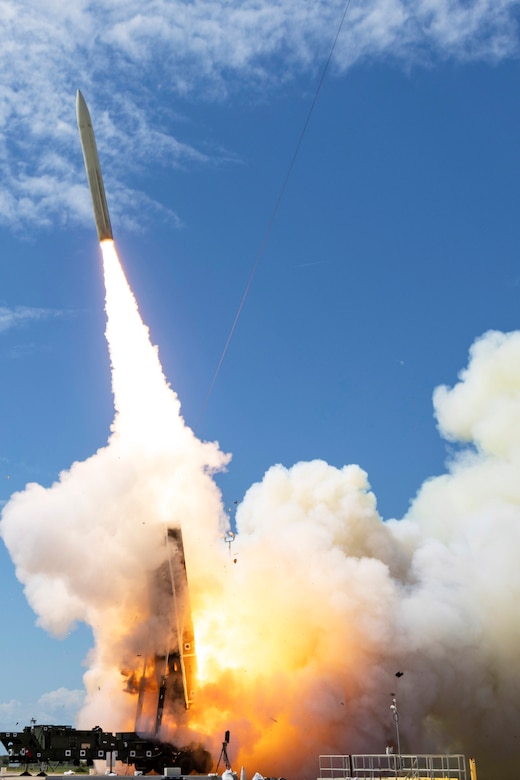
A missile launches during daytime, leaving plumes of smoke and flames behind it as it rises into a blue sky.

The milestone reflects a synchronized effort across contracting centers, program executive offices and industry partners, with ACC-Redstone Arsenal at the center of executing the acquisition strategy. 
 
"This effort marked a significant milestone as the first production contract for the common hypersonic glide body program, transitioning from an [other transaction authority] to a [federal acquisition regulation] part 15 contract," said Eric Blystone, command pricing branch chief. "With limited historical cost data available, the team coordinated closely with partners, including [the Defense Contract Management Agency] and [the Defense Contract Audit Agency], to conduct detailed analysis and support a fair and reasonable outcome for the government." 
 
The effort shows how disciplined execution and early alignment can accelerate complex acquisition programs while maintaining standards. 

"This development and production contract provides the Army and Navy the ability to achieve optimized pricing across base and option years, allowing the government to buy to budget while maximizing every taxpayer dollar," said Vince Dickens, command branch chief of hypersonic missile and counter-unmanned aerial systems. "The close partnership across contracting, pricing and stakeholders was critical to delivering a successful outcome for the warfighter."

Spring Culminating Exercise Tests Cadet Warfighter Skills

Nearly 3,000 cadets participated in the U.S. Air Force Academy's spring culminating exercise in Colorado Springs, Colorado, April 15-18. 

The exercise is rigorous, realistic, multidomain military training that develops cadets into combat-ready Air Force and Space Force leaders. 

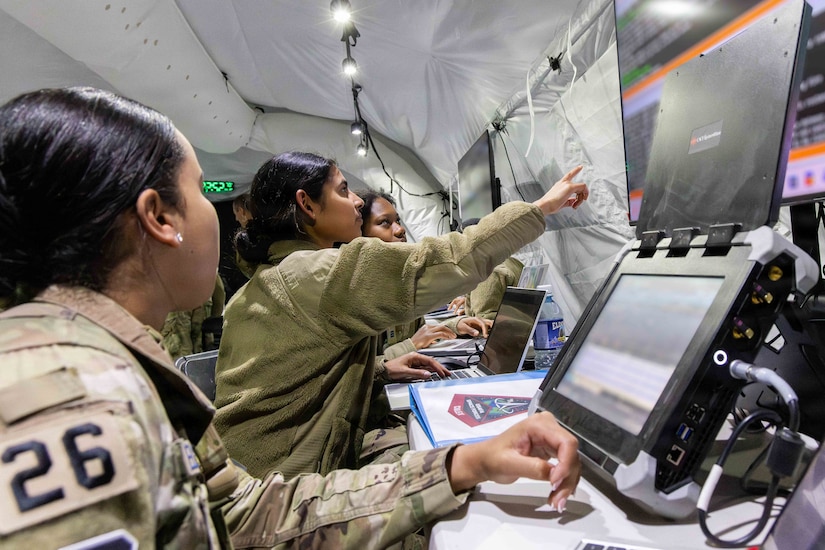
Three women in camouflage military uniforms sit in front of computers and monitors inside a tent; the middle one is pointing to a monitor.

"Our focus is forging these cadets into warfighters," said Air Force Lt. Col. Benjamin Mackey, division chief for Cadet Wing Operations. "We're presenting them with opportunities to learn and grow. The [culminating exercise] allows them to test their military training so that when they graduate, they're ready to lead on Day 1 in any environment."

From Classroom to Combat Scenarios 

The comprehensive exercise applied classroom learning and small-group military training in a notional field training environment, where cadets practiced command and control, cyber operations and integrating space effects into their mission planning and other joint force capabilities. 

"The [culminating exercise] exposed cadets to leading in a joint warfighting construct," Mackey said. "It provided them with a reference of the framework they'll use as officers and gave them valuable background knowledge, which will make them that much more effective working with their sister services."

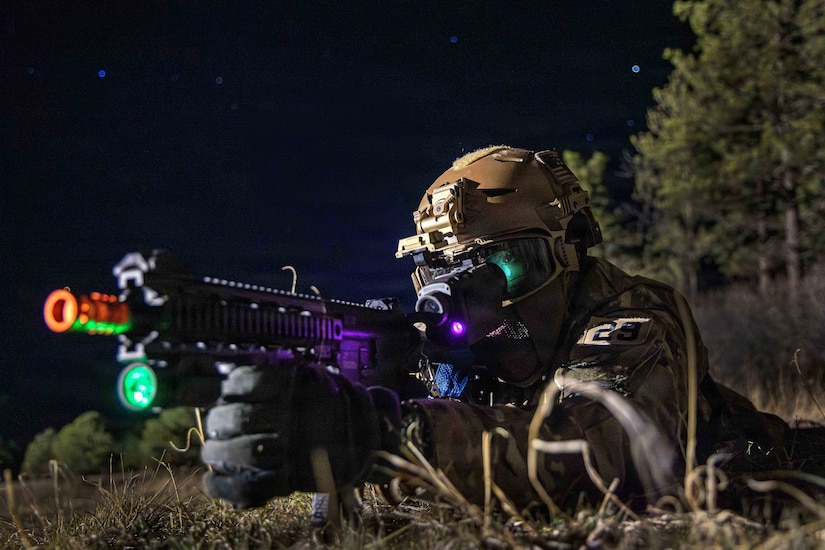
A person in a camouflage uniform and goggles lies on the grass in darkness with their torso lifted and points a machine gun.

The exercise required cadets to synchronize efforts across multiple teams and functional areas, reinforcing the idea that individual actions contribute to mission success at a larger scale. Cadets were expected to assess evolving situations, prioritize tasks and make timely decisions, while maintaining accountability for their teams and mission objectives. 

Decision-Making Under Pressure 

Academy planners designed the exercise around realistic, stressful scenarios to develop critical thinking skills while testing the mettle of cadets. 

"This exercise gave cadets a chance to sharpen their skills within a controlled yet dynamic environment," said Air Force Tech. Sgt. Richard McArdle, an academy exercise planner. "We designed it to replicate something they'll most likely see during their Air Force or Space Force careers to improve their ability to adapt and overcome in ever-changing environments."

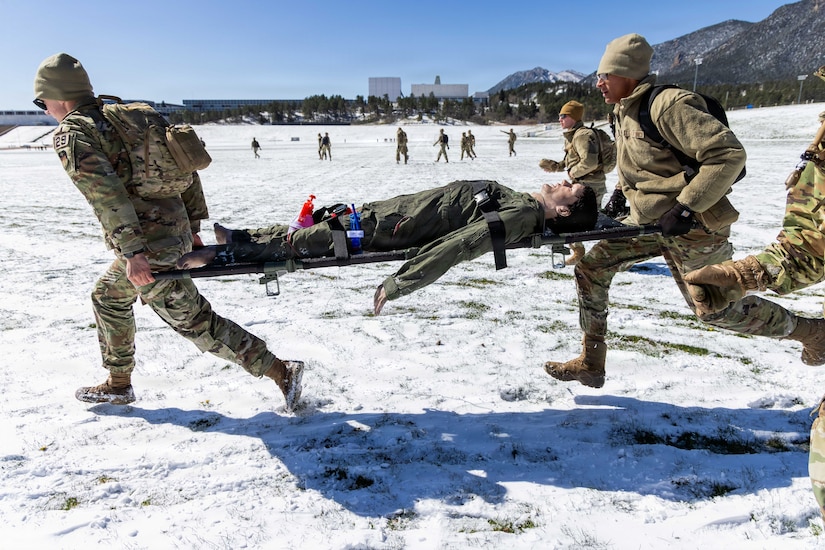
Two people dressed in camouflage military uniforms run outside in the snow while carrying a manikin on a stretcher; nearly a dozen people in similar attire are also running. In the distance are trees, mountains and buildings.

A separate group of cadets served as an opposing force, a tactical enemy team that worked to disrupt friendly operations within each joint operations area. 

"We designed the exercise to have these items called injects," McArdle said. "When a cadet squadron or [joint operations area] meets a certain objective, one of the injects will be triggered to change the scenario to give the cadets more things to think about and adapt to."

Applying Training in Real-Time Scenarios 

One scenario involved the Air Expeditionary Task Force issuing an order to the joint personnel recovery center to rescue a cadet in enemy territory. 

"It was an opportunity for cadet leadership to test how they've organized, trained and equipped their fellow cadets to be ready to step into a specified role within a larger scenario to accomplish the mission," Mackey said. "I'm impressed with how they've gotten after it."

The quick response force received the order, prepared themselves and used navigation, small unit tactics, tactical combat casualty care and field communication techniques to locate and extract their teammate. "My biggest takeaway was learning how to adapt in real-time," said Cadet 2nd Class Joseph Bevivino, quick response force commander. "Our plans changed quickly, and we had to make decisions and maintain command and control from a distance. It reinforced how important communication, flexibility and trust are in a dynamic environment."

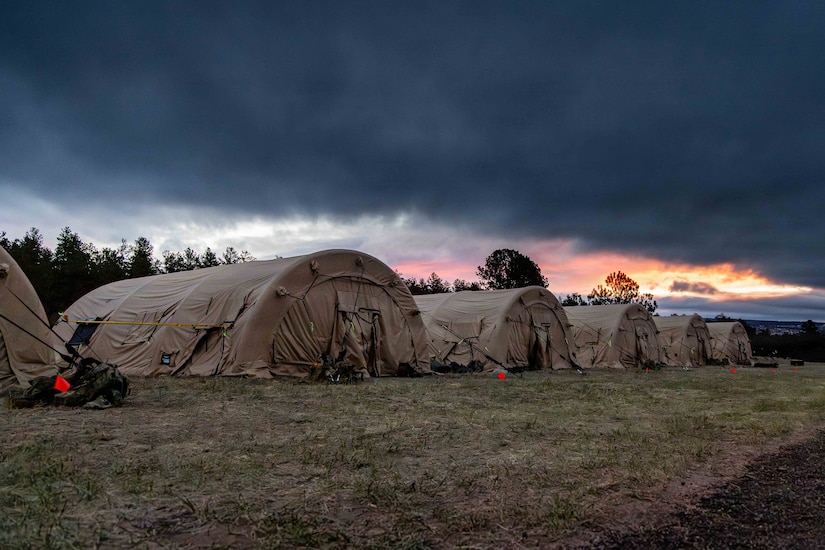
Six military tents are set up in a line on a grassy field under clouds, as the sun sets in the distance.

The sense of ownership extended beyond individual missions to the exercise's overall design and execution. 

"One thing that makes the academy unique is that we place an immense amount of responsibility on the cadets," McArdle said. "They played a big part in making this exercise happen. From providing logistical support to mission planning, which allowed [the] permanent party to tailor what we do around what the cadets planned for. The [culminating exercise] has so many moving parts, and without the cadets, permanent party, contractors and civilians, it would have been impossible."

Preparing Leaders for Day 1 

The multiday training event ensured cadets gained the leadership skills and experience needed to navigate unforeseen challenges throughout their careers, Mackey said. 

"The skills that the cadets learn might not directly translate into their Air Force specialty code or Space Force specialty code, but their leadership, teamwork and problem-solving skills will absolutely translate to any job they'll do," he added. 

Academy officials directed the culminating exercise as a cumulative test for cadets to incorporate lessons learned during their basic cadet training, silver training weekends and individual leadership training, ensuring they are prepared for the rigors of leadership upon graduation and commissioning as second lieutenants in the Air Force or Space Force.