Monday, October 19, 2026

Meet the Army Athletes Competing in the United World Wrestling Championships

Six soldier-athletes from the U.S. Army World Class Athlete Program will carry Army pride and medal ambitions to the 2026 United World Wrestling Championships in Astana, Kazakhstan, Oct. 24 through Nov. 1. 

The four Greco-Roman wrestlers and two women's freestyle wrestlers account for 20% of Team USA's 30-person roster, underscoring the program's significant contribution to the nation's international wrestling success. 

"It's always an honor to go out there and represent the World Class Athlete Program, the Army and the United States on the global stage," said Army Sgt. 1st Class Spenser Mango, the Army's Greco-Roman wrestling coach and two-time Olympian, participating in his 14th world championships as a competitor and coach. "It doesn't get better than that."

Army Sgt. Kamal Bey, 82 kg 

Two men in athletic uniforms wrestle in front of a crowd in a gymnasium; one man holds another upside down as he tries to pin him during the match.

This is the fifth world championships for Bey, who finished 10th at 77 kg in last year's world championships in Zagreb, Croatia.

Bey said moving up to 82 kg was more of a health decision to prepare his body before cutting down to 77 kg for the Olympic push, but he's not giving up anything by moving up a weight class.

"It definitely feels good," said Bey, a 2024 Olympian whose military occupational specialty is culinary specialist. "I'm filling out the weight class. I got in the weight room, worked with the coaches, and I'm getting bigger, stronger, faster, and most importantly, I'm healing up. I'm not giving up anything by moving up to 82 kg; I'll tell you that."  

Bey's experience makes him an important resource to his teammates competing on the world stage, some for the first time.

"He's been doing this for a while," said Army Spc. Timothy Young, who will represent Team USA at 97 kg. "I'm always taking whatever I can from him because he's done this a few times."

For Bey, there's no better feeling than representing the United States on all fronts, not only as a citizen but as a soldier.

"When WCAP and All-Army post about us and share what we're doing, I know it gives fellow soldiers something to be proud of," Bey said. "It shows that somebody just like them is out there accomplishing amazing things. It also shows civilians there are different avenues within the Army to achieve success. I don't think there's any other country in the world I'd rather represent."

Army Sgt. Dalton Roberts, 60 kg 

Two men in athletic uniforms wrestle in front of a crowd in a gymnasium; one man holds another, trying to pin him during the match as another person in casual attire observes.

This will be the third world championships for Roberts, a motor transport operator who relishes being one of the senior competitors for both Army WCAP and Team USA.

"I'd say the team cohesion is really high," Roberts said. "In Greco-Roman wrestling, there's always been a strong brotherhood, so that's nothing new, but something feels different this year. We all get along well, we push each other, and we hold each other accountable."

Working with new sports psychologists, new strength and training coaches, and more international travel has boosted the team's confidence going into the world championships, Roberts said, adding it has also boosted his own confidence.

"I believe I can accomplish what I want; I just have to put it all together on the day of competition," he said. "I believe this year is the time to do it."

Representing the Army and the United States on the world stage is a privilege Roberts doesn't take for granted.

"It's a beautiful thing, and it's an honor," he said. "I carry a great deal of pride on my shoulders when I get these opportunities. It's awesome."

Army Staff Sgt. Xavier Johnson, 63 kg 

Two men in athletic uniforms wrestle in front of a crowd in a gymnasium; one man holds another as he leans back, trying to pin him during the match.

Johnson, a motor transport operator, returns to the world championships after making his senior-level debut in Belgrade, Serbia, in 2023. The difference this time is perspective.

Johnson admitted he was initially caught up in the magnitude of his first world championships. Three years later, he views himself as a seasoned competitor who belongs among the world's best athletes.

"It's not a mistake that I got here," he said. "It was supposed to happen the way it happened."

He has also approached his weight management more scientifically. Although cutting to 63 kg remains demanding, Johnson said this cycle has been easier than previous attempts because he began managing his weight earlier and more deliberately.

Johnson believes WCAP's qualifiers are carrying teammates who could not compete because of injuries or military requirements. That collective responsibility — and the emergence of strong domestic Greco-Roman programs — has given the Army wrestlers added motivation.

"This is bigger than just myself," Johnson said. "It's for the people behind me as well."

Army Spc. Timothy Young, 97 kg 

Two men in athletic uniforms wrestle in front of a crowd in a gymnasium; one man holds another as he leans back, trying to pin him during the match.

Young, a unit supply specialist, made his first world championships by turning a difficult moment at the U.S. Open in Las Vegas in April into a defining tournament.

After losing his second match in the best-of-3 final, Young recognized that nobody would give him a place on the world team. He responded by increasing his aggression.

"This isn't going to be just given to me," he said. "I have to go out there and take it if I really want this."

Traveling to a previous world championships as a teammate's training partner made the goal feel attainable.

Former world champion and WCAP coach Dremiel Byers, a member of the National Wrestling Hall of Fame, told Young the experience would leave him hungrier.

Young said Byers was right.

"Ever since I've been at WCAP, he's the one coach where I'm like, 'This is the guy I want in my corner,'" Young said. "He's definitely one person I can trust."

A tall wrestler for his class, Young intends to maximize his leverage from the top position, securing his lock quickly and lifting opponents before they can defend.

"I get really excited when I get my chance on top. I'm like, 'This is it right here,'" Young said. "My coach tells me: 'Tim, get right to your lock, get them up and send them. Don't waste any time. Just lock it and get it up.'" 

Young said competing in his first world championships fulfills his four core principles.

"I get to go out there and represent God, family, country and wrestling," he said. "It just feels really good. I get to honor all of them every time I step on the mat."

Army Spc. Abby Nette, 59 kg

A man in casual attire holds up the arm of a woman in an athletic uniform in front of a crowd in a gymnasium.

Nette, a culinary specialist, returns to the world championships for the first time since placing 10th in 2022, carrying sharper execution and a clearer competitive identity.

She attributes much of her renewed purpose to her father, who died in 2025. Before his death, he urged her to keep moving forward and told her how proud he was.

"Now I do it for both of us," Nette said.

Nette said she has finally learned to trust the complete wrestler she has become, and she understands how her individual strengths work together.

"For the first time ever, I know exactly who I am," she said.

She also draws confidence from WCAP's institutional support. Nette said she never has to enter a competition questioning whether her unit and the Army stand behind her.

"That's something beautiful about WCAP," she said. "It's also a privilege to represent the United States of America and the U.S. Army. As a U.S. soldier, that's really cool to say."

Army Spc. Aduago Nwachukwu, 62 kg 

Two women in athletic uniforms wrestle in front of a crowd in a gymnasium.

Nwachukwu, who earned a silver medal on Oct. 16 at the 2026 Under-23 World Championships in Las Vegas, begins her second senior world championships campaign after placing seventh in 2025.

Her preparation has centered on disciplined weight management while transitioning from the U-23 world championships to the senior tournament. Instead of regaining substantial weight between events, she remained close to 62 kg, expecting the controlled cut to improve her performance.

Nwachukwu's confidence comes from results. She has defeated wrestlers who later competed for senior world medals, which convinced her she can reach the podium — and the top step.

"I'm on that level where I know I can be a world champion," she said.

For Nwachukwu, competing as a member of the Army WCAP also represents a rare union of service and sport.

"Serving your country while doing the thing you love most is a blessing and a privilege," she said. "I always tell people it's the best thing you could ever do."

Marine Corps Battalion Redesignates as First Medium Missile Battalion

A man in a camouflage military uniform salutes while standing in a field as another man in similar attire stands beside him holding a unit guidon; dozens of other people in similar attire stand in formation in the background.

History was made at the home of the 2nd Marine Division as the 1st Battalion, 10th Marine Regiment, redesignated from an artillery battalion to a medium missile battalion during a ceremony Oct. 9 at Camp Lejeune, North Carolina, creating a first-of-its-kind unit in the Marine Corps.

In accordance with the commandant's planning guidance, the battalion was selected to redesignate to align with the Marine Corps Force Design 2030 plan, supporting modernization efforts by adding the Navy-Marine Expeditionary Ship Interdiction System to its arsenal.

"The medium-range missile battalion employs the NMESIS," said Marine Corps Lt. Col. Joseph Mozzi, battalion commander. "[The NMESIS] is the Marine Corps' emerging ground-based anti-ship missile capability, and it will also be a ground-based, long-range precision fires platform."

First introduced to the 3rd Marine Littoral Regiment in 2024, the interdiction system combines a remotely operated ground unit for expeditionary fires carrier with a launcher that can fire two Naval Strike Missiles, providing sea denial, sea control and a defense against maritime threats.

"The requirement for the Marine Corps to have a land-based capability to conduct sea denial was identified as a crucial step to facilitate the maritime component commanders to fight for sea control," Mozzi said.

In an ever-changing battlefield, adaptability is crucial to the success of defensive powers. Integrating the NMESIS provides the service with a rapidly deployable system that can function in austere, expeditionary environments.

During Large Scale Exercise 2021, the Marine Corps successfully tested the system off the coast of Hawaii with a Naval Strike Missile fired toward a surface target at sea. With an effective range of more than 130 nautical miles and the ability to target surface ships and fixed ground targets, Marine Corps leaders said the Naval Strike Missile is a critical asset for denying adversaries access to key portions of contested waters.

"Projecting combat power ashore from the sea is historically what [Marines] do," said Marine Corps Col. William Soucie, 10th Marine Regiment commander. "What we will be able to do with [the NMESIS] is shoot in support of not only maneuver that's already ashore [but] we will also be able to shoot in support of maneuver[s] at sea."

The redesignation is the first artillery battalion modernization in the Marine Corps. Redesignating as a medium missile battalion offers the division new capabilities while still retaining lightweight howitzer capabilities.

The NMESIS does not replace the battalion's cannon artillery; rather, Soucie said it complements it. The regiment will retain artillery capabilities in another battalion, while the new system within the 1st Battalion will seamlessly integrate to provide close and continuous fires to units ashore and at sea.

As a unit in the service-retained force, the 1st Battalion was a candidate for artillery modernization because it gives the II Marine Expeditionary Force commanding general, and the Marine Corps as a whole, greater flexibility during a crisis.

"While the transition of the weapons platform is interesting, what makes the story compelling is that the Marines and sailors in that formation are not changing," Soucie said. "They are just as good as they have always been. And they will make the platform successful, and whatever mission they are assigned [to] successful, because they are phenomenal."

Department of War Announces Research Security Mitigation Results From Academic Institutions

The Department of War announced today the successful completion of its initial research security audits of 30 universities. All 30 universities have fully mitigated identified relationships with foreign entities of concern included on the most recent NDAA Section 1286 list, published in July 2026. Overall, the audits resulted in more than 80 termination-related actions across the 30 universities. These actions included the termination of relationships with entities on the NDAA Section 1286 list, as well as precautionary terminations involving entities not specifically identified on the list.

While the Department worked collaboratively with all 30 universities, several went above and beyond by quickly terminating problematic relationships with entities on the NDAA Section 1286 list and implementing significant mitigation measures to safeguard research. These institutions include:

  1. Oklahoma State University
  2. The Pennsylvania State University
  3. University of North Carolina at Chapel Hill
  4. University of South Carolina
  5. University of Southern California
  6. University of Texas at Austin
  7. Virginia Tech

"These academic institutions that went above and beyond deserve immense credit for setting the benchmark in domestic research security," said Joseph Jewell, Assistant Secretary of War for Science and Technology. "Rather than settling for minimum compliance, these institutions took bold, self-initiated steps to protect their labs, faculty, and intellectual property from foreign exploitation. Their proactive commitment ensures that groundbreaking research directly empowers the American warfighter and strengthens our Nation's technological edge."

The Department will continue to update the NDAA Section 1286 list, as appropriate, and assess universities that retain problematic relationships with entities on the list.

"I am proud that the Department of War went 30-for-30 in working with these top-tier research universities to terminate relationships with malign foreign entities. The Department commends the institutions that took decisive action to mitigate relationships that could expose American research to foreign exploitation," said Emil Michael, Under Secretary of War for Research and Engineering. "Our work will continue. Institutions that fail to meet research security standards are on notice: taxpayer dollars will not support institutions whose partnerships put the American warfighter or the Nation’s technological advantage at risk."

The Department will continue this effort alongside partners in Congress, specifically the House and Senate Armed Services Committees, the House and Senate Appropriations Committees, and the House Select Committee on the Chinese Communist Party.

Secretary of War Pete Hegseth to Visit Ohio and Wisconsin, for the Arsenal of Freedom Tour

Secretary of War Pete Hegseth will travel tomorrow to Dayton, Ohio, and Eau Claire, Wisconsin, as part of the Arsenal of Freedom Tour.

In Dayton, Secretary Hegseth will visit SNC and deliver remarks to the workforce. He will be accompanied by Secretary of the Air Force Troy Meink.

In Eau Claire, Secretary Hegseth will visit Riverside and deliver remarks to the workforce alongside Small Business Administrator Kelly Loeffler.

Medal of Honor Monday: Army Col. Lloyd L. 'Scooter' Burke

Army Col. Lloyd L. "Scooter" Burke served on active duty for 30 years and saw three wars. He received the Medal of Honor in 1952 for the courage and leadership he displayed as a young officer during the Korean War. 

Burke was born Sept. 29, 1924, in Tichnor, Arkansas, to Arthur Dewey Burke, a lumber mill foreman, and Betty. He was the second oldest and had four siblings: Claude, Dorothy, Donna and Betty. His family nicknamed him Scooter because, as a child, he was always scooting around the house and yard. 

A man in a formal military uniform is wearing a star-shaped medal attached to a ribbon around his neck.

In 1930, his family moved to Clarendon, Arkansas, and a few years later, they moved down the road to Stuttgart, Arkansas. After graduating from Stuttgart High School in 1942, Burke enrolled at Henderson State Teachers College in Arkadelphia, Arkansas. However, he dropped out in 1943 to enlist in the Army. 

He served two years in Italy as a combat engineer during World War II, rising to the rank of sergeant.  

After being honorably discharged on Jan. 28, 1946, he returned to Henderson State, majored in chemistry and joined the ROTC program.  

In 1946, he married Virginia Fletcher, and they had three children. They divorced in February 1975, and three years later, Burke married Maxine Hardin. 

Following graduation in June 1950, Burke was commissioned as an Army second lieutenant, just as the Korean War was starting. After infantry officer training at Fort Benning, Georgia, he was assigned to Company G, 2nd Battalion, 5th Cavalry Regiment, 1st Cavalry Division, and boarded a troop transport ship to South Korea. 

On Nov. 26, 1950, near Samso-ri, North Korea, his unit encountered an enemy roadblock on a ridge, manned by Chinese soldiers who had recently come to the aid of their communist ally. 

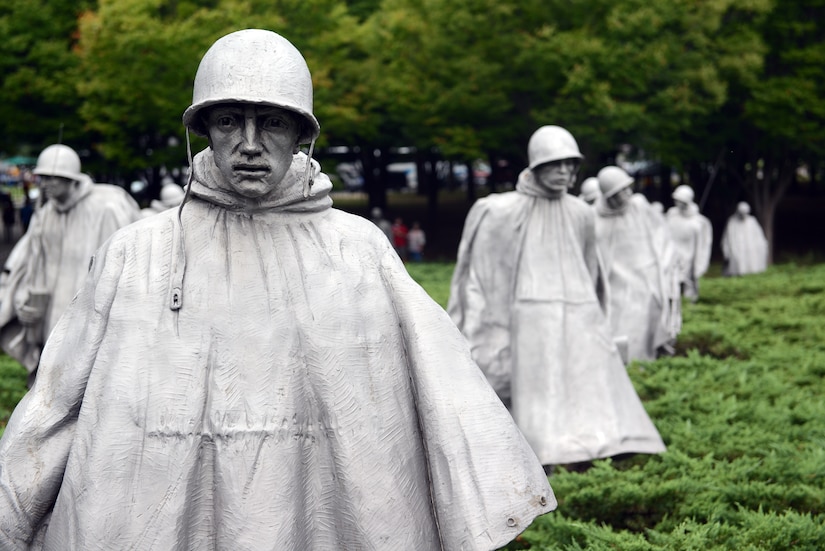
A stainless steel statue of a man in a military-style helmet and rain poncho is positioned in a landscaped area near similar statues.

Burke led his company in five attacks that cleared the impasse, earning him the Distinguished Service Cross — the second-highest Army medal for valor. 

From December 1950 to January 1951, the soldiers battled south of the 38th Parallel to establish defensive lines against overwhelming enemy forces.  

On Oct. 28, 1951, Burke's unit was on Hill 200 near Chong-dong, North Korea. His Medal of Honor citation states that intense enemy fire had pinned down leading elements of his company when Burke left his command post to rally and urge the men to follow him toward three bunkers impeding their advance. 

Dashing to an exposed vantage point, he threw several grenades at the bunkers and then returned for an M1 rifle and the grenade projection adapter, which allowed him to fire grenades instead of throwing them. 

He made a lone assault — killing the crew of a bunker. He lobbed grenades through the opening of another bunker and, with his pistol, killed three of its occupants who were attempting to surround him.

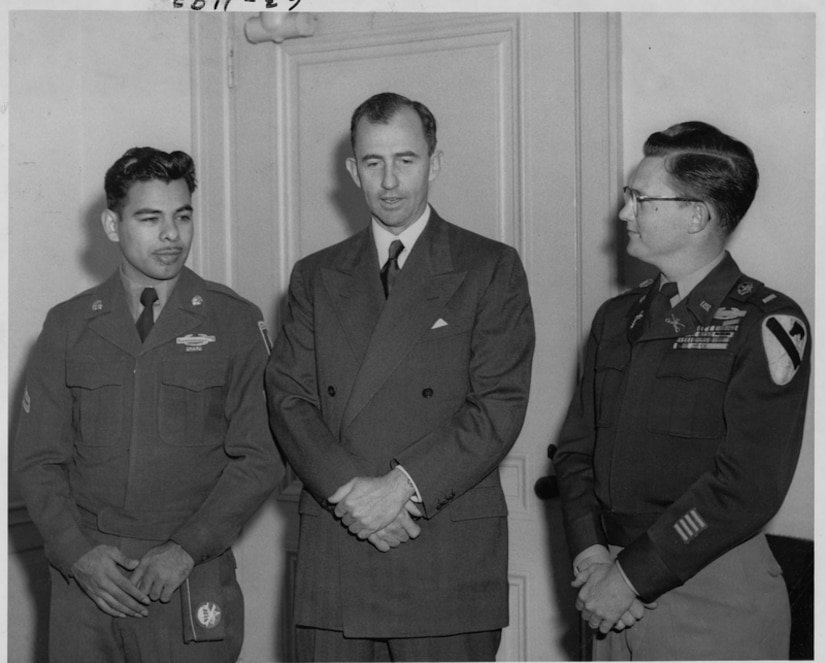
Three men stand side by side with their hands folded beneath their waists.

Ordering his men forward, Burke charged the third bunker, catching several enemy grenades in midair and hurling them back at the enemy. Inspired by his display of valor, his men stormed the hostile positions but were again pinned down by increased fire.  

Grabbing an M1919 Browning machine gun and three boxes of ammunition, Burke dashed through the impact area to an open knoll, set up his gun and poured crippling fire into the ranks of the enemy, killing approximately 75.  

Although wounded, he procured more ammunition and destroyed two mortar emplacements and a machine-gun position with his accurate fire. Cradling the weapon in his arms, he then led his men forward, killing about 25 more enemy forces and securing the objective.

After being treated for his wounds, he flew back to the U.S., where President Harry S. Truman awarded him the Medal of Honor during a ceremony at the White House, April 11, 1952. 

Burke chose to remain on active duty and was assigned as an infantry school instructor at Fort Benning from 1952 to 1955. He served as a company commander with the 13th Infantry Regiment at Fort Carson, Colorado, deploying to Smith Barracks in Baumholder, West Germany, until April 1958. 

He was assigned to the 1st Infantry Division at Fort Riley, Kansas, for two years, followed by four years as an Army staff officer at the Pentagon. In July 1964, Burke returned to Fort Riley and became the battalion commander of the 2nd Battalion, 16th Infantry Regiment, 1st Infantry Division. 

Three people in military uniforms and carrying weapons run toward a helicopter as two other helicopters hover in the distance.

In June 1965, his unit deployed to South Vietnam, tasked with protecting Bien Hoa Air Base and the surrounding area. On July 22, 1965, while flying in a UH-1 Huey helicopter, enemy fire from the Viet Cong riddled the bird, causing it to crash. Burke sustained multiple back, foot and leg injuries that required months of recovery and surgeries. 

Following his recovery, he served as the chief Army liaison to the House of Representatives from 1966 until his retirement. He rose to the rank of colonel and retired June 30, 1978.  

A burial marker sits in a grassy field and reads, "Lloyd L. Burke, Medal of Honor, Col. U.S. Army."

After his retirement, Burke moved to Hot Springs, Arkansas, where he and other veterans advocated for the building of the Korean War Veterans Memorial on the National Mall in Washington. He participated in the memorial's dedication in July 1995. 

Burke died of a heart attack June 1, 1999, and is buried in Arlington National Cemetery in Virginia. 

In 2004, the U.S. Post Office in Stuttgart, Arkansas, was named for him, and in 2017, the youth services center at Camp Humphreys, South Korea, was dedicated to Burke. A highway historical marker also stands at his birthplace in Tichnor, Arkansas. Tichnor and Stuttgart claim Burke as their native son. The ROTC program at this alma mater is nicknamed Burke's Raiders in his memory.