Friday, May 22, 2026

For Old Guard Soldiers, 'Flags In' Is a Personal Mission

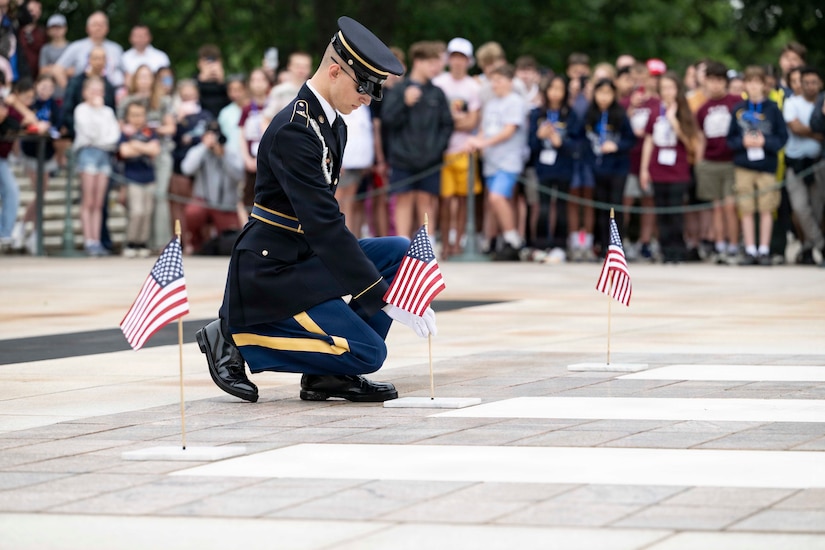
A man in a formal military uniform kneels while placing a small American flag into a flag holder on the ground.

Yesterday, in the early morning dawn, soldiers assigned to the 3rd U.S. Infantry Regiment, known as "The Old Guard," marched into the only two national cemeteries managed by the Army, their rucksacks packed with small American flags.  

Their mission: to honor America's fallen heroes by placing a flag in front of each headstone and columbarium column — approximately 250,000 at Arlington National Cemetery in Virginia, and 13,500 at the United States Soldiers' and Airmen's Home National Cemetery in Washington.  

This tradition, known as "Flags In," takes place annually at both cemeteries on the Thursday before Memorial Day.  

As the soldiers fanned out through Arlington National Cemetery's 639 acres, they placed a booted toe against each headstone and columbarium column before inserting a flag into the ground at their heel, creating a uniform distance for each flag.  
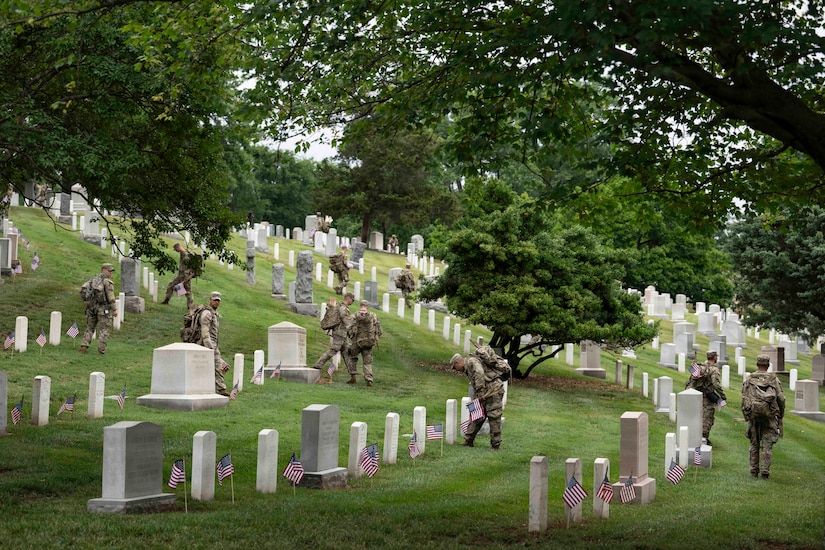
Nearly a dozen people in camouflage military uniforms walk through a cemetery, placing small American flags at each gravesite.
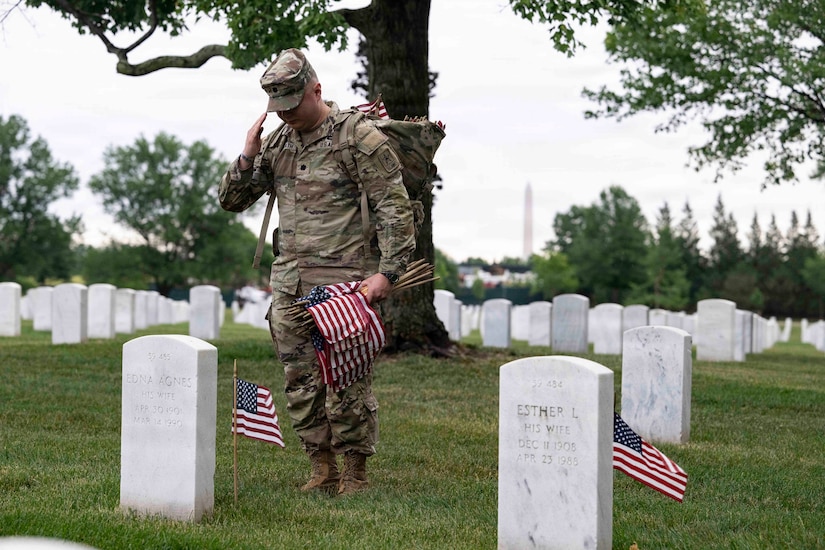
A man in a camouflage military uniform stands in a cemetery and salutes toward a gravesite, while holding small American flags.
"Getting this right is important," said Army Master Sgt. Jeb Hague, as he turned back to a flag and adjusted it slightly. Hague, who has served in the Old Guard Fife and Drum Corps since 2006, has placed flags in nearly every section of the cemetery. "When I do this, I learn a little bit more each year," he said, adding that different sections have different meanings.  

The Old Guard has been placing flags in front of headstones since 1948, when it was first designated as the Army's official ceremonial unit. Every available soldier in the regiment participates. At Arlington National Cemetery, where service members from the Revolutionary War through today's conflicts are laid to rest, "Flags In" connects today's soldiers to generations of military service and sacrifice — spanning 250 years of American history.  

For many Old Guard soldiers, "Flags In" is also a deeply personal mission.  

Hague is among those with friends and family members laid to rest in Arlington. His great-uncle, Alvin J. Buchanan Jr., who served in the Navy during World War II and the Korean War, is buried in Section 66. His friend Army Staff Sgt. Adam Dickmyer, a fellow Old Guard soldier who served as a tomb guard at the Tomb of the Unknown Soldier, was killed in Afghanistan in 2010 and is buried in Section 60.  
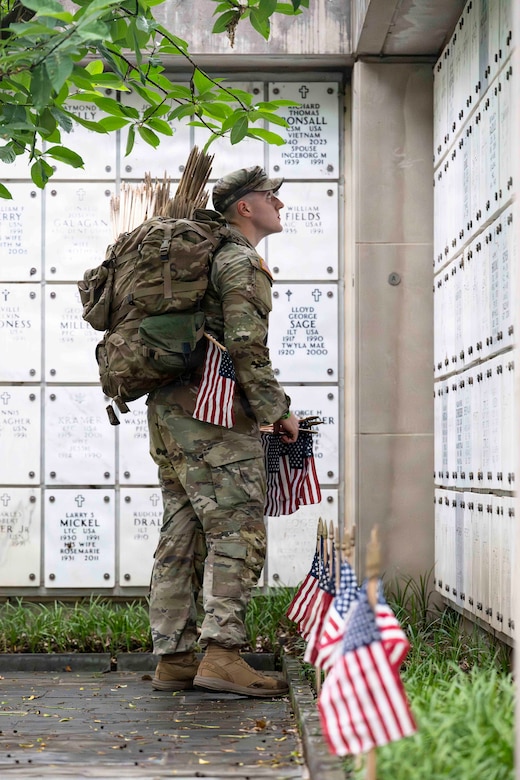
A man in a camouflage military uniform looks up at a columbarium column while holding small American flags.

"Memorial Day is so special and solemn," Hague said. "But for me, [Flags In] is much more personal. "In the early morning quiet, before the cemetery opens to the public, soldiers can reflect on those who have lost their lives to defend our nation. I make sure to take a few seconds to read the name and remember them," Hague said.  

Later in the day, the tomb guards, also members of the 3rd U.S. Infantry Regiment, placed flags at the Tomb of the Unknown Soldier to honor the three unknowns buried there, along with all unidentified and missing American service members.  

Meanwhile, at the United States Soldiers' and Airmen's Home National Cemetery, veterans residing in the Armed Forces Retirement Home joined uniformed Old Guard soldiers in placing flags.  

By the afternoon, American flags waved across the iconic landscapes of both cemeteries.    

During Memorial Day weekend, visitors and family members will see the results of the soldiers' meaningful mission — one of the many ways the U.S. military ensures that its fallen are never forgotten. For the Old Guard, the day represents, in Hague's words, "a chance to give back" by commemorating all who served and sacrificed throughout the nation's 250-year history.

Songs Inspired Patriotism During American Revolutionary War

Music has a way of uniting people and generations, and the American Revolutionary War was no different, as it was often used to boost morale for both the Continental Army and British troops.

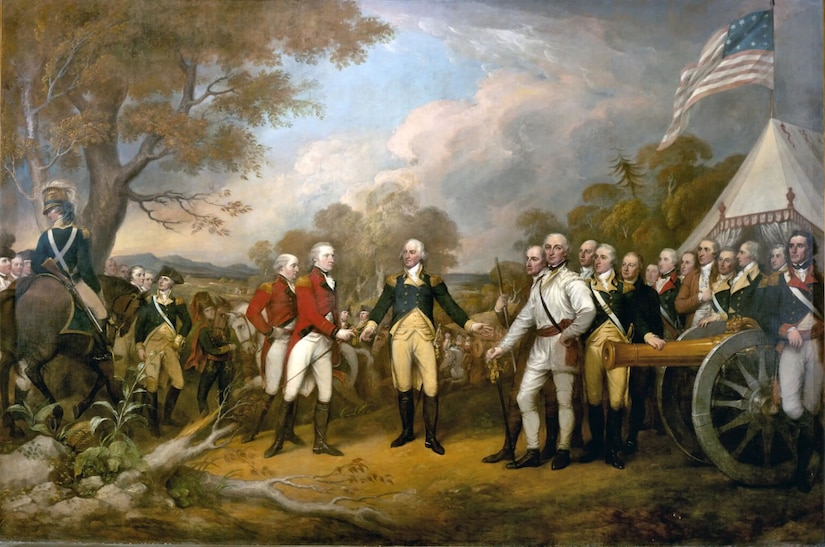
A painting depicts troops in various Revolutionary War-era military uniforms standing next to a cannon in the countryside under a partly cloudy sky.

Many of that era's most popular patriotic songs were originally religious hymns adapted for the war effort or original sacred compositions that took on a military character. As America celebrates 250 years of freedom, here is a look back at a few of the many songs that inspired the birth of a nation. 

"Yankee Doodle" 

Perhaps the most well-known song still sung today is "Yankee Doodle." It was originally sung by British military officers to mock the American service members they served with during the French and Indian War.

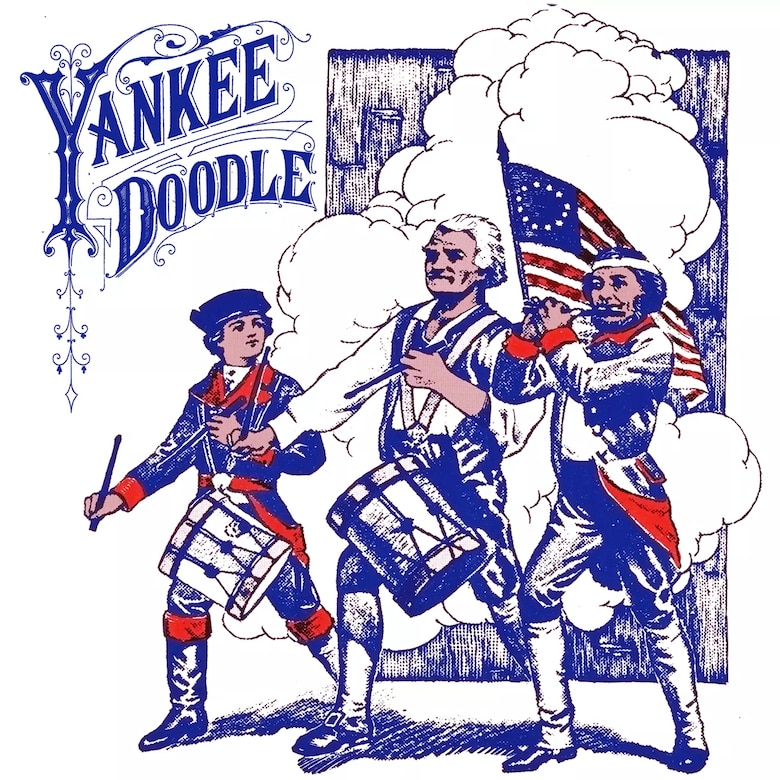
A graphic depicts three Colonial soldiers playing drums and a flute and carrying a Betsy Ross flag. In the top-left corner are the words, “Yankee Doodle.”

Written by British Army surgeon Richard Shuckburgh while campaigning in New York, circa 1755, the song was embraced by American troops, who added verses to it that mocked the British and hailed their commander, Continental Army Gen. George Washington. By 1781, "Yankee Doodle" had become a song of national pride among Americans.  

The song begins with/Yankee Doodle went to town/A-riding on a pony/Stuck a feather in his cap/And called it macaroni. 

The term macaroni was used to describe a fashionable man who dressed and spoke in an outlandishly affected and effeminate manner.

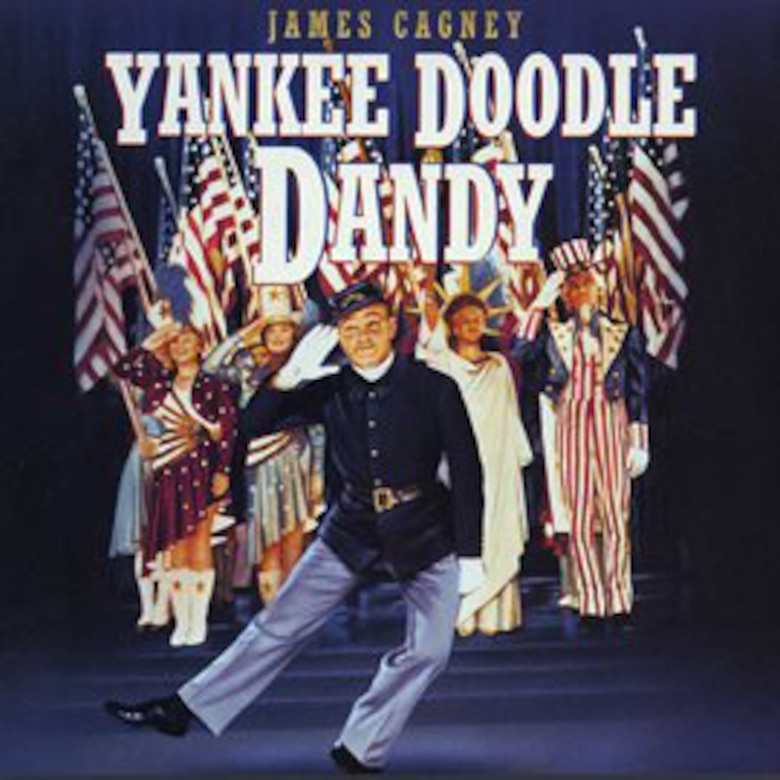
A poster depicts flags, soldiers and the word “James Cagney, Yankee Doodle Dandy.”

The American version was written in 1776 by Edward Bangs, a Minuteman, and was played during the British surrender following the Battle of Saratoga, Oct. 17, 1777, in New York.

"Yankee Doodle" was revived by George M. Cohan to create the patriotic song, "The Yankee Doodle Boy" for his 1904 Broadway musical "Little Johnny Jones." In 1942, the movie "Yankee Doodle Dandy," about the life of Cohan, starred James Cagney, for which he won an Oscar.

The song "Yankee Doodle" was adopted as Connecticut's official state anthem in 1978. 

"Chester" 

The unofficial anthem of the American cause, William Billings' "Chester," was immensely popular during the war. It encouraged the patriots to be strong, because God was standing on their side against the British tyrants, which is heard in these lyrics: 

When God inspir'd us for the fight/ Their ranks were broke, their lines were forc'd/ Their ships were shatter'd in our sight/ Or swiftly driven from our coast. 

Billings, a Boston native, was America's first choral composer. Chester is an old Latin word for military camp. The song was the first truly patriotic song with both the tune and lyrics written by an American in the American colonies. 

"Liberty Song" 

The "Liberty Song" was an early American patriotic ballad composed by John Dickinson, a founding father. It is often attributed as the origin of the phrase: "United We Stand, Divided We Fall."  

The song was one of the first to circulate within the 13 colonies and is thought to have fostered a sense of shared identity and resistance among the colonists. It includes the following lyrics: 

Then join hand in hand, brave Americans all/ By uniting we stand, by dividing we fall/ In so righteous a cause let us hope to succeed/ For heaven approves of each generous deed. 

The 1969 song, "United We Stand" by Brotherhood of Men, was a romantic ballad that took some inspiration from "Liberty Song" with the lyric, "united we stand, divided we fall." Despite the romantic connotations, the song became a rallying cry for the Vietnam War based on these lyrics:  

For united we stand, divided we fall/ And if our backs should ever be against the wall/ We'll be together, together, you and I. 

"Free America" 

Joseph Warren, a member of the Sons of Liberty, wrote "Free America" to the tune of "The British Grenadiers," inspiring many colonists to volunteer for the cause of freedom during the Revolutionary War with the following words:  

Torn from a world of tyrants/ Beneath this western sky/ We formed a new dominion/ A land of liberty/ The world shall own we're freemen here/ And such will ever be/ Huzza, huzza, huzza/ For love and liberty. 

"The World Turned Upside Down" 

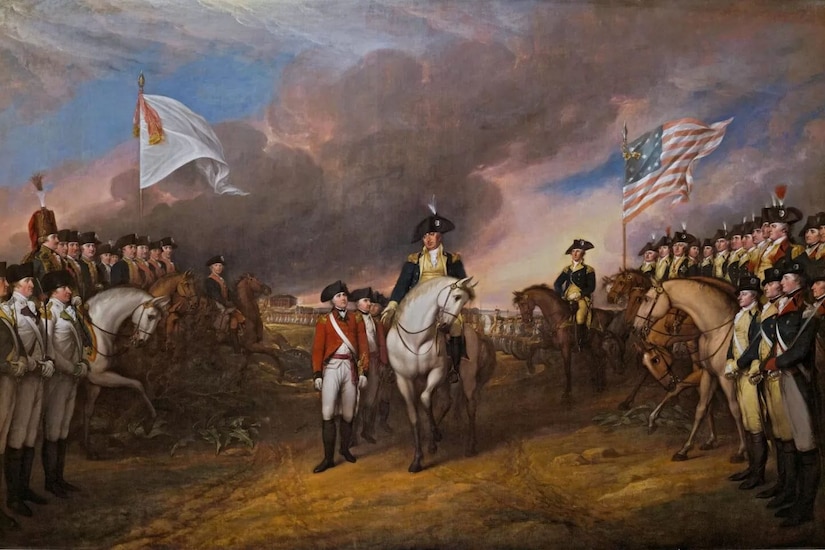
A painting depicts several men in Revolutionary War uniforms outside under a blue sky with gray clouds. One man stands next to another man sitting on a horse, as soldiers stand in two formations on either side of them.

The song "The World Turned Upside Down" is a 17th-century British ballad written to protest the Puritan banning of traditional Christmas celebrations. It is thought to have been played by the British Army band when they surrendered after the Siege of Yorktown in 1781, though there is no historical evidence that it actually happened. The lyrics include the following:  

Listen to me and you shall hear, news hath not been this thousand year/Since Herod, Caesar, and many more, you never heard the like before/Holy-dayes are despis'd, new fashions are devis'd/Old Christmas is kickt out of Town/Yet let's be content, and the times lament, you see the world turn'd upside down. 

If the song title seems familiar, it is because the words gained new popularity more than 300 years after they were first written, when Lin-Manuel Miranda wrote his 2015 Broadway musical, Hamilton. 

Near the end of the first act, "Yorktown (The World Turned Upside Down)" recaps the historic Battle of Yorktown: 

We negotiate the terms of surrender/I see George Washington smile/We escort their men out of Yorktown/They stagger home single file/Tens of thousands of people flood the streets/There are screams and church bells ringing/And as our fallen foes retreat/I hear the drinking song they're singing/The world turned upside down.

At 96, Former Army Tank Driver Reflects on the Korean War

Army Staff Sgt. Stanley Martinez was the last man to step off the truck. It was autumn of 1951, somewhere north of Busan, South Korea, the deuce-and-a-half tactical vehicle he had ridden in from the country's southern tip had been dropping replacements all day: a soldier here, two there, each stepping into a slot another had just vacated.  

Martinez waited for his turn, listening to artillery thump in the dark. 

"You couldn't see anything, but you could hear it going off," he said. 

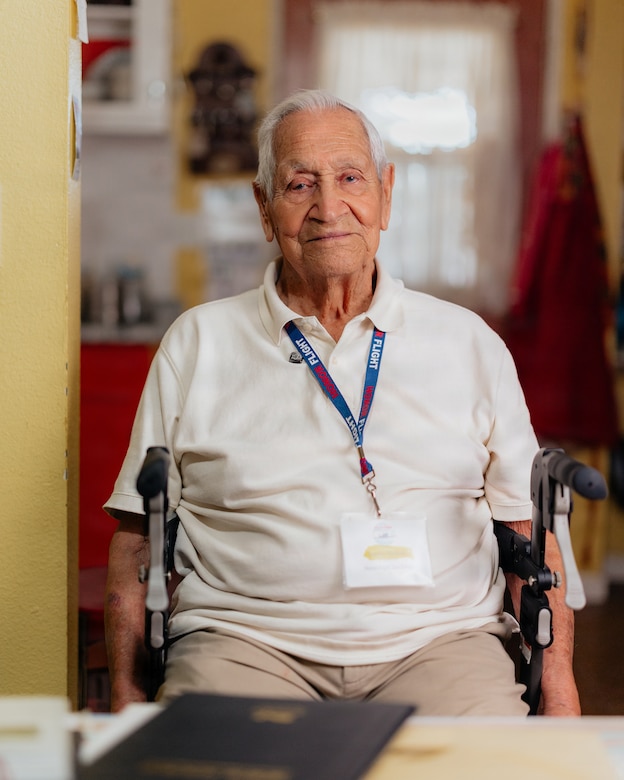
Now, decades later, at 96, he is one of two surviving members of his local Korean War Veterans Association chapter. He served as a tank driver assigned to the 7th Infantry Division, whose hourglass patch remains worn by soldiers at Joint Base Lewis-McChord, Washington, today. 

An older man with white hair sits in a wheelchair posing for a photo in a house.
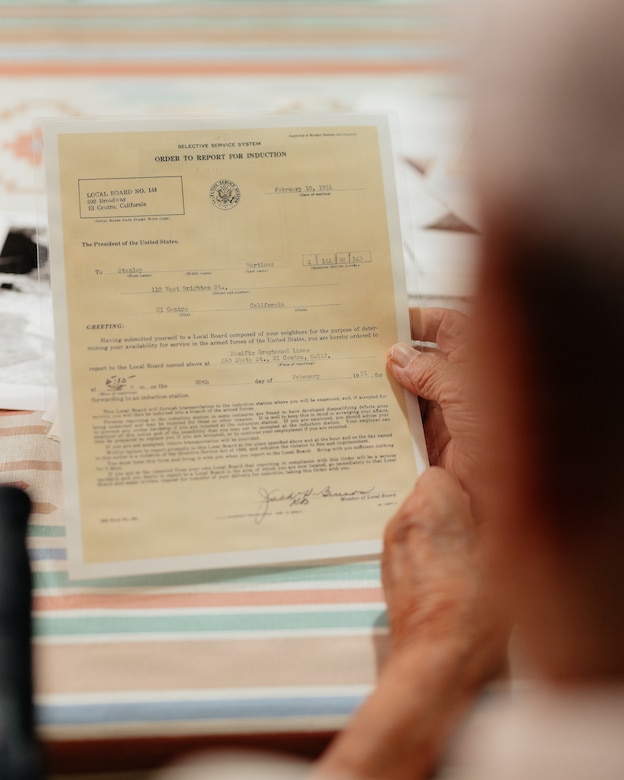
An older man holds a military draft notice in his hand while sitting at a table.
Martinez grew up the son of a New Mexico coal miner, one of 10 children: six brothers and four sisters. His mother died when he was six. His father never remarried and raised all 10 by himself.  

He moved to El Centro, California, in 1947 to live with one of his sisters. At that time, gas cost 17 cents a gallon, and Hank Williams was just starting to climb the country charts. He almost enlisted before being drafted. 

He and his childhood friend, Guillermo, walked to the post office, where young men would sign their enlistment papers at that time. 

On the way, a car pulled up alongside them, with a couple of guys inside and cold beer in the back seat. 

"I let [Guillermo] go [in] by himself, and I jumped in the car," he recalled. [He] was shipped to Korea, and soon after was reported missing in action. 

"To this day, they still haven't heard anything from him," Martinez said. "No bones. Nothing." 

Martinez's draft notice arrived months later, signed by President Harry S. Truman. By then, one of his brothers had died during World War II in the English Channel in December 1941, seven months after high school, when a German U-boat sank his ship. Remembering the loss, Martinez said he was proud to be called up, especially since he had been ready to volunteer. 

Within a week of receiving the notice, he was on a bus to San Diego for a physical. Soon after, he went to Camp Roberts, California, a World War II installation the Army was hastily reactivating. 

Sixteen weeks of infantry training followed. After graduating, he took a 13-day voyage to Yokohama, Japan, then traveled by train to Sasebo, Japan, took a ferry to Busan, South Korea, and then endured a long, slow truck ride north.  

Martinez began his military career as an infantryman but did not stay one for long. A few weeks after arriving in South Korea, an officer asked if anyone could drive a truck. Martinez had hauled carrots and watermelons in Southern California, so he volunteered. 

"They put me in a tank," he said. "All they did was show me the gears and the clutch." 

He drove for a four-man crew supporting infantry patrols for about a year. His world narrowed to a 10-inch periscope slit. The crew slept inside the tank while the infantry soldiers slept in foxholes. Hot food was served twice a month; the rest was C-Rations, prepackaged food. Whenever the Air Force struck the hills, Martinez watched napalm explode from a distance. 

"That was some dangerous stuff," he said. "All you could see was the fire. It was white." 

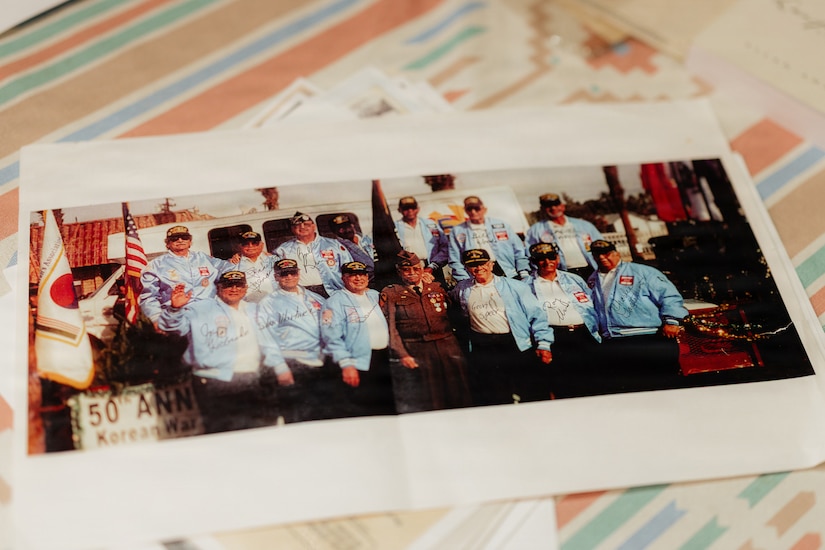
A photo of 14 men in jackets and hats posing together is displayed on a table.
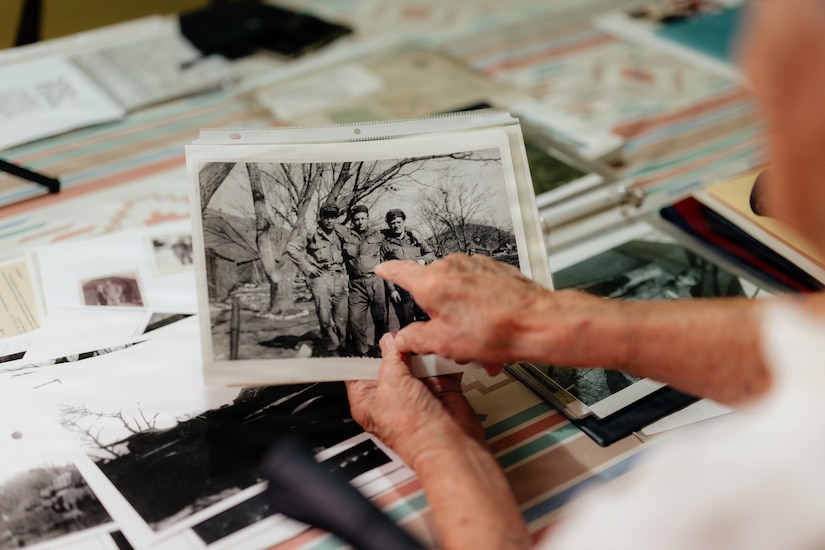
An older man points to a photo in his other hand of three men in military uniforms posing for a photo outside.
Martinez eventually rotated home, ferrying back to San Francisco. Then he went to Fort Hood, Texas, to finish his enlistment. He had married his wife, Alice, before deploying. Soon they will mark their 75th anniversary. After leaving the Army, he raised a family in El Centro and stayed on his feet until arthritis forced him to use a walker. Only Martinez and his friend Benny Benavides remain in his Korean War Veterans Association chapter. 

Several years ago, he returned to South Korea, on a trip sponsored by the South Korean government. The villages he remembered as rubble had become a metropolis. 

"It's something like San Francisco now," he said. 

When asked what he would advise young soldiers wearing his old patch, Martinez paused. 

"I think everybody should spend a couple of years in the service," he said. "Learn some discipline. It makes a difference."