Monday, February 16, 2026

Robins Air Force Base Laser-Focused on Aircrew Eye Protection

Airmen at Robins Air Force Base, Georgia, are helping solve a growing problem among American pilots and aircrews worldwide.
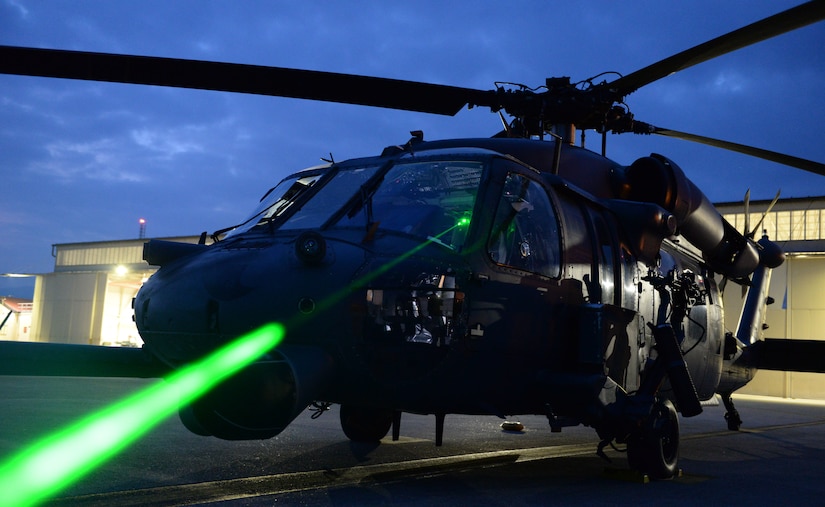
A green laser light beam shines from the cockpit of a helicopter.

 
The Federal Aviation Administration says laser strikes on aircraft have increased by almost 48% since 2020, with more than 10,000 incidents reported in 2025 alone. 
 
Pointing a laser at an aircraft became a federal crime in 2012 and can result in up to five years in prison and a $250,000 fine. Violators can also face FAA fines in addition to local and state criminal penalties. 
 
"These strikes can cause serious and, in some cases, permanent eye damage, with health concerns ranging from temporary flash blindness to severe retinal injuries," said Air Force Master Sgt. Bridgette Brzezinski, a bioenvironmental engineering flight chief assigned to the 78th Operational Medical Readiness Squadron. "Laser exposures can severely disrupt critical phases of flight, such as takeoff and landing, and can have significant psychological effects on aircrew even at distances where ocular damage is unlikely."
 
To combat this threat, the Air Force Life Cycle Management Center Human Systems Division is pioneering the next generation of protective technology. 
 
The AFLCMC/ROU, based at Wright-Patterson Air Force Base, Ohio, is working with its operations and support team at Robins Air Force Base on the Aircrew Laser Eye Protection – Technology Insertion program. This evolutionary acquisition program replaces and upgrades laser protection eyewear every five to seven years. 
 
Kevin Frost, AFLCMC/ROU operation and support mechanical engineer, and Eric Miltner, AFLCMC/ROU operations and support equipment specialist, are providing vital sustainment considerations to help develop improved eyewear that reduce the dangerous impacts of laser attacks on aircrews. 
 
They are now working to field a new family of products, the Block 3. It consists of six modular devices, each worn under specific conditions during takeoffs and landings. The kit includes separate day, night and ballistics spectacles, and visors that provide peripheral protection while wearing night vision goggles.
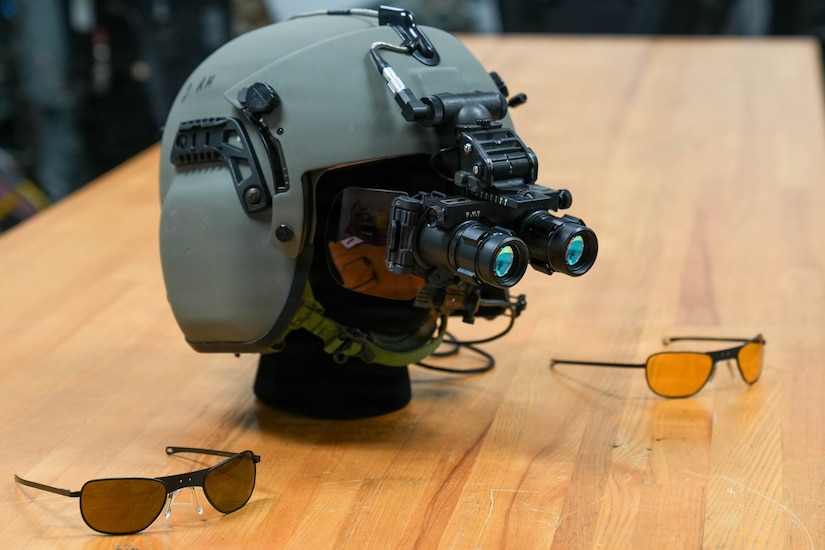
A helmet with vision protection goggles sits on a table alongside two vision protection glasses.

 
Frost and Miltner say the latest changes include a new dye that can filter a wider range of light wavelengths and a new version of the night spectacles that allows more natural light through the lens, increasing visibility for aircrews. 
 
"The main difference is that the Block 3s filter more wavelengths of light and provide more protection than the Block 2s," Miltner said. 
 
The duo also collaborates with technicians and airmen in the field to ensure that their technical orders and manuals are easily understood by the people who use the equipment every day. 
 
"We go to an actual base where people are going to be using this equipment," Miltner said. "We show them the manual, and we let them walk through the steps without us assisting just to make sure it all makes sense." 
 
Frost and Miltner see thousands of airmen using ALEP and the equipment they maintain, which gives meaning to their work, Frost said.
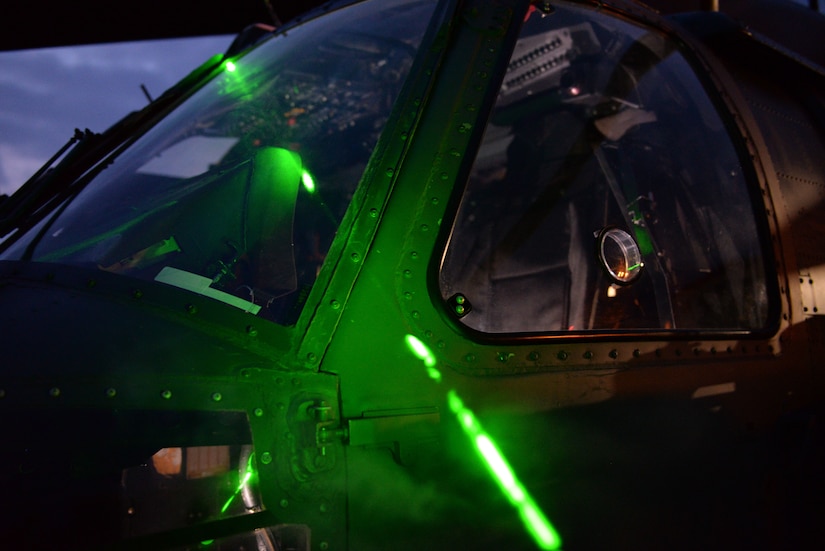
Air Force Airman 1st Class Hannah Stubblefield

"It helps us make sure that they have everything they need, because a lot of this stuff is critical safety equipment and we want to keep our airmen and aircraft safe while they’re in the air," he said. 
 
AFLCMC/ROU plans to field more than 45,000 devices to Air Force units by 2029.

Face of Defense: Army Reserve Officer Finds Success in Tactical Fitness Arena

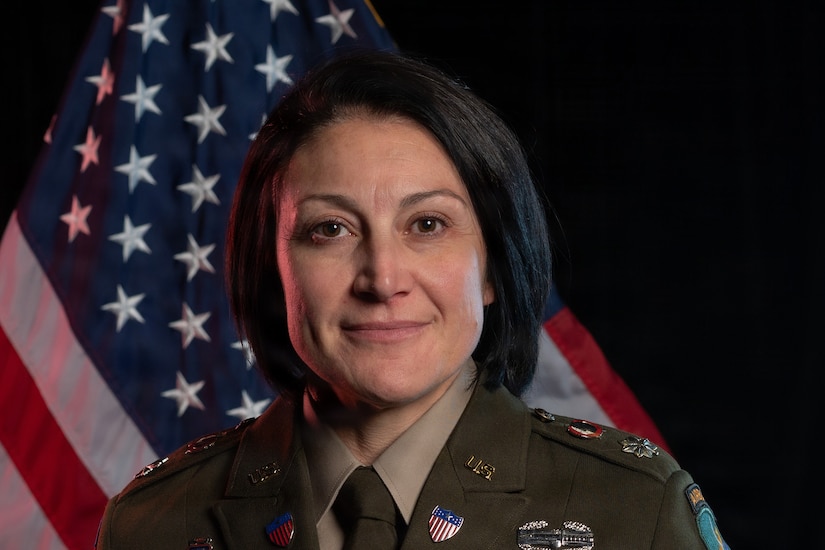
Army Reserve Lt. Col. Lauren Sharpless, 42, balances a demanding leadership role with elite competition, winning the 40 and over national title at the Tactical Games National Championship in 2024 and finishing second in 2025 while pushing soldiers and civilians toward daily fitness.

A woman wearing a military uniform poses for a photo in front of a flag.

Shaping Readiness 

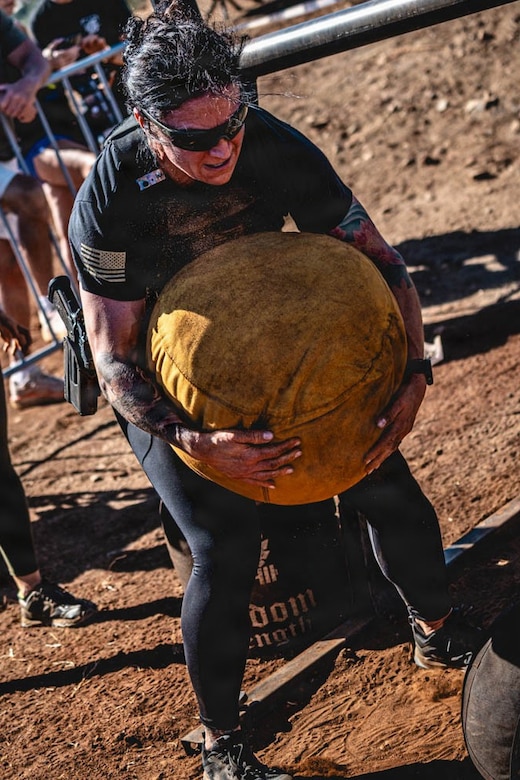
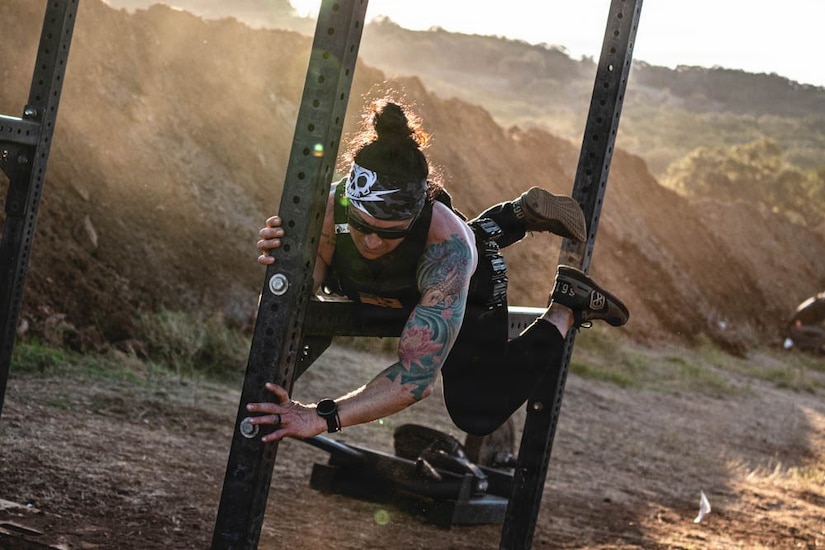
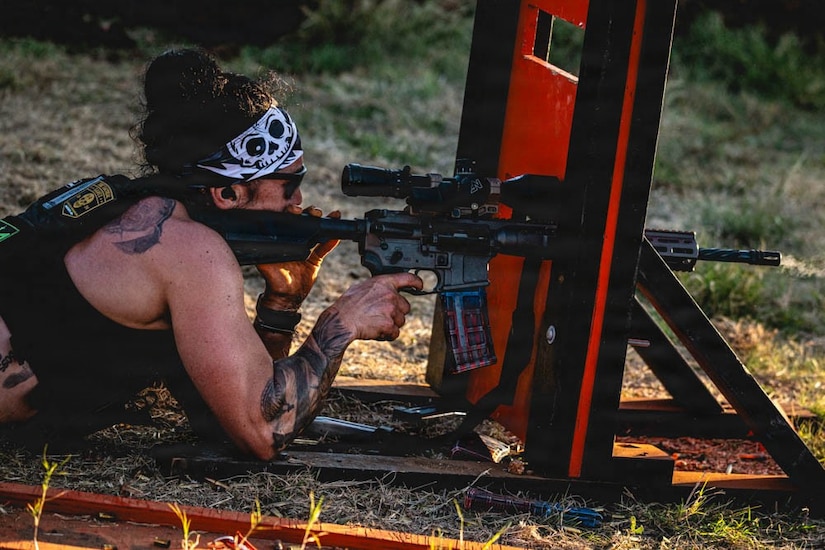
Sharpless trains like a soldier and competes like one. As the director of training for U.S. Army Reserve Command, she spends her days shaping readiness. Outside of her position, she tests her personal readiness against a field of athletes who must run, lift, climb and then steady their breathing to shoot with precision.

A soldier carries a large ball in muddy terrain.
Sharpless discovered the competition on social media, signed up and, with coaching from Army Reserve noncommissioned officer and CrossFit trainer Tony Cowden, became a champion.

"I like to set the example," Sharpless said. "I always want to push myself. I want to motivate and inspire others."

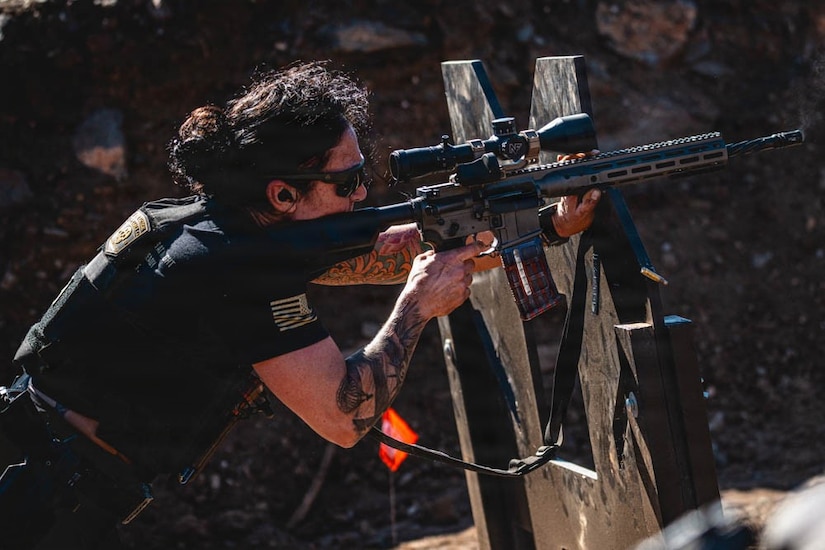
The Tactical Games blends functional fitness and marksmanship into staged "battles" that pair grueling physical work with immediate shooting tasks. Competitions are organized into divisions and tiers — including elite, intermediate, masters and tactical — with tailored physical standards and shooting requirements so civilians, law enforcement, military and first responders compete on a level playing field. Events range from regional two-day contests to a multiday national championship that crowns division winners and national champions.

A soldier aims down toward a target using a rifle wearing ear plugs and sunglasses.

Athletic Roots 

Sharpless' athleticism is family lore. Her father was a high school and college basketball player who once drew interest from the Dallas Cowboys. Her brother played basketball in college and for Brazil's national team and now works as an athletic director. Her sister earned a spot on the Secret Service Counter Assault Team and trains and competes with Sharpless. That lineage, she said, helped shape a competitive instinct she now channels into training soldiers and civilians alike.

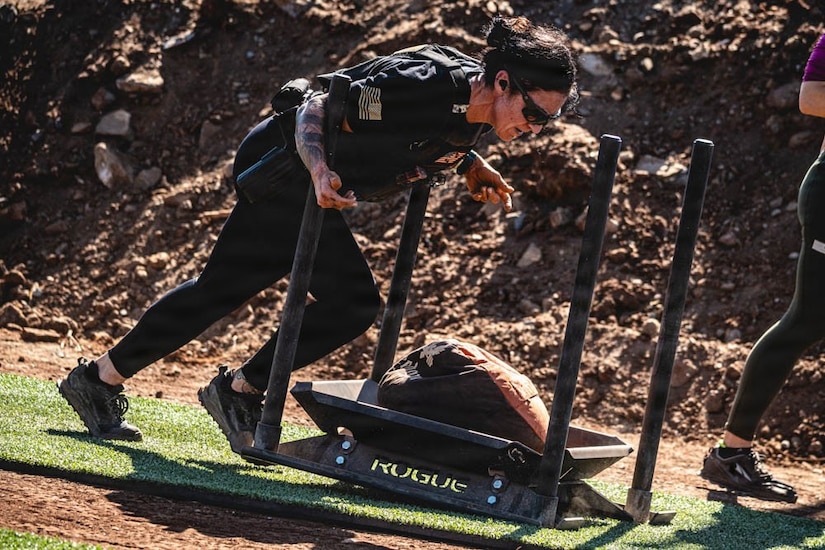
A soldier pushes a metal object down artificial turf.
A soldier climbs over a bar in desert terrain.
 Her message is practical and human. "Commit, make a plan, and stick to it," she advises soldiers and others.

Sharpless recommends 20 to 30 minutes a day of focused activity and says fitness should be inclusive: a walk during a work break counts as exercise. To that end, she recognizes the challenge of reaching reserve soldiers, who juggle civilian jobs and military obligations, and she uses her visibility in the sport to share training tips and motivation.

A soldier lays on the ground and aims a rifle through a guard toward a target.

Goals for Success 

Overall, Sharpless has clear goals. She wants to win the national title two-to-three times in a row so there is "no question" about her place in the sport and then step away satisfied. Until then, she keeps training, coaching and competing — a reminder that leadership can be shown in uniform and on a course where fitness, firearm proficiency and mental toughness converge.

Medal of Honor Monday: Army 2nd Lt. Darwin Kyle

Army 2nd Lt. Darwin Keith Kyle was an experienced soldier who'd survived World War II and took pride in looking after his fellow soldiers. During a firefight during the Korean War, Kyle gave his life to ensure his platoon mates could survive. For his selflessness, he was awarded a posthumous Medal of Honor.

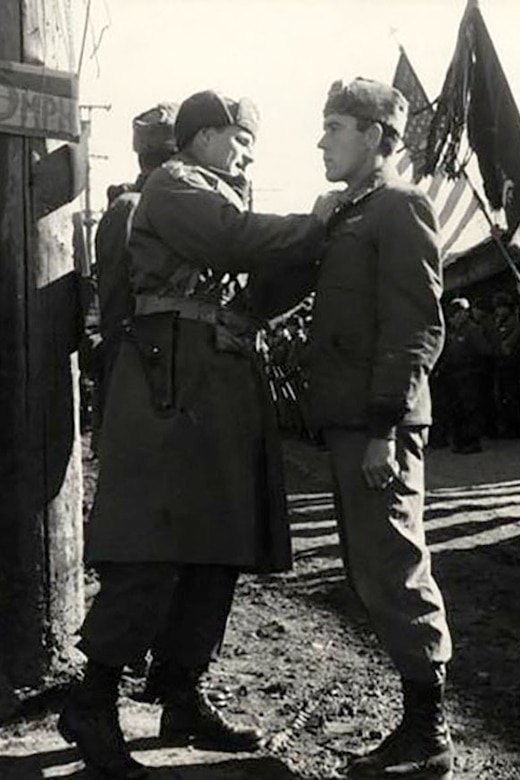
A man pins something to the lapel of another man. Two flags are being presented in the background.

Kyle was born June 1, 1918, in the coal mining town of Jenkins, Kentucky, to Charles and Pearl Kyle. He had an older brother, also named Charles.

At some point in Kyle's youth, the family moved to Racine, West Virginia, where he grew up and attended Sherman High School before enlisting in the Army in November 1939.

Kyle served valiantly during World War II, earning a Silver Star for his actions in France and Germany. According to a 2001 article in The Mountain Eagle newspaper out of Whitesburg, Kentucky, Kyle received the award for saving soldiers from six disabled Allied tanks that had been hit by enemy fire.

Kyle was discharged from the service in August 1945 and returned to West Virginia. At some point, he married Betty Totten. The couple went on to have two daughters, Donna and Nancy.

Civilian life didn't seem to suit Kyle, though, so in July 1947, he reenlisted in the Army. The veteran soldier was assigned to the 6th Infantry Division in South Korea, where he served as part of the post-World War II occupation force.

An aerial view shows tons of supplies sitting at a staging area beside a port. Two ships float alongside the port.

By the summer of 1950, when war broke out on the Korean Peninsula, Kyle was back in the U.S., serving as a master sergeant in Massachusetts assigned to Company K, 7th Infantry Regiment, 3rd Infantry Division. By that autumn, however, Kyle was back in Korea, this time to fight.

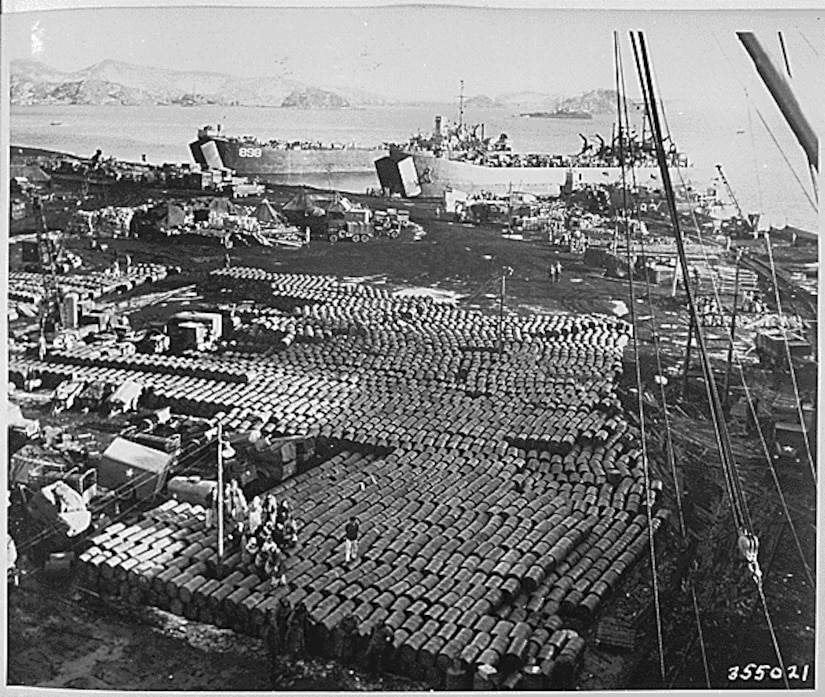
In December 1950, when Americans were evacuated from the North Korean port city of Hungnam, Kyle helped move several injured soldiers to safety after an explosion ripped through the area. His leadership and bravery during that incident quickly earned him a battlefield commission to second lieutenant, according to the West Virginia Encyclopedia Online.

On Feb. 16, 1951, the platoon that Kyle was leading was ordered to remove Chinese defenders from snow-packed Hill 185 near Kamil-Ni, South Korea. When they got pinned down by intense fire, Kyle remained out in the open so he could move among his men and encourage them to continue advancing toward the strongly entrenched enemy.

The encouragement worked, and they made some forward progress, but they were quickly pinned down again by enemy machine gun fire that wounded six soldiers. Kyle immediately reacted by charging the machine gun nest and fighting its crew in hand-to-hand combat, taking out the position's three enemy soldiers by himself.

Once the platoon started moving toward the hill again, they were met with intense automatic weapons fire from a well-concealed enemy position on their right flank. This time, Kyle led his men in a bayonet charge against the position.

A man pins something to the lapel of another man. Two flags are being presented in the background.

Kyle fired his carbine and threw grenades as he went. He took out four enemy soldiers before a burst from an enemy submachine gun killed him. 

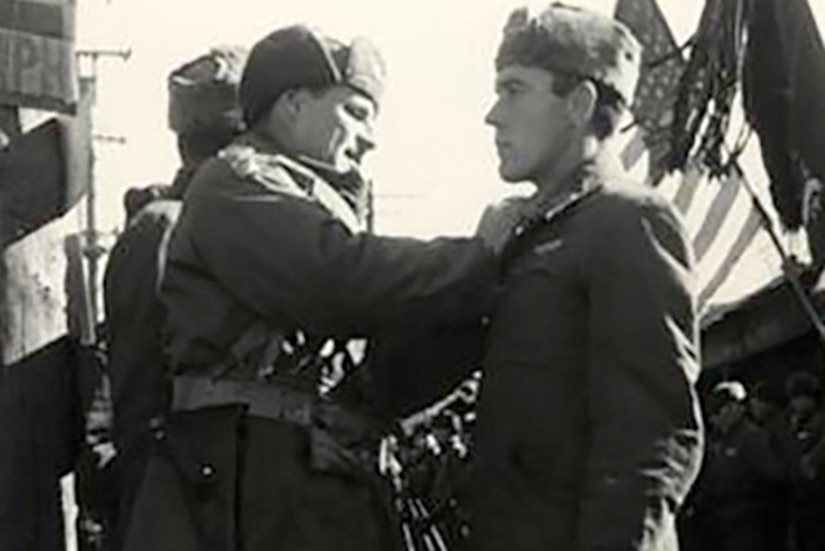
Kyle's leadership and extraordinary heroism during the chaos helped save his fellow soldiers' lives. For his selfless sacrifice, Kyle was awarded a posthumous Medal of Honor. His wife and daughters accepted it on his behalf from Defense Secretary Robert Lovett during a Pentagon ceremony on Jan. 16, 1952.  

Soon after his family received the award, the Army named Camp Kyle in western South Korea in his honor. The camp remained open until 2005.  

Kyle is buried in Sunset Memorial Park in South Charleston, West Virginia.  

His heroics haven't been forgotten. In 1955, an elementary school in South Charleston was named in Kyle's honor. A bridge in West Virginia was renamed for him in 1996 before it was rebuilt and rededicated again in his name in 2023.  

In 2024, a new housing tower at Camp Humphries in South Korea was also named for Kyle.