Sunday, May 10, 2026

Utah National Guard Integrates Air, Ground Capabilities During Exercise Wolverine

The sounds of saw blades against concrete, the striking of hammers against nails and the movement of debris amid collapsed rubble echoed across the western training area at Camp Williams, Utah, during an Exercise Wolverine simulated search and extraction scenario, April 30.
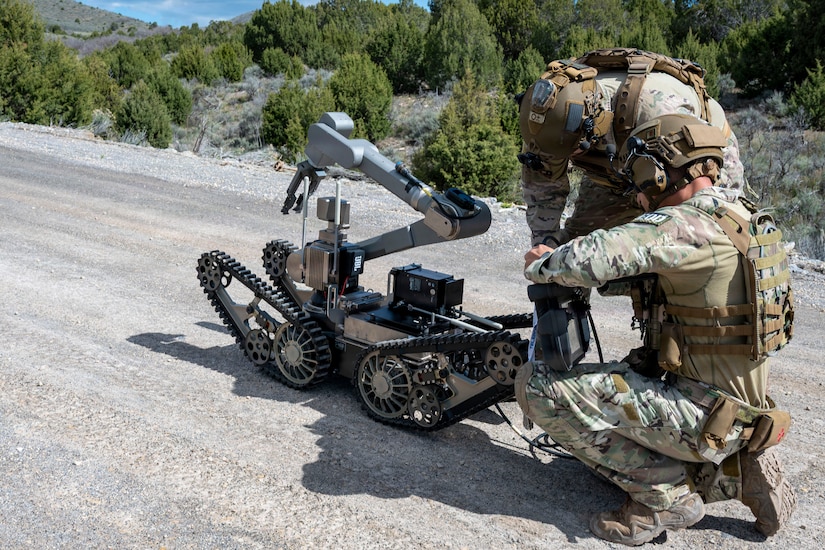
Two men wearing camouflage military uniforms and tactical gear work on a bomb robot outside on a gravel road; there are trees and mountains in the background.

The exercise focused on strengthening joint interaction between Utah Army and Air National Guard units in disaster response and air-to-ground operations to support homeland defense. 

At the site known as the "rubble pile," soldiers assigned to the 1457th Engineer Battalion search and extraction team worked to remove simulated casualties from collapsed concrete structures during a train derailment scenario. Teams operated at a high tempo to safely remove rubble, assess casualties and transfer simulated victims to a secure medical location.

While search and extraction members remained central to the scenario, additional units supported simulated emergency response operations throughout the exercise. The 65th Field Artillery Brigade and the 204th Maneuver Enhancement Brigade played key roles in the exercise, alongside the 151st Medical Group, the 97th Aviation Troop Command, and the 8th Homeland Response Force.
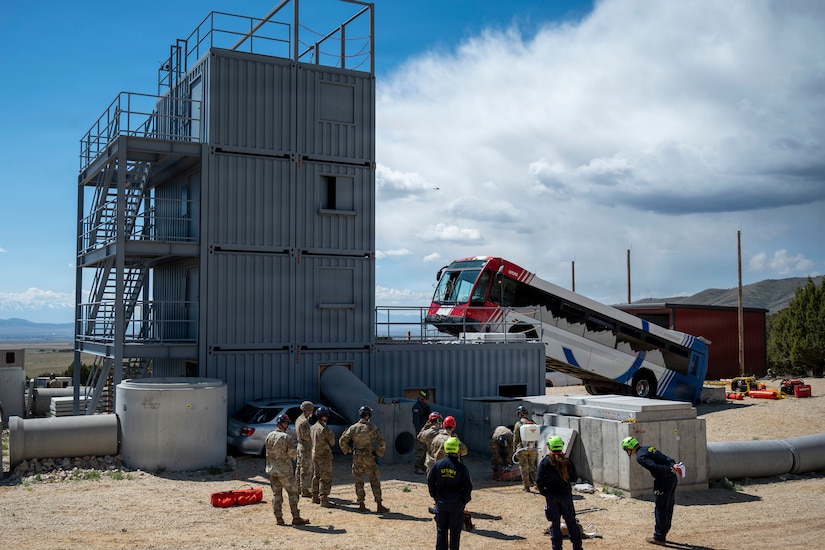
Eight people wearing camouflage military uniforms and helmets, and four people in coveralls and helmets, stand outside near a tall building as they prepare for training; there is a bus in the background with its front wheels on the side of the building.

"We're bringing counter-unmanned aerial systems capabilities, communications link between the ground and Air [National] Guard, and a fire package to the joint operations center," said Army Lt. Col. Emilio Suazo, 65th Field Artillery Brigade executive officer, adding that the training demonstrates their ability to respond to domestic emergencies while balancing both state and federal missions. 

A key component of the exercise is the AN/TPQ-53 multimission radar, operated by soldiers assigned to the artillery brigade. The system detects, tracks and classifies indirect fire threats, including mortars, rockets, cannons and artillery, at ranges of up to approximately 20 kilometers.

In addition to its counterfire mission, the radar provides an emerging counter-unmanned aircraft system capability, enabling operators to identify and monitor UAS activity while employing survivability techniques to reduce its electromagnetic signature.

Supporting that capability, the Link 16 tactical communication system enhances real-time coordination across the force. The system strengthens situational awareness and supports Utah's disaster response operations, while the exercise provides an opportunity to further integrate it into homeland defense missions.

"It's important because we often don't get enough joint training with the Air Force and our civilian partners," said Army Master Sgt. Nathan Torres, 8th Homeland Response Force chemical, biological, radiological and nuclear task force noncommissioned officer in charge. "This is another way we can solidify that relationship and work with our partners, because when a disaster happens, we will rely on each other to accomplish these tasks."

Exercise Wolverine provided the joint military assets and personnel in Utah with the opportunity to prepare for potential threats to homeland defense.

Forging Tactical Readiness During Iron Ascent

In a deliberate push to build a more agile and combat-ready force, the 92nd Air Refueling Wing launched Iron Ascent, a rigorous three-day tactical training course, held at Fairchild Air Force Base, Washington, April 29-May 1.

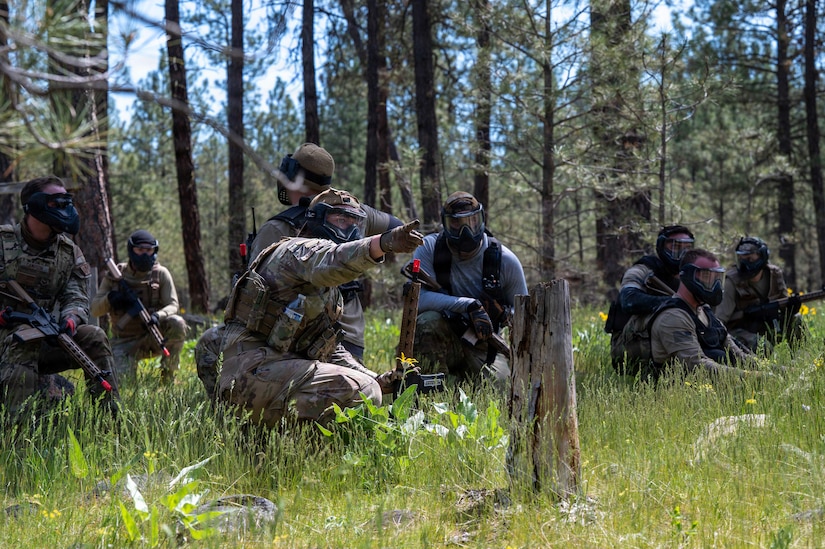
Eight people in camouflage military uniforms and face shields crouch in tall grass while holding weapons in a wooded area; one person points as the others observe.

The inaugural program pulled airmen out of their typical daily duties and into hands-on combat environments, enabling training participants from various career fields to operate as capable expeditionary warfighters. The initiative was spearheaded by Air Force Chief Master Sgt. Lindsay Moon, 92nd ARW command chief, who saw a need to provide airmen with training beyond computer-based modules and classroom instruction. 

"Iron Ascent is a course that we locally created, realizing there was a need to get past the things we learn by [computer] or in a classroom, and trying to get folks out into the field and really recognizing what [the] warrior ethos is," Moon said. "It allowed us to drop people out into the field to do combat-related operations, even if it's not the same thing we expect them to do day to day." 

The result was a rigorous, multifaceted training experience. The first day was dedicated to academics, where participants received briefings on essential deployment skills. 

"The classroom instruction covered deployment tactics, explosive ordnance disposal capabilities and tactical combat casualty care," said Air Force Tech. Sgt. Katlynn Bell, the noncommissioned officer in charge of training for the 92nd Security Forces Squadron, who also served as part of the exercise cadre. "It was mainly learning the fundamentals, so it's easier for the practical portions later on." 

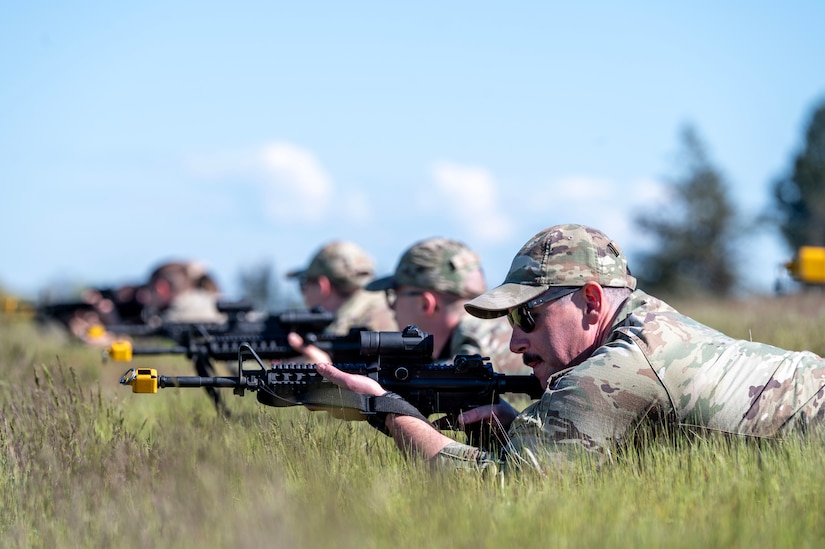
Four people in camouflage military uniforms lie in a row in tall grass under a blue sky with clouds and aim weapons.

During day two, the airmen split into two groups to apply their new knowledge, swapping halfway through the day so everyone completed both events. One group practiced close-quarters battle tactics and troop movements at the security forces' "shoot house," and the other group rappelled down a 30-foot wall with survival, evasion, resistance and escape specialists. 

"We tried to progressively build on the concepts," Moon said. "We were able to hand them actual M4 [assault rifles] so they could practice clearing rooms, being in formation and communicating together."

The final day culminated in a field training exercise at Nighthawk Range, where participants faced a series of challenging scenarios across 50 acres of terrain. They defended locations, acquired intelligence and navigated through ambushes against opposing forces, putting all their training to the test under high-stress conditions. 

"You saw a lot of different stressors that were applied to them, and it was amazing to watch them face those [stressors]," Moon said. 

The exercise reflected the Air Force's broader push toward creating a more agile and versatile force. 

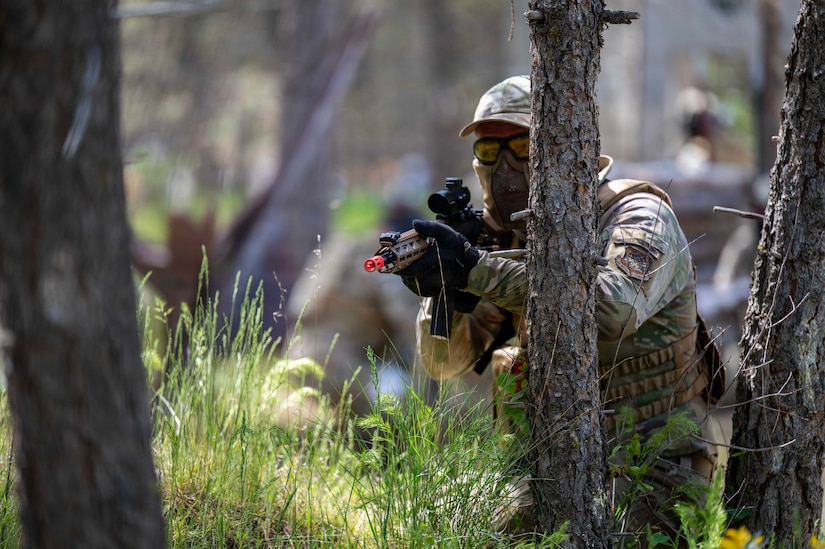
A person in a camouflage military uniform, goggles and a face covering stands in a wooded area and aims a weapon.

"It's important for people to understand that we may ask you to do things outside of what you learned in tech school," Moon said. "But that is okay; you can do hard things. We had airmen from finance and weather training right alongside security forces and survival instructors; watching them all work together was amazing." 

Air Force Staff Sgt. Dakota Peterson, NCOIC of physical security for the squadron, who also served as part of the exercise cadre, noted the training established a critical baseline for airmen who may find themselves in unexpected roles during a deployment. 

"It's critical because when they deploy, they might be asked to step outside their normal duties, and this training provides that foundation," Peterson said. "It's a stepping stone that allows them to say, 'Hey, I have some experience. I trained for this a year ago, and now I can apply it here.'" 

For the cadre, one of the most rewarding aspects was watching the volunteer participants embrace the challenges head-on. 

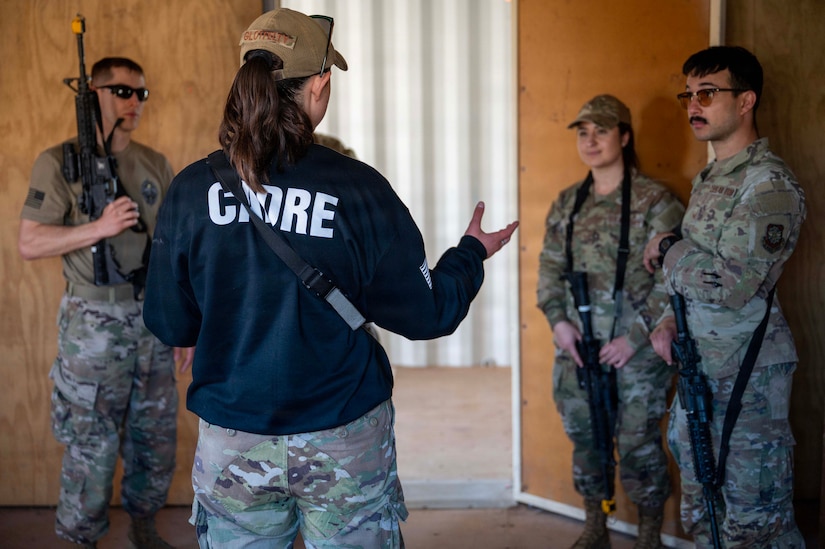
A woman in a camouflage military uniform and black jacket that says "CADRE" on the back speaks to three people in camouflage military uniforms who are holding weapons inside a training structure.

"It was really awesome to see people stepping out of their comfort zones, and not being afraid of it, and really just embracing it," Bell said. "It's all volunteers here; no one here was told to be here." 

The enthusiasm was palpable. According to Moon, many participants immediately asked how they could be involved in the next iteration, a testament to the program's success and the growing appetite for hands-on, tactical training.