Showing posts with label fort sill. Show all posts

Wednesday, September 02, 2026

Army Artillery Brigade Builds Tactical Proficiency

 Sept. 2, 2026 | By Army Capt. Lydia Laga, 75th Field Artillery Brigade

Warfighting mastery is forged through the relentless, daily grind of tough, realistic training, fueled by the dedication of soldiers who refuse to let constraints define their readiness.
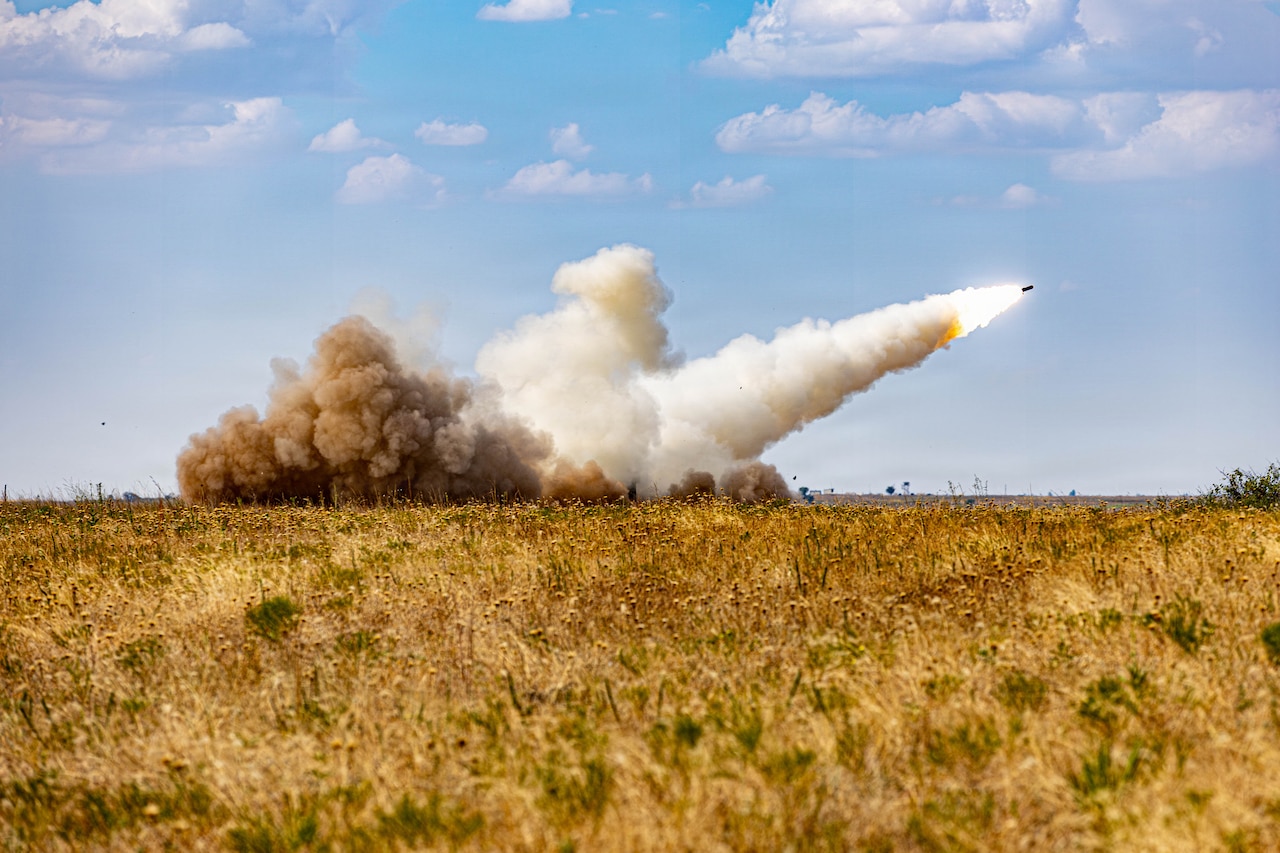
A rocket takes off from a field, shooting smoke and kicking up a cloud of dust behind it.

This is the standard of the 75th Field Artillery Brigade, and it was on full display in late August as the 2nd Battalion, 4th Field Artillery Regiment, took to the Fort Sill, Oklahoma, training areas to execute Artillery Table VI section qualifications and validate their Role 1, initial medical support for combat operations capabilities.

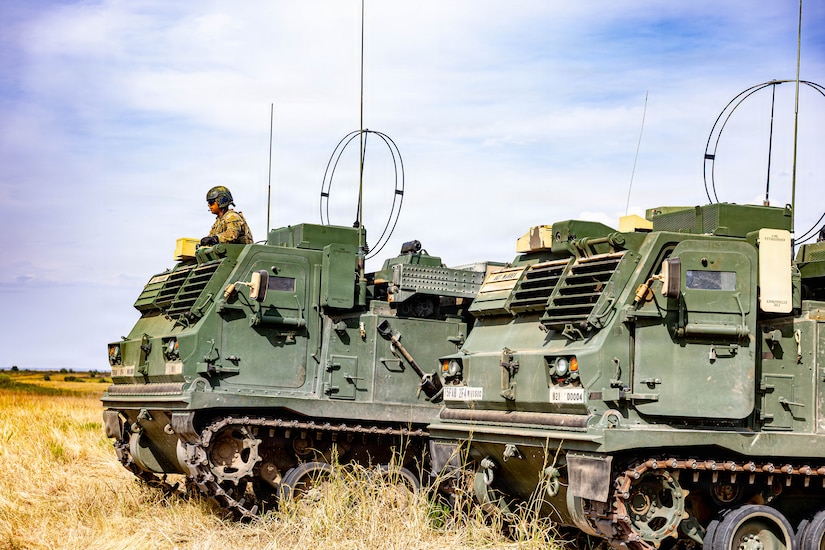
In the high-tempo environment of large-scale combat operations, the M270A1 Multiple Launch Rocket System is a devastating instrument of tactical lethality. But the platform's capability is only as good as the crew inside. Rather than treating the qualification as a routine exercise, the battalion used it to build adaptability and grit under pressure, particularly as soldiers navigated real-world manning and maintenance constraints.

For unit leaders, the focus was clear: build tactical proficiency from the ground up by investing in soldiers and empowering junior leaders.

"I feel that my battery did very well on this certification/qualification considering some of our maintenance and manning constraints," said Army Capt. Rachele Smith, Bravo Battery commander. "We have mostly new leaders within our formation and some soldiers stepping up to fill chief and gunner roles, so this was their first time having their feet to the fire."

Smith's approach was unyielding, pushing her platoon leaders to treat every simulated and live-fire iteration with absolute tactical realism.

"Our goal was to keep this training as tactical and realistic to how we'd fight as possible, so I was hard on the platoon leadership to stick to our hit times and key tasks," she explained. "The great part about these section qualifications is that it builds the training foundation for the battery and allows us to progress into our platoon and battery collective training in the upcoming months."
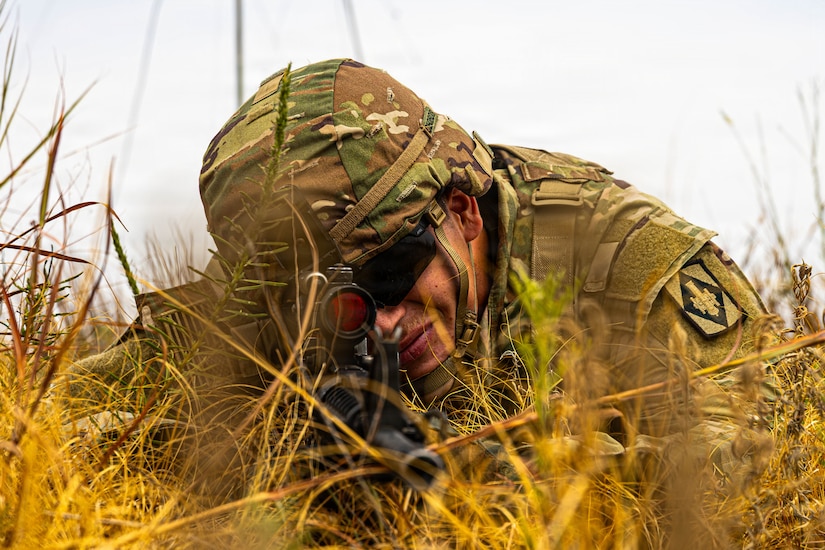
A man wearing a camouflage military uniform lies on the ground in a grassy field aiming a rifle.
A man wearing a camouflage military uniform stands in the open hatch of a military vehicle that is sitting in a field; there is another vehicle beside the first one.
This commitment to incremental growth embodies the III Armored Corps' training guidance, refining lethality and mastering the fundamentals of combat. By letting junior soldiers step up into critical roles, the unit turned potential constraints into a powerful opportunity for leader development.

While the firing batteries refined their lethality downrange, the battalion's Headquarters and Headquarters Battery validated medical readiness, another critical element of survival on the modern battlefield.

Under the cover of darkness Aug. 27, the battalion's medical section established an aid station in the training area, treating simulated blast trauma and severe hemorrhages under unscripted, chaotic conditions.

Like the firing crews, the medical team had to overcome the challenge of a fresh roster to build a cohesive capability.

"Role 1 training is beneficial to our medical section because it allows us to train as we would fight," said Army 1st Lt. Monique Pilcher, battalion field medical assistant and medical exercise training lead. "It builds our ability to rapidly establish, operate and sustain a Role 1 capability while developing proficiency in casualty treatment, triage, evacuation, medical logistics and team coordination."

For Pilcher, success during the nighttime validation came from exhaustive rehearsals and trusting her young medics to carry out their duties.

"Most importantly, it gives our soldiers the opportunity to rehearse their individual responsibilities as part of a cohesive medical team, so when we encounter a real-world casualty or [mass casualty], we can respond quickly, confidently and effectively," she said. "Rehearsals were very important due to having a brand-new team of medics training for the first time."
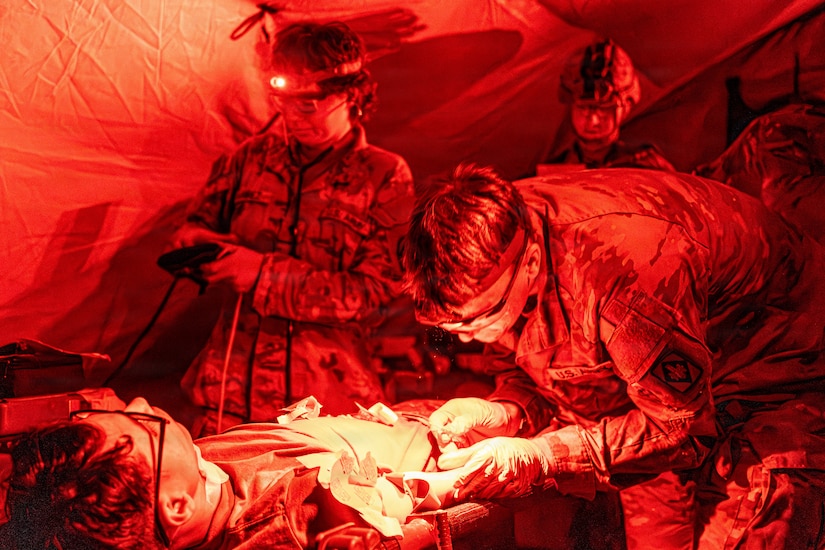
A man wearing a camouflage military uniform checks on a simulated patient in a tent at night; there are three other people in similar attire working in the background.

From the fire direction centers transmitting data-centric missions to the signal specialists securing the tactical networks, and the medical teams operating under limited visibility, the unit demonstrated what cohesive readiness looks like. It is a shared burden carried by every soldier who stepped up to fill a larger role and every leader who mentored them through the process.

The battalion now shifts focus to Artillery Table XII platoon collective qualifications, building on a foundation of hard work and professionalism from its crew members. While this recent qualification focused on individual launcher sections and fire direction centers, the next one elevates the training to a collective qualification.

In this phase, these independent sections must integrate, move, communicate and survive together as cohesive, synchronized platoon-sized elements under tactical command, transforming individual weapon systems into a unified force multiplier. The road to warfighting mastery is long, but as Smith noted, the unit is taking it "day by day to make small incremental changes over time."

Friday, August 21, 2026

Corps of Engineers Modernizes Historic Fort Sill Barracks

Built in 1939, ahead of World War II, Building 900 at U.S. Army Garrison, Fort Sill, Oklahoma, looks much the same on the outside as it did over eight decades ago.  

The building features the same historic architecture as neighboring buildings. But behind the historic facade, the U.S. Army Corps of Engineers, Tulsa District, is overseeing and executing a high-tech modernization project that will make this one of the most structurally reinforced buildings on the installation.  

A beige building with the number 900 on it. Another building is just behind it.

As part of the military construction mission, USACE provides engineering, construction and project management support for military installations, helping deliver facilities that support readiness and quality of life for soldiers. This construction project is transforming the 43,000-square-foot building to meet current unaccompanied enlisted personnel housing standards.  

"This building has housed enlisted personnel and Marines for decades," said Joe Krachinsky, quality assurance representative, USACE, Tulsa District. "This project will completely change the layout of the building to support today's needs."  

The historic shell of the building will remain intact, but the interior is being completely renovated and updated for modern living.  

When the renovation is complete, the barracks will house 72 soldiers. Each will have a private bedroom and bathroom, with two soldiers sharing each kitchen. Each floor will also have new day rooms, common areas and enhanced laundry facilities. 

The building will have entirely new heating, ventilation and air conditioning systems, lighting, fire alarms and sprinkler systems.  

Aligning with the USACE mission to build faster, smarter and together, engineers on the project are using innovative construction methods to reinforce the aging structure.  

The inside of a building under construction. A man in construction safety gear is in the background.

"Because Fort Sill is located in a region known for severe weather, the building is being designed to withstand tornadoes as well as seismic activity," said Jessica Goodin, construction manager, USACE, Tulsa District. "The reinforcement goes from the basement to the roof and works as one interlocking lattice."  

Engineers are retrofitting the existing building with a progressive collapse design, a structural engineering approach that ensures localized damage won't cause the entire building to collapse. The method reinforces the existing structure, so losing a column does not cause a significant portion of the building to collapse. Instead, the load is redistributed to surrounding structural columns, allowing the building to remain stable long enough for occupants to evacuate.  

Shotcrete, a concrete mixture sprayed onto a surface at high velocity, will be applied to the existing concrete structural system to reinforce and strengthen it to meet the progressive collapse design requirements.  

"Building 900 marks the first use of progressive collapse design in the district," Krachinsky said. "This project will also be the first use of shotcrete on Fort Sill as a final protective coating."  

Concrete footings, steel and dowels establish a secure foundation. Rebar is installed on each level, starting in the basement and fished through holes drilled into the concrete, locking the floors to the beams. Even the windows, a naturally weak point, are fortified with steel plate headers, mounted studs and carbon fiber wraps so the rebar can lock the walls and headers together.  

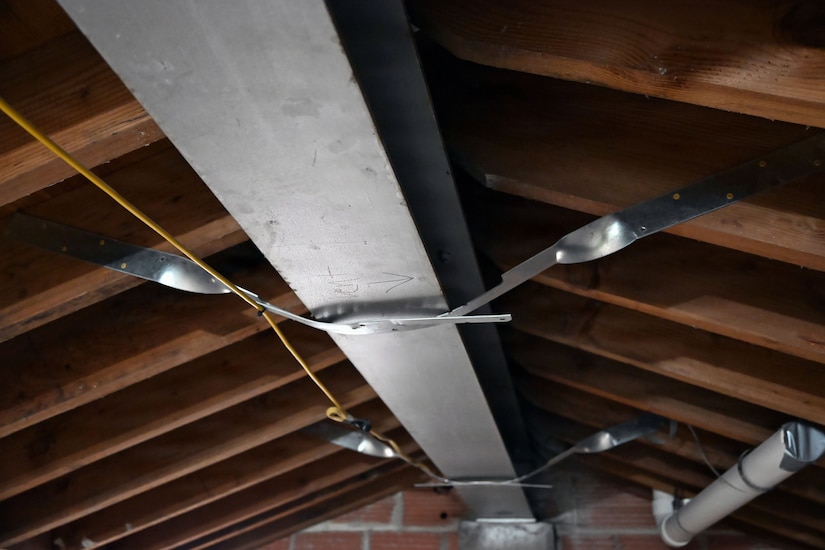
The ceiling roof trusses of a building under construction.

At the top of the structure, the team wrapped the roof trusses in steel, reblocked them and reinforced them with three-quarter-inch plywood and metal strapping to lock the roof to the beams.  

To ensure structural integrity the team conducts rigorous pull tests on the footings and the carbon fiber anchored to the walls and concrete. Engineers use a hydraulic pump attached to floor rings or anchors to test the load capacity of the wrapped beams and other structural reinforcements, ensuring the building meets safety specifications.  

By using technology and applying modern science and engineering to a historic building's footprint, USACE is delivering a facility that honors the history of Fort Sill and the Army while providing a safe, modern home for the soldiers of today and tomorrow.

Tuesday, December 20, 2011

Face of Defense: Commando Couple Embraces Army Values

By Michelle Kennedy
Fort Drum Public Affairs

FORT DRUM, N.Y., Dec. 20, 2011 – Balancing work and personal responsibilities is a challenge for many families, but dual military families face a different set of challenges when dealing with long duty days, deployments and other separations.

One Army couple here -- Warrant Officer Julia Armstrong and Sgt. 1st Class Everett Armstrong -- has endured almost 35 years of combined military service, all while raising a family, balancing work schedules and keeping open lines of communication.

Julia Armstrong, who serves as an adjutant general technician for 2nd Brigade Combat Team "Commandos," works down the hall from her husband, who is the brigade's dining facility noncommissioned officer in charge. While working in the same building has its benefits, it hasn't always been easy.

Everett Armstrong who has served in the Army for 20 years, never thought the military was the right choice for him. "The military was always something I loved watching on TV, but I never thought it would be for me," he said.

That was until he figured out the military would be his ticket out of his rough Houston neighborhood and for the family life he desired.

"Growing up, I was adamant about being married," he continued. "I didn't want to be a football star; I just wanted to be a father.”

“I was already ready for the mission that was coming,” he said of his decision to enlist. But, “I think it was hard on my family when I went straight into the military. They had no clue until that recruiter showed up on the doorstep. I was ready to write a new chapter for myself, and I say it turned out great."

Armstrong’s high school graduation was June 6, 1991, and five days later, he was at basic training.

"The military has been very good for me -- I've got my kids, my wife and everything," he said.

He and his wife met in 1996 while he was stationed at Fort Sill, Okla.

"We met on a basketball court, of all places," he said.

That wouldn’t seem strange except, "I'm 6'2" and he's 5'4," and everybody assumes that I'm the basketball player," Julia Armstrong said, laughing. "I'm so not athletic."

Armstrong was not in the Army when she met her husband while dropping her friend off at her job on Fort Sill. She noticed a group of soldiers playing basketball and goofing around. That's when she saw Everett.

Armstrong asked her friend about her future husband, but her friend warned her that he was "short."

"From a distance, 5'4" doesn't look that bad, but when I met him -- he was short," she said. "We exchanged phone numbers, and we talked on the phone every day that week. We had our first date that Friday and we've been inseparable from that point on. We got married six months later (in September 1996)."

Even though it's been almost 16 years since they met, Armstrong still remembers exactly what his wife was wearing.

"I thought she was gorgeous -- in tennis shoes, sweat pants that were a little high because she was so tall, and a big Starter overcoat," he said. "Our first words were, 'Wow, you're short!' and, 'Wow, you're tall!' And we joked from there."

The Armstrongs think it's funny when people don't realize they're married.

"It's hilarious, even now," Julia Armstrong said. "We have the same last name, but even until a couple of months ago, there were people who didn't put the two together that we are married."

Laughing, understanding and communication have helped this Army couple stay strong during their careers.

Nine months after they were married, Julia Armstrong decided to join the Army in May 1997.

"I had been going to school, working two jobs and raising our oldest (son), and it was just too much," she said.

Fifteen years later, she still loves the Army, but she said she's a little scared at what the future may hold if her husband decides to retire.

"He's at that point where he's at the end of the road, and that scares me because I'm so used to us being a dual-military couple," Armstrong said.

The Armstrong family has been fortunate to not have to endure too many separations from each other or from their four children -- Devyn, 17; Stephon, 15; and twins Trinity and Everett Jr., 4.

With the exception of training and his deployment to Iraq from 2003 to 2004, the couple has been able to stay close. The Armstrongs served together during all their assignments, including Korea.

"All of our duty stations have been always been about us being together as a family unit," Julia Armstrong said. "We've always considered our family and the Army equal; if it was good for the Army and it was good for the family, it was good for us."

During their careers, balancing work and family hasn't always been easy, she explained.

"There were times where you question if you're putting the military before your family or vice versa," Armstrong said, adding that over the years, they have learned to share the responsibility equally. "There are so many other factors. I think what works for us is that we communicate."

Each has faced jobs that required long hours and late nights, while the other tended to the children, cooked dinner and cleaned the house.

"I think for us, it just works," Julia Armstrong said. "We tackle things head on. We discuss it and talk about it. There's no time for someone to say 'I don't want to do that,' because it's all about the kids and making sure things are good for them."

Although the couple has mastered the ways of Army life on and off duty, it is still a struggle when it comes to ensuring their children are taken care of. When both have to go to the field, they have to know that the people who watch their children are responsible.

"It takes coordination," she said. "You can't just leave your kids with anyone; you have to have that support system. We don't have family here, so it takes a while to get to know people and trust them with your kids. That's a lot of responsibility to pass on to someone else."

Everett Armstrong agreed. Right now, it's his wife's turn to work late some days, so he picks up the slack at home.

"We're in sync," he said. "I already know what needs to be done, and I know when she's working late. There's no reason for me to call to ask what she needs me to do. I'm already starting the washing, cooking, kids are bathed, so when she gets home all she needs to do is rest."

He added that throughout his career, he has been fortunate to have great assignments.

"At Fort Sill, when I first met my wife, it was pretty rough because I was always in the field or always working," Armstrong said. "As the years progressed, I've bounced around and gotten some excellent jobs where I can cover my own hours."

Julia Armstrong added that she believes a lot of their success throughout the years has to do with the command climate. They've been fortunate to have supportive commands that understood their situation.

"They have to understand that (with us), they're getting two for the price of one," Armstrong said. "There will be times where a kid gets sick, and I have to leave work because he can't.

Working in an environment where people understand that and they support you and they see that you're still part of the team, (you're) an asset and they're getting the best end of the deal makes all the difference."