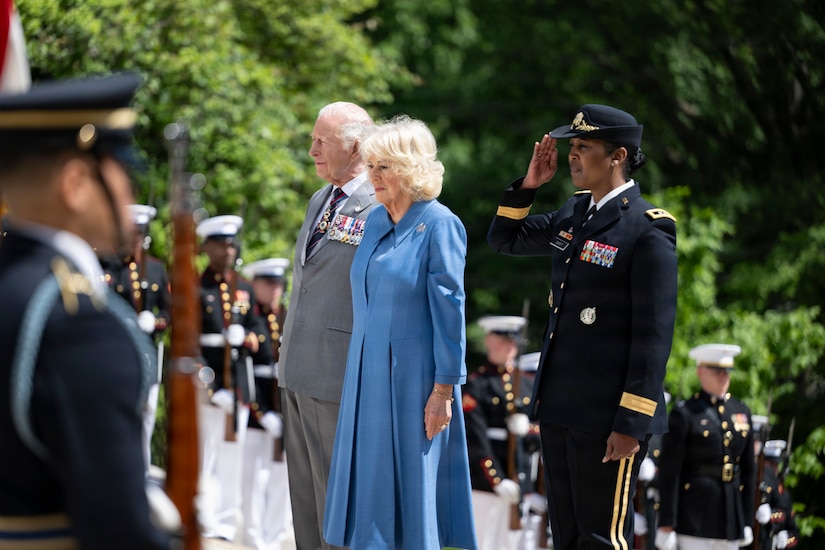
On April 30, King Charles III and Queen Camilla entered Arlington
National Cemetery for a full honors wreath-laying ceremony at the Tomb
of the Unknown Soldier, marked by a 21-gun salute. The ceremony was on
the final day of their state visit, commemorating the 250th anniversary
of American independence.
The king and queen were escorted by Army Maj. Gen. Antoinette Gant,
commanding general of Joint Task Force - National Capital Region and
U.S. Army Military District of Washington; and Monica Crowley, U.S.
ambassador, assistant secretary of state and chief of protocol. They
stood at attention as the United States Army Band "Pershing's Own"
played "God Save the King" and "The Star-Spangled Banner."
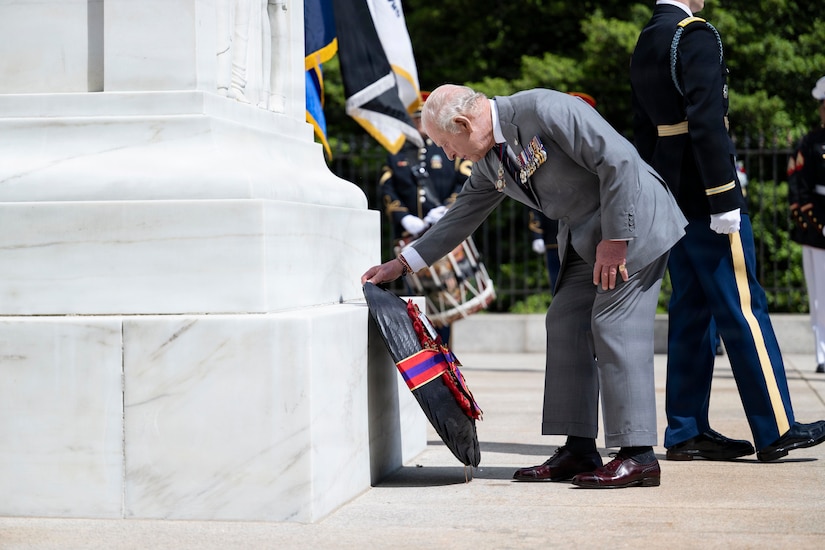
At the tomb, King Charles laid a wreath composed of red poppies, a
symbol of remembrance in the British Commonwealth dating back to World
War I. The wreath included a note from the king that read, "In
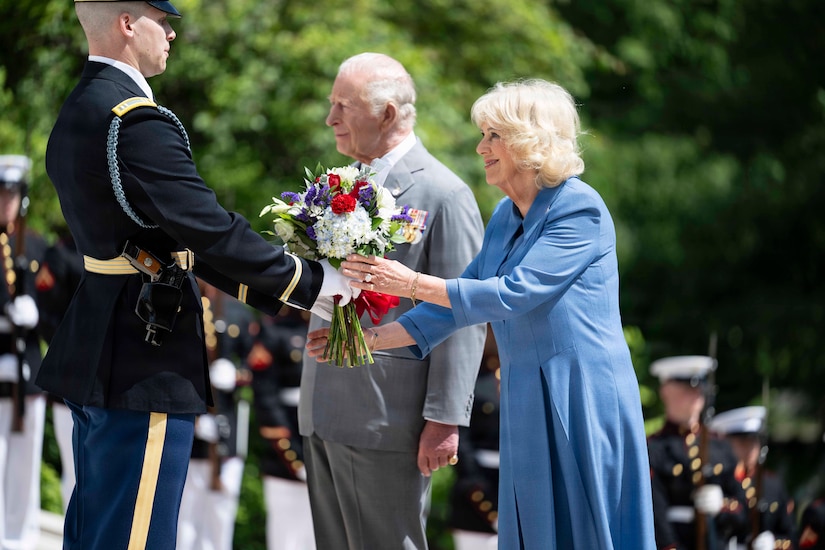
everlasting remembrance." The queen then placed a bouquet of red, white
and purple flowers next to the wreath.
The Tomb of the Unknown Soldier itself embodies the two nations' deep
and poignant historical connections. Dedicated on Nov. 11, 1921, with
the burial of an Unknown Soldier from World War I, the tomb at Arlington
was partly inspired by Britain's Tomb of the Unknown Warrior at
Westminster Abbey, dedicated exactly one year earlier. All three
unknowns, representing American service members who died in World War I,
World War II and the Korean War, fought in conflicts in which the
United States and Britain were allies.
After the wreath-laying ceremony, Karen Durham-Aguilera, executive
director of Army National Military Cemeteries and Office of Army
Cemeteries, greeted the royal couple inside the Memorial Amphitheater.
"Arlington National Cemetery is honored that the king and queen
visited these hallowed grounds while commemorating America's 250th
birthday," Durham-Aguilera said. "The enduring bond between the United
States and the United Kingdom stands as a testament to shared history
and sacrifice."
The king and queen's visit to the cemetery concluded at the Canadian
Cross of Sacrifice — a memorial at which Elizabeth II and Prince Philip,
King Charles' parents, had also paid respect during their 1957 state
visit. This memorial honors Americans who volunteered to fight, and
ultimately died, with the Canadian Expeditionary Force in World War I,
prior to the U.S. entrance into the conflict.
Like the tomb, the Canadian Cross reflects shared commemorative
traditions. Designed by British architect Sir Reginald Blomfield for the
Commonwealth War Graves Commission, the Cross of Sacrifice stands as an
iconic emblem of World War I at CWGC cemeteries worldwide. Fittingly,
the king and queen were accompanied at this memorial by service members
from not only the U.S. and the U.K., but also British Commonwealth
nations Canada, New Zealand and Australia.
The royals' visit to Arlington National Cemetery — described by the
British Embassy as "one of the most symbolically significant acts of
remembrance a foreign dignitary can undertake on American soil" —
reflected the enduring military, diplomatic and cultural alliance
between the United States and the United Kingdom.




 Posts
Posts

