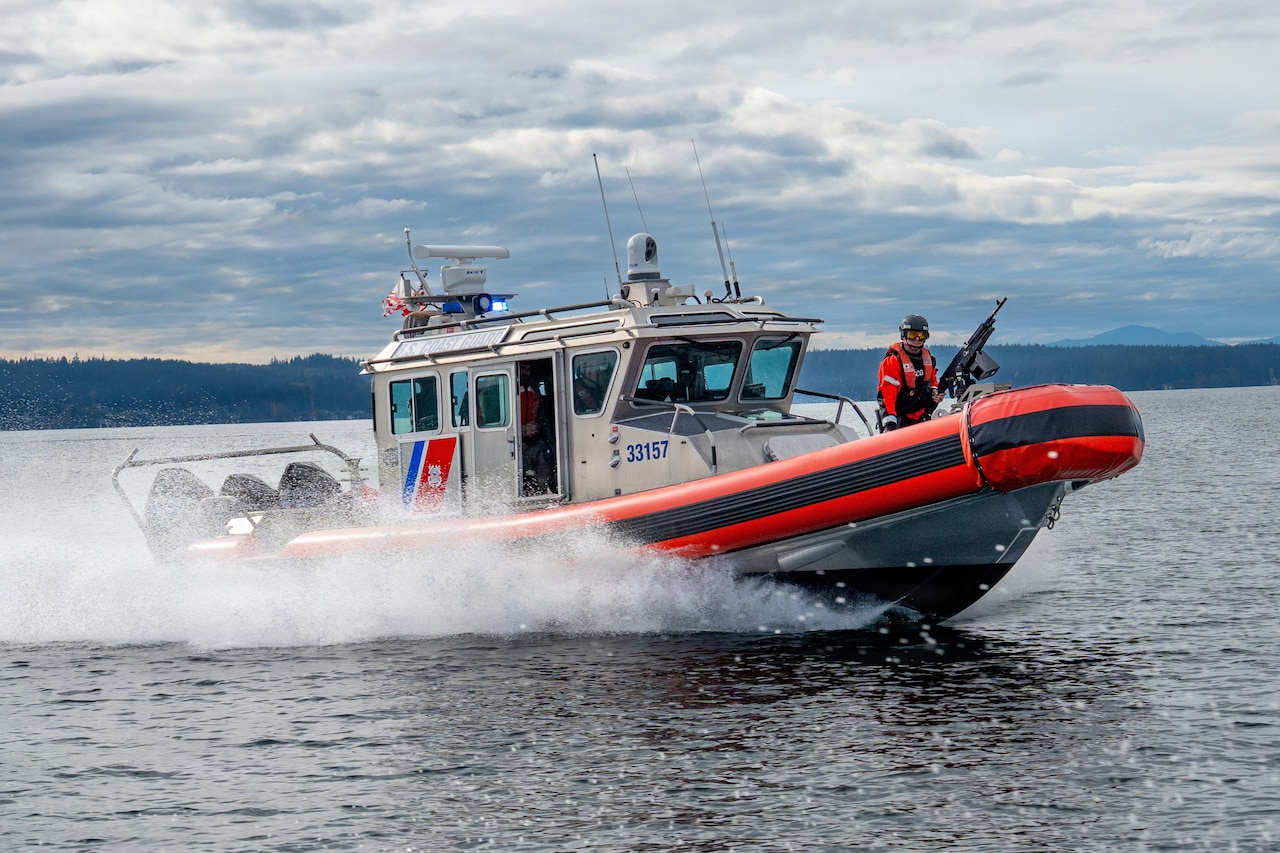
The Olympic Peninsula is home to one of the most unique ecosystems in the world, known for its extreme elevation changes — the landscape spans a portion of the Washington coastline to the snow-capped Olympic Mountains.
It is home to the largest temperate rainforest in the continental U.S. and features species of wildlife and plants found nowhere else on Earth because of the region's geographic isolation. Continue north to where towering pine trees give way to the rocky coastline of the Salish Sea and one can even find a Coast Guard station that serves as an operational hub for the Maritime Force Protection Unit Bangor.
Established in 2007, the MFPU is a specialized single-mission unit dedicated to providing strategic in-transit security escorts for Navy ballistic missile submarines as they transit U.S. territorial waterways until they slip silently beneath the waves.
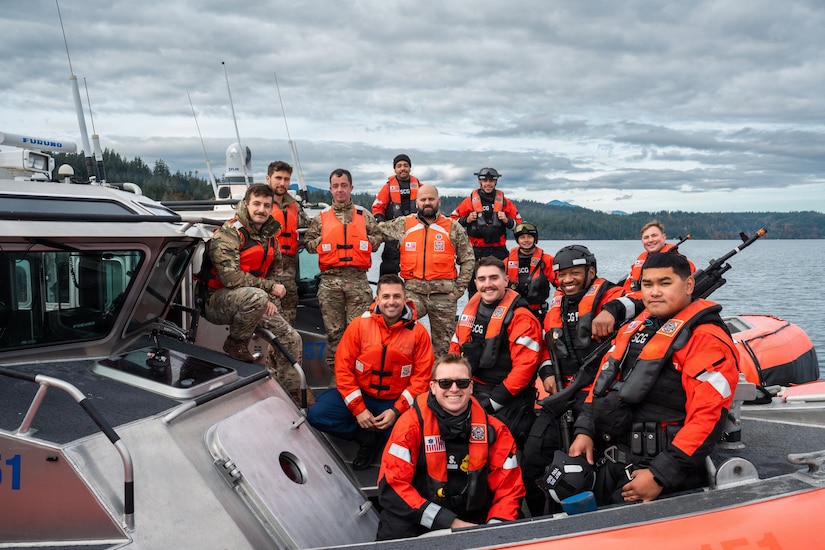
There are only two MFPUs in the U.S. — one at Naval Base Kitsap-Bangor, Washington, and the other at Naval Submarine Base Kings Bay in Georgia — to coincide with the two bases that support the Navy's fleet of ballistic missile submarines. For Coast Guard Lt. Cmdr. James Provost, operations officer and lead patrol commander of MFPU Bangor, mission success begins the day before an escort event with a rigorous review of potential risk and threat factors.
"I'm looking at the weather, looking at civilian traffic going to and from the major ports in the area like Vancouver, [Canada], Seattle, and Tacoma, [Washington]," he said.
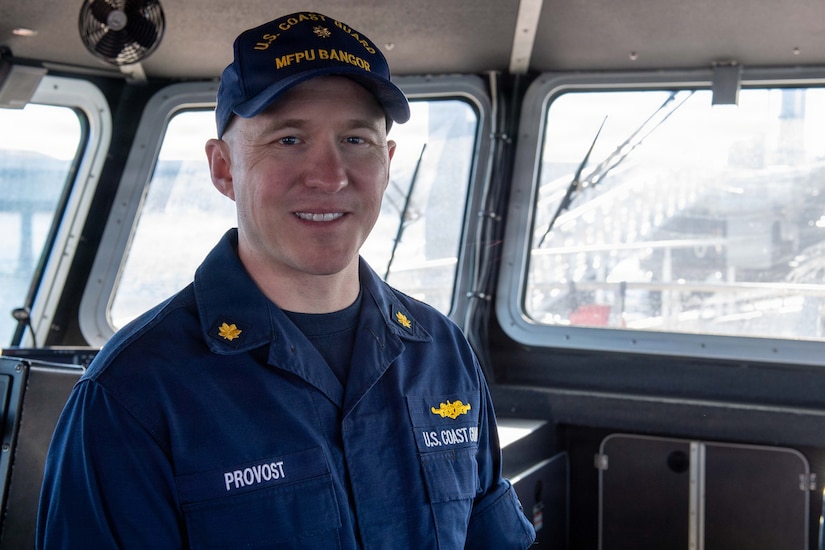
For Provost, it was the MFPU's unique mission and prospect of working closely with the Navy that drew him to his current role.
"The joint work with the Navy feels like a very important mission. It's gratifying when you have a busy day, you're working really hard to maintain the integrity of the security zone and clear a safe path for the submarine," he said. "For us, boring days are good days. We don't want exciting days."
When asked what the most difficult aspect of the job is from an operations perspective, Provost likens the mission to a chess match. The unit is responsible for ensuring submarines receive the best possible escort from homeport to dive point, or from dive point to homeport.
Comprising the pieces of the "chess board," the MFPU has small boats, ships and a mix of personnel to support the ceaseless operational tempo of Commander, Submarine Group 9's fleet of submarines.
The MFPU remains at the cutting edge of security operations because of its high standards and rigorous training. Their impeccable record of mission success is a testament to their expertise and something this unit of elite operators is extremely proud of.
"Nothing can beat watching from the bridge when you have the full escort in place with blocking vessels, multiple screening vessels, all working in coordination with one another. Seeing the team executing the mission to keep the public away and screening all the recreational and fishing vessels is just very impressive," Provost said.
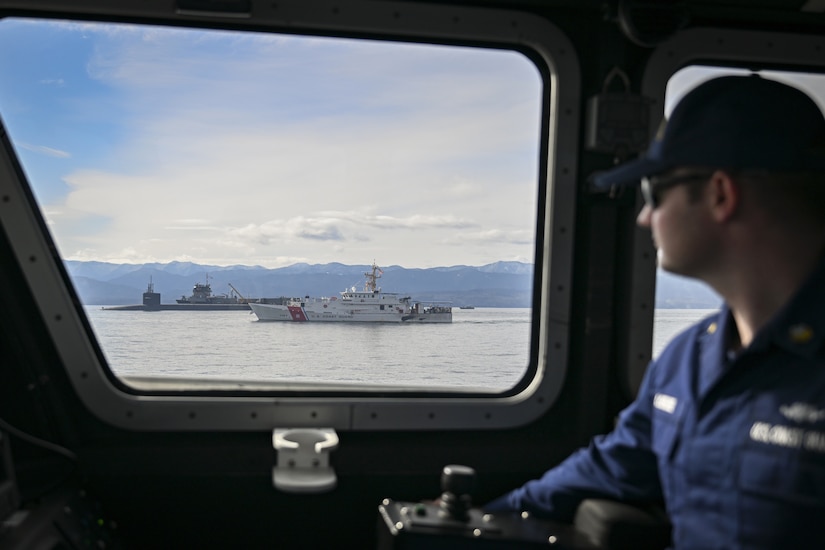
One thing that sets the MFPU apart from other Coast Guard units is the tremendous amount of responsibility granted to its members. While other Coast Guard units have to request permission from senior command elements to employ weapons, this isn't the case for the MFPU, where the ability to respond rapidly to a potential threat is critical to national security.
"Our [small-boat operators], a [petty officer third class], have weapons release authority," Provost said. "If they've demonstrated the proper judgment and maturity necessary, our commanding officer has designated weapons release authority down to them, which is very serious. To see a junior person like that succeed and grow into a seasoned tactical [operator] is incredibly satisfying."
One of those service members is Coast Guard Petty Officer 1st Class Jacob Guilford, whose diverse career spans search and rescue operations in Galveston, Texas, drug interdiction operations in Charleston, South Carolina, and small-boat operations on Maryland's Eastern Shore.
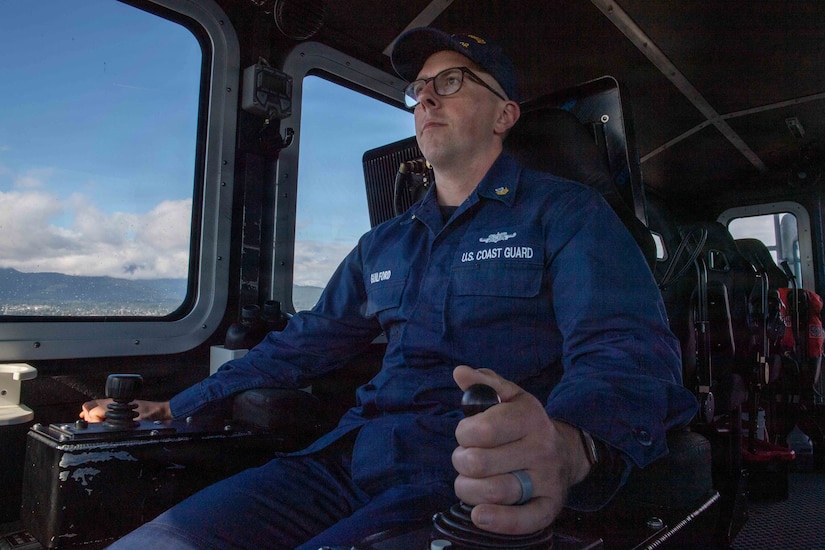
For Guilford, the MFPU was an opportunity to further diversify his career.
"I had done pursuit at a couple of units, which are like offensive operations," Guilford said. "But I had never done tactics before, which is more defensive and the primary mission here."
Like Provost, the unit's joint aspect drew Guilford to the Pacific Northwest. Significantly, this tour was the first time Guilford worked closely with the Navy, and the first time he had ever seen a submarine.
"You hear about nuclear subs, and you see it in the movies, but seeing it in person and seeing the size of it and just knowing their capability — you could feel the importance of our mission," Guilford said. "Being up close to it added a weight to what we're doing. We're protecting them so that they can maintain stability in the world."
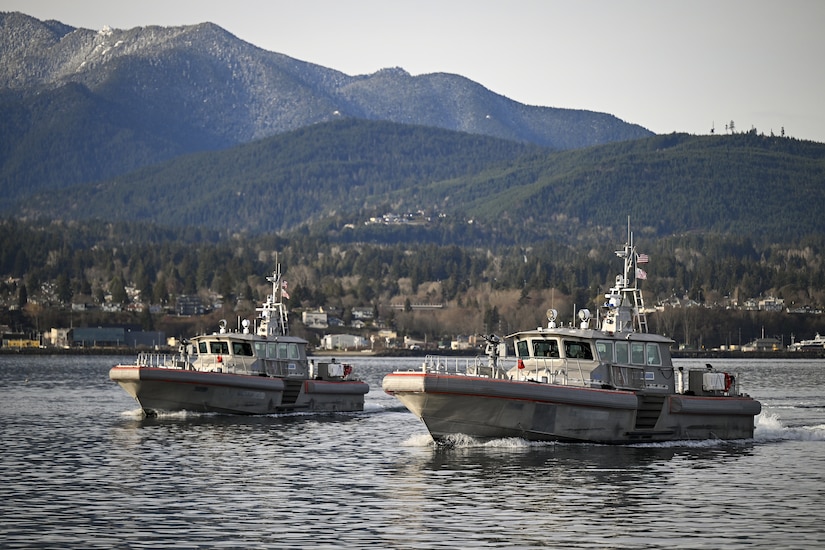
Because of the Coast Guard's unique authorities that do not exist anywhere else inside the U.S. armed forces, it was an ideal partner to provide the Navy with strategic domestic waterway security. Today, MFPU members work hand in hand with their Navy counterparts to ensure seamless integration between the partner sea services.
That integration begins with daily communication with representatives from the submarine group, Submarine Squadron 17 and Submarine Readiness Squadron 31, regarding ship schedules, future events, logistics and intelligence sharing.
Additionally, MFPU boat crews fine-tune their skills at the Trident Training Facility Bangor and Kings Bay — state-of-the-art hubs that traditionally allow submariners to build proficiency and where every patrol commander, boat crew and gunner can train for a wide variety of scenarios that test judgment, reaction time and management of multiple threats.
This level of training is how the Coast Guard ensures personnel assigned to the force protection units are prepared to deter threats during submarine transit. The unique capabilities of the MFPU bolsters Navy and Coast Guard joint objectives for robust security of strategic assets.
The partnership between the unit and Bangor's submarine crews goes beyond the training facility. A deep appreciation for each other's roles is embedded in their culture, along with the understanding that synergy between the two is emblematic of joint force integration.
For Coast Guard Petty Officer 1st Class Nicholas Cifelli, MPFU Bangor unit member, seeing the inside of a submarine was an eye-opening experience.
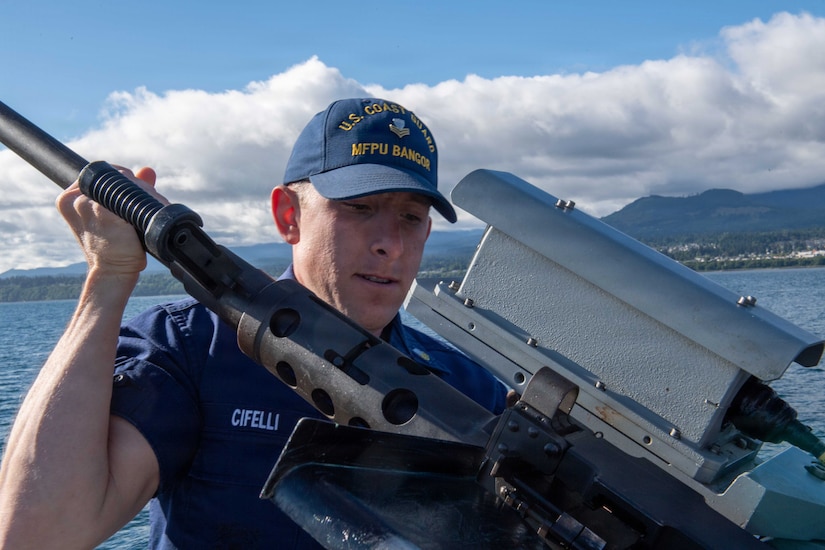
"It was amazing to go from seeing how large and looming the [submarine] is from the perspective we have during an escort, [to] then seeing the size of accommodations for the crew," he said. "To hear how many personnel work on those subs compared to the size of the galley is impressive."
As a weapons division lead petty officer, Cifelli is an expert in employing the unit's weapons systems to prevent a potential threat from entering the security zone.
For him, his experience at the MFPU has been an opportunity to develop his leadership skills. The large number of service members he leads is another example of the authority and responsibility granted to unit members.
Additionally, the MFPU mission has given Cifelli the chance to experience a wide variety of weapons systems within his rating, from small arms to the .50-caliber machine gun and even new systems designed to counter emerging threats.
Regardless of how future threats evolve, the MFPU will remain ready to protect the nation's "boomers" on their way to the deep.
And for Provost, another "boring" day is reward enough to keep him going, though a little recognition doesn't hurt.
"A few weeks ago, we got a chance to talk to a [commanding officer] of we had just escorted and he was like, 'You guys are awesome. The way your [escort vessels] came out and took position perfectly and intercepted two targets of interest — that was so cool.' Knowing we're seen and appreciated — that just feels good," he said.




 Posts
Posts

