Wednesday, June 10, 2026

Department of War Establishes Cyber Mastery Incentive Pay

The Department of War (DoW) is launching the Cyber Mastery Incentive Pay (C-MIP) program, a key effort in the Secretary of War's Project Patriot Pipeline initiative, and an important step toward hardening our cyber defenses and strengthening our Defense Industrial Base capacity to compete in the cyber domain.

C-MIP fundamentally modernizes how the Department incentivizes its Cyberspace Operations Forces (COF) assigned to U.S. Cyber Command. The C-MIP Framework provides DoW a powerful tool to build and drive an elite corps of cyber warfighters ready to dominate in the digital battlespace. As part of the broader Secretary of War-approved CYBERCOM 2.0 effort, C-MIP is a forward-looking, multi-layered incentive framework that promotes domain mastery within our most critical cyber work roles.

"Cyber domain capabilities are high-demand, low-density skill sets critical to our daily warfighting operations. To incentivize our cyber forces and meet both Department of War and Defense Industrial Base needs, we need to shed legacy incentive models and invest directly in our people serving on the digital front lines. C-MIP does this," said Anthony J. Tata, Under Secretary of War for Personnel and Readiness. "It is a strategic initiative to attract, develop, and retain the specialized workforce needed to counter threats, deter aggression, and dominate the cyber domain." The C-MIP program moves beyond one-size-fits-all incentive models to a flexible and cumulative system that directly links pay to certified skill mastery and the performance of exceptionally demanding duties.

"C-MIP fundamentally changes our approach by incentivizing the pursuit of deep, technical, and career-long expertise," said Katie Sutton, Assistant Secretary of War for Cyber Policy. "By breaking down the bureaucratic norms of government incentives, this framework enables increased lethality by driving the skills, roles, and duties most vital to mission success. New incentive frameworks normally take years to develop, but the CYBERCOM 2.0 team has driven this outcome in 60 days. This framework ultimately sends a clear signal to our cyber warriors that the Department values the skills necessary to outpace and prevail against our Nation's adversaries by incentivizing Service Members' commitment to cyber domain mastery."

The C-MIP program features two distinct and cumulative layers:

  • Skill Incentive Pay (SIP): The foundational layer that directly rewards an individual's demonstrated work role skill level — Basic, Senior, or Master — established by U.S. Cyber Command (USCYBERCOM). This layer creates a clear and compelling path for our cyber warriors to pursue continuous technical growth.
  • Special Duty Pay (SDAP): A monthly incentive for members performing duties that USCYBERCOM designates as exceptionally demanding. This pay recognizes the specialists who scale their skills across the force by serving as instructors, certified work role trainers, and in advanced cyber duties.

The Assistant Secretary of War for Cyber Policy (ASW-CP) will oversee the execution of the C-MIP framework. The ASW-CP will closely partner with the Office of the Under Secretary of War for Personnel and Readiness (USW(P&R)), U.S. Cyber Command (USCYBERCOM), and the Military Departments to ensure the framework remains agile to warfighter requirements. General Joshua M. Rudd, Commander of USCYBERCOM, stated, "I'm excited about what C-MIP represents. Our warfighters take on complex missions that demand extraordinary commitment and technical expertise. We need to ensure that commitment is being recognized, especially when our operators step into our most demanding roles."

Taking effect October 1, 2026, the C-MIP program launches a new era of cyber talent management. By aligning a competitive incentive model with Secretary Hegseth's strategic vision, the Department of War begins to unleash our Nation's potential to build and sustain world-class cyber forces for years to come.

33rd Maintenance Squadron Refurbishes Khobar Towers Memorial Sword

Airmen assigned to the 33rd Maintenance Squadron have worked to revitalize the flaming sword centered on the 33rd Fighter Wing's Khobar Towers Memorial by modifying it to keep the flame burning without environmental disruption.

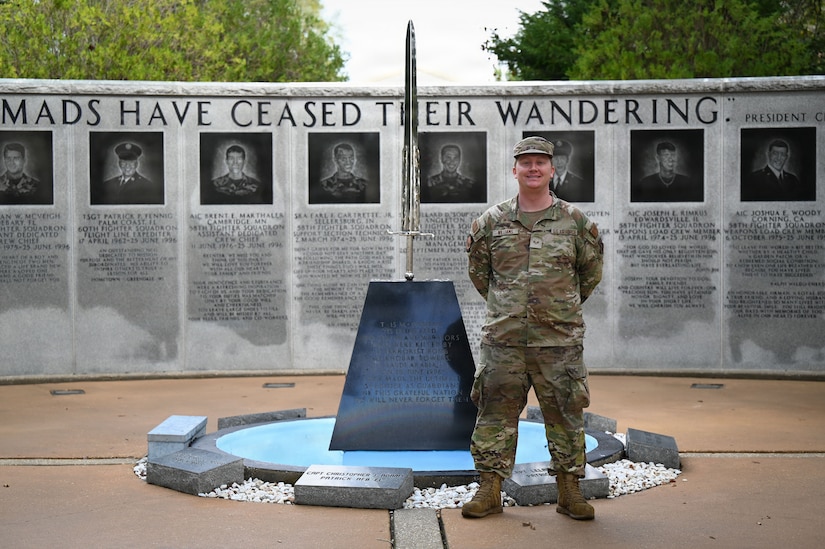
A man wearing a camouflage military uniform stands in front of a sword wedged into a stone block. Behind him is a wall memorializing the fallen service members of a tower bombing.

The evening of June 25, 1996, went down in history as a tragic night of lasting impact when terrorists bombed Khobar Towers, a housing complex in Dhahran, Saudi Arabia, killing 19 U.S. airmen — 12 assigned to the 33rd Fighter Wing. The sacrifice of the airmen will forever root the wing's values and continue to fuel the mission.

In 1997, airmen assigned to the 33rd Fighter Wing milled a stainless-steel sword to be placed at the center of a memorial located at Eglin Air Force Base, Florida. The sword bears a flame that burns continuously, representing an everlasting legacy "forged by fire."

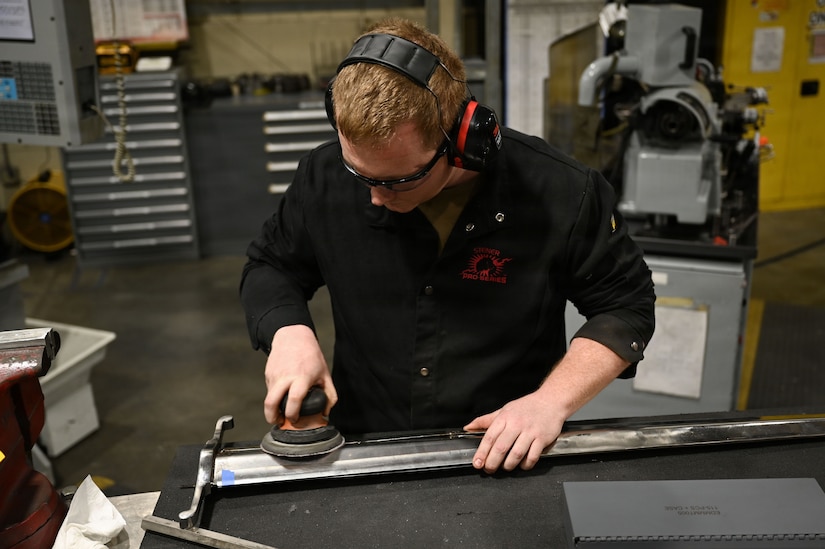
As the 30th anniversary of the bombing approaches, 33rd Maintenance Squadron airmen have been working to revitalize the sword by polishing the steel and making structural modifications.

Air Force Senior Airman Adam Williams, 33rd Maintenance Squadron metals technology journeyman, and Air Force Airman 1st Class Sir Christon Oliver, 33rd Maintenance Squadron metals technology apprentice, have combined expertise and worked diligently to properly modify the sword and refresh the original design.

A man wearing a black shirt and protective eye gear uses a power sander to sand a large sword. Heavy machinery is behind him.

"The flame kept going out. So, we've made little fins that go on the side to protect the flames from going out from wind, leaves, debris, anything like that," Williams said.

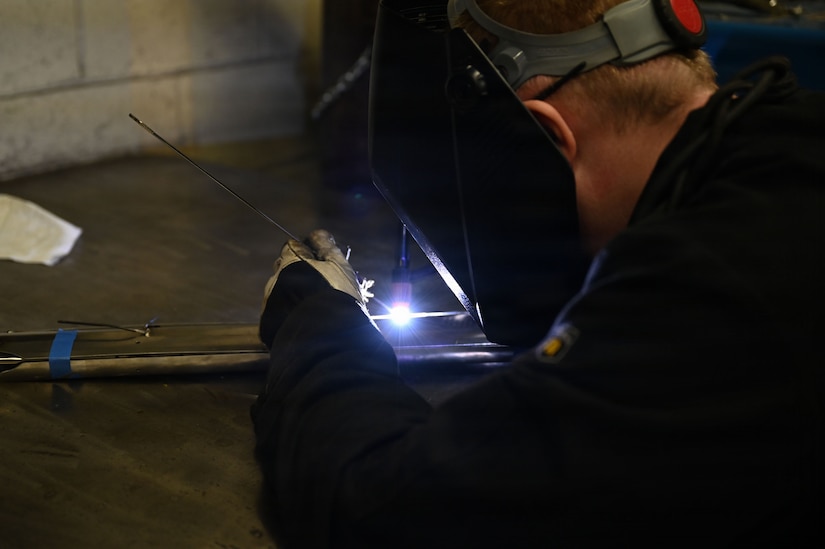
Williams fabricated the fins from sheets of metal, while both Williams and Oliver produced welds that cleanly attached the fins to the blade. They cut 19 holes representing the 19 lost airmen into the sides of the sword, allowing the flame to disperse.

"There's some propane that goes through it, so we've got holes on each side that, when the sword is connected to the base, it uses regular pressure to ignite, and that's how it stays lit all the time," Williams said.

One airman assigned to the project has a deeper connection to the sword and its legacy. Williams was born in Jeddah, Saudi Arabia, a month and a half after the Khobar Towers bombing. Williams' father, a U.S. Navy veteran, was working as a contractor in Saudi Arabia at the time of the attack and the family lived close to the bombing site.

A man wearing protective face gear welds a large sword.

"I spent 18 years in Dammam, which is 45 minutes from Khobar Towers. So, as I grew up, to go into town, you had to drive by Khobar Towers and that whole area, and that was my childhood," he said. "[The Khobar Towers Memorial] resonated with me, because I knew where it was and what the impact was."

Williams later joined the Air Force and was assigned to the wing linked to this significant part of his youth, and he shared what it means to him.

"I feel so honored to be able to be a part of this history. I literally walked those streets where it happened, and I still sometimes get goosebumps," he said.

The sword represents more than just the memorial's centerpiece.

"[The sword's significance] is keeping the heritage alive and honoring those [who] did die for us. It's also making sure that those family members [who] do come, see that we've put the effort in and made time for them, because they have the loved ones that made the ultimate sacrifice," Williams said. "We've put the effort in to make sure it's going to withstand the test of time, and I think in 30 years all it will need is a little touch-up."

With the 33rd Maintenance Squadron's efforts, the flaming sword will continue to burn, withstanding the environment for years to come.

"The incredible service, sacrifice and resiliency our airmen demonstrated during the Khobar Towers tragedy is part of our nomad legacy. That legacy wasn't achieved from a single event; it's an honor we earn and maintain every day with our actions," said Col. Dave Skalicky, 33rd Fighter Wing commander. "Our commitment to that legacy is what I see in that sword."