Showing posts with label drone warfare. Show all posts

Sunday, August 30, 2026

Sky Soldiers Train for Modern Conflict in Europe's Premier Crucible Event

More than 2,300 paratroopers assigned to the 173rd Airborne Brigade, along with more than 2,100 allied and partner forces from 10 nations are participating in Exercise Saber Junction 26 at the Joint Multinational Readiness Center in Hohenfels, Germany.
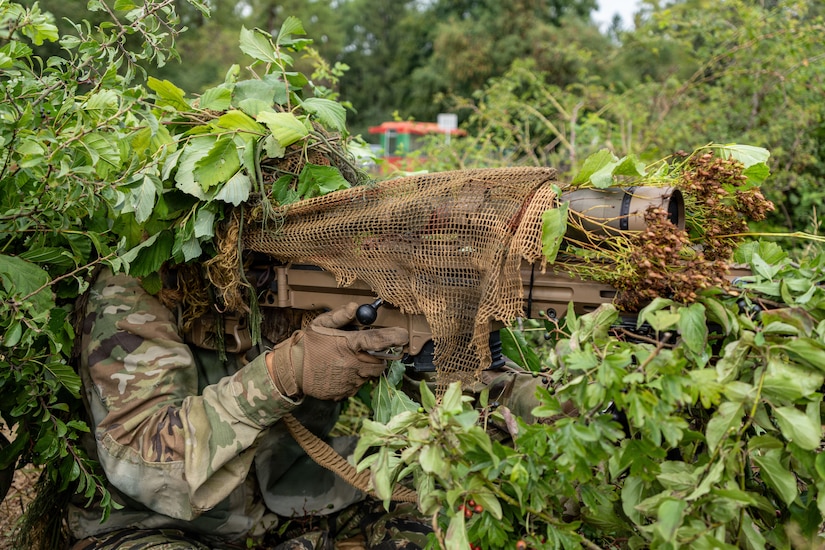
Two people wearing military combat gear walk through a forest.

Overseen by U.S. Army Southern European Task Force, Africa, the rotation is designed to validate warfighting readiness, strengthen NATO interoperability and prepare forces for large-scale combat operations across the European theater. 

Exercise Saber Junction 26 tests the brigade's ability to rapidly deploy, conduct joint forcible entry, execute offensive and defensive operations, and regenerate combat power in a contested environment. The exercise incorporates lessons learned from ongoing conflicts, including electronic warfare, unmanned aerial systems, dispersed maneuver and contested communications.  

Southern European Task Force, Africa serves as the division-level higher command for the rotation, integrating U.S. and allied formations, issuing division orders, maintaining the common operating picture, and rehearsing mission command essential for operations across Europe and Africa. 

"Saber Junction is where our soldiers and our allies prove they are ready for the demands of modern war," said Army Maj. Gen. Matthew W. Brown, Southern European Task Force, Africa commander. "This rotation is a crucible event — designed to expose gaps, accelerate learning and ensure that formations are trained and lethal. The 173rd continues to demonstrate that disciplined application of the fundamentals, ground-up innovation and persistence remain the hallmarks of a combat-credible force. The brigade is ready — and the lessons we gather here help our Army scale innovation at pace and strengthen NATO's collective readiness."

The exercise also highlights modernization efforts within the 173rd Airborne Brigade, including the work of the bayonet innovation team, the brigade's internal innovation cell comprised of paratroopers, engineers, warrant officers and technical specialists. The team designs, builds and fields low-cost, high-impact technologies such as first-person view drones, intelligence, surveillance and reconnaissance platforms, ground robots and artificial intelligence-enabled tools. It operates a facility that can produce drones in-house and integrates lessons from Ukraine, Joint Multinational Readiness Center rotations and multinational exercises to help the brigade adapt rapidly and strengthen NATO interoperability.

"Our standards are nonnegotiable: disciplined, lethal and relentless. Saber Junction is where we put those expectations to the test," said Army Col. Mark E. Bush, 173rd Airborne Brigade commander. "This exercise validates our ability to deploy at the time of need, fight and succeed regardless of the mission environment or enemy capability and posture the brigade for future operations. Through the character, competence and commitment of our Sky Soldiers, we will deliver overwhelming firepower, maneuver aggressively and accomplish the mission alongside our allies." 

Exercise Saber Junction 26 includes participants from Belgium, Bosnia and Herzegovina, Czech Republic, Germany, Hungary, Italy, Kosovo, Lithuania, Poland, Ukraine, and the United States. The exercise strengthens multinational interoperability and accelerates combined decision making across the European theater.

Friday, August 14, 2026

Centcom Launches First-Ever Multinational Attack Drone Task Force

U.S. Central Command announced efforts to establish the first multidomain, multinational attack drone task force yesterday.

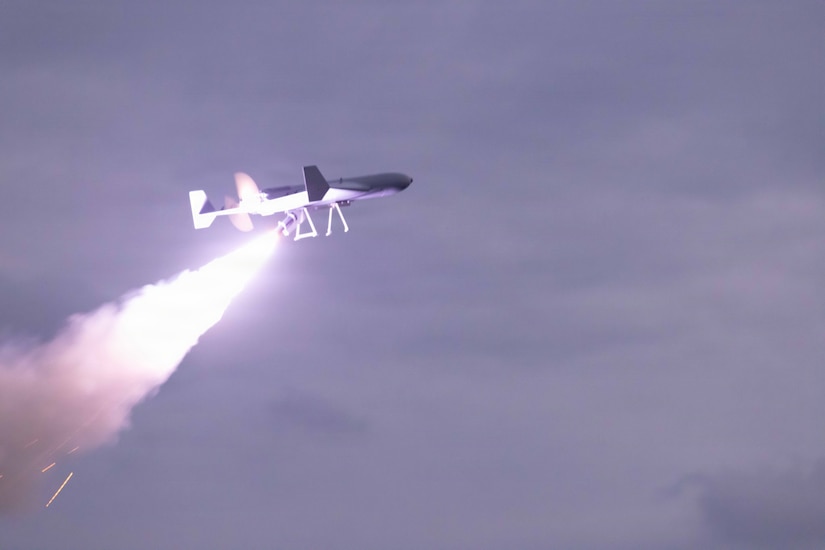
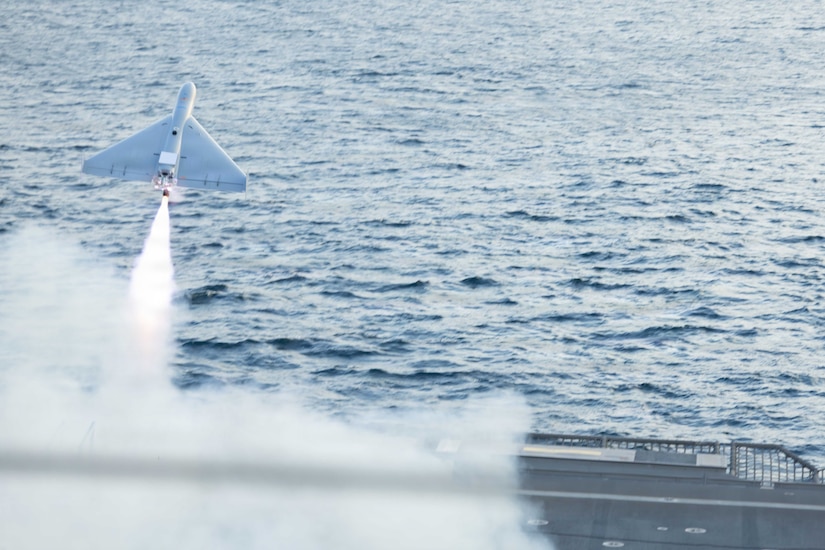
A drone takes off from the deck of a ship at sea.

The unit, called Task Force Falcon Strike, will employ one-way attack drones consisting of unmanned systems from above, on and below the sea, operated by military support staff from the United States and regional partners.

Falcon Strike's launch occurs nine months after Centcom established Task Force Scorpion Strike, the U.S. military's first dedicated one-way attack drone squadron in the Middle East.

Scorpion Strike rapidly achieved key operational milestones, including the first launch of an aerial attack drone from a Navy warship last December. The squadron also employed one-way unmanned aerial systems during Operation Epic Fury and during strikes on Iranian port facilities in July using unmanned attack vessels at sea.

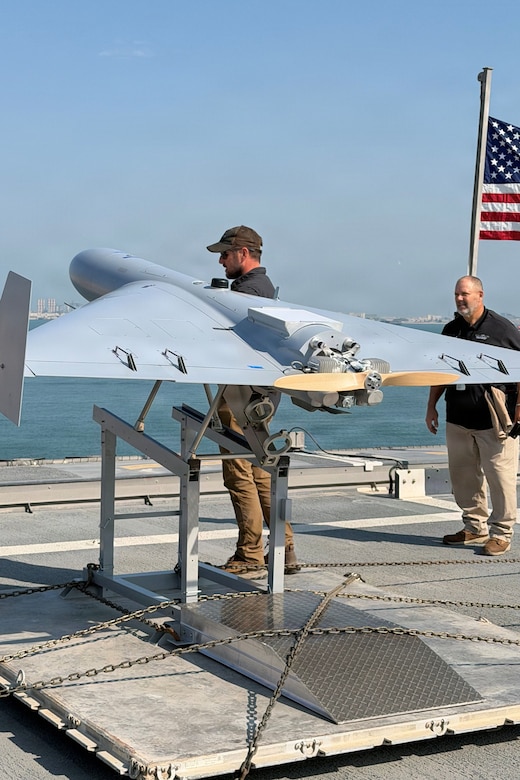
A man wearing casual attire, a baseball cap and sunglasses works on a drone as another man in similar attire looks on. They are both standing on the deck of a ship at sea.

"Task Force Falcon Strike will expand on Scorpion Strike's success given the tremendous innovation happening among our regional allies and partners," said Navy Adm. Brad Cooper, Centcom commander. "Integrating and deploying our new capabilities together will help us rapidly realize the new possibilities that are on the horizon."

Centcom has initiated consultations with official invitations to regional partners. As regional partners formally join, Task Force Falcon Strike will scale attack drone capabilities across the Middle East into a unified multidomain, multinational deterrent.

"The United States military has a lot of strong partnerships and friends in the region," Cooper said. "We are collectively stronger when we integrate and deploy new capabilities together."

Personnel from U.S. Special Operations Command Central, which launched Scorpion Strike, will lead Falcon Strike's staff of U.S. and regional representatives.

A drone takes off from the deck of a ship at sea.

Thursday, June 18, 2026

Drone Dominance Program Receives First Order, Gauntlet II Gets Underway

Drone Dominance Program Gauntlet Phase II qualifiers conclude this week at Camp Grayling, Michigan. This high-stakes test pits 49 companies and 79 unique unmanned aerial systems against rigorous mission scenarios, including long-range strikes and close-quarters tactical assaults. Each company brought 20 drones to take on the challenge. 

The qualifier event is a critical test for a battlefield that is evolving at an unprecedented pace and showcased how the War Department is answering the call with radical innovation. 

The Drone Dominance Program is a $1.1 billion, two-year effort to execute President Donald J. Trump's Executive Order 14307, which articulated the urgent need for the department to procure, integrate and train with low-cost, high-performing drones manufactured in the U.S.  

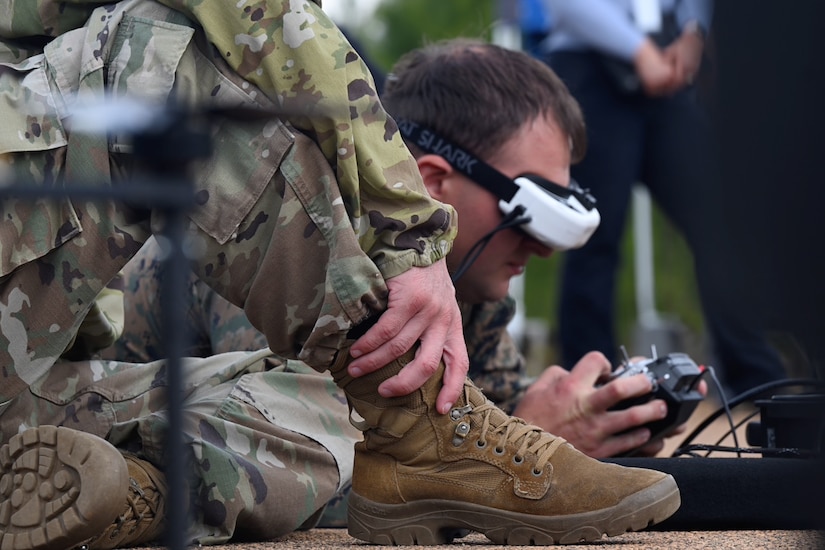
A man lies on his stomach while wearing a headset and holding a remote control. People in similar attire sit next to him.

The goal of the program is to rapidly arm combat units with a massive, scalable fleet of low-cost, expendable one-way attack drones. The effort is also expected to increase the flow of private capital into the U.S. industrial base, while simultaneously driving down costs. 

Sponsored by the Office of the Secretary of War and jointly administered by the Defense Innovation Unit and Test Resource Management Center, the Drone Dominance Program is at the forefront of the department's pivot to a challenge-based acquisition approach. It also means shifting from slow, multiyear cycles to agile, six-month sprints.   

The program is putting technology to the test in a series of four gauntlet phases — demanding, realistic challenges designed to identify the most resilient and effective drone platforms.  

At the conclusion of each phase, selected drone technologies are fast-tracked for large-scale production, ensuring warfighters are equipped with a decisive advantage on the modern battlefield. 

"This is an urgent matter," said Owen West, DIU director. "Our adversaries are scaling their UAS technology, tactics and industries at an alarming rate. Following Secretary of War [Pete] Hegseth's orders, we are acting decisively to develop new defensive and offensive capabilities to match these threats." 

West noted that the department is already seeing results.  

The first batch of drones was accepted, with nearly 2,000 additional units shipped to the services and thousands more ramping up for fulfillment.  

Following a highly successful Phase I, which saw the purchase of 30,000 drones, the department is gearing up for the next major milestone. 

"As directed by President Trump and Secretary Hegseth, we have begun to equip our warfighters with the best drones in the world," said Travis Metz, DIU deputy director. "We have ordered 30,000, which are being delivered now and will be ordering 60,000 more in September, all based on competitive events and moving supply chains to the United States as we progress." 

By fostering fierce commercial competition via a public leaderboard, the department aims to scale production from 30,000 to 150,000 units per phase, ultimately dropping the target unit cost from $5,000 to approximately $3,000. By 2027, the Drone Dominance Program intends to field more than 200,000 lethal, artificial intelligence-enabled drones, ensuring the U.S. military executes a technological leapfrog to secure an enduring edge over our adversaries. 

Gauntlet II will kick off later this summer, during which entrants must bring 120 drones as the competition expands into night operations and more complex urban and confined environments.

Friday, March 13, 2026

Soldiers Assist Air Force Squadron With Drone Warfare Training

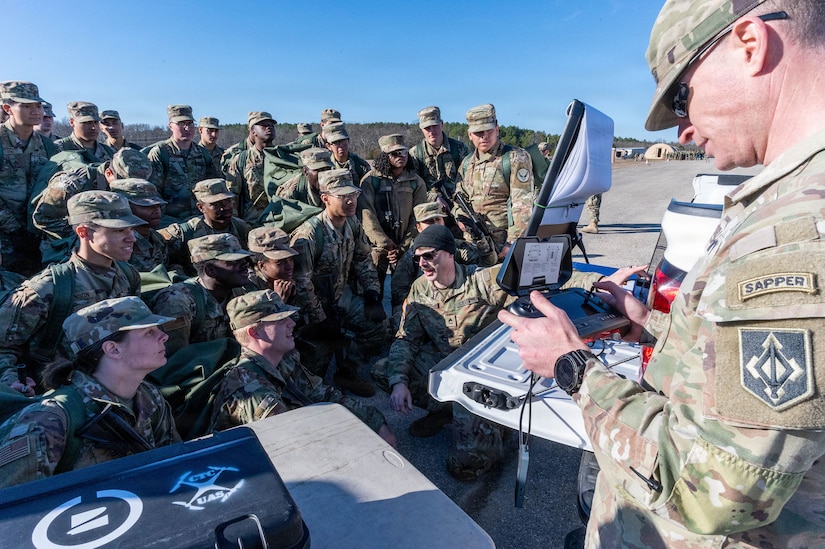
More than 200 airmen training with the Air Force's 368th Training Squadron spent Feb. 27 at Fort Leonard Wood, Missouri, learning about unmanned aerial systems during an exercise designed to cultivate Air Force airmindedness and the warrior ethos. 
 
The training squadron, based at Fort Leonard Wood, provides initial skills and advanced level training in the areas of ground transportation, engineering, emergency management and pavements and construction equipment. 

A man in a camouflage military uniform uses a remote control to pilot a drone while another man in similar attire crouches as he speaks to a group of people in camouflage military uniforms gathered outside.

 
According to Air Force Tech. Sgt. Christopher Moss, a specialty code instructor assigned to the training squadron, airmen at various specialty schools on base usually train separately, but this day was unique because it brought them all together. 
 
"It allows them to integrate with our other schoolhouses, bringing them together as one force instead of each person learning just their craft," Moss said. "Producing more well-rounded airmen for the force." 
 
Air Force Capt. Nathan Elking, 368th Training Squadron director of operations, said the unique training event is called Bracer Forge and is an operational readiness exercise. 
 
"It is a continuation of the training airmen receive at basic training," Elking said. "Both exercise initiatives are designed to instill airmindedness and warrior ethos in our airmen." 
 
The squadron's exercise topics vary, but the current unmanned aerial system focus was driven by the unit's specialty codes, which according to Elking play a key role in airfield damage assessment and rapid airfield damage recovery. 
 
"Before each iteration of Bracer Forge, we provide the participating airmen with an operation order for the day and reporting instructions with a training scenario to recover a damaged airfield," he said. 
 
Squadron instructors prepared four stations for the airmen to rotate through. 

A man in a camouflage military uniform speaks to a group of people in similar attire holding rifles while they stand in a tent.

 
At the airfield damage assessment challenge, Elking said teams conducted an assessment on a simulated airfield and relayed the information to their teammates in an emergency operations center. 
 
"The airmen in the EOC were tasked with creating a map of the airfield using the details their counterparts called in over the radio," he said. 
 
While at the UAS reporting challenge, teams established defensive fighting positions and reported UAS activity to their teammates in the EOC by consolidating the information into a report to send up. 

The other two stations were a high intensity physical fitness event and a UAS capabilities overview. Soldiers assigned to the Maneuver Support Center of Excellence Combat Training Company gave the UAS portion of the training. 
 
"We are not subject matter experts on counter-UAS and UAS employment. Being able to leverage our Army partners at [center of excellence] played a significant role in the exercise's success," Elking said. 
 
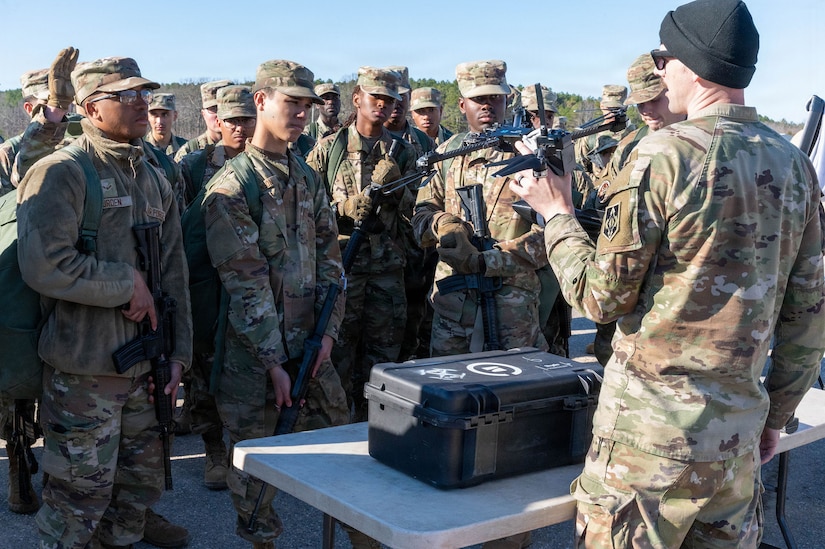
According to Army Sgt. 1st Class Austin Priebe, Combat Training Company UAS chief, his mission was to introduce small UAS threats, and teach the basics of identifying, reacting to and reporting small UAS threats. 

A man in a camouflage military uniform holds a drone while speaking to a group of people in similar attire gathered outside. In front of the man is a black case sitting on a table.

 
Priebe said most trainees he instructs have watched or controlled a simulated UAS in video games, but being able to experience a UAS in person, see and hear a drone up close, is "essential to prepare service members for what they will see in current and future conflicts." 
 
"We conducted practical exercises on scanning for [small] UAS, completing a report and showed the airmen what they look like from an elevated viewpoint," Priebe said. 
 
This was the training company's first time facilitating interservice UAS training. 
 
"I've largely been focused on enabling training and instruction to the Army units here on Fort Leonard Wood since the inception of our UAS program this past fall," Priebe said. 
 
As the battlefield changes rapidly, so does our training requirements. If our organization can provide more realistic and in-depth training to our brothers and sisters in other branches, we only stand to benefit as a military." 

Priebe said his team is looking forward to conducting more interservice training events in the future. 
 
At the end of the day, the exercise was a catalyst for innovation, Elking said. 
 
"By exposing airmen to the dual nature of UASs — both as a threat to counter and a tool to master — we challenge them to rethink their mission sets and pioneer new solutions for the modern battlefield," he said.