Thursday, November 27, 2025

Defense Logistics Agency Team Continues Thanksgiving Support for Service Members Around the World

Wherever America's troops are serving around the globe, they will experience the taste and smells of home this Thanksgiving holiday, thanks to the Defense Logistics Agency's Troop Support Subsistence team.
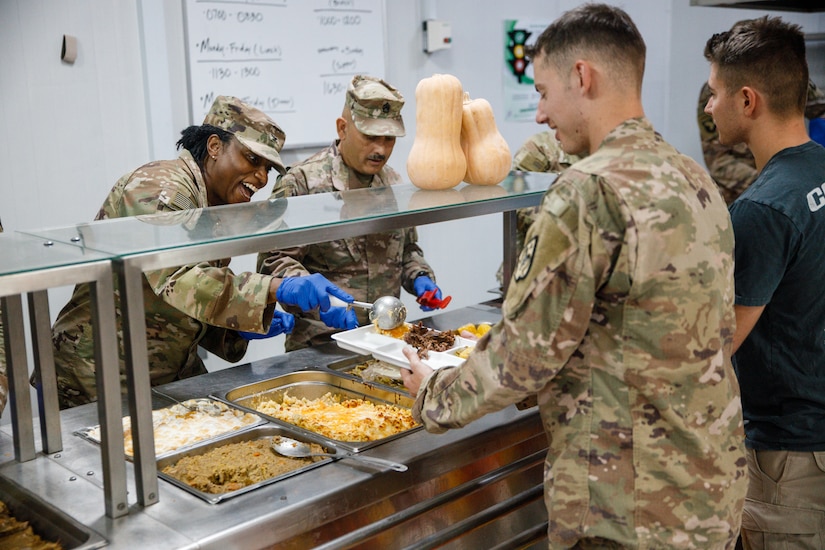
Service members in camouflage military uniforms serve food to other service members in similar attire that are standing in a cafeteria buffet line.

One of the largest annual efforts for the supply chain, the team ensured more than 380,000 pounds of traditional Thanksgiving food and other treats were delivered for the 2025 holiday. 

"It is the most significant event that has the greatest influence on the morale of the warfighter and their families," said Robin Whaley, DLA's chief of subsistence for customers outside the continental U.S. 

Careful planning, coordination with multiple parties and attention to detail all go into making sure items arrive in time for the holiday, Whaley added. 

Varying troop strength around the globe each year adds to the importance of being precise in the ordering process. 

"Holiday requirements are like fingerprints in that no two are alike," said John Sheehan, TSS director of customer operations. "The ebb and flow of one holiday item to the next is based on the fluid troop requirements and preferences from year to year." 

For the team, there is always a sense of pride in completing this mission. 

"There is excitement in knowing we are giving the warfighters a representation of their home and knowing the work we do helps them feel more connected to their families and communities," said Army Master Sgt. Jose Montero, TSS noncommissioned officer in charge. "I feel extremely proud knowing an extremely talented, committed team ... worked diligently to ensure every warfighter has a hot meal for Thanksgiving."
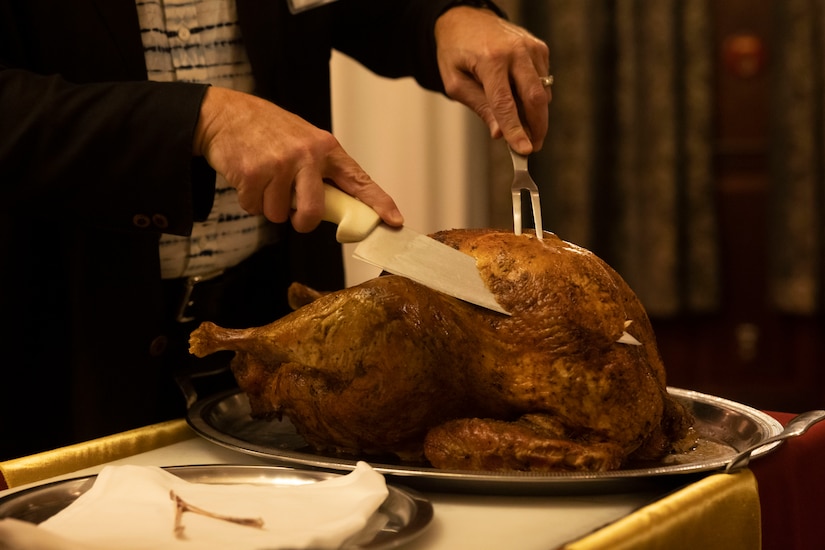
A person is carving a baked turkey with a large knife.

For Army Chief Warrant Officer 4 Shemika Harris, a TSS military food advisor, this was her first experience being on the planning side of ensuring holiday meals for the warfighter. 

"I'm absolutely impressed by the effort and genuine concern that the Defense Logistics Agency Troop Support Subsistence team puts into this mission," Harris said. "They approach each holiday with a sense of pride and purpose knowing that these meals mean far more than just food." 

This Thanksgiving holiday, military dining facilities can expect to receive:  

  • 152,626 pounds of turkey; 
  • 124,022 pounds of beef;  
  • 66,054 pounds of ham;  
  • 38,081 pounds of shrimp;  
  • 6,512 cans of sweet potatoes;  
  • 15,282 cases of pies, cakes;  
  • 792 cases of eggnog;  
  • and other holiday treats.

DLA Troop Support annually supplies America's armed forces with more than $25 billion worth of food, uniforms, protective equipment, medicine and medical supplies, and construction and equipment items. 

Projecting Power From the Tower

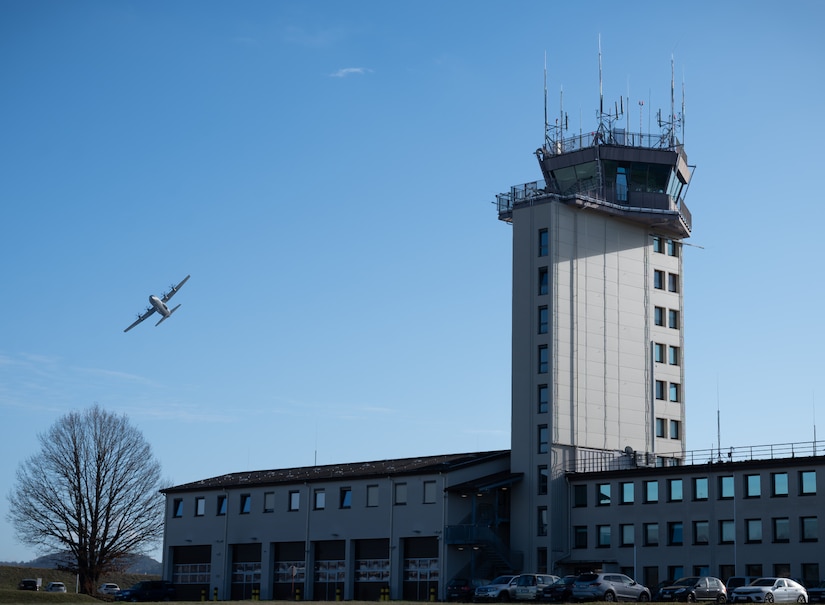
From the top of Ramstein Air Base's air traffic control tower, the view of the local German countryside stretches for miles. From that vantage point, 86th Operations Support Squadron air traffic controllers navigate the arrival and departure of every aircraft within the airspace.

A military cargo aircraft flies by an air traffic control tower. There are cars parked outside of the building.

 
In a small room on top of the control tower, a team of airmen works 24/7 to sequence aircraft and coordinate with host-nation partners to ensure safe, uninterrupted flight operations. 
 
"Our job never stops," said Air Force Staff Sgt. Lana Fischer, 86th OSS air traffic control watch supervisor. "We work nights, weekends and holidays."

"We never let our guard down," she continued. "One mistake on our end could have a dire impact, so we run checklists and briefs constantly. Our No. 1 rule is to ensure safe airfield operations." 
 
The tower provides air traffic services for the base's surrounding area from the surface to 3,600 feet using both visual and radar feeds. They do all of this while simultaneously meeting every standard required to fly within the local airspace.
 
Daily operations inside the tower require tight teamwork.

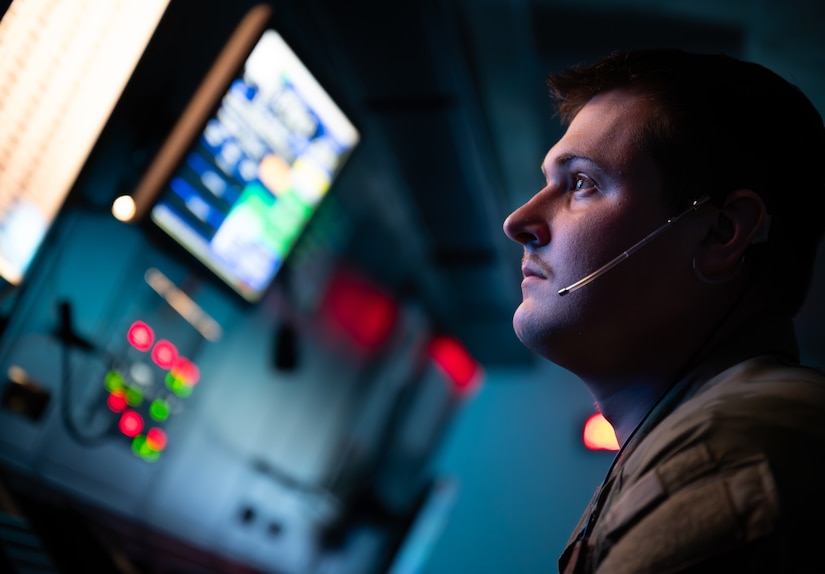
A man's face is illuminated as he stares at a screen while seated in a dark room.

 
"It's a very close-knit environment," said Air Force Master Sgt. Paige Smith, 86th OSS air traffic control chief controller. "You're working in a small space together every day, so the team becomes like family. I was stationed here 10 years ago, and it still feels the same. I love coming to work with these people." 
 
To Smith, the job is like solving a puzzle. Sequencing aircraft with different performance characteristics requires constant recalculation in real time. 
 
"You see a potential conflict out the window and you start working through the solution in your head," Smith said. "Which aircraft needs spacing? Who needs priority? You see your plan play out in front of you and that's the part I love."
 
Ramstein Air Base's air traffic controllers play a vital role in missions far beyond Germany. From aeromedical evacuation movements to distinguished visitor support, many of the Air Force's nationally visible operations begin or end under a tower's control. 
 
"We're called the Global Gateway for a reason," Smith said. "A lot of what happens downrange starts here. We may not always know the details, but we know we're a piece of it by keeping the airfield open and safe."

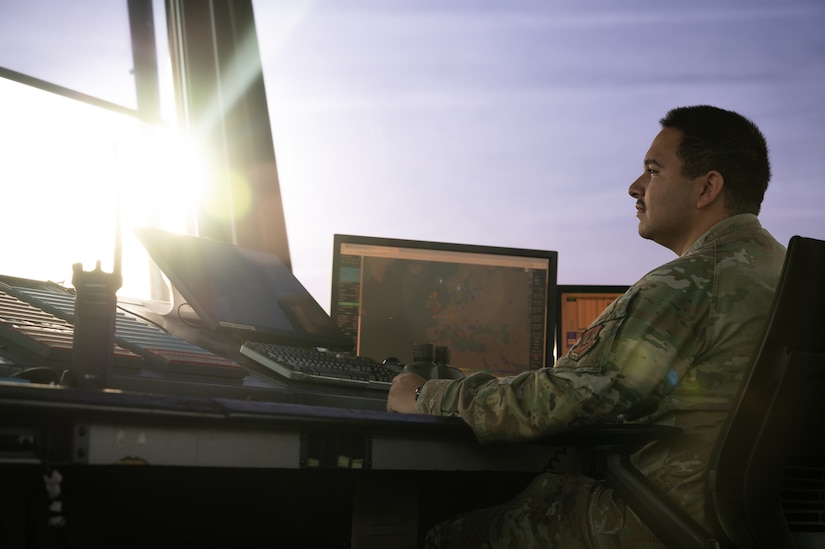
A man in a military camouflage uniform sits at a desk while he looks out the surrounding windows. Bright light from the sun pierces through the front window.

 
Every arrival and departure goes through multiple units before entering or leaving the base. 
 
The ground controlled approach facility controls a wider proximity of airspace around the installation that the airmen in the tower cannot see. The GCA radar team sequences aircraft until they are roughly 5 miles outside the range of the flight line before they transition them to the tower, who takes control of the final approach and landing.
 
Departure works in reverse; the tower works the aircraft from its parking spot through takeoff and up to 5 miles away before handing it off to the GCA for further support. 
 
"They work the larger host nation controlled airspace," Smith said. "If GCA is closed, then we work directly with our host-nation partners at Langen, Germany, but most of the time we hand aircraft back and forth with GCA. It's one mission, just different pieces of the airspace." 
 
Air Force air traffic controllers are increasingly becoming dual-rated, meaning they gain experience in both tower and radar operations. Ramstein Air Base supports that initiative by rotating qualified airmen between the tower and GCA duties.

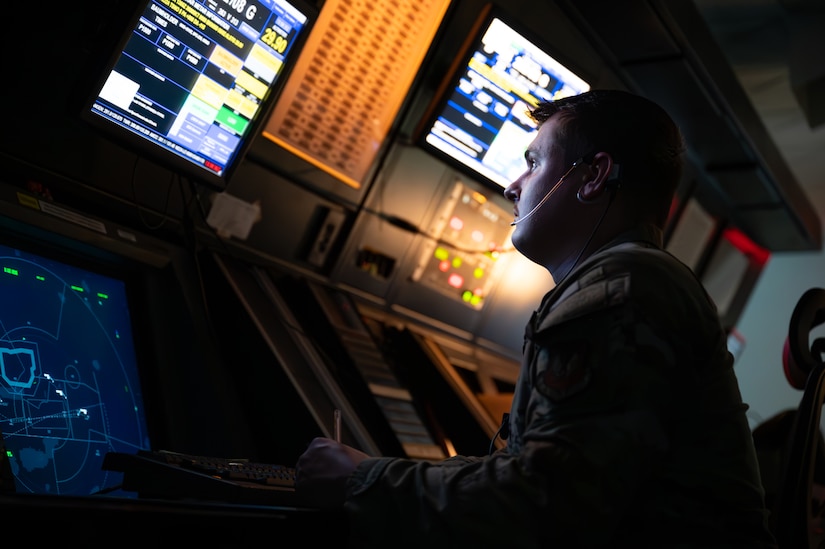
A man's face is illuminated as he stares at a screen while seated in a dark room.

 
"We want people to have breadth in the career field," Smith said. "It makes you a more agile controller. Our [training] school teaches the foundation for both operations, but you get certified while performing on-the-job duties at your first base." 
 
The responsibility of controlling airfield operations requires diligent focus, discipline and continuous support from every controller.