Showing posts with label D.C. National Guard. Show all posts

Thursday, August 27, 2026

The Capital's Defenders: Two Centuries After Historic Battle, Citizen-Soldiers are Recognized

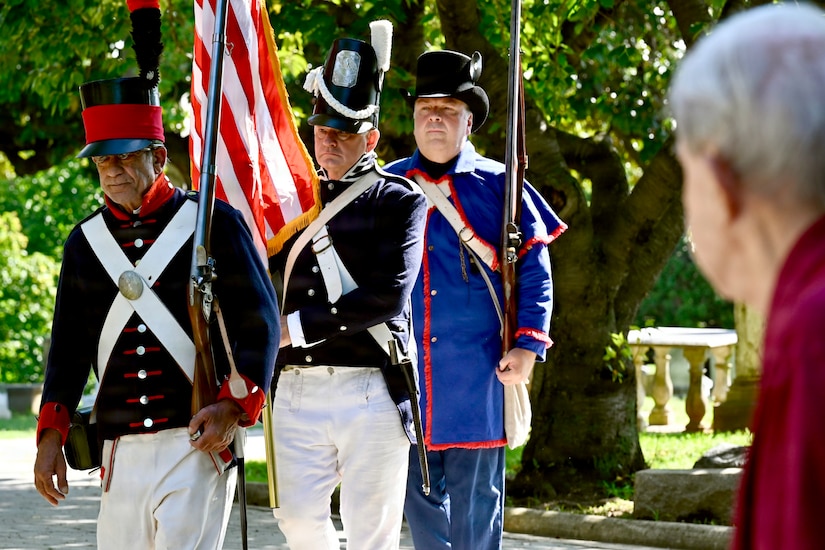
Three men dress in historical military uniforms stand in a line; the man in the middle is holding the American flag while the other two men are holding muskets.

As America celebrates 250 years of independence, the District of Columbia National Guard, citizens and other government staff gathered at the Congressional Cemetery in Washington, Aug. 23, to look back 212 years — to a moment when ordinary citizens answered an extraordinary call and stood in defense of the young nation's capital during the Battle of Bladensburg.

The wreath-laying ceremony connected America's Freedom 250 commemoration with the citizen-soldier tradition that helped defend the nation in its earliest years and continues today with the National Guard. Held among the gravesites of those who lived that history, the ceremony honored their courage while examining the lessons their service left for future generations.

"Whether you're describing acts of bravery or military chaos, the story [of that battle] cannot be told without recognizing the role of the citizen-soldier," said Mark Hudson, executive director of the cemetery. "The local militia joined the desperate fight to defend our young nation."

Historian Glenn Williams placed their service within the broader Chesapeake campaign during the War of 1812. With much of the nation's military strength committed elsewhere, he said the Washington area was defenseless except for the citizen-soldiers of the militia as British forces advanced toward the capital.

Williams described how American riflemen initially engaged and counterattacked the British advance before reinforcements shifted the balance. Outnumbered three to one and eventually outflanked, the American defense collapsed, clearing the way for British forces to enter Washington and burn several prominent public buildings.

Army Brig. Gen. Leland D. Blanchard II, interim commanding general of the D.C. National Guard, said approximately 1,000 D.C. militia members assembled to defend the capital in 1814.

"They were ordinary Americans who answered an extraordinary call," he said. "They stood in defense of a young capital, a young government and an independence won only a generation earlier."

For Blanchard, remembering the battle also means confronting the lessons that came from defeat. The militia members who assembled in 1814 possessed courage and commitment, but courage alone could not overcome their shortcomings in preparation, organization and coordination.

"Bladensburg reminds us that courage is essential, but courage must be matched by readiness," Blanchard said. "Training matters. Leadership matters. Command and control matter. And the relationships we build before a crisis matter when that crisis arrives."

Reflections on the D.C. Militia Legacy

Those lessons, he said, remain relevant more than two centuries later as the National Guard confronts an increasingly complex mission set spanning domestic response, homeland defense and support to global operations.

"Readiness is not something we begin building when the emergency starts," Blanchard said. "It is built every day — through training, preparation and trust between the people and organizations who may one day be called to respond together."

While the Battle of Bladensburg ended in defeat, Blanchard emphasized that its enduring value lies in what America carried forward from the experience.

"Winning independence and preserving independence are not the same thing," he said. "One required a generation to establish a nation. The other requires every generation to remain prepared to defend it."

That responsibility, he said, has always depended on more than one organization or institution.

A.J. Orlikoff, cemetery director of programming, brought the commemoration from military history to personal remembrance. Through research, Orlikoff has positively identified 26 D.C. militia veterans of the Chesapeake campaign buried at the Congressional Cemetery, while noting many more may remain unidentified.

"These defenders of the capital came from all walks of life — clerks, craftsmen, public officials, businessmen — all stepped up to defend the city," he said, before reading aloud the names of all 26 identified militiamen, restoring individual identities to men whose graves, in some cases, are unmarked.

"By reading their names and visiting their graves, we are doing much more than simply remembering a battle," Orlikoff said. "We're restoring their identity as people; we're restoring the memory of their service."

Following the remarks, Hudson and Blanchard laid a wreath at the grave of one of the fallen militiamen. A color guard then rendered a ceremonial volley in honor of those who defended the capital.

For Blanchard, the connection between 1814 and 2026 remains clear. The uniforms, technology, missions and threats have changed, but the responsibility to remain ready— and the citizen-soldier and airmen tradition behind it — endures.

"The citizen-soldier is not simply part of our history," Blanchard said. "It is a living tradition. Today, ordinary men and women continue to step away from their families, their careers and their communities when the nation calls."

That continuity carries particular meaning in Washington, where today's D.C. National Guard traces its heritage to the militia tradition that helped defend the capital more than two centuries ago.

Tuesday, March 10, 2026

260th Special Purpose Brigade Activated to Strengthen Security in the Nation's Capital

The District of Columbia National Guard activated the 260th Special Purpose Brigade at the D.C. Armory, March 7. It is the only brigade in the Army specifically designed to coordinate military support to civil authorities and protect critical infrastructure in the nation's capital.

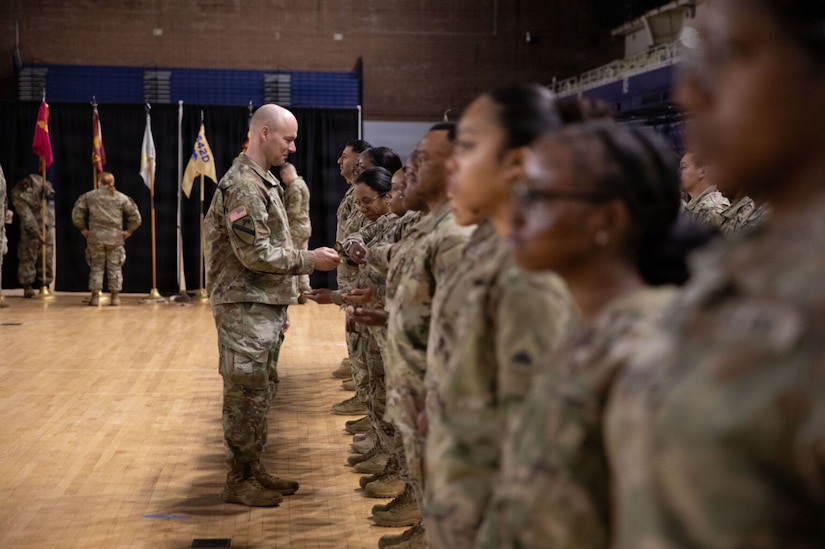
A group of people dressed in camouflage military uniforms stand at attention as a man also dressed in similar attire hands them a coin.

The brigade was created in response to Executive Order 14339 and a subsequent directive from the secretary of war. These called for the immediate establishment, training and equipping of a dedicated National Guard unit. The goal is to support public safety operations and strengthen coordination between military forces and civilian security partners in the district.  

Army Brig. Gen. Craig Maceri, land component commander for the D.C. National Guard, presided over the activation ceremony. Soldiers stood in formation as the brigade's colors were uncased — a military tradition that signals a unit's formal activation and readiness for duty.  

"The activation of the 260th Special Purpose Brigade represents the deliberate execution of national guidance," Maceri said. "This unit provides the critical command and control structure that enables us to execute a broad spectrum of scalable operations while effectively integrating with our federal and district partners."  

The brigade will coordinate military support to civil authorities and enabling National Guard forces to rapidly integrate with federal and local agencies responsible for safeguarding the capital.

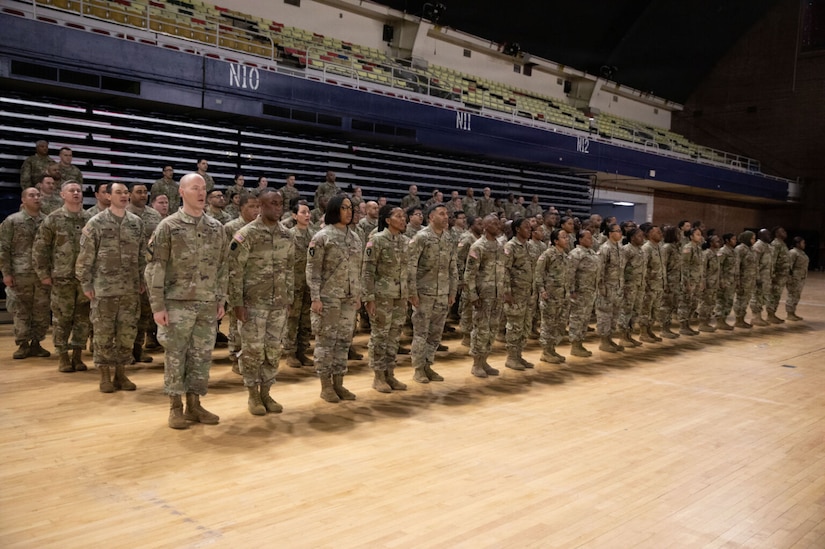
A group of people dressed in camouflage military uniforms stand in formation.

Washington presents a unique operational environment, including the constitutional institutions of the federal government, foreign embassies and national monuments, as well as millions of visitors each year. Protecting that environment requires close coordination between military forces and civilian agencies during major national events, security operations and emergencies.  

Among the brigade's key partners is the U.S. Marshals Service, which regularly works alongside the D.C. National Guard during security operations in the capital.  

"Partnerships like this are essential in Washington," U.S. Marshal Jurgen Soekhoe said. "The 260th Special Purpose Brigade brings a level of coordination and readiness that allows federal law enforcement and the National Guard to operate as a unified team when security demands it."  

Army Col. Lawrence Doane, commander of the 260th Special Purpose Brigade, said the brigade structure ensures continuous coordination with partner agencies. It also allows the brigade to expand rapidly when missions require additional forces.

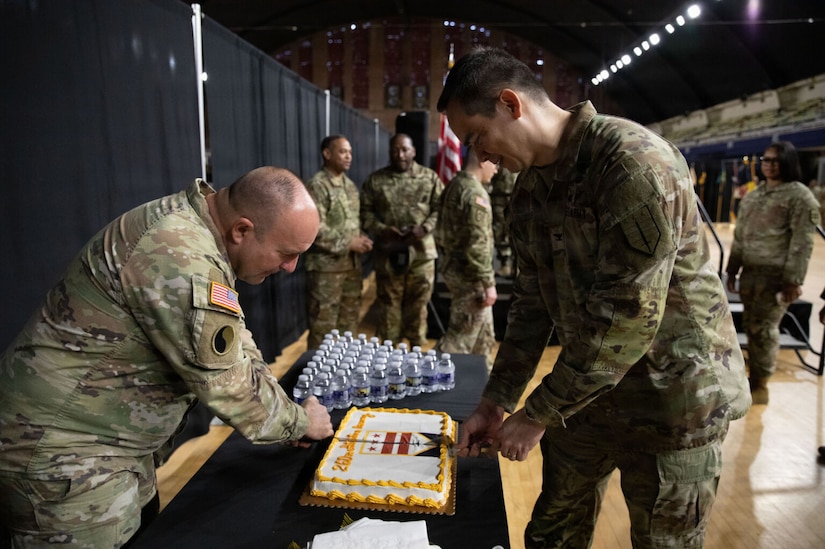
A man dressed in a camouflage military uniform cuts a cake as another man in similar attire looks on.

"This brigade gives us an operational foundation for unity of effort," Doane said. "It ensures continuity of planning and coordination so that when the situation changes, we can respond quickly and with clarity."  

The brigade also reflects the unique federal role of the D.C. National Guard, which reports directly to the president, not a state or territory governor. This structure places the organization at the center of national-level security planning for the capital.  

The unit's new patch connects the brigade's modern mission with its historic lineage. The design features three red stars and two red bars drawn from the District of Columbia flag, itself derived from the coat of arms of George Washington's family.  

The brigade carries forward the heritage of the 260th Military Police Command, a D.C. National Guard headquarters brigade that, for decades, coordinated military police operations supporting civil authorities and emergency response across the district, until its inactivation in 2011. Its lineage reflects a long-standing mission of integrating National Guard forces with federal and local partners to protect critical institutions and maintain security in the nation's capital.

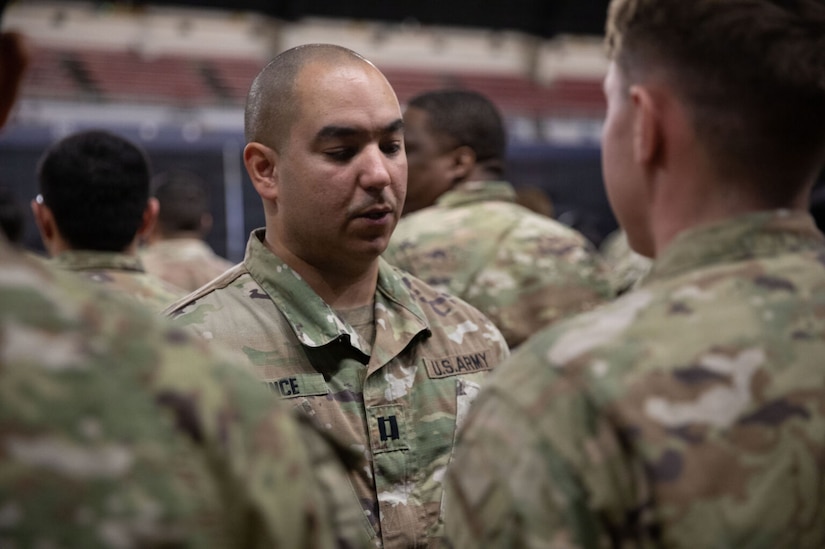
A man wearing a military camouflage uniform, stands while looking down. Other men in the foreground stand at attention.

At the patch's center is an upright, unsheathed sword representing the brigade's role in providing security for all who live, work and visit the nation's capital.  

"This new patch reflects something bigger," Doane said. "It represents our commitment to protecting every person who sets foot in the nation's capital."  

With the uncasing of its colors, the 260th Special Purpose Brigade begins its mission as a dedicated force. It will support public safety, infrastructure protection and coordination between civilian and military agencies in Washington.  

Tuesday, September 09, 2025

JTF-DC Medic Doubles as Third-Year Medical Student so Others May Live

 Sept. 9, 2025 | By Army Master Sgt. Whitney Hughes, National Guard Bureau

Not many people can say their interest in one of the body's most complicated organs began with a water pump. 
 
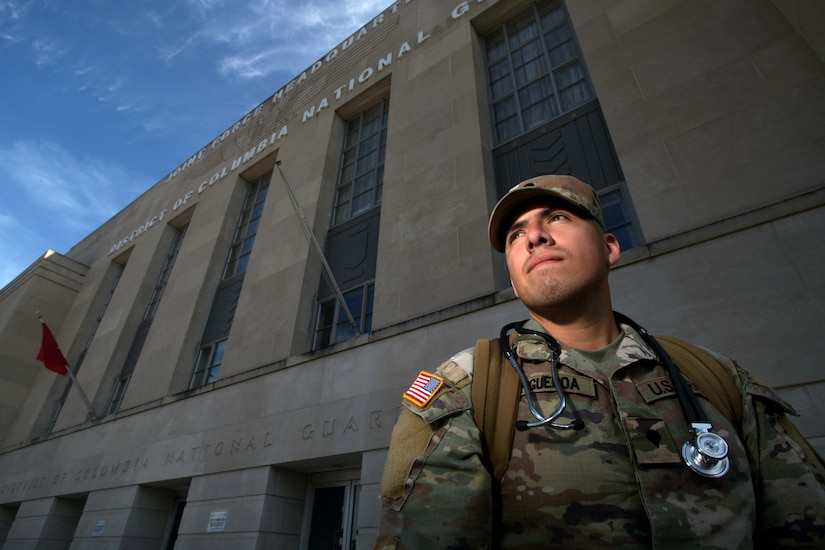
However, for Army Spc. Elias Figueroa, a combat medic assigned to the D.C. Army National Guard and third-year medical student, his interest in medicine began with helping his father install a water pump. His inherent understanding of the pump system and the similarities he drew to the human cardiovascular system are what drew him to the field. 

A person wearing a camouflage military uniform stands outside in front of a building and gazes up into the distance.

 
"Just understanding the pump systems, the math made sense and the picture made sense in my head," said Figueroa, adding that it converted so well in his first two years of medical studies that he was tutoring other students. 
 
This same curiosity and hands-on approach drove him to join the Army National Guard as a combat medic and led to his current assignment with the D.C. Safe and Beautiful Task Force, Joint Task Force District of Columbia. He initially joined the National Guard in 2020 and qualified as a combat medic upon graduating from an intense 16-week course focused on emergency medical technician, emergency medical services and tactical combat casualty care training. 
 
Since being on duty with the task force, his duties have included treating fellow soldiers and responding to several incidents involving civilians. 
 
His squad leader, Army Sgt. Jay Whited, said Figueroa's experience and skill set have been invaluable in many of the situations they have encountered. 
 
"He's treated at least half a dozen civilians at Union Station since the mission started," Whited said. "We are very lucky to have such a well-trained medic. He's right there, and he's pretty close to being a doctor, so that makes us feel good. It's good for him. It's an actual medical emergency in public that he can get his hands on and do something about." 
 
While assigned to the task force, Figueroa has provided hands-on treatment or assessments for everything from a heat casualty to a narcotic overdose. He said experience like that gives him an advantage going into his third year of medical school, where studies move from the classroom to practical application with patients. 
 
"A lot of us [medical students] kind of fumble to the point to where some people repeat a semester because they just can't do the clinical part," Figueroa said. "So, I've been able to kind of hone my abilities a little bit. I'm a little more confident. I was like, 'Oh, I can do that. I can take vitals without even hesitating. I can go through an assessment.'" 
 
Despite the added confidence, he doesn't take the gravity of his position lightly. 
 
"It's a responsibility," Figueroa said. "You can't freak out. You have to keep a level head and relax. For all those events, when someone yells 'Medic!' I'm calm as heck, I don't overreact." 
 
He said he often reminds himself to begin with the basics to stay calm as he assesses and reassures the patient. 
 
"And that's kind of the first thing that comes to mind is just relax and do the job," Figueroa said. 
 
For the 28-year-old, medicine goes beyond a job to a spiritual and moral code. When he "found Christianity and God" during college, Figueroa asked himself what his strengths were and how he could use them to serve others. That also tied in with a duty he felt as a naturalized citizen to serve his country. 
 
His family emigrated from Peru, and he and his parents became American citizens in 2011. 
 
"My dad got citizenship that January, and I got it through him, because I was still a minor," Figueroa said. "I always felt I didn't really earn it. My dad took the test. My dad did all this work. So, part of me was like, I want to actually earn this." 
 
His family started off in an apartment, and now they own three properties — one of which is the house where he helped install the water pump that inspired his interest in cardiology, he noted. 
 
"This country gave us a lot, it's kind of like the American dream showed itself," Figueroa said, who will conclude his time with the D.C. task force in two weeks to return to his role as a full-time medical student.