Tuesday, February 24, 2026

Justified Accord 2026 Begins in Kenya, Tanzania

Exercise Justified Accord 2026 the U.S. Africa Command's largest annual, multinational exercise in East Africa, officially began yesterday across Djibouti, Kenya and Tanzania.
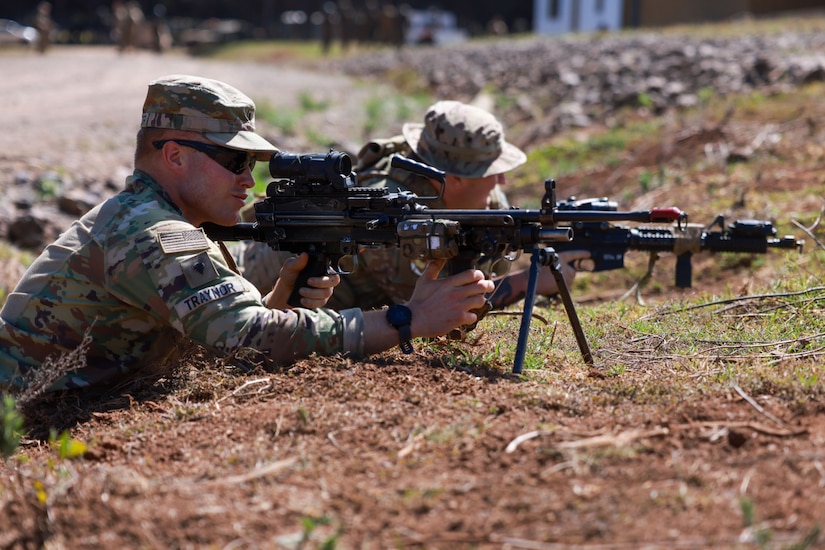
Two men wearing camouflage military uniforms point weapons at something outside of the photo frame while lying on the ground in the prone position.

Led by U.S. Army Southern European Task Force, Africa, JA26 integrates approximately 1,500 personnel from Djibouti, Kenya, Tanzania, the United States and several other nations to build readiness, deepen partnerships and strengthen regional security. 

The exercise, that continues through March 13, is designed to strengthen cooperation and advance regional security by enabling partner-led security operations against shared counterterrorism threats. It serves as a premier innovation hub in East Africa to validate new technologies in austere environments.  

"The true strength of Justified Accord lies in our partners taking the lead," said Army Lt. Col. Jason Fernandez, the Justified Accord branch chief assigned to SETAF-AF. "This exercise embodies the principle of burden sharing, creating a powerful, partner-led security network capable of shouldering the responsibility for a stable and prosperous East Africa."

A tilt-rotor aircraft lifts off spreading dust through the air in a desert-like environment.

JA26 features a training approach tailored to shared regional security needs.

In Kenya, activities focus on enhancing joint command and control, including a multinational live-fire exercise, a command post exercise integrating special operations and conventional forces, air-to-ground integration, and defensive cyber operations centered in Nairobi and Isiolo. 

In Tanzania, the focus is on readiness, global force projection and joint readiness for crisis response. The exercise features a bilateral field training exercise on jungle warfare and counter-improvised explosive devices, alongside a medical readiness exercise to support local communities and increase U.S. medical readiness.
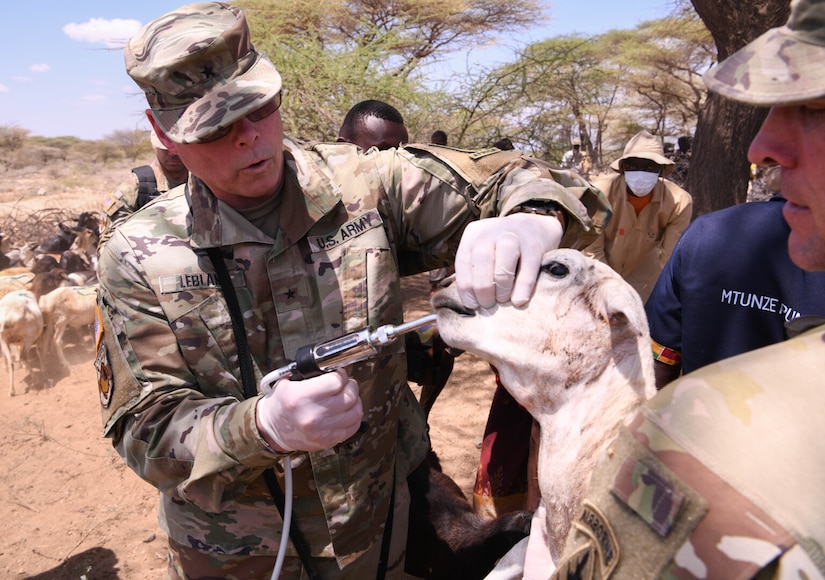
A man wearing a camouflage military uniform administers medication to a goat while another man wearing in similar attire holds the animal.

JA26 heavily leverages the National Guard Bureau's State Partnership Program to deepen long-term military relationships. 

The Massachusetts National Guard continues its decade-long partnership with Kenya, leading complex kinetic training, while the Nebraska National Guard builds on its newly developed partnership with Tanzania, focusing on expeditionary medical and ground force readiness.

The training concludes with distinguished visitor days, showcasing the tangible return on investment of this multinational partnership and shared security cooperation.
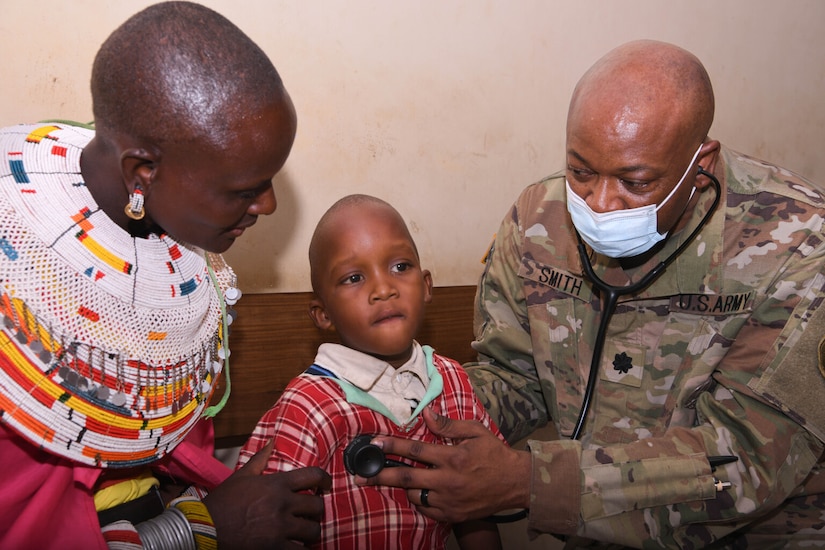
A man wearing a camouflage military uniform places a stethoscope on the chest of a child while a woman wearing traditional Kenyan clothing watches.

During the JA26 distinguished visitor days, in coordination with the U.S. military and the U.S. Department of Commerce (U.S. Embassy Nairobi), selected U.S. and African vendors will set up technology expositions. The industry day will directly connect commercial technological solutions with military and interagency end-users, fostering collaboration and aligning innovation with operational requirements focused on counterterrorism, unmanned aerial systems, and counter-UAS capabilities. 

"A truly resilient joint force is powered by a thriving defense ecosystem," Fernandez said. "What you will see is that ecosystem in action, a strategic partnership between our warfighters and commercial innovators from both the U.S. and our partners." 

Joint Interagency Task Force Announces Counter-UAS Marketplace

Joint Interagency Task Force 401 announced today that its revolutionary counter-unmanned aircraft systems marketplace has reached initial operational capability.

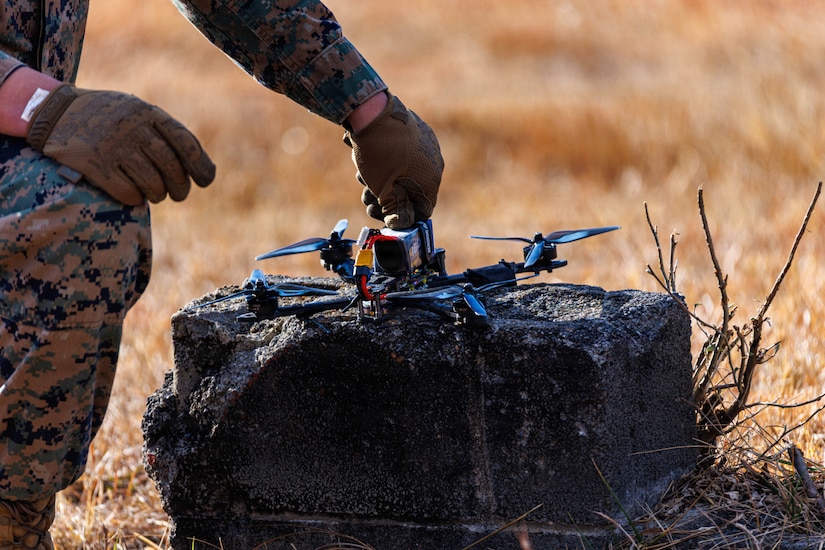
A person wearing a camouflage military uniform and sitting off-screen, kneels and places a drone on a rock.

The online platform, hosted on the common hardware systems electronic catalog, will revolutionize how the War Department and its interagency partners acquire critical counter-UAS technology. 

The marketplace streamlines the process for users to identify and procure the right equipment to meet their specific needs, featuring a growing catalog of validated counter-UAS systems and components, with plans to include performance data from the task force's authoritative test and evaluation repository. It allows customers to compare systems based on real-world performance against a variety of threats and in different environments. 

"The JIATF 401 [counter]-UAS marketplace is a critical step forward in our whole-of-government approach to countering the threat of small drones," said Army Brig. Gen. Matthew Ross, JIATF 401 director. "Our goal is to integrate sensors, effectors and mission command systems into a responsive, interoperable network that protects service members and American citizens alike." 

The marketplace is built on an established indefinite delivery, indefinite quantity contract, enabling customers to place orders immediately and significantly reducing the lengthy contracting process typically associated with defense procurement. The common hardware systems website provides an intuitive interface for users to browse available equipment, review technical specifications and compare pre-negotiated contract options. 

"Building and maintaining the [counter]-UAS marketplace has been a collaborative effort focused on delivering a user-friendly and effective tool for the warfighter," said Army Maj. Matt Mellor, the lead acquisitions specialist assigned to JIATF 401. "We've worked to create a platform that not only simplifies the procurement process but also provides the crucial data and expert support necessary for our customers to make informed decisions. This is about getting the best technology into the hands of those who need it as quickly as possible." 

The marketplace is actively expanding its inventory to include all validated counter-UAS equipment not already designated as a program of record. The common hardware systems electronic catalog already lists over 1,600 items, demonstrating its capacity to support a comprehensive, growing selection of counter-UAS solutions. 

Access to the marketplace is available to users throughout the War Department and interagency partners via a common access card or other government-issued smart card. 

Air Force Secretary Outlines Priorities

The Department of the Air Force's priorities are readiness, modernization, defending the homeland — including the entire hemisphere, border security, missile defense, nuclear deterrence and people, said Air Force Secretary Troy Meink, who spoke yesterday during the Air and Space Forces Association's 2026 Warfare Symposium in Aurora, Colorado.

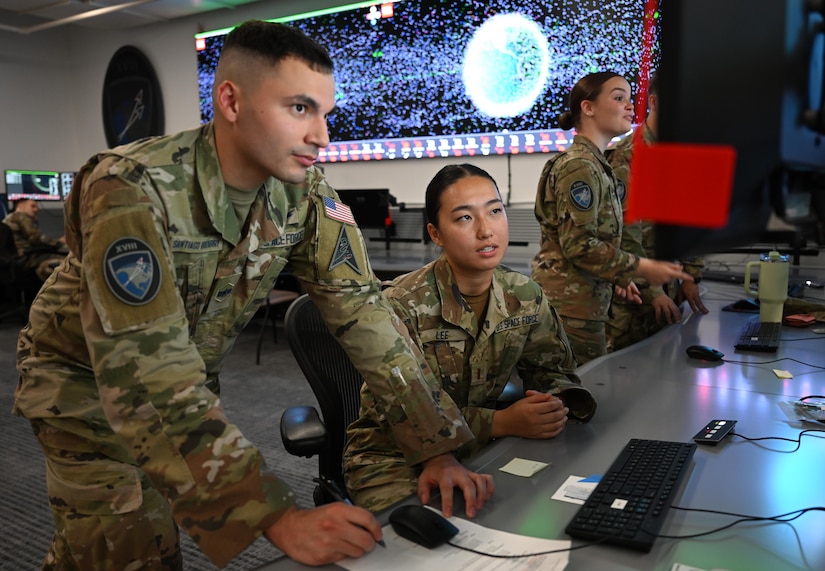
Two members in Space Force uniforms look at information on a computer screen.

From a conventional deterrence perspective, the focus is on China, which continues to expand and modernize its military at an extremely fast pace, making deterrence in the Indo-Pacific region the biggest challenge by far, he said.

"Given that threat environment, the Air Force and the Space Force must be ready at any time for any threat across the entire spectrum of conflict," Meink said.

One of the challenges is scaling up production of weapon systems and munitions. Accomplishing that requires the revival of the defense industrial base, which has experienced decades of neglect, he said.

A B-21 Raider aircraft is unveiled, with blue and white lights in the background.

The good news is that beginning last year, production of advanced aircraft and munitions has ramped up. Not as fast as needed, but faster than in the past, the secretary said, adding the testing program for the LGM-35A Sentinel is proceeding well.

The Air Force will replace the aging LGM-30 Minuteman III intercontinental ballistic missile with the Sentinel ICBM. This represents the modernization of the land-based leg of the nuclear triad.

An image of a Sentinel intercontinental ballistic missile in a cloudy sky.

In the space domain, an increase in rocket launches has put more capability into orbit than ever before, thanks to help from commercial partnerships and other military services, as well as the National Reconnaissance Office.

Acquisition transformation includes delivering mission-effective capabilities faster.

"To do that, we must innovate faster than our adversaries," the secretary said.

To accomplish this, the workforce must be empowered to unleash their talent, take the initiative and know that supervisors have their backs, Meink said, adding that the Department of the Air Force has a phenomenal team.