Saturday, October 18, 2025

The Quiet War: How 2026 Will Be Fought in Cyberspace, Cryptocurrencies, and Crowds

The next war won’t start with a missile streaking across a black sky. It’s already humming under your fingertips—an electrical storm inside routers and wallets and social feeds. There are no parades, no declarations, no borders to cross. There is only the constant pressure of influence, intrusion, and money in motion. The battlefield is invisible. The soldiers look like us. And the weapons are information, currency, and belief.

America is not sleepwalking into this conflict—we’re scrolling into it. The Quiet War has no single author and no single front. Nation-states stir it. Terror networks exploit it. Criminal gangs profit from it. Lone actors are recruited by it. The rules were never written for it. And 2026 will be the year we either learn to fight in this strange atmosphere or we inhale it until our institutions wheeze.

This essay lays out the operating picture of 2026 through three converging fronts—Cyber, Currency, and Crowds—then connects them to a realistic threat matrix for the United States: domestic violent extremism, transnational jihadist networks (especially ISIS-K), state-enabled proxies, and crime-terror hybrids in the Western Hemisphere. The goal is not to frighten; it is to focus. The Quiet War rewards the disciplined, the integrated, and the fast. Everyone else becomes content.


I. The New Grammar of Conflict

For most of the twentieth century, Western strategy assumed that force is something you can see: formation, mobilization, projection, impact. In 2026 the grammar has been rewritten. Force still matters—but narrative, identity, and liquidity now shape the battlefield long before the first kinetic strike. Call it non-kinetic domain dominance: whoever commands the data flows, the cash flows, and the attention flows wins the shaping fight and narrows the other side’s options.

Three realities define this new grammar:

  1. Speed beats scale. A fragment of code, a synthetic video, a coordinated “influencer” dogpile—each can move faster than policy can react. A day of trending fiction can shatter a year of careful deterrence.

  2. Enablers outrun enforcers. Financial plumbing, shell companies, virtual asset service providers, mixing services, and gray-market remittance channels are adapting faster than compliance regimes. The money that animates extremist plots rarely touches a bank; it passes through a chain of plausible deniability.

  3. The home front is the front. In 2026 the most immediate terrorism danger to Americans is inside the homeland. The same platforms that deliver groceries deliver propaganda, targeting cues, and operational guidance to people who never picture themselves as “combatants” until the moment they act.

A practical conclusion follows: the most dangerous adversaries are not always the ones with the biggest guns—they’re the ones with the best routers, the quietest donors, and the deepest reach into our heads.


II. The Cyber Front: Intrusion as Atmosphere

There is no “peace” in cyberspace. There is only constant contact—probing, mapping, stealing, pre-positioning, and sometimes flipping the switch when the stakes or the message warrants it. What changes in 2026 is not the existence of this contact but its automation and autonomy.

State actors—Russia, China, Iran, North Korea—will continue to drive the highest-end intrusions against critical infrastructure, defense industrial targets, and media platforms. They will also continue to outsource deniable operations to quasi-patriotic hacker groups and cut-outs. But the rising noise floor comes from the commercialization of sophisticated capabilities: AI-assisted spear phishing, large-scale credential stuffing, automatic lateral-movement kits, and marketplaces where zero-days are sold like concert tickets.

Non-state actors are already adapting. Jihadist and extremist communities don’t need to invent new tools; they simply rent them and hide in the traffic. Expect three developments to define 2026:

  • AI-augmented intrusion at scale. Models trained to profile an organization’s social graph and craft individualized phish at machine speed will make yesterday’s “good tradecraft” seem quaint. The goal is not to breach one target; it is to breach thousands, cheaply.

  • Supply-chain subversion for narrative effect. Attacks that swap code libraries, poison updates, or tamper subtley with content pipelines will be designed as psychological operations as much as technical ones. Imagine your trusted software pushing a “security alert” that is actually a rumor.

  • Ransomware with a political payload. Criminal crews will continue to monetize chaos. But watch for a sharper overlap: ransomware timed to civic events, or “leaks” engineered to feed extremist narratives. Profit and politics are not rivals—they are roommates.

Cyber risk will not distribute evenly. Hospitals, regional utilities, municipal systems, and small defense suppliers remain softest because they are essential but thinly resourced. The Quiet War goes where the doors are unlocked and the pain is high.

The old comfort—“they’ll hit the big cities first”—is obsolete. In cyberspace, every town is a capital.


III. The Currency Front: Money in the Shadows

Follow the money and you find the plot, the logistics, the loyalty. You also find the weak points in a global economy built for speed and convenience, not hard attribution.

In 2026, the terrorist-financing picture is a web of old ingenuity and new rails:

  • Traditional methods—hawala, bulk cash, trade-based money laundering—will persist. They’re durable because they fit local cultures of trust and because they hide in legitimate commerce.

  • Virtual assets lower friction. Cryptocurrencies and tokenized stores of value do not create illicit finance; they simply accelerate it, reduce overhead, and offer an illusion of anonymity. “Mixers” and cross-chain bridges complicate tracing. “Stablecoins” reduce volatility risk for illicit treasuries.

  • Front organizations, sham NGOs, and shell companies remain the great equalizers. They convert dirty flows into clean contracts and humanitarian cover, then back again. As one watchdog put it, the shell company is the getaway car of global finance.

What’s new in 2026 is the convergence of automation and opacity. Expect to see:

  • AI-managed laundering that monitors on-chain heuristics and shifts routes dynamically as analysts close in.

  • Exploiting humanitarian and conflict flows—using real crises and real charities as camouflage to move money to fighters who destabilize the same communities donors think they’re saving.

  • Micro-financing of terror through thousands of small transactions designed to never trip a threshold or provoke a file. It’s not the one big wire anymore; it’s the drip-drip that fills the barrel.

Financial intelligence officials already warn that our regulations are chasing a shape-shifting adversary. In a world where a smartphone can become a bank, compliance is a moving target and the bad actors have more time to aim.


IV. The Crowd Front: Weaponized Attention

The old propaganda playbook targeted ideology; the new one targets identity. It isn’t trying to persuade you with argument; it’s trying to trigger you with emotion. That makes everyone susceptible. It’s easy to picture the “other side” as the only target. The truth is colder: anyone who can be enraged can be enlisted.

The engineering of mass behavior in 2026 will lean on four accelerants:

  1. Generative AI as an attention multiplier. Synthetic news anchors, voice-cloned officials, “citizen footage” that never happened—high-quality fakes tuned to your fears. The aim isn’t perfect realism; it’s plausible urgency.

  2. Algorithmic herding. The crowd moves when it believes the crowd is moving. You don’t need millions of bots; you need a few thousand accounts to simulate momentum and your target’s network will do the rest.

  3. Micro-targeted grievance. Adversaries don’t push a single narrative; they plant conflicting narratives calibrated to fracture social trust—law enforcement vs. communities, veterans vs. activists, “patriots” vs. “traitors.” The goal is not to win an argument. It’s to make civil argument impossible.

  4. Street-to-screen feedback loops. Protests and counter-protests become laboratories for content. A single clash edits into a thousand different “truths,” each confirming a separate faction’s suspicions. Extremists fish in these waters for recruits. Terrorists look for cover.

If the meme is the new missile, then friction is the new air defense. Platforms and communities that slow virality, that reward context and penalize incitement, blunt the weapon. But friction and profit rarely coexist. That is the national dilemma we keep postponing.


V. The Threat Picture for 2026

The three fronts converge into a threat matrix. Not every actor uses every tool; not every danger is equal. But the pathways are consistent.

1) Domestic Violent Extremism (DVE)

The most persistent and immediate risk to Americans remains homegrown—small cells and lone actors radicalized through grievance content, guided by accessible tradecraft, and financed at trivial cost. The ideology is not a single flag; it is a marketplace of rage: racially or ethnically motivated extremism, violent anti-government currents, accelerationist fantasies, and retaliatory violence around domestic flashpoints. The signature of 2026 is less the spectacular plot and more the sustained pressure of low-complexity attacks against soft targets.

Cyber and currency amplify this. A radicalized individual can acquire instruction, reconnaissance, and money without leaving a digital footprint that looks any different from normal life: a shopping list of dark-market items, a cascade of “tutorials,” a handful of anonymous donations, and a narrative that promises immortality in fifteen seconds of infamy.

Expect targeted violence against civic spaces, faith communities, government facilities, law enforcement, and symbolic cultural venues. The psychological objective is to convince Americans that we cannot live together, cannot debate without blood, cannot trust the person in the next line. If the Quiet War breaks the American imagination, kinetic attack becomes merely punctuation.

2) ISIS-K and the Post-Caliphate Network

The Islamic State lost its caliphate but not its method. Its brand survives as a franchise model across Africa and Central Asia, and its most dangerous offshoot for external plotting remains ISIS-K. It is both a local player in Afghan-Pakistani dynamics and a global impresario of inspiration: it curates grievances, circulates training, claims credit for mayhem it merely fertilized, and occasionally directs or facilitates something bigger.

The 2026 risk is twofold:

  • Inspiration pipelines—online radicalization that translates into attacks with little command-and-control signature in the West.

  • External-operations facilitation—small networks using conflict zones and permissive borders for travel, training, or staged propaganda designed to provoke overreaction.

The network’s financial strain is real; salaries have fallen, recruitment pools fluctuate, and counter-terrorist finance (CTF) scrutiny has improved. But austerity can make terrorism more dangerous, not less, because it drives reliance on cheapest methods: small arms, edged weapons, vehicle rammings, crude IEDs, simple cyber-enabled harassment. These are low-cost, high-terror per dollar.

3) Al-Qaida Affiliates and the Sahel’s Expanding Fire

The center of gravity for jihadist territorial ambition shifted toward Africa, especially the Sahel and East Africa, where security vacuums and governance stresses allow al-Qaida-aligned coalitions and Islamic State affiliates to recruit, tax, and terrorize. This matters to the United States even when it feels geographically distant. American diplomats, contractors, aid workers, and commercial interests operate in these zones. The guarding of ports and corridors that feed global supply chains depends on regional stability. And every ungoverned space invites external-ops incubation.

For 2026, the most realistic U.S. exposure is indirect: kidnap-for-ransom, attacks on partners, and maritime disruptions radiating from coastal penetration by Sahel insurgencies. But indirect does not mean unimportant. Small fires in fragile places can cast global smoke.

4) State-Enabled Proxies and Gray-Zone Tactics

Terrorist tactics are no longer the exclusive property of “terrorist organizations.” States sponsor, shelter, or look away when proxies act in their interest. They wage campaign-length cyber operations below the threshold of open war. They use quasi-legal information outfits to launder narratives into Western discourse. They strike dissidents abroad and call it policing. They mix criminal profit with political intimidation.

This is not the Cold War; it is colder. And it means that some of the most sophisticated adversaries the United States faces in 2026 will be hybrids: part intelligence service, part criminal enterprise, part ideological movement, each piece disposable if exposed. You cannot deter what can always claim it doesn’t exist. You can only raise the cost and shorten the runway.

5) Crime-Terror Hybrids in the Western Hemisphere

Cartels and gangs are not “terrorists” in the strict legal sense, but many have adopted terroristic methods—assassinations, bombings, mass intimidation—to control territory and political outcomes. In parts of Latin America this convergence has produced instability whose shockwaves reach U.S. communities through migration surges, supply chain risk, and diaspora-targeted violence.

The Quiet War cares little about our labels. When a criminal group uses terror tactics, the effect on local populations and regional governance is the same. And when those groups partner with ex-insurgents or foreign enablers for weapons, training, or laundering, the problem becomes strategic.


VI. Likely Scenarios in 2026

Forecasts are not prophecies. But smart preparation begins with plausible arcs:

  1. A lone-actor attack against a civic venue, inspired by domestic or transnational propaganda, executed with low-tech means, broadcast live. The damage is limited; the political aftershock is not.

  2. A coordinated ransomware wave against hospitals or utilities in several states, timed to a polarizing national event. The attackers claim ideology; the wallets end in familiar criminal hands. Crime and cause become mutually reinforcing alibis.

  3. A high-profile disruption traced to a compromised AI or data pipeline, where manipulated information drives a financial panic or a public safety failure. The post-mortem reveals a months-long operation that looked like routine traffic at every step.

  4. A kidnapping or targeted killing of U.S. partners in West Africa, claimed by a jihadist faction, amplified by affiliates for recruitment, and financed through a chain of small donations that never trigger a threshold.

  5. A gray-zone operation against diaspora activists on U.S. soil, blending surveillance, intimidation, and cyber harassment. The sponsor denies involvement; the victims lose faith in protection; the message to others is received.

None of these scenarios require an army. All of them require readiness—technical, legal, and cultural.


VII. How We Win the Quiet War

There is no silver bullet, only a stack: tools, partnerships, habits. The stack must be faster than the threat and harder to break than the story the threat tells.

1) Harden the Domestic Cognitive Space

  • Make community-based prevention boringly normal. It works best when it looks like school programs, public-health models, and faith-community partnerships—when it speaks the language of belonging, not bureaucracy. We will not de-radicalize by lecture. We will pre-radicalize by invitation.

  • Modernize legal friction for virality. The First Amendment’s protection of speech is non-negotiable. But amplification is not speech; it is a product feature. Platforms that profit from algorithmic herding should carry a duty of due care when intelligence flags crisis conditions. The law does not have to define truth to dampen incitement.

  • Train a citizenry that can recognize weaponized content. Media literacy is not a luxury subject. It is digital civil defense. Teach adolescents how to spot synthetic media the way we taught earlier generations how to spot fake checks.

2) Starve the Money

  • Terrorist finance is a plumbing problem. Fix the pipes. Close the loopholes for shell companies, enforce beneficial-ownership transparency, demand real compliance from virtual asset service providers, and audit the humanitarian sector’s susceptibility to exploitation with respect and resolve.

  • Treat mixers and cross-chain bridges like high-risk financial services. Not every privacy tool is a crime tool, but the ones that function like unregistered laundries should face the same scrutiny. If a bridge’s business model depends on opacity, the rest of us are paying the bill.

  • Expand trade-based money-laundering analytics. Terror money is increasingly hidden in shipping paperwork and invoice games. The countermeasure is pattern-matching at scale across customs, banks, and logistics firms, with legal authorities that allow sharing fast.

3) Build Real Cyber Resilience

  • Push security into the bottom of the market. National programs should subsidize basic hardening for hospitals, municipalities, and small suppliers—MFA, patch pipelines, offline backups, tabletop exercises. The cost of not doing this is paid in ambulances and brownouts.

  • Assume breach, practice recovery. The fastest way to defang ransomware is to make it boring for the attacker: immutable backups, segmented networks, and rehearsed playbooks that bring the lights back in hours, not days.

  • Treat information systems like safety systems. When AI and data feeds steer real-world decisions—dispatching, triage, utility loads—apply the rigor we use for aviation: testing, auditing, red-teaming, and mandatory reporting of serious near misses.

4) Think Like a Network, Not a Silo

  • Fuse intelligence without drowning in it. The Quiet War produces oceans of “signals.” The answer isn’t to collect more; it’s to prioritize better and share faster with those who can act—state fusion centers, local partners, and the private sector.

  • Tie foreign and domestic CT in one narrative. The same group that menaces a contractor in West Africa may inspire a teenager in Milwaukee. Our strategies should reflect reality: one network, many faces.

  • Elevate financial intelligence to co-equal status with the kinetic kill chain. If you cut the money—quietly and relentlessly—you cut the muscle memory that makes plotting possible.


VIII. What to Watch (2026 Indicators)

  • A sharp rise in small-value, high-velocity on-chain movements around conflicts and protests—signals of micro-financing or covert redistribution.

  • A mainstream platform caught amplifying a synthetic incident before verification—evidence that our cultural “immune system” is still too slow.

  • Regional coups or collapses in the Sahel that open a corridor to coastal states—test cases for whether jihadist expansion can leverage maritime access.

  • Evidence of state-enabled proxy activity in North America or Europe targeting dissidents or diaspora leaders—gray-zone tactics crossing legal red lines.

  • A major hospital system reduced to pen-and-paper for days due to ransomware—signalling that we continue to under-invest in the bottom tier of critical infrastructure.

When any of these appear, the response must be whole-of-nation and on the clock. In the Quiet War, victory belongs to the side that acts before the narrative hardens.


IX. The Stakes

A skeptic might say: This is melodramatic. America is strong; we’ve seen worse. They’re right about the strength. They’re wrong about the form of the test.

The Quiet War is not trying to defeat our military. It’s trying to exhaust our civic capacity, erode our trust in one another, and make us mistake inconvenience for oppression, rumor for proof, performance for policy. It’s trying to convince us we’re alone. We are not.

What we decide in 2026 is whether we will adapt. Whether we will fight for the spaces between us with the same seriousness we bring to the spaces beyond us. Whether we will invest in the boring things that make bright things possible: backups, audits, local partnerships, shared facts, honest disagreements, slow conclusions.

The missiles may never fly. The invasions may never march. Yet the war is here—inside the signal, inside the wallet, inside the crowd. The question is not whether we will fight. The question is whether, by the time we notice, the fight has already chosen us.


References (no hyperlinks)

  1. U.S. Department of Homeland Security. Homeland Threat Assessment 2025. Washington, DC: DHS, September 30, 2024.

  2. Office of the Director of National Intelligence. Annual Threat Assessment of the U.S. Intelligence Community 2025. Washington, DC: ODNI, March 18, 2025.

  3. Defense Intelligence Agency. Worldwide Threat Assessment: Statement for the Record to the House Armed Services Committee (2025). Washington, DC: DIA, 2025.

  4. U.S. Department of Homeland Security. National Terrorism Advisory System Bulletin, June 22, 2025.

  5. Financial Action Task Force (FATF). Comprehensive Update on Terrorist Financing Risks (2025). Paris: FATF, July 8, 2025.

  6. Financial Crimes Enforcement Network (FinCEN). Advisory FIN-2025-A001: ISIS-Related Illicit Financial Activity. Washington, DC: U.S. Department of the Treasury, April 1, 2025.

  7. Europol. European Union Terrorism Situation and Trend Report (TE-SAT) 2024. The Hague: Europol, December 12, 2024.

  8. Europol. Major Developments and Trends on Terrorism in Europe in 2024 (press summary). The Hague: Europol, June 24, 2025.

  9. United Nations Security Council, Counter-Terrorism Committee/CTED. Briefing on the Secretary-General’s Strategic-Level Report on ISIL/Da’esh, February 7, 2025.

  10. Associated Press. “Islamic State and al-Qaida Threat Is Intense in Africa, with Growing Risks in Syria, UN Experts Say.” AP News, August 2025.

  11. Reuters. “Financial Crime Watchdog Calls for Countries to Come Clean on Shell Companies.” Reuters Business, September 3, 2025.

  12. FATF. “The Financial Action Task Force: Mandate and Areas of Work.” Paris: FATF, 2025.


Author’s Note on Method

This assessment synthesizes publicly available U.S. government threat reporting, European law-enforcement trend data, international counter-terror finance findings, and mainstream wire-service coverage of UN expert reporting and global regulatory updates through October 2025. It prioritizes patterns that are stable across multiple sources (e.g., domestic violent extremism as the leading homeland threat; terrorist-financing adaptability; ISIS-K’s external-ops posture; the Sahel’s expanding insurgent footprint) while recognizing that specific incident risk fluctuates with geopolitical shocks.

Wednesday, October 08, 2025

When Obedience Ends: The Ambiguous Safeguard of Military Refusal

The health of a democracy is often measured not by the loyalty of its citizens, but by the limits of its obedience. In constitutional systems like that of the United States, civilian control of the military is a sacred principle—a safeguard against coups, militarism, and arbitrary power. Yet this very principle conceals a paradox: when the highest civilian authority issues an unlawful order, the defense of the Constitution depends on the willingness of military officers to refuse. This “last-ditch” protection is both noble and dangerous, for it transforms the armed forces from instruments of obedience into guardians of legality—a role fraught with moral tension and political risk.

From the Nuremberg Trials to General Mark Milley’s caution during the 2020 U.S. election, history reveals moments when soldiers, officers, and statesmen faced the ultimate test of conscience. Their decisions sometimes preserved constitutional order—but they also exposed the deep ambiguities in systems that rely on moral restraint instead of institutional clarity. Recent events, such as the October 2025 U.S. strike on an alleged drug-trafficking vessel near Venezuela, demonstrate how this dilemma endures in modern form. When legality is murky and authority expansive, the line between obedience and illegality blurs, leaving individual officers—and entire nations—balanced on the knife-edge between justice and overreach.

This essay examines the benefits, challenges, and especially the ambiguities of relying on military refusal of unlawful orders as the final defense of constitutional democracy. While such refusal can protect the republic, it also reveals the fragility of the system that depends upon it.


The Ethical Ideal and Its Constitutional Promise

In principle, the refusal to carry out illegal orders reflects the moral maturity of the professional military. The U.S. Uniform Code of Military Justice (UCMJ) requires obedience only to lawful orders (Article 92). This mandate stems from international law, particularly the Nuremberg Principles, which rejected “I was only following orders” as a defense for war crimes. As Luban (2016) observes, Nuremberg redefined military obedience itself: a lawful order is one consistent with both statute and conscience.

From this perspective, the refusal to obey unlawful commands is not insubordination—it is fidelity to the rule of law. When Warrant Officer Hugh Thompson Jr. intervened to stop the My Lai massacre in 1968, landing his helicopter between U.S. troops and Vietnamese civilians, he embodied the principle that morality must constrain command. Similarly, in 2020, General Mark Milley told Congress that “the military will play no role in the election process” (PBS, 2020). His words affirmed that the armed forces answer to the Constitution, not to individuals. In both cases, moral courage and institutional duty converged.

Yet even as these acts inspire trust, they reveal a weakness: the health of the republic should not depend on the conscience of a few officers. Lawful refusal is an ethical safeguard, but a precarious one. It presumes that those who must disobey will recognize the moment, interpret it correctly, and act at personal risk. It is, in essence, a moral stopgap for systemic failure.


The Fragile Line Between Legality and Loyalty

The first great ambiguity lies in defining what is illegal. In moments of crisis, legality is often obscured by urgency and classified information. As Ghiotto (2025) notes, even senior officers can struggle to determine whether an order is “manifestly unlawful” when it is wrapped in the language of national security or emergency authority.

The October 2025 U.S. strike on a vessel near Venezuela illustrates this ambiguity in vivid, contemporary form. U.S. officials claimed the targeted boat was transporting narcotics and that the strike—one of several similar operations—was part of a “non-international armed conflict” against transnational drug traffickers (Associated Press, 2025). The strike killed four people; Venezuela condemned it as an “act of extrajudicial violence,” and Colombia protested that some of the dead were its citizens. Legal experts questioned whether the operation violated international law or the sovereignty of coastal states (Al Jazeera, 2025).

For the officers who executed the strike, legality was not a simple question. The operation’s justification combined law enforcement, counterterrorism, and military combat rationales—a blend of authorities that blur legal categories. Was it a lawful military action, or an illegal use of force outside congressional authorization? The answer depends on classified intelligence and disputed interpretations of international law. In such conditions, it becomes nearly impossible for an officer to know whether refusal would be principled resistance—or career-ending insubordination.

This is precisely the gray zone that threatens to make moral courage impracticable. When legality is elastic, disobedience becomes not a matter of ethics but of peril.


Civil-Military Friction and the Dangers of Judgment

The second ambiguity arises from civil-military tension. Civilian control is a constitutional cornerstone, yet when military leaders question civilian orders, they risk accusations of politicization. The problem is not disobedience itself—it is the perception of military autonomy.

During the final months of the Trump administration, Milley and other senior leaders reaffirmed that the armed forces would not intervene in electoral disputes or act domestically against citizens (Military Times, 2022). Their stance was constitutionally sound but politically explosive. Some hailed it as heroism; others decried it as veiled resistance. The same act of restraint that defends democracy can appear, in another light, as defiance of civilian authority. That paradox has no permanent solution.

The 1991 Soviet coup attempt further illustrates the danger. When hardliners ordered troops to storm Moscow’s White House and depose President Gorbachev, generals such as Pavel Grachev refused. Their restraint preserved reform—but also exposed the vacuum of civilian legitimacy that forced the military to decide the nation’s fate. As Braver (2025) observes, “every act of moral refusal by soldiers is an indictment of the system that left them no lawful choice.”


The Burden of Conscience and the Myth of Clarity

The third ambiguity lies within the human heart. Soldiers are trained to obey quickly and decisively; they are not philosophers. Demanding that they also interpret legality under pressure imposes an unbearable moral burden. As Caron (2019) notes, the ethical responsibility of the soldier extends “beyond the mere legality of the order, into the uncertain terrain of moral consequence.”

The Tiananmen Square massacre of 1989 is the tragic mirror image of My Lai. Some Chinese units refused to fire on civilians; others obeyed. The legality of the order was unquestionable under Chinese law, yet its moral illegitimacy was plain. Both groups acted under command; only one preserved humanity. History vindicated the resisters—but at the cost of their careers, freedom, and sometimes their lives.

In democratic societies, the burden of conscience operates differently but just as heavily. Officers who question orders—such as those leading the Venezuelan strikes—must weigh not only legality but loyalty, optics, and personal consequence. To refuse is to gamble with livelihood and legacy. To obey may mean complicity in unlawful acts. There is no perfect guidance, only risk.


The “Last Ditch” Dilemma

At the heart of this issue lies the “last ditch” dilemma: when all other safeguards fail, the military’s moral restraint becomes democracy’s final defense. This is both noble and catastrophic. It presupposes the collapse of institutional checks—the courts, the legislature, and the electorate. If the fate of the republic depends on one general’s conscience, the republic is already in crisis.

The nuclear command structure offers a chilling example. Although the president alone can authorize a launch, officers in the chain of command are trained to verify legality before executing. Yet as Braver (2025) points out, that verification would occur in minutes, under existential pressure. The final safeguard against catastrophe, therefore, is not the law but human judgment—a fragile firewall of conscience.

The Venezuela strike underscores the same fragility at a lower scale. The operation’s legality remains contested; oversight was minimal; the justification was vague. No court reviewed it, no congressional debate preceded it, and no officer publicly objected. Whether it was lawful or not, the system left no room for meaningful refusal. When actions of violence occur in shadows, the last ditch disappears altogether.


Legality Without Legitimacy

The final ambiguity is the gulf between legality and legitimacy. Orders may be technically lawful yet morally indefensible. The Iraq invasion of 2003 and the use of torture at Abu Ghraib both relied on legal memos that stretched the meaning of authority. Similarly, the Venezuelan operations are defended under the banner of “counter-narcotics warfare,” yet lack transparency or international consensus. If law becomes a tool of justification rather than restraint, its moral authority dissolves.

Wolfendale (2009) warns that a professional ethic must rise above mere legality, but when it does, it risks undermining civilian supremacy. The officer who refuses may be a hero—or a threat to democracy. The one who obeys may preserve order—or participate in injustice. The distinction often emerges only in hindsight. That uncertainty is not a flaw in military ethics; it is a reflection of politics itself.


Conclusion: The Strength and Fragility of Moral Firewalls

The refusal to follow illegal orders is among the noblest expressions of civic virtue. From Nuremberg to My Lai, from Moscow in 1991 to Washington in 2021, the courage to disobey has preserved the moral boundaries of civilization. Yet to rely on that courage as a systemic safeguard is to confess institutional weakness. When legality depends on conscience, and restraint depends on the moral clarity of a few, the rule of law stands on perilous ground.

The U.S. strike near Venezuela captures this danger in real time: an action justified in secret, defended in abstraction, and carried out without oversight. Whether lawful or not, it embodies the modern condition of military ethics—where soldiers act amid uncertainty and legality is a matter of argument rather than clarity. The same government that teaches its officers to disobey unlawful orders often gives them no means to know which orders those are.

Ultimately, the survival of democracy should not depend on moral luck. It must rest on transparent laws, accountable leaders, and institutions strong enough to prevent the unlawful from being ordered in the first place. When the guardians of force must choose between obedience and justice, the republic has already entered dangerous terrain. The final act of loyalty may indeed be the courage to disobey—but a nation that depends on that courage is already running out of time.


References

Al Jazeera. (2025, October 6). Can U.S. strikes on suspected drug boats off Venezuela be legally justified? https://www.aljazeera.com/news/2025/10/6/can-us-strikes-on-suspected-drug-boats-off-venezuela-be-legally-justified

Associated Press. (2025, October 3). Hegseth announces latest strike on boat near Venezuela he says was trafficking drugs. https://apnews.com/article/1848b02febe08acacb82979d7da47dfb

Braver, J. (2025). Disobeying lawful but unethical orders in the army. University of Wisconsin Legal Studies Research Paper No. 5288109.

Caron, J. F. (2019). Can soldiers disobey lawful orders? Journal of Military Ethics, 18(3), 221–236.

Ghiotto, A. J. (2025). (Un)Lawful orders. New York University Journal of Legislation & Public Policy, 27(2), 211–260.

Luban, D. (2016). Knowing when not to fight. Georgetown Law Faculty Publications and Other Works, 2621.

Military Times. (2022, August 11). Everything we know Gen. Milley has told the Jan. 6 panel. https://www.militarytimes.com/news/2022/08/11/everything-we-know-gen-milley-has-told-the-jan-6-panel

PBS NewsHour. (2020, August 28). Top general says no role for military in presidential vote. https://www.pbs.org/newshour/politics/top-general-says-no-role-for-military-in-presidential-vote

Wolfendale, J. (2009). Professional integrity and disobedience in the military. Journal of Military Ethics, 8(2), 127–140.


Sunday, October 05, 2025

The Brink of Conflict: U.S.–Venezuela Tensions After the 2025 Naval Strike

On October 5, 2025, the United States Navy conducted a strike on a vessel off the Venezuelan coast, claiming it was engaged in drug smuggling. The attack—announced by President Donald Trump during the U.S. Navy’s 250th-anniversary ceremony—killed several people and sparked outrage from the Venezuelan government. Officials in Caracas condemned the action as a violation of sovereignty, while U.S. leaders characterized it as a lawful operation against “narco-terrorist” activity in the Caribbean. The incident instantly reignited debate over U.S. interventionism in Latin America and raised questions about whether such confrontations could spiral into open conflict.

This essay examines the 2025 naval strike within the historical continuum of U.S.–Venezuelan relations, analyzing its strategic, legal, and geopolitical implications. While the attack underscores the aggressive resurgence of coercive diplomacy in U.S. foreign policy, a convergence of legal, political, and strategic factors still makes a full-scale war between the United States and Venezuela unlikely in the near term. Nonetheless, the episode illuminates the enduring volatility of hemispheric security relations and the precarious balance between counter-narcotics enforcement and the risk of escalation.


Historical and Political Background

The roots of U.S. involvement in Latin America stretch back two centuries. The Monroe Doctrine of 1823 asserted that European interference in the Western Hemisphere would be viewed as aggression, effectively establishing the United States as the region’s self-appointed arbiter. By the early twentieth century, the Roosevelt Corollary to the Monroe Doctrine expanded this authority into a justification for intervention—ostensibly to maintain stability and protect U.S. interests (Smith, 2005).

Throughout the Cold War, this hemispheric logic persisted in actions such as the 1961 Bay of Pigs invasion in Cuba, the 1965 Dominican Republic intervention, and the 1989 invasion of Panama. These precedents created a pattern in which the United States routinely justified military involvement under the banners of anti-communism, counter-narcotics, or democracy promotion (Grandin, 2006).

Venezuela entered this geopolitical frame in the late twentieth century as a country of strategic importance due to its vast oil reserves. The rise of Hugo Chávez in 1999, and later Nicolás Maduro, shifted Venezuela toward an anti-U.S. foreign policy anchored in “Bolivarian socialism.” The United States responded with escalating sanctions and diplomatic isolation. By the 2020s, Washington had designated Venezuela’s top officials as corrupt “narco-regime” actors, framing the government as both a criminal enterprise and a security threat (Rendon, 2021). The October 2025 strike thus represented not a departure but an intensification of long-standing U.S. regional doctrines.


The October 2025 Naval Strike

According to statements from the Pentagon and the White House, the October 5, 2025, naval strike targeted a vessel “engaged in transnational narcotics smuggling” approximately 80 nautical miles off Venezuela’s coast. Defense Secretary Pete Hegseth claimed the action fell within U.S. authority to interdict narco-terrorist assets operating in international waters (Associated Press, 2025). Venezuelan officials countered that the strike occurred within their exclusive economic zone and killed civilians. Vice President Delcy Rodríguez declared that the government was prepared to “defend every inch of our maritime sovereignty,” hinting at a possible state of emergency.

The international response was cautious. The Organization of American States called for restraint, while the United Nations urged verification of the incident’s circumstances. Regional governments largely avoided taking sides. Yet the symbolic meaning of the attack was unmistakable: a U.S. warship had used force near Venezuelan territory without prior consent, resurrecting memories of past interventions and testing the boundaries of maritime law.


Strategic and Legal Dimensions

From a legal standpoint, the strike occupies an ambiguous space between law enforcement and warfare. Under Article 51 of the United Nations Charter, a nation may use force in self-defense if an armed attack occurs, but anti-narcotics operations generally fall under law enforcement jurisdiction. The United States justified its actions under existing counter-narcotics statutes, particularly the Foreign Narcotics Kingpin Designation Act and related executive authorizations targeting “narco-terrorism” networks (O’Connell, 2019). However, critics argue that labeling drug smugglers as terrorists stretches both domestic and international legal definitions, effectively militarizing law enforcement (Casey, 2024).

The Venezuelan perspective centers on sovereignty. Even if the strike occurred in international waters, it was geographically and politically close enough to be perceived as an act of intimidation. For a government already isolated by sanctions, such a display risks framing the U.S. as an aggressor willing to operate unilaterally in its near abroad.

Strategically, the incident fits a pattern of power projection rather than invasion preparation. The U.S. Navy’s Caribbean operations have long served dual purposes: interdiction of illicit trafficking and signaling deterrence to adversarial regimes. The strike thus functions as both tactical enforcement and geopolitical messaging. While militarily limited, its psychological impact is substantial—illustrating Washington’s willingness to escalate enforcement into kinetic action when diplomacy fails.


Escalation Risks

The danger of escalation lies not in deliberate policy but in miscalculation. Maritime operations in contested waters are inherently volatile; one misidentified target could trigger retaliation. Venezuelan coastal defenses, though outdated, include anti-ship missiles and fighter aircraft capable of harassment. Reports of Venezuelan jets shadowing U.S. vessels after the October 5 strike underscore the potential for accidents (Barnett, 2025).

Third-party involvement further complicates the picture. Russia and China have provided diplomatic backing and limited military technology to Venezuela, viewing it as a strategic counterweight to U.S. influence in the hemisphere. An expanded U.S. campaign could invite symbolic or logistical support from these powers, turning a regional standoff into a theater of great-power signaling.

Information warfare also plays a role. Both governments have used state media to frame the event for domestic consumption: Washington presents decisive action against crime, while Caracas portrays heroic resistance to imperial aggression. Such narratives harden positions and reduce the political flexibility needed to de-escalate.


Constraints on War

Despite heightened tensions, multiple constraints make a full-scale war improbable.

First, the political and legal costs for the United States would be severe. A large-scale intervention without United Nations authorization would violate international norms and risk alienating allies. Congress has shown little appetite for approving new foreign wars, particularly in Latin America.

Second, there are strong regional and diplomatic disincentives. Latin American governments, through organizations like CELAC and MERCOSUR, generally oppose military interventionism. Even countries sympathetic to U.S. policy on narcotics prefer diplomatic approaches. The legitimacy costs of a unilateral attack would outweigh its tactical benefits (Corrales, 2020).

Third, Venezuela’s strategic value to U.S. interests does not justify the expense of a major war. Its oil production has collapsed under sanctions, and its regional influence is limited. A conflict would likely drag on amid complex urban and guerrilla warfare conditions, drawing U.S. forces into another protracted engagement.

Finally, global conditions constrain escalation. The United States remains strategically committed to Europe and the Indo-Pacific, while economic challenges at home limit public tolerance for new conflicts. As Casey (2024) notes, “U.S. coercive diplomacy is effective only when matched with restraint; otherwise, it risks draining legitimacy faster than it builds compliance” (p. 77).


Historical Parallels and Lessons

The 2025 incident echoes earlier moments when U.S. actions in Latin America walked the line between law enforcement and warfare. The 1989 invasion of Panama—launched under the pretext of capturing drug-trafficking leader Manuel Noriega—illustrates how anti-narcotics rhetoric can mask broader political aims. Similarly, the 1962 Cuban Missile Crisis demonstrates how naval operations in the Caribbean can escalate from signaling to near-catastrophe.

Historically, restraint has often served U.S. interests better than force. Following the 1962 crisis, back-channel diplomacy and international mediation prevented war while maintaining U.S. strategic credibility. In the Venezuelan case, de-escalation mechanisms—such as maritime coordination hotlines, third-party verification, and joint anti-drug task forces—could reduce misunderstandings.

Latin American history also teaches that military interventions, even when tactically successful, tend to breed long-term instability. As Grandin (2006) observed, “The recurring illusion that order can be imposed from abroad has done more to erode hemispheric trust than to preserve it” (p. 210). Applying that lesson today could spare both nations a cycle of confrontation that neither can afford.


Future Scenarios

Looking ahead, three broad outcomes appear plausible.

Best-case scenario: Diplomatic engagement through neutral intermediaries—perhaps the United Nations or regional partners like Brazil—facilitates a framework for maritime deconfliction and cooperative anti-narcotics monitoring. Both sides maintain rhetorical hostility but avoid further incidents.

Middle-case scenario: Tensions persist through tit-for-tat posturing, additional U.S. strikes on smuggling vessels, and Venezuelan military demonstrations. The conflict remains limited but normalizes a low-level state of hostility, reminiscent of U.S.–Cuba relations during the late Cold War.

Worst-case scenario: Miscalculation or civilian casualties provoke retaliation, leading to air or naval clashes. International condemnation forces the United States to choose between escalation and retreat, risking a politically costly standoff.

The determining variable across these scenarios is communication. The absence of direct military-to-military channels increases the probability of misperception. Historically, as the Cuban Missile Crisis showed, escalation is often a failure of dialogue rather than strategy.


Conclusion

The October 2025 naval strike off Venezuela’s coast represents a sharp reminder of how fragile the boundary between enforcement and aggression can be. It embodies the long historical tension between U.S. security policy and Latin American sovereignty—a cycle of projection and resistance that spans two centuries. Yet it also underscores the limits of power in a connected world: even a global superpower must balance military capability with legal legitimacy and political prudence.

While war between the United States and Venezuela remains unlikely, the incident reveals how quickly tactical operations can carry strategic consequences. It serves as both warning and opportunity—a chance for Washington to recalibrate its approach to hemispheric security, and for Caracas to avoid provoking the very confrontation it fears. Ultimately, stability in the Americas will depend less on the might of navies and more on the willingness of nations to turn from confrontation toward communication.


References

Associated Press. (2025). U.S. Navy strikes suspected drug-smuggling vessel near Venezuela. Washington, D.C.: Associated Press Archives.

Barnett, N. (2025). Caribbean Flashpoint: Maritime Power and Regional Security in the 2020s. London: Routledge.

Casey, M. A. (2024). Coercive Diplomacy in the Western Hemisphere: Law, Power, and Perception. New York: Columbia University Press.

Corrales, J. (2020). Fixing Democracy: Political Decline and Renewal in Venezuela. Baltimore: Johns Hopkins University Press.

Grandin, G. (2006). Empire’s Workshop: Latin America, the United States, and the Rise of the New Imperialism. New York: Metropolitan Books.

O’Connell, M. E. (2019). The Art of Law in the International Community. Cambridge University Press.

Smith, P. H. (2005). Talons of the Eagle: Latin America, the United States, and the World. 3rd ed. Oxford University Press.

Monday, September 29, 2025

Hegseth Speaks at Inaugural Gold Star Advisory Council Meeting

Secretary of War Pete Hegseth today chaired the first-ever meeting of the War Department's Gold Star Advisory Council, during which he vowed to improve the Pentagon's overall process for interacting with Gold Star families, including the department's Casualty Assistance Program.   

Gold Star family members are the surviving relatives of U.S. service members who died in the line of duty. 

Hegseth established the council — which is tasked with honoring the memories of fallen service members and ensuring their family members are never forgotten or left behind — in May with the signing of a memo. 

"For far too long — especially in our generation — there was just a big gap between what 'right' looks like and what reality was. Whether it's husbands or wives or fathers or mothers, the whole casualty assistance and Gold Star process was broken," Hegseth said, adding that Gold Star families should be welcomed into the arms of a grateful nation, rather than running into bureaucracy or being unable to get the answers they need. 

"Our charge here is that there's a lot of things that are broken [and] a lot of things that need to change. … We may not have broken them, but we're in charge now and we're going to fix them, and we're going to do everything we can," Hegseth said.  

The Gold Star Advisory Council will seek to elevate the voices of Gold Star family members directly to War Department leadership to "tackle real concerns and transform the casualty process for good," Hegseth told the media earlier in the day, adding that the council has his "full backing to call out the failures, shake up the bureaucratic status quo and drive the changes that will stick."  

Co-vice chairs of the council include Anthony Tata, undersecretary of war for personnel and readiness, and Gold Star wife Jane Horton, who also serves as a senior advisor to Hegseth. 

"As much as I can humanly understand — and I know I can't understand everything that each of you have been through — I know the responsibility I have … to make sure we get this right … and to make sure that we take care of all of you and everyone that you represent," Tata told the Gold Star family members in attendance.  

"And you have my commitment in that regard," he added. 

Horton told the Gold Star family members in attendance that it was an honor to serve them and to represent their fallen service members. She also said she has confidence in Hegseth's commitment to the council. 

"I know that [Hegseth] means it when he says that we're going to get things done and that there's going to be action behind these words," Horton said.   

During the meeting, Hegseth was sure to credit past efforts made by those who worked in the War Department's Gold Star program, stating that it wasn't for a lack of caring that the program had deficiencies. 

"It was just not enough concentration on forging that solution that really works and really shows the humanity to a process that is ultimately a human process," Hegseth said. 

"Hopefully we can aggregate all of that [previous hard work] with the authority of the secretary's office and drive some of that change that maybe just couldn't get done because it wasn't happening at this level," he added.    

Army's 1st Cavalry Division Conducts First Switchblade 600 Live-Fire Exercise

As part of Pegasus Charge, 1st Cavalry Division's effort in support of the Army's "Transforming in Contact" initiative to modernize armored formations, soldiers assigned to the 2nd Armored Brigade Combat Team, 1st Cavalry Division, conducted Fort Hood's first live-fire exercise of the Switchblade 600 Loitering Munition System, Sept. 15. 

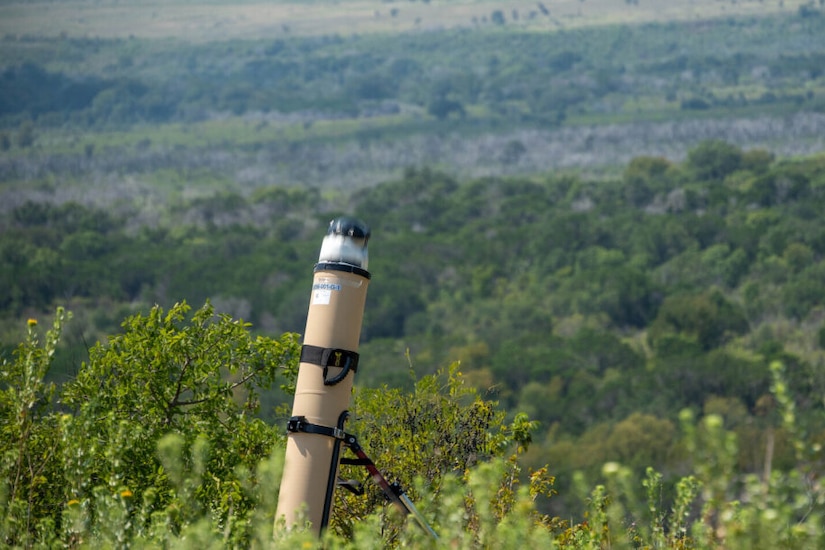
A tube-like military weapons system sits outside in a semi-wooded area.

 
The Switchblade 600 — a tube-launched, unmanned aircraft system — has already seen extensive use by Special Operations Forces, light infantry units and foreign partners. The 1st Cavalry Division is among the first armored units to field the system. 
 
"This is the first time for all of our soldiers to see these munitions fired, and you can feel the excitement in the air," said Army Capt. Jeffrey Weller, Multifunctional Reconnaissance Troop commander, 2nd Armored Brigade Combat Team, 1st Cavalry Division. "The Switchblade enables the brigade to engage targets with precision between 5 and 15 kilometers in front of our forward line of troops, extending our reach and lethality."

Modernizing the Fight

The Army's broader Transforming in Contact initiative aims to overhaul how armored formations fight by integrating new technologies, particularly drones and advanced communications.

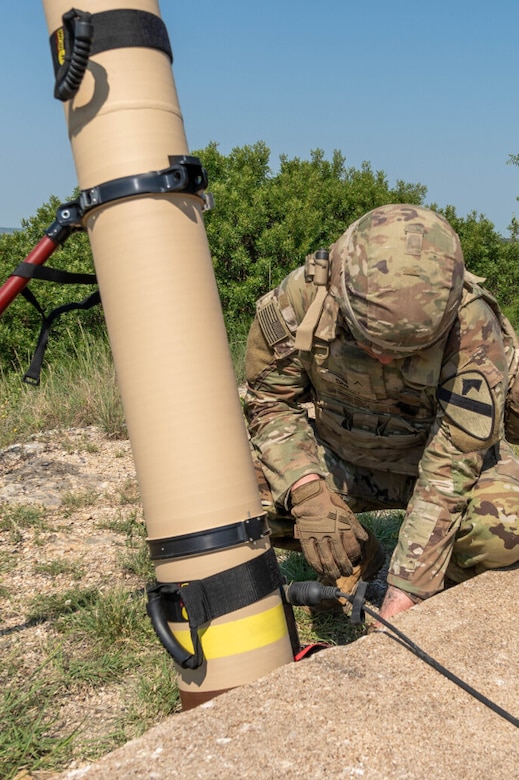
A person wearing a camouflage military uniform sets up a weapons system outside in a desert environment.

"A huge thing the Army has seen across multiple battlefields, whether in Ukraine or elsewhere, is the rapid modernization and high usage of drones," Weller said. "We're taking those lessons learned and revamping our [unmanned aircraft] systems to stay ahead of adversaries." 
 
Roughly 5 feet long and weighing 75 pounds, the battery-powered Switchblade 600 resembles a drone, but carries a Javelin multipurpose warhead. It has a flight time of 40 to 45 minutes, a range of up to 27 miles and delivers a 5-pound explosive payload. 
 
"It's a remote-controlled missile that flies like a drone until it gets to the target," explained a flight operations supervisor with the system's manufacturer. "The operator uses onboard cameras to identify, select and engage the target." 
 
Once launched from its tube, the Switchblade can navigate through waypoints, loiter over the target area and strike with precision. Operators also retain the ability to wave off a strike mid-flight if conditions change. 
 
"The Switchblade allows us to target vehicles or small groups of personnel from much farther away than before," Weller said. "It increases our lethality, minimizes collateral damage and helps protect soldiers on the front lines." 

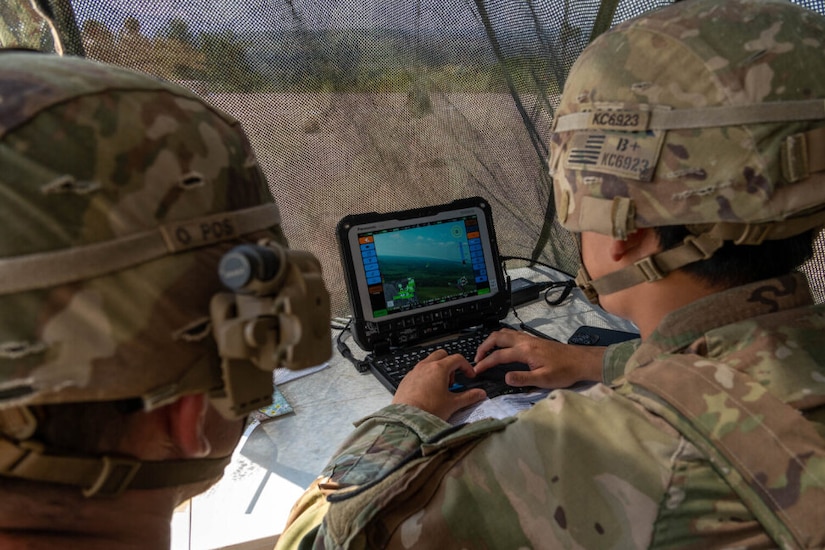
Two people wearing camouflage military uniforms and helmets look at a small screen under a camouflage-netted tent.

Before the live-fire exercise, soldiers completed a five-day training course with the manufacturer, during which they learned to set up, arm and program the drones for flight and strike missions. 
 
Army Spc. Drake Cross, a Switchblade operator who has flown RQ-7 Shadow and RQ-28 Quadcopter drones for the division, said this was his first experience with a munition-carrying UAS. 
 
"Everything else I've flown has been for surveillance and target acquisition," Cross said. "This is the first one where I can actually deliver a round. It's exciting because it saves soldiers' lives by hitting targets without putting us in danger." 
 
Cross said the system was user-friendly and similar to other UAS platforms, adding, "There's not much of a learning curve. Once you identify and lock onto a target, you can adjust right up until impact to make sure you're hitting what you want."

Looking Ahead

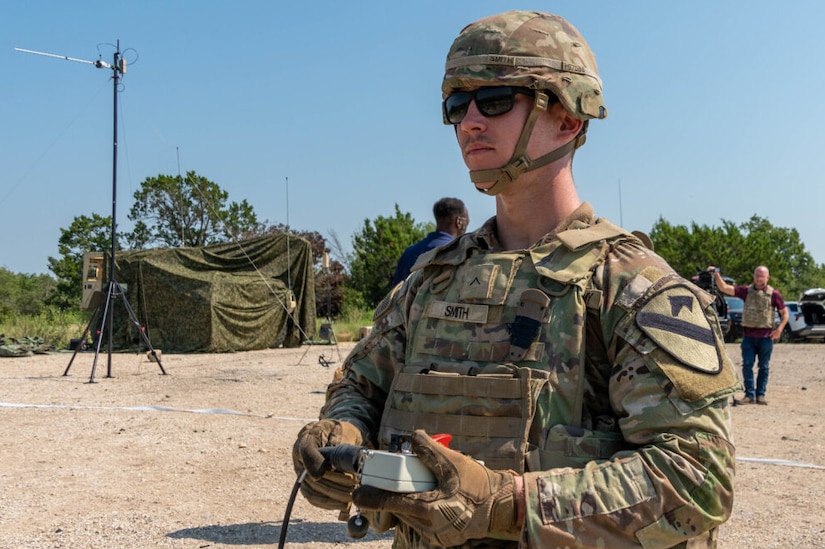
A person wearing sunglasses, a helmet and a camouflage military uniform holds an electronic switch outside in a desert environment. In the background are a camouflage tent and other personnel.

Weller said the Switchblade is just one example of how Transforming in Contact is reshaping the 1st Cavalry Division's armored formations. He noted that the unit will use the system during their upcoming rotation at the National Training Center at Fort Irwin, California. 
 
"The battlefield is constantly changing, and the Army has to modernize to keep pace," he said. "Seeing systems like the Switchblade in action shows us the future of how our formations will fight. It's a big step toward keeping our soldiers safer and more lethal."

Joint Insertion Training Enables Combined U.S.-Japan Live-Fire Exercise

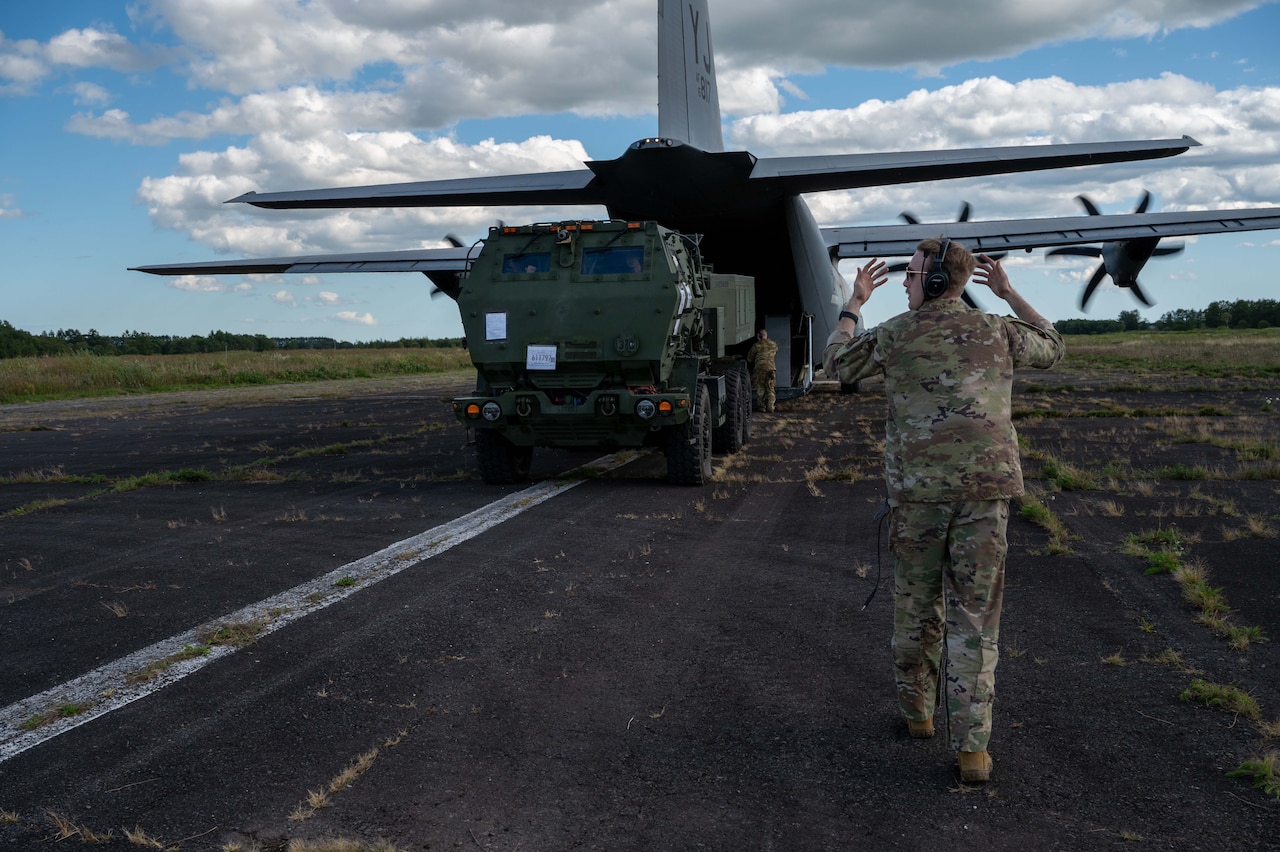
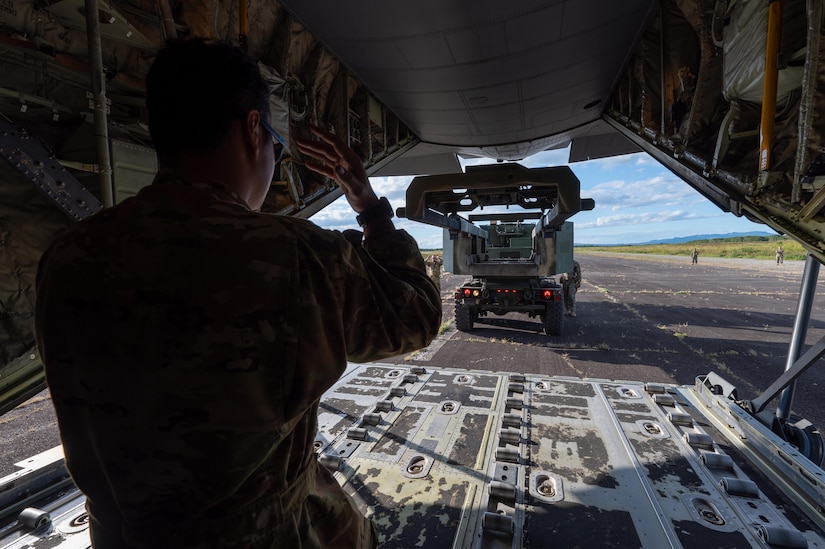
A man wearing a camouflage military uniform walks backwards on a tarmac as he guides a large green military vehicle out of a military cargo aircraft.

Airmen assigned to the 36th Airlift Squadron conducted a High Mobility Artillery Rocket System rapid insertion training during a joint operational support mission with Marines at Kadena Air Base and Kenebetsu Air Base, Japan, Sept. 18–19, enabling a bilateral live-fire exercise between the Marine Corps and the Japan Ground Self-Defense Force. 
 
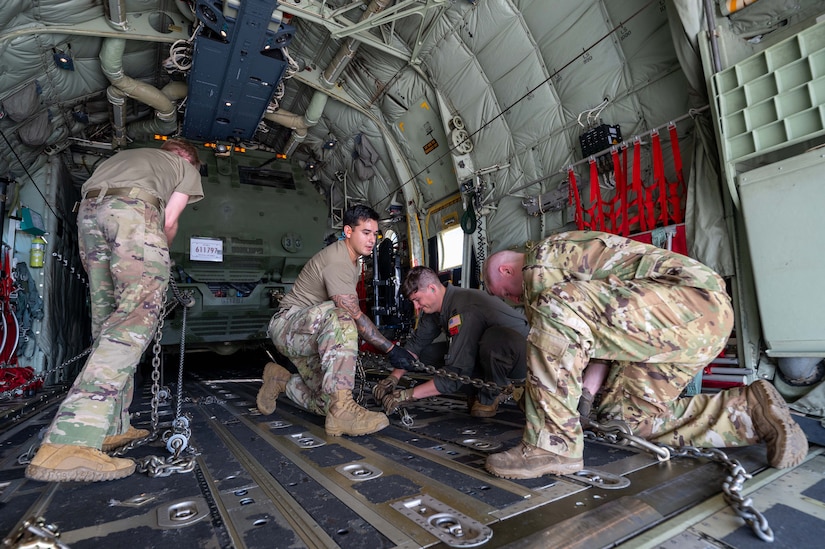
The training gave personnel an opportunity to practice emerging tactics, techniques, and procedures that allow C-130 Hercules aircrews to reload ammo pods into a High Mobility Artillery Rocket System without any material handling equipment, a process known as HIMARS direct reload inside plane. 

Three men wearing camouflage military uniforms and another man wearing coveralls attach chains to the floor of a military cargo aircraft. The chains are securing a military vehicle inside the aircraft that is in the background.

 
This marked the first time on record that an Air Mobility Command aircrew within Pacific Air Forces has executed this process, as the 36th Airlift Squadron continues to develop homegrown training events designed to refine the skills needed to support operations in austere environments. 
 
"[This process] pushes and furthers the C130's capabilities for supporting HIMARS and [rapid insertion] operations," said Air Force Tech. Sgt. Trevor Humes, 36th AS instructor loadmaster. "By practicing rapid reload operations, we better enforce the lethality of our joint partners while reducing everyone's period of vulnerability. Being able to practice austere operations proves our readiness for contested environments." 

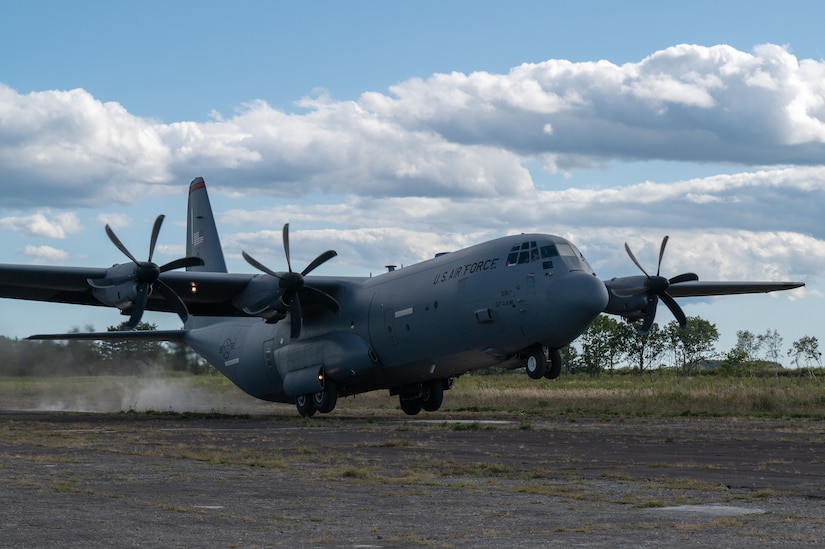
A large gray military cargo aircraft takes off from a runway. There is a field and trees in the background.

 
The first day of the mission began with aircrews from the 36th AS departing in two C-130J Super Hercules aircraft from Yokota Air Base to Kadena Air Base, where they met MC-130J Commando II personnel assigned to the 353rd Special Operations Wing, along with Marines from the 3rd Battalion, 12th Marine Regiment, 3rd Marine Division. 
 
The 353rd SOW is currently writing checklists and procedures for the direct reload mission in conjunction with the 561st Weapons Squadron and provided the 36th AS with the draft publications necessary to prepare them for mission execution. 

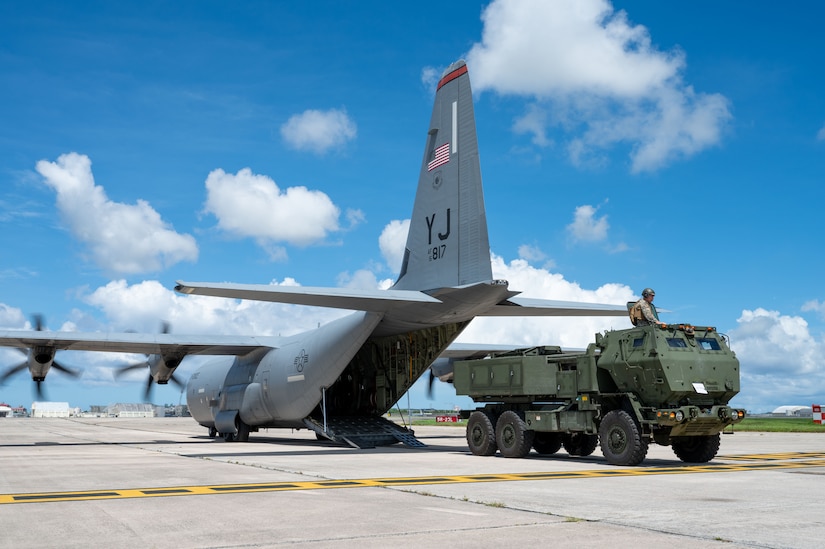
A man wearing a camouflage military uniform stands in the open hatch of a large green military vehicle as it backs into a gray military cargo aircraft on a tarmac.

 
Additionally, 353rd SOW personnel provided hands-on training to 36th AS aircrews, guiding them through the process of loading an ammo pod into a HIMARS. 
 
The 353rd SOW conducts missions requiring unique skill sets, so expanding the training to 36th AS personnel increases the number of C-130 aircrews capable of maneuvering and sustaining joint operations in the Pacific theater. This added capacity is valuable if the special operations wing is tasked with a low-density, high-demand mission. 
 
Other units at Kadena Air Base further augmented the 36th AS to ensure a successful training. 

A man wearing a camouflage military uniform guides a military vehicle into the back a large military cargo aircraft. There are four other service members in similar attire standing outside the aircraft on the tarmac.

 
"This mission wasn't accomplished by one unit," said Air Force Col. Donavan Laskey, 374th Airlift Wing deputy commander. "It was accomplished by multiple units coming together as one team to show what we can do in a joint and combined environment. Our partners from the Marine Corps, 18th Wing, 733rd Air Mobility Squadron and 353rd Special Operations Wing played key roles in making it happen, and it is this kind of teamwork that ensures we are ready to respond whenever and wherever needed." 
 
The 36th AS aircrews departed Kadena the following day for Kenebetsu Air Base, transporting a HIMARS on one C-130J and two ammo pods on another. They then applied the direct reload procedures they had practiced the day before, demonstrating rapid reloading in a realistic environment without traditional support or infrastructure. 
 
This proved to be an invaluable experience for some of the newer aircrew members. 

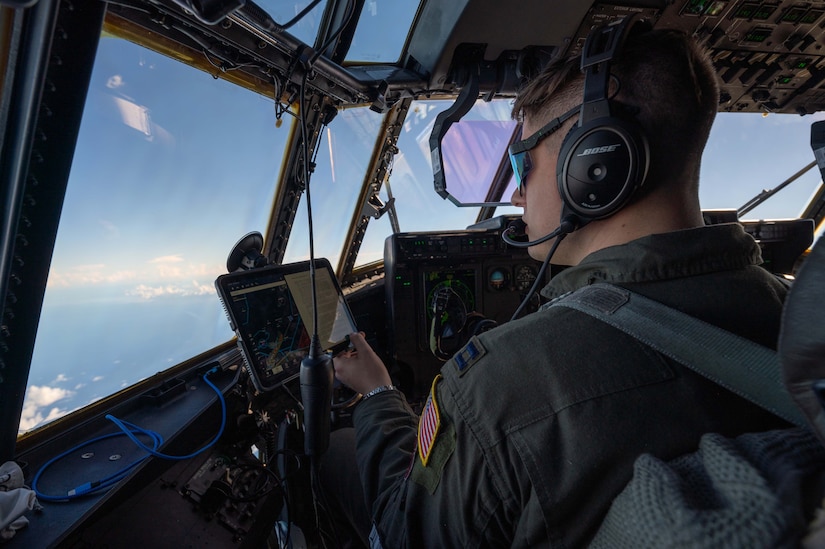
A man wearing a flight suit, sunglasses and a headset looks at a tablet screen while sitting in the cockpit of a military cargo aircraft. The aircraft is flying, and you can see clouds outside the windows of the cockpit.

 
"As a new airman, being part of this training gave me valuable insight into how we prepare for real-world contingency operations," said Air Force Airman 1st Class Andrew Giorgio, 36th AS loadmaster. "It was eye-opening to see the operational capability of the C-130J and how it supports the mission." 
 
Flying crew chiefs assigned to the 374th Aircraft Maintenance Squadron also supported the training, performing regular tasks while augmenting the 36th AS loadmasters to expedite the process. 
 
Airmen assigned to Yokota Air Base regularly conduct training events to strengthen agile combat employment capabilities and build interoperability with joint partners in support of a free and open Indo-Pacific. As it looks ahead, the squadron plans to build on this training by increasing efficiency and advancing their ability to respond in the event of a combat mission. 
 
"Our feedback and experiences are shaping future publications for our airframe and fellow aviators," Humes said. "By practicing and honing these procedures, we can take these lessons learned and continue to push the capabilities of our aircraft and partners." 

Naval Hospital in Japan Tests Readiness During Mass Casualty Drill

Navy Medicine Readiness and Training Command Yokosuka, Japan, conducted a large-scale mass casualty drill Sept. 23, testing its ability to triage, treat and transport multiple simulated patients during a crisis.

The exercise included 10 simulated casualties, ranging from a femur fracture with controlled bleeding to complex scenarios such as punctured lungs, cardiac emergencies and burn injuries. Throughout the day, patients were received, stabilized and transferred, with the final casualty requiring medical evacuation through Naval Air Facility Atsugi.

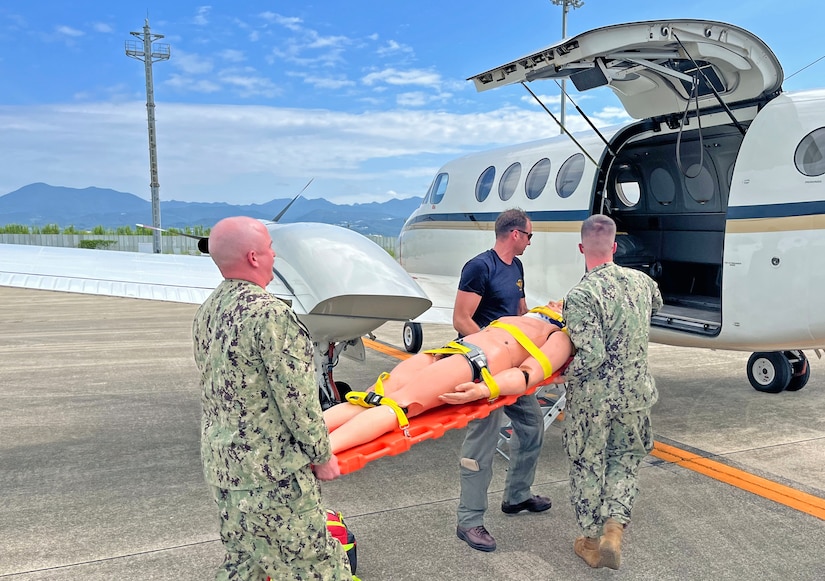
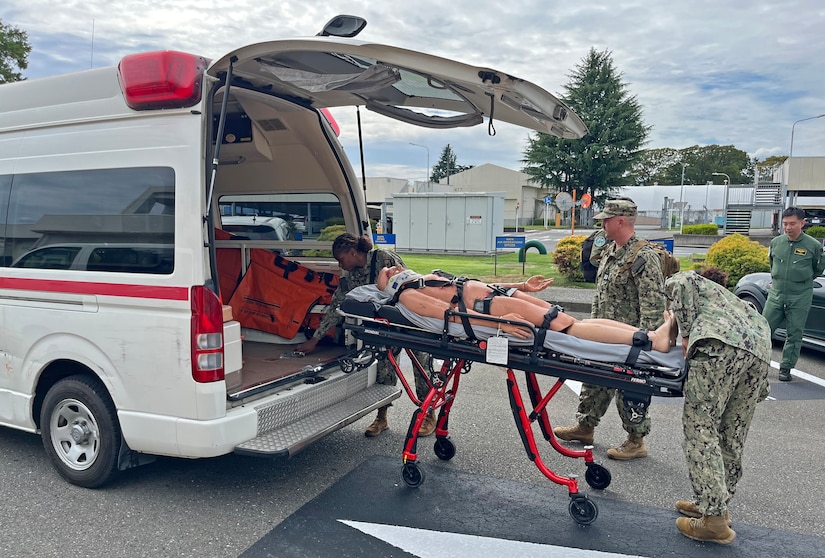
Two sailors wearing camouflage military uniforms and a man in civilian attire load a medical mannequin onto a medical jet.


In the culminating scenario, medical personnel from Navy Medicine Readiness and Training Unit Sasebo transferred a simulated casualty to Nagasaki Airport, where it was met by a C-12 Huron aircraft assigned to NAF Atsugi and a medical crew from NMRTC Yokosuka. The aircraft flew to Atsugi, where the patient was offloaded and transported by ambulance to Naval Hospital Yokosuka for further treatment.

"This drill gave us the opportunity to test not only our in-hospital care but also our coordination with outside commands, such as Fleet Air Western Pacific, to ensure rapid evacuation when needed," said Nikolai Kerry, emergency manager at NMRTC Yokosuka.

Navy Capt. Torrin Velazquez, commanding officer of NMRTC Yokosuka, emphasized the importance of integrating new patient transport and aviation evacuation procedures into the command’s training cycle.

"Testing these new capabilities is essential to building the kind of muscle memory that ensures our teams can respond instinctively when seconds matter," Velazquez said. "By practicing these processes until they come naturally, we strengthen our readiness and safeguard the lives of those who depend on us. I want to thank every sailor, civilian and partner command who played a role in making this exercise successful."

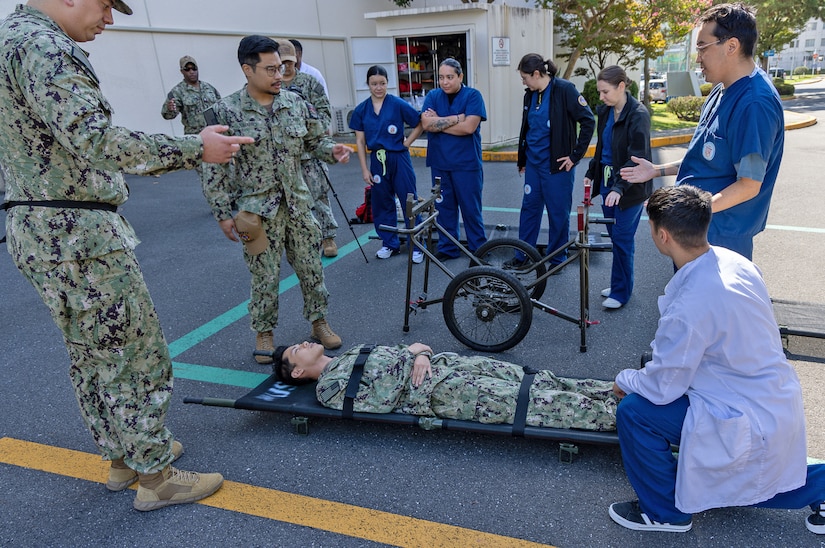
Two sailors wearing camouflage military uniforms speak to two medical personnel wearing scrubs as a sailor wearing a camouflage military uniform is lying on the ground strapped to a stretcher. Other people dressed in medical scrubs stand by and observe.


Mass casualty drills are designed to prepare medical providers, first responders and supporting personnel for large-scale incidents such as natural disasters, terrorist attacks or major accidents. These events test readiness by requiring participants to triage patients, allocate limited resources and coordinate across commands in time-sensitive situations.

"While the scenarios are simulated, the pressure is real," Kerry said. "These drills highlight gaps in our procedures, strengthen teamwork across agencies, and most importantly, help us save lives when an actual emergency happens."

The exercise featured realistic injuries on a timed schedule to challenge hospital personnel. Early scenarios focused on orthopedic trauma, such as wrist and ankle fractures, while later patients presented more medically complex cases, including pregnancy issues and cardiac conditions.

Drills like this benefit both the Navy and the broader community by improving readiness, refining processes and ensuring all personnel know their roles in a crisis. NMRTC Yokosuka conducts mass casualty drills at least once or twice a year, often in partnership with other Navy installations and commands.

Three sailors wearing camouflage military uniforms load a medical mannequin into the back of an emergency vehicle.


"This kind of training goes beyond the hospital walls," Kerry said. "By practicing in different environments and with different partners, we ensure we’re prepared for anything — from a disaster on base to a real-world emergency at sea."

The day concluded with the successful execution of the simulated casualty transfer from Sasebo to Yokosuka, underscoring the importance of interoperability and rapid response across Navy medical facilities in Japan.

Medal of Honor Monday: Army 1st Lt. Frank Luke Jr.

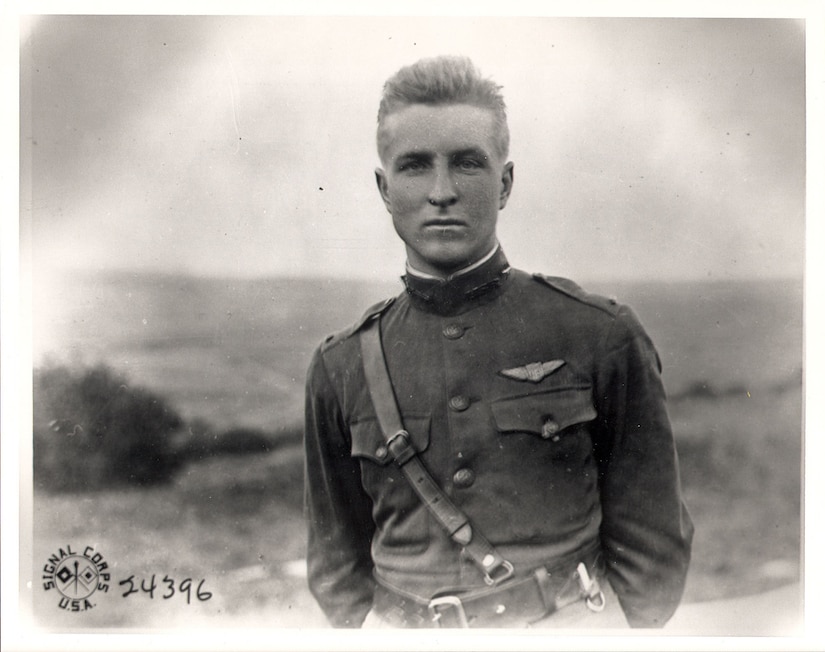
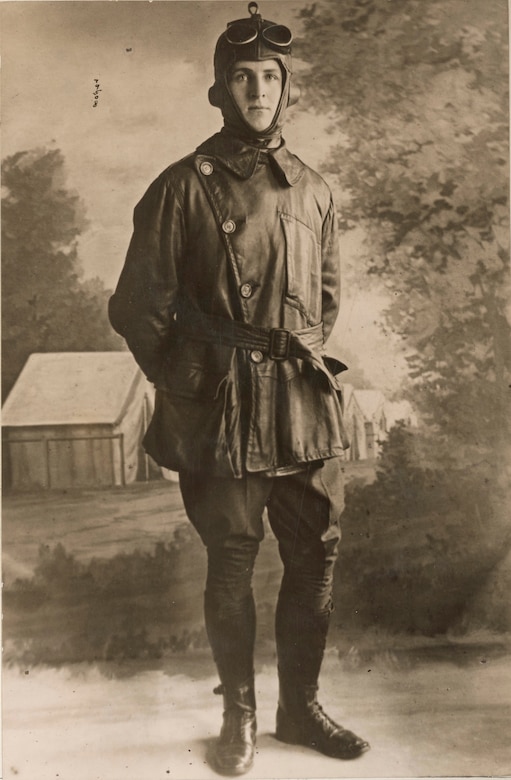
Aviation was in its infancy during World War I, but Army 1st Lt. Frank Luke Jr. took to it like a duck to water. Earning the nickname the "Arizona Balloon Buster" for the high number of enemy observation balloons he shot down, Luke was known as the most spectacular air fighter of the war. He didn't make it home, but his heroics in the sky made him the first Army aviator to receive the Medal of Honor.  

A man in a military dress uniform poses stoically for a photo.

Luke was born May 19, 1897, in Phoenix. He was the fifth of nine children born to his parents, Tillie and Frank Luke Sr.  

Luke grew into a strong young man. He was known as one of the best athletes at Phoenix Union High School, where he was the track team captain and a member of the basketball and football teams. According to a speaker at his Medal of Honor ceremony, one time he even saved the life of a friend who was struggling to cross a stream when they went camping.  

In September 1917, a few months after the U.S. entered World War I, Luke enlisted in the Army Signal Corps' Aviation Section, which transformed in April 1918 to the Army Air Service. Luke learned to fly aircraft at Rockwell Field in San Diego, receiving his wings and a commission to second lieutenant in January 1918.  

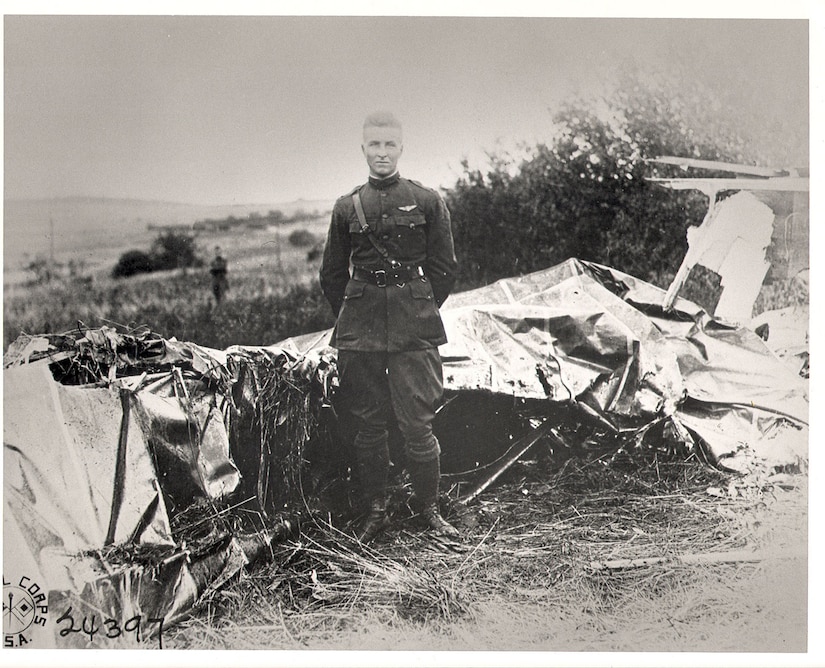
A man dressed in a military uniform stands stoically in front of a crumpled pile of metal.

Soon after, Luke was sent to France for additional combat training, which he completed in May 1918. From there, he went to Cazaux, France, to serve on the Western Front with the 1st Pursuit Group, 27th Aero Squadron. On Aug. 16, 1918, Luke took down his first enemy aircraft in combat.  

In the short amount of time Luke spent overseas, he earned the reputation of being a bit of a loner who occasionally ignored orders and sought to destroy the enemy on his own. He did, however, team up with a friend, Army 1st Lt. Joseph Wehner, during the mid-September St. Mihiel Offensive. During that time, Luke shot down three aircraft, and the pair destroyed five German observation balloons, which Luke attacked frequently.  

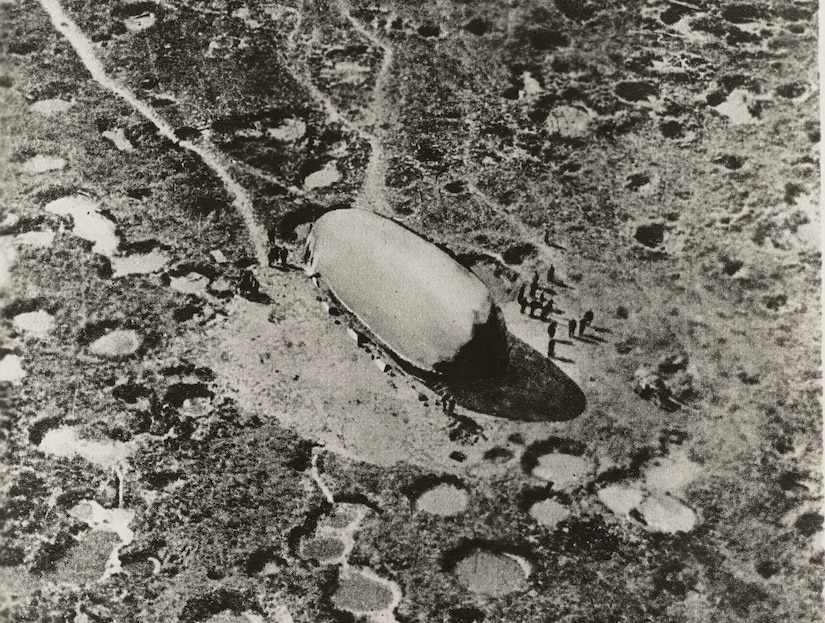
While tethered balloons don't sound like a difficult target, they were one of the toughest any pilot could face during World War I. The hydrogen-filled balloons were critical to the war's trench warfare environment, serving as observation posts that enabled both sides to look deep behind enemy lines. Observers in the balloons communicated with their leaders and adjusted artillery fire on the ground in real time to increase accuracy.  

A massive balloon sits on the ground with craters scattered around it. About a dozen people stand beside the balloon.

Because the balloons had such great tactical value, most were protected by heavy antiaircraft gun batteries, and there were often squadrons of airplanes ready to pursue anyone who considered going after them. Pilots who continually targeted the balloons were considered to have a death wish, historians said.  

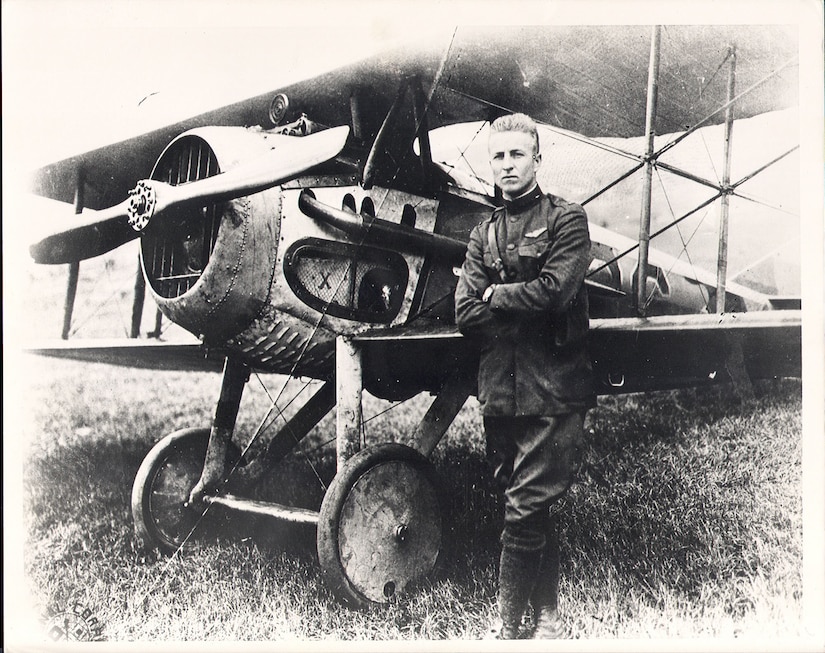
Luke's last flight — and his most valiant — happened on Sept. 29, 1918, near Murvaux, France. That day, he took to the skies in a French-built Spad XIII aircraft to go after enemy observation balloons, even though he hadn't received the proper permission, according to Air Force historians.  

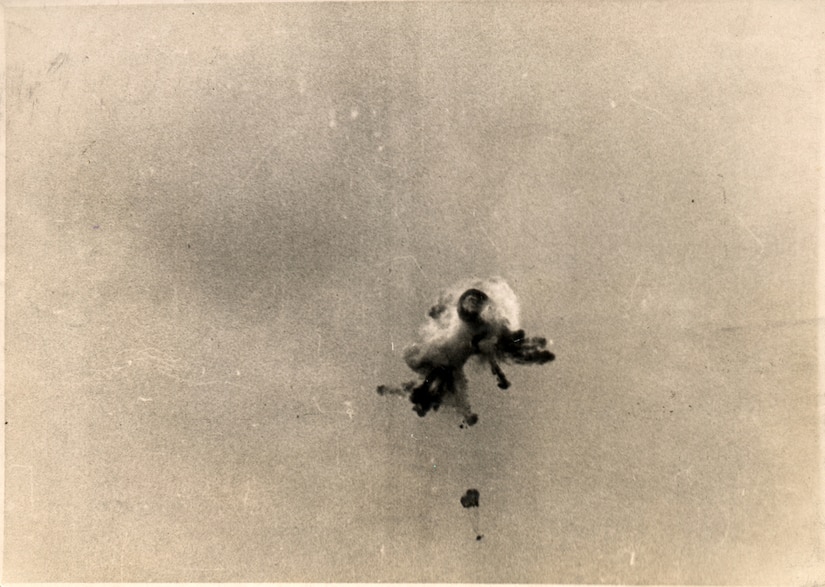
When Luke neared the enemy balloon line, eight German planes that were protecting it came after him. Despite the heavy fire he took from those planes and the ground batteries below, Luke didn't hesitate to attack back, shooting down three balloons. He then descended to within 50 meters of the ground and, with at least a dozen villagers watching, opened fire on enemy troops, killing six and wounding many more.  

Smoke and debris hang in the sky. A small parachute can be seen below the debris.

During the melee, Luke was also hit and severely wounded in the right shoulder. He was then forced to make an emergency landing in hostile territory. Surrounded by German forces on all sides who called on him to surrender, Luke refused. Instead, he drew his automatic pistol and fought back until he was killed.  

In Luke's brief career, he took down four airplanes and 14 balloons. His record of 18 "kills" stands second only to Army Capt. Eddie Rickenbacker's 26, according to the National Museum of the U.S. Air Force.  

Aside from the French villagers who made a sworn affidavit to what they saw Luke do that day, the fallen aviator's comrades also couldn't say enough about his bravery.  

A man in a World War I-era flight suit poses for a photo.

"No one had the sheer contemptuous courage that boy possessed. He was an excellent pilot and probably the best flying marksman on the Western Front," said Army Maj. H.E. Hartney, Luke's commander. "We had any number of expert pilots, and there was no shortage of good shots, but the perfect combination — like the perfect specimen of anything in the world — was scarce. Frank Luke was the perfect combination." 

On May 29, 1919, Luke's father received the Medal of Honor on his son's behalf from Army Brig. Gen. Howard R. Hickok. Luke, who also received two Distinguished Service Crosses, was then posthumously promoted to first lieutenant.  

Rickenbacker also received the Medal of Honor for his actions during the war, but it wasn't awarded to him until 1930.  

Luke was initially buried by the Germans in the area where he fell; however, he was later moved and buried in a grave in the Meuse-Argonne Cemetery in Romagne-sous-Montfaucon, France.  

His Medal of Honor was donated to the National Museum of the U.S. Air Force at Wright-Patterson Air Force Base, Dayton, Ohio.  

A man wearing a military uniform with his arms crossed over his chest stands in front of a propeller aircraft.

Luke's valor has certainly not been forgotten. On Armistice Day in 1930, before it became known as Veterans Day, a statue of his likeness was unveiled at the grounds of the Arizona State Capitol building in Phoenix. Luke Avenue on Joint Base Elmendorf-Richardson, Alaska, was also named for him.  

But perhaps his best-known namesake would be the one right near where he grew up: Luke Air Force Base outside of Phoenix was named in his honor in 1949. 

Sunday, September 28, 2025

The History of Military Awards and Decorations: Global Traditions and the American Experience

Throughout history, societies have sought ways to honor those who demonstrated courage, loyalty, and sacrifice in battle. Military awards and decorations serve as visible tokens of recognition, bestowed upon soldiers not only to commemorate their actions but also to inspire others and reinforce collective identity. They range from medals for valor to badges of service and campaign ribbons that chronicle a soldier’s career.

While the practice of honoring warriors is ancient, the form and meaning of military decorations have evolved with political systems and cultural values. Monarchies tied awards to nobility and fealty, empires used them to solidify loyalty, and modern republics adapted them to reflect merit, inclusivity, and service. This essay surveys the global history of military awards and decorations with emphasis on the United States. By tracing their origins, comparing different nations’ practices, and examining the purposes and critiques of such honors, we can see how decorations mirror the societies that create them.


Origins of Military Awards in Antiquity

The earliest recognizable military decorations can be found in ancient civilizations. In Greece, victorious athletes and warriors received laurel wreaths, symbols of honor tied to civic pride (Poliakoff, 1987). The Romans systematized decorations into a complex hierarchy of crowns, such as the corona civica (oak crown) awarded for saving the life of a fellow citizen, and the corona muralis (wall crown) given to the first man to scale an enemy wall (McDonnell, 2006). These honors were not ornamental; they were highly prestigious, often granting lifelong privileges, including seats of honor at public games.

Outside the Mediterranean, Chinese dynasties bestowed courtly titles, robes, and banners on distinguished generals, while Islamic caliphates often rewarded service with khil‘a—robes of honor symbolizing favor and legitimacy. In all cases, the decorations underscored values of courage, loyalty, and service to the state or ruler.


Medieval and Early Modern Traditions

During the Middle Ages, military awards took the form of chivalric orders, many of which survive today as ceremonial institutions. King Edward III of England founded the Order of the Garter in 1348, granting it to loyal nobles and distinguished knights (Risk, 1965). In Burgundy, Philip the Good established the Order of the Golden Fleece in 1430, intertwining military honor with dynastic prestige.

The Ottoman Empire used jeweled weapons and symbolic garments to mark service, while in Renaissance Europe medals emerged as standardized objects. By the 16th century, monarchs were issuing portable decorations that could be worn on the body or uniform, signaling a shift toward recognizability and universality. These awards were both political tools and instruments of hierarchy, reinforcing fealty while publicly displaying royal gratitude.


18th–19th Century Developments: The Birth of Modern Decorations

The 18th and 19th centuries marked the true emergence of modern military honors. In Prussia, Frederick the Great created the Pour le Mérite in 1740, often awarded for acts of courage and leadership. France under Napoleon broke with aristocratic exclusivity by establishing the Legion of Honor in 1802. This decoration could be granted to soldiers of any class, symbolizing the revolutionary ideal of meritocracy (Werlich, 1974).

Britain’s Victoria Cross, instituted in 1856 during the Crimean War, further democratized valor awards. Its plain bronze design emphasized equality: it could be awarded regardless of rank. Across the Atlantic, the young United States experimented with its own traditions. George Washington established the Badge of Military Merit in 1782, a purple cloth heart awarded for “instances of unusual gallantry” or meritorious service. Although awarded only three times, it set a republican precedent for merit-based recognition (Kerrigan, 2006).

During the Civil War, Congress authorized the Medal of Honor (1861 for the Navy, 1862 for the Army). Initially awarded liberally, it became the cornerstone of U.S. military decorations, representing the nation’s highest recognition for valor. This period solidified decorations as permanent, structured elements of military culture.


The United States: Building a System of Recognition

Revolutionary Roots and the Civil War

The Badge of Military Merit embodied Washington’s vision of a republic that valued service over aristocratic privilege. Although it lapsed after the Revolution, the concept resurfaced in the 20th century with the revival of the Purple Heart in 1932, linking contemporary sacrifice to the nation’s founding ideals (Kerrigan, 2006).

The Medal of Honor, by contrast, became the preeminent U.S. award during the Civil War. Initially given to more than 1,500 soldiers for actions ranging from valor to simple service, its prestige was diluted. In the early 20th century, review boards rescinded many awards, tightening standards to preserve its significance (Borch, 2013).

World Wars and Expansion

World War I catalyzed the creation of additional awards to fill the gap between the Medal of Honor and lower service recognitions. The Distinguished Service Cross, Distinguished Service Medal, and Silver Star emerged, recognizing acts of gallantry and meritorious service short of the highest award. The Distinguished Flying Cross honored aviators, reflecting new domains of warfare (Borch, 2013).

In 1932, the Purple Heart was formally reestablished to honor those wounded or killed in action, directly connecting modern soldiers to Washington’s original badge. World War II saw further expansion, including the Bronze Star and a range of campaign and service medals to recognize broad participation in theaters of war. The Good Conduct Medal honored enlisted service members for discipline and dedication.

Cold War and Modern Conflicts

During the Cold War, the U.S. created Joint Service awards to reflect inter-branch cooperation, as well as humanitarian and achievement medals for non-combat contributions. The Vietnam War introduced the Combat Action Ribbon and other decorations tailored to new types of conflict.

In recent decades, operations in Iraq and Afghanistan led to new campaign medals and continued refinement of criteria for valor. Unit citations and multinational medals (such as NATO awards) reflected coalition warfare. At the same time, controversies arose over recognition disparities, leading to posthumous upgrades of awards for minority veterans long overlooked (Smith, 2017).

The modern U.S. system balances combat valor, meritorious service, and inclusivity, with ribbons and medals collectively forming a visible résumé of a service member’s career.


Comparative Perspectives: Other Nations

Although the United States has developed a distinctive system, its traditions parallel those of other countries.

  • United Kingdom: The Victoria Cross remains Britain’s highest award for valor, granted sparingly. Other honors, such as the Distinguished Service Order and Military Cross, fill the hierarchy. British culture emphasizes gallantry and individual courage (Duckers, 2004).

  • France: The Legion of Honor continues as both a military and civilian award, symbolizing republican ideals. The Croix de Guerre, established in World War I, specifically honors combat bravery.

  • Russia and the Soviet Union: Tsarist Russia created the Order of St. George in 1769, while the Soviet Union established the Hero of the Soviet Union award in 1934. Post-Soviet Russia continues with the Hero of the Russian Federation.

  • Japan: The Order of the Rising Sun, established in 1875, recognized distinguished service, while modern Japanese awards reflect postwar pacifism.

  • China: The People’s Liberation Army maintains a system of honors, including the Order of August 1st and the Medal of the Republic, reflecting socialist ideology and revolutionary continuity.

These comparative examples show that while the form of awards differs, their purpose—to embody national values and reward sacrifice—remains constant.


Purposes and Critiques of Military Awards

Military awards serve multiple purposes. They recognize individuals, boost morale, encourage continued service, and serve as tools of propaganda and diplomacy. Ceremonies confer legitimacy upon governments and bind soldiers to institutions.

Yet awards are not without controversy. Some critics argue that the proliferation of medals dilutes their meaning. Others highlight inequities: women and minority service members historically received fewer awards, often corrected only decades later (Smith, 2017). Political considerations sometimes influence decisions, leading to disputes over fairness. In the United States, the 2005 Stolen Valor Act highlighted concerns about fraudulent claims, underscoring the symbolic power decorations still hold.


The Symbolism of Decorations

Beyond practical recognition, military awards function as symbolic language. Ribbons and medals worn on uniforms act as visible biographies, telling the story of where a soldier has served and what they achieved. A rack of ribbons is not merely decoration but a portable record of honor, sacrifice, and identity. Ceremonial presentations reinforce values of service and continuity, making awards both personal and institutional symbols.


The Future of Military Awards

As warfare evolves, so too must the systems of recognition. Cyber warfare, remote drone operations, and hybrid conflicts raise questions about how to honor nontraditional combat roles. Similarly, humanitarian missions, peacekeeping, and disaster relief increasingly dominate military activity, requiring awards that capture these contributions. Debates over modernization, inclusivity, and global coalition recognition will shape future systems. What remains unchanged is the need to honor those who serve.


Conclusion

From Roman crowns to modern medals, military awards have always mirrored the values of their societies. They have served as tools of loyalty, honor, and remembrance. The United States, drawing on republican ideals, created a system that prizes merit and inclusivity while adapting to modern warfare. Compared with global traditions, the American system reflects both continuity and innovation.

Ultimately, decorations are more than metal and ribbon. They are cultural texts, embodying sacrifice and service across generations. As new challenges emerge, the practice of honoring soldiers will remain vital—not merely for individuals but for the societies that send them into harm’s way.


References

Borch, F. L. (2013). Medals for Soldiers and Airmen: Awards and Decorations of the United States Army and Air Force. McFarland.

Duckers, P. (2004). British Military Medals: A Guide for the Collector and Family Historian. Shire Publications.

Kerrigan, M. (2006). Military Medals of the United States. Chartwell Books.

McDonnell, M. (2006). Roman Manliness: Virtus and the Roman Republic. Cambridge University Press.

Poliakoff, M. (1987). Combat Sports in the Ancient World. Yale University Press.

Risk, J. C. (1965). The History of Orders and Decorations. Swan Sonnenschein.

Smith, T. E. (2017). Honor, Service, and Valor: A History of Military Decorations in the United States. University Press of Kansas.

Werlich, R. (1974). Orders and Decorations of All Nations: Ancient and Modern, Civil and Military. Quaker Press.

National Park Service. (2025). Military Awards and Honors: Historical Resources. U.S. Department of the Interior.ards (from the Badge of Military Merit to modern campaign medals) to accompany the essay?

Saturday, September 27, 2025

U.S. and UAE Conduct 9th Joint Military Dialogue

 Sept. 27, 2025

From September 25-26, senior delegations from the United Arab Emirates (UAE) and the United States (U.S.) convened in Abu Dhabi for the 9th U.S.-UAE Joint Military Dialogue (JMD).  The UAE delegation was led by Assistant Under Secretary for Policy & Defense Communication His Excellency Ali Al Ahmed and the U.S. delegation was led by Assistant Secretary of War for International Security Affairs, The Honorable Daniel Zimmerman.

The JMD is the preeminent bilateral forum for advancing the U.S.-UAE defense partnership, providing an opportunity to review common security concerns, develop joint approaches, and advance shared goals in support of a more secure and prosperous UAE and broader Middle East region. 

The delegations discussed a range of bilateral and regional defense issues, including integrated air and missile defense, military cooperation, foreign military sales, and emerging capabilities development. The JMD provided an opportunity for delegations to build out the newly announced partnerships between the U.S. Defense Innovation Unit (DIU) and the UAE's Tawazun Council, as well as the UAE and the Texas National Guard under the State Partnership Program.

The United States and the UAE reaffirmed their commitment to a strong and mutually beneficial bilateral defense relationship, and to enhancing military-to-military cooperation, joint capability development, and long-term defense alignment between the two nations. As Major Defense Partners (MDP), the two sides agreed to deepen their cooperation across multiple domains to advance shared objectives, including a commitment to sign a Special Operations Forces Statement of Intent in the near future. The UAE is one of two countries that was designated by the United States as an MDP. The United States and UAE will continue to invest in this critical partnership on the basis of mutual respect, common interests, and a shared vision of peace through strength.