Showing posts with label pentagon. Show all posts

Tuesday, August 18, 2026

One War Department Unit Takes Next Step in Legacy of Innovation

Seven months ago, Secretary of War Pete Hegseth stood before a large crowd of Lockheed Martin employees in Texas, during the third stop of his nascent Arsenal of Freedom tour, to show his appreciation for the people behind the defense industrial base.
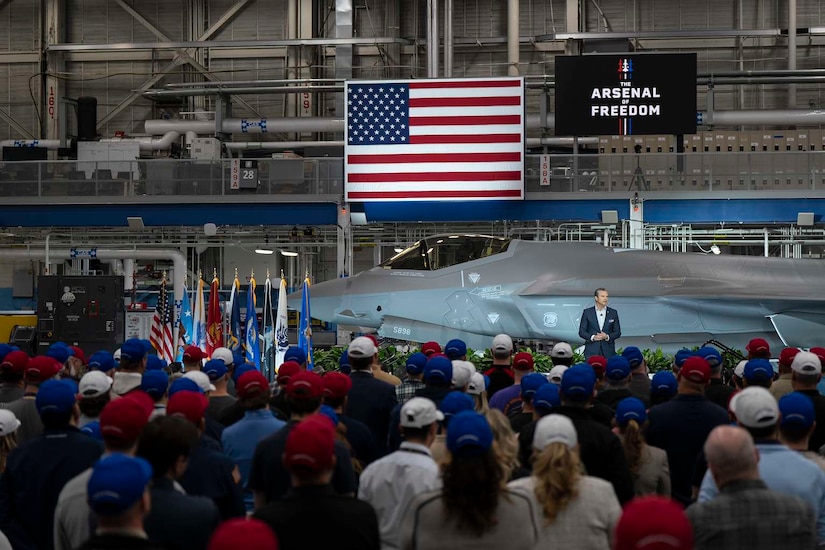
A man in business attire stands on a stage in a hangar and speaks to a large crowd of people in casual attire and baseball caps; behind him is a military aircraft, an American flag and a banner that reads, “Arsenal of Freedom.”

During his remarks, Hegseth made clear that supercharging the defense industrial base, which is one of the four lines of effort in the 2026 National Defense Strategy, is something the current administration and the War Department want to see happen at a rapid clip.

"We've got to go fast. The warfighters need it; they deserve it. We've got near-peer adversaries that are building at record speed," Hegseth said. "[This] Arsenal of Freedom tour is meant to speak to you and your peers, and to tell you to keep going."   

To facilitate that need "to go fast," the War Innovation Unit — formerly the Defense Innovation Unit and still abbreviated as DIU for contractual purposes — is working to cut through red tape with the defense industrial base.  

Founded in 2015, DIU is purpose-built to accelerate the War Department's adoption of commercial technology at speed and scale to lower cost and increase combat power. Since January, it has been working to answer Hegseth's call for the expedited acquisition of commercial capabilities across the services in several ways. 

Its latest initiative is the Bridge Program.   

Conceived and developed over the past year by Sarah Pearson — a former Navy officer, technology executive and current chief of strategic initiatives at DIU — the Bridge Program was created to drive long-term, systemic reform across the War Department.
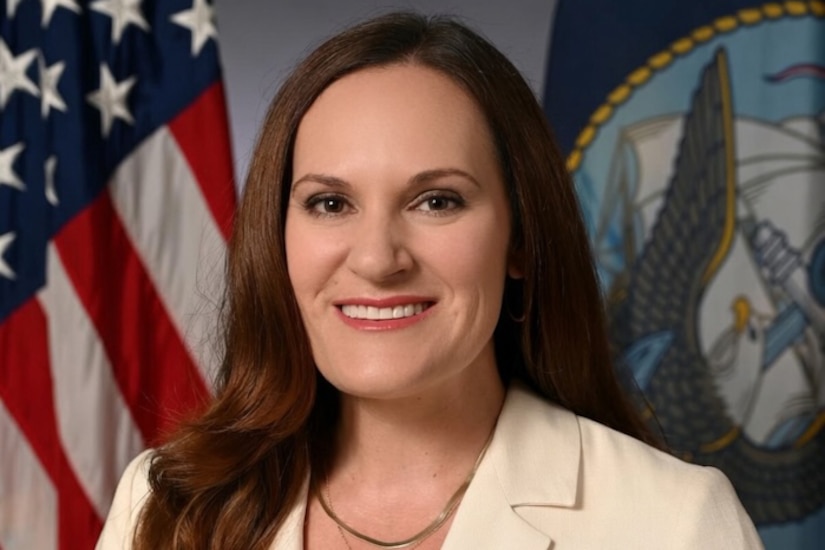
A woman in business attire poses for a portrait; behind her are the American flag and the U.S. Navy flag.

Throughout her career, Pearson has witnessed firsthand the hurdles nontraditional companies face when attempting to sell and scale commercial solutions for the military. 

Under her direction, the Bridge Program is now executing a targeted strategy to eliminate critical bottlenecks — specifically around security clearances, access to classified spaces, technology accreditations and testing.  

By dismantling these operational barriers, the program seeks to broaden the War Department's commercial engagement aperture, mitigate risks, accelerate capability development and maximize adoption rates to deliver best-in-class commercial technologies directly to the warfighter. 

The program's first line of effort focuses on evolving the model for classified space design, construction, accreditation and operation.  

By blending commercial technologies, process improvements, rapid contracting, policy and Congressional support, the department is jointly addressing each aspect of the value chain around classified infrastructure.  

"When successful, we will have demonstrated a new model, a model where classified infrastructure is resourced based upon usage and becomes operational within months — not years — of the need arising," Pearson said.  

Furthermore, she emphasized the critical importance of continued close collaboration within the War Department.  

"Our partners within three offices — the offices of the undersecretary of war for intelligence and security; acquisition and sustainment; and research and engineering — as well as the Defense Intelligence Agency, the Defense Counterintelligence Security Agency and the armed services have been the single greatest unlock in achieving the early success we've seen so far," Pearson said. 

DIU's Bridge Program, and the broader working group across the aforementioned organizations, had its first major contracting announcement last month, when President Donald J. Trump announced a $10 billion investment in Pennsylvania's defense industry July 16.  

The announcement included investment in four shared commercial classified facilities, one of which will be built in Pittsburgh — using the joint funding model that the Bridge Program is prototyping.  

Beyond Pittsburgh, the Bridge Program has contracted for nine additional commercially owned and operated sites across the U.S., including Austin, Texas; San Francisco; Boston; Charleston, South Carolina; Chicago; Cleveland; Louisville, Kentucky; and New York. 

Additional locations will be announced in the coming weeks.

The Bridge Program's second line of effort focuses on establishing the fastest and most trusted accreditation portfolio within the department — something Pearson said can't be accomplished without deep cybersecurity expertise — a thoughtful approach to risk and incorporation of the world's best artificial intelligence capabilities.

By using technology to enhance and accelerate DIU's authorization process, the Bridge Program team will condense timelines and enable greater throughput with fewer resources.

"We plan to shift the risk management framework process to the left in prototype development and build cybersecure solutions that the services can more easily field. Indexing toward accreditations for every program and sooner in development are critical to adoption," Pearson explained.

The third line of effort — test and evaluation — draws on DIU's core competency, prototyping commercially derived technologies inside the department's developmental and operational test infrastructure.

Through partnership, technology and new approaches, Pearson said DIU is building an end-to-end test approach for portfolio companies entering the prototype pipeline, with testing opportunities throughout the contract lifecycle.

The result is a process that stitches capability development together with existing and emerging test infrastructure, for both physical and digital applications.

As DIU continues to expand and implement the Bridge Program in support of Hegseth's call to revamp and expedite the acquisition process, Pearson said it will continue to lean on unprecedented partnership across the department, its history of pioneering new approaches and its deep conviction that the warfighters deserve the best capabilities available.

Friday, November 14, 2025

Department of War Name Set in Bronze at Pentagon Entrances

 Nov. 13, 2025 | By C. Todd Lopez, Pentagon News

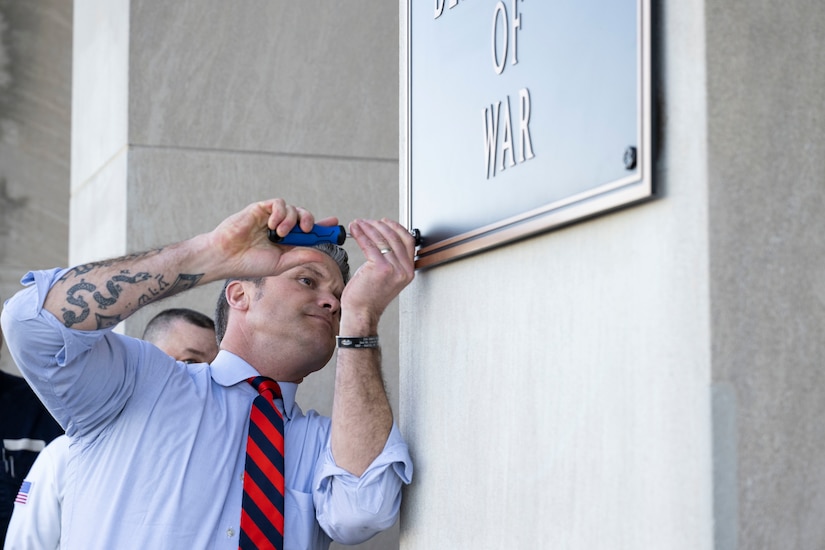
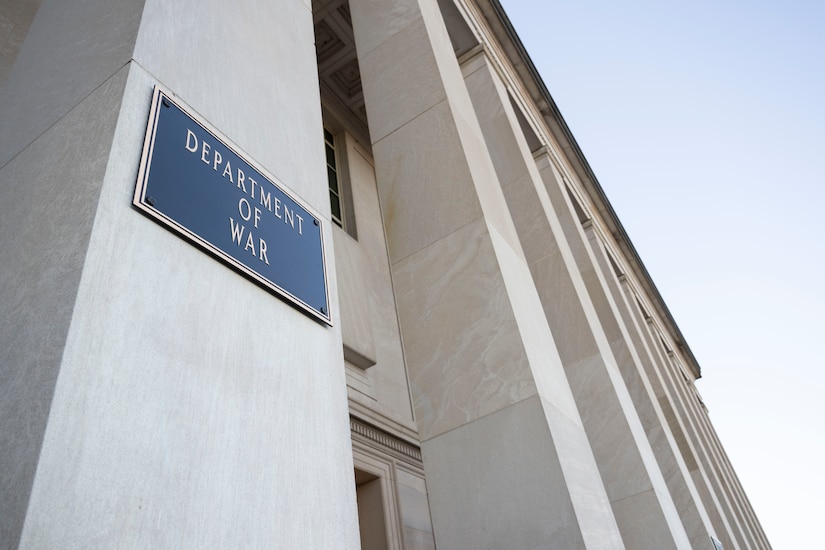
At the Pentagon today, facilities personnel took down outdated bronze plaques at two of the building's entrances and replaced them with recently minted plaques bearing the new name of the federal agency that leads America's fighting force: "Department of War."

A person in business attire uses a screwdriver to secure a plaque to a concrete wall.

One of those new plaques was put up at the River Entrance, which faces the Potomac River and serves as the Pentagon's grand entrance. It's where Secretary of War Pete Hegseth greets counterparts from partner and allied nations, as well as other dignitaries and distinguished visitors. 

The Mall Entrance, which faces north toward the National Mall in Washington, also got a new sign. Outside that entrance are the Pentagon's helicopter landing pads. 

"We wanted to replace [the old signs] because we want everybody who comes through this door to know that we are deadly serious about the name change of this organization," Hegseth said. 

In early September, President Donald J. Trump signed an executive order changing the name of the Defense Department back to the War Department — a name the department held for more than 150 years, from 1789 to 1947. 

Construction on the Pentagon began in 1941 and was completed in 1943. When the building opened that year, it housed the Department of War. In fact, the dedication stone on the Pentagon — located outside the Mall Entrance — has "War Department" engraved at the top, along with the names of Franklin D. Roosevelt, who was president at the time, and Henry L. Stimson, who served as Secretary of War from 1940 to 1945. 

Now, the Pentagon again houses the War Department. 

A plaque on a wall reads "Department of War."

"We love everything that the Department of Defense represented," Hegseth said. "But this is a new era of the Department of War that is focused on winning wars ... and making sure that we know exactly what the mission is and that the troops are sent there to succeed and win." 

The name "Department of War," Hegseth said, harkens back to America's founding. 

"[We are] reestablishing [the department] back to Henry Knox and George Washington and the founding of our nation — to fight and win our nation's wars if called upon," he said. "And of course, the whole goal is to deter wars in the first place ... to establish peace." 

The new name also reflects a new ethos for the department, Hegseth said, after he personally fastened the last screw on the new River Entrance plaque. 

"We are rebuilding it; we are reestablishing deterrence — it's based on America first, peace through strength and common sense," he said. "And now everybody that enters this building, whether it's generals or civilians or foreign leaders, is going to see: this is not just on paper. This is not just a title. This is exactly who we are." 

The new bronze plaques are each roughly 30 by 20 inches and weigh about 60 pounds. 

The old plaques, which say "Department of Defense," had been on the building for more than 70 years, Hegseth said. 

Monday, September 29, 2025

Hegseth Speaks at Inaugural Gold Star Advisory Council Meeting

Secretary of War Pete Hegseth today chaired the first-ever meeting of the War Department's Gold Star Advisory Council, during which he vowed to improve the Pentagon's overall process for interacting with Gold Star families, including the department's Casualty Assistance Program.   

Gold Star family members are the surviving relatives of U.S. service members who died in the line of duty. 

Hegseth established the council — which is tasked with honoring the memories of fallen service members and ensuring their family members are never forgotten or left behind — in May with the signing of a memo. 

"For far too long — especially in our generation — there was just a big gap between what 'right' looks like and what reality was. Whether it's husbands or wives or fathers or mothers, the whole casualty assistance and Gold Star process was broken," Hegseth said, adding that Gold Star families should be welcomed into the arms of a grateful nation, rather than running into bureaucracy or being unable to get the answers they need. 

"Our charge here is that there's a lot of things that are broken [and] a lot of things that need to change. … We may not have broken them, but we're in charge now and we're going to fix them, and we're going to do everything we can," Hegseth said.  

The Gold Star Advisory Council will seek to elevate the voices of Gold Star family members directly to War Department leadership to "tackle real concerns and transform the casualty process for good," Hegseth told the media earlier in the day, adding that the council has his "full backing to call out the failures, shake up the bureaucratic status quo and drive the changes that will stick."  

Co-vice chairs of the council include Anthony Tata, undersecretary of war for personnel and readiness, and Gold Star wife Jane Horton, who also serves as a senior advisor to Hegseth. 

"As much as I can humanly understand — and I know I can't understand everything that each of you have been through — I know the responsibility I have … to make sure we get this right … and to make sure that we take care of all of you and everyone that you represent," Tata told the Gold Star family members in attendance.  

"And you have my commitment in that regard," he added. 

Horton told the Gold Star family members in attendance that it was an honor to serve them and to represent their fallen service members. She also said she has confidence in Hegseth's commitment to the council. 

"I know that [Hegseth] means it when he says that we're going to get things done and that there's going to be action behind these words," Horton said.   

During the meeting, Hegseth was sure to credit past efforts made by those who worked in the War Department's Gold Star program, stating that it wasn't for a lack of caring that the program had deficiencies. 

"It was just not enough concentration on forging that solution that really works and really shows the humanity to a process that is ultimately a human process," Hegseth said. 

"Hopefully we can aggregate all of that [previous hard work] with the authority of the secretary's office and drive some of that change that maybe just couldn't get done because it wasn't happening at this level," he added.    

Tuesday, September 16, 2025

Hegseth Welcomes Top Army Rangers to Pentagon

 Sept. 16, 2025 | By Matthew Olay, Pentagon News

Secretary of War Pete Hegseth hosted a pair of U.S. Army Rangers at the Pentagon today, following the soldiers having won the Army's 41st Annual David E. Grange Jr. Best Ranger Competition earlier this year. 

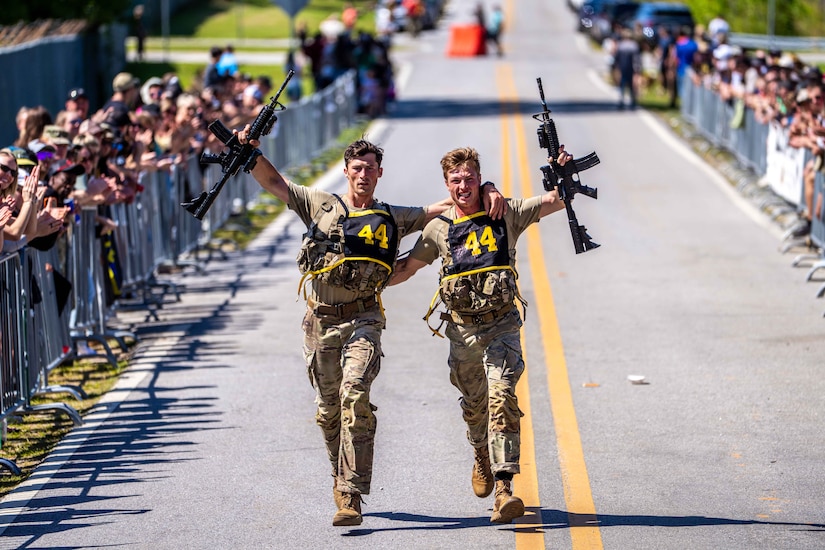
Two men in camouflage military uniforms run on a road with their arms around each other while holding rifles in the air. On either side of the road, long lines of spectators cheer them on.

Hegseth invited Army Capt. Kevin Moore and Capt. Griffin Hokanson — both from the 75th Ranger Regiment, and both of whom were first lieutenants at the time — to the Pentagon via social media, shortly after the two secured victory at the competition, April 13.  

Hegseth said he wanted to invite the soldiers to Washington because they exemplify the warrior ethos, a topic of which's restoration the secretary highly prioritizes within the War Department. 

"I think how you prepare is indicative of how you might perform, and preparing by performing at the highest level is exactly what we would want everybody to aspire to," Hegseth said after meeting with the Rangers in his office. 

He went on to say that the best of the best Army Rangers and the Best Ranger Competition embody the highest level of competition, and that bringing the Rangers to the Pentagon was a way to showcase excellence.  

"That's what it is: excellence … Our enemies know what we're capable of … [and] these two captains embody that," he added.  

Both Moore and Hokanson agreed that the annual event is directly linked to the warrior ethos.  

"I think competition is an extremely important part of that warrior ethos, driving everybody to higher levels and greater heights," Moore said, adding that he thinks the competition works to make the Army, as a whole, better.  

"For me, the warrior ethos is being an expert in your craft. And, as members of the [75th] Ranger Regiment, I feel like … that warrior ethos has always been there; and I think you can see that by the Ranger Regiment's performance in the Best Ranger Competition," Hokanson said.  

Prior to meeting with Hegseth, the two Rangers received a roughly 45-minute, private tour of the Pentagon that heavily focused on the Army's history. 

"The Pentagon tour, it's great. Coming from the Ranger Regiment, you kind of reflect on what the [Regiment's] been doing over the past 20-plus years, going back to the terrorist attacks that sparked our conflicts that we've lived through," Hokanson said.  

"I was a history major in college … [so] most of the stuff on that tour was actually quite interesting to me, and it's just very interesting to see everything that's out there," Moore said of the tour, adding that this was his first visit to the Pentagon. 

"It's been really incredible," he said.  

Held from April 11 to 13 at Fort Benning, Georgia, the 2025 Best Ranger Competition saw 52 teams from an assortment of Army units — including the Army National Guard — competing against each other in a series of challenges.  

Each day saw a number of teams getting cut from the competition, with Moore and Hokanson placing first in the competition's final event just prior to being named the competition's overall winners. 

This was the fourth year in a row that soldiers from the 75th Ranger Regiment were victorious in the competition. 

"Most people can't do 10 minutes of what you did, and yet, you did it for days and days on end and at a really high level," Hegseth told Moore and Hokanson while commenting on their success at this year's BRC. 

"That's why we wanted to celebrate and recognize [you]."  

Saturday, July 11, 2015

Carter Asks County Execs to Find New Ways to Work with Service Members, Vets


By Jim Garamone
DoD News, Defense Media Activity

WASHINGTON, July 11, 2015 – As the nation’s military adapts new strategies and personnel policies, Defense Secretary Ash Carter today asked counties and communities across America to consider new ways to provide service to troops and veterans.

Carter told the National Association of Counties conference in Charlotte, North Carolina, that as strategies change to keep America safe, personnel policies will change, too. Counties, cities and towns across America will be affected, he said.

“Our men and women don’t come from the Pentagon,” the defense secretary said. “They come from your communities. We recruit from your communities. Our service members and their families live in your communities while they’re serving, including our Guardsmen and reservists. And when they leave military service, they are, once again, in your communities.”

This is happening at a time when fewer Americans have a personal connection to the military, Carter said. From World War II to the advent of the all-volunteer force in 1973, three out of four Americans had a personal connection to the military. That number is now one in three and is likely to go down. Put another way, at the end of World War II, 10 percent of Americans were in the military. Today it is around 1 percent.

Department Seeks Talent

America’s military today is the “finest fighting force the world has ever seen,” he said. People are at the heart of that and attracting the right mix of people moving forward is key to military preeminence in the future.

Attracting and retaining men and women with high-demand talents and high-level skills means moving away from an Industrial Age recruiting and retention model, the defense secretary said.

“To attract and compete for talent in these new generations, we’re trying to build what I call the Force of the Future. We’re pushing to be attractive to this new generation,” Carter said. The military needs to be more geographically diverse, he said. There has to be “more on-ramps and off-ramps to give our people more choices” as DoD brings the personnel system into the 21st century.

“We’re drilling tunnels through the walls that too often separate government and the private sector particularly in scientific and commercial technology areas,” he said. “Because we need America’s brightest minds to contribute to our mission.”

DoD, Community Health Tied to Education

These changes will affect communities across the country, the defense secretary said. He noted that community schools are the wellsprings for future scientists and technology professionals and he urged members of the association to continue the recent emphasis on science, technology, engineering and math programs.

The bottom line is that counties and local communities “are the source of the American military’s enduring strength, because you provide our men and women in uniform the preparation, the care and the purpose they need to defend our country,” he said.

And when their military service is over, they will return to their communities. But even that will change, Carter said.

“Transition out of the military will look different than it did 70 years ago, or, for that matter, 10 years ago,” he said. “It’ll mean that in the future, some might only serve for a time, while others may spend 25 years moving back and forth between national service and other opportunities.”

Service members and their families may spend more time in communities without having to move around as often as they do now, Carter said.

Support Troops by Knowing Them

Each community is different, as are the foundations of preparation, care and purpose, the defense secretary said.

“People from urban areas and rural areas may have different ideas of what their community should look like,” he said. “Still, in a future where each community’s foundation should be different … there should be some elements that they have in common.

“For example, let’s make a future where more Americans nationwide strive not only to support our troops, but to know our troops. Let’s make a future where this is a two-way street where both military and civilian communities contribute to each other,” Carter said.

Embracing service members, veterans and their families also makes good sense for local jurisdictions, he said. When veterans come into communities, “empower them with opportunities to continue leading lives of meaning and purpose,” he told the conference-goers.

“To be clear, they aren’t looking for handouts,” Carter said.

Veterans are 20 percent more likely to give to charities, volunteer 30 percent more hours per year and are three times more likely to join a service or civic organization, the defense secretary said.

“The 9/11 generation volunteered to serve in a time of war, and they have a strong desire to continue making a difference in the world,” he said. “All it takes is finding the right opportunity.”

Wednesday, September 12, 2012

Obama: Lives Lost on 9/11 Ushered in Stronger Nation


By Cheryl Pellerin
American Forces Press Service

WASHINGTON – Eleven times, the nation has marked another Sept. 11 come and gone and paused in remembrance, reflection, unity and purpose, President Barack Obama said here today during a service at the Pentagon Memorial.

Joining the president on stage before a somber audience were Defense Secretary Leon E. Panetta and Army Gen. Martin E. Dempsey, chairman of the Joint Chiefs of Staff.

Behind them, a large American flag hung from the top of the Pentagon, draping over the side of the building like the one firefighters and soldiers unfurled that morning in 2001 during rescue and recovery efforts after hijackers crashed American Airlines Flight 77 into the Pentagon.

“This is never an easy day,” Obama said. “But it is especially difficult for all of you -- the families of nearly 3,000 innocents who lost their lives -- your mothers and fathers, your husbands and wives, your sons and your daughters. They were taken from us suddenly and far too soon.”

The president said no one can imagine the pain that surviving families and friends have endured or how difficult it has been for them to carry on and rebuild their lives.

“But no matter how many years pass, no matter how many times we come together on this hallowed ground, know this: that you will never be alone,” Obama said.

“Your loved ones will never be forgotten,” he added. “They will endure in the hearts of our nation because, through their sacrifice, they helped us make the America we are today -- an America that has emerged even stronger.”

The president noted that those who boarded the ill-fated airliners or went to work at the World Trade Center or the Pentagon on the morning of Sept. 11, 2001, had no inkling of what was to come.

“Most of the Americans we lost that day had never considered the possibility that a small band of terrorists halfway around the world could do us such harm,” Obama told the Pentagon audience.

“Most had never heard the name al-Qaida,” he said, “and yet it's because of their sacrifice that we've come together and dealt a crippling blow to the organization that brought evil to our shores. Al-Qaida's leadership has been devastated, and Osama bin Laden will never threaten us again. Our country is safer, and our people are resilient.”

Most of those who died on Sept. 11 had never worn the nation’s uniform, the president said, but they inspired more than 5 million Americans to enlist in the military services and do everything their country has asked over the past decade.

“Today, the war in Iraq is over. In Afghanistan, we’re training Afghan security forces and forging a partnership with the Afghan people. And by the end of 2014, the longest war in our history will be over,” Obama said. “Meanwhile, countless civilians have opened their hearts to our troops, our military families and our veterans.”

In 2001, memorial services were held for Americans of different races and creeds, backgrounds and beliefs, Obama said. “And yet,” he added, “instead of turning us against each other, tragedy has brought us together.”

American’s fight is with al-Qaida and its affiliates, not with Islam or any other religion, the president said. “This country was built as a beacon of freedom and tolerance,” he continued. “That’s what's made us strong, now and forever.

On a day when others sought to bring the nation down, its citizens choose to build it up with a National Day of Service and Remembrance, the president said.

“This anniversary allows us to renew our faith that even the darkest night gives way to a brighter dawn,” he said. “Today we can come here to the Pentagon and touch these names and kneel beside a building where a single stone still bears the scars of that fire.”

In Pennsylvania, anyone can visit the field of honor where one of the hijacked airliners crashed on 9/11 and remember the heroes who made it sacred, he added. In New York, water cascades into the footprints of the Twin Towers, and a new tower rises above the New York skyline.

“Though we may never be able to fully lift the burden carried by those left behind, we know that somewhere a son is growing up with his father’s eyes, and a daughter has her mother’s laugh -- living reminders that those who died are with us still,” Obama said.

When the history books are written, the president said, “the true legacy of 9/11 will not be one of fear or hate or division. It will be a safer world, a stronger nation, and a people more united than ever before.”

Earlier, on a cool morning that was much like the morning of Sept. 11, 2001, the president and First Lady Michelle Obama began the day with a simple ceremony of their own at the White House. Soon after 8:30 a.m., hundreds of White House staff gathered on the South Lawn in the shade of the portico and in patches of sun. Most stood with hands crossed in front of them, speaking in whispers.

At 8:45 a.m., two Marines appeared before the door beneath the portico leading onto the South Lawn. Another pair of Marines presented the colors -- one holding the flag, the other a trumpet.

At 8:46 am, about the time American Airlines Flight 11 struck the North Tower of the World Trade Center in New York in 2001, a full Marine color guard emerged from the doors, taking up a place on each side of an aisle left for the president and first lady.

The couple walked slowly down the grassy strip and stood with heads bowed as the Marine trumpeter began playing taps, then held hands as they walked back into the White House.

Friday, September 07, 2012

DOD to Host 9/11 Remembrance Ceremony


Secretary of Defense Leon E. Panetta will host a remembrance event at approximately 9:30 a.m. EDT on Sept. 11, at the Pentagon Memorial to honor the memory of those killed at the Pentagon in the 2001 terrorist attack.  This is an event for the family members of those lost in the terrorist attack and is not open to the general public.  The remembrance includes a wreath laying, a moment of silence, music and official remarks from Secretary Panetta and Chairman of the Joint Chiefs of Staff Gen. Martin E. Dempsey.

Media coverage of this event is limited to pre-determined pool coverage.

Opened on Sept. 11, 2008, the Pentagon Memorial is the first dedicated national commemorative to honor those killed during the 2001 terrorist attacks.  The Pentagon Memorial consists of 184 individual memorial units honoring the 59 people aboard American Airlines Flight 77 and the 125 in the Pentagon who lost their lives at 9:37 a.m. on Sept. 11, 2001.  For more information on the Pentagon Memorial, please visit http://www.whs.mil/memorial .

This event will be televised and streamed live via the Pentagon Channel and http://www.pentagonchannel.mil .