Showing posts with label 1st cavalry division. Show all posts

Monday, September 29, 2025

Army's 1st Cavalry Division Conducts First Switchblade 600 Live-Fire Exercise

As part of Pegasus Charge, 1st Cavalry Division's effort in support of the Army's "Transforming in Contact" initiative to modernize armored formations, soldiers assigned to the 2nd Armored Brigade Combat Team, 1st Cavalry Division, conducted Fort Hood's first live-fire exercise of the Switchblade 600 Loitering Munition System, Sept. 15. 

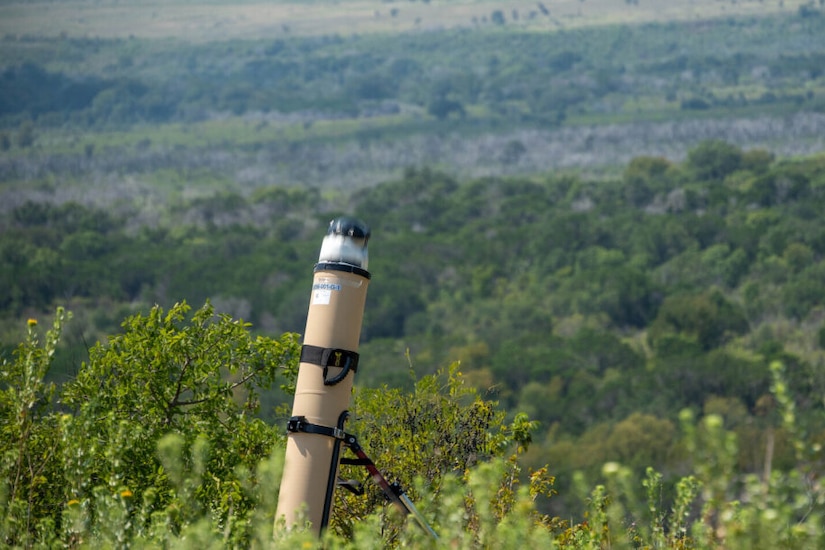
A tube-like military weapons system sits outside in a semi-wooded area.

 
The Switchblade 600 — a tube-launched, unmanned aircraft system — has already seen extensive use by Special Operations Forces, light infantry units and foreign partners. The 1st Cavalry Division is among the first armored units to field the system. 
 
"This is the first time for all of our soldiers to see these munitions fired, and you can feel the excitement in the air," said Army Capt. Jeffrey Weller, Multifunctional Reconnaissance Troop commander, 2nd Armored Brigade Combat Team, 1st Cavalry Division. "The Switchblade enables the brigade to engage targets with precision between 5 and 15 kilometers in front of our forward line of troops, extending our reach and lethality."

Modernizing the Fight

The Army's broader Transforming in Contact initiative aims to overhaul how armored formations fight by integrating new technologies, particularly drones and advanced communications.

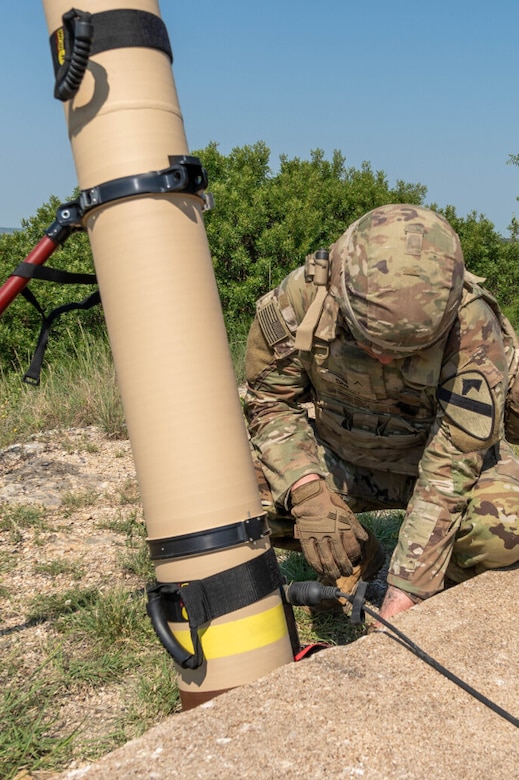
A person wearing a camouflage military uniform sets up a weapons system outside in a desert environment.

"A huge thing the Army has seen across multiple battlefields, whether in Ukraine or elsewhere, is the rapid modernization and high usage of drones," Weller said. "We're taking those lessons learned and revamping our [unmanned aircraft] systems to stay ahead of adversaries." 
 
Roughly 5 feet long and weighing 75 pounds, the battery-powered Switchblade 600 resembles a drone, but carries a Javelin multipurpose warhead. It has a flight time of 40 to 45 minutes, a range of up to 27 miles and delivers a 5-pound explosive payload. 
 
"It's a remote-controlled missile that flies like a drone until it gets to the target," explained a flight operations supervisor with the system's manufacturer. "The operator uses onboard cameras to identify, select and engage the target." 
 
Once launched from its tube, the Switchblade can navigate through waypoints, loiter over the target area and strike with precision. Operators also retain the ability to wave off a strike mid-flight if conditions change. 
 
"The Switchblade allows us to target vehicles or small groups of personnel from much farther away than before," Weller said. "It increases our lethality, minimizes collateral damage and helps protect soldiers on the front lines." 

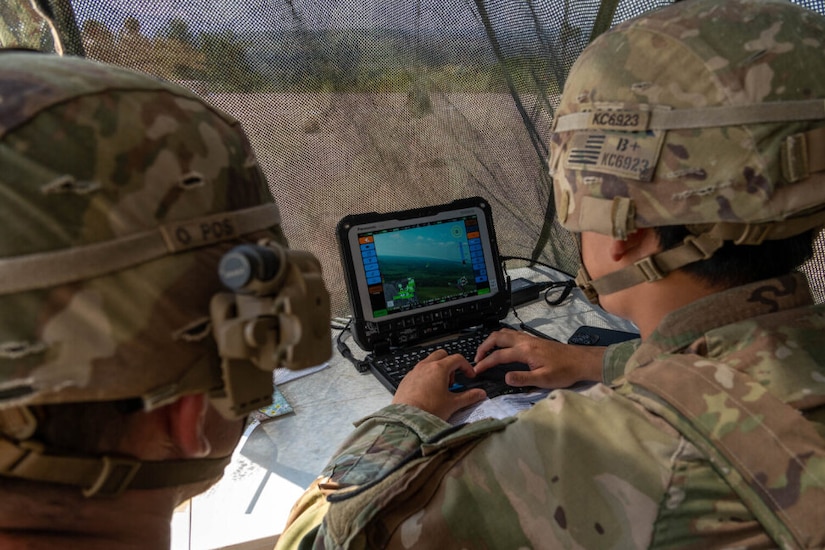
Two people wearing camouflage military uniforms and helmets look at a small screen under a camouflage-netted tent.

Before the live-fire exercise, soldiers completed a five-day training course with the manufacturer, during which they learned to set up, arm and program the drones for flight and strike missions. 
 
Army Spc. Drake Cross, a Switchblade operator who has flown RQ-7 Shadow and RQ-28 Quadcopter drones for the division, said this was his first experience with a munition-carrying UAS. 
 
"Everything else I've flown has been for surveillance and target acquisition," Cross said. "This is the first one where I can actually deliver a round. It's exciting because it saves soldiers' lives by hitting targets without putting us in danger." 
 
Cross said the system was user-friendly and similar to other UAS platforms, adding, "There's not much of a learning curve. Once you identify and lock onto a target, you can adjust right up until impact to make sure you're hitting what you want."

Looking Ahead

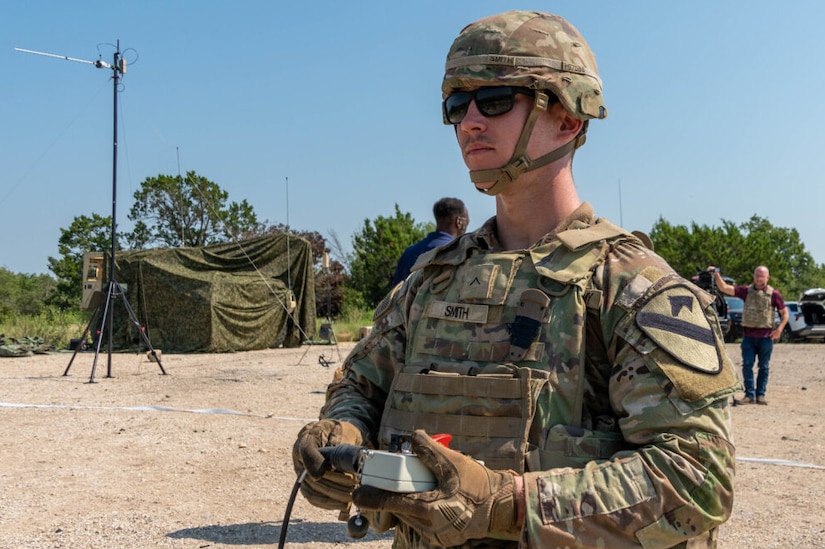
A person wearing sunglasses, a helmet and a camouflage military uniform holds an electronic switch outside in a desert environment. In the background are a camouflage tent and other personnel.

Weller said the Switchblade is just one example of how Transforming in Contact is reshaping the 1st Cavalry Division's armored formations. He noted that the unit will use the system during their upcoming rotation at the National Training Center at Fort Irwin, California. 
 
"The battlefield is constantly changing, and the Army has to modernize to keep pace," he said. "Seeing systems like the Switchblade in action shows us the future of how our formations will fight. It's a big step toward keeping our soldiers safer and more lethal."

Monday, April 09, 2012

Soldier Missing in Action from Korean War Identified


The Department of Defense POW/Missing Personnel Office announced today that the remains of a serviceman, missing in action from the Korean War, have been identified and will be returned to his family for burial with full military honors.

Army Cpl. Patrick R. Glennon of Rochester, N.Y., will be buried April 11, at Arlington National Cemetery.  On Nov. 1, 1950, Glennon, and the G Company, 8th Cavalry Regiment, 1st Cavalry Division, were holding a defensive position along the Nammyon River near Unsan, North Korea, when they were attacked by Chinese forces.  Glennon was listed as missing in action following the heavy fighting.

In April 2007, the Democratic People’s Republic of Korea (DPRK) handed over six boxes of remains of American service members to New Mexico Governor Bill Richardson and former U.S. Secretary of Veterans Affairs Anthony Principi, who were visiting North Korea.  The remains had been recovered from areas near Unsan, where Glennon had been lost.

Metal identification tags bearing Glennon’s name, and other material evidence were included with the remains.  To identify the remains, scientists from the Joint POW/MIA Accounting Command and the Armed Forces DNA Identification Laboratory used circumstantial evidence and forensic identification tools such as dental records and mitochondrial DNA -- which matched Glennon’s cousins.

Today, more than 7,900 Americans remain unaccounted-for from the Korean War.  Identifications continue to be made from the remains that were returned to the United States, using forensic and DNA technology.

For additional information on the Defense Department’s mission to account for missing Americans, visit the DPMO website at http://www.dtic.mil/dpmo or call 703-699-1169.

Wednesday, February 29, 2012

Frontline Psych with Doc Bender: Good Nutrition Matters, Let Me Tell You Why

By Dr. James Bender, DCoE psychologist

Dr. James Bender is a former Army psychologist who deployed to Iraq as the brigade psychologist for the 1st Cavalry Division’s 4th Brigade Combat Team out of Fort Hood, Texas. During his deployment, he traveled through Southern Iraq, from Basra to Baghdad. He writes a monthly post for the DCoE Blog on psychological health concerns related to deployment and being in the military.

Hello. Athletes looking for a performance edge, soldiers wanting to get through combat leadership training, people coping with mental health concerns, and those wanting an energy boost, can all benefit from the same thing: good nutrition.

Nutrition is important for everyone, not just people trying to lose weight. There’s a well-established link between nutrition and mental health. Neurotransmitters, chemicals inside the brain that are crucial for brain functioning, are derived from food. Also, there’s a relationship between nutrition and several psychological conditions like insomnia, depression and anxiety. This does not necessarily mean that poor nutrition causes these problems; it does mean the two are related. For example, while most obese people are not depressed, obesity is associated with higher levels of depression. Therefore, eating well is often a useful adjunct to mental health treatment.

The military is taking note of the value of nutrition. Earlier this month, the Defense Department launched a nutrition campaign consisting of updates to the menus at military dining facilities, the first such updates in almost 20 years. Healthy options will now be the “only” option. Assistant Secretary of Defense for Health Affairs Dr. Jonathan Woodson describes obesity as a national security concern because there’s a smaller pool of potential candidates available for military service. Nearly 30 percent of potential military candidates between the ages of 17-24 can’t meet entrance requirements because they’re overweight. Additionally, about 1,200 entry-level service members are discharged annually for weight-related issues.

Here are a few nutrition tips to get you started:

 ■You don’t need nutritional supplements; you can meet all your nutritional needs through healthy food choices.
■A lot of research is being conducted on omega-3 fatty acids, commonly found in fish oil supplements and the chemical substance S-adenosyl-methionine (SAMe). While not yet conclusive, research shows a positive relationship between these substances and improved mental health.
■Physically-active people need more nutritionally dense food, not just more calories.
■Here are two websites for more information about nutrition: www.nutrition.gov and the Defense Department’s Human Performance Resource Center.

There is no “magic wand” when it comes to performance enhancement. Sleep, nutrition, exercise and social support all play important roles in your physical and mental performance. Think of nutrition as one tool in your toolbox.

Stay safe and I’ll write again next month.

Tuesday, November 08, 2011

Face of Defense: Veterans Inspire Longest-Serving Recruiter

Discover incredible true stories from the best military books as veterans tell you their experiences and sacrifices.

By Donna Miles
American Forces Press Service

FORT MEADE, Md., Nov. 8, 2011 – Last week, retired Army Sgt. Maj. Ray Moran visited the Baltimore Military Entrance Processing Station here to bid goodbye and good luck to young men and women, many whom he recruited himself, as they headed off to basic military training.

Moran’s frequent visits to the station are reminiscent of his boyhood days in Latrobe, Pa. He remembers fondly when he and his brother, Sam, ran to the local railroad station to wave goodbye to U.S. troops bound for combat during World War II.

Veterans inspired Moran’s life-long love of the military and the men and women who serve in uniform.

He joined their ranks as soon as he was old enough, in 1948. It was the start of a 30-year career that included duty in post-World War II Japan, in Korea during the Korean Conflict, in Vietnam, and after volunteering to return to active duty after his retirement, during Operation Desert Storm.

Today, as he celebrates his 82nd birthday, Moran continues to make his mark on the military as its oldest and longest-serving recruiter. Over the past 60 years, he figures he has enlisted more than 1,000 soldiers, and he continues to sign on more every day.

Talking with Moran, still widely known by the moniker he picked up in Vietnam, “Old Soldier,” is like reading chapters out of a history book.

He remembers being too young to enlist during World War II, but making a point with his brother to give a proper send-off to combat-bound troops marching down his street to the local train station every Tuesday. “We were always there,” he said.

Looking at his long list of duties after he enlisted in the Army, it’s clear that Moran was, in fact, always where the action was.

Shortly after his basic training at Camp Breckenridge, Ky., he found himself helping keep the peace in post-World War II Tokyo. When war broke out in Korea, he deployed there on July 17, 1950, with the 1st Cavalry Division’s 2nd Battalion, 7th Cavalry.

Moran recalls moving with his unit into North Korea, all thinking the war was almost over when news broke that China had entered the conflict. “The Chinese had joined the North Koreans in the war and were pushing back our troops,” he said.

Moran was among the troops charged with retrieving the bodies of more than 800 of their fellow soldiers killed during an attack near North Korea’s Yalu River. Some, their hands tied behind their backs with barbed wire, had been shot in the head.

The experience was a far cry from the triumphant Armistice Day parade Moran had expected to be a part of in Japan.

Army Gen. Douglas MacArthur had personally selected his unit to return from Korea to parade through downtown Tokyo. “The problem was, there were so many mines in the bay in Korea that the Navy couldn’t come in to get us,” Moran said.

Instead, he remained in Korea, where, time and time again, he enjoyed chance encounters with his brother. Moran remembered setting up and manning roadblocks one blustery night in November 1950 when Sam drove through, transporting wounded troops.

“That night, I’d been freezing until I heard his voice,” Moran recalled. “But after that, I stayed warm all night long.”

Serendipity struck again when both Moran boys returned home from the war hours apart on July 10, 1951.

Members of the local VFW and American Legion – many of them the same World War II troops they had bid farewell to at the railroad station -- descended on their home to make them honorary members.

“They kind of motivated us,” Moran said.

Moran was so motivated, in fact, that he decided to reenlist and continue his military service that ultimately lasted three decades.

It was the start of his recruiting career that included some of the toughest assignments ever: recruiting for other recruiters in Vietnam, and recruiting the first members of the all-volunteer military force.

Looking back, Moran said he’s proud of what he helped create. “We built a volunteer Army that really proved itself in Desert Storm,” he said. “They were just a marvelous bunch of soldiers, and they have done it right through to Iraq and Afghanistan today. We are very proud of the all-volunteer Army.”

Even after hanging up his uniform in 1978, Moran has remained an integral part of that force as a civilian Army Reserve recruiter here at U.S. Army Recruiting Command’s 1st Recruiting Brigade.

He had only one brief hiatus from that duty when, after three phone calls to the Army retired branch in St. Louis, Mo., he convinced the right person to recall him to active duty during Operation Desert Storm.

Moran, who was 60 years old at the time, served casualty escort duty at the mortuary at Dover Air Force Base, Del. “It was what the Army needed me to do, so that’s what I did,” he said.

He recalled the sad duty of escorting the remains of 28 members of the Army Reserve’s 14th Quartermaster Detachment soldiers, some from his hometown, killed by an Iraqi Scud missile attack on Feb. 25, 1991.

When terrorists struck the United States on 9/11, 70-year-old Moran again volunteered to return to military duty, but the Army drew the line.

“I got really upset when the Army said no,” he said. “They told me that at my age, they were only accepting doctors [from the retirement rolls].”

The consolation, he said, was knowing he could continue to serve the military he loves by recruiting good-quality, dedicated forces to fill its ranks.

Recruiting runs in Moran’s blood. He admits that back during his first recruiting stint in Pennsylvania, he took his future wife, Barbara, on their first date to a one-day recruiting training conference in Pittsburgh.

Moran bonds with potential recruits easily, with his big, easy smile and encouraging manner. One needs to spend only a few hours with him to realize that he has friends of all ages nearly everywhere he goes.

He’s become a fixture in and around Fort Meade and within the recruiting community. A Fort Meade street now bears his name. He was honored in late 2008 as one of the first two inductees into the Army’s Recruiting and Retention Hall of Fame at Fort Jackson, S.C. Even the name of that honor recognizes Moran’s legendary status; it’s known as the Sgt. Maj. Ray Moran “Old Soldier” Hall of Fame.

Moran marvels that he now finds himself recruiting children, and even the grandchildren, of the veterans he enlisted -- including his own grandson.

“Recruiting is easy when you love something, and I happen to love the military. So talking about it is an easy task for me,” he said. “Everyone in the service is red, white and blue to me.”

Moran said he recognizes that military service isn’t for everyone, and takes pains not to “sugar-coat” the military experience to the men and women he talks with.

“I know we have tough times and we make sacrifices and there are hardships. I’m not getting away from that,” he said. “But I will tell you this: there are a lot of rewards. And the biggest reward in the world is just having the camaraderie and respect that you get from your fellow soldiers.”

Today’s recruits are smart, he said, and know what they are signing on for and what they want to do in the military. “So I am sort of a locomotive, to take them where they want to go,” he said. “It’s pretty wonderful.”

Despite the vast changes he’s witnessed, Moran finds that the same values continue to attract people to the armed services. “I just think it’s personal pride, and I really think it is patriotism and love of country,” he said. “I see that in their faces every day.”

Moran recognizes that cuts in budgets and recruiting billets are likely to force him into a second retirement, probably early next year. “It wasn’t my time to retire, in my book, but Uncle Sam needs it to happen, so we are going to salute and say, ‘We’ll do it,’” he said.

His perpetual ear-to-ear smile faded only slightly as he acknowledged what seems to be inevitable.

Looking back over his career, Moran said he has just one regret: he offered his father a handshake rather than a hug when he left home more than six decades ago to join the Army. It’s a transgression he apologized for when he returned home, and that his father assured him he’d more than made up for with a belated bear hug as he returned home.

“I am grateful,” Moran said of his career, regaining his infectious enthusiasm. “I look back and say, there’s no reason in the world not to be so happy that everything turned out the way it has,” with a devoted wife and family and rewarding career.

“The work I have done has been so meaningful to me, and I have made so many friends along the way,” he said. “So when I look back, I just have too much to be grateful and thankful for to even think any other way.”

This Veterans Day, Moran will express that gratitude through a tradition he shares with his family and their closest friends. They’ll travel to Washington to attend a full day of ceremonies, beginning at the Tomb of the Unknown at Arlington National Cemetery, then at the Vietnam Memorial Wall and, finally, at the Korean War and World War II memorials.

Moran said he takes pride knowing he has recruited and served with some of the “finest people in the world” who took part in those conflicts and continue to serve in the military.

“I’ve had a challenging career and loved every minute of it, and I would do it all again,” he said. “And it all stems from veterans. They were the ones that inspired me when I was a young man, and continue to do so to this day.”
Tuesday, June 28, 2011

Frontline Psych with Doc Bender: What Does PTSD Mean To You?

Posted by Dr. James Bender, DCoE psychologist

Dr. James Bender is a former Army psychologist who deployed to Iraq as the brigade psychologist for the 1st Cavalry Division’s 4th Brigade Combat Team out of Fort Hood, Texas. During his deployment, he traveled through Southern Iraq, from Basra to Baghdad. He writes a monthly post for the DCoE Blog on psychological health concerns related to deployment and being in the military.

Hi. June 27 is Post-Traumatic Stress Disorder Awareness Day. It’s designed to promote awareness and dialogue about post-traumatic stress disorder (PTSD). Few of the only good things to come out of war are the tremendous advances in the science of treating illness and injuries, both physical and psychological. These advances are due partly to more resources and attention being paid to combat-related injuries and partly due to health care providers, unfortunately, getting a lot more practice in treating these conditions.

PTSD was first recognized as a “real” mental illness in this country in 1980 by the American Psychiatric Association in their Diagnostic and Statistical Manual, a long book that lists every mental condition that’s formally recognized. This disorder was around long before that, ever since combat has been around. There are writings by ancient Greek warriors from the Battle of Marathon about soldiers with no physical ailments who suffered because of the stress they encountered. In the American Civil War, PTSD was called “nostalgia” and treatment consisted of a soldier, especially Southern soldiers who lived close to the battlefield, walking home and taking a few days off before returning to the battlefield. (Interestingly, we still use a similar approach today in certain cases.) In World War I it was called shell shock and in World War II it was called neurosis, an old Freudian term that means anxiety. In the Vietnam Era the symptoms were described as combat stress reaction.

Today, there is more awareness, research and treatment for PTSD. Researchers are working hard to increase our understanding of and treatments for the disorder. New advances in brain imaging have led to remarkable discoveries. For example, PTSD actually shrinks a part of the brain called the hippocampus, which grows back with successful treatment.

Unfortunately, we didn’t always understand or appreciate the effects of PTSD the way we do now. A lot of vets from previous wars were labeled as cowards or fakers for speaking about their symptoms or seeking help. Their voices and demands for research and treatment paved the way for the advances we have today. Vietnam vets in particular lobbied professional groups and legislatures to do something about the problem. I do a lot of outreach and advocacy in my job at DCoE and some of the biggest advocates for this generation’s veterans are Vietnam vets. Several of them have told me, “I want America to treat you better than it treated me.”

So this Monday, I’m going to give thanks to all the warriors who worked tirelessly and effectively to bring this problem to the forefront. As both a clinician and a veteran, I owe them a lot.

Thank you for your service. Those of you in Iraq and Afghanistan, stay safe and cool. Leave me a note if you have any questions or comments.