Showing posts with label joint training. Show all posts

Tuesday, June 30, 2026

Exercise Venom Forge Strengthens Partnerships, Boosts Combat Readiness

 June 30, 2026 | By Air Force Staff Sgt. Jake Jacobsen, 432nd Wing

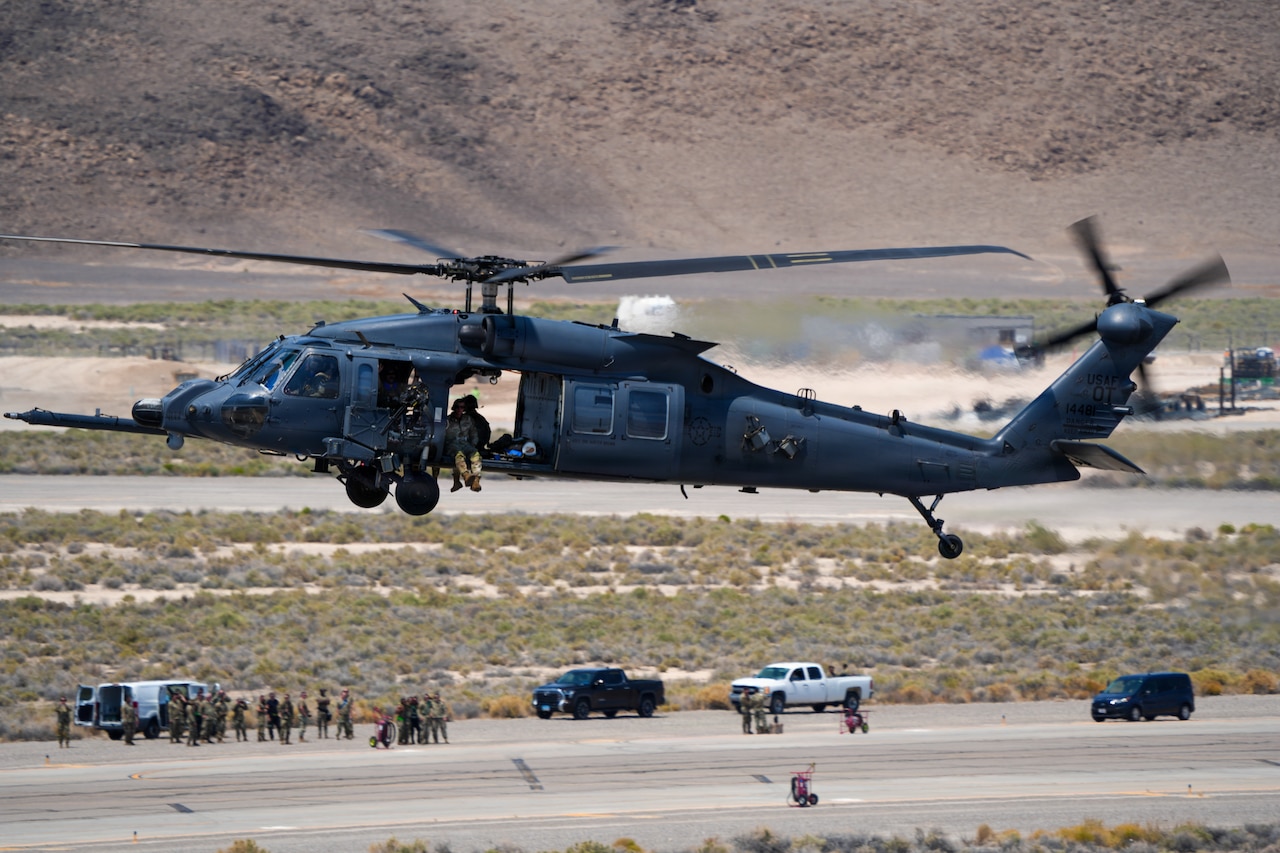
A military helicopter hovers above a flight line as people in military camouflage uniforms stand around on the ground.

An integration exercise designed to develop new tactics, techniques and procedures, combined support from five wings, seven groups and 17 squadrons across a multitude of operations and support at Creech Air Force Base, Nevada, June 17.

Dubbed Venom Forge, this exercise implemented lessons derived from the 57th Maintenance Group's inaugural Agile Maintenance Leadership Course to develop tactical-level maintenance leaders who can build mission-type orders, manage risk, communicate under friction, generate aircraft and create the conditions for combat airpower to happen.

In preparation for the event, mission partners completed a multiplatform hot-pit refueling site certification on base, helping enable contingency hot-pit and integrated combat turn training for multiple fighter platforms. The effort created a foundation for future agile combat employment training iterations.

"Creech [Air Force Base's] support was critical because it gave the capstone an unfamiliar environment and helped turn the course concept into executable training," said Air Force Maj. Yoarmerby Gomez, 57th Maintenance Group maintenance tactics officer. "This exercise required more than ramp space. It required access, support equipment, airfield operations, fuels support, fire emergency services, safety, security, medical response planning, host-base coordination and leadership buy-in."
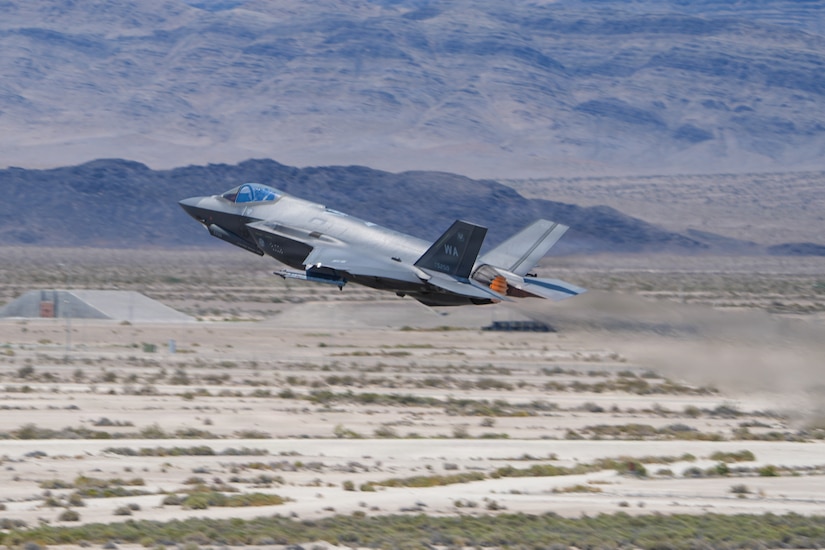
A military jet flies over desert terrain.

To execute the exercise, organizations from the 57th Wing, 99th Air Base Wing, 53rd Wing, 355th Wing and 432nd Wing came together to give students a realistic stage to experience how maintenance decisions affect logistics. The students learned how movement timelines affect aircraft generation, how medical and emergency-response planning affects mission risk, and how base constraints shape execution.

The base provided further support with equipment required for execution, facilitation of access across the installation and aided aircraft integration and operations not part of normal day-to-day mission operations.

"[The base] provided the right balance of proximity, realism and operational value," Gomez said. "It is close enough to Nellis [Air Force Base] to support a controlled hub-to-spoke training model but separate enough to force students to coordinate with a real host base instead of relying on home-station assumptions."

To further test units involved, an inject involving members suffering from simulated heat stroke was enacted, allowing medical teams on HH-60W Jolly Green II helicopters to integrate critical care air transport while aggressor units conducted hot-pit integrated combat turns on F-35A Lightning IIs and F-16C Fighting Falcons.
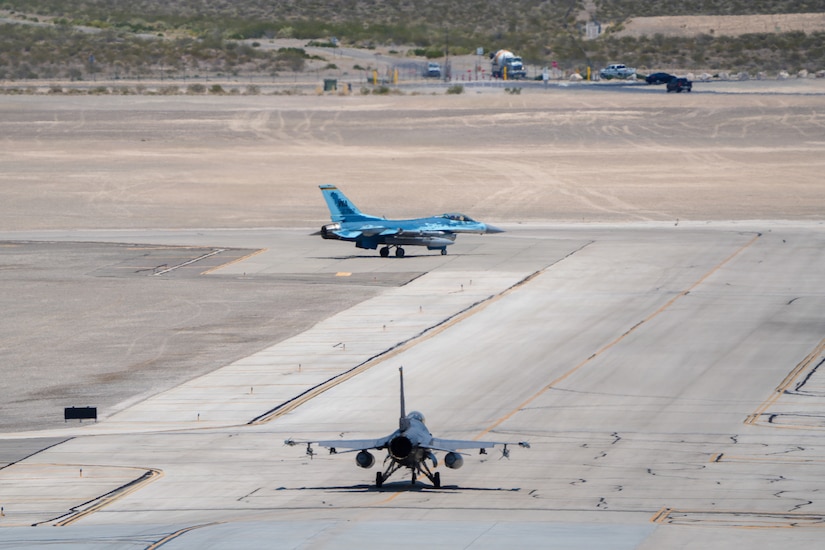
Two military jets taxi on a flight line.

"What made Venom Forge unique was that every organization had its own reason to be there," Gomez said. "One of the clearest examples of the training value was the level of deconfliction required on the airfield. At one point, F-35s and F-16s were being refueled and rearmed while two HH-60s were entering the airspace. These elements of controlled chaos were exactly what we wanted the students to experience. It forced multiple agencies to communicate, deconflict and execute safely in a dynamic environment."

The certification and partnership conducted during the exercise enabled a repeatable foundation for future iterations. These next events could include more students, additional mission partners, different aircraft and more deliberate deconfliction across multiple simultaneous operations.

"For the students, Venom Forge showed that aircraft generation is not just a maintenance action," Gomez said. "Thanks to this exercise, we now have a scalable course model, a stronger relationship with [the base], a multiagency training framework and a better understanding of what it takes to generate combat airpower from a spoke location."

Monday, September 29, 2025

Joint Insertion Training Enables Combined U.S.-Japan Live-Fire Exercise

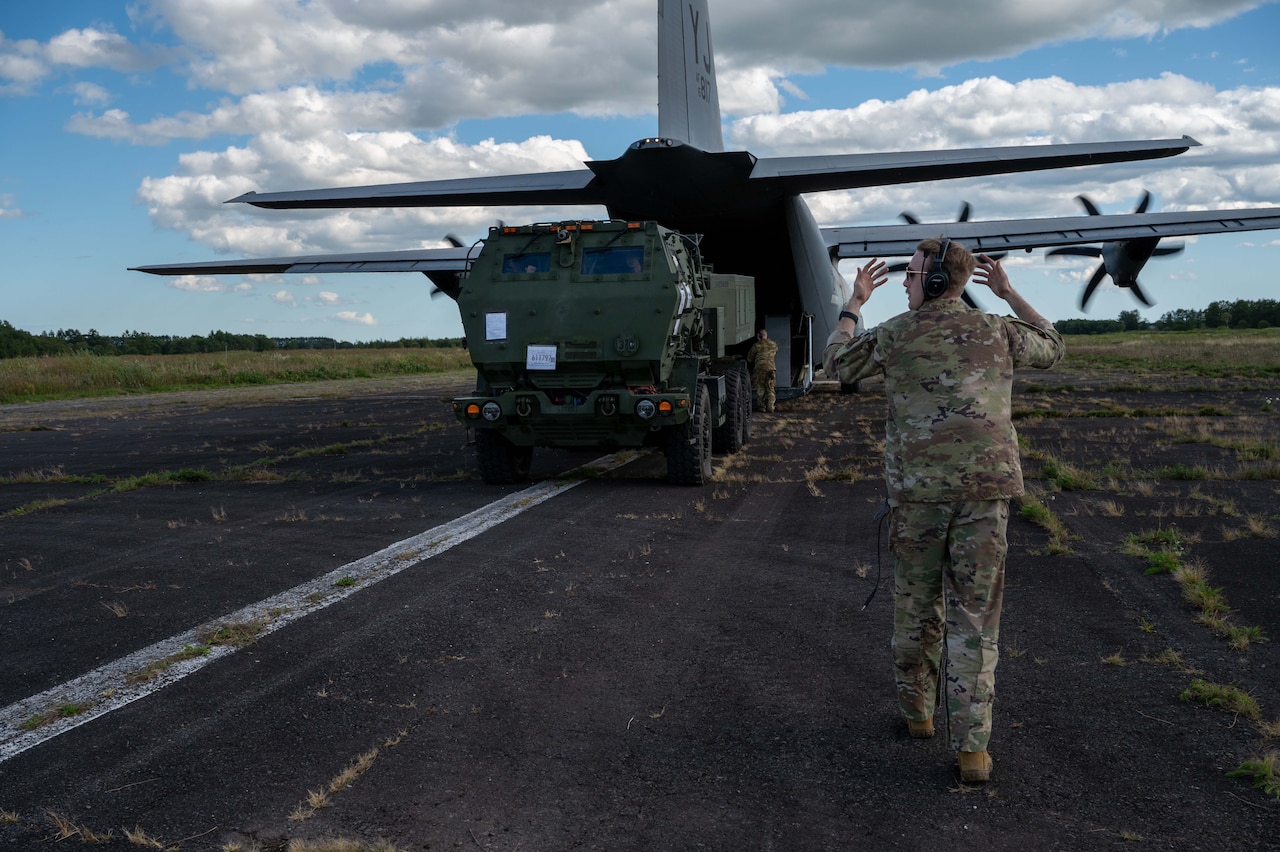
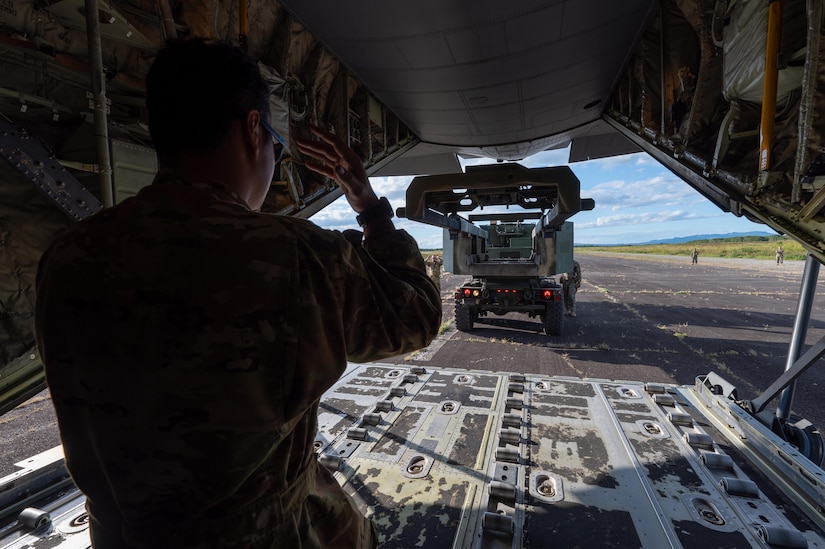
A man wearing a camouflage military uniform walks backwards on a tarmac as he guides a large green military vehicle out of a military cargo aircraft.

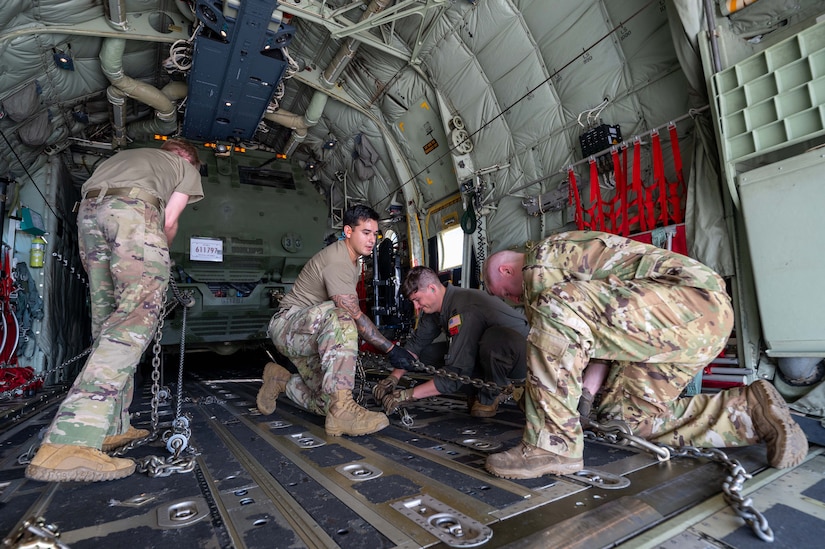
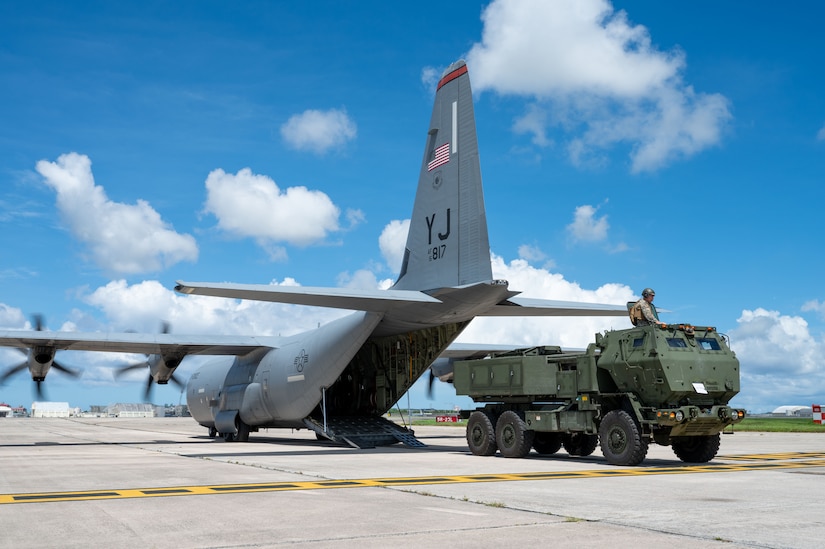
Airmen assigned to the 36th Airlift Squadron conducted a High Mobility Artillery Rocket System rapid insertion training during a joint operational support mission with Marines at Kadena Air Base and Kenebetsu Air Base, Japan, Sept. 18–19, enabling a bilateral live-fire exercise between the Marine Corps and the Japan Ground Self-Defense Force. 
 
The training gave personnel an opportunity to practice emerging tactics, techniques, and procedures that allow C-130 Hercules aircrews to reload ammo pods into a High Mobility Artillery Rocket System without any material handling equipment, a process known as HIMARS direct reload inside plane. 

Three men wearing camouflage military uniforms and another man wearing coveralls attach chains to the floor of a military cargo aircraft. The chains are securing a military vehicle inside the aircraft that is in the background.

 
This marked the first time on record that an Air Mobility Command aircrew within Pacific Air Forces has executed this process, as the 36th Airlift Squadron continues to develop homegrown training events designed to refine the skills needed to support operations in austere environments. 
 
"[This process] pushes and furthers the C130's capabilities for supporting HIMARS and [rapid insertion] operations," said Air Force Tech. Sgt. Trevor Humes, 36th AS instructor loadmaster. "By practicing rapid reload operations, we better enforce the lethality of our joint partners while reducing everyone's period of vulnerability. Being able to practice austere operations proves our readiness for contested environments." 

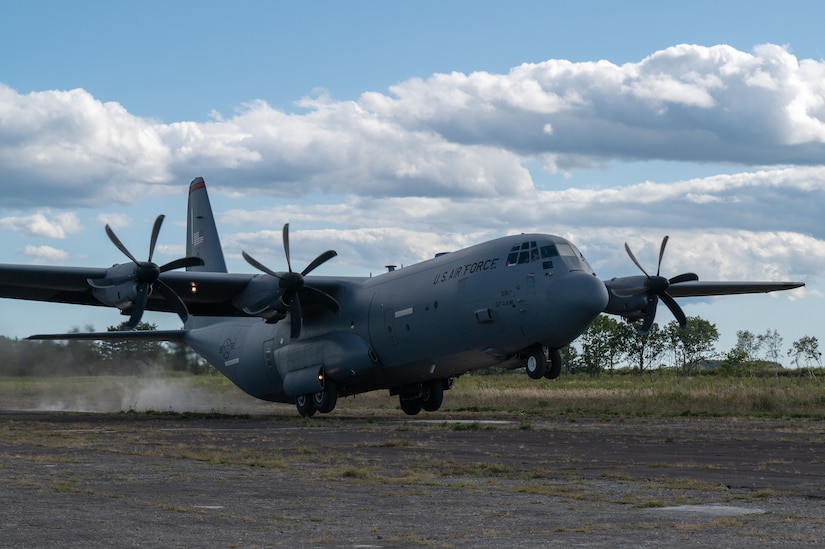
A large gray military cargo aircraft takes off from a runway. There is a field and trees in the background.

 
The first day of the mission began with aircrews from the 36th AS departing in two C-130J Super Hercules aircraft from Yokota Air Base to Kadena Air Base, where they met MC-130J Commando II personnel assigned to the 353rd Special Operations Wing, along with Marines from the 3rd Battalion, 12th Marine Regiment, 3rd Marine Division. 
 
The 353rd SOW is currently writing checklists and procedures for the direct reload mission in conjunction with the 561st Weapons Squadron and provided the 36th AS with the draft publications necessary to prepare them for mission execution. 

A man wearing a camouflage military uniform stands in the open hatch of a large green military vehicle as it backs into a gray military cargo aircraft on a tarmac.

 
Additionally, 353rd SOW personnel provided hands-on training to 36th AS aircrews, guiding them through the process of loading an ammo pod into a HIMARS. 
 
The 353rd SOW conducts missions requiring unique skill sets, so expanding the training to 36th AS personnel increases the number of C-130 aircrews capable of maneuvering and sustaining joint operations in the Pacific theater. This added capacity is valuable if the special operations wing is tasked with a low-density, high-demand mission. 
 
Other units at Kadena Air Base further augmented the 36th AS to ensure a successful training. 

A man wearing a camouflage military uniform guides a military vehicle into the back a large military cargo aircraft. There are four other service members in similar attire standing outside the aircraft on the tarmac.

 
"This mission wasn't accomplished by one unit," said Air Force Col. Donavan Laskey, 374th Airlift Wing deputy commander. "It was accomplished by multiple units coming together as one team to show what we can do in a joint and combined environment. Our partners from the Marine Corps, 18th Wing, 733rd Air Mobility Squadron and 353rd Special Operations Wing played key roles in making it happen, and it is this kind of teamwork that ensures we are ready to respond whenever and wherever needed." 
 
The 36th AS aircrews departed Kadena the following day for Kenebetsu Air Base, transporting a HIMARS on one C-130J and two ammo pods on another. They then applied the direct reload procedures they had practiced the day before, demonstrating rapid reloading in a realistic environment without traditional support or infrastructure. 
 
This proved to be an invaluable experience for some of the newer aircrew members. 

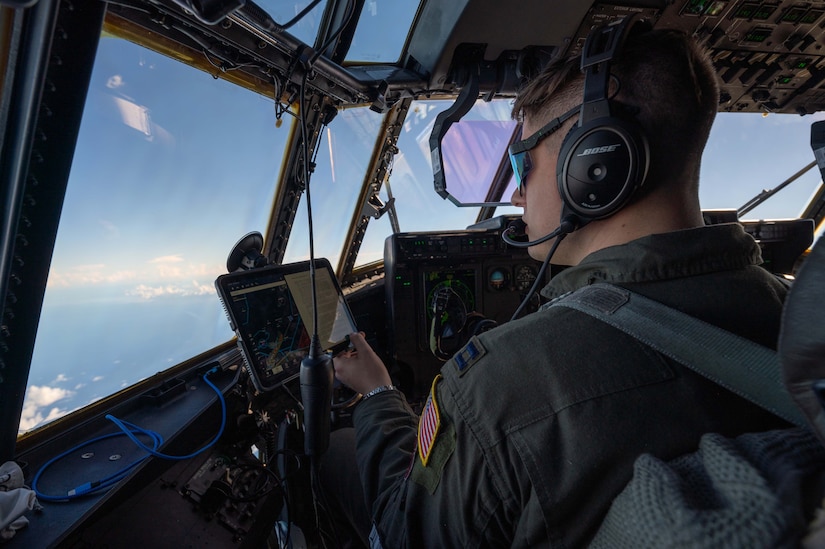
A man wearing a flight suit, sunglasses and a headset looks at a tablet screen while sitting in the cockpit of a military cargo aircraft. The aircraft is flying, and you can see clouds outside the windows of the cockpit.

 
"As a new airman, being part of this training gave me valuable insight into how we prepare for real-world contingency operations," said Air Force Airman 1st Class Andrew Giorgio, 36th AS loadmaster. "It was eye-opening to see the operational capability of the C-130J and how it supports the mission." 
 
Flying crew chiefs assigned to the 374th Aircraft Maintenance Squadron also supported the training, performing regular tasks while augmenting the 36th AS loadmasters to expedite the process. 
 
Airmen assigned to Yokota Air Base regularly conduct training events to strengthen agile combat employment capabilities and build interoperability with joint partners in support of a free and open Indo-Pacific. As it looks ahead, the squadron plans to build on this training by increasing efficiency and advancing their ability to respond in the event of a combat mission. 
 
"Our feedback and experiences are shaping future publications for our airframe and fellow aviators," Humes said. "By practicing and honing these procedures, we can take these lessons learned and continue to push the capabilities of our aircraft and partners." 

Thursday, September 11, 2025

Joint Service Teamwork Forged During Exercise Sage Eagle

Army Green Berets and supporting elements assigned to the 3rd Special Forces Group teamed with security forces airmen from the Air National Guard for Sage Eagle 25-4, a joint training exercise designed to enhance the services' interoperability and readiness, conducted in late August.

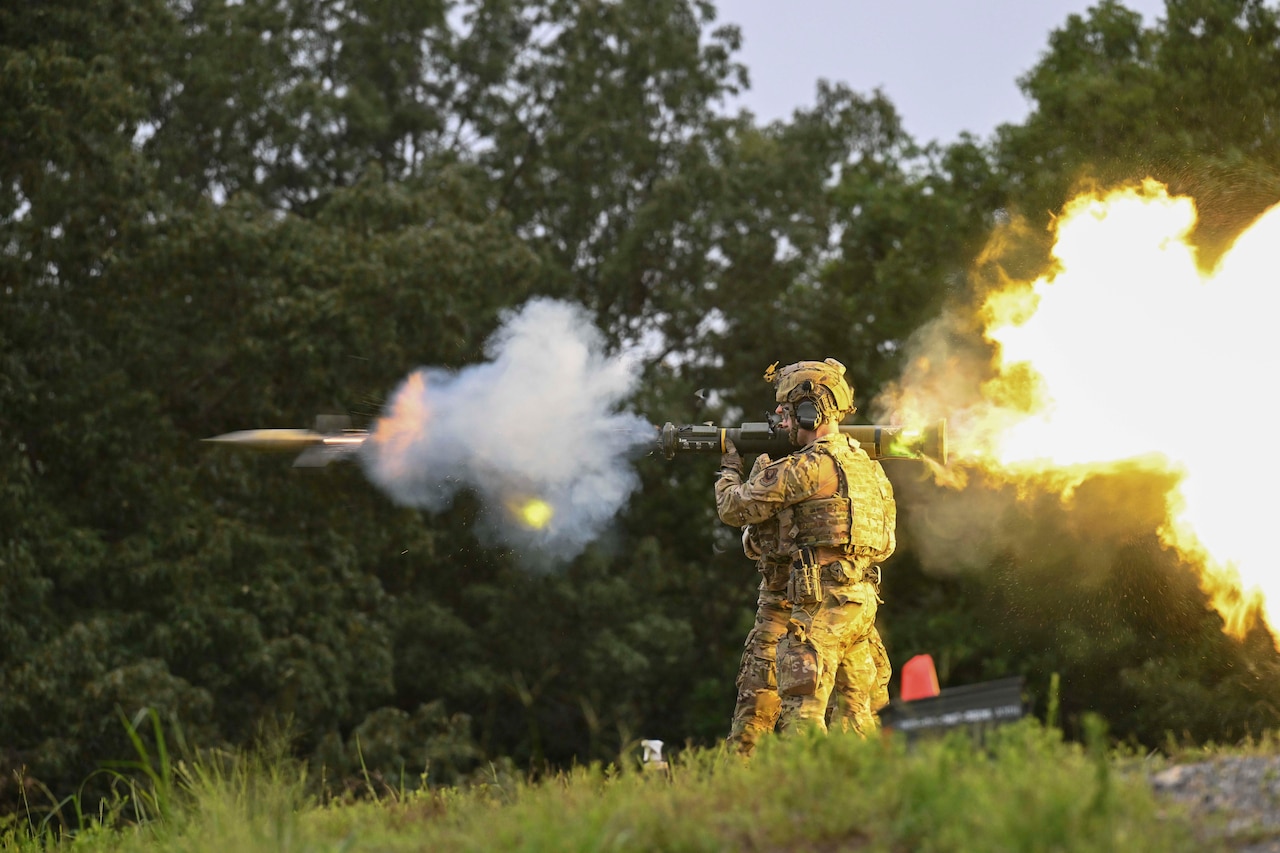
Two service members wearing camouflage stand close to each other as one fires a shoulder-launched missile that creates smoke in front and fire behind the launcher.

With a focus on small-unit tactics, joint mission planning and advanced combat scenarios, the training at Fort A.P. Hill, Virginia, aimed to better prepare special operations forces and the Air National Guard for real-world missions that reinforce their ability to jointly operate in diverse operational environments. 
 
Sage Eagle 25-4 commenced with weapons familiarization, pairing soldiers and airmen in a series of classes that built a foundational understanding of weapons handling and functions. Green Berets trained the airmen on multiple weapons systems, including the M320 grenade launcher and the M249 squad automatic weapon.  

Weapons training culminated in an M4 rifle qualification range before transitioning into advanced tactical training. From dawn to dusk, airmen repeatedly conducted realistic training simulations in small-unit tactics, including close-quarters battle drills, ambushes and raids, immersing them in the demanding tempo of special operations.  

"I think it's great to see the different ways that the Green Berets teach things, for example, room clearing," said Air Force Airman 1st Class Leann Minnick, a security forces airman assigned to the 193rd Special Operations Security Forces Squadron. "They taught us many ways to do it that I'm generally not trained to do, so I could bring that back to my unit." 
 
Following multiple days of weapons training, teams entered a five-day field environment, plagued with rugged terrain and dense vegetation, which challenged even the most experienced service members.  

Limited access to supplies and the need for covert movements through rugged landscapes added another layer of complexity to the training, requiring teams to adapt quickly or risk mission failure. Following days of training from the Army's elite, airmen applied what they learned to plan and execute simulated raids and ambushes, evading a multitude of different enemy threats to complete the mission. 

"[The Green Berets] are experts at detail, which is what it boils down to," said Air Force Tech. Sgt. Jason Tartaglia, a security forces airman assigned to the 166th Security Forces Squadron. "And that's really what makes them so great. Just thinking outside the box or looking at something from a different angle makes a huge difference." 
 
The training culminated in a realistic joint forcible entry exercise, leveraging the unique skills of each service in a mission to capture a high-value target. Soldiers breached the compound under simulated hostile fire, systematically clearing each floor of enemy threats and overcoming tight stairwell fighting positions, barricaded rooms and simulated casualties on every level.
 
While Green Berets maneuvered throughout the compound, the Air National Guard security forces secured the exterior of the compound, facing unruly crowds and demonstrators. Leveraging their training, the security forces mitigated all potential threats, enabling both services to seamlessly withdraw. 
 
Sage Eagle isn't just tactical training; it's a crucible for joint force integration. The exercise honed critical skills in cross-service communication, adaptive planning and mission execution in complex environments. Participants gained instrumental insights, directly enhancing current operations and fortifying readiness for future challenges. 
 
"This training pushed us to our limits, but that's how we get better," Minnick said. "When we walk away tired, dirty and more capable than before — we know it was worth it."

Thursday, September 27, 2012

Carter Visits F-16 International Training School


By Air Force Lt. Col. Christine Rhodes
162nd Fighter Wing Public Affairs

TUSCON, Ariz., Sept. 27, 2012 – Deputy Defense Secretary Ashton B. Carter visited the 162nd Fighter Wing at Tucson International Airport here yesterday to learn about international F-16 Fighting Falcon aircraft pilot training.

The Arizona Air National Guard was one of several stops Carter made throughout the Tucson area.

"It was very good for our airmen to see a senior Department of Defense leader visit our installation," said Air Force Col. Mick McGuire, 162nd Fighter Wing commander. "Dr. Carter left with a strong understanding of our mission and the impact of our global training success."

Carter and his staff met with students and exchange pilots from Iraq, Singapore, Japan, Denmark, Poland, South Korea, Norway and the Netherlands.

Air Guardsmen here train more than 70 international student pilots per year, offering several training programs that range from initial F-16 training to qualify new pilots to an advanced weapons course, officials said.

The 162nd is the "face of the USAF to the world" providing the best-trained coalition warfighting partners for the U.S. Air Force, officials said. The wing has trained pilots from 28 countries that fly the F-16, while developing strategic partnerships and building strong international relationships based on performance, friendship and trust.

Tuesday, September 25, 2012

Wisconsin Guard cadets part of international exchange


Wisconsin National Guard Public Affairs Office

Two Wisconsin Army National Guard Soldiers participating in the Reserve Officer Training Corps (ROTC) program at the University of Wisconsin-Whitewater were among six cadets to spend a month abroad recently in a cultural exchange program, teaching English as a second language to military cadets in other nations.

Cadet Derek Kumrow, 24, of Random Lake, Wis., is a member of the 829th Engineer Company. The business graduate student taught English through the Cultural Understanding and Language Proficiency (CULP) program. He described the trip as a once-in-a-lifetime experience.

"I was completely on the opposite side of the world learning what it takes to become an officer in other countries' military," Kumrow said. "I met people and experienced things that I would have never got the chance to do any other time in my life."

Cadet Daniel Kaiser, 22, of Appleton, Wis., is a member of the 1st Battalion, 105th Cavalry and also is the ROTC cadet battalion commander at UW-Whitewater. The sociology and criminal justice senior taught English to cadets in Lithuania, and said the trip raised his awareness of the differences between cultures.

"As future leaders, it is important for cadets to realize that policies that are made often have a father reaching influence than what first comes to mind," Kaiser said. "It is important to look at all variables. This trip has given me a tendency to think about things in a broader perspective."

Other cadets visited Hanoi, Vietnam; the Ukraine, and South Korea. Besides teaching English, the cadets were charged with creating better bonds with residents in the countries they visited.

To prepare for the CULP trip, cadets had to complete courses through the State Department and Department of Defense, learn how to teach English as a second language, learn some of the language and customs of the nation they would visit - and, of course, receive vaccinations.

UW-Whitewater launched its CULP program in 2009, and first sent students to Ghana in 2011 as part of an internship program.

Information for this article was provided by the UW-Whitewater Royal Purple.

Friday, September 21, 2012

U.S. Navy Ships Depart For Joint Warrior Exercise 12-2


By Mass Communication Specialist 2nd Class (SW/AW) Foster Bamford, Navy Public Affairs Support Element West

USS GETTYSBURG, At Sea (NNS) -- Two U.S. Navy ships, led by Commander, Destroyer Squadron (COMDESRON) 26, departed from the U.S. for Scotland, Sept. 17.

The ships will take part in the Joint Warrior 12-2 exercise with allied navies. Joint Warrior is a coalition exercise designed and led by the Joint Tactical Exercise Planning Staff (JTEPS) in the United Kingdom.

Sailors from guided-missile destroyer USS Mitscher (DDG 57), guided-missile cruiser USS Gettysburg (CG 64), Helicopter Maritime Strike (HSM) 46 Detachment 2 and U.S. maritime support reconnaissance patrol aircraft from Experimental Evaluation Test Squadron (VX) 1, Patrol Squadron (VP) 9 and VP 10 and fleet replenishment oiler USNS Leroy Grumman (TAO 195) will play a role in the exercise, which is intended to improve interoperability between allied navies and prepare them for possible joint exercises in the real world.

"Allied and coalition operations are the standard when units deploy," said Capt. Nelson Castro, commander of COMDESRON 26. "This exercise provides a venue for our Sailors to practice and learn NATO operating procedures."

Joint Warrior is the United Kingdom's advanced naval certification course and is on par with a U.S. Joint Task Force Exercise. The exercise is a multi-national training event for allies in a maritime environment. It aims to improve interoperability and prepare forces for combined exercises. There are 12 countries participating in Joint Warrior including the U.S. and the United Kingdom. Those countries are Denmark, Netherlands, Estonia, France, Spain, Norway, Brazil, Germany, Canada, Sweden, and Belgium.

"Many of the allied units involved in Joint Warrior exercises will be the same units our ships will see on deployment," said Castro. "This familiarity allows for the development of trust. All nations benefit from open commerce in the maritime common. Our Navy deployed forward supports the movement of goods worldwide, which affects everyone."

Joint Warrior is a two-week exercise that begins in early October. It involves sea, ground and air assets from participating allied and NATO forces and aims to foster a spirit of teamwork between allied nations.

Panetta Takes Questions From Chinese Cadets


By Karen Parrish
American Forces Press Service

BEIJING  – Two very different military traditions briefly converged here yesterday when Defense Secretary Leon E. Panetta, following a speech at the People’s Liberation Army’s Armored Forces Engineering Academy, opened the floor to questions from cadets and officers in the audience.

As the audience waited for Panetta’s arrival – his schedule had been pushed back when his earlier meeting with Vice President Xi Jinping went longer than planned – the trim, green-uniformed young men sat quietly in rows of auditorium seating rising sharply from floor level to perhaps three stories in height. When Panetta appeared, walking down the steps from the top of the auditorium toward the stage, they broke into sustained applause.

The young Chinese soldiers peppered Panetta, the first U.S. defense secretary ever to visit the academy, with questions on topics ranging from how the two nations’ forces can work more closely to Taiwan arms sales to his impressions of the Chinese military.

To the first question, Panetta said he believes two nations’ militaries can work together in several ways. He added that senior leader interaction is the best lead-in to such cooperation, and is “very effective at improving relations.”

“There is noting better to produce cooperation than the ability to openly communicate with one another on an equal basis,” he continued.

Secondly, he said, increasing joint training exercises between U.S. and Chinese armies, navies and air forces could improve the capabilities of both nations’ forces. “It gives us lessons about how we can improve in our operations,” the secretary added, noting that as Pacific powers, both the United States and China share concerns about terrorism, nuclear proliferation, humanitarian assistance and disaster relief, countering piracy and other issues.

The two militaries’ ability to work together against terrorism is critical to the future, Panetta said, while cooperating to help people stricken by disaster “would be a tremendous symbol to the world of how two major powers can work together to help bring relief.”

On the question of U.S. arms sales to Taiwan, Panetta said the issue was discussed during his meetings with Chinese leaders here this week.

Joint communiqués issued in 1972, 1979 and 1982 outline policy agreements between the United States and China and include both countries’ agreement to a “one-China” policy. In the third communiqué, the United States agreed to a gradual reduction of arms sales to Taiwan.

“Let me make clear that the United States has a one-China policy, pursuant to the communiqués, … and that we do not support an independent Taiwan,” Panetta said.

At the same time, he added, the Unites States supports better relations between China and Taiwan.

“Frankly, we have been encouraged by recent developments between China and Taiwan that indicate there is a willingness on both sides to engage in efforts to improve that relationship,” he said.

Panetta said the United States does have a commitment to assist Taiwan, as outlined in the Taiwan Relations Act of 1979.

“Our belief is that this assistance, in some ways, provides better confidence and security on their part to be able to engage [with China] in those kinds of negotiations and discussions. … Our goal is to try to improve the relationship between China and Taiwan … to prevent any kind of conflict in the future,” the secretary told the cadets and officers.

Another question sought Panetta’s impressions of China’s military, and the man in charge of the nearly 3 million active and reserve U.S service members seemed to warm to the topic.

“In order to have an effective military, you have to have good discipline and good order, and you have to have good leadership,” he said. “The one thing I am impressed by when I see the Chinese military is the level of discipline … within the force. That’s extremely important.”

Many officers who work with him in the Pentagon have a lot of combat experience, the secretary noted. He added they would say “the most important thing, if you are in battle, is having that discipline – to be able to respond to orders, to do what you have to do … to achieve victory.”

Strong leaders also are vital to military mission accomplishment, he said.

“That means good officers, good [noncommissioned officers], good soldiers, … good people at every level, who can take control of those they are responsible for,” he said.

Just like China, he added, the United State has great weapons, ships, aircraft and technology.

“But none of that would be worth anything without good men and women who are willing to serve their country. … From what I have seen, you have that good discipline and order,” Panetta said.