Showing posts with label Pacific theater. Show all posts

Tuesday, January 06, 2026

Medal of Honor Monday: Army Air Corps Brig. Gen. Kenneth Walker

Army Air Corps Brig. Gen. Kenneth Newton Walker participated in dangerous bombing missions alongside his air crews during World War II because he wanted to understand how to beat the enemy. Walker never came home from his last mission. He received a posthumous Medal of Honor and is credited with helping to create the blueprint for the modern Air Force.
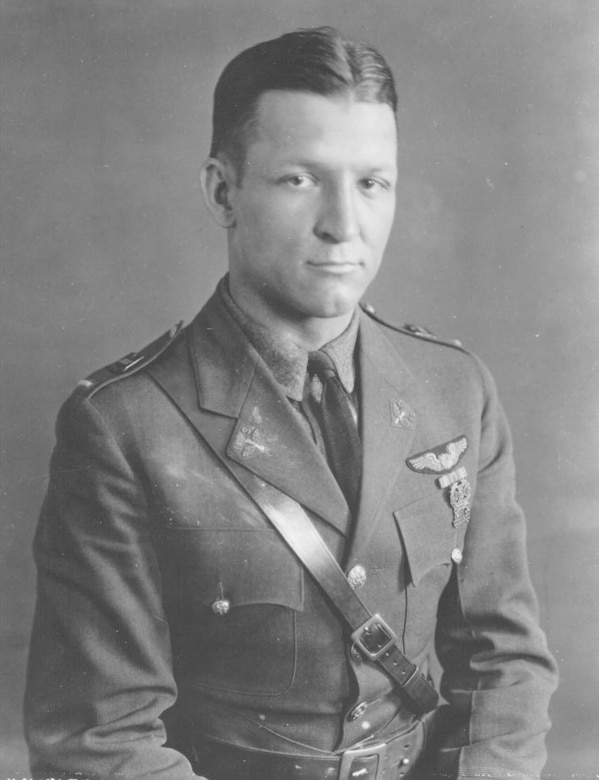
A man in uniform poses for a photo.

Walker was born July 17, 1898, in Cerrillos, New Mexico, to Wallace and Emma Walker. His parents separated shortly after he was born, so Walker's mother raised him alone. At some point in his youth, the pair moved to Denver, where Walker became a Boy Scout and took an interest in several sports, including football, wrestling and boxing.

According to Air University Press author Martha Byrd, Walker's maternal grandparents lived in Omaha, Nebraska, so Walker also lived there for a few years before graduating from Omaha High School of Commerce in 1915. However, by 1917, he had returned to Denver, eventually enlisting in the Army on Dec. 15 of that year. He remained in the service for the rest of his life.

Walker became a pilot just as aerial warfare was being established. He trained at the University of California, Berkeley, School of Military Aeronautics and then at Mather Field, California, earning his commission and his wings in the Army Air Service in November 1918. He received a commission in the regular Army July 1, 1920.

Over the next few years, Walker served as a flying instructor in Texas, then in Oklahoma, where he met Marguerite Potter in 1920. The pair married in 1922 and eventually had two sons, Kenneth Jr. and Douglas.
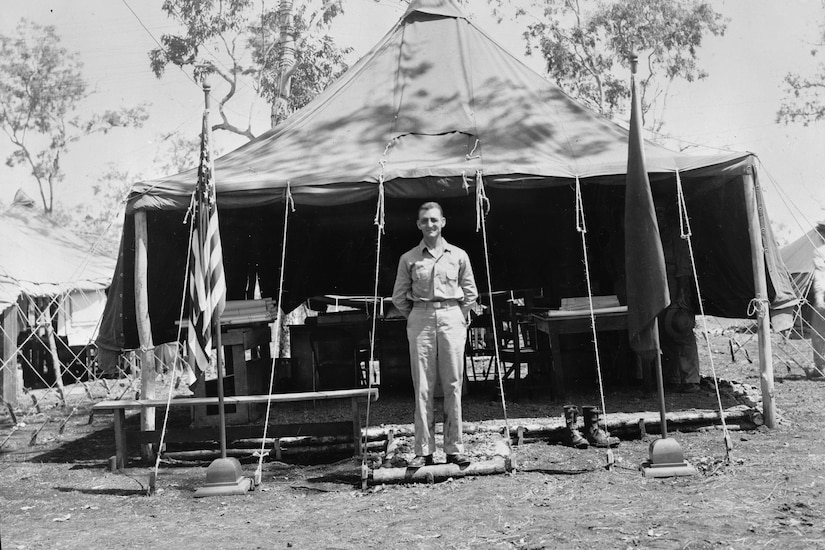
A man stands in front of an open tent with an American flag posted out front.

That same year, Walker graduated from the Air Service Operations School before being sent to the Philippines to command the Air Intelligence Section at Camp Nichols. When he returned to the U.S. in 1925, he continued his education and rose through the ranks, serving as an operations officer, bomb squad commander and instructor at various installations.

By January 1941, then-Maj. Walker found himself serving in Washington in the high-level position of assistant chief of the Air War Plans Division. Prior to the Pearl Harbor attacks, Walker was one of four Army Air Corps officers who created the blueprint of how to attack Japan and Germany from the air, according to a 2017 profile of Walker in the San Angelo Standard-Times. That strategy was later considered a key component of the Allied victory.

In July 1942, as the war raged, Walker was promoted to brigadier general and sent to the Pacific Theater. Shortly after his arrival, he was appointed as the commanding general of the Air Force's 5th Bomber Command.

From September 1942 to January 1943, Walker repeatedly went on bombing missions deep into enemy-held territory with his air crews. According to the San Angelo Standard-Times, he also went on bombing missions alone — something few generals did. His desire to take part in the danger earned him great respect from his subordinates. The lessons he learned from those missions helped him develop a highly efficient technique for bombing in the face of enemy aircraft and antiaircraft fire, according to his Medal of Honor citation.
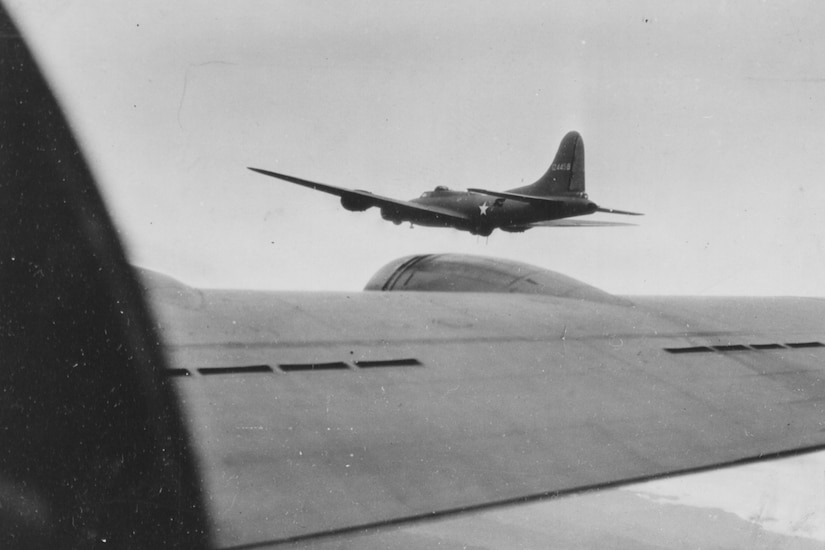
An aircraft is seen from the wing of another aircraft.

On Jan. 5, 1943, Walker joined several air crews on one of those dangerous missions. Six B-17 Flying Fortresses and six B-24 Liberators were sent on a daytime bombing mission over the Japanese-held harbor at Rabaul on the island of New Britain in Papua New Guinea. The attack was a success in that direct hits were scored on nine enemy ships. However, the bombers didn't get away before enemy fighters and antiaircraft fire came after them.

Walker was flying as an observer on a B-17 nicknamed the San Antonio Rose, which came under heavy attack. The aircraft was last seen with one engine on fire and several fighter aircraft on its tail. Evidence collected later showed that two of the aircraft's crew members were able to bail out; however, all 11 crew members were eventually declared dead.

On March 25, 1943, Walker's oldest son, Kenneth Jr., received the Medal of Honor on his father's behalf from President Franklin D. Roosevelt during a White House ceremony. Walker was the highest-ranking Army official to be reported missing during the war.
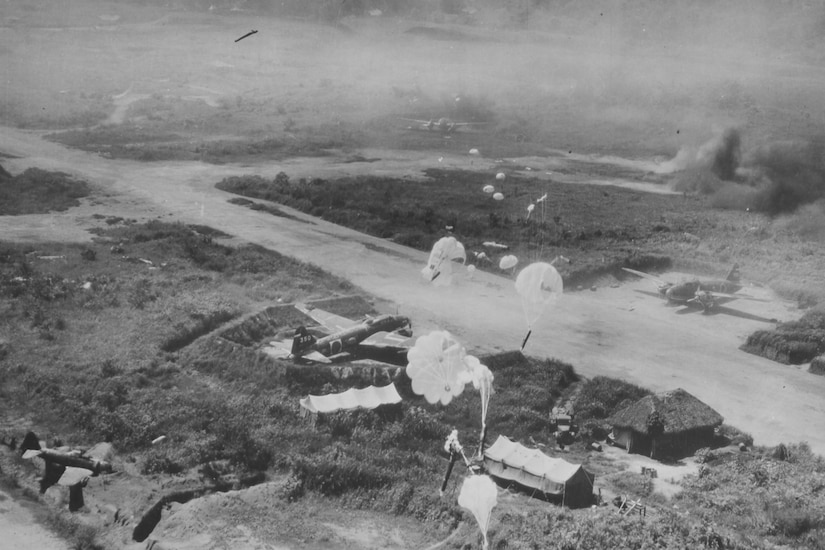
An aerial view of an island airstrip as parachutes drop on it.

Well before his death, Walker and a few other Air Corps Tactical School instructors were invited by a federal commission to testify in support of creating a separate military air organization that wasn't subordinate to any other branches. Thanks to his work with this commission and the air war plan used during World War II, Walker is considered one of the forefathers of the modern Air Force.

Walker has been remembered in many ways, including on the Wall of the Missing at the Manila American Cemetery in the Philippines.

In January 1948, Roswell Army Air Field in Roswell, New Mexico, was redesignated as Walker Air Force Base in honor of the fallen general. At Maxwell Air Force Base, Alabama, the home of the College of Aerospace Doctrine Research and Education, Walker Hall was also named for him.

Every year, a small number of papers written by field-grade officers in the Air Force Fellows program are selected to be published online. Those papers are known as the Walker Papers. The chosen officers attend civilian universities and organizations for a year to study national security strategy and serve as military ambassadors to prestigious institutions.

Monday, September 29, 2025

Joint Insertion Training Enables Combined U.S.-Japan Live-Fire Exercise

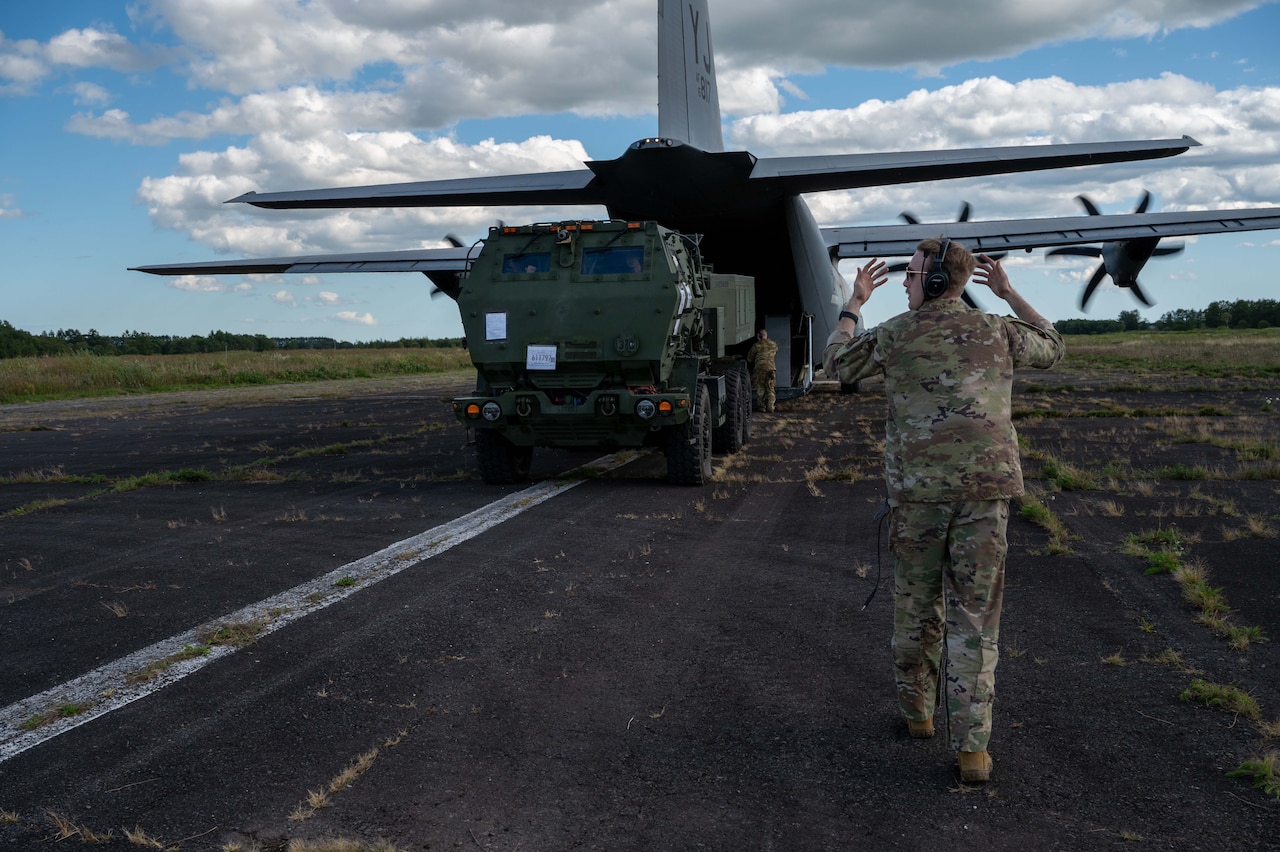
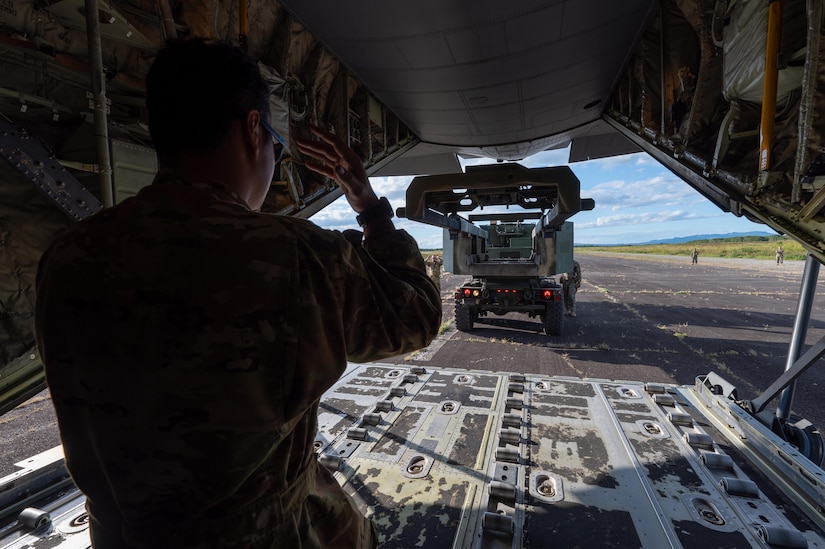
A man wearing a camouflage military uniform walks backwards on a tarmac as he guides a large green military vehicle out of a military cargo aircraft.

Airmen assigned to the 36th Airlift Squadron conducted a High Mobility Artillery Rocket System rapid insertion training during a joint operational support mission with Marines at Kadena Air Base and Kenebetsu Air Base, Japan, Sept. 18–19, enabling a bilateral live-fire exercise between the Marine Corps and the Japan Ground Self-Defense Force. 
 
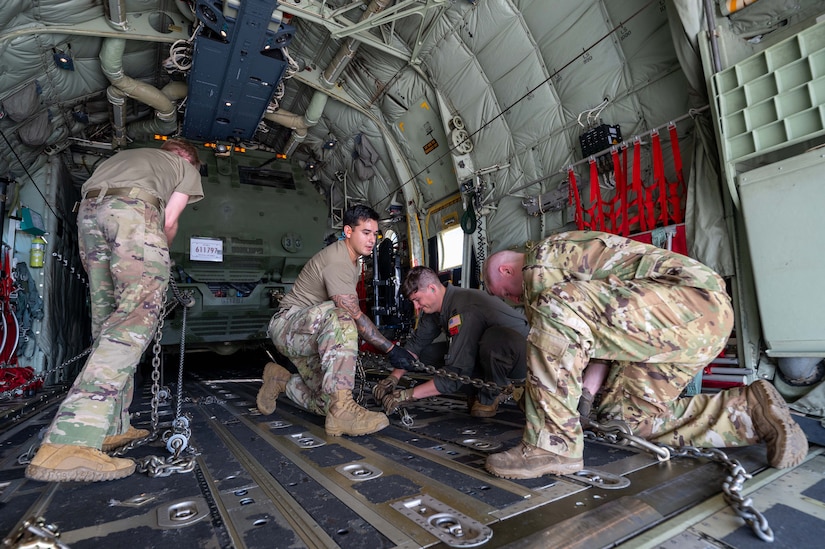
The training gave personnel an opportunity to practice emerging tactics, techniques, and procedures that allow C-130 Hercules aircrews to reload ammo pods into a High Mobility Artillery Rocket System without any material handling equipment, a process known as HIMARS direct reload inside plane. 

Three men wearing camouflage military uniforms and another man wearing coveralls attach chains to the floor of a military cargo aircraft. The chains are securing a military vehicle inside the aircraft that is in the background.

 
This marked the first time on record that an Air Mobility Command aircrew within Pacific Air Forces has executed this process, as the 36th Airlift Squadron continues to develop homegrown training events designed to refine the skills needed to support operations in austere environments. 
 
"[This process] pushes and furthers the C130's capabilities for supporting HIMARS and [rapid insertion] operations," said Air Force Tech. Sgt. Trevor Humes, 36th AS instructor loadmaster. "By practicing rapid reload operations, we better enforce the lethality of our joint partners while reducing everyone's period of vulnerability. Being able to practice austere operations proves our readiness for contested environments." 

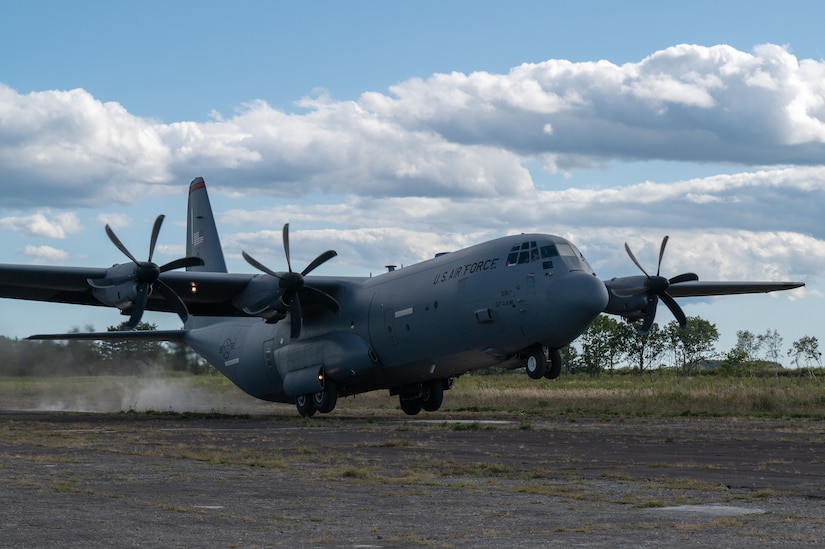
A large gray military cargo aircraft takes off from a runway. There is a field and trees in the background.

 
The first day of the mission began with aircrews from the 36th AS departing in two C-130J Super Hercules aircraft from Yokota Air Base to Kadena Air Base, where they met MC-130J Commando II personnel assigned to the 353rd Special Operations Wing, along with Marines from the 3rd Battalion, 12th Marine Regiment, 3rd Marine Division. 
 
The 353rd SOW is currently writing checklists and procedures for the direct reload mission in conjunction with the 561st Weapons Squadron and provided the 36th AS with the draft publications necessary to prepare them for mission execution. 

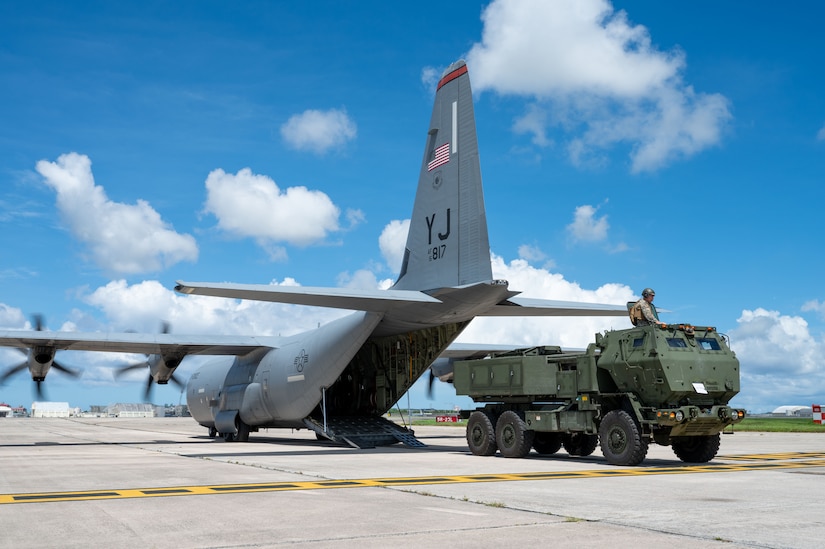
A man wearing a camouflage military uniform stands in the open hatch of a large green military vehicle as it backs into a gray military cargo aircraft on a tarmac.

 
Additionally, 353rd SOW personnel provided hands-on training to 36th AS aircrews, guiding them through the process of loading an ammo pod into a HIMARS. 
 
The 353rd SOW conducts missions requiring unique skill sets, so expanding the training to 36th AS personnel increases the number of C-130 aircrews capable of maneuvering and sustaining joint operations in the Pacific theater. This added capacity is valuable if the special operations wing is tasked with a low-density, high-demand mission. 
 
Other units at Kadena Air Base further augmented the 36th AS to ensure a successful training. 

A man wearing a camouflage military uniform guides a military vehicle into the back a large military cargo aircraft. There are four other service members in similar attire standing outside the aircraft on the tarmac.

 
"This mission wasn't accomplished by one unit," said Air Force Col. Donavan Laskey, 374th Airlift Wing deputy commander. "It was accomplished by multiple units coming together as one team to show what we can do in a joint and combined environment. Our partners from the Marine Corps, 18th Wing, 733rd Air Mobility Squadron and 353rd Special Operations Wing played key roles in making it happen, and it is this kind of teamwork that ensures we are ready to respond whenever and wherever needed." 
 
The 36th AS aircrews departed Kadena the following day for Kenebetsu Air Base, transporting a HIMARS on one C-130J and two ammo pods on another. They then applied the direct reload procedures they had practiced the day before, demonstrating rapid reloading in a realistic environment without traditional support or infrastructure. 
 
This proved to be an invaluable experience for some of the newer aircrew members. 

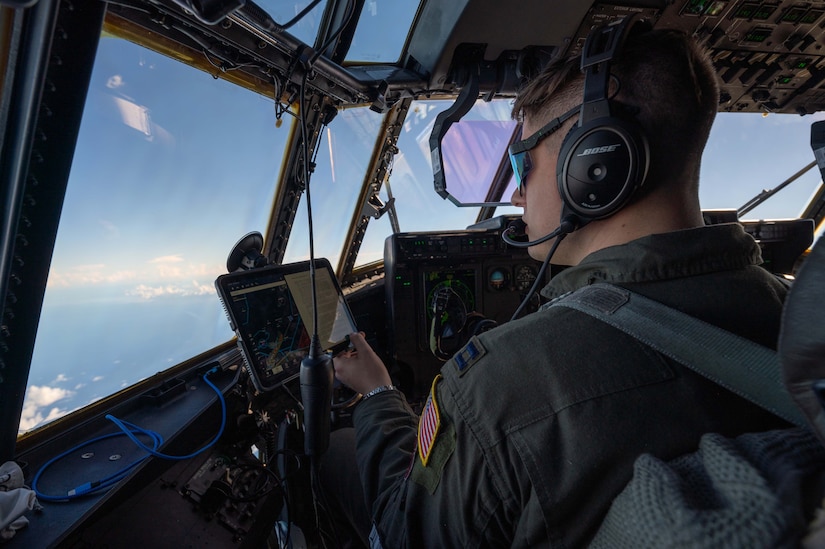
A man wearing a flight suit, sunglasses and a headset looks at a tablet screen while sitting in the cockpit of a military cargo aircraft. The aircraft is flying, and you can see clouds outside the windows of the cockpit.

 
"As a new airman, being part of this training gave me valuable insight into how we prepare for real-world contingency operations," said Air Force Airman 1st Class Andrew Giorgio, 36th AS loadmaster. "It was eye-opening to see the operational capability of the C-130J and how it supports the mission." 
 
Flying crew chiefs assigned to the 374th Aircraft Maintenance Squadron also supported the training, performing regular tasks while augmenting the 36th AS loadmasters to expedite the process. 
 
Airmen assigned to Yokota Air Base regularly conduct training events to strengthen agile combat employment capabilities and build interoperability with joint partners in support of a free and open Indo-Pacific. As it looks ahead, the squadron plans to build on this training by increasing efficiency and advancing their ability to respond in the event of a combat mission. 
 
"Our feedback and experiences are shaping future publications for our airframe and fellow aviators," Humes said. "By practicing and honing these procedures, we can take these lessons learned and continue to push the capabilities of our aircraft and partners."