Showing posts with label japan. Show all posts

Monday, September 29, 2025

Naval Hospital in Japan Tests Readiness During Mass Casualty Drill

Navy Medicine Readiness and Training Command Yokosuka, Japan, conducted a large-scale mass casualty drill Sept. 23, testing its ability to triage, treat and transport multiple simulated patients during a crisis.

The exercise included 10 simulated casualties, ranging from a femur fracture with controlled bleeding to complex scenarios such as punctured lungs, cardiac emergencies and burn injuries. Throughout the day, patients were received, stabilized and transferred, with the final casualty requiring medical evacuation through Naval Air Facility Atsugi.

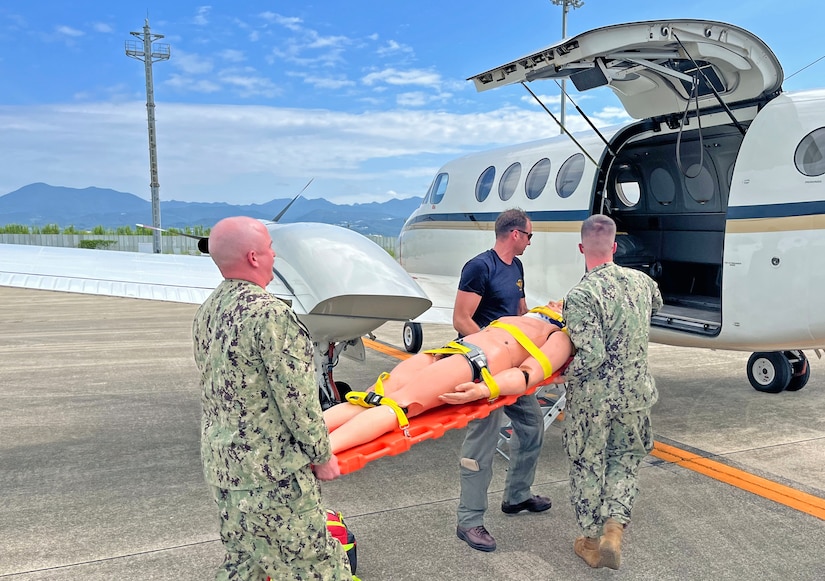
Two sailors wearing camouflage military uniforms and a man in civilian attire load a medical mannequin onto a medical jet.


In the culminating scenario, medical personnel from Navy Medicine Readiness and Training Unit Sasebo transferred a simulated casualty to Nagasaki Airport, where it was met by a C-12 Huron aircraft assigned to NAF Atsugi and a medical crew from NMRTC Yokosuka. The aircraft flew to Atsugi, where the patient was offloaded and transported by ambulance to Naval Hospital Yokosuka for further treatment.

"This drill gave us the opportunity to test not only our in-hospital care but also our coordination with outside commands, such as Fleet Air Western Pacific, to ensure rapid evacuation when needed," said Nikolai Kerry, emergency manager at NMRTC Yokosuka.

Navy Capt. Torrin Velazquez, commanding officer of NMRTC Yokosuka, emphasized the importance of integrating new patient transport and aviation evacuation procedures into the command’s training cycle.

"Testing these new capabilities is essential to building the kind of muscle memory that ensures our teams can respond instinctively when seconds matter," Velazquez said. "By practicing these processes until they come naturally, we strengthen our readiness and safeguard the lives of those who depend on us. I want to thank every sailor, civilian and partner command who played a role in making this exercise successful."

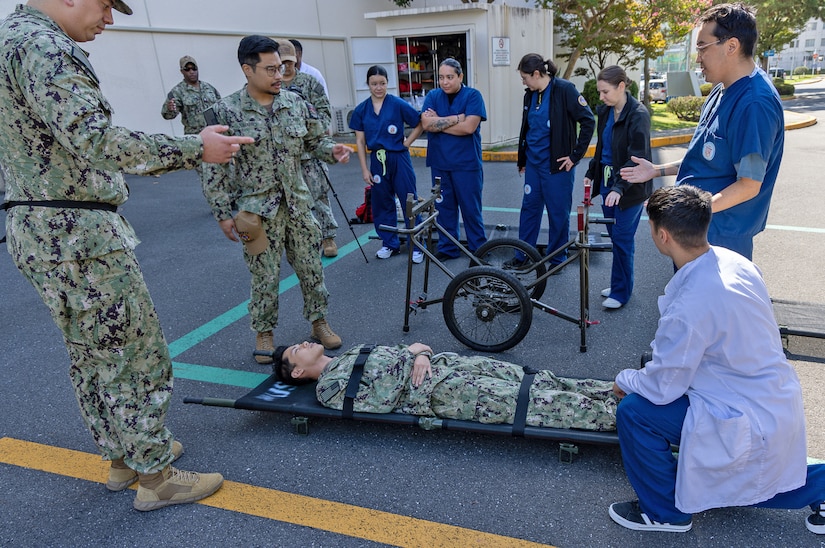
Two sailors wearing camouflage military uniforms speak to two medical personnel wearing scrubs as a sailor wearing a camouflage military uniform is lying on the ground strapped to a stretcher. Other people dressed in medical scrubs stand by and observe.


Mass casualty drills are designed to prepare medical providers, first responders and supporting personnel for large-scale incidents such as natural disasters, terrorist attacks or major accidents. These events test readiness by requiring participants to triage patients, allocate limited resources and coordinate across commands in time-sensitive situations.

"While the scenarios are simulated, the pressure is real," Kerry said. "These drills highlight gaps in our procedures, strengthen teamwork across agencies, and most importantly, help us save lives when an actual emergency happens."

The exercise featured realistic injuries on a timed schedule to challenge hospital personnel. Early scenarios focused on orthopedic trauma, such as wrist and ankle fractures, while later patients presented more medically complex cases, including pregnancy issues and cardiac conditions.

Drills like this benefit both the Navy and the broader community by improving readiness, refining processes and ensuring all personnel know their roles in a crisis. NMRTC Yokosuka conducts mass casualty drills at least once or twice a year, often in partnership with other Navy installations and commands.

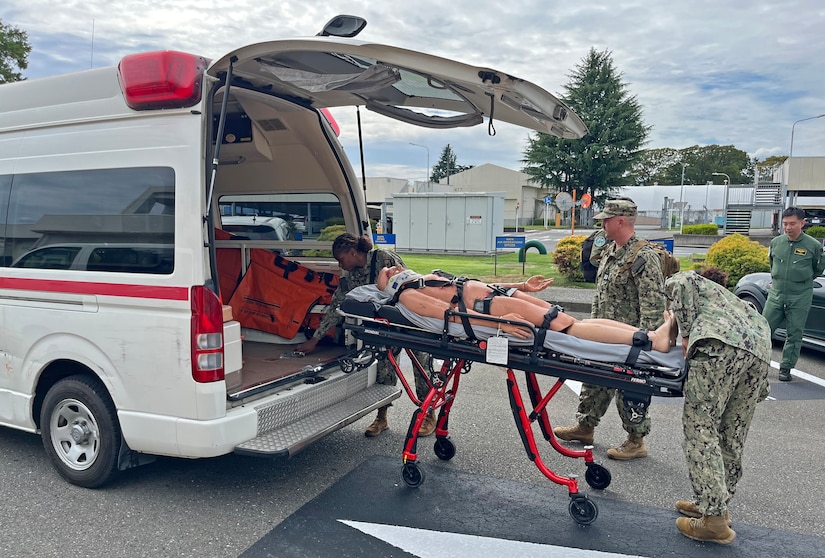
Three sailors wearing camouflage military uniforms load a medical mannequin into the back of an emergency vehicle.


"This kind of training goes beyond the hospital walls," Kerry said. "By practicing in different environments and with different partners, we ensure we’re prepared for anything — from a disaster on base to a real-world emergency at sea."

The day concluded with the successful execution of the simulated casualty transfer from Sasebo to Yokosuka, underscoring the importance of interoperability and rapid response across Navy medical facilities in Japan.

Wednesday, September 26, 2012

Panetta Shares Perspectives From Latest Trip


American Forces Press Service

WASHINGTON, Sept. 26, 2012 – In a message to the men and women of the Defense Department, Defense Secretary Leon E. Panetta shared his perspectives from his recent trip to the Asia-Pacific region.

Here is the secretary’s message:

This week I returned from a week-long trip to Japan, China, and New Zealand, my third trip to the Asia-Pacific region as Secretary of Defense.

The underlying purpose of the trip was to support our new defense strategy, which calls for the Department of Defense to increase our focus on the Asia-Pacific region. This strategy is part of a government-wide effort that includes increased economic, diplomatic, development, and security efforts – all in order to renew and revitalize America’s role in a region that is becoming more critical to our future security and prosperity.

My first stop was Tokyo, a city that I have visited a number of times in previous capacities, and on my first trip to Asia as Secretary of Defense last year. I am always appreciative of the warm hospitality and genuine friendship that the people of Japan extend to me and all their American visitors. It reflects the fact that Japan is a very close ally in the region, and that our Alliance has served as the cornerstone of peace and stability in the Asia-Pacific for more than 50 years.

This trip took place during a time of increased tensions between China and Japan over competing claims to the Senkaku Islands in the East China Sea – an episode that serves as a reminder of the important role the United States military continues to play in ensuring peace and security in the region. My message to the Government of Japan, which I would later repeat in China, was simple: the United States doesn’t take a position on competing sovereignty claims but we urge both sides to exercise calm and restraint, and we have an interest in seeing this dispute resolved peacefully and through diplomatic means.

While in Japan, I had very productive meetings with Foreign Minister Gemba and Defense Minister Morimoto that allowed us to make progress on two key issues for our Alliance. First, we agreed to pursue an additional ballistic missile defense radar, directed at protecting the people of Japan, U.S. forward-deployed forces, and the U.S. homeland, from the North Korean missile threat. Second, we set the stage for an agreement, announced later in the week that reconfirmed the safety of the MV-22 Osprey aircraft, enabled the commencement of flight operations, and paved the way for the deployment of the aircraft to in Okinawa. The Osprey is an important new capability that will greatly enhance our ability to defend Japan and respond to crises in the region – with twice the speed, three times the payload, and four times the range of the platform it replaces.

Before departing Tokyo, I had the opportunity to visit with several hundred American service members stationed at Yokota Air Base – a critical hub for our activities in the region. I had the chance to describe our new defense strategy and point out that the key to our strength rests with them – the men and women in uniform serving our Nation. It’s always a highlight for me to have the opportunity to interact with service members wherever I travel in the world.

My next stop was Beijing, a visit that marked my first trip to China as Secretary of Defense. The goal of this visit was to build on the progress we have made toward establishing a military-to-military relationship with China that is healthy, stable, reliable, and continuous. Our two nations have had a series of high-level interactions this year – from the visit of Vice President Xi to the Pentagon earlier in the year to General Liang’s visit in May – that have helped to build sustained and substantive interactions between our leaders. My visit continued this trend. One of the highlights was an elaborate welcome banquet General Liang hosted in my honor at the State Guest House in Beijing, which even included a magic show and a few hundred toasts that we all survived.

In my discussions with key military and civilian leaders, the thing that most impressed me is that we are building the kind of relationship where we can talk openly and candidly about our disagreements. At the same time, we are increasingly able to identify areas where our militaries can cooperate more – such as counterpiracy and maritime security, humanitarian relief and disaster assistance, and peacekeeping operations. In that spirit, I invited China to send a ship to RIMPAC 2014 – the world’s largest multilateral Naval exercise.

I was also encouraged by my interactions with young officers and cadets at the Engineering Academy of PLA Armored Forces, where I gave a speech focusing on the United States rebalance to Asia-Pacific region and had the opportunity to join students for lunch in the cafeteria. The questions that I got from the young cadets were candid and thoughtful, and it was clear that they appreciated my message that a stronger defense relationship between the U.S. and China is critically important to security and prosperity in the 21st century.

On my third and final day in China, I was able to fly to the coastal city of Qingdao and visit the headquarters of the North Sea fleet. There, I toured a PLA frigate and a diesel powered submarine. I was impressed with the professionalism and discipline of the PLA sailors, and it is clear that they are working to modernize their military. Throughout my visit, I stressed the importance of increasing their transparency as they undergo this modernization, so it was a positive step for me to be given a tour of these ships.

From Qingdao, we boarded our plane for the final time in China and took an overnight flight down to Auckland, New Zealand, the final stop on this trip.

It was the first visit I’ve ever made to New Zealand, and I was struck by the similarities in landscape between Auckland and my native Northern California. It was a special honor to be in Auckland because I was the first United States Secretary of Defense to visit New Zealand in 30 years.

Soon after I arrived, New Zealand’s Defence Forces hosted a welcome ceremony for me that befitted the historic nature of this visit. During the ceremony, a group of Maori tribesman approached me with a ceremonial challenge. My job was to pick up a dagger while not smiling and maintaining eye contact in order to signal that I came in peace. Luckily, I passed the test.

My broader purpose in traveling to New Zealand was first and foremost to recognize that New Zealand has been a stalwart friend over the past decade of war. In Afghanistan, New Zealand has made a variety of contributions to the war effort and continues to lead the Bamiyan provincial reconstruction team. During my visit, I paid tribute to New Zealand’s war heroes at their National War Memorial Museum, and I had the opportunity to recognize five individual soldiers from the New Zealand Defence Forces with Army Commendation Medals.

New Zealand also plays an important role as a provider of security in the South Pacific, and as the United States rebalances to the Asia-Pacific region we are looking for new ways to partner together to enhance regional security. To that end, I was pleased to be able to announce while in New Zealand that the U.S. government is changing some policies that govern interactions with New Zealand’s military, which were put into effect after New Zealand passed nuclear-free legislation in the mid-1980s. Specifically, we have eliminated restrictions on discussions and exercises between our two militaries, and we have established a mechanism to authorize individual visits by ships of New Zealand’s Royal Navy to U.S. military and coast guard facilities, both in the United States and around the world.

These changes sent a strong signal that we are entering into a new era of defense cooperation with New Zealand. More broadly, my entire week-long trip sent the message that the United States is following through with our strategy to rebalance towards the Asia-Pacific region. Throughout the week, it was heartening to hear Allies, friends and partners in the region welcome the Department’s renewed focus on Asia-Pacific. The high regard they have for the U.S. military is a reflection of the dedication and professionalism of all our men and women in uniform, and the civilians who support them. I am proud of what we have accomplished together and grateful for your continued service to a strong and secure America.
Monday, September 17, 2012

U.S., Japan Agree to Add Second Radar Installation


By Karen Parrish
American Forces Press Service

TOKYO, Sept. 17, 2012 – The United States and Japan have agreed to add a second U.S. anti-ballistic missile radar installation in Japan, Defense Secretary Leon E. Panetta announced here today.

During a news conference following separate meetings with Japanese Foreign Affairs Minister Koichiro Gemba and Defense Minister Satoshi Morimoto, Panetta and Morimoto both discussed the radar’s significance.

“The United States and Japan have begun coordination on the future deployment of additional ‘Tippy-Two’ surveillance radar to Japan,” the secretary said. “The purpose of this is to enhance our ability to defend Japan. It’s also designed to help forward-deployed U.S. forces, and it also will be effective in protecting the U.S. homeland from the North Korean ballistic missile threat.”

The continued close cooperation on ballistic missile defense reflects the two countries’ joint commitment to the alliance, and to promoting peace and security in the Asia-Pacific region, he said.

The secretary responded to a question on China’s likely reaction to the new radar installation in Japan. Panetta, whose next stop on this trip will be to Beijing, said it’s no secret to China that the United States is concerned about the ballistic missile threat North Korea poses.

“It’s for that reason that we believe it’s very important to move forward with this … radar. … We have made these concerns very clear to the Chinese, that North Korea and the use of these ballistic missiles is a threat to our security, … and we’ve also made clear that we will take steps to protect the United States and … our allies from that threat,” he said. “And I will continue to make that point with the Chinese when I have the opportunity to meet with them.”

While he agrees that the radar is important for Japanese, U.S. and regional defense, Morimoto said, the United States and Japan have yet to decide on a location for the second radar. “I don’t think we are at the juncture to discuss this yet,” he said in response to a question at the news conference.

A defense official traveling with Panetta told reporters on background the radar, a second Army Navy Transportable Radar Surveillance system, or AN-TPY-2, will augment one previously set up in Shariki on the northern part of Honshu island. A team from the United States arrived in Japan this week to work with Japanese officials in determining a site for the new radar, the official added.

The official said the radar is not a defense against China, but rather against the growing ballistic missile threat North Korea poses to “the U.S. homeland as well as U.S. citizens, our deployed forces, allies and partners in the region.”

“U.S. missile defense and Japan are focused on deterring North Korean aggression,” the official said, “and if deterrence fails, defending against the growing arsenal of North Korean ballistic missiles. North Korea has hundreds of ballistic missiles that can threaten our interests … [as well as] other countries in the region.”

The official said the land-based system will bolster regional security and allow flexibility in deploying ships equipped with the same radar, now stationed in the Asia-Pacific region, to other parts of the world as needed.

“The U.S. has been committed to the collective regional security of the Asia-Pacific region for decades, and to that end we cooperate with our partners on a broad range of capabilities, including missile defense,” the official said.

According to a Missile Defense Agency fact sheet, the AN-TPY-2 is an X-band, high-resolution, phased-array radar designed specifically for ballistic missile defense, capable of tracking all classes of ballistic missiles and identifying small objects at long distances.

Used with the Ballistic Missile Defense System, the AN-TPY-2 acts as advanced “eyes” for the system, detecting ballistic missiles early in their flight and providing precise tracking information for the system’s use.

Thursday, September 06, 2012

DoD Launches Tomodachi Registry Website


From Department of Defense

WASHINGTON (NNS) -- The Department of Defense (DoD) launched the Operation Tomodachi Registry website Sept. 5.

The website provides location-based radiation dose estimate reports for adults and children comprising the DoD-affiliated population on or near mainland Japan following the Great East Japan Earthquake and Tsunami of March 11, 2011.

DoD-affiliated members who were in Japan during the nuclear reactor crisis, medical providers, and the public at large will be able to download location-based radiation dose estimate reports from the website. These reports include medical interpretations and provide comparisons of the Operation Tomodachi radiation doses with more commonly experienced radiation doses.

The website also includes information on the event, DoD's response to the crisis, and answers to frequently asked questions. By the end of the calendar year, individuals in the registry may request a dose assessment that is individually tailored for them, based on more detailed location data that they can provide using the "Contact Us" function on the Operation Tomodachi Registry website.

After extensive environmental monitoring and analysis, it has been determined that none of the nearly 70,000 members of the DoD-affiliated population (service members, DoD civilian employees and contractors, and family members of service members and civilian employees) who were on or near the mainland of Japan between March 12 and May 11, 2011, are known to have been exposed to radiation at levels associated with adverse medical conditions.

The Operation Tomodachi Registry, which will be housed in a secure database containing the names, locations, and radiation doses for all members of the DoD-affiliated population, will be completed by Dec. 31, 2012. Personally identified information will be omitted from this website.

Tuesday, August 28, 2012

Assistant Secretary of the Navy Visits Japan


By Mass Communication Specialist 2nd Class (SW/AW) Adam Thomas, Commander Naval Forces Japan Public Affairs

YOKOSUKA, Japan (NNS) -- Assistant Secretary of the Navy (ASN)(Manpower and Reserve Affairs), Juan M. Garcia III, kicked off a tour to the region Japan U.S. military installations with a visit to Commander, Fleet Activities Yokosuka (CFAY) Aug. 27.

During his tour of the region, Garcia is scheduled to visit a total of five region Japan area installations including CFAY, Commander, Fleet Activities Sasebo, Naval Air Facility Atsugi, Marine Corps Air Station Futenma and Marine Corps Air Station Iwakuni.

"We're here visiting the region for three reasons," said Garcia. "First, in a time of enormous change in the Navy and Marine Corps which includes a new budget, a new national defense strategy and significant personnel policy changes, we need to address some possible misperceptions, give you the ground truth as we know it, and hopefully alleviate some anxiety."

Garcia held an all-hands call at CFAY where he highlighted the "21st Century Sailor and Marine", a new initiative rolled out by the Secretary of the Navy and senior leaders, which is designed to maximize the personal readiness of Sailors and Marines in order to sharpen the effectiveness of combat forces.

"We know that the new national defense strategy which includes a rebalance to the Pacific is a sea service strategy," said Garcia. "It's about the Navy and Marine Corps, and most importantly the great folks that are out here on the tip of the spear. We want to make certain that they have the tools needed to excel and that's what the 21st Century Sailor and Marine is all about."

During the all-hands call, Sailors and Marines had the opportunity to ask Garcia questions and address their concerns regarding recent personnel policies.

"I was impressed by Assistant Secretary of the Navy Garcia's responses to our questions. He spoke about a lot of good information regarding the new initiatives," said Master-at-Arms 1st Class Theodore Mitchell. "It makes Sailors feel good that he's taken the time to come and speak to us about our concerns. He didn't just talk around the subjects; he addressed them right at our level."

The position of ASN is to act on matters that affect manpower and personnel policy within the Department of the Navy. His duties include issues that affect active duty and Reserve Sailors, Marines, and Department of the Navy civilians.