Showing posts with label panama. Show all posts

Friday, August 14, 2026

Southcom Mission Shifts to Protecting Sovereignty of U.S., Partner Nations

At the Combined Jungle Training Center-South in Cristobal Colon, Panama, yesterday, Secretary of War Pete Hegseth met with U.S. service members who are learning how to survive in the most brutal, unforgiving jungles of the Western Hemisphere, all while retaining their combat effectiveness.
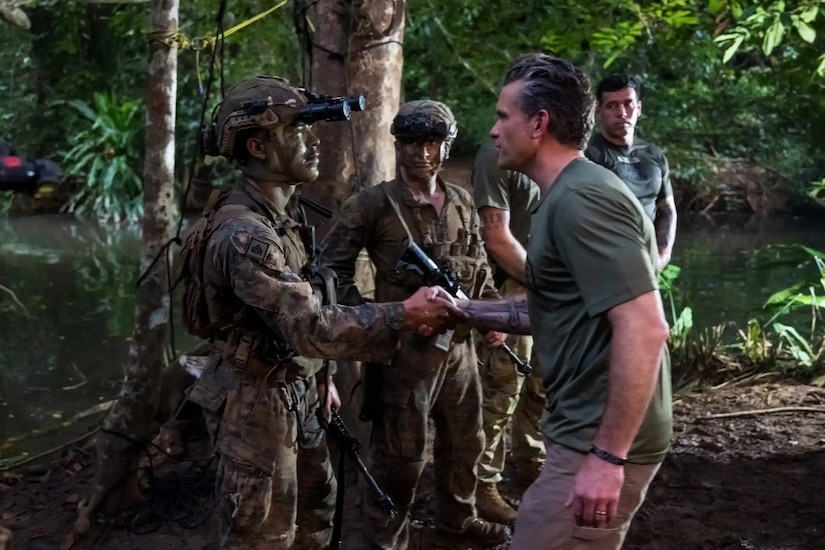
In a jungle environment, a man in casual attire shakes hands with a man in a camouflage military uniform and night vision equipment on his helmet while people in similar attire observe.

The visit coincided with the secretary's address during the Americas Counter Cartel Coalition, a U.S.-led multinational security and political alliance formed to combat transnational drug cartels, reduce illegal migration across the Western Hemisphere and limit foreign geopolitical interference. It also coincided with Exercise Panamax 2026, a multinational military exercise hosted by Panama and sponsored by U.S. Southern Command. 

In the dense jungle on the northern side of the Panama Canal, Hegseth told service members at the training center that what they are doing is exactly what he likes to see when he meets with warfighters. 

"I think this is what ... the warrior ethos looks like; it's what reestablishing it looks like," he said. "It happens in training centers like this, with Americans like this, who do really difficult things in really tough places." 

While at the training center, Hegseth met with instructors assigned to the Jungle Operations Training Course-Panama, along with Marines assigned to Littoral Combat Force-24, who were in Panama to participate in Panamax.
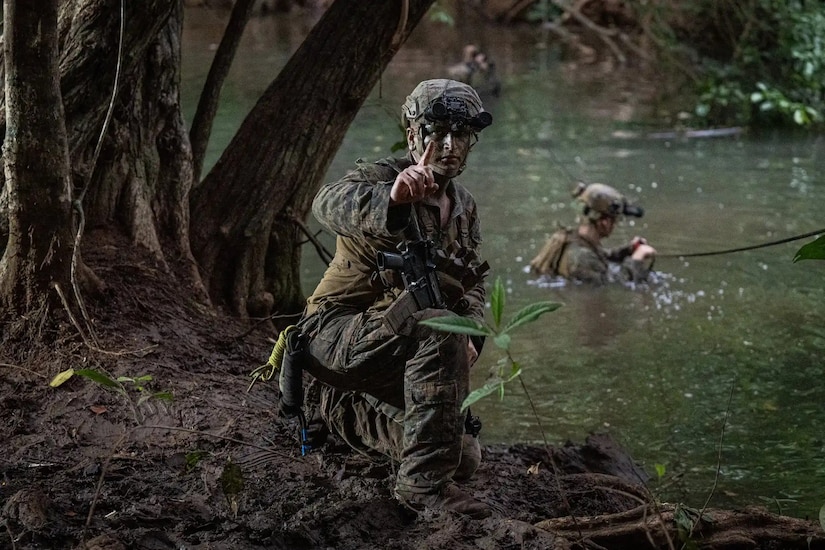
In a jungle environment, a man in a camouflage military uniform kneels on a riverbank as another man in similar attire stands in the water.
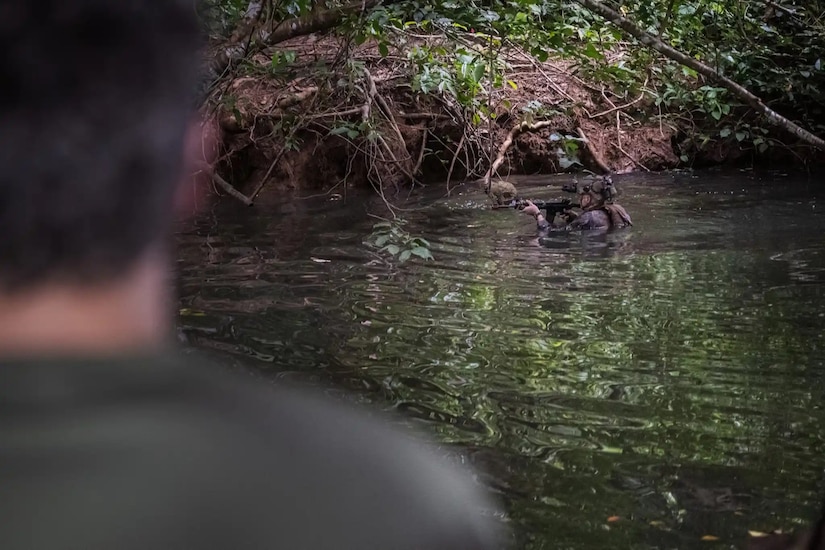
A rear-facing man observes two people in camouflage military uniforms as they move through water; one man carries a rifle.
The secretary said the service members who train at the center are willing to do things no other Americans are willing to do, to include helping U.S. allies in both Central and South America protect the nation's backyard. 

"That's what we're doing here with the A3C [and with] Panamax ... expanding peace through strength in our hemisphere, right here in the jungles with our partners," he said. 

Noting a big shift in the Southcom mission, Hegseth said that just 18 months ago, the command was less focused on protecting the Americas and deterring threats. 


"This is a different Southcom; this is a different mission," he said. "We are focused on military capabilities against real threats who need to be deterred and defeated, and we're going to give them everything they need to do it, on behalf of the American people." 

The secretary said that under President Donald J. Trump, Southcom's mission has focused on working with partners in the region to keep everybody safe from a variety of shared threats. 

"We know exactly what that mission looks like," he said. "We're empowering commanders like [Marine Corps Gen. Francis L. Donovan] to do it in Southcom; we're working with partners like Panama, like Ecuador, like Colombia ... they're going to send students here soon to swim across this very same river, [to] be a part of this very same training." 

The nations involved in the Americas Counter Cartel Coalition — 19 nations in all, with Colombia signing on just yesterday — are going to be involved in the same training as U.S. service members in Panama. The secretary said that the same things that necessitate American jungle training also motivate every other nation in the region. 

"It turns out, in the [Western] Hemisphere, they face the very same security challenges, the same threat of drugs, the same threat of criminal cartels that threaten their citizens, the same ones that threaten our citizens," Hegseth said. 

U.S. law enforcement personnel stationed at the U.S. southern border to stop illegal immigration and drug traffickers, combined with training across Central and South America in places such as Ecuador, Colombia and Panama, puts increasing pressure on shared threats. 

"That's going after the enemies of our country — designated terrorist organizations — unabashedly," Hegseth said. 

Earlier in the day, the secretary announced the new motto of the Americas Counter Cartel Coalition: "We do bad things to bad people." 

"For too long, bad people did bad things to good people, inside the United States of America and across Central and South America," he said. "We're going to empower great Americans and great partners to do really good stuff and be very capable about bringing violence against drug cartels and designated terrorist organizations, because we're dead serious about securing the homeland." 

A big part of that is the Trump corollary to the Monroe Doctrine. In 1823, President James Monroe articulated a foreign policy, now known as the Monroe Doctrine, which declared that the Western Hemisphere was off-limits to further colonization efforts or interference by European nations. Later, that expanded to include interference by any foreign power. 

In 1904, President Theodore Roosevelt added to that doctrine that the U.S. could intervene in the affairs of Latin America to protect U.S. interests. 

And now, Hegseth said, there is Trump's corollary to the Monroe Doctrine. 

"It is a recognition that [designated terrorist organizations] ... will not control our hemisphere ... and we will not allow foreign malign influence to take over ... key terrain like the Panama Canal," he said. 

Hegseth said Colombia's inclusion in the Americas Counter Cartel Coalition is significant. 

"The A3C had formed, but in some ways, it missed part of its core," he said. "Colombia is going to be [an] incredible partner. They offered to be a headquarters or a hub for the A3C as the brand-new 19th member. They've got ... hundreds of thousands of capable members of their military and decades of training with the United States ... that mil-to-mil relationship has been long-standing, and that's why they're coming to this jungle course soon."

Wednesday, June 20, 2012

Southcom Exercise Program Promotes Stability, Security


By Donna Miles
American Forces Press Service

MIAMI, June 20, 2012 – Several military exercises that just wrapped up or are under way exemplify U.S. Southern Command’s robust exercise program, one that officials consider integral to regional stability and U.S. national security.

Exercise Tradewinds 2012, which kicked off in Barbados June 15 and continues through the upcoming weekend, is focused on what Air Force Gen. Douglas M. Fraser, the Southcom commander, calls the most pressing regional challenge: transnational organized crime.

U.S. Marine Forces South is leading the exercise, which has brought together defense and law enforcement from the United States, Canada and 15 Caribbean countries for the 28th year to enhance their ability to work together against a common threat.

Speaking during opening ceremonies in Bridgetown, Barbados, Marine Corps Col. Michael Ramos, MARFOR-South chief of staff, emphasized the benefit of Exercise Tradewinds to participating nations. “We recognize the value of working together to confront these common security challenges,” he said. “We are truly united through our collaboration and collective efforts to fight terrorism, illicit trafficking and transnational criminality in all forms and in being prepared to effectively respond to natural disasters.”

Another exercise that concluded last week in Colombia, Fuerzas Comando 2012, brought together special operators from 21 regional countries for a grueling counterterrorism and special operations skills competition. That event, sponsored by U.S. Special Operations Command South, was designed to promote military-to-military relationships, increase interoperability and improve regional security.

“This is the one forum that we have annually where we can come together as a region and talk about ideas, [about how to] increase our effect, collectively, against these dangerous non-state-actor threats we face,” Navy Rear Adm. Thomas L. Brown II, commander of Special Operations Command South, told American Forces Press Service.

These are just two examples of a broad Southcom exercise program that last year alone included hundreds of training and educational events, 12 major multinational exercises with regional partners and 56 medical readiness training exercises in 13 countries, according to Army Maj. Gen. Gerald W. Ketchum, the command’s director of theater engagement.

“You don’t want to show up on game day for the big game, when you have never practiced together,” Ketchum told American Forces Press Service at the Southcom headquarters here. “And that is really what the exercise program is all about.”

Toward that end, the exercise program centers on four basic pillars: security and illegal migration and illicit trafficking, peacekeeping, counterterrorism, and humanitarian assistance and disaster relief.

The annual Peacekeeping Operations-Americas exercise that wrapped up last month brought together the United States and 15 partner nations to train in skills needed to serve as peacekeepers in Central and South America and the Caribbean.

U.S. Army South sponsored the four-phase exercise, conducted over the course of three months in Chile and the Dominican Republic in support of the State Department’s Global Peace Operations Initiative.

U.S. Ambassador to Chile Alejandro Daniel Wolff emphasized the importance of building the skills and interoperability needed for militaries to conduct vital peacekeeping roles. “Exercises like this offer the opportunity to learn from each other and to become more capable in our tasks to create a safer future for everybody,” Wolff said during the May 11 closing ceremony in Santiago.

Other Southcom exercises focus primarily on humanitarian assistance. These efforts, Ketchum explained, give military members an opportunity to use their skills while leaving behind tangible improvements in host nations. Sometimes it’s a new or renovated school, a newly dug well or new building to serve as an emergency operations center in the event of a natural disaster. Other exercises provide training for host-national medical staffs or desperately needed care in local communities.

For example, Army engineers and medical professionals currently deployed to Honduras and Guatemala for Beyond the Horizon 2012 are providing medical, dental and engineering support. Participants in another joint humanitarian exercise, New Horizons 2012, are providing training, free medical care and critical infrastructure in poor areas of Peru.

Officials said the efforts help address critical needs while showing U.S. support and commitment to the region. For many of the participants, the reward is getting to make a visible difference in others’ lives.

"My favorite part of this exercise is seeing the work getting done," said Army 1st Lt. Johnny Robey, commander of the Missouri National Guard’s 1140th Engineer Battalion, supporting Beyond the Horizon 2012 in Honduras. "I enjoy going to the sites and seeing the immediate impact of what we're here to do.”

Among Southcom’s array of multinational security exercises, PANAMAX remains the largest. The annual exercise focuses on supporting the Panamanian government in defense of the strategic Panama Canal.
Eighteen nations participated in last year’s exercise, working to improve the interoperability of their military and civil forces to guarantee safe passage through the canal and ensure its neutrality.

“This is a theme that is embraced by virtually everyone in the region: free and open access to the canal and flow of goods through the Panama Canal,” Ketchum said. “Everyone recognizes that it is clearly something of great value to the entire hemisphere to ensure that.”

Ketchum cited the growing success of the exercise as partners in the region step up to assume major leadership roles. Colombia took on the land component commander role last year, and will retain it during this year’s PANAMAX, in August. “They have embraced this role, and done a wonderful job,” Ketchum said. “Ultimately, that’s good for all of us, because we need interoperability and we need to be able to communicate with each other.”

Meanwhile, Brazil is preparing to assume leadership of the maritime component role during the upcoming PANAMAX, Fraser told Congress earlier this year. Fraser called the move “an important step in strengthening the expanding partnerships in the hemisphere.”

With expansion efforts under way at the Panama Canal that will increase the seaborne traffic it handles, close, regional cooperation will be more critical than ever, Fraser told the Senate Armed Service Committee in March. “I don’t see a direct change to the threat or to the concerns as we look into the future, but our PANAMAX exercise will remain critical to that effort,” he said.

Ketchum said the capabilities built and relationships strengthened through the exercise program have a direct impact on regional stability and U.S. national security.

“We truly believe that it takes an international approach to address the challenges we face in the region, and that these engagements are supporting that effort, he said. “We want to be the security partner of choice, and we look forward to continuing to work with our partner nations in the region.”

(Army Sgt. Sarah E. Lupescu, from the Missouri National Guard; Army Sgt. Alysia Jarmon, from the 65th Public Affairs Operations Center; and Robert Ramon from U.S. Army South contributed to this article.)

Wednesday, November 09, 2011

Veterans Day Honors Service, Sacrifice

Read about real veterans' experiences and the sacrifices they made in the best military books written by the veterans.

By Jim Garamone
American Forces Press Service

WASHINGTON, Nov. 9, 2011 – Until the 1960s, veterans groups used the red poppy as the symbol of Veterans Day. In Great Britain, it still is.

The symbol comes from a poem, “In Flanders Fields,” written by Canadian doctor John M. McCrae in 1915.

The first two verses of McCrae’s three-verse poem read:

“In Flanders fields the poppies blow
Between the crosses, row on row,
That mark our place; and in the sky
The larks, still bravely singing, fly
Scarce heard amid the guns below.
“We are the Dead. Short days ago
We lived, felt dawn, saw sunset glow,
Loved and were loved, and now we lie
In Flanders fields.”

McCrae tended to the first victims of a German chemical attack on the British line at the Belgian town of Ypres during World War I.

The fields of Flanders, where some of the most horrific battles occurred, are now dotted with cemeteries filled with the war dead. If you fly across France and Belgium, you can still see the remains of the trench systems of the war.

The Great War of 1914 to 1918, called the first modern global conflict, was an enormous divide for the world. Millions of service members died in the conflict. Millions more civilians were also killed or died of disease.

It truly was a world war. Troops fought in Turkey, the Balkans, East Africa and the Middle East as well as in Russia and France. The war caused the Russian czar to fall and allowed Vladimir Lenin to build what would become the Soviet Union.

On Nov. 11, 1918, that war came to an end. At 11 a.m. the shooting stopped. A war that saw 20,000 British "Tommies" die in 20 minutes at the Battle of the Somme in 1916, was over. The war that saw 1,384,000 French "poilus" die, ended in the trenches that extended from Switzerland to the Belgian coast. Americans, who joined the war in 1917, lost more than 100,000 soldiers in the fighting.

The Germans had signed an armistice with the allies and to the generations of The Great War, Nov. 11 remains Armistice Day. For decades, veterans sold paper poppies to raise money for memorials and for the families of those who died in the war.

But The Great War was not, as President Woodrow Wilson hoped, "the war to end all wars." World War II rose from its ashes, and millions more died to stop the mad dreams of dictators from 1939 to 1945. The U.S. Congress changed the name of Armistice Day to Veterans Day to honor all veterans after more blood was spilled during the Korean conflict to halt aggression.

Congress moved Veterans Day, along with most other federal holidays, to be celebrated on the closest Monday to the traditional date. But soon Congress reversed itself on Veterans Day because of public pressure to honor the powerful symbolism of the 11th hour of the 11th day of the 11th month.

This year, national observance of “11-11-11,” will include a presidential wreath-laying at Arlington National Cemetery and ceremonies around the country.

Along with two world wars and Korea, Americans and their allies have fought and died in Vietnam, Lebanon, Grenada, Panama, Kuwait, Iraq, Afghanistan and other places.

Today, the United States' armed forces confront enemies around the world. U.S. soldiers, sailors, airmen, Marines and Coast Guardsmen defend freedom on station wherever, whenever they are called.

Those serving in the military today are ensuring that they do not ignore the final verse of McCrae's poem:

"Take up our quarrel with the foe:
To you from falling hands we throw
The torch; be yours to hold it high.
If ye break faith with us who die
We shall not sleep, though poppies grow
In Flanders fields."

Editor’s Note: This is a slightly revised version of a story initial published by the American Forces Press Service in 2005.

Monday, August 22, 2011

Chief of Navy Reserve visits Reserve Staff during PANAMAX

From U.S. 4th Fleet Public Affairs

MAYPORT, Fla. (NNS) -- Vice Adm. Dirk Debbink, Chief of Navy Reserve and Commander, Navy Reserve Force visited U.S. Naval Forces Southern Command and U.S. 4th Fleet (COMUSNAVSO/C4F) headquarters, Aug. 21 to meet with Reserve staff members during PANAMAX.

Rear Adm. Kurt W. Tidd, COMUSNAVSO/C4F, welcomed Debbink and his delegation as they arrived at the headquarters.

"We're very proud to have Admiral Debbink visit us today," said Tidd. "This visit is an opportunity for us to discuss how Navy Reservists fully integrate into the everyday operations of their active duty counterparts both in real world situations as well as exercises such as PANAMAX."

During his visit, Debbink toured the headquarters, and got to talk to several Reservists and got a glimpse of the Navy's total force in action during PANAMAX.

"It is great to join you this morning and see the tremendous work of the Navy's total force for this exercise." said Debbink. "It is not just an exercise....your contributions to the operations here at NAVSO and during PANAMAX is significant in that they prove the strategic importance of this area of responsibility."

PANAMAX is one of the largest multinational training exercises in the world. The annual U.S. Southern Command (USSOUTHCOM) sponsored exercise series focuses on ensuring the defense of the Panama Canal, crucial to the unrestricted flow of global maritime commerce.

COMUSNAVSO/C4F supports U.S. Southern Command joint and combined full-spectrum military operations by providing principally sea-based, forward presence to ensure freedom of maneuver in the maritime domain, to foster and sustain cooperative relationships with international partners and to fully exploit the sea as maneuver space in order to enhance regional security and promote peace, stability, and prosperity in the Caribbean, Central and South American regions.

Wednesday, August 17, 2011

Panama Canal Defense Exercise Begins

By Terri Moon Cronk
American Forces Press Service

WASHINGTON, Aug. 16, 2011 – One of the world’s largest multinational military exercises gets under way today to test plans to defend the Panama Canal.

Some 3,500 military and civilian personnel from 17 countries are participating in the 12-day exercise dubbed PANAMAX 2011, U.S. Southern Command officials said.

Co-sponsored by Southcom and the Panamanian government, PANAMAX is a joint, combined operation focused on defending one of the world’s most strategic and economically crucial waterways for global trade, officials said.

This year’s exercise focuses on building the interoperability and capacity that would be necessary to defend the canal in the event of a threat, Southcom spokesman Jose Ruiz said.

“We hope the Panama Canal will never have to be defended from a serious threat,” Ruiz said, “but capacity is a very important part of being able to respond to emerging threats.” While the participating countries have an interest in the canal, two-thirds of the canal’s shipping traffic is from the United States, Ruiz noted.

The exercise will develop and test the command and control of forces at sea, involving participants in maritime, air, land, space and cyber operations, he said. Scenarios include open water diving operations, counterdrug interdictions and simulated river operations.

PANAMAX will take place off the coasts of Panama, Texas, Florida and Mississippi through Aug. 26.

The PANAMAX exercise series began in 2003 with the United States, Panama and Chile participating, Ruiz said. Interest in the exercise and in protecting the canal has grown over the years, he added, and participation has expanded to as many as 20 partner countries, he added.

“We worked with our partner nations for many years with the approach that regional security challenges require regional solutions and approaches,” he said.

Friday, April 15, 2011

This Day in Naval History - April 15

From the Navy News Service

1885 - Naval forces land at Panama to protect American interests during a revolution.
1912 - USS Chester (CL 1) and USS Salem (CL 3) sailed from Massachusetts to assist RMS Titanic survivors.
1918 - First Marine Aviation Force formed at Marine Flying Field, Miami.
1961 - Launching of first nuclear-powered guided-missile cruiser, USS Bainbridge (CGN 25), at Quincy, Mass.
1962 - USS Princeton (CV 37) brings the first Marine helicopters to Vietnam. This was the first Marine advisory unit to arrive in South Vietnam.
1969 - A North Korean aircraft shoots down a Navy EC-121 reconnaissance aircraft over the Sea of Japan.
1986 - During Operation Eldorado Canyon, Navy aircraft from USS America (CV 66) and USS Coral Sea (CV 43) attack Libya in conjunction with Air Force aircraft, after Libya is linked to the terrorist bombing of a West Berlin discotheque that killed one American and injured 78 people.

Wednesday, January 05, 2011

This Day in Naval History - Jan. 05

From the Navy News Service

1855 - USS Plymouth crew has skirmish with Chinese troops.
1875 - Cmdr. Edward Lull begins expedition to locate the best ship canal route across Panama.
1943 - In the Southwest Pacific, USS Helena (CL 50) fired first proximity-fused projectile in combat, shooting down a Japanese divebomber in the process.
1968 - Lt. Clarence W. Cote becomes the first male Nurse Corps officer in the regular Navy.