Showing posts with label air force. Show all posts

Thursday, March 05, 2026

Air Force, Space Force Ready for All Warfighting Challenges

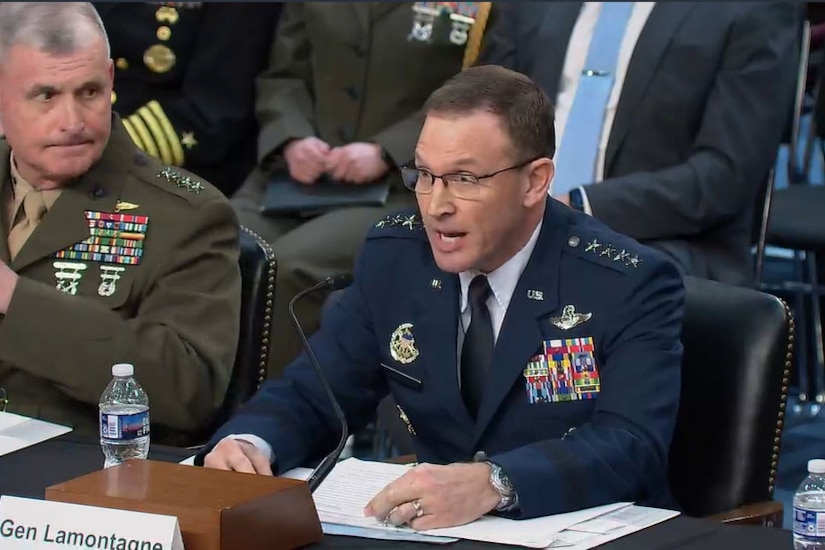
The Air Force's lethality depends on the professionalism of airmen and the capability of their equipment, said Air Force Gen. John D. Lamontagne, Air Force vice chief of staff, who testified yesterday at a Senate Armed Services Committee hearing on joint force readiness in Washington.

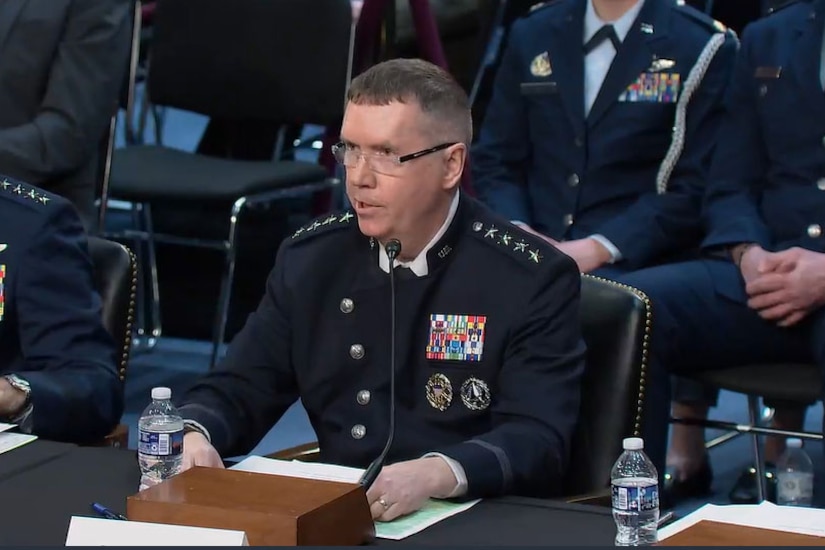
A man seated at a table wearing a formal military uniform speaks into a microphone.

"Airmen are our most precious resource. The active-duty, Air National Guard, reserve and civilian workforce are why the United States Air Force is effective at a moment's notice," Lamontagne said.

The Air Force updated its fitness policy to push airmen to new levels and ensure they are ready to stand shoulder to shoulder with its joint partners on the toughest battlefields, the general said.

The service is improving airmen's quality of life by updating dormitories and child development care centers.

"We strive to make the Air Force an unmatched place to serve," Lamontagne said, adding that recruiting goals are being met and retention numbers are strong.

The Air Force is increasing aircraft availability, which allows aviators to get the repetitions they need to build competence. The service is also recapitalizing its ground-based strategic deterrent, fighter, bomber and tanker aircraft, as well as the command-and-control architectures that bring them together, the general said.

At the tactical level, airmen are practicing agile combat employment and preparing to fight in exercises like Bamboo Eagle. Last summer, the Air Force deployed more than 400 aircraft and 15,000 personnel across 50 locations in the Pacific region, Lamontagne said.

Space Force Gen. Shawn N. Bratton, vice chief of space operations, said his service, along with commercial partners, executed 170 launches this year.

A man seated at a table wearing a formal military uniform speaks into a microphone.

A new radar has upgraded optical surveillance systems to track adversarial activity on orbit better, he said, noting that additional systems will increase domain awareness.

Regarding readiness, Bratton said guardians must be ready at any time for any threat across the entire spectrum of conflict. They participated in a variety of exercises designed to ensure space superiority, and officer training courses now include training in space, cyber, intelligence and acquisitions.

"We will need to double in size in the coming years to meet identified operational needs, as well as significantly increase our training facilities. Even as we prepare for current warfighting challenges, we are aggressively looking ahead at capability requirements for the future force," he said.

Tuesday, January 27, 2026

Air Force, Navy Aircraft to Fly Over Super Bowl LX

To commemorate America's 250th birthday, the Air Force and the Navy are conducting a joint flyover during Super Bowl LX at Levi's Stadium in Santa Clara, California, Feb. 8, 2026. 

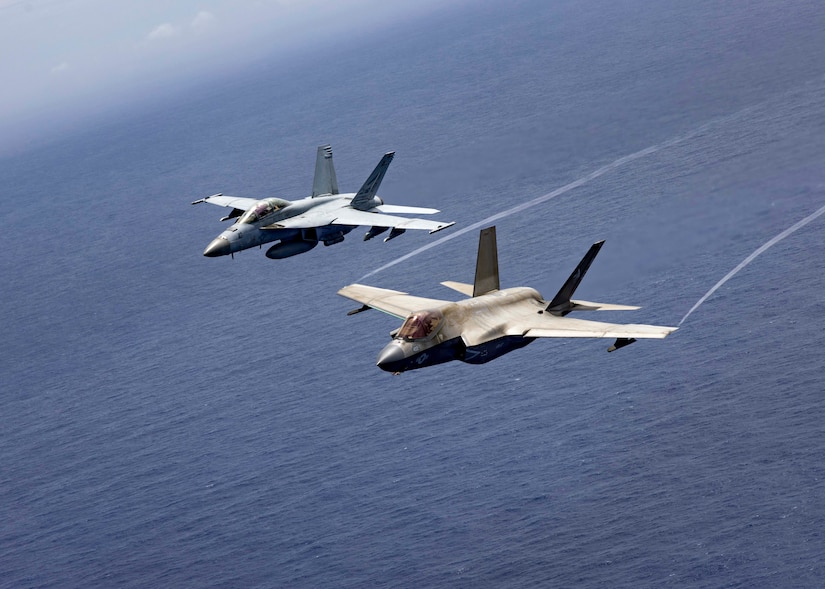
The formation, featuring two Air Force B-1 Lancers, from Ellsworth Air Force Base, South Dakota, and two F-15C Eagles, from Fresno Air National Guard Base, California, alongside a pair of Navy F/A-18E Super Hornets and two F-35C Lightning IIs, from Naval Air Station Lemoore, California, is a symbol of the nation's journey and independence.

While this flyover features the Air Force and Navy, a powerful symbol of America's  airpower and maritime strength, it symbolizes the entire joint force — Army, Marine Corps, Navy, Air Force, Space Force and Coast Guard — working together across every domain to defend the nation, safeguarding 250 years of American independence.

A graphic of military jets flying in formation at the top of a Super Bowl LX logo that has a San Francisco landscape inside it. The bottom of the graphic reads "USA 250."

A Military District of Washington joint armed forces color guard will render military honors during the national anthem. This prestigious interservice team from the capital region provides unparalleled ceremonial precision and national representation. The service members of the Air Force and Navy flyover will participate in community outreach events leading up to game day, including public displays of the aircraft, search and rescue demonstration and backseat flights on the F/A-18F Super Hornet with community leaders.
 
As the nation celebrates the country's 250th birthday throughout 2026, the joint community outreach efforts throughout the Super Bowl week demonstrate the joint force's shared history and enduring commitment to defending freedom and supporting the nation's independence.

Two military jets fly through the air. The closest aircraft has trails of water vapor coming off the wings.

 
At one of the most-watched events in the world, the flyover will be a visible reminder that America's military remains united, ready and dominant — 250 years strong.

Friday, September 26, 2025

Security Forces in Alaska Take Part in Specialized Training

Eight airmen assigned to the 673rd Security Forces Squadron participated in a Fly Away Security Team training course at Joint Base Elmendorf-Richardson, Alaska, Sept. 15-19.

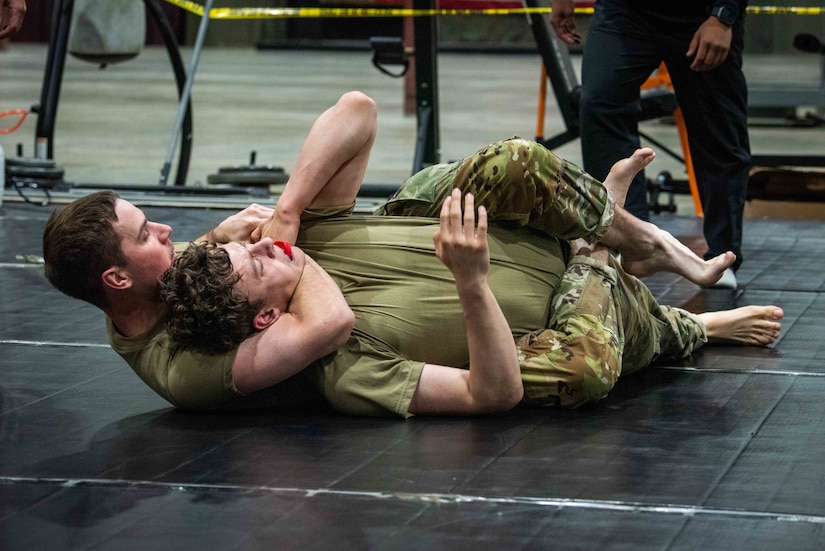
Two men dressed in camouflage military uniforms wrestle during combatives training. One man has a red bite guard in his mouth.

 
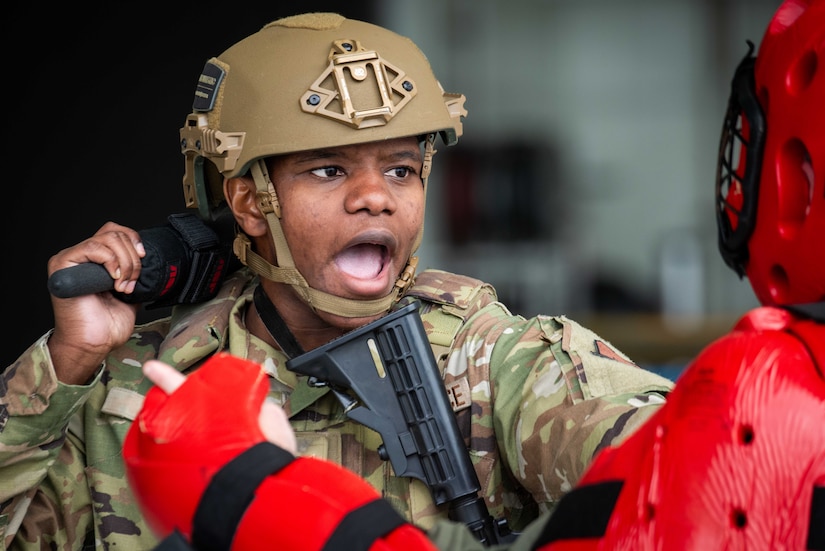
Fly Away Security Team training is a five-day, 40-hour course that challenges airmen physically and mentally to enhance their lethality while protecting aircraft, aircrew, cargo and distinguished visitors during operations on austere airfields. 
 
They aid in humanitarian missions and War Department operations; their missions typically involve providing a security perimeter around aircraft at unsecured, foreign airfields.

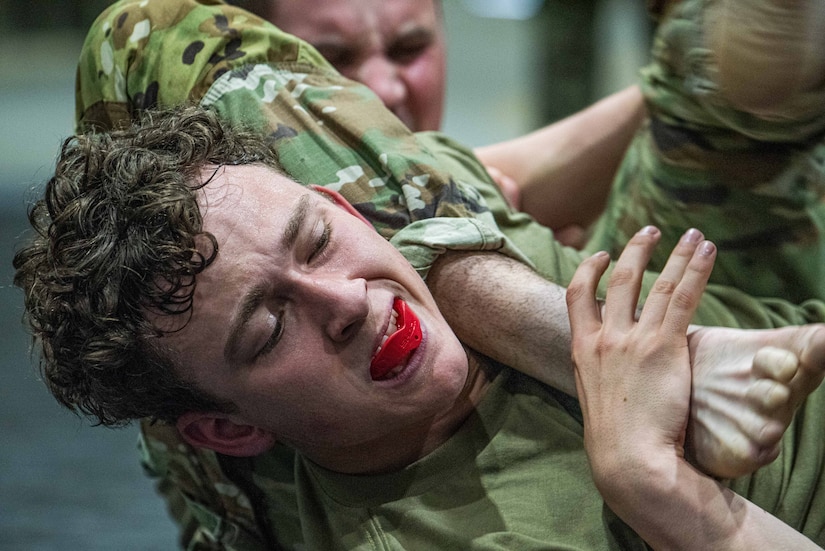
Two men wearing camouflage military uniforms wrestle during combatives training. One man has a red bite guard in his mouth.

 
"Fly Away Security is a certification that should carry a lot of weight — it is not for your average security forces member," said Air Force Staff Sgt. Taylor Davis, 673rd Security Forces Squadron noncommissioned officer in charge of small unmanned aircraft systems. "Here at [Joint Base Elmendorf-Richardson], we hold the FAST to a higher standard, and we train them at a higher standard; we train them to win." 
 
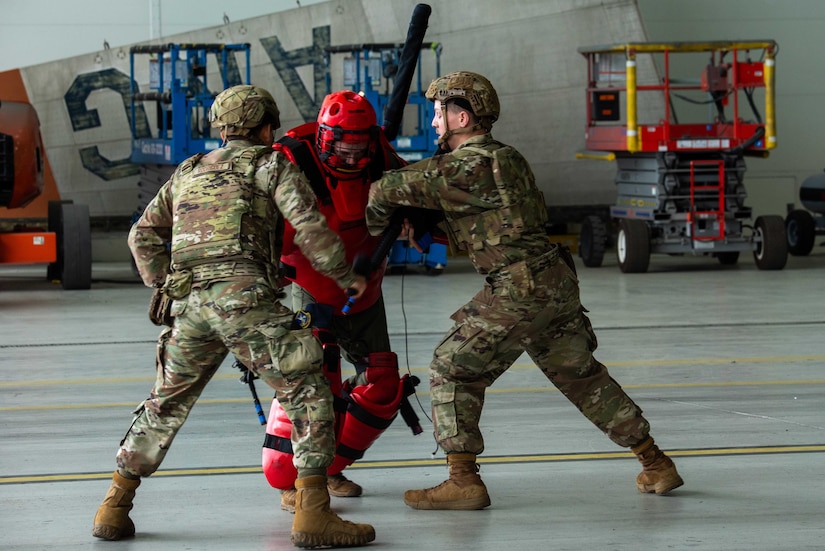
During the course, students undergo combat and hands-on training. They work through real-world simulations, demonstrating skills they have learned throughout the week. Some of the training included peer-on-peer wrestling, baton evaluation and flightline training with a C-17 Globemaster III assigned to the 517th Airlift Squadron.

A man wearing an advanced combat helmet and camouflage military uniform swings a baton at a person wearing a red padded suit during baton combatives training.
Two men wearing advanced combat helmets and camouflage military uniforms push a person dressed in a red padded suit and helmet during combatives training.
"We train our members to go out to these austere locations or airfields that do not have adequate security," said Air Force Tech. Sgt. Adam Stanley, 673rd Security Forces Squadron base defense noncommissioned officer in charge. "They have been trusted in protecting personnel and assets to provide a safer environment within their area of responsibility." 
 
The 673rd Security Forces Squadron conducts FAST training courses multiple times a year, not only for its own members but also for other Air Force units. They plan to expand the program to enhance security for airfields and aircraft.

Monday, September 22, 2025

Senior Air Force Leader Recounts Recent Successes, Underscores Need to Outpace Adversaries

 Sept. 22, 2025 | By Matthew Olay, Pentagon News

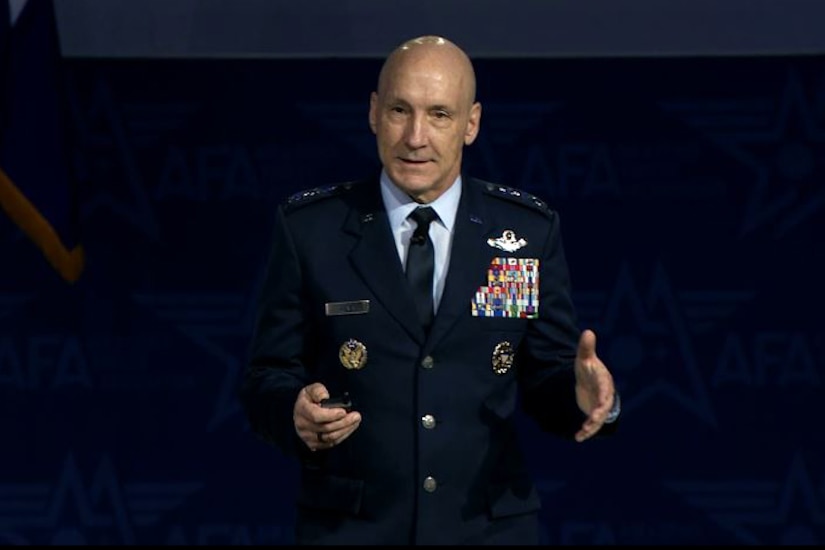
During a keynote address at the Air and Space Forces Association's Air, Space and Cyber Conference at National Harbor, Maryland, today, Air Force Chief of Staff Gen. David W. Allvin spoke of the service's recent successes — both real-world and exercise-based — while also underscoring the importance of keeping a winning pace when facing our nation's adversaries. 

A person in a dress military uniform speaks and gestures with his hands indoors.

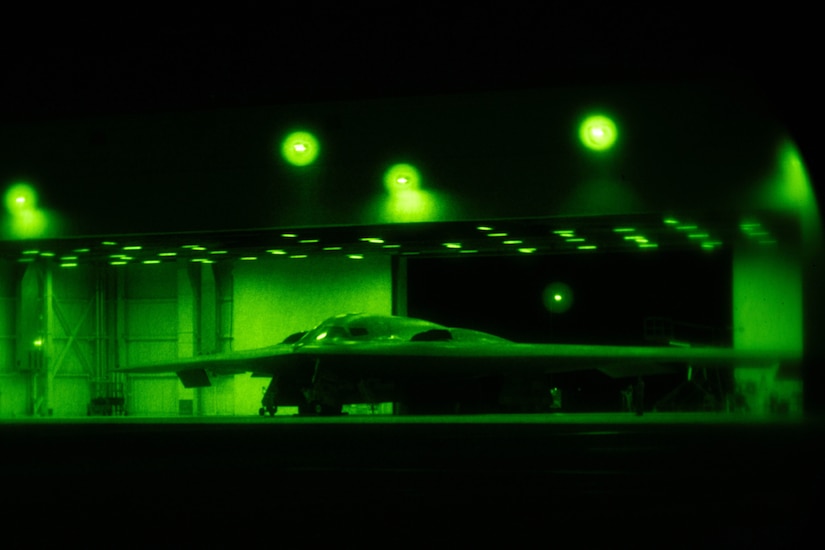
Allvin led off his remarks discussing the complexity of the Air Force's successful execution of Operation Midnight Hammer, the June 21 mission during which numerous Air Force assets inflicted significant damage on Iran's nuclear program at three separate sites. 

Regarding that mission, Allvin said it wasn't just the precision of the weapons and capabilities that stood out, but it was also the airmen who handled the complexity of the operation with great skill and professionalism. 

"It was a complex and imaginative mission that was designed, but with that complexity came unforeseen issues that came up in front of our airmen — over and over and over again," Allvin said. 

"And, in a story that will never really, truly be told in public, our airmen were unbelievable," he continued, adding that Air Force personnel properly assessed risk, understood what their roles were and knew what it would take to execute the mission successfully.  

A view through night vision of a flat, triangular-looking military aircraft sitting in a hangar.

Allvin also spoke highly of Exercise Resolute Force Pacific, a large-scale event conducted July 10-Aug. 8, which he described as the largest Air Force-led exercise in the Indo-Pacific region since the Cold War. 

"What set this exercise apart was the scope and the scale and the complexity [involving] transitioning from the types of fights we've done to the types of fights we don't want to have to do, but need to prevail [in] if we do," Allvin said.  

While discussing the Air Force's current state of readiness, Allvin said it's essential to constantly be asking whether the service is going fast enough and reaching deep enough to meet the challenges of the day. 

"In this environment, with the consequences on the other side of it, we have to beware of the familiar [and] be cautious about the warm blanket of the comfortable," Allvin said, adding that it's necessary to keep up a quick pace of readiness because U.S. adversaries aren't slowing down.

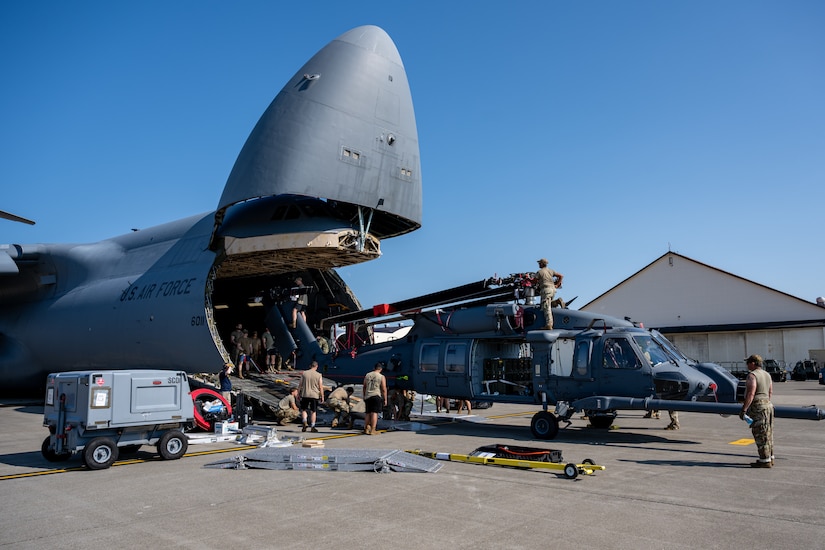
A handful of service members in casual attire are on a tarmac loading a military helicopter with its rotors folded together into the front end of a large military cargo aircraft.

To illustrate his point, Allvin circled back to Operation Midnight Hammer, stating that, in the aftermath of the operation, Iran likely went straight to work on fortifying its nuclear program and making it less vulnerable to attack. 

"You can believe they probably got after it immediately … and we've got to respond to that," Allvin said.  

Returning to the topic of pacing, Allvin said merely moving at the "speed of relevance" is not adequate enough to meet present-day challenges. 

"Last time I checked, our mission says 'fly, fight and win.' … So, if you want to know what the pace is, that's the pace. We have to move out at the pace to win, and if we're not getting there, then we need to find another gear," he said. 

Allvin ended his remarks by calling himself an optimist, saying he believes the Air Force will continue to keep the pace to win because of the constant influx of talented, skilled, innovative and ready airmen who are consistently joining the ranks on a regular basis. 

He also praised industry partners and entrepreneurs who are working to deliver the materiel the Air Force needs. 

"And what the nation needs is one Air Force, integrated, aligned, focused [and] ready to fight; the nation needs more Air Force [with] more capability, more capacity [and] more options for the president; and the nation needs your Air Force moving out at a pace to win," Allvin concluded.

Thursday, October 29, 2015

Qatar moves one step closer to receiving U.S. Air and Missile Defense Operations Center

by Justin Oakes
66th Air Base Group Public Affairs


10/28/2015 - HANSCOM AIR FORCE BASE, Mass. -- Last week the Air Force and the State of Qatar finalized an agreement for the next step in the delivery of a U.S. integrated air and missile defense system for the Qatari Emeri Air Force.

The Qatar Air and Missile Defense Operations Center, or ADOC, program located at Hanscom AFB awarded Raytheon a $160 million contract for Phase II of the initiative. The contract covers the procurement, delivery, installation and sustainment of the Qatar ADOC system as well as training of Qatari personnel.

Qatar -- a key U.S. partner and also a member of the Gulf Cooperation Council, a political and economic alliance of six Middle Eastern countries -- requested the purchase of a U.S. missile defense system, said James Ware, Qatar ADOC program manager.

"By supporting this sale, it will ultimately benefit the U.S. by providing better interoperability with U.S. Central Command forces," he added.

U.S., coalition forces and the Gulf Cooperation Council share information for united defense and work hand-in-hand within USCENTCOM.

The ADOC itself is a command and control center focused on air and missile defenses. It  consists of multiple different weapon systems and radars, and is composed of a command center, space for operations and planning personnel as well as senior leader offices.

With the next phase underway and on track, the Hanscom program office plans to meet with Qatari officials this month to discuss interoperability requirements to determine what information will be exchanged between the ADOC and existing and planned systems.

One of the systems that is planned to be integrated into the ADOC is the Army's PATRIOT Air and Missile Defense System.

"Mutual approval is necessary prior to adoption of any planned integrated system to ensure data protection is commensurate with prescribed U.S. procedures and standards," Ware said.

Program officials also plan to conduct an Interim Design Review that will allow Raytheon to receive stakeholder feedback early in the development cycle.

"Ultimately, the delivery of the ADOC not only improves upon Qatar's defense infrastructure, but helps solidify an ongoing partnership between the two countries,"  said Tom Cook, Qatar ADOC branch chief.

Sunday, August 30, 2015

General Levy discusses current, future Tinker needs during annual symposium

by John Parker
72nd Air Base Wing Public Affairs


8/28/2015 - MIDWEST CITY, Okla. -- The Air Force needs private industry to help field new weapon systems faster and the nation requires more graduates in scientific and technical fields to maintain America's edge in combat air power, the head of the Air Force Sustainment Center said recently.

Lt. Gen. Lee Levy II addressed more than 800 attendees, including scores of defense contractors, Aug. 18, 2015, at the 10th annual Tinker and the Primes Requirements Symposium in Midwest City, Oklahoma. The general and Oklahoma Gov. Mary Fallin were keynote speakers at the three-day event.

The commander of the Air Force Sustainment Center with more than 35,000 personnel in Oklahoma, Utah and Georgia said some potential adversary nations possess the industrial and technological means to take new weapon systems "from idea to hardware" in 18 months.

"That ought to give us all pause, right?" Levy said. "Because in modern warfare the pace of warfare is almost instantaneous. In some cases it's simply the speed of electrons."

The Air Force will need faster development times for new innovations in areas as diverse as swarming unmanned aerial systems, space and cyberspace capabilities and micro-robots, the general said.

"Other nations who wish to do us harm sometimes field hardware capabilities a lot quicker than we do, and all of us in this room are partners in that strategic agility that's essential to going faster to delivering those combat capabilities sooner at a more affordable cost so we can afford to get ready not only for today, but for the future," the general said.

Representatives hailing from prime contractors such as Northrop Grumman to Oklahoma aerospace companies traveled from 34 states and three countries to network and learn about Tinker Air Force Base's current and future needs. Tinker directors, managers and engineers conducted multiple presentations on those subjects.

Levy also encouraged professionals, elected officials, parents and teachers to continue inspiring students to pursue the STEM disciplines of science, technology, engineering and math.

"When I look at the requirements in the future for software engineers, mechanical engineers, electrical engineers and computer scientists, I think at the Air Force Sustainment Center I could hire every single one that's produced in the state of Georgia, the state of Oklahoma and the state of Utah and still not have enough people to fill all the chairs that I need to fill."

Governor Fallin praised the work of the Midwest City Chamber of Commerce and Rose State for hosting the annual symposium that helps fuel Oklahoma businesses, innovation and jobs. Tinker packs a $3.5 billion economic impact for the state.

"We understand the importance of partnership, the importance of community support for Tinker Air Force Base, our men and women who wear the uniform, and our civilians, who serve our great nation," the governor said.

Symposium organizers also honored retired Air Force Lt. Gen. Bruce Litchfield. The former AFSC commander was awarded the symposium's inaugural Tinker and the Primes Patriot Award for his outstanding achievements for the Air Force and Oklahoma. The award inscription quotes the general's signature saying.

"I know the award says, 'It's a great day to fly,' but that's not my job anymore," Litchfield said. "So I'm going to tell you this in my (retirement) coming out party that it's my job, it's my responsibility, to make this a great day to thrive and that's what I'm going to work to do. It's not about flying anymore. It's about America thriving, and I think that's what we all need to rally around and that's what's going to make America great. That's why this award is so special to me."

Wednesday, July 29, 2015

Air Force promotes fatigue countermeasures

Air Force Materiel Command Health & Wellness Team

7/29/2015 - WRIGHT-PATTERSON AIR FORCE BASE, Ohio -- Human fatigue results from sleep deprivation. Fatigue has become a growing concern in the Air Force as sustained and continuous operations, along with global deployments, are stretching the ability of our forces to meet growing mission demands. Some Airmen may question whether fatigue is really a big enough hazard to worry about. Fatigue can decrease an Airman's attention span and reaction times, and can impair their mental process, which can lead to increased probability of operational errors, mishaps and off-duty accidents. Ensuring that Airmen get the proper amount of sleep has become a serious challenge.

The Air Force defines fatigue as the state of tiredness associated with:
· Long hours of work
· Prolonged periods without sleep
· Physiologic stressors of the flight environment
· The requirement to work at times that are out of sync with the body's biological -- or circadian -- rhythms

To raise awareness about fatigue and disseminate information to Airmen regarding strategies for its management, the Air Force Medical Operations Agency has developed and published the Air Force Fatigue Management Guide. Highlights of the guide include: understanding the nature of fatigue, fatigue countermeasures, good sleep habits and advice for handling unavoidable sleep loss.

One hard-copy of the guide will be distributed to each current and incoming Airman during the next year. The point of contact for distribution of the guide is the installation's Medical Group. An electronic guide is also available; instructions to download can be found at the AFMCwellness.com website or by contacting a Med Group point of contact.

Civilian Health Promotion Services will be offering classes on sleep health during the month of August. Civilian employees can obtain their "Guide to Healthy Sleep" booklet by contacting their local CHPS team or visiting AFMCwellness.com.

Innovative Airmen recognized by AF vice chief of staff

Secretary of the Air Force Public Affairs Command Information

7/29/2015 - WASHINGTON (AFNS) -- Air Force Vice Chief of Staff Gen. Larry O. Spencer presented the inaugural General Larry O. Spencer Innovation Awards July 23 at the Pentagon, to Airmen who made the most significant contributions to saving Air Force financial and manpower resources this year.

"This is personal for me -- not because of the award name, but because I'm so passionate about innovation," Spencer said during the ceremony.

Andrew Sloper, a logistics management specialist at Hill Air Force Base, Utah, was the individual award winner. He increased the Ogden Air Logistics Center's capacity by 216 percent while reducing annual depot costs by 37 percent during the F-22 Raptor depot consolidation initiative streamlining. His effort provided a projected $300 million "should cost" savings.

"I've often been accused of having a lot of passion in what I do," Sloper said. "Making sure that we streamline our processes and get the aircraft back to the warfighter is my number one priority."

The team award went to the Air Combat Command Surgeon General's Home Station Medical Response and Bioenvironmental team from Joint Base Langley-Eustis, Virginia. The team identified and eliminated a redundant chemical detection capability across the Air Force, which resulted in an immediate savings of $2.3 million and a total savings over the life cycle of $3.5 million.

"It's an honor to be a member of this team receiving the inaugural General Larry O. Spencer Innovation Award," said Maj. Perry Johns, assigned to the Home Station Medical Response Branch. "Air Force leadership has created a culture of innovation and good stewardship. I hope this initiative has laid a cornerstone on which the Air Force will continue to build future successes."

In the spirit of that culture, Spencer challenged those in attendance to think about the vast impact innovation has had, and will continue to have, on the Air Force.

"What is the Air Force going to look like when you're standing up at your retirement ceremony?" Spencer asked. "It's going to look a lot different than it does now. The reason these awards are so important is that you all now are contributing to the way the Air Force is going to look in the future."

Tuesday, July 21, 2015

First F-35 fighter squadron activated at Hill

by Mitch Shaw
Hilltop Times Correspondent


7/21/2015 - HILL AIR FORCE BASE, Utah -- The jets won't arrive for another few months, but the first F-35 fighter squadron has officially started work at Hill Air Force Base.

The 34th Fighter Squadron -- affectionately known as the Rude Rams -- was reactivated at Hill Friday afternoon, marking the beginning of the F-35's combat era for both the 388th and 419th Fighter Wings. The fighter squadron is a historic one, with a past that can be traced back to Word War II and includes participation in conflicts from Vietnam and the first Gulf War to Iraq and Afghanistan, post Sept. 11, 2001.

The squadron was mothballed as an F-16 unit in 2010 as part of an Air Force restructuring plan to retire planes and save money, but it returns to accommodate the F-16's replacement, becoming the first operational Air Force unit to fly combat-coded F-35s.

Col. David B. Lyons, current 388th commander and former commander of the 34th, said the reactivation is one of the highlights of his career. He led the squadron when it was deactivated in 2010.

"This has got to be one of the finest days of my military career," he said. "To see this squadron shut down in 2010 was heartbreaking, but somebody, somewhere had the good sense to bring it back to duty."

Lt. Col. George Watkins, new commander of the squadron, said that while the first operational F-35 is not slated to arrive at the base until September, the new squadron shouldn't have trouble keeping busy until then.

The first group of F-35 maintainers, which will make up the 34th Aircraft Maintenance Unit, have been at Hill for two months, completing mostly administrative work critical to the upcoming aircraft transition.

Watkins said the airmen have been writing programs on how the unit will maintain the F-35 in peace and wartime scenarios and have created a flying-hours program that includes directives for training, off-station sorties, contingency scenarios, local flying, and any major modifications to the aircraft.

"There a lot of work to be done before we get that first jet," Watkins said.

The initial group of F-35 maintainers from the 419th are in training, and the first 419th pilot to fly the F-35 will beginning training this fall.

When the F-35s begin to arrive at Hill, they'll be divided among three fighter squadrons and flown and maintained by members of both the 388th and its reserve component 419th Fighter Wing.

After the first jets arrive at Hill, the rest of the fleet will be coming in on a staggered basis, spread through 2019. There will eventually be a total of 72 F-35s at Hill, with approximately 35 to 40 pilots in each of the three fighter squadrons.

The jets will be delivered at a rate of just more than one per month until August 2016. By then, Hill officials hope to have 15 jets and reach a status known as "Initial Operational Capability," which means the fighter wings meet the minimum operational capabilities to use the jet for normal operations.

The 34th is scheduled to have five qualified pilots during the first month of flying, taking turns in what will be two F-35s on base. The 388th FW is sending pilots through training at Eglin AFB, Florida and Luke AFB, Arizona. By January 2016, the wing will have 10 pilots qualified to fly the F-35, including Watkins and Lyons, who both finished their training earlier this year.

The colonels answered to those who have criticized the F-35 program for its expense and apparent lack of performance. The most recent cost estimate for operating and supporting the F-35 fleet exceeds $1 trillion and a leaked internal brief written by a test pilot who was flying the F-35 during a January test run revealed the jet was losing dogfights to the F-16.

"Things aren't perfect, but things are still in development and you can see the potential," Lyons said, adding that the F-35 flies similarly to the F-16, but by fusing many different sensors together, makes the pilot's job easier in the cockpit.

Fighter Wing Spokesman Nathan Simmons said that by the time the F-35 is in full operation at Hill in 2019, the 388th will have added more than 260 active-duty positions.

Thursday, July 16, 2015

Veterans in Blue: Johnny "Bulldog" Hernandez

by Tech. Sgt. Robert Barnett
JBER Public Affairs


7/16/2015 - JOINT BASE ELMENDORF-RICHARDSON, Alaska -- Johnny Hernandez joined the Air Force in 1981 with dreams of flying. However, the cost of education prevented him from becoming a pilot, so he settled for a job as a tactical aircraft maintenance specialist.

The job allowed him to travel the world, where highlights of his career included serving in Germany, England, Kuwait, Korea, Saudi Arabia and other countries.

After being treated for several ear infections, he was referred to different specialists. In 1987, Hernandez underwent a computerized axial tomography scan and was diagnosed with cancer.

It took two surgeries to remove it, leaving a scar that reached above his left ear down to his throat.

"When you almost lose your life ... you don't feel indestructible anymore," Hernandez said.

"You realize you can be hurt."

He was now completely deaf in his left ear and considers his biggest challenge being told he would not be able to continue in his career field. "It made me keep pressing forward," he said.

Hernandez convinced the doctors to let him keep going on the condition that he report his condition getting any worse. It never did.

He retired in 2001 and became a recovery care coordinator at the Warrior Transition Unit on Joint Base Elmendorf-Richardson.

Motivated by his experiences with cancer, Hernandez is dedicated to helping military members access their benefits, from education to medical needs.

"I want to share my story with others," he said. "It really brings what I'm doing here into perspective. I'm extremely passionate about people."

Wednesday, July 15, 2015

AF rolls out details to improve RPA mission


By Secretary of the Air Force Public Affairs , / Published July 15, 2015

WASHINGTON (AFNS) -- In response to a critical shortage of remotely piloted aircraft pilots, the Air Force rolled out more details of its plan to fix the problem in both the short and long term. The most recent initiatives include creating bonuses for RPA pilots of $15,000 per year beginning in fiscal year 2016; placing some newly minted pilots in RPA squadrons beginning in August; and investing more than $100 million to buy more ground control stations, simulators and contract instructors.

"In a complex global environment, RPA pilots will always be in demand," said Secretary of the Air Force Deborah Lee James. "Remarkable Airmen have ensured the success of the (MQ-1 Predator and MQ-9 Reaper) programs. We now face a situation where if we don't direct additional resources appropriately, it creates unacceptable risk. We are working hard to put solutions in place to bring needed relief to our Airmen and ensure our actions show their value to our mission."

Bonus pay

The Air Force is looking at special and incentive pays to enhance recruiting and retention, as well as recognize RPA pilot contributions to the mission, according to officials. Under this proposal RPA pilots would be able to choose between a Critical Skills Retention Bonus of five years at $15,000 per year or nine years at $15,000 per year. This bonus is similar in value and commitment to what has been offered to aviators in the past who have similar training and experience. Members who choose either the five- or nine-year option would also be eligible to receive 50 percent payment upfront.

"We will continue to maintain a persistent focus on this mission set and bring about the necessary relief to sustain operations responsibly," James said. "This is a high demand mission set. It is a national security imperative that we get this right."

Undergraduate pilot training graduates to RPA

As another part of the solution, about 80 UPT graduates over the next 12 months will be assigned to RPA positions for one assignment tour to help alleviate growing pressure on overtaxed RPA crews. Air Force pilot training bases are at Columbus Air Force Base, Mississippi; Laughlin AFB, Texas; Vance AFB; Oklahoma; and Sheppard AFB, Texas. The current plan is to only use the UPT pipeline for one year while the RPA-unique training pipeline increases from approximately 190 to 300 RPA pilot graduates per year. The last time the Air Force placed a UPT graduate directly into the RPA career field was 2011.

“The most critical challenge we face in this mission area is a shortage of RPA pilots and the UPT grads are the fastest way to address that shortfall without sacrificing mission capability in other platforms,” said Air Force Chief of Staff Gen. Mark A. Welsh III. “Actions we take today will allow the Air Force to continue to provide world-class, strike-ready (intelligence, surveillance and reconnaissance) over the battlefield and enhance overall combat capability."

As part of the get-well plan, the move to place UPT graduates as RPA pilots addresses a constant demand for real-time ISR in support of combatant commander needs. Those UPT graduates selected will get the requisite RPA training for the MQ-1B or MQ-9.

"Those selected for RPA duties will serve one tour and then be placed in manned aircraft if desired after completion of that tour," Welsh said. "This will help the Air Force achieve a healthy steady state for the RPA enterprise as soon as possible."

Additional RPA investments and improvements

In addition to the initiative to place UPT graduates directly into the RPA enterprise, the Air Force increased the use of Guard and Reserve Airmen as well as contractors in order to bring relief to a community in high demand. In April, Air Force leadership worked with the Defense Department to bring relief as the secretary of Defense adjusted the number of required combat air patrols from 65 to 60 by October. Air Force leaders are currently working reprogramming actions within the DOD and Congress to reallocate funding to critical areas like the RPA program.

The $100 million is part of the omnibus and subject to congressional approval. The omnibus is a tool available to move funds to areas identified as critical mission need areas. Initiatives include buying six next-generation ground control stations, more training simulators and associated facilities, improved software tools, and accelerating the development of automatic takeoff and landing capability.

“On average, an MQ-1 Predator and MQ-9 Reaper pilot flies up to 900 hours per year,” James said. “In comparison, fighter pilots fly an average of 250 hours. Due to the demand for services, the MQ-1/9 enterprise is the second largest in the regular Air Force behind only C-17 (Globemaster III) pilots.”

The Air Force is also turning its attention to ensure appropriate manning deficits are addressed in MQ-1/9 training and at the RPA schoolhouse. The Air Force will increase instructor pilot manning at the MQ-1B and MQ-9 Formal Training Unit from 61 to 100 percent due to the combat air patrol reduction and the Air National Guard assistance.

"We must fully man the MQ-1/9 schoolhouse in order to increase student throughput and replenish the force," Welsh said. "The current demand puts requirements for active-duty RPA pilots at about 300 per year, but our current active-duty training production output is only 180 pilots per year. We are projected to hit 3 million flight hours this fall. We have to get this right."

The first MQ-1 operation occurred in 1995. In August 2011, the Predator surpassed 1 million hours of total development, test, training, and combat. In October 2013, the MQ-1 and MQ-9 RPAs accumulated 2 million flight hours. It took 16 years for the community to reach 1 million hours and a mere 2.5 years to double those flight hours. The Air Force expects the undergraduate RPA pilot pipeline to produce enough RPA pilots to sustain current operations by 2017.
Tuesday, July 14, 2015

AF releases SSIP results to DOD contractors


By Senior Airman Hailey Haux, Secretary of the Air Force Public Affairs Command Information / Published July 14, 2015

WASHINGTON (AFNS) -- Today, the Department of the Air Force announced its top performing industry partners for 2015. This is the second annual ranking released as part of the Defense Department's Superior Supplier Incentive Program.

SSIP is designed to incentivize contractor performance by identifying suppliers with the highest rankings in terms of cost, schedule, performance, quality, and business relations. Its publication is intended to incentivize suppliers to improve performance.

"The feedback the department provides to industry through the Superior Supplier (Incentive) Program is intended to allow our suppliers to benchmark their major business units against other firms,” said Frank Kendall, the under secretary of defense for acquisition, technology and logistics. “It lets the leadership and employees of the best performing firms know that their work is high quality and appreciated, and it helps the firms that have more room to improve know where they need to focus their efforts."

SSIP uses performance data gathered through the Contractor Performance Assessment Reporting System to rate the 25 largest companies doing business with each of the three services based on contract obligations, and categorizes their business segments into one of three performance tiers, with "Tier I" being the best.

Last year was the first year the SSIP was brought to life as part of Kendall’s Better Buying Power initiative. The Air Force joined the other services in releasing results that validated and in some cases, surprised industry.

“I (would) say the first year was very successful,” said Bobby Smart, the deputy assistant secretary for Acquisition Integration. “We gained industries’ attention, but we also gained their confidence that we’re trying to create an environment to communicate with them and set up a series of metrics that we could all measure and understand to gauge their performance against their competitors and continually improve.”

SSIP has several objectives in order for it to be successful: improve productivity, publicly acknowledge performance and provide incentives, and continuously improve suppliers’ performance.

Broken into three tiers, 45 business sectors were rated based on a set of metrics established by the Army, Navy and Air Force.

“We got with the Army and Navy and have started to standardize how we are implementing the program so that all the comparisons across the entire Department (of Defense) are the same,” Smart said. “That has been a real, in my mind, important lesson we have learned in the first year, and a lesson that we are trying to apply to make the program better and fairer so (suppliers) understand what it is that we are measuring against.

“I believe, over time, we will have a better assessment of our companies when we start to see trends,” Smart said. “It’s really hard just in the first year to look at how the companies ranked and know if that’s really a true assessment of the contribution they are making. If we look at trends over time, we will have a better view of how our companies are performing.”

Once the foundation is set, Smart said he hopes the program will continue to grow as time goes on, to include other contracts.

“In a time of stable or declining budgets, we have to come up with ways to incentivize our industry partners in a positive way, so they have a priority of maximizing our defense dollars,” Smart said. “In today’s environment, we absolutely have to convey to them that we must maximize the productivity from every defense dollar that we have and our contractors know that, and I think that’s why they have embraced this in such a positive way. It’s a win-win for the companies and for the Department of Defense.”