Friday, October 23, 2026

Naval Unmanned Helicopters Get Second Life

Oct. 23, 2026 | By Megan Wasel, Portfolio Acquisition Executive Aviation

In a prime demonstration of joint force agility and resource optimization, the Navy and Army partnered to rapidly repurpose divested MQ-8C Fire Scout unmanned helicopters, transforming excess inventory into dynamic test assets. 

At the direction of the Office of the Chief of Naval Operations, the Navy began divesting the MQ-8C Fire Scout platform in February 2024, with a final sundown scheduled by the end of fiscal year 2026. However, a rapid joint initiative has given these advanced unmanned aerial systems a second life and accelerated critical testing for the Army. 

An unmanned military helicopter hovers over the ground in the desert with mountains in the background.

The Multi-Mission Tactical UAS Program Office was roughly 60% complete with the overall divestment process of transferring aircraft, mobile control systems and support equipment to the 309th Aerospace Maintenance and Regeneration Group in Tucson, Arizona, when a request for information arrived from the Army to discuss a potential handover of the assets. 

In November 2024, the program office received a request to evaluate whether the MQ-8C Fire Scout, which was nearing its sundown, could serve as a captive carry testbed for the U.S. Army Redstone Test Center, a subordinate organization under the U.S. Army Test and Evaluation Command at Redstone Arsenal, Alabama. 

By December, cooperating teams scheduled a site visit to Point Mugu, California, to evaluate the MQ-8C and its mission control systems. 

A month later, the test center submitted a formal request to the Navy for four MQ-8C aircraft, two mobile mission control systems, spare engines and associated support equipment for site standup at Redstone Arsenal. 

The request was approved in May 2025. By July, all four aircraft, both control systems and dual site support equipment were successfully delivered to Redstone Arsenal to facilitate test center operational plans. 

The program office also collaborated with Naval Supply Systems Command to secure vital communications security assets — including radios, transponders and modems — that had already been returned to common stock earlier in the divestment process. Following a year of collaborative negotiations, the final assets arrived at Redstone Arsenal this July. 
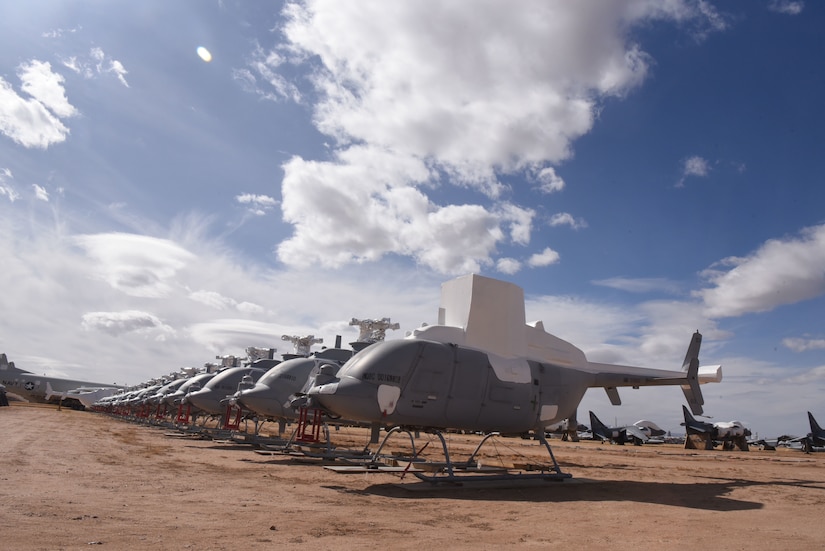
A row of drone helicopters without their propellers are stored in the desert.

"Considering where we started — having zero experience with these systems — it's quite remarkable what has been accomplished," said Army Chief Warrant Officer 4 Taylor Kiel, test director and experimental test pilot with the test center's Aviation Flight Test Directorate. "We are certainly thankful for the many people across various organizations that helped us along the way." 

In August, the center successfully completed ground testing and launched flight tests at Dugway Proving Ground, Utah, and Redstone Arsenal, building aircrew confidence and providing hands-on maintenance experience. This collaborative effort saved the Army just over $70 million in procurement costs, with additional cost savings in research, development, test and evaluation, flight hours, data collection, contracts, asset sourcing and manpower. 

"Our priority is delivering lethal and ready capabilities to the warfighters," said Marine Corps Col. Leigh Irwin, program office manager. "Repurposing these MQ-8C assets from storage to active testing is a major acquisition win for both services, demonstrating how we can supercharge existing capabilities and increase acquisition velocity to support joint operations."  

Completing this transition and initiating flight tests within 14 months stands as a testament to the rapid acquisition timeline and the resilience of the MQ-8C platform, and it represents a remarkable joint achievement by the program office, the Navy and the Army in support of the warfighter, Irwin said.

Fighting to Stay: Army Combatives Team Builds Camaraderie, Retention

Voluntarily getting punched in the face might seem like an unusual approach to improving morale. 

Since World War II, 101st Airborne Division soldiers have traded parachutes for helicopters, but apparently, some soldiers still prefer a more direct approach to combat — stepping into a cage. 

Two men in camouflage military uniform pants, T-shirts and protective pads on their hands and feet fight outside in a cage; a man in casual attire observes from the rear.

At Fort Campbell, Kentucky, the Screaming Eagles Combatives Team and the 3rd Brigade Combat Team's fight night events do more than teach soldiers how to fight. They're building camaraderie, developing confidence and giving soldiers something that can be difficult to measure: a reason to stay in the Army. 

For Army Pfc. David Reese, an infantryman and combatives fighter assigned to the 101st, the training has practical value. 

"Every form of combat isn't always going to be a gunfight," he said. "Sometimes you're going to be in predicaments where you're going to have to do hand-to-hand [combat]." 

But for Reese, the greater value lies in the relationships built through competition. 

"I think when it comes to building a brotherhood and when it comes to going toe-to-toe with your buddy in that cage, it makes all the difference," he said. 

Two soldiers wrestle on a mat with a net around its sides outside as a large group of other soldiers watch.

Army Spc. Jefferson Da Silva, an indirect fire infantryman and combatives coach assigned to the 101st, has practiced martial arts for approximately 17 years. His experience includes about 45 fights, 22 of them professionally. 

"I think all of the soldiers need to build this confidence," Da Silva said. "As a fighting force, we need that." 

Da Silva said combatives help soldiers develop confidence in themselves, trust their leaders and solve problems under pressure. 

Army Capt. George Morales-Lasalle, a cyber warfare officer assigned to the 101st, said combatives offer something beyond his daily duties. 

"I get discipline, I get healthy, it gives me control, and situational awareness of things that could happen," Morales-Lasalle said. 

The team brings together soldiers from different ranks and military occupational specialties who might otherwise never cross paths. An infantryman can train alongside a cyber warfare officer, and a junior enlisted soldier might teach an officer a thing or two. 

"This is a very solid team. We're here to teach each other," Morales-Lasalle said. "It's kind of like a ." 

The sense of family can make the difference between a soldier leaving the Army and signing another contract. 

"I have a corporal who wants to stay in," Morales-Lasalle said. "He is willing to reenlist if he's part of the combatives team." 

This raises an important point: soldiers don't always stay for bonuses, promotions or duty assignments. Sometimes, they stay because they've found a team they don't want to leave. 

The 3rd Brigade Combat Team, better known as the Rakkasans, has expanded those opportunities through fight night events at Fort Campbell. The competitions allow soldiers to represent their units, test their skills and develop relationships outside of their daily responsibilities. 

"It allows me to be able to connect with other people and also let out frustrations in different ways," Reese said. 

He hopes to make the Army a career. 

While combatives won't solve every retention challenge, the program demonstrates how competition, mentorship and shared experiences can give soldiers a stronger connection to their units and a reason to continue serving. 

At Fort Campbell, the Screaming Eagles are proving that sometimes the best retention strategy isn't another briefing. It's a good fight, strong camaraderie and a reason to stay.

DoW Announces 2026 Secretary of War Maintenance Awards Winners

The Department of War announced the 2026 winners of the Secretary of War Maintenance Awards. These awards are presented annually to recognize outstanding achievements in weapon systems and military equipment maintenance.

The Rear Admiral Grace M. Hopper Award for Software Maintenance Excellence recognizes the top organic software activity that, through its mission accomplishments, provided extraordinary capability for operational units supported. The award is named after RDML Grace Hopper, a pioneer of computer programming who popularized the idea of machine-independent programming languages. This year's winner is the United States Army Weapon Systems Sustainment Program from the Combat Capabilities Development Command Armaments Center.

The Department also selected the Sustainment Training, Advice, and Assistance of Foreign Military Forces Awards. The awards recognize teams or organizations that have excelled at providing training, advice, and assistance to the militaries of developing countries as part of U.S. foreign policy goals. In the Ministerial Category, the winner is the Jordan Defense Management Advising Team at the Defense Security Cooperation University. The operational category winner of this year's award is the United States Navy Center for Naval Aviation Technical Training Unit Jacksonville.

The Robert T. Mason Award for Depot Maintenance Excellence recognizes exceptional quality and achievement in Department of War depot-level maintenance programs. It is awarded for outstanding mission accomplishment, effective support to warfighters, and innovative logistics processes. This award commemorates Robert T. Mason, a former Assistant Deputy Under Secretary of Defense for Maintenance Policy, Programs and Resources, who championed the Department's depot-level maintenance program. The Tactical Aircraft Program assigned to Fleet Readiness Center Southwest is this year's recipient.

Six field-level award winners were selected in three categories: small, medium, and large. The small category winners are the Army's Maintenance Company for the 10th Special Forces Group; and the 96th Aircraft Maintenance Squadron, Eglin Air Force Base. Winners from the medium category included 1st Maintenance Battalion, 1st Combat Readiness Regiment, I Marine Expeditionary Force; and Forward Deployed Regional Maintenance Center, United States Navy 5th and 6th Fleets. Large category winners were the 2d Light Armored Reconnaissance Battalion, 2d Marine Division, II Marine Expeditionary Force; and the USS GERALD R. FORD. 

From the six field-level winners, only one will be selected as this year's recipient of the highly coveted Phoenix Award. Organizations winning the Phoenix Award are considered to be the best of the best and held in very high esteem as the top-performing field-level maintenance unit in the Department. The Phoenix Award winner will be announced at the annual DoW Maintenance Awards Banquet in December. 

Units will formally be presented their awards at a ceremony December 9, at the Broward County Convention Center in Fort Lauderdale, FL. The ceremony is held in conjunction with the annual DoW Maintenance Symposium. 

To learn more about the Secretary of War Maintenance Awards and the DoW Maintenance Symposium, you can visit https://events.sae.org/event/dow2026/home

DoW, Navy Close on $1.7 Billion Hampton Roads Barracks Project

The Department of War and the Department of the Navy today announced financial close on Homeport Hampton Roads Phase II, a $1.7 billion initiative to modernize unaccompanied housing for thousands of Sailors across the Hampton Roads region.

"Ships, aircraft, weapons, and networks matter. But our decisive advantage is, and will always be, the warfighter. That means investing in the places where Sailors live, train, recover, and prepare for the next mission," said Michael P. Duffey, Under Secretary of War for Acquisition and Sustainment. "Thanks to Acting Secretary of the Navy Hung Cao, Hunt Military Communities, and our regional partners for their collaboration and making the Hampton Roads Barracks Project a reality."

The agreement with Hunt Military Communities moves the project from concept to construction and will deliver modern barracks Newport News. The development will replace aging facilities, including Huntington Hall, and address critical unaccompanied housing requirements in Newport News, Norfolk, and Virginia Beach.

"Our skilled warfighters are the asymmetric advantage that makes our Navy great," said Acting Secretary of the Navy, the Honorable Hung Cao. "This investment in the renovation and building of housing for more than 8,000 Sailors in the Hampton Roads area ensures our Sailors have the quality of service they deserve while being good stewards of the American taxpayer's money."

Over five years, the project will construct or renovate 8,098 beds. By leveraging private-sector capital, the agreement is expected to save taxpayers over $325 million and free resources for other Navy quality-of-life priorities. The project also increases long-term sustainment funding by 400 percent to ensure high-quality housing throughout the life of the agreement.

The initiative is supported by regional cooperation, including an authorized interest-free loan from the Commonwealth of Virginia to the City of Newport News.

This project aligns with the Department of War's broader priorities to modernize military infrastructure, ensuring that as the Navy updates its fleet, its installations actively support the needs of today's mission and warfighters.