Showing posts with label korean war. Show all posts

Friday, July 17, 2026

Medal of Honor Recipient Welcomes Newest Student Naval Aviators

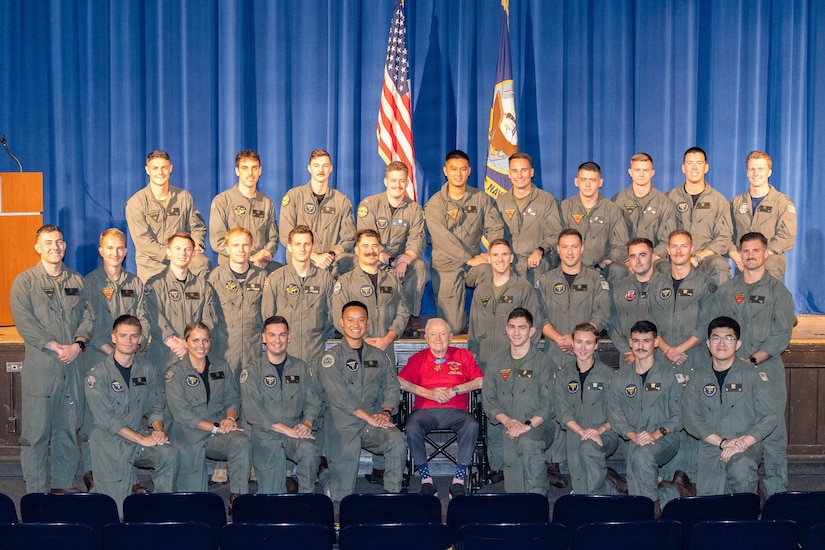
The oldest living Medal of Honor recipient returned to the base where he earned his gold wings July 15, joining Naval Aviation Schools Command in congratulating 29 student naval aviators who completed their introductory flight evaluation training, the first milestone on the path to those same wings.

An elderly man in a wheelchair poses for a photo in an auditorium with dozens of men in flight suits.

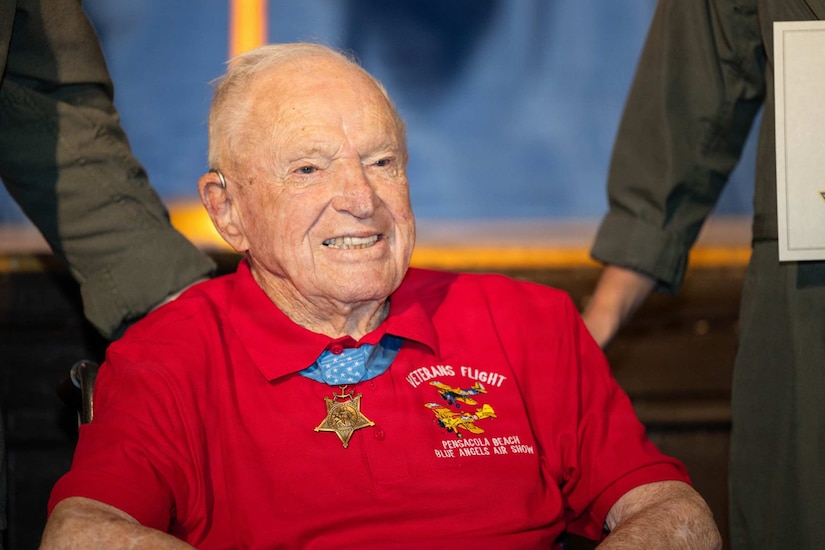
Retired Navy Capt. E. Royce Williams, 101, enlisted during World War II and earned his wings at Naval Air Station Pensacola, Florida, in August 1945, going on to fly combat missions in the Korean and Vietnam Wars.

He received the Medal of Honor Feb. 24, 2026, for a 1952 solo engagement against seven Soviet MiG-15 jets that remained classified for more than 50 years. He is the only living Medal of Honor recipient from the Korean War.

For the student naval aviators seated in front of him, the medal was not the point; the wings were. Williams earned his at the end of the same training pipeline these students have entered, and, 81 years later, he came back to tell them what carried him through it.

An elderly man in a wheelchair smiles while posing for a photo with a medal around his neck.

"He is the living, breathing standard, the embodiment of what it means to be a United States naval aviator," said Navy Capt. Ron Rumfelt, NASC commanding officer. "This is the history and heritage you join today."

NASC, a subordinate command of Naval Education and Training Command, trains and develops future naval aviators, naval flight officers and aircrew for the Navy, Marine Corps and Coast Guard. The flight evaluation training is the entry point of that pipeline, combining aviation ground school and introductory flight instruction to screen and prepare students before they report to primary flight training.

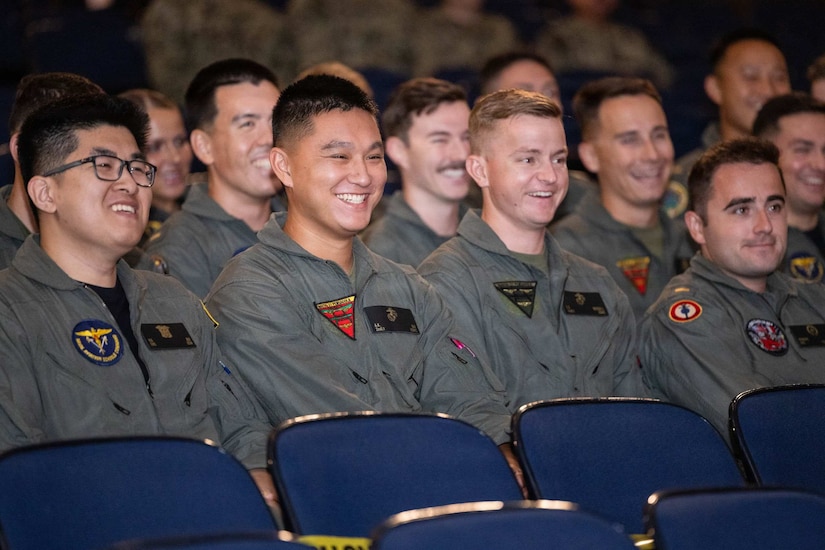
Dozens of men in flights suits laugh while sitting in an auditorium.

Rumfelt told the graduates that the connection between Williams' era and theirs is the training itself.

"We are the best-trained aviators in the world. We do it better than anybody," he said. "It starts with preparation. It ends with debriefs. We call that the relentless pursuit of perfection, because you do not know when that training is going to be called upon, when you will be challenged like Capt. Williams was challenged."

After the ceremony, Williams took questions from the graduates. When asked what advice he would give a student naval aviator to be successful, he pointed to the same standard.

"You have to want it. The word that comes to mind is push. Be diligent," Williams said. "Each one of you is different, but you are all trying to attain the same goal, [be] the best you can. I took every activity as a challenge."

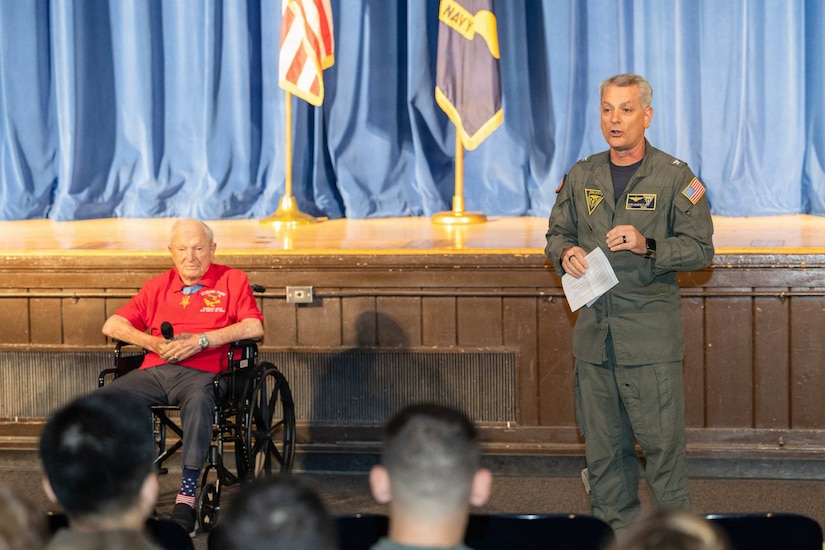
A man in a flight suit speaks to a group of people sitting in an auditorium while an elderly man in a wheelchair holds a microphone next to him.

That approach, he told the students, never changed across a career that spanned three wars and ended with his retirement as a captain in 1980.

"It was not a game. It was business," he said. "I applied myself, and the rewards were good."

The graduates now report to primary flight training, where they will fly the T-6B Texan II or enter the helicopter training track on the way to their own wings.

Friday, July 10, 2026

U.S. Navy to Christen Future USS George M. Neal

PASCAGOULA, Miss.—The U.S. Navy will christen the future USS George M. Neal (DDG 131) during a ceremony at Huntington Ingalls Industries Inc. (HII) Shipbuilding on Saturday, July 11, at 9 a.m. CDT.

The principal address will be delivered by William Toti, performing the duties of the Undersecretary of the Navy.

"The future USS George M. Neal honors a legacy of extraordinary courage and sacrifice," said Toti. "As we christen this ship, we mark another step toward building the Navy our nation needs. Flight III destroyers are critical to our nation's security, and we are proud to accept each one built by the skilled workforce at Ingalls."

Additional speakers include the Honorable Mike Ezell, U.S. Representative, Mississippi's 4th District; Vice Adm. Doug Williams, Director of Portfolio Acquisition Executive Strategic Systems Programs; and Christopher Kastner, President and Chief Executive Officer, HII.

In a time-honored tradition, the ship's sponsor, Kelley Neal Gray, daughter of the namesake, will christen the ship by breaking a bottle of sparkling wine across the bow.

The ship is named in honor of Korean War veteran Aviation Machinist's Mate 3rd Class George M. Neal, who was awarded the Navy Cross for his heroism during a search-and-rescue mission over North Korea. While serving with Helicopter Utility Squadron ONE (HU-1) in 1951, Neal volunteered for a perilous mission deep in enemy territory to rescue a downed aviator. After their helicopter crashed under heavy enemy fire, he aided his fellow crew members in evading capture for nine days, enduring subsequent imprisonment as a POW before his release.

Arleigh Burke-class destroyers are the backbone of the U.S. Navy's surface fleet, providing protection to America around the globe. These highly capable, multi-mission ships conduct various operations from peacetime presence to national security and provide a wide range of warfighting capabilities in multi-threat air, surface, and subsurface domains. These elements of sea power enable the Navy to defend American prosperity and prevent future conflict abroad.

The christening of DDG 131 underscores the Navy's commitment to building America's Fleet of the Future. For 250 years, American naval power has projected strength globally, operating forward 24/7, 365 days a year. This operational tempo demands continuous capability, and the Fleet of the Future is our answer. The ceremony will be livestreamed at: https://www.hii.com/events/DDG131

Media may direct queries to the Navy Office of Information at (703) 697-5342.

For more information on Arleigh-Burke Class Destroyers, visit:
https://www.navy.mil/Resources/Fact-Files/Display-FactFiles/Article/2169871/destroyers-ddg-51/

Monday, December 01, 2025

Medal of Honor Monday: Marine Corps Staff Sgt. William Windrich

Marine Corps Staff Sgt. William Gordon Windrich was only in Korea for a short time, but the skills he'd honed during World War II helped him lead his cold, dirty and disheveled comrades to freedom during one of the most savage battles in modern military history.  

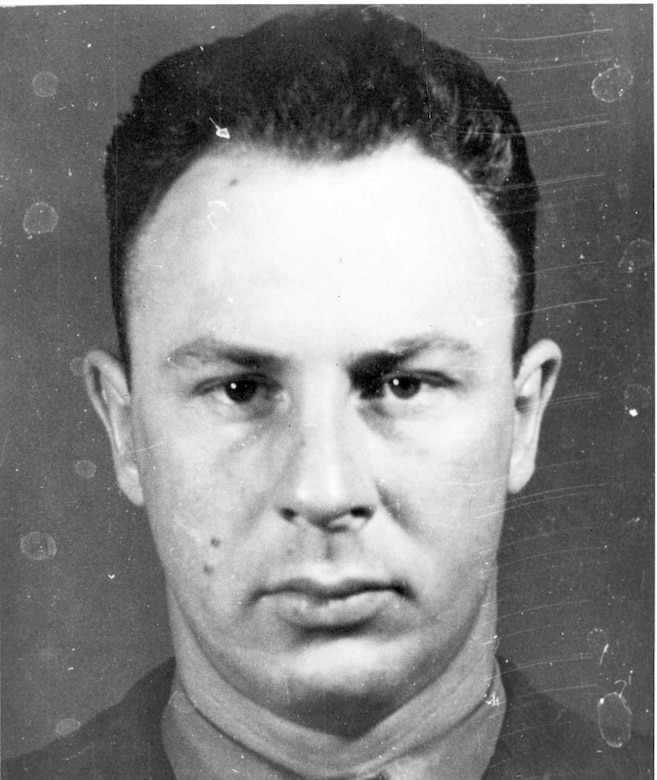
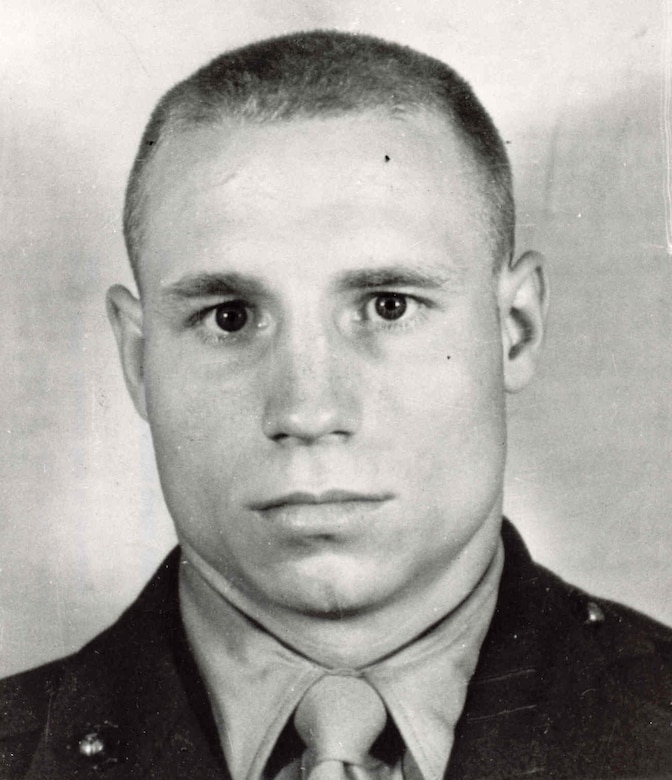
A man poses stoically for a photo.

Windrich didn't survive the Battle of Chosin Reservoir to tell his own story, but his heroics led him to posthumously receive the Medal of Honor.  

Windrich was born May 14, 1921, in Chicago to World War I veteran Herman Windrich and his wife, Marguerite. He had a sister named Virginia. 

When Windrich was young, the family moved to nearby Hammond, Indiana, where their father worked as a foreman at the city's only oil refinery.  

Windrich attended several public schools before dropping out and enlisting in the Marine Corps Reserve in June 1938. By November 1940, he was called up to active duty. 

During World War II, "Windy," as he was called, spent nearly two years in the South Pacific as a machine-gunner, seeing action during the Battle of Tarawa in the Gilbert Islands. He was discharged soon after the war ended and, after returning home, earned his GED diploma. At some point, he married his hometown girlfriend, Margaret. They had a daughter named Alita.  

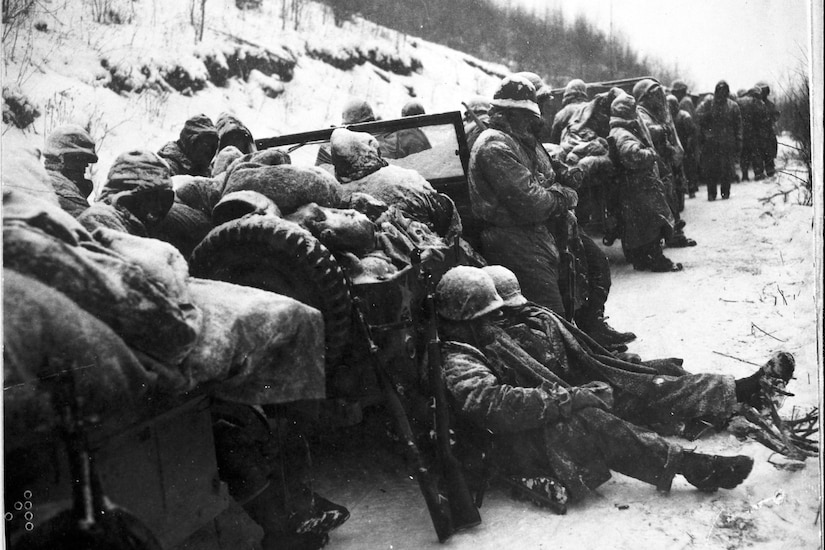
Dozens of men in cold-weather gear lounge near a line of military vehicles in the snow.

Civilian life didn't suit Windrich, however. So, in February 1946, he reenlisted in the Marine Corps. That summer, while serving aboard the USS Mount McKinley, Windrich took part in the atomic bomb testing at Bikini Atoll. In the years that followed, he served in positions in around Washington and in China.  

Windrich was on military police duty at Camp Pendleton, California, when the Korean War broke out in the summer of 1950. As part of the 1st Provisional Marine Brigade, he was one of the first Marines to see action in the conflict. He took part in the Inchon landing and the capture of Seoul before being transferred to Company I of the 3rd Battalion, 5th Marines, 1st Marine Division.  

Windrich was the company's platoon sergeant during the infamous Battle of Chosin Reservoir, where about 30,000 troops from the United Nations, many of whom were U.S. Marines and soldiers, chased defeated North Korean army soldiers up the Korean Peninsula to try to force them over the border into China. When they reached the Chosin Reservoir, however, about 120,000 Chinese troops surged south over the border instead, ambushing U.N. troops and cutting them off from their main supply route.  

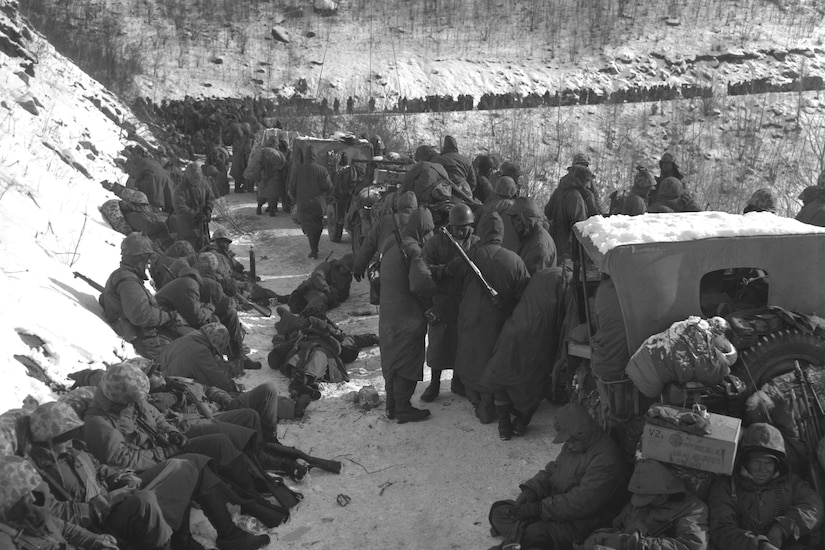
The nearly three-week battle was one of the most brutal in military history, waged in below-zero temperatures, heavy snow and frigid winds.  

Hundreds of men in cold-weather gear sit and stand alongside a line of military vehicles on a mountainside in the snow.

On the night of Dec. 1, 1950, the enemy launched a sudden attack on the forward elements of Company I's position on Hill 1520. As Marines fell, Windrich organized a group of men and spearheaded an assault toward the top of the hill to confront the enemy forces.  

Despite intense enemy automatic weapons, mortar and grenade fire, the group was able to effectively hold back the attackers while the remaining troops withdrew to safer ground. However, the assault group was decimated in the process. Most of the men were either wounded or killed, including Windrich, who suffered a head wound from a bursting grenade.

Windrich fell back to where his company had repositioned themselves. After refusing medical attention, he organized a new group of volunteers to evacuate the fallen Marines on the frozen hillside.  

Windrich then placed the rest of the troops on the left flank of the defensive sector as the enemy attacked again. Windrich was severely wounded in the leg and couldn't stand, but he refused to leave the fight, shouting words of encouragement and directing his team's fire until the attack was pushed back. Even then, he continued to direct his platoon to set up defensive positions. Eventually, Windrich succumbed to the bitter cold and excessive blood loss.  

"He allowed himself to be placed on a stretcher, and as he lay down, he told one of the men carrying him that he just wanted to go to sleep. Then he died," read a 1985 article on Windrich in his hometown newspaper, The Times. 

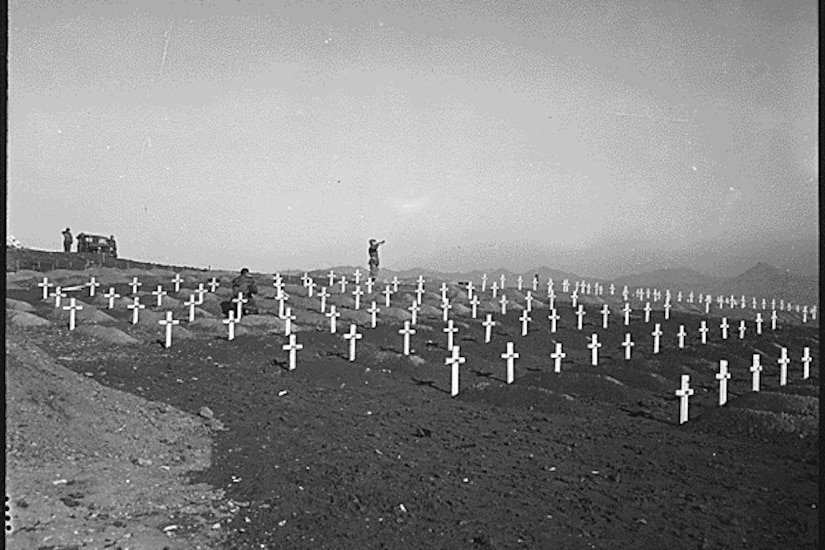
A man plays a bugle in the middle of a graveyard full of white crosses.

Windrich's bravery and devotion to duty inspired the men around him to hold the line despite the tremendous odds against them. Eventually, they were able to fight their way south to freedom. But the battle took its toll. The U.S. reported more than 12,000 casualties, including more than 3,000 dead. 

Windrich's fellow Marines weren't able to carry his body down the 70 miles of mountainous terrain, so he was left behind with the promise from commanders that they would come back for all the fallen Americans when they could.  

Windrich is one of 17 men who received the Medal of Honor for valiant actions during the battle. On Feb. 8, 1952, his widow and daughter received the nation's highest honor for valor on his behalf during a Pentagon ceremony.  

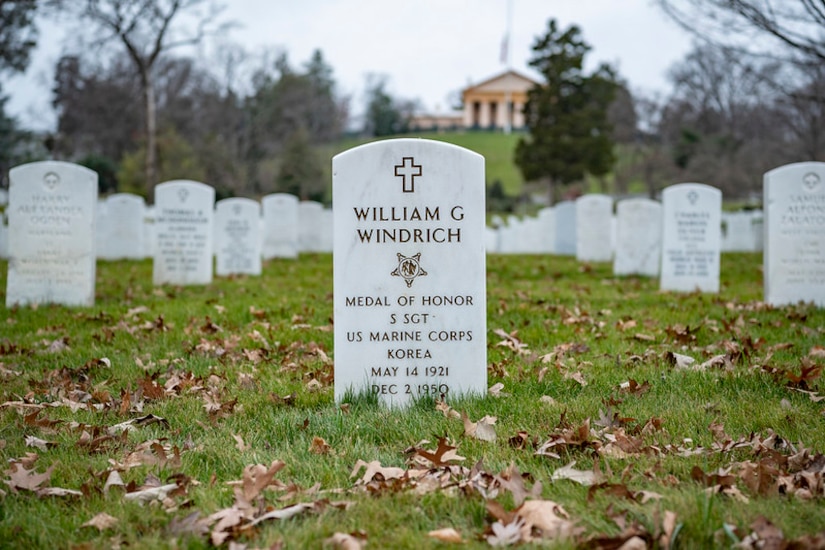
A grave marker is highlighted prominently among a field of other matching grave markers.

More than four years after the Battle of Chosin Reservoir ended, the promise to bring Windrich's body home was fulfilled, and his remains were repatriated. On July 29, 1955, he was buried in Arlington National Cemetery, Virginia. 

Near his hometown in Lake County, Indiana, residents and visitors can read about Windrich's heroics on a section of the Korean War veterans memorial that's dedicated to him. The National Museum of the Marine Corps in Triangle, Virginia, has also erected a Chosin Few Battle Monument in honor of those who fought there. 

Monday, September 22, 2025

Medal of Honor Monday: Marine Corps Cpl. Jack Davenport

Do I save others or save myself?  

That's a question an unknown number of service members have asked themselves during battle throughout the ages. It's one Marine Corps Cpl. Jack Arden Davenport didn't hesitate on. During an attack in Korea, he chose to save his comrade's life instead of his own. That selfless decision led him to receive a posthumous Medal of Honor.  

A man looks stoically at the camera for a photo.

Davenport was born Sept. 7, 1931, in Kansas City, Missouri, to Fred and Gloria Davenport. He had a sister named Jane and a twin brother, Karl, who served in the Navy.  

Davenport was an active child who always liked to be on the go, his parents told the Kansas City Times in 1952. Throughout high school, he played baseball and was a paperboy for the Kansas City Star newspaper, where his father worked.  

After graduating from Paseo High School in 1949, Davenport studied for a year at the University of Kansas, where he played on the school's football team. He was also an amateur boxer who participated in at least one Golden Gloves tournament.  

However, when the Korean War broke out, Davenport decided to trade in studying for the fight against communism. He enlisted in the Marine Corps July 1950. After basic training, he was stationed at Camp Pendleton outside of San Diego, where he earned the nickname "Dynamite" from other Marines. In December of that year, he was deployed to join the 3rd Battalion, 5th Marine Regiment, 1st Marine Division in Korea.  

According to newspaper reports of the time, Davenport was on the front lines almost continuously until the day he made the ultimate sacrifice.  

Early on Sept. 21, 1951, Davenport was serving as a squad leader with Company G in the Songnae-dong area of Seoul, South Korea, when they were attacked by enemy troops trying to infiltrate their sector.  

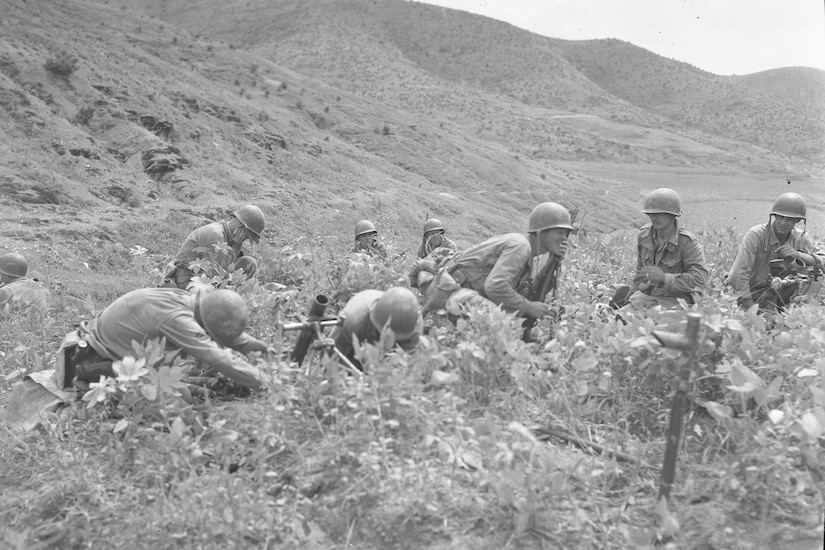
Nearly a dozen people in combat uniforms and helmets huddle in tall grass.

Davenport directed his comrades to defend their position. He and a fellow Marine, Pfc. Walter Barfoot, were doing so from a foxhole. Suddenly, an enemy grenade fell at their feet.  

Without any concern for his own life, Davenport jumped on the deadly projectile, which killed him. Barfoot was spared, however, and their unit managed to repulse the enemy, largely in part to Davenport's calm leadership.  

Many of Davenport's fellow Marines wrote to his family after his death, according to a December 1952 issue of the Kansas City Times.  

"He was the best. They didn't come finer or more courageous that little ole Dynamite," one Marine wrote to Davenport's mother.  

The fallen 20-year-old's body was returned to the U.S. in January 1952 and buried in Mount Moriah Cemetery in Kansas City.  

About a year later, Davenport posthumously received the nation's highest honor for valor. The Medal of Honor was presented to his father on his behalf during a Pentagon ceremony. Davenport's brother, Karl, was flown in by the Navy from Japan on special leave for the ceremony.  

In the late 1980s, a gymnasium at Camp Pendleton was named in Davenport's honor.  

Monday, September 01, 2025

Medal of Honor Monday: Army Capt. Frederick F. Henry

During the early days of the Korean War, Army Capt. Frederick Funston Henry chose to take the brunt of an enemy attack alone so the rest of his platoon could survive. For his gallant actions and self-sacrifice, Henry received a posthumous Medal of Honor.  
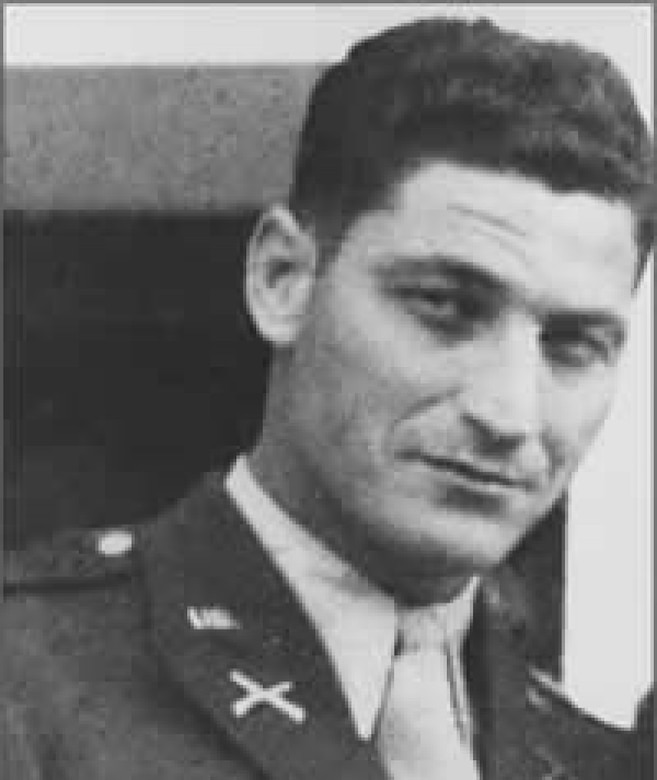
A man in a military dress uniform poses for a photo.

Henry was born Sept. 23, 1919, in Vian, Oklahoma, to James and Ida Mae Henry as the third oldest of 13 children. As if they knew he would go on to do great things, his parents named him after Army Maj. Gen. Frederick Funston, a Medal of Honor recipient who served during the Philippine-American War at the turn of the century. 

The family eventually moved about three hours west to Clinton, Oklahoma, where Henry grew up before enlisting in the Army in September 1940. Five of his brothers also served during World War II, while two continued their service in Korea.  

Henry served in the 6th Army during World War II and earned a battlefield commission to second lieutenant while in the Pacific Theater in 1945. After hostilities ended, he served in Germany, where he met Lavon "Bonnie" Southam, a combat nurse, according to The Salt Lake Tribune. The pair later married and had two children, Frederick Jr. and Sharon.  

When the Korean War broke out, Henry's unit, Company F of the 28th Infantry Regiment, 2nd Infantry Division, was one of the first to deploy to the peninsula in the summer of 1950.  

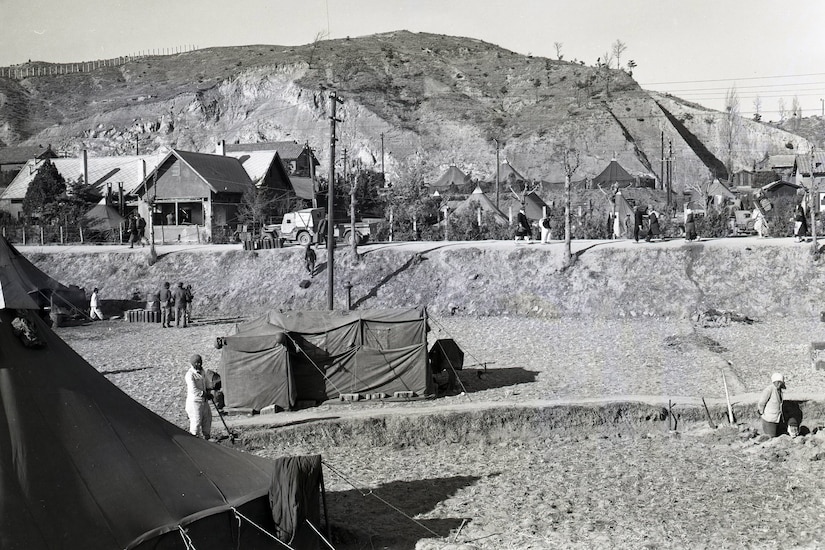
A small building and some tents are set up beside a barren hill. There are people in civilian attire walking around the area, and large buildings in the background.

On Sept. 1, 1950, the 33-year-old first lieutenant was leading his platoon as it held a strategic ridge near the town of Andong, South Korea, when they were attacked by a much larger enemy force. Heavy mortar and artillery fire quickly threw the platoon into disarray. To keep the unit together, Henry left his foxhole so he could move around his men, ordering them to stay in place and return fire.  

Encouraged by Henry's bravery, the platoon reformed its defensive line and delivered intense fire back, impeding the enemy's advance. Unfortunately, the enemy succeeded in knocking out all communications, so Henry had no way of knowing if the main line of resistance was still in place.  

"There were bullets and shells falling all around," Army Sgt. Richard Siman, who was part of Henry's platoon, later told officials. "Our ammunition was running low." 

Despite being seriously injured, Henry stayed put while ordering the wounded men in his platoon to evacuate. He had them give him all their weapons and ammunition before they left, so he could set up a one-man position. He then ordered the rest of his platoon to withdraw.  

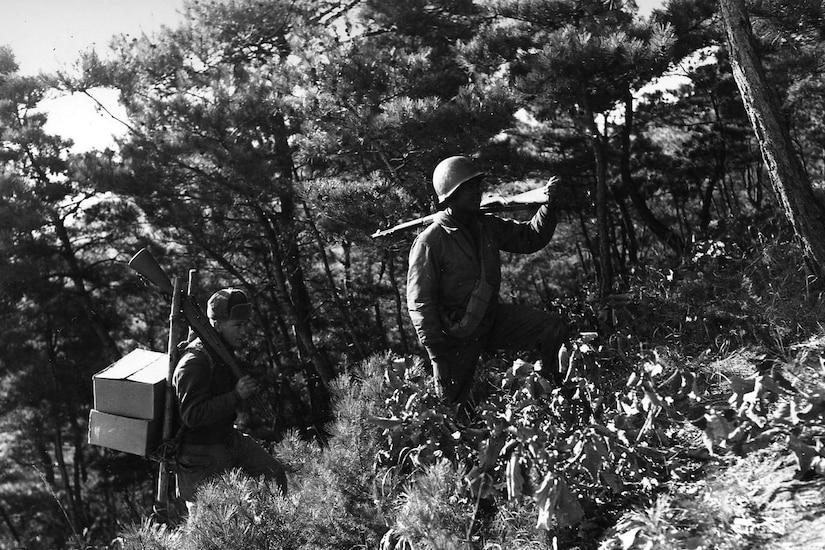
Two men in military uniforms carrying guns and boxes march up a hillside.

Henry was last seen firing every weapon he had at the enemy. His Medal of Honor citation stated that his effort caused approximately 50 enemy casualties before he ran out of ammunition, and his position was overrun. His selfless actions that day saved his platoon and kept the enemy at bay long enough for the main line of resistance to fully push them back.  

Henry was initially listed as missing in action. He was officially declared dead on Dec. 31, 1953, and posthumously promoted to captain. His name is listed on the Wall of the Missing at the National Memorial Cemetery of the Pacific in Honolulu. According to the Defense POW/MIA Accounting Agency, his remains have not yet been recovered.  

On Jan. 9, 1951, Henry's widow received the Medal of Honor on his behalf from President Harry S. Truman during a White House ceremony. Four other fallen soldiers also posthumously received the honor that day.  

Henry has not been forgotten. In May 1960, a U.S. camp that's part of current-day Army Garrison Daegu was named Camp Henry in his honor. In 2004, a memorial was dedicated to him at a park in his hometown of Vian. In 2013, he was inducted into the Oklahoma Military Hall of Fame. A year later, a highway near his hometown was renamed for him.  

Friday, August 11, 2023

Honoring Heroism: Medal of Honor Recipients of the Korean War

The Korean War, often referred to as the "Forgotten War," holds a significant place in history as a conflict that tested the resolve of nations and showcased the extraordinary bravery of individuals. Amid the challenges of this war, many remarkable acts of valor and heroism took place on the battlefield. The Medal of Honor, the United States' highest military decoration, was bestowed upon numerous individuals who exhibited extraordinary courage and selflessness during the Korean War. Let's take a moment to honor some of these recipients and their incredible feats.

Corporal Tibor Rubin (April 28, 1929 – December 5, 2015) Corporal Rubin, born in Hungary, displayed immense valor while serving as a rifleman during the Korean War. He was captured by Chinese forces but managed to escape and joined American and UN forces as a guerrilla fighter. Rubin was recognized for his exceptional dedication and saved the lives of countless fellow prisoners by diverting enemy fire. He was finally awarded the Medal of Honor in 2005, decades after his heroic actions.

Lieutenant Colonel Don C. Faith Jr. (August 31, 1920 – December 2, 1950) Lieutenant Colonel Faith, commander of the 32nd Infantry Regiment, exhibited extraordinary leadership and courage during the Battle of Chosin Reservoir. Despite overwhelming odds and being heavily outnumbered, he led his men in defending Hill 902. Faith's bravery and sacrifice inspired his troops to hold their ground, ultimately enabling others to withdraw safely. Tragically, he lost his life during the battle, but his legacy of unwavering leadership lives on.

Private First Class William R. Charette (March 29, 1932 – March 18, 2012) Private First Class Charette, a Navy corpsman attached to the Marine Corps, displayed unparalleled courage in the face of danger. Despite being wounded himself, he repeatedly risked his life to provide medical aid to wounded Marines. His selflessness and determination to save lives earned him the Medal of Honor and the eternal gratitude of those he served alongside.

Master Sergeant Woodrow W. Keeble (May 16, 1917 – January 28, 1982) Master Sergeant Keeble, a Dakota Sioux Native American, exemplified bravery during the Korean War. Despite being wounded, he led his platoon in a critical assault on enemy positions. He single-handedly silenced two machine gun bunkers and killed several enemy soldiers. His actions saved countless lives and paved the way for his platoon's success. Keeble's Medal of Honor was posthumously awarded in 2008.

Private Hector A. Cafferata Jr. (November 4, 1929 – April 12, 2016) Private Cafferata's valorous actions during the Battle of Chosin Reservoir earned him the Medal of Honor. Despite being wounded, he held his position and defended against waves of enemy attacks. His bravery inspired his comrades, and his unwavering determination ensured the safety of his fellow Marines.

These are just a few of the many individuals whose actions during the Korean War epitomized courage, honor, and sacrifice. Their stories serve as a reminder of the immense sacrifices made by servicemen and women to defend freedom and protect their fellow soldiers. As we reflect on their heroism, let us ensure that their legacy is never forgotten, and let their valor continue to inspire future generations.

Monday, August 10, 2015

Soldier Missing From Korean War Accounted For


The Department of Defense POW/MIA Accounting Agency (DPAA) announced today that the remains of a serviceman, missing from the Korean War, have been identified and will be returned to his family for burial with full military honors.

Army Cpl. Nehemiah E. Butler Pocomoke City, Maryland, will be buried today in Arlington National Cemetery. In late December 1950, Butler and elements of Company C, 19th Infantry Regiment (IR), 24th Infantry Division (ID), were deployed near Seoul, South Korea, when their unit was attacked by enemy forces. During the attempt to delay the enemy forces from advancing, Butler was separated from his unit while moving towards a more defensible position. Butler was reported missing Jan. 1, 1951.

On July 19, 1951, a Republic of South Korea military officer told U.S. Army Graves Registration Services (AGRS) personnel about the remains of a U.S. serviceman, who, died and was buried near the village of Chik-Tong-ni. The AGRS team located the remains. Due to lack of documentation, the remains were declared unidentified. The remains were interred as unknown at the U.N. Military Cemetery in Tanggok, and were later disinterred and transferred to the Central Identification Unit (CIU) in Kokura, Japan. In 1955, the remains were transferred to the National Memorial Cemetery of the Pacific (NMCP), commonly known as the “Punchbowl”.

In 2009, the Department of Defense (DoD) re-examined records and concluded that with advances in technology, the possibility of identification of some of these unknowns buried in the Punch Bowl now existed.

In the identification of Butler’s remains, scientists from the DPAA and the Armed Forces DNA Laboratory (AFDIL) used circumstantial evidence, dental and chest radiographs comparison, and mitochondrial DNA analysis, which matched his sister.
Today, more than 7,800 Americans remain unaccounted for from the Korean War. Using modern technology, identifications continue to be made from remains that were previously turned over by North Korean officials or recovered from North Korea by American recovery teams.

Monday, October 01, 2012

Marine Missing in Action from Korean War Identified


The Department of Defense POW/Missing Personnel Office (DPMO) announced today that the remains of a serviceman, missing in action from the Korean War, have been identified and will be returned to his family for burial with full military honors.

Marine Pfc. Richard S. Gzik, of Toledo, Ohio, will be buried today, at Arlington National Cemetery near Washington, DC.  On Dec. 2, 1950, Gzik and the other Marines of M Battery, 11th Artillery Regiment, 1st Marine Division, came under attack on the west side of the Chosin Reservoir in North Korea.  It was during this battle that Gzik was killed in action and his remains were buried alongside the road leading to Hagaru-ri.  Later that month, the withdrawal of U.N. forces from the Chosin Reservoir region made it impossible to recover Gzik’s remains.

In 1954, United Nations and Communist Forces exchanged the remains of war dead in what came to be called “Operation Glory.”  All remains recovered in Operation Glory were turned over to the Army Central Identification Unit for analysis.  Those which were unable to be identified, given the technology of that time, were interred as unknowns at the National Memorial Cemetery of the Pacific in Hawaii -- the “Punchbowl.” 

In 2012, analysts from the Joint POW/MIA Accounting Command (JPAC) re-examined the case records and determined that advances in technology could likely aid in the identification of the unknown remains as Gzik.  Once the remains were exhumed, scientists from JPAC used circumstantial evidence and forensic identification tools, including dental records and radiographs, to validate Gzik’s identification.  

Using modern technology, identifications continue to be made from remains that were previously buried as unknown.  Today, 7,947 Americans remain unaccounted for from the Korean War. 

For additional information on the Defense Department’s mission to account for missing Americans, call 703-699-1169, or visit the DPMO web site at http://www.dtic.mil/dpmo .

Monday, August 27, 2012

SECNAV Remembers Legacy of Naval Aviator, Astronaut Neil Armstrong


From Secretary of the Navy Public Affairs

WASHINGTON (NNS) -- "On behalf of the men and women of the Navy Department, I extend my deepest and most heartfelt sympathies to the family of Neil Armstrong.

"Mr. Armstrong rightly belongs to the ages as the man who first walked on the moon, a pioneer of space exploration and science. A giant. But to those of us in his Navy family, he will also remain a shipmate -- a naval aviator who flew nearly 80 combat missions during the Korean War. A leader.

"He never wanted to be a living memorial, and yet to generations the world over his epic courage and quiet humility stands as the best of all examples. It is not merely his "small step" we admire; it is his very large and humble heart.

"The world has lost a legend. We have lost a friend, unique in our lifetime and never to be out of our minds."

Ray Mabus
 Secretary of the Navy