Showing posts with label southcom. Show all posts

Friday, October 09, 2026

Autonomous Surface Craft Help Patrol Panamanian Waters

When Exercise Panamax 2026 concluded in mid-August, Panamanian security leaders were impressed with the performance of the Corsair unmanned surface vessels that the U.S. Navy brought along with them.

A small boat sails in the water; a large container ship sails in the background.

The Corsair platforms, the same type that recently rescued downed AH-64 Apache pilots off the coast of Oman, participated in the exercise alongside U.S. and partner forces. During that time, they demonstrated the potential of long-endurance uncrewed systems to support maritime security.  

For Panama, those capabilities could help expand the country's ability to monitor maritime approaches, identify suspicious activity, and respond to threats posed by illicit trafficking and regional threat networks. 

In the weeks following Panamax, the U.S. embassy and U.S. Southern Command coordinated with Panama's Ministry of Security to retain the Corsairs for a maritime security mission conducted in partnership with Panama's National Aeronaval Service. 

The effort supports Panama's ongoing work to protect its territorial waters, counter drug trafficking and other illicit activity, and strengthen security along critical maritime routes. 

It also advances the Americas Counter Cartel Coalition's objectives to improve regional coordination against cartels, narco-terrorist networks and other regional threats while respecting the sovereignty and authorities of partner nations. 

"The Corsairs are providing additional patrol craft," said Marine Corps Col. Ian Fletcher, commander of Southcom’s newly established Autonomous Warfare Command. "Their onboard radar and electro-optical sensors provide many of the enhanced detection capabilities associated with a manned patrol craft, allowing operators to maintain awareness over a larger area." 

The long-endurance craft are engineered to operate reliably without an onboard crew. The platforms can maintain a persistent patrol presence across the maritime domain, complementing Panama's existing fleet, aircraft and personnel. 

By integrating uncrewed systems with manned patrol vessels and airborne assets, Panama can expand the area it monitors and increase its potential threat assessment speed. The additional coverage can help crews distinguish routine activity from activity requiring further investigation, enabling manned assets to focus on response and interdiction missions. 

"The platforms can operate alongside manned patrol craft and provide additional information to crews at sea," Fletcher said. "That gives partner forces greater flexibility, improves efficiency, and expands the area they can monitor without requiring additional personnel aboard each vessel." 

The current mission focuses on strengthening maritime awareness and supporting partner efforts against narcotics trafficking, regional threat networks and threats associated with designated terrorist organizations. The platforms operate as a complement to — not a replacement for — Panama's maritime security forces and decision-making authorities. 

Fletcher said the effort also creates an opportunity for Panama and Southcom to assess how additional autonomous systems could support the protection of critical waterways and maritime infrastructure. 

"As we learn from these operations, we can examine where additional autonomous capabilities may increase maritime presence and awareness," he said. "That includes exploring how systems can operate safely and effectively in the canal environment." 

The partnership reflects a shared commitment to regional security: combining Panama's leadership, regional cooperation and emerging technology to counter illicit networks, strengthen maritime security, and help secure the Western Hemisphere and the reliable flow of commerce through the Panama Canal.

Friday, August 14, 2026

Southcom Mission Shifts to Protecting Sovereignty of U.S., Partner Nations

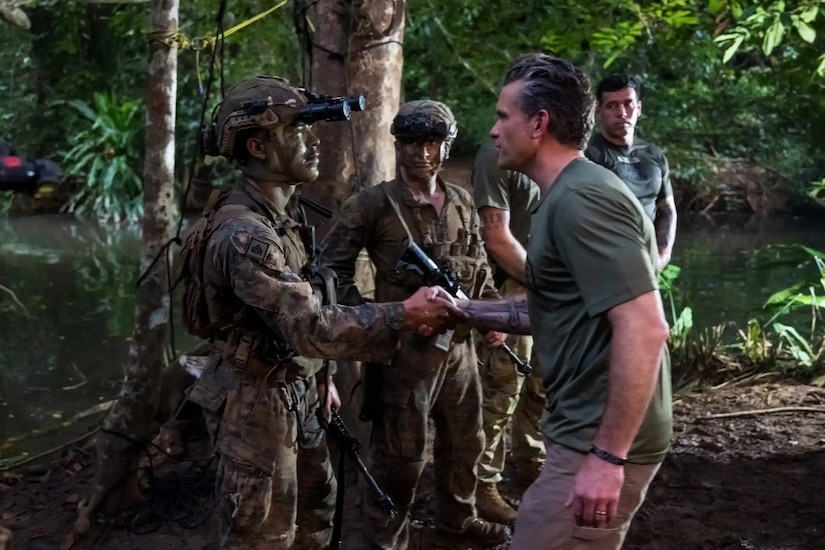
At the Combined Jungle Training Center-South in Cristobal Colon, Panama, yesterday, Secretary of War Pete Hegseth met with U.S. service members who are learning how to survive in the most brutal, unforgiving jungles of the Western Hemisphere, all while retaining their combat effectiveness.

In a jungle environment, a man in casual attire shakes hands with a man in a camouflage military uniform and night vision equipment on his helmet while people in similar attire observe.

The visit coincided with the secretary's address during the Americas Counter Cartel Coalition, a U.S.-led multinational security and political alliance formed to combat transnational drug cartels, reduce illegal migration across the Western Hemisphere and limit foreign geopolitical interference. It also coincided with Exercise Panamax 2026, a multinational military exercise hosted by Panama and sponsored by U.S. Southern Command. 

In the dense jungle on the northern side of the Panama Canal, Hegseth told service members at the training center that what they are doing is exactly what he likes to see when he meets with warfighters. 

"I think this is what ... the warrior ethos looks like; it's what reestablishing it looks like," he said. "It happens in training centers like this, with Americans like this, who do really difficult things in really tough places." 

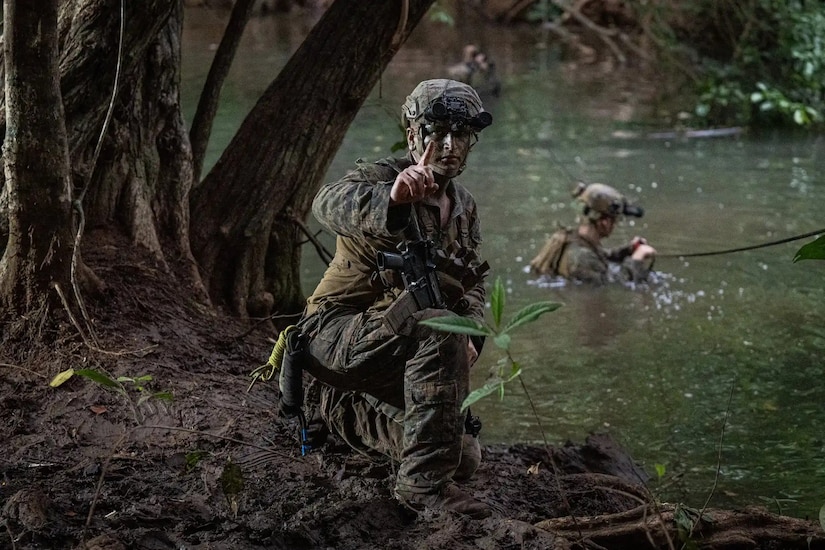
While at the training center, Hegseth met with instructors assigned to the Jungle Operations Training Course-Panama, along with Marines assigned to Littoral Combat Force-24, who were in Panama to participate in Panamax.

In a jungle environment, a man in a camouflage military uniform kneels on a riverbank as another man in similar attire stands in the water.
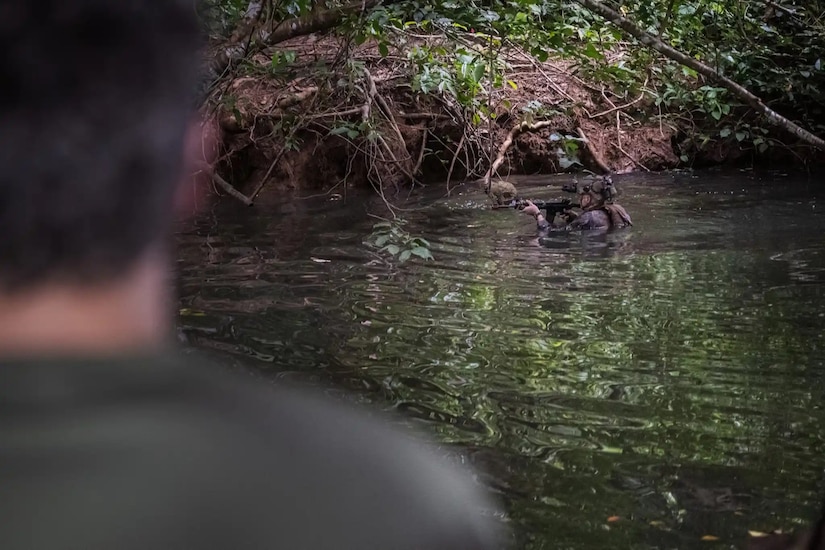
A rear-facing man observes two people in camouflage military uniforms as they move through water; one man carries a rifle.
The secretary said the service members who train at the center are willing to do things no other Americans are willing to do, to include helping U.S. allies in both Central and South America protect the nation's backyard. 

"That's what we're doing here with the A3C [and with] Panamax ... expanding peace through strength in our hemisphere, right here in the jungles with our partners," he said. 

Noting a big shift in the Southcom mission, Hegseth said that just 18 months ago, the command was less focused on protecting the Americas and deterring threats. 


"This is a different Southcom; this is a different mission," he said. "We are focused on military capabilities against real threats who need to be deterred and defeated, and we're going to give them everything they need to do it, on behalf of the American people." 

The secretary said that under President Donald J. Trump, Southcom's mission has focused on working with partners in the region to keep everybody safe from a variety of shared threats. 

"We know exactly what that mission looks like," he said. "We're empowering commanders like [Marine Corps Gen. Francis L. Donovan] to do it in Southcom; we're working with partners like Panama, like Ecuador, like Colombia ... they're going to send students here soon to swim across this very same river, [to] be a part of this very same training." 

The nations involved in the Americas Counter Cartel Coalition — 19 nations in all, with Colombia signing on just yesterday — are going to be involved in the same training as U.S. service members in Panama. The secretary said that the same things that necessitate American jungle training also motivate every other nation in the region. 

"It turns out, in the [Western] Hemisphere, they face the very same security challenges, the same threat of drugs, the same threat of criminal cartels that threaten their citizens, the same ones that threaten our citizens," Hegseth said. 

U.S. law enforcement personnel stationed at the U.S. southern border to stop illegal immigration and drug traffickers, combined with training across Central and South America in places such as Ecuador, Colombia and Panama, puts increasing pressure on shared threats. 

"That's going after the enemies of our country — designated terrorist organizations — unabashedly," Hegseth said. 

Earlier in the day, the secretary announced the new motto of the Americas Counter Cartel Coalition: "We do bad things to bad people." 

"For too long, bad people did bad things to good people, inside the United States of America and across Central and South America," he said. "We're going to empower great Americans and great partners to do really good stuff and be very capable about bringing violence against drug cartels and designated terrorist organizations, because we're dead serious about securing the homeland." 

A big part of that is the Trump corollary to the Monroe Doctrine. In 1823, President James Monroe articulated a foreign policy, now known as the Monroe Doctrine, which declared that the Western Hemisphere was off-limits to further colonization efforts or interference by European nations. Later, that expanded to include interference by any foreign power. 

In 1904, President Theodore Roosevelt added to that doctrine that the U.S. could intervene in the affairs of Latin America to protect U.S. interests. 

And now, Hegseth said, there is Trump's corollary to the Monroe Doctrine. 

"It is a recognition that [designated terrorist organizations] ... will not control our hemisphere ... and we will not allow foreign malign influence to take over ... key terrain like the Panama Canal," he said. 

Hegseth said Colombia's inclusion in the Americas Counter Cartel Coalition is significant. 

"The A3C had formed, but in some ways, it missed part of its core," he said. "Colombia is going to be [an] incredible partner. They offered to be a headquarters or a hub for the A3C as the brand-new 19th member. They've got ... hundreds of thousands of capable members of their military and decades of training with the United States ... that mil-to-mil relationship has been long-standing, and that's why they're coming to this jungle course soon."

Thursday, January 17, 2008

Joint Chiefs Chairman Visits U.S. Southern Command

By Petty Officer 1st Class Michael Wimbish, USN
Special to American Forces Press Service

Jan. 15, 2008 - The chairman of the Joint Chiefs of Staff visited U.S. Southern Command headquarters here yesterday, where he thanked servicemembers and staff for their work and stressed the importance of the security cooperation efforts the command oversees in Latin America and the Caribbean.
Navy Adm. Michael G. Mullen told more than 1,000 command members during an outdoor "all hands" address that their efforts to build partnerships in the region will pay future dividends, especially in an ever-changing security environment.

"My long-term vision is to be in a position where we have relationships that we can depend on, if needed -- and that's so much about what goes on in this command," Mullen said. SOUTHCOM annually sponsors dozens of large and small-scale operations, exercises and engagements that focus on security issues in the region, including a slate of humanitarian assistance missions.

"It's an incredibly important command at an incredibly important time in our history," the nation's highest-ranking
military officer said.

The visit was Mullen's first to SOUTHCOM since becoming chairman in October. In addition to his address, Mullen was briefed on the command's latest missions in preparation for his trip to Colombia and El Salvador later this week. He will meet with
military leaders of both nations to discuss ongoing U.S. military cooperation efforts there, which include SOUTHCOM support to regional counterdrug missions.

Mullen's visit to the headquarters was part of a five-day tour of SOUTHCOM's area of operations.

Earlier yesterday, he visited the Joint Interagency Task Force South in Key West, Fla., the SOUTHCOM component that oversees air and maritime counterdrug missions in the Caribbean Sea, Gulf of Mexico, and the eastern Pacific. The task force, praised as a model of interagency success, helped interdict more than 200 metric tons of cocaine last year. On Jan. 13, Mullen stopped at U.S. Naval Station Guantanamo Bay, touring detention facilities and addressing troops there.

During the "all hands" session at SOUTHCOM headquarters, Mullen reiterated his view in support of closing the Guantanamo Bay detention facilities, but stressed that there are no plans in the works to do so.

"It not for me to make that decision," he said. "It's a very, very complex set of circumstances. So it is not in any way, shape or form as simple as saying, 'Let's just close it.'" The facility carries connotations that affect how people around the world view the United States, he noted.

"It's my judgment that Guantanamo Bay has hurt the United States of America from an image standpoint, having nothing to do with the justice side of this that I think needs to be carried out in a just, fair way," he explained.

Mullen commended the work of the U.S. troops conducting the mission there, saying they are carrying out their mission in way that "makes us all proud."

Also during his visit to SOUTHCOM, Mullen praised the command's recent humanitarian efforts in the region, including last summer's deployment of the hospital ship, USNS Comfort, which provided medical care to 98,000 people in 12 countries.

"I really believe that if we do (these types of missions), it goes a long way to preventing any kind of conflict or outbreak," he said. "And should we get to the point, tragically, that we have an outbreak or we have that kind of conflict, we'll have relationships in advance that we can leverage, as opposed to creating them in the heat of the battle."

SOUTHCOM is one of the
military's nine unified combatant commands. It's responsible for providing contingency planning, operations and security cooperation for Central and South America; the Caribbean, except U.S. commonwealths, territories and possessions; Cuba; and the Bahamas and their territorial waters. Its area of operations encompasses more than 450 million people in 32 countries and 13 territories and protectorates.

(
Navy Petty Officer 1st Class Michael Wimbish serves with U.S. Southern Command Public Affairs.)