Showing posts with label homeland security. Show all posts

Friday, August 14, 2026

Southcom Mission Shifts to Protecting Sovereignty of U.S., Partner Nations

At the Combined Jungle Training Center-South in Cristobal Colon, Panama, yesterday, Secretary of War Pete Hegseth met with U.S. service members who are learning how to survive in the most brutal, unforgiving jungles of the Western Hemisphere, all while retaining their combat effectiveness.
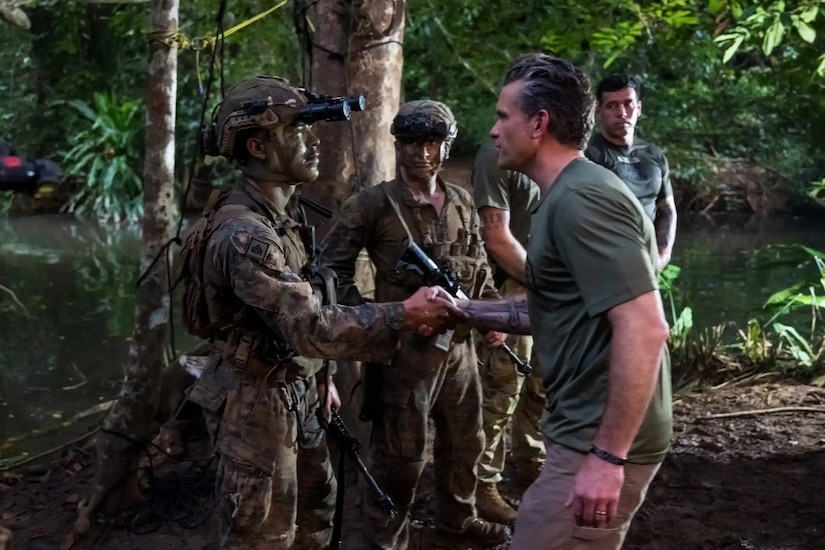
In a jungle environment, a man in casual attire shakes hands with a man in a camouflage military uniform and night vision equipment on his helmet while people in similar attire observe.

The visit coincided with the secretary's address during the Americas Counter Cartel Coalition, a U.S.-led multinational security and political alliance formed to combat transnational drug cartels, reduce illegal migration across the Western Hemisphere and limit foreign geopolitical interference. It also coincided with Exercise Panamax 2026, a multinational military exercise hosted by Panama and sponsored by U.S. Southern Command. 

In the dense jungle on the northern side of the Panama Canal, Hegseth told service members at the training center that what they are doing is exactly what he likes to see when he meets with warfighters. 

"I think this is what ... the warrior ethos looks like; it's what reestablishing it looks like," he said. "It happens in training centers like this, with Americans like this, who do really difficult things in really tough places." 

While at the training center, Hegseth met with instructors assigned to the Jungle Operations Training Course-Panama, along with Marines assigned to Littoral Combat Force-24, who were in Panama to participate in Panamax.
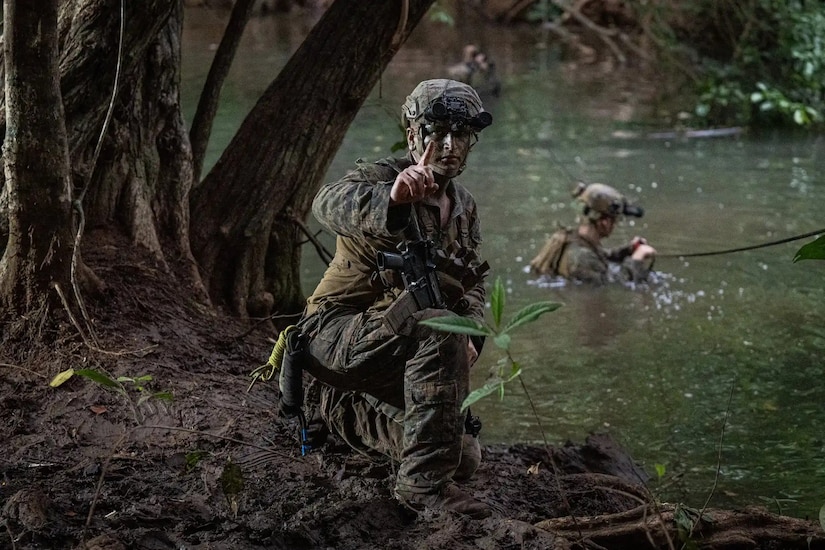
In a jungle environment, a man in a camouflage military uniform kneels on a riverbank as another man in similar attire stands in the water.
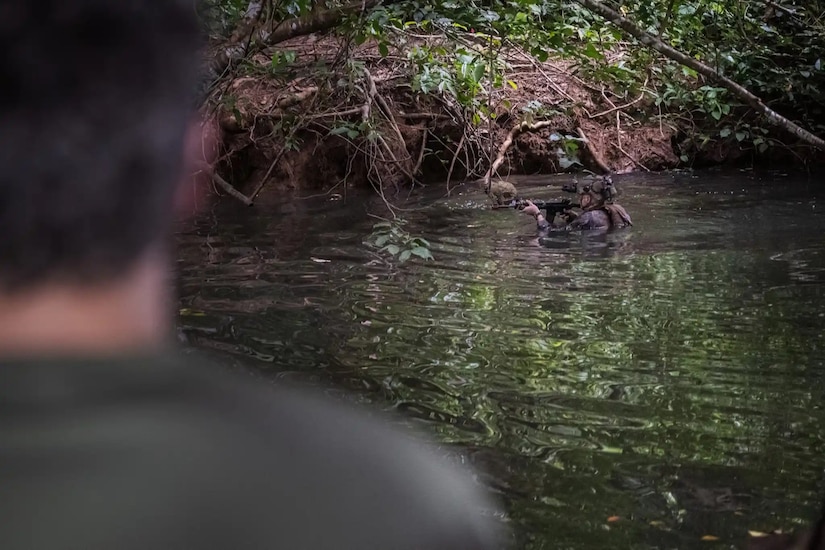
A rear-facing man observes two people in camouflage military uniforms as they move through water; one man carries a rifle.
The secretary said the service members who train at the center are willing to do things no other Americans are willing to do, to include helping U.S. allies in both Central and South America protect the nation's backyard. 

"That's what we're doing here with the A3C [and with] Panamax ... expanding peace through strength in our hemisphere, right here in the jungles with our partners," he said. 

Noting a big shift in the Southcom mission, Hegseth said that just 18 months ago, the command was less focused on protecting the Americas and deterring threats. 


"This is a different Southcom; this is a different mission," he said. "We are focused on military capabilities against real threats who need to be deterred and defeated, and we're going to give them everything they need to do it, on behalf of the American people." 

The secretary said that under President Donald J. Trump, Southcom's mission has focused on working with partners in the region to keep everybody safe from a variety of shared threats. 

"We know exactly what that mission looks like," he said. "We're empowering commanders like [Marine Corps Gen. Francis L. Donovan] to do it in Southcom; we're working with partners like Panama, like Ecuador, like Colombia ... they're going to send students here soon to swim across this very same river, [to] be a part of this very same training." 

The nations involved in the Americas Counter Cartel Coalition — 19 nations in all, with Colombia signing on just yesterday — are going to be involved in the same training as U.S. service members in Panama. The secretary said that the same things that necessitate American jungle training also motivate every other nation in the region. 

"It turns out, in the [Western] Hemisphere, they face the very same security challenges, the same threat of drugs, the same threat of criminal cartels that threaten their citizens, the same ones that threaten our citizens," Hegseth said. 

U.S. law enforcement personnel stationed at the U.S. southern border to stop illegal immigration and drug traffickers, combined with training across Central and South America in places such as Ecuador, Colombia and Panama, puts increasing pressure on shared threats. 

"That's going after the enemies of our country — designated terrorist organizations — unabashedly," Hegseth said. 

Earlier in the day, the secretary announced the new motto of the Americas Counter Cartel Coalition: "We do bad things to bad people." 

"For too long, bad people did bad things to good people, inside the United States of America and across Central and South America," he said. "We're going to empower great Americans and great partners to do really good stuff and be very capable about bringing violence against drug cartels and designated terrorist organizations, because we're dead serious about securing the homeland." 

A big part of that is the Trump corollary to the Monroe Doctrine. In 1823, President James Monroe articulated a foreign policy, now known as the Monroe Doctrine, which declared that the Western Hemisphere was off-limits to further colonization efforts or interference by European nations. Later, that expanded to include interference by any foreign power. 

In 1904, President Theodore Roosevelt added to that doctrine that the U.S. could intervene in the affairs of Latin America to protect U.S. interests. 

And now, Hegseth said, there is Trump's corollary to the Monroe Doctrine. 

"It is a recognition that [designated terrorist organizations] ... will not control our hemisphere ... and we will not allow foreign malign influence to take over ... key terrain like the Panama Canal," he said. 

Hegseth said Colombia's inclusion in the Americas Counter Cartel Coalition is significant. 

"The A3C had formed, but in some ways, it missed part of its core," he said. "Colombia is going to be [an] incredible partner. They offered to be a headquarters or a hub for the A3C as the brand-new 19th member. They've got ... hundreds of thousands of capable members of their military and decades of training with the United States ... that mil-to-mil relationship has been long-standing, and that's why they're coming to this jungle course soon."

Tuesday, August 14, 2012

CPPD Hosts Virginia Secretary of Veterans Affairs and Homeland Security


By Susan Henson, Center for Personal and Professional Development Public Affairs

VIRGINIA BEACH, Va. (NNS) -- Virginia's secretary of Veterans Affairs and Homeland Security visited the Center for Personal and Professional Development Aug. 9.

Terrie Suit met with CPPD leadership and toured the command to gain an understanding of CPPD's role in developing Sailors who think critically, act responsibly and lead proactively.

The tour included a stop at the Virtual Education Center (VEC) for a brief on the center's capabilities and education services it provides to Sailors worldwide.

Suit was appointed as assistant to the governor for commonwealth preparedness in January 2010 by Virginia Gov. Bob McDonnell. The Commonwealth reorganized some positions the following year, which resulted in Suit appointment

"It is a great honor to host such a distinguished visitor at CPPD," said CPPD Commanding Officer Capt. John Newcomer. "Secretary Suit's visit is a great opportunity to explain our work to provide Sailors the tools they need to lead with courage, respect and trust, and mentor future leaders to do the same. Part of that development is through voluntary education, and the VEC's work is essential to assisting Sailors navigate through the waters of completing higher education requirements for a degree."

The daughter of a career U.S. Army officer and wife of a now-retired Navy senior chief, Suit is familiar with the demands of military life and related challenges of earning a college degree. She has earned an Associate degree from Tidewater Community College and Bachelor's degree in political science from Old Dominion University.

Suit's tour included stops at the Training directorate, which creates, maintains and has oversight for personal and professional course curricula; the Voluntary Education (VOLED) directorate, which is responsible for the Navy's VOLED program; and VOLED's Virtual Education Center (VEC), which provides virtual education assistance and counseling to Sailors and veterans.

Julie Gifford, regional military liaison, accompanied her the tour of CPPD.

At the end of her visit, Suit said she was excited to see the progress of the Navy College Program.

"Governor McDonnell wants to ensure Virginia is supporting our service members as they pursue education and professional development for their Navy career as well as their eventual transition to civilian life," she said. "Julie and I will be proactively identifying future opportunities for Virginia to work together in support of Navy College and the Center for Personal and Professional Development. Thank you for all that you are doing here."

In addition to VOLED, CPPD is responsible for providing a wide range of personal and professional development courses and materials, including General Military Training, Navy instructor training, alcohol and drug awareness program training, suicide prevention, Bearings classes, and Personal Responsibility and Values Education and Training (PREVENT) classes. CPPD's leadership training is delivered multiple times throughout a Sailor's career via command-delivered enlisted leadership training material and officer leadership courses in a schoolhouse setting.

Friday, April 27, 2012

Panetta Reaffirms Partnership, Friendship With Chile


By Cheryl Pellerin
American Forces Press Service

SANTIAGO, Chile  – In talks here today with his Chilean counterpart and the nation’s head of government, Defense Secretary Leon Panetta discussed ongoing and emerging issues, from drug trafficking to cyber security, that the countries plan to address as partners.

During this first visit to the country as defense secretary, Panetta met with Chilean President Sebastian Pinera and Defense Minister Andres Allamand at the Ministry of Defense in Chile’s capital and largest city, Santiago.

“The United States and Chile are neighbors, we are friends, and we have built a longstanding defense relationship founded on mutual respect, shared values and the goal of advancing peace and stability in this hemisphere and beyond,” Panetta said during a joint press conference this afternoon with Allamand.

“This shared goal has been the focus of my meetings throughout Latin America,” the secretary added, “and it was the focus of my meetings today with President Pinera and Minister Allamand.”

Chile is the third South American country Panetta has visited this week, after successful meetings with counterparts and officials in Colombia and Brazil.

In today’s meeting, Panetta said, he and Allamand continued a discussion that began last month in Washington, in which they considered how to enhance collaboration in areas of key interest to both nations.

The areas include enhancing the security capacity of nations in the hemisphere, countering illicit drug trafficking, meeting humanitarian needs, working together on issues like cyber security, confronting those who would undermine the stability of the nations, and examining defense institutional reform.

An example of the U.S.-Chile common effort to confront narcotics trafficking is called Operation Martillo, a multinational and interagency drug-interdiction effort to shut down illicit trafficking routes on both coasts of the Central American isthmus.

“Chile is making an important contribution to this effort,” Panetta said, “and earlier today the United States announced that, as part of Operation Martillo, our forces conducted a major drug bust off the coast of Panama, seizing $362 million worth of cocaine.”

The secretary commended the Department of Homeland Security and the U.S. Customs and Border Protection Service who were in the lead in that effort, with the support of the U.S. Southern Command.

“These are the kinds of results that strong partnerships can deliver,” he added.

“Today’s operation shows how important it is for countries in the region to cooperate and work together to confront these kinds of threats,” Panetta said, “and build even stronger mechanisms of regional security cooperation.”

Another example is the ongoing effort to strengthen regional security cooperation, the secretary said, “particularly as we look ahead to this year’s [October] Conference of the Defense Ministers of the Americas in Uruguay, which both the minister and I will be attending.”

Panetta and Allamand also discussed cooperation in humanitarian assistance and disaster response coordination.

“This initiative I believe will improve our ability to respond to natural disasters by creating a framework to share information, share expertise and deliver the capabilities that we absolutely need to help save lives for our people more quickly and more effectively,” Panetta said.

Chilean officials clearly understand what it means to respond to natural disasters, he added, and Chile’s critical lessons learned must be shared with the rest of the hemisphere.

“I commend Chile’s leadership in helping advance this proposal,” the secretary said, “and I look forward to working with them to try to make this a reality.

Panetta noted Chile’s success in helping those who suffered in Haiti’s 2010 earthquake and tsunami, and in December 2011 the hundreds evacuated from a massive forest fire that raged through Torres del Paine Park in Patagonia, one of the country's most popular national parks, destroying more than 21,000 acres.

“I commend the Chilean government and the Chilean people,” Panetta said, “because they are an inspiration to the United States and the world in overcoming adversity and emerging even stronger.”

Chile and the United States share more than a hemisphere, he said.

“We also share the Pacific Ocean, and we are both Pacific nations,” he said, adding that the security and prosperity of both nations depends on the Asia Pacific region.

“That’s where many of the key challenges and opportunities in the 21st century lie,” the secretary said.

Panetta detailed the Defense Department’s new defense strategy for 2020 and Chile’s important role.

Allamand said Chile was the first country in South America to sign a free-trade agreement with the United States, and that his nation is in the final stages of drafting its first national defense and security strategy.

Between Chile and the U.S., the defense minister said, “we share a lot of principles, in terms of what is the needed [for] a safer world.”

“ … We share concerns about the risks of what are called the new threats to security such as drug trafficking, organized crime, civil attacks, terrorism and arms proliferation,” he said.

“We agree on the importance of the Pacific and the need to safeguard the value of peace on regional and global levels,” Allamand added. “And we agree that in the future the global security of the world demands cooperation and innovative alliances among all countries.”

Panetta said the U.S.-Chile defense relationship in many ways is a fulfillment of the Defense Department’s new strategy.

“It is exactly the kind of partnership we need under the strategy to help advance global peace and global security,” the secretary said.

“So I’m very grateful to the minister and to the president and to the Chilean people for their friendship, for their shared commitment to building a safer world for the future,” he added.

“We are one family in this hemisphere, una famiglia, as we say in Italian,” Panetta said. “And like any family, we must work together to give our children a better life, a more secure life, and protect our people.”

Friday, April 13, 2012

Dempsey: Nation Faces Security Paradox


By Karen Parrish
American Forces Press Service

WASHINGTON, April 13, 2012 – The world today is less violent but also more dangerous than at any other time in human history, the nation’s senior military officer told a Harvard University audience yesterday.

That “counterintuitive combination” of peace and potential conflict is “the essence of what I like to call the security paradox,” Army Gen. Martin E. Dempsey, chairman of the Joint Chiefs of Staff, told the audience attending a John F. Kennedy School of Government forum in Cambridge, Mass.

“Although geopolitical trends are ushering in greater levels of peace and stability worldwide, destructive technologies are available to a wider and more disparate pool of adversaries,” Dempsey said.

In the past, the general noted, it took a nation’s power to create a national security threat: industrial progress fueled the world wars, and the threat of mutually assured destruction between superpowers kept the Cold War from getting too hot.

Today, the same rise in global trade and information technology that has increased cooperation and cut violence between nations also has put 21st century weapons in reach of smaller groups, the chairman said.

“More people have the ability to harm us or deny us the ability to act than at any point in my life - and that’s the security paradox,” he added.

While in the past only the United States could drop a bomb down a chimney, “now dozens of middleweight militaries around the world have that [precision munitions] capability,” he said.

Potential adversaries now can buy “off-the-shelf” more than 90 percent of the components needed to build an electronic warfare system, Dempsey said. That creates a risk to “the very systems that provide our battlefield edge: our computer networks, our sensors, and our precision navigation ability,” he said.

Cyber attack is another evolving threat that doesn’t require a large military to launch it, Dempsey said.

“With the right computer virus, a single person can disrupt life for … an entire city, and potentially even our entire nation,” he added.

“The message is that the margin of error is growing smaller,” the chairman warned.

The U.S. military must counter these new and elusive threats even as its budget shrinks, Dempsey noted.

“We have to make hard choices about where to put our resources — and where to pull them back,” he said.

The Defense Department strategy balances cost, force structure, mission and risk, Dempsey said. The strategy aims for a force with fewer service members, greater agility and more powerful technology, he added.

The Army, Navy, Air Force and Marine Corps need to meld service-unique strengths to build capabilities “that don’t exist unless they’re combined,” the general said.

The force will be regionally postured but globally networked, “scaled and scoped to demand,” he said.

“Finally, it will be a force that provides a degree of security in balance with what the nation needs and what the nation can afford,” Dempsey added.

The security paradox presents a difficult challenge, Dempsey said. “But challenges are nothing new to this nation,” he said. “We have adapted and re-invented ourselves many times throughout our history.”

The newly commissioned USS New York is emblematic of the nation, and of 21st century U.S. military strategy, the chairman said.

The New York is an amphibious ship that carries a Marine expeditionary unit, which combines ground, air and logistics capabilities, and usually has about 2,200 Marines and sailors assigned.

The bow of the just-commissioned ship, Dempsey said, “was forged from seven tons of steel pulled from the rubble of the twin towers. …This steel — tempered to be stronger than it was before — will carry experienced, war-tested Marines half way around the world and back.”

The New York and its crew will patrol the Mediterranean Sea and the Arabian Gulf, “keeping faith with our partners and allies in port calls and conducting exercises or actual real-world operations as needed,” he said.

The ship is a testament to the nation’s resilience, the chairman said.

“When I think of the challenges we face,” Dempsey added, “I think of the USS New York. She and her crew are part of the agile and technologically advanced force we are building. They are ready to prevail in any conflict. They are the best this country has to offer.”

Tuesday, April 10, 2012

CBP Donates Seized World War I Artillery to Military Museum


Charleston, S.C. - A rather unusual seizure by U.S. Customs and Border Protection enabled 13 pieces of World War I German military items to find a new home. These items, with an appraised value of $2,000, consisted of inert artillery casings, projectiles and fuses as well as an inert artillery collar (77mm and 105mm). They were seized in January on behalf of the Bureau of Alcohol, Tobacco, Firearms and Explosives from a shipment originating in the United Kingdom. Although the importer indicated that these items were intended to be used as curios and relics, they were found to be in violation of ATF regulations. 

Once a determination was made that the articles were inert, or safe to seize and store, CBP took possession. Shortly after, the Director/Curator of the U.S. Army Artillery Museum contacted CBP requesting transferal of the seized items to the museum located in Fort Sill, Okla.

The U.S. Army Artillery Museum tells the story of artillery from 1775 to the present with more than 70 guns and artillery pieces and numerous other artifacts from headgear and ammo to small arms and uniforms. Since the museum already housed several models of German World War I artillery pieces that used the same calibers of ammunition, they felt that these additional items would be an asset to the collection.

CBP agreed that the items would be of greater value in the museum, therefore, the transfer was approved. As a result, the artillery pieces will be formally catalogued in the museum collection of the U.S. Army and placed on public exhibition.

U.S. Customs and Border Protection is the unified border agency within the Department of Homeland Security charged with the management, control and protection of our nation's borders at and between the official ports of entry. CBP is charged with keeping terrorists and terrorist weapons out of the country while enforcing hundreds of U.S. laws.

Sunday, November 06, 2011

Vigilant Shield Tests Homeland Defense Processes

Combatting drugs, crime, terrorism... all in a day's work for Coast Guard personnel! Discover the best Coast Guard books written by real Coast Guard veterans!

By Donna Miles
American Forces Press Service

WASHINGTON, Nov. 4, 2011 – Navy ships, Army ground-based radar and missile systems and Air Force, Navy and Coast Guard aircraft have descended on Key West, Fla., for the field training portion of U.S. Northern Command’s annual homeland defense exercise that kicked off this week.

Northcom’s Vigilant Shield 12 exercise launched Nov. 1 and continues through Nov. 10, combining field and command post exercises to train Northcom and North American Aerospace Defense Command staffs in homeland defense and homeland security processes, Lt. Alain Blondin of the Canadian navy, a command spokesman, told American Forces Press Service.

“The scenario for the exercise is based on potential military threats to the United States and Canada that require extensive military planning to provide a range of military options to our national leadership,” said Army Gen. Charles H. Jacoby Jr., Northcom and NORAD commander, in a blog announcing the exercise.

Northcom’s operations center at Peterson Air Force Base, Colo., working in coordination with a joint deployable integrated air and missile defense system and elements of a logistics support facility dispatched to Naval Air Station Key West, are testing their capabilities against simulated enemy attacks, Blondin said.

Although most of the scenarios are classified, Blondin said, they will involve “the full spectrum of threats,” including simulated terrorist attacks.

“It’s an old Army truth that you have to train like you fight, and the exercise scenario will undoubtedly put us through our paces,” Jacoby said. This exercise will not only train us for that worst-case situation, but it will also aid our planners in preparing for it.”

“Homeland defense is our most important mission, and it’s a sacred trust we share with the citizens of the United States and Canada,” he said. “VS 12 will make us better and, most importantly, make our countries safer in the long run.”

To increase the realism of the scenarios and test the ability of federal, state and international partners to provide a synchronized response to homeland threats, Vigilant Shield planners have piggybacked on other training exercises.

For example, routine training flights under way across the Washington, D.C., region are testing Northcom’s and NORAD’s ability to coordinate with the Department of Homeland Security and Federal Aviation Administration, among other federal agencies.

This year’s Vigilant Shield is being linked to two other concurrent exercises: Vigilant Guard Arizona and Determined Dragon. Vigilant Guard Arizona, a joint regional exercise sponsored by Northcom and the National Guard Bureau, is designed to improve military processes, procedures and coordination with state and local responders, officials said. Canada Command is conducting Determined Dragon to test the readiness of Canadian forces at the national level.

Jacoby emphasized the importance of a strong exercise program to maintain readiness, noting Winston Churchill’s famous quote, “Everywhere men pray for peace, but prepare for war.”

“I firmly believe that quote accurately reflects how the men and women of these commands go at their business each and every day, and that’s why it’s important as we look at a decreasing military budget to maintain and sustain critical training exercises like Vigilant Shield,” he said. “Every time you exercise, you learn something new.”