Showing posts with label jungle warfare. Show all posts

Wednesday, September 16, 2026

Southern Vanguard 2026 Turns Peruvian Jungle Into a Classroom

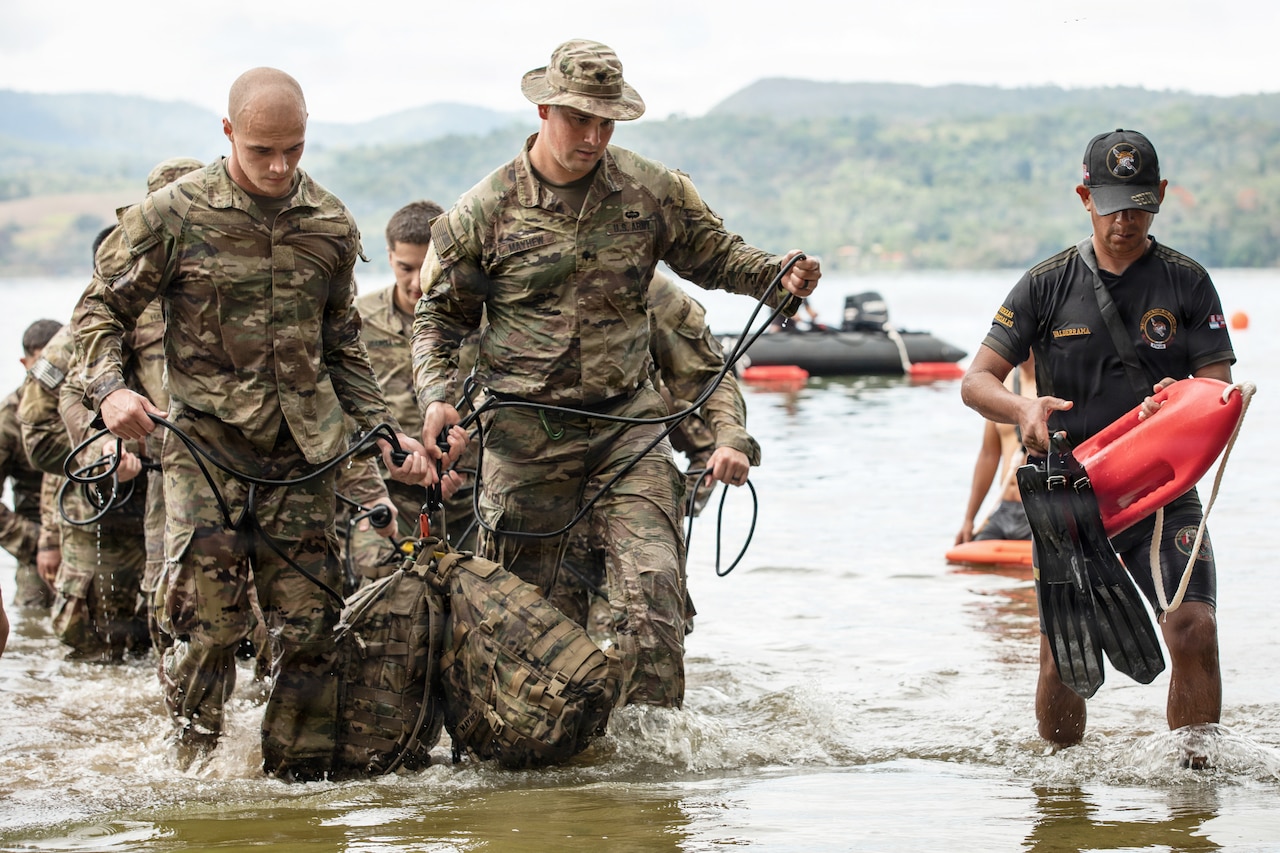
Nearly a dozen people in camouflage military uniforms walk through a body of water as a man in a black uniform walks next to them carrying a flotation device.

Movement slows. Equipment gets heavier. Water becomes an obstacle instead of a landmark. The environment quietly strips away assumptions about how quickly a formation should move or how easily a soldier can accomplish a familiar task.

For U.S. soldiers training alongside Peruvian and Chilean forces during Exercise Southern Vanguard 26, that friction is exactly the point.

In the hills surrounding Sauce, Peru, soldiers are learning to move, survive and operate in terrain where their Peruvian counterparts have spent years developing expertise. During the opening days of jungle warfare training, multinational formations started at various lanes, including amphibious movement, survival skills and small-unit tactics designed for an environment that can punish even routine movement.

A man wearing a camouflage military uniform and sunglasses poses for a photo in a jungle environment.

"Multiply fatigue by 10," Army Capt. Jared Fonzi, an operations planner assigned to the 551st Infantry Regiment, U.S. Army Western Hemisphere Command, said while describing the physical effects of jungle operations. "The climate, the terrain, the physical exhaustion that everyone here goes through — pictures do not justify the stress and the physical fatigue."

Southern Vanguard 26 is a multinational exercise hosted by the Peruvian Army and designed to strengthen interoperability among participating forces while building proficiency in jungle mobility, survivability and tactical operations. For American soldiers, participation offers something difficult to replicate at home: The opportunity to become students of a partner force operating in a terrain it understands intimately.

Fonzi, a graduate of the Jungle Operations Training Course-Panama, Ranger School and an infantry officer proficient with conventional U.S. tactics, said jungle warfare changes the scale at which soldiers must think and maneuver.

"The size of the maneuvering element is far smaller," he said. "You don't really maneuver as a platoon, which is usually the bread and butter of U.S. operations. Here, with smaller elements — team size, squad size — you need to rely more on individual survival techniques and minimal equipment."

That emphasis places greater importance on survival, fieldcraft and understanding the environment itself. Humidity, elevation, water obstacles, rainfall and dense vegetation are not simply background conditions.

"These climate differences and natural elements are what affect the fight," Fonzi said. 

That reality is also driving U.S. soldiers to look outward for expertise.

Fonzi said U.S. forces are relying heavily on jungle warfare specialists from countries such as Peru, Colombia and Panama to understand how forces accustomed to the environment operate and which techniques might improve U.S. tactics, techniques and procedures.

The dynamic is visible throughout Southern Vanguard 26.

Peruvian instructors are leading much of the jungle training, while U.S. instructors work alongside them and help translate techniques for American formations. Fonzi described the Peruvian approach as aggressive and immediate, often moving soldiers quickly from instruction into practical application.

"There's really no crawl phase here," he said. "They'll give a brief instruction, and then they just throw them in the water or whatever training environment they go into."

The approach may differ from how many American soldiers are accustomed to training, but adapting to unfamiliar methods is part of the exercise itself.

Interoperability is often discussed in terms of radios, procedures and whether two formations can communicate on a battlefield. But before any of that works, soldiers have to understand how their partners think, move and solve problems.

Sometimes that begins with something as unremarkable as getting everyone across a body of water. That process requires a certain humility.

The U.S. military brings considerable capability nearly anywhere it goes. The jungle offers a useful reminder that capability and expertise are not the same thing. Sometimes readiness means arriving prepared to teach. Other times, it means recognizing when someone else has something to teach you. Southern Vanguard creates room for both.
For soldiers operating beneath the jungle canopy, the lessons are as physical as they are tactical. 

"Being wet 24/7, fighting through brush, crossing water — these little things have a huge impact on how you fight," Fonzi said.

Over the course of the exercise, those small hardships become part of a larger test: whether multinational formations can adapt together in an environment that does not care how experienced, capable or well-equipped they were before entering it.

That may ultimately be the most valuable lesson hidden beneath the canopy. Partnerships become meaningful when soldiers learn to depend on one another before circumstances require them to.

Friday, August 14, 2026

Southcom Mission Shifts to Protecting Sovereignty of U.S., Partner Nations

At the Combined Jungle Training Center-South in Cristobal Colon, Panama, yesterday, Secretary of War Pete Hegseth met with U.S. service members who are learning how to survive in the most brutal, unforgiving jungles of the Western Hemisphere, all while retaining their combat effectiveness.

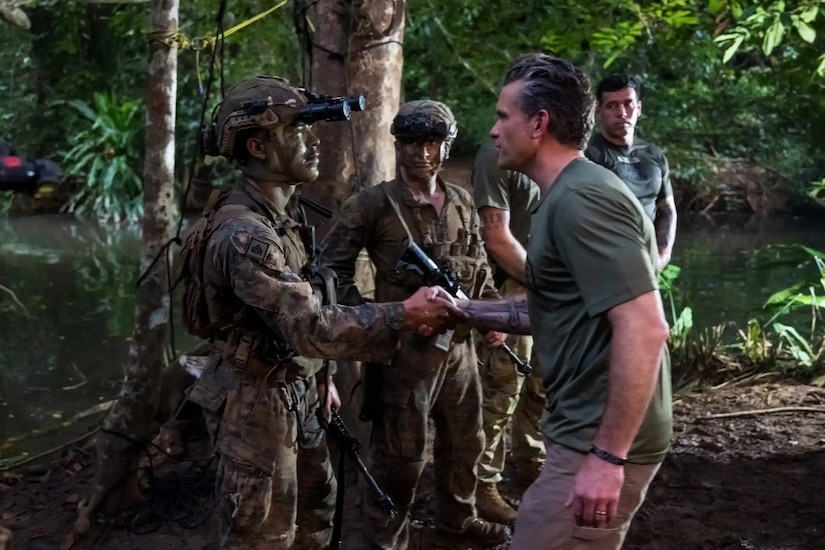
In a jungle environment, a man in casual attire shakes hands with a man in a camouflage military uniform and night vision equipment on his helmet while people in similar attire observe.

The visit coincided with the secretary's address during the Americas Counter Cartel Coalition, a U.S.-led multinational security and political alliance formed to combat transnational drug cartels, reduce illegal migration across the Western Hemisphere and limit foreign geopolitical interference. It also coincided with Exercise Panamax 2026, a multinational military exercise hosted by Panama and sponsored by U.S. Southern Command. 

In the dense jungle on the northern side of the Panama Canal, Hegseth told service members at the training center that what they are doing is exactly what he likes to see when he meets with warfighters. 

"I think this is what ... the warrior ethos looks like; it's what reestablishing it looks like," he said. "It happens in training centers like this, with Americans like this, who do really difficult things in really tough places." 

While at the training center, Hegseth met with instructors assigned to the Jungle Operations Training Course-Panama, along with Marines assigned to Littoral Combat Force-24, who were in Panama to participate in Panamax.

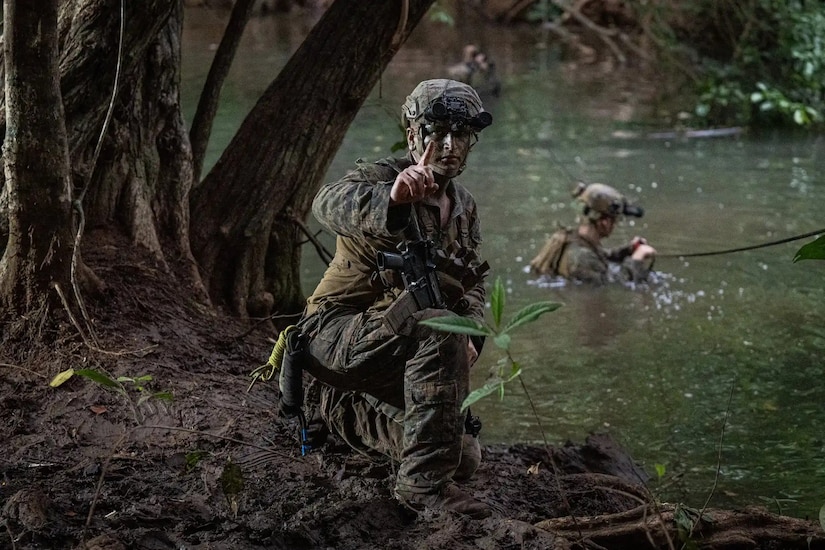
In a jungle environment, a man in a camouflage military uniform kneels on a riverbank as another man in similar attire stands in the water.
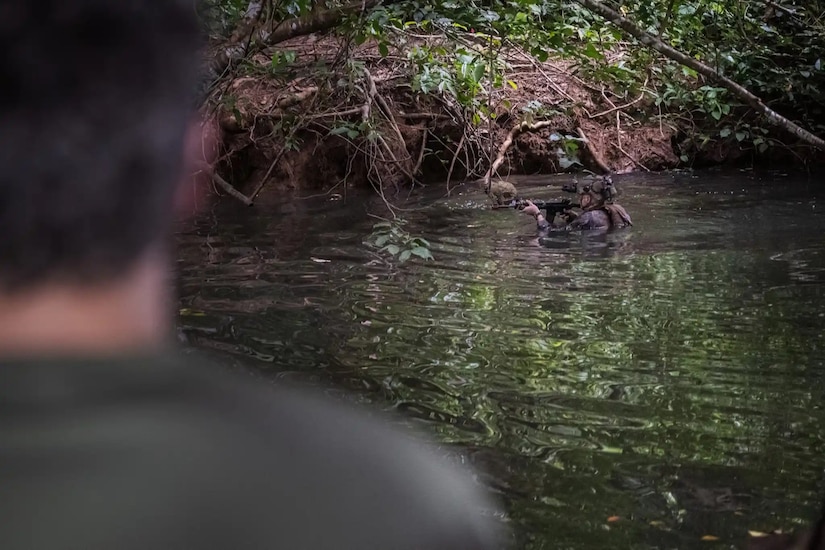
A rear-facing man observes two people in camouflage military uniforms as they move through water; one man carries a rifle.
The secretary said the service members who train at the center are willing to do things no other Americans are willing to do, to include helping U.S. allies in both Central and South America protect the nation's backyard. 

"That's what we're doing here with the A3C [and with] Panamax ... expanding peace through strength in our hemisphere, right here in the jungles with our partners," he said. 

Noting a big shift in the Southcom mission, Hegseth said that just 18 months ago, the command was less focused on protecting the Americas and deterring threats. 


"This is a different Southcom; this is a different mission," he said. "We are focused on military capabilities against real threats who need to be deterred and defeated, and we're going to give them everything they need to do it, on behalf of the American people." 

The secretary said that under President Donald J. Trump, Southcom's mission has focused on working with partners in the region to keep everybody safe from a variety of shared threats. 

"We know exactly what that mission looks like," he said. "We're empowering commanders like [Marine Corps Gen. Francis L. Donovan] to do it in Southcom; we're working with partners like Panama, like Ecuador, like Colombia ... they're going to send students here soon to swim across this very same river, [to] be a part of this very same training." 

The nations involved in the Americas Counter Cartel Coalition — 19 nations in all, with Colombia signing on just yesterday — are going to be involved in the same training as U.S. service members in Panama. The secretary said that the same things that necessitate American jungle training also motivate every other nation in the region. 

"It turns out, in the [Western] Hemisphere, they face the very same security challenges, the same threat of drugs, the same threat of criminal cartels that threaten their citizens, the same ones that threaten our citizens," Hegseth said. 

U.S. law enforcement personnel stationed at the U.S. southern border to stop illegal immigration and drug traffickers, combined with training across Central and South America in places such as Ecuador, Colombia and Panama, puts increasing pressure on shared threats. 

"That's going after the enemies of our country — designated terrorist organizations — unabashedly," Hegseth said. 

Earlier in the day, the secretary announced the new motto of the Americas Counter Cartel Coalition: "We do bad things to bad people." 

"For too long, bad people did bad things to good people, inside the United States of America and across Central and South America," he said. "We're going to empower great Americans and great partners to do really good stuff and be very capable about bringing violence against drug cartels and designated terrorist organizations, because we're dead serious about securing the homeland." 

A big part of that is the Trump corollary to the Monroe Doctrine. In 1823, President James Monroe articulated a foreign policy, now known as the Monroe Doctrine, which declared that the Western Hemisphere was off-limits to further colonization efforts or interference by European nations. Later, that expanded to include interference by any foreign power. 

In 1904, President Theodore Roosevelt added to that doctrine that the U.S. could intervene in the affairs of Latin America to protect U.S. interests. 

And now, Hegseth said, there is Trump's corollary to the Monroe Doctrine. 

"It is a recognition that [designated terrorist organizations] ... will not control our hemisphere ... and we will not allow foreign malign influence to take over ... key terrain like the Panama Canal," he said. 

Hegseth said Colombia's inclusion in the Americas Counter Cartel Coalition is significant. 

"The A3C had formed, but in some ways, it missed part of its core," he said. "Colombia is going to be [an] incredible partner. They offered to be a headquarters or a hub for the A3C as the brand-new 19th member. They've got ... hundreds of thousands of capable members of their military and decades of training with the United States ... that mil-to-mil relationship has been long-standing, and that's why they're coming to this jungle course soon."