Showing posts with label emergency response. Show all posts

Tuesday, August 04, 2026

Washington National Guardsmen Support Statewide Wildfire Response

As wildfires spread across Washington state recently, Washington National Guardsmen joined the firefight working alongside state and local partners to protect threatened communities, property and critical infrastructure.  

On July 19, Washington Army National Guard aviation crews began providing sustained aerial firefighting support using two UH-60 Black Hawk helicopters and a CH-47 Chinook helicopter, based out of Deer Park, Wash.
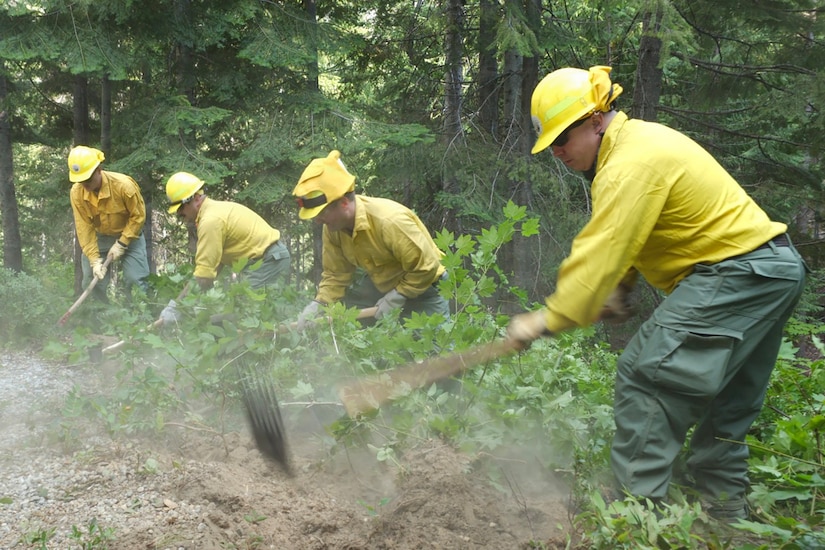
Four men wearing firefighter gear use garden tools to dig up brush from a wooded area.

Operating under demanding conditions that include intense heat, smoke and rapidly changing fire behavior, crews have flown repeated daily missions to deliver water directly onto active fires and support firefighters.  

By the end of the 15th day of aviation operations, National Guard aircrews had accumulated 146.5 flight hours and dropped 1,181 buckets, or approximately 970,000 gallons, of water.  

"Wildfire suppression operations is hands down the most physically and mentally demanding task an Army aviator will perform," said Army Lt. Col. Adam Hanisch, Washington Army National Guard state aviation officer. "These missions require constant communication with firefighters on the ground, as well as with multiple aircraft from various agencies supervising and participating in a visually degraded environment with zero margin of error. We take this extremely seriously from preparation through execution and are honored to provide this service to Washington state."  

As new fires broke out through late July, National Guard hand crews, ground personnel, were requested July 28 by the Washington Department of Natural Resources for support at a fire north of Leavenworth, Wash. On July 31, more than 100 guardsmen, including five 20-person hand crews, mobilized to Pangborn Memorial Airport to in-process and receive their equipment before heading to the fire camp in Plain, Wash.

"This is a mission we train for long before wildfire season arrives, so when we get the call from our partners at the Department of Natural Resources, we're ready to go," said Air Force Maj. Gen. Gent Welsh, Washington National Guard commander. "I'm incredibly proud of these men and women who have stepped forward to support this mission and [I] am confident they'll bring hard work and professionalism to the fire line. They're taking on demanding, dangerous work to protect our communities, and I hope everyone will do their part to keep them, and everyone working around the clock to fight these fires, as safe as possible."  

Wildland firefighting has become a recurring domestic response mission for the Washington National Guard. Each year, guardsmen train alongside the Washington Department of Natural Resources and other firefighting agencies to prepare for the possibility of being called to support wildfire response. That preparation allows service members to integrate quickly with civilian agencies while remaining under the direction of the incident command system.  

The mission is one Washington National Guardsmen have answered repeatedly over the past three decades. From the large-scale response to the 1994 wildfire season to recent activations across the state, soldiers and airmen have supported wildland firefighting efforts from the air and on the ground.  

On Aug. 1, multiple fires erupted near the city of Spokane, Wash., forcing residents to evacuate a heavily populated area. The Washington National Guard immediately activated 100 service members to support local law enforcement officers with traffic control point operations, helping residents get to safety.   

"Answering the call when our state needs us is at the very core of who we are. This is the spirit of the guard," said Air Force Col. Carrie Wentzel, Washington National Guard director of joint operations. "We train for these critical missions, prepare our force to the highest standards, and when the call comes, we respond alongside our partners in the field. Our soldiers and airmen are Washingtonians, and they are fully committed to helping our communities protect lives, homes and property during wildfires."

Tuesday, January 27, 2026

National Guardsmen Activated in Response to Winter Storm Fern

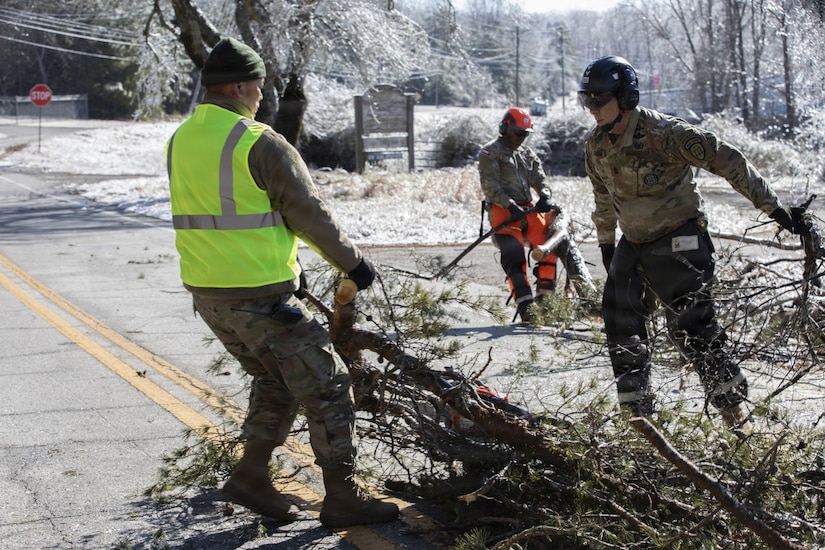
More than 5,400 National Guard members are on duty in 15 states in the aftermath of winter storms that dropped snow and ice from the Midwest to the mid-Atlantic and the South over the weekend.

Three men dressed in camouflage military uniforms pull tree branch debris away from a road.

"[I'm] proud of our incredible National Guardsmen who are stepping up once again," said Air Force Gen. Steven Nordhaus, chief of the National Guard Bureau, in a post shared on his official social media account before the storm. "To everyone in the storm's path: take all precautionary measures to stay safe. The National Guard is always ready, always there."  

Arkansas National Guard soldiers have been driving along icy roadways alongside state police officers, assisting motorists who slid off the road and using military vehicles to recover disabled vehicles.  

North Carolina Army National Guard soldiers performed similar missions.

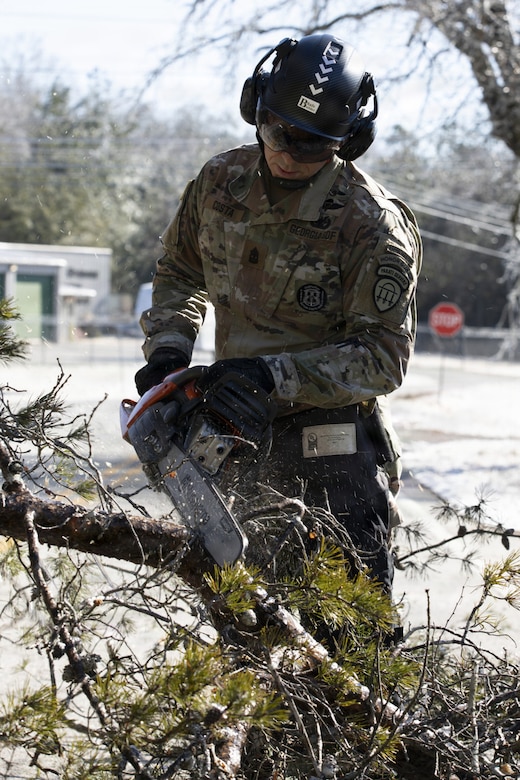
A man dressed in a camouflage military uniform uses a hand saw to cut a tree branch.
"We used our high-mobility vehicles to pull those individuals back onto the road and get them on their way," said Army Lt. Col. Ellis Parks, North Carolina National Guard Public Affairs director.  

Guard members have also assisted with traffic management, conducted health and welfare checks, and transported local first responders and emergency personnel as they responded to calls for assistance.  

In Delaware, that meant more than 100 Guard members on duty with vehicles positioned throughout the state. In Kentucky more than 2,000 Guard members were activated to respond to icy and snowy conditions.  

In Maryland and other affected areas, Guard members began staging vehicles, equipment and other resources in the days leading up to the storm.  

"The safety and well-being of Maryland residents is our top priority," said Army Brig. Gen. Craig Hunter, Maryland National Guard Joint Staff director. "By preparing our personnel and equipment before the winter storm, we can respond immediately to requests for assistance from local jurisdictions and help ensure our communities remain safe during this weather."

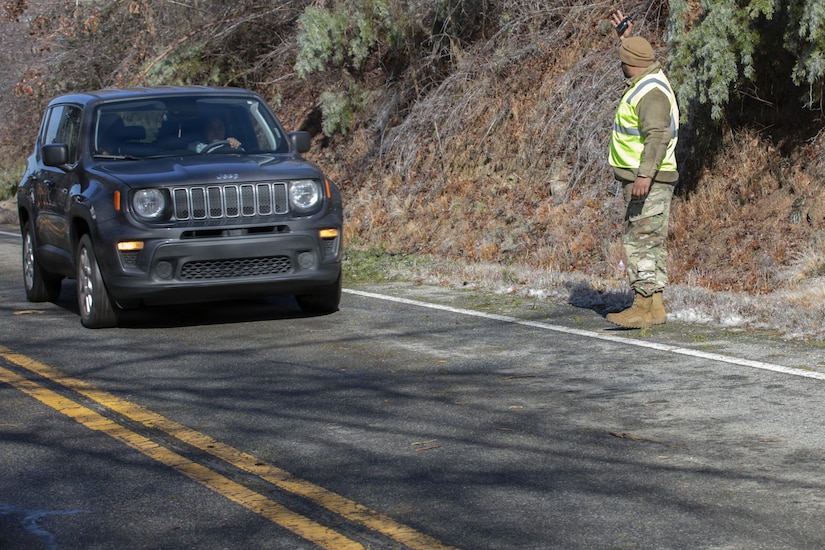
A man wearing a hazard vest and camouflage military uniform stands by a roadside to direct a car away from a work zone.
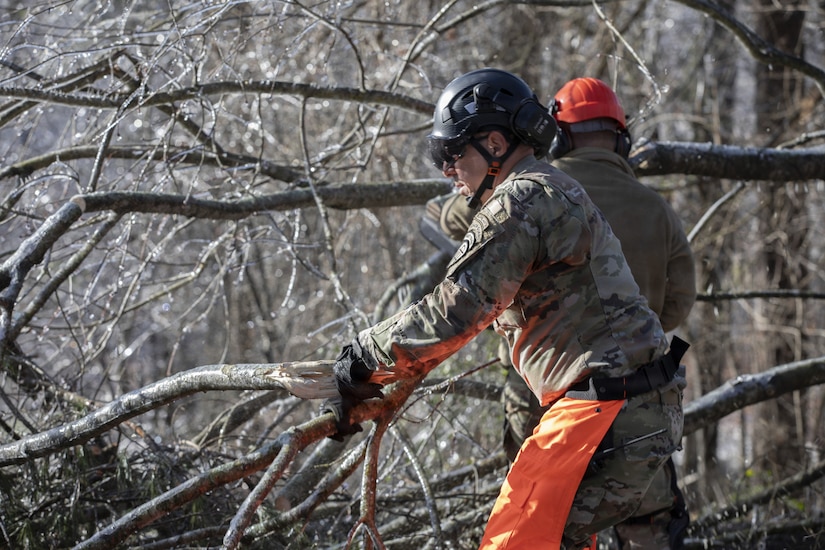
Two men dressed in camouflage military uniforms remove broken branches.
Guard officials said soldiers and airmen will remain on duty helping communities recover from severe winter weather as long as they are needed.  

In total, National Guard units from 15 states were activated in response to Winter Storm Fern, including Alabama, Arkansas, Delaware, Indiana, Kentucky, Maryland, Missouri, North Carolina, Oklahoma, Pennsylvania, South Carolina, Tennessee, Texas, Virginia, and the District of Columbia.  

Guard members in six additional states are on alert to support state and local officials if needed.  

Tuesday, September 09, 2025

JTF-DC Medic Doubles as Third-Year Medical Student so Others May Live

 Sept. 9, 2025 | By Army Master Sgt. Whitney Hughes, National Guard Bureau

Not many people can say their interest in one of the body's most complicated organs began with a water pump. 
 
However, for Army Spc. Elias Figueroa, a combat medic assigned to the D.C. Army National Guard and third-year medical student, his interest in medicine began with helping his father install a water pump. His inherent understanding of the pump system and the similarities he drew to the human cardiovascular system are what drew him to the field. 

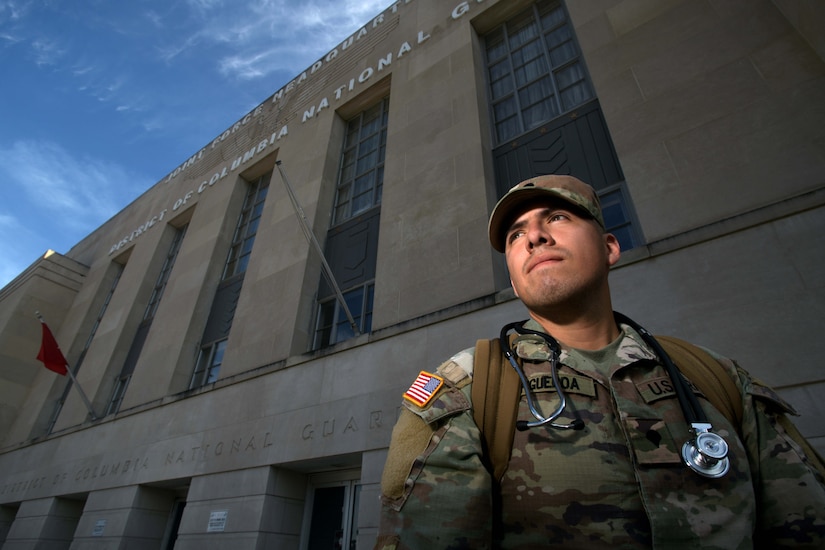
A person wearing a camouflage military uniform stands outside in front of a building and gazes up into the distance.

 
"Just understanding the pump systems, the math made sense and the picture made sense in my head," said Figueroa, adding that it converted so well in his first two years of medical studies that he was tutoring other students. 
 
This same curiosity and hands-on approach drove him to join the Army National Guard as a combat medic and led to his current assignment with the D.C. Safe and Beautiful Task Force, Joint Task Force District of Columbia. He initially joined the National Guard in 2020 and qualified as a combat medic upon graduating from an intense 16-week course focused on emergency medical technician, emergency medical services and tactical combat casualty care training. 
 
Since being on duty with the task force, his duties have included treating fellow soldiers and responding to several incidents involving civilians. 
 
His squad leader, Army Sgt. Jay Whited, said Figueroa's experience and skill set have been invaluable in many of the situations they have encountered. 
 
"He's treated at least half a dozen civilians at Union Station since the mission started," Whited said. "We are very lucky to have such a well-trained medic. He's right there, and he's pretty close to being a doctor, so that makes us feel good. It's good for him. It's an actual medical emergency in public that he can get his hands on and do something about." 
 
While assigned to the task force, Figueroa has provided hands-on treatment or assessments for everything from a heat casualty to a narcotic overdose. He said experience like that gives him an advantage going into his third year of medical school, where studies move from the classroom to practical application with patients. 
 
"A lot of us [medical students] kind of fumble to the point to where some people repeat a semester because they just can't do the clinical part," Figueroa said. "So, I've been able to kind of hone my abilities a little bit. I'm a little more confident. I was like, 'Oh, I can do that. I can take vitals without even hesitating. I can go through an assessment.'" 
 
Despite the added confidence, he doesn't take the gravity of his position lightly. 
 
"It's a responsibility," Figueroa said. "You can't freak out. You have to keep a level head and relax. For all those events, when someone yells 'Medic!' I'm calm as heck, I don't overreact." 
 
He said he often reminds himself to begin with the basics to stay calm as he assesses and reassures the patient. 
 
"And that's kind of the first thing that comes to mind is just relax and do the job," Figueroa said. 
 
For the 28-year-old, medicine goes beyond a job to a spiritual and moral code. When he "found Christianity and God" during college, Figueroa asked himself what his strengths were and how he could use them to serve others. That also tied in with a duty he felt as a naturalized citizen to serve his country. 
 
His family emigrated from Peru, and he and his parents became American citizens in 2011. 
 
"My dad got citizenship that January, and I got it through him, because I was still a minor," Figueroa said. "I always felt I didn't really earn it. My dad took the test. My dad did all this work. So, part of me was like, I want to actually earn this." 
 
His family started off in an apartment, and now they own three properties — one of which is the house where he helped install the water pump that inspired his interest in cardiology, he noted. 
 
"This country gave us a lot, it's kind of like the American dream showed itself," Figueroa said, who will conclude his time with the D.C. task force in two weeks to return to his role as a full-time medical student. 

Tuesday, August 26, 2025

Guard Members Partner With Local Authorities to Render Life-Saving Aid in Multiple Incidents


Aug. 26, 2025 

By Army Master Sgt. Whitney Hughes  

"It was chaotic — people were running and screaming," said Army Staff Sgt. Zachary Graham, a member of the South Carolina National Guard assigned to the D.C. Safe and Beautiful Task Force, Joint Task Force District of Columbia.

Moments earlier, a man had been struck by a train and thrown across a Washington Metro station platform in Washington, Aug. 20. Graham and his fellow soldiers, all members of the 4th Battalion, 118 Infantry Regiment, immediately secured the scene, called 911 and assisted first responders in rendering first aid, ultimately reviving the man to the point that he was conscious and moving when EMTs transported him.

"Everybody was panicking but able to keep a clear head and make the phone call to 911 to get an ambulance on the way," said Army Spc. Nicholas Garrison, who was on patrol with Graham at the NoMa-Gallaudet U Metro station. "Our presence was important for getting him help as quickly as possible."

This was one of several life-threatening incidents in the past week where members of the task force were first on the scene to provide aid to local citizens and assist local authorities.

In an event at Union Station, two D.C. Army National Guard military police officers were conducting a joint patrol with the Amtrak Police Department, Aug. 15, when they encountered an unconscious man.

Army Sgt. Jay Whited, a team leader assigned to the 372nd Military Police Battalion, said the man appeared to have fainted and did not look well. They resuscitated him and contacted emergency services. Whited said the police suspected the man was experiencing a narcotic overdose and asked the guard members to help secure the scene while they administered naloxone, a medication used to reverse the effects of opiates.

"We are pretty uniquely positioned here, like all National Guard units, but even more so because it's D.C. and it's so small," he said. "We are uniquely experienced as well, and we integrate with local agencies well because we have done it so many times."

In addition to the metro incidents, guard members intervened during the assault of a U.S. Park Police officer, alerted the D.C. Metropolitan Police Department to a man brandishing a knife and making verbal threats at the Waterfront Washington Metro station and helped the U.S. Drug Enforcement Administration locate a missing child in southwest Washington.

Army Brig. Gen. Leland D. Blanchard, interim commanding general of the D.C. National Guard, stated that approximately 2,000 guard members are supporting the task force and providing critical assistance to local law enforcement officers. 

"The members of the District of Columbia National Guard are highly trained and capable of assisting our interagency partners to keep our district safe," he said.