Showing posts with label fighter pilot. Show all posts

Monday, August 31, 2026

Medal of Honor Monday: Marine Corps Brig. Gen. Robert Edward Galer

Marine Corps Brig. Gen. Robert Edward Galer was a fighter pilot during World War II and went on to serve more than 20 years on active duty. He received the Medal of Honor for his actions in the skies over Guadalcanal in 1942.
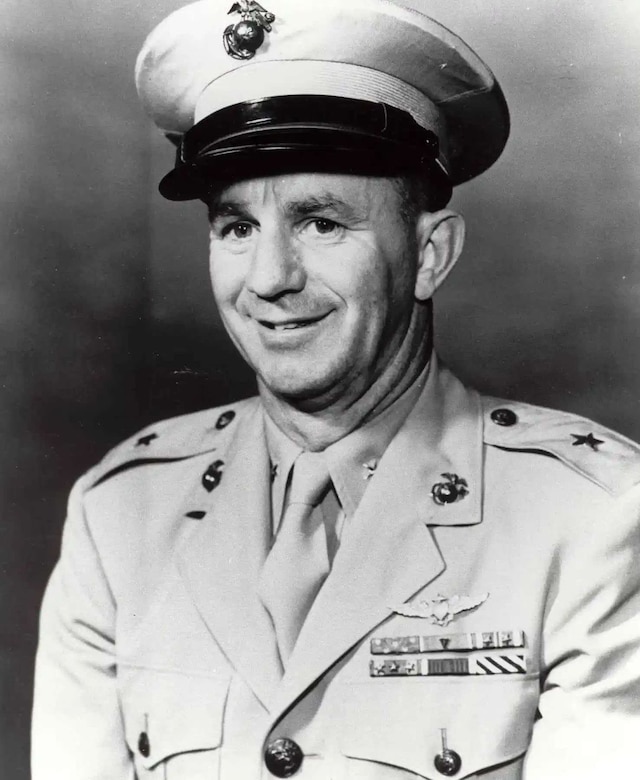
A man in a formal military uniform poses for a photo.

Galer was born Oct. 23, 1913, in Seattle. He was the youngest son of Frederick George Galer and Mary Loretta Leahy, and he had two older brothers, Vincent and Fred Galer Jr. 

Galer went to Queen Anne High School, where he excelled in sports, playing basketball, football, baseball and tennis, as well as running track. After high school, he attended the University of Washington in Seattle, where he was an All-American basketball player and a member of Navy ROTC. He graduated in 1935 with a bachelor's degree in industrial engineering. Following graduation, he enlisted in the Marine Corps because he wanted to fly quicker than an officer commission would allow. Galer began flight training at Naval Air Station, Pensacola, Florida, and about halfway through the course, he was offered an officer commission and became a second lieutenant in July 1936. 

In April 1937, he was assigned to the 1st Marine Brigade, Marine Corps Base Quantico, Virginia, for duty with Aircraft One. Over the next year, he served at The Basic School in Philadelphia, and he was briefly assigned to the Brooklyn Navy Yard before being ordered to St. Thomas in the U.S. Virgin Islands, where he served with Marine Scouting Squadron-3.
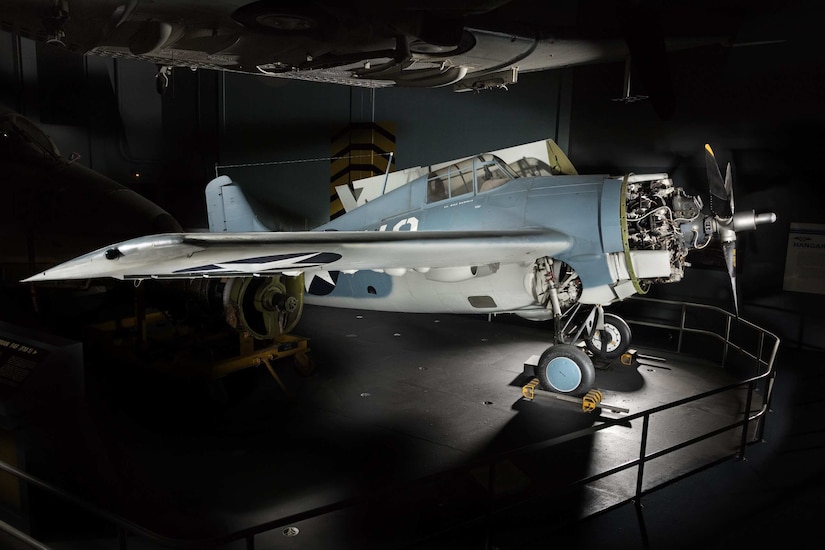
A propeller aircraft is displayed in a dark museum with a spotlight shining on it.

He married his first wife, Dorothy Beyer, shortly before the start of World War II. They had two children: Vincent and Robert Tipton Galer, who later retired as a colonel from the Air Force. Galer's first marriage ended in divorce, and he married his second wife, Sharon Alexander, in 1981; he became the stepfather to her children, Charles and Christine. 

Galer transferred to Marine Corps Air Station Ewa Field on Oahu, Hawaii, in January 1941. In an August 1998 interview, he described the days leading up to the Dec. 7, 1941, Japanese attack on Pearl Harbor. 

"There was practically no mention of trouble with Japan," Galer said. "In fact, the Saturday before the attack, we lined up the airplanes, wingtip-to-wingtip, and nobody even mentioned that we should scatter them."  

Ewa had very little damage from the attack, except for the airplanes. Galer said none of them were operational, so the Marines were issued rifles. 

Four Marines at Ewa were killed during the attacks, becoming some of the first American casualties of World War II. Galer and his fellow Marines on the ground fought back with machine guns, rifles and pistols.
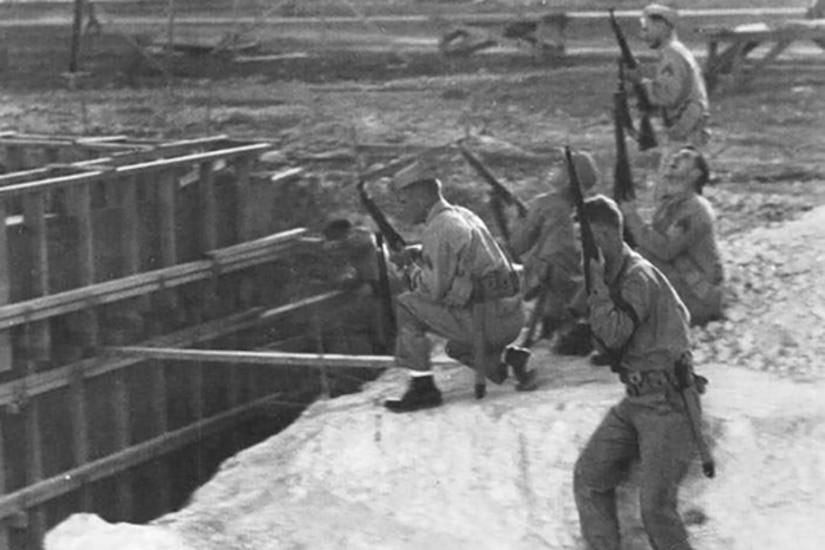
Five men in World War II-era military uniforms crouch and stand outside as they point their rifles toward the sky.

From Aug. 30 to Sept. 28, 1942, the dates of his Medal of Honor action, Galer, now a major, was the commander of Marine Fighter Squadron 224, Marine Aviation Group 21, flying over the skies around Guadalcanal in the Solomon Islands in the South Pacific in an F4F-4 Wildcat. 

His citation reads that he led his squadron in aerial combat with enemy forces in daring and aggressive raids against Japanese aerial forces, which were vastly superior in numbers.  

He availed himself of every favorable attack opportunity, shooting down 11 enemy bomber and fighter aircraft over a period of 29 days. Though suffering the extreme physical strain attendant upon protracted fighter operations at an altitude above 25,000 feet, the squadron, under his zealous and inspiring leadership, shot down a total of 27 Japanese planes. 

Galer received the Medal of Honor from President Franklin D. Roosevelt during a White House ceremony held March 24, 1943. 

The following month, he was assigned to Marine Corps Air Depot Miramar, in Southern California, where he was the assistant operations officer. He was promoted to lieutenant colonel and returned to Ewa in November 1943, where he was chief of staff, Marine Air, Hawaiian Area. During his 1998 interview, Galer said he was told Medal of Honor recipients wouldn't fly again, so he trained units on "this new-fangled radar." 

In July 1945, he took command of a cadet regiment at Marine Barracks, Naval Air Training Base, Corpus Christi, Texas, a position he held for two years before he attended the Armed Forces Staff College in Norfolk, Virginia. 

Galer remained on active duty another 10 years, with assignments at Marine Corps Air Station Cherry Point in North Carolina, Naval Air Station San Diego and the 1st Marine Aircraft Wing in South Korea. He was promoted to colonel in March 1951. 

On Aug. 5, 1952, while flying an AU-1 Corsair, Galer was shot down by antiaircraft fire over North Korea, while leading a squadron attack near Wonsan. After parachuting safely to the ground, he evaded capture by hiding in a cornfield.  

Upon his rescue, Galer said, "I do know that every pilot flying in this theater should have the highest possible morale with the knowledge that so many are ready and willing to risk so much to get them [when they are shot down]." 

After being hospitalized for two months for injuries sustained from ejecting from his aircraft, Galer was assigned as the assistant chief of staff for personnel at Marine Corps Air Station El Toro, California.  

His final assignment was with the Guided Missiles Division for the Department of the Navy, in Washington, where he served as the assistant director and then the acting director in January 1956. 

Galer retired from the Marine Corps July 31, 1957, and he was meritoriously promoted to brigadier general. That same year, he graduated from George Washington University in Washington with a master's degree in engineering administration. 

Following his retirement, Galer moved to Dallas, where he worked in the defense industry and then at a real estate firm.
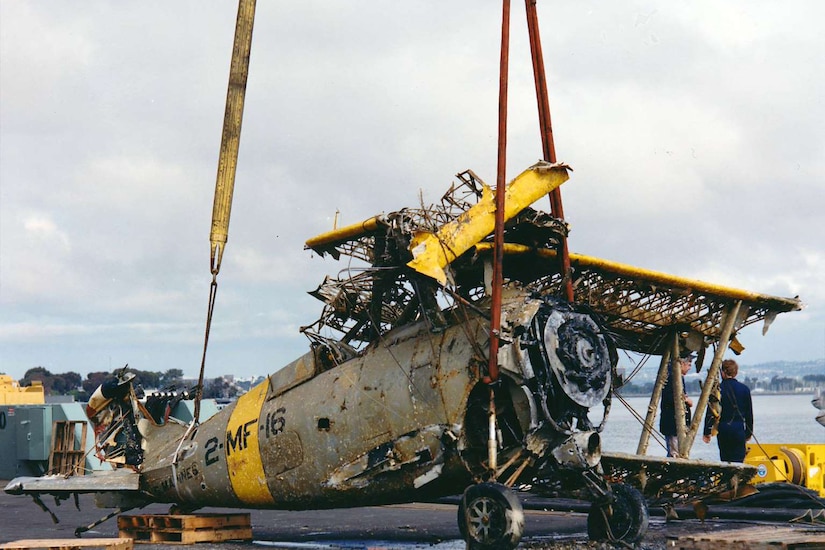
A wrecked World War II-era plane is lowered to the ground near an ocean.

In the early 1990s, he collaborated with the San Diego Air and Space Museum to restore the F3F biplane that he had ditched off the coast of San Diego in 1940 due to a mechanical failure. It was recovered from the ocean floor April 5, 1990, at a depth of 1,800 feet. 

Galer died June 27, 2005. He is buried alongside his wife, Sharon, in the Texas State Cemetery in Austin, Texas. 

In addition to the Medal of Honor, he also received the Legion of Merit with Valor, the Distinguished Flying Cross with one gold star, the Air Medal with four gold stars and the Purple Heart. 
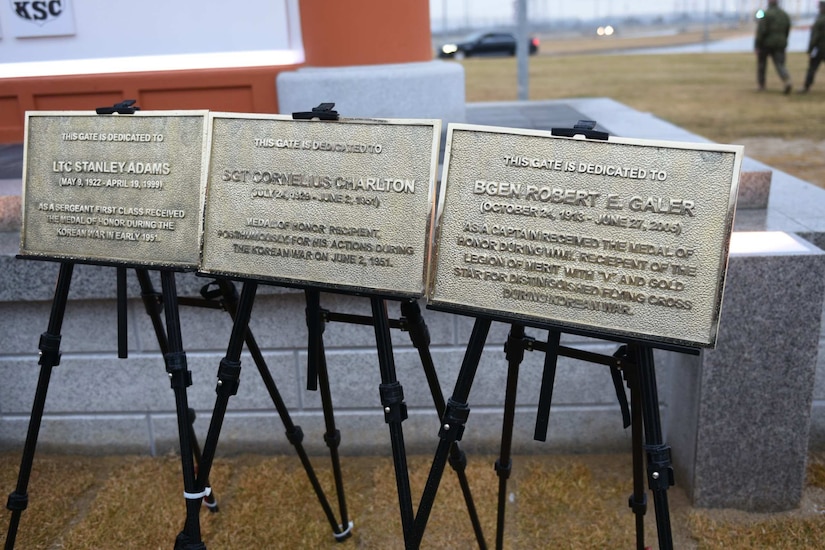
Three plaques, each dedicated to service members, are displayed on easels outside during a ceremony.

On Dec. 17, 2020, a plaque was dedicated to Galer at Camp Humphreys, South Korea. There's also a monument dedicated to him and other military alums on the campus at the University of Washington in Seattle. 

Wednesday, May 18, 2011

Face of Defense: Fighter Pilot Balances Work, Motherhood

By Air Force Airman 1st Class Daniel Phelps
20th Fighter Wing

SHAW AIR FORCE BASE, S.C., May 18, 2011 – When Air Force Maj. Jaime Nordin saw her first airshow as a child, she knew she wanted to fly fighter jets.

"I was mesmerized by fighters -- the idea of going fast and flying upside-down," said the F-16 pilot with the 79th Fighter Squadron here, one of 58 women among the Air Force’s 2,689 fighter pilots.

The role of Air Force fighter pilots is to maintain superiority in the air and support the ground fight. But Nordin's mission goes beyond that. She also is the mother of a 2-year-old daughter named Caleigh.

"Being a mom and a fighter pilot are both equally demanding, which makes having only 24 hours in a day hard," she said. "But more and more, I'm becoming a mom, and a fighter pilot is my trade."

Nordin said she was five to six weeks pregnant when she found out Caleigh was on the way. "Because of that,” she said, “I joke with my daughter that she has flown in an F-16." But impending motherhood meant that Nordin had to take some time off from flying.

"Between pulling high G’s and the ejection seat, flying while pregnant is a ‘no go,’" she said.

Being grounded was difficult at first, the major acknowledged. "I went through an identity crisis because I had to stop flying,” she said. “I had to become something other than a fighter pilot. But after a while, my motherly instincts took over."

During that time, Nordin worked in the operations support squadron at Hill Air Force Base, Utah. After the time off from the pregnancy and recovery, her qualifications for flying were out of date, so she had to take a class at Luke Air Force Base, Ariz.

"During the time off, I really missed flying," Nordin said. "It's kind of a need. I missed being in the air and the camaraderie of the squadron."

Nordin's husband also is an F-16 pilot, which presents unique challenges to the couple in raising a 2-year-old. For example, she said, she sometimes worries about what will happen while she's flying or in the middle of something else and can't pick up Caleigh.

"Fortunately, we have friends who are willing to step in and help us out at the drop of a hat," she said. "Several times we've had to cash in on them for help because of mission requirements."

For times when the two pilot parents have temporary deployments at the same time and can't bring Caleigh, they have a family care plan in place to ensure their daughter’s care.

"We've been making adjustments in our lives to make things work since Day One," Nordin said. "The busy lifestyle is the only life we know. We've always had to adjust and readjust. [Caleigh has] always known this life."

But so far, she added, the couple has not yet had to miss out on any key moments in their daughter's life.

"I know there are a ton of families where that is not the case, so we've been blessed in that way," she said. "You have to learn to celebrate the ordinary."

The mom and fighter pilot said she can tell that her daughter understands what it means for her parents to be pilots.

"She can tell you what an F-16 is," she said. "She is thrilled by them. She'll see one fly and say that's mom or dad. She enjoys sitting and watching the planes taxi down the runway. She's engulfed in it."

Friday, April 08, 2011

Naval Aviation Past, Present and Future Honored by Hawaii State Senate

By Mass Communication Specialist 2nd Class Robert Stirrup, Commander, Navy Region Hawaii Public Affairs

HONOLULU (NNS) -- The senate of the Twenty-Sixth Legislature of the State of Hawaii presented a resolution to honor 100 years of naval aviation at the State Capitol in Honolulu, April 5.

Four representatives were recognized as a part of the Centennial of Naval Aviation (CONA) and were presented with certificates by Will Espero, senator of the 20th district for the state of Hawaii.

"Naval aviators, Navy and Marine Corps, have put themselves in harm's way for 100 years, training, testing, and when called upon, fighting to defend freedom. At this moment, they fly missions over Afghanistan and Libya. They patrol the skies to defend us," said Espero. "Naval aviators provide humanitarian relief. They provide support for Pacific Partnership to build peace and prevent war. Right now, they are saving lives in Japan."

The honorees included Cmdr. Brian Grimm, chief staff officer for Commander, Patrol and Reconnaissance Wing Two; Ens. Sally Deboer, assigned to Patrol Squadron Nine; Jay Dunn, a former Marine Corps aviator that flew CH-46 Sea Knight helicopters in southeast Asia during the Vietnam War and current volunteer at the Pacific Aviation Museum; and Mrs. Kathy Newlund, wife of Cmdr. Steven Newlund, commanding officer of Patrol Squadron Four.

The four honorees represented the past, present, future and family aspect of Naval Aviation.

Dunn, who represented the heritage of naval aviation, spoke about importance how aviation supports the Navy and Marine Corps.

"Naval aviation allows us to project power around the world," said Dunn. "Now with being able to have many types of aircraft deployed aboard ships really helps in supporting the Navy and Marine Corps mission."

Dunn currently volunteers at the Pacific Aviation Museum on Ford Island, where he teaches young people.

Grimm, who represented the present of naval aviation, talked about the legacy of naval aviation throughout the last 100 years.

"It is important that we pause and look back at the heritage that naval aviation has left on the Navy and Marine Corps over the last century," Grimm said. "It's amazing to see where we've come from with the first fliers to not only the aircraft and equipment that we use today, but the tactics as well."

Deboer, who is on her first operational assignment and who represented the future of naval aviation, explained her thoughts on the Centennial of Naval Aviation from a junior aviator's standpoint.

"Looking at the centennial of naval aviation from my perspective, it's an amazing experience to be among people here today who are a part of the history of naval aviation, from the Vietnam War to the first Gulf War and up until now," Deboer said. "To learn the lessons of the past from some of the pioneers of naval aviation is the most important principle in celebrating the Centennial of Naval Aviation."

Newlund, who represented the family aspect of naval aviation, spoke about her husband's service as a naval aviator and his involvement with the current humanitarian relief efforts in Japan.

"My husband and Patrol Squadron 4 are currently supporting Operation Tomodachi over in Japan right now, and they have a big impact with supporting the ongoing relief efforts," Newlund said. "I'm extremely proud of his service and the great things that he continues to do."

In Espero's speech on the Senate floor, he said, "Many significant episodes have since been recorded in the annals of military history, such as the first transatlantic crossing by air in 1919 and the first aircraft carrier in 1922. Many naval aviators were among the first astronauts in space and on the moon."

He added, "Patrol aviation has been an important part of the history of Hawaii since 1919 and is vital to our national defense. From 1927 to 1947, Honolulu International Airport was known by its original name, John Rodgers Field, after the brave Navy commander who served as a navigator on the first flight from San Francisco to Hawaii in 1925. Sea Service aviators based in Hawaii achieved victory in World War II in the 1942 Battle of the Coral Sea and Battle of Midway. They demonstrated the power of Marine and Navy pilots who later helped win the Cold War. From Ford Island, Barbers Point and Kaneohe Bay, Oahu, to Barking Sands Kauai, naval aviators serve with honor, courage, and commitment."

In 2011, the Navy is observing the Centennial of Naval Aviation with a series of events nationwide celebrating 100 years of heritage, progress and achievement in naval aviation.

Wednesday, March 16, 2011

Blue Angels Announce Changes to 2011 Show Schedule

By Mass Communication Specialist 3rd Class Julia A. Casper, Blue Angels Public Affairs

PENSACOLA, Fla. (NNS) -- The Navy Flight Demonstration Squadron, or Blue Angels, announced two changes to their 2011 show schedule Mar. 10.

Two new show sites were announced as Lynchburg, Va., May 14-15; and Battle Creek, Mich., July 2-3.

Demonstration sites are selected in support of Department of Defense objectives and in the interest of the armed services with safety as the primary consideration.

Performances greatly assist in the recruiting and retention goals for the military services, enhance esprit de corps among uniformed men and women and demonstrate the professional skills and capabilities of the Naval services to the American public and U.S. allies.

For information on individual air shows, please go to the air show's official websites. For details on the Centennial of Naval Aviation please visit http://www.public.navy.mil/airfor/centennial/Pages/welcome.aspx.

For more news from Navy Blue Angels, visit www.navy.mil/local/blueangels/.

Monday, March 14, 2011

Plan Improves Navy, Marine Corps Air Capabilities

By Lisa Daniel
American Forces Press Service

WASHINGTON, March 14, 2011 – Navy and Marine Corps leaders today signed an agreement by which the Corps will join the Navy in buying the F-35 joint strike fighter variant designed for aircraft carriers, service leaders announced today.

Navy Secretary Ray Mabus, Chief of Naval Operations Adm. Gary Roughead, and Marine Corps Commandant Gen. James F. Amos signed a memorandum of agreement today on the purchase of F/A-18E/F and F-35B/C fighter jets they say will improve air capabilities for both services.

Under the agreement, the two services will buy 680 F-35s. The Navy will buy 260 of the F-35C carrier variant, and the Marine Corps will buy 80 of the F-35Cs, along with 340 of the F-35Bs, a short-take off, vertical-landing variant. The Corps will assign five of its air squadrons to flying the F-35Cs in the Navy’s carrier air wing, the agreement says.

Defense Secretary Robert M. Gates announced in January that he was placing the F-35B on the equivalent of two years probation due to testing problems with the STOVL aircraft.

Today’s agreement demonstrates the commitment of Gates, Mabus and Roughead to the purchase of the F-35B, Thomas E. Laux, the Navy’s deputy assistant secretary for air programs, said during a press briefing. “These quantities match the fiscal 2012 budget request,” he said.

The F-35Cs will be assigned to the Navy’s aircraft carriers, while the “B” variants are assigned to L-class ships, Laux said. “Our priority is to do testing of the F-35Cs on the carrier,” he said. “We will learn a lot about the F-35Bs on the L ships” to determine if the STOVLs may be used on carriers.

The agreement reflects the “enduring partnership” of Navy and Marine Corps aviation, Laux said. Training for the aircraft will be “completely integrated,” and there will be only one pipeline, he said.

The combination of F-35B and C variants, along with the F-18s, will improve the services’ advance air capabilities, service officials said.

“Together, the Navy and Marine Corps are stronger than they are alone,” Laux said. “Together, we are more formidable than we are apart.”

Sunday, March 13, 2011

DoDLive Bloggers Roundtable: WWII Pilot Reflects on Pearl Harbor Attack

We scheduled a DoDLive Bloggers Roundtable with World War II Navy Cross recipient and fighter ace William E. "Bill" Davis for Wednesday, Dec. 8. Davis shared details of his October 1944 bombing attack that sunk the Japanese aircraft carrier Zuikaku. The Zuikaku held a special place in the minds of a Navy pilot in 1944. She was the last remaining aircraft carrier that participated in the attack on Pearl Harbor. Bills bombing run nearly cost him his life but he and his men sunk her, and, militarily, the closure for Pearl Harbor was now complete.

Wednesday, March 09, 2011

Future Aviators in Australia Appreciate F-16

By Air Force Master Sergeant Cohen A. Young
Defense Media Activity - Hawaii

GEELONG, Australia, March 8, 2011 – More than 30 future aviators gathered around an F-16 fighter jet based at Misawa Air Base, Japan, during the 2011 Australia International Air Show here March 5.

The students are members of the Australian Air League, a volunteer organization for young people interested in aviation.

“Our organization gives the children a better appreciation of how aviation affects Australia, said Michael Diamond, the organization’s 2nd officer and acting commander of its Sunbury Squadron.

Members of the Pacific Air Forces F-16 demonstration team gave the children a tour of the main U.S. performer at the bi-annual air show, which drew more than 180,000 people over six days. The public didn’t have the opportunity to reach out and touch the jets, as the young aviation enthusiasts did.

“This is an absolute buzz for the children today,” Diamond said. “The general public got to see the jets fly, but through your program, the children were able to get closer and speak with the people that handle it, and this will be something that they remember for an awful long time.”

The performance thrilled the young people with the thought of flying an F-16.

“The F-16 is just awesome, and the performance was really cool,” said 13-year old Emaon Connor, the acting leading cadet. The students met two of the pilots and many of the maintenance personnel who work on the F-16.

“It was wonderful having the kids with us and showing them what our whole mission as the Pacaf demo team is all about,” said Air Force Tech. Sgt. Timothy Connor, an egress systems craftsman. Connor showed the children all around the plane, introduced them to the other team members and answered many of their questions.

“The ability for the children to be able to come out here and put their hands on the aircraft allowed them to see the bigger picture of what we and the pilots do was pretty awesome,” Connor said.

Monday, February 14, 2011

Family Members of 1st Navy Pilot Attend Navy Centennial Events

By Communication Specialist 2nd Class (SW/AW) Joseph H. Moon

SAN DIEGO (NNS) -- The daughter and several descendants of the Navy's first aviator visited Naval Air Station, North Island for the base's open house and the Centennial of Naval Aviation's Parade of Flight event for a tour of the facilities and an A-1 Triad demonstration, Feb. 11 and 12.

Elizabeth Gordon Ellyson Carmichael, 89, the last surviving child of Navy Aviator #1 Lt. Theodore Gordon Ellyson, and her family provided a living historical connection to the past of Naval Aviation, said Centennial Parade of Flight Air Boss Lt. Cmdr Ed Chandler.

"I'm aviator number something too big for me even to remember, and he was Naval Aviator number one; the first guy brave enough to go out there and be taught how to fly a Navy airplane," Chandler said.

Family members of the pioneering aviator expressed their appreciation for the attention given to Ellyson.

"We grew up with legends and stories of T.G. Ellyson, so it is neat to see what he was doing 100 years ago at this location, and it has been fun participating," said Tony B. Court, 58, grandson of Ellyson.

Court would later have an opportunity to assist in the preparation of an A-1 Triad demonstration, helping to wheel a replica of the plane his grandfather flew to its launch point in the San Diego Bay. While the replica A-1 Triad did not become airborne, it did skim around the bay, while the family and other observers watched. Ellyson made history when he flew the Navy's first A-1 Triad in its maiden flight in Hammondsport, N.Y.

"The plane is amazing, we've assembled three branches of the family to witness this event and it's one we will certainly remember," said Court.

This event marks the first time some of the family have been to any kind of air show or seen a functional A-1 Triad.

"I'm very impressed that my grandfather flew such a frail plane and did so well at it," said
Bill Court
, 61,grandson of Ellyson. "Being able to see this first hand for the first time, I realize what an incredibly great man my grandfather was," he said.

Touring the flight line and viewing some of the more modern aircraft, the family got to see the evolution of Naval Aviation from that frail A-1 to advanced F-18s.

"One hundred years really isn't that long of a time period when you think about it," said aspiring
Naval Aviator T. Gordon Ellyson Court
, 17, named after his great-grandfather. "When you look at all these Navy fighter planes and aircraft and then see that my great-grand father was the first one to start this whole new business, it is amazing when you think about it."

In 2011, the Navy is observing the Centennial of Naval Aviation with a series of events nationwide celebrating 100 years of heritage, progress and achievement in naval aviation.

For more news from Commander, Naval Air Forces, visit www.navy.mil/local/airpac/.

Tuesday, February 01, 2011

Air Defense Exercise Readies Fighters for Super Bowl Mission

From a Continental United States North American Aerospace Defense Command Region News Release

WASHINGTON, Jan. 31, 2011 – Military fighter jets will be busy this week preparing to protect the skies around Cowboys Stadium in Arlington, Texas, during Super Bowl XLV on Feb. 6.

Amalgam Virgo 11-05A, a North American Aerospace Defense Command air defense exercise, will allow interagency partners the chance to practice procedures in response to airspace violations, officials said.

The Amalgam Virgo exercise comprises a series of training flights held in coordination with the Federal Aviation Administration, Customs and Border Protection, Civil Air Patrol, and the Continental United States NORAD Region's Western Air Defense Sector, officials said.

Residents in the area can expect flights to begin around Feb. 2 and to continue for about an hour and a half.

"Interagency coordination is a key aspect of our daily air defense measures," said Air Force Maj. Gen. Garry C. Dean, commander of the Continental United States NORAD Region. "This Amalgam Virgo exercise is an excellent opportunity for all of our interagency air defenders to hone our air defense skills in preparation for Super Bowl Sunday."

These exercises are carefully planned and closely controlled to ensure rapid response capability, officials said, noting that flights of this nature have taken place throughout the United States since the start of Operation Noble Eagle, the command’s response to the terrorist attacks of Sept. 11, 2001.

Since then, officials said, the Continental United States NORAD Region’s fighters have responded to more than 3,400 possible air threats and have flown more than 58,200 sorties with the support of Airborne Warning and Control System and air-to-air-refueling aircraft.

This Day in Naval History - Jan. 31

From the Navy News Service

1944 - A U.S. amphibious landing takes place on Kwajalein, Marshall Islands.
1961 - Lt. Cmdr. Samuel Lee Gravely Jr. becomes the first African-American to command a combat ship, USS Falgout (DER 324).
1981 - The era of enlisted naval aviators ends when the last pilot retires.

Wednesday, May 27, 2009

World War II Fighter Pilot

On June 5, 2009, Conversations with Heroes at the Watering Hole will feature a conversation with World War II Army Air Corps fighter pilot Captain Jerry Yellin.

Program Date: June 5, 2009
Program Time: 2100 hours, Pacific
Topic:
World War II Fighter Pilot
Listen Live:
http://www.blogtalkradio.com/LawEnforcement/2009/06/06/World-War-II-Fighter-Pilot

About the Guest
Captain
Jerry Yellin, USA “enlisted in the Army Air Corps on Feb. 15, 1942, his 18th birthday and graduated from Luke Field in August, 1943 as a fighter pilot. He was in combat in the Pacific Theater and Iwo Jima with the 78th Fighter Squadron and participated in the first land based fighter mission over Japan on April 7, 1945 and the last mission of the war on August 14, 1945. He was awarded the Distinguished Flying Cross with an Oak Leaf cluster and the Air Medal with four Oak Leaf clusters. He was discharged a Captain in December 1945.” Captain Jerry Yellin is the author of Of War & Weddings: A Legacy of Two Fathers and The Blackened Canteen.

About the Watering Hole
The Watering Hole is
police slang for a location cops go off-duty to blow off steam and talk about work and life. Sometimes funny; sometimes serious; but, always interesting.

About the Host
Lieutenant Raymond E. Foster was a sworn member of the
Los Angeles Police Department for 24 years. He retired in 2003 at the rank of Lieutenant. He holds a bachelor’s from the Union Institute and University in Criminal Justice Management and a Master’s Degree in Public Financial Management from California State University, Fullerton; and, has completed his doctoral course work. Raymond E. Foster has been a part-time lecturer at California State University, Fullerton and Fresno; and is currently a Criminal Justice Department chair, faculty advisor and lecturer with the Union Institute and University. He has experience teaching upper division courses in Law Enforcement, public policy, Law Enforcement Technology and leadership. Raymond is an experienced author who has published numerous articles in a wide range of venues including magazines such as Government Technology, Mobile Government, Airborne Law Enforcement Magazine, and Police One. He has appeared on the History Channel and radio programs in the United States and Europe as subject matter expert in technological applications in Law Enforcement.

Listen, call, join us at the Watering Hole:
http://www.blogtalkradio.com/LawEnforcement/2009/06/06/World-War-II-Fighter-Pilot

Program Contact Information
Lieutenant Raymond E. Foster, LAPD (ret.), MPA
editor@police-writers.com
909.599.7530