Showing posts with label leadership. Show all posts

Monday, October 27, 2025

Clash of Titans: How Freemasons Shaped the Cold War


“The temple we seek to build is not merely a monument of stone, but the living sanctuary within the chambers of our own heart.”

The Temple Within (Foster, 2025)


When Titans Wore Aprons

At the dawn of the Cold War, two men stood astride history: Harry S. Truman and Douglas MacArthur. Each was a national hero, a symbol of postwar American power, and, significantly, a Freemason. Bound by oaths to the same Craft, they were taught the same moral vocabulary of duty, humility, and fidelity to principle. Yet, across the Pacific, they would come to embody opposite interpretations of Masonic leadership.

Truman, the steady builder, had risen through the degrees of Masonry by patient labor and deliberate service, convinced that true mastery is earned only through discipline and restraint. MacArthur, the born commander, had been made a Mason “at sight,” an honor reserved for those whose lives already seemed to reflect the virtues of the Craft. For him, mastery was not attained by slow chiseling but conferred by destiny itself.

Their clash during the Korean War was not merely political. It was philosophical—a contest between the Mason who built and the Mason who believed himself already complete. Beneath the uniforms and offices lay a deeper drama: whether the temple of democratic order would be governed by the trowel or by the sword.


The Builder of the Craft — Harry S. Truman

Harry S. Truman’s Masonic story began long before his presidency. Initiated in 1909 at Belton Lodge No. 450 and later serving as the first Worshipful Master of Grandview Lodge No. 618, he advanced through the ranks to become Grand Master of the Grand Lodge of Missouri in 1940 (Truman Library, 2024). His Masonic worldview was shaped by labor: every degree, every lesson, every office occupied by effort. He once wrote that Freemasonry is “a system of morals which makes it easier to live with your fellow man, whether he understands it or not.”

For Truman, the Craft was not ornamental. It was architecture—an ordered geometry of ethics. The Square symbolized fairness, the Level equality, and the Plumb uprightness. When he entered the White House upon Franklin Roosevelt’s death in 1945, those working tools became his moral compass. The decision to end World War II with the atomic bomb, the desegregation of the armed forces, and the Marshall Plan’s rebuilding of Europe each reflected the same internal design: measured strength guided by moral proportion.

In the presidency, as in the lodge, Truman valued process over passion. He viewed government as a temple that must be preserved stone by stone, its integrity more vital than the ambitions of any single man. The president’s role was not to wield the hammer of power but to ensure that the structure held firm against both tyranny and chaos. In this, Truman lived the lesson of the ancient builder who refused to reveal the secret of his art, preferring to die rather than betray his trust.


The Mason Made in a Moment — Douglas MacArthur

If Truman was the Craftsman, MacArthur was the Commander. In 1936, the Grand Lodge of the Philippines made him a Mason “at sight,” a rare and symbolic act. It bypassed the usual ritual progression, declaring that MacArthur’s life already embodied Masonic virtue: courage, honor, intellect, and faith in destiny. To many, he was the perfect archetype of the enlightened warrior—disciplined, visionary, and loyal to what he called “Duty, Honor, Country.”

Yet, his Masonic identity was fundamentally different from Truman’s. It was recognition, not construction. MacArthur saw himself as an instrument chosen for great works—first in liberating the Pacific, later in rebuilding Japan. His oversight of Japan’s postwar constitution and democratization remains one of the most remarkable feats of statecraft in modern history (Brands, 2016).

But the same conviction that gave him courage also bred defiance. MacArthur’s faith in moral clarity often eclipsed his respect for hierarchy. He believed he saw the divine plan of history with a soldier’s precision and a prophet’s certainty. In the lodge’s allegory, he was not the one carving the stone by instruction; he was the man convinced he already knew the temple’s completed form. The danger in such certainty, Masonically speaking, is that the pursuit of Light can become a reach for ownership of Light itself.


The Fault Line — What They Clashed About

The Korean War: Context

The fault line between these two Masons opened over the Korean Peninsula. On June 25, 1950, North Korean forces, armed and supported by the Soviet Union, crossed the 38th parallel and invaded South Korea. Truman, interpreting the invasion as a direct challenge to postwar order, authorized the use of American and United Nations forces to repel the attack (Gaddis, 2005).

MacArthur, Supreme Commander of the Far East, executed a daring amphibious landing at Inchon, reversing the war’s momentum. Seoul was retaken, and MacArthur’s name was again celebrated across the free world. But his triumph carried a perilous momentum. As U.N. forces pushed northward toward the Yalu River, China entered the war. Truman, fearing escalation into World War III, ordered a strategic withdrawal and adopted a doctrine of containment rather than total victory.

MacArthur saw that as appeasement. He urged permission to bomb Chinese bases, blockade their coast, and, if necessary, employ nuclear weapons. Truman refused. To him, expanding the war risked catastrophe. “This war is not about conquest,” he said, “but about the defense of principle” (McCullough, 1992). When MacArthur publicly criticized that policy and communicated with Congress and the press in defiance of orders, Truman relieved him of command in April 1951.

2. The Masonic Metaphor

In Masonic symbolism, Truman stood upon the Square—law, hierarchy, and disciplined order—while MacArthur grasped the Sword, convinced that moral clarity required decisive action regardless of procedural restraint.

Truman’s response echoed the lesson of the ancient builder: that fidelity to one’s oath outweighs the temptation to seize mastery prematurely. MacArthur’s defiance mirrored the eternal danger of confusing inspiration with authority. Truman saw disobedience not as courage but as hubris—the rejection of the very geometry that keeps power just. MacArthur, in turn, viewed Truman’s restraint as weakness—a failure to fulfill the moral mission entrusted to America’s might.

The result was a fracture of extraordinary visibility: two Freemasons, two visions of duty, standing on opposite sides of the Pacific, each certain that his path alone preserved the Light.


How the Clash Shaped Cold War Policy

Containment over Crusade

Truman’s decision to remove MacArthur became the defining moment of civilian supremacy in modern American history. It established that no general, no matter how decorated, could substitute personal conviction for constitutional authority. More profoundly, it defined the Cold War’s moral framework.
Rather than pursue crusades of liberation through total war, the United States would fight through containment, deterrence, and alliance-building. The Truman Doctrine pledged aid to nations resisting communist aggression but within boundaries of legality and diplomacy. The Marshall Plan rebuilt Europe not as conquest but as partnership. The North Atlantic Treaty Organization (NATO) institutionalized collective security without resorting to pre-emptive warfare.
In this measured architecture, one can sense the builder’s touch: restraint as strength, moral clarity expressed in structure rather than fire. Truman’s actions reflected the Masonic principle that Light must be diffused through harmony, not domination.

The Moral Geometry of Power

MacArthur’s dismissal also illuminated the other side of the moral geometry. His vision of a decisive, world-redeeming struggle against Communism prefigured later debates within U.S. policy—most notably the “rollback” strategies considered under Eisenhower and Kennedy (Leffler, 2007). His legacy survived not in policy but in ethos: the belief that America’s moral duty might one day require unrestrained force.
Thus, the Truman–MacArthur conflict did not simply end a command; it set the Cold War’s boundary of morality. It defined what it meant for America to lead the “Free World”: through measured stewardship rather than messianic crusade. The Sword would remain in the builder’s hand—but under the rule of the Square.

Symbolic Legacy in the Lodge of Nations

Both men left behind enduring structures. Truman’s careful diplomacy laid the foundation for Western recovery and the long-term containment of Soviet expansion. MacArthur’s bold reconstruction of Japan gave Asia a model democracy and an economic powerhouse.

Each, in his way, became a builder of temples: one diplomatic, one constitutional. Truman built with mortar; MacArthur built with vision. Together, though they clashed bitterly, they shaped the architecture of a world that still bears their mark. Their opposing interpretations of Freemasonry produced not destruction but balance—two columns supporting the same edifice of postwar order.


The Hidden Lesson of the Craft

Freemasonry teaches that the Light cannot be taken by force; it is revealed to those who labor in faith. The legend of the ancient builder—who kept his trust even when threatened—reminds Masons that mastery comes through integrity, not ambition. In that quiet lesson lies the key to understanding Truman and MacArthur.

Truman lived as the builder, guarding the temple of democratic order against both tyranny abroad and arrogance at home. His refusal to yield civilian authority preserved the constitutional sanctum. MacArthur, driven by vision, sought to complete the temple swiftly—to raise it to glory by his own design. Yet his impatience, like all untempered zeal, threatened the very balance he hoped to defend.

Their confrontation was not a betrayal of the Craft but its ultimate testing: what happens when two men of Light interpret their oaths differently? The answer was written not in ritual but in history itself. Truman’s decision affirmed that leadership must be answerable to law; MacArthur’s defiance reminded the world that even moral conviction must bow before order.

In the moral architecture of the Cold War, both were essential. Truman’s plumb line gave the West its enduring vertical of stability. MacArthur’s vision gave it reach, daring, and idealism. The temple they contested still stands—a structure of competing virtues held in tension, preserved by discipline, inspired by courage.


Light Through Conflict

The Truman–MacArthur confrontation was the crucible in which modern American power was forged. It tested whether democracy could wield atomic strength without losing its moral foundation. It asked whether men of conviction could remain servants of a higher design rather than masters of it.

In the end, Truman’s decision to relieve MacArthur did more than end a dispute; it defined the moral limits of the nuclear age. It ensured that the United States would fight its greatest struggles not as conqueror but as custodian—guarding a fragile balance between freedom and destruction.

Both men were Masons. Both believed they served the same Light. Yet one built by measure, and the other by vision. Their clash revealed that even among brothers, the path to Light diverges—one through restraint, the other through destiny—but both, in the end, shaping the temple of history.


References

Brands, H. W. (2016). The General vs. the President: MacArthur and Truman at the Brink of Nuclear War. Doubleday.
Foster, R. E. (2025). The Temple Within: A Master Reflection on Light, Labor and Legacy. WaveCloud Corporation.
Gaddis, J. L. (2005). The Cold War: A New History. Penguin Press.
Leffler, M. P. (2007). For the Soul of Mankind: The United States, the Soviet Union, and the Cold War. Hill and Wang.
McCullough, D. (1992). Truman. Simon & Schuster.
Pike, A. (1872). Morals and Dogma of the Ancient and Accepted Scottish Rite of Freemasonry. Southern Jurisdiction.
Truman Library. (2024). Harry S. Truman’s Masonic Life. Harry S. Truman Presidential Library and Museum.

Friday, September 26, 2025

Green to Gold: Alaska Guardsman Embarks on Path to Leadership

The leaves aren't the only thing changing in Alaska this fall. For Cadet Gabriel Gravel, an Alaska National Guardsman attending the University of Alaska Anchorage, transformation is also happening on his journey from enlisted soldier to officer candidate through the Army's Green to Gold program.

Gravel joined fellow ROTC cadets from his school, as well as the University of Alaska Fairbanks, for the annual joint fall field training exercise at Joint Base Elmendorf-Richardson, Alaska, Sept. 17-20. During the multiday event, cadets were challenged with land navigation, patrolling and obstacle courses, all while developing the leadership traits needed to earn a commission. 

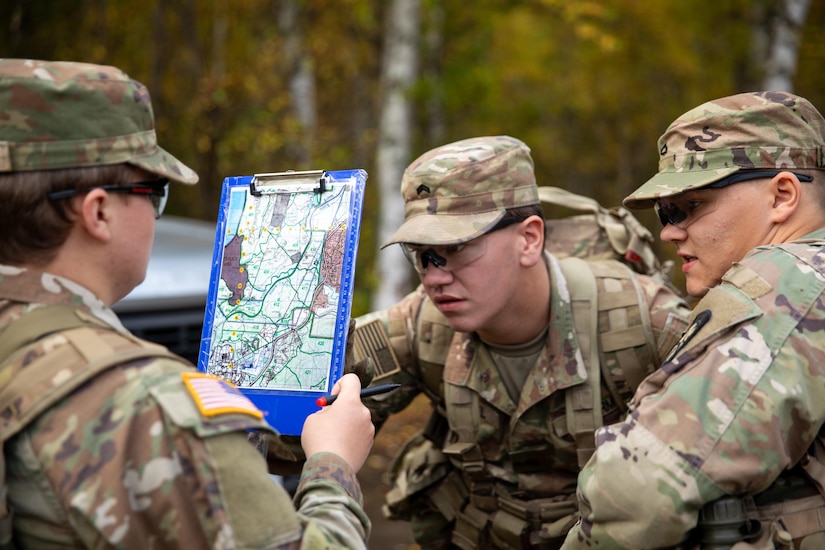
Two soldiers wearing camouflage military uniforms look at the back of a clipboard, while another soldier in similar attire holds it up while looking at a map attached to the clipboard.

The Green to Gold program provides enlisted soldiers with the opportunity to pursue a college degree while preparing to become Army officers. For Gravel, the transition builds on years of exposure to the Army, first in Junior ROTC, then as an enlisted soldier before stepping into the cadet role. 

"When I was in JROTC, I talked to senior and retired officers — lieutenant colonels and majors," he said. "I picked their brains, and it led me toward something I wanted to do." 

Additionally, Gravel said his enlisted experience provides an advantage in ROTC training and defines the type of officer he wants to become.

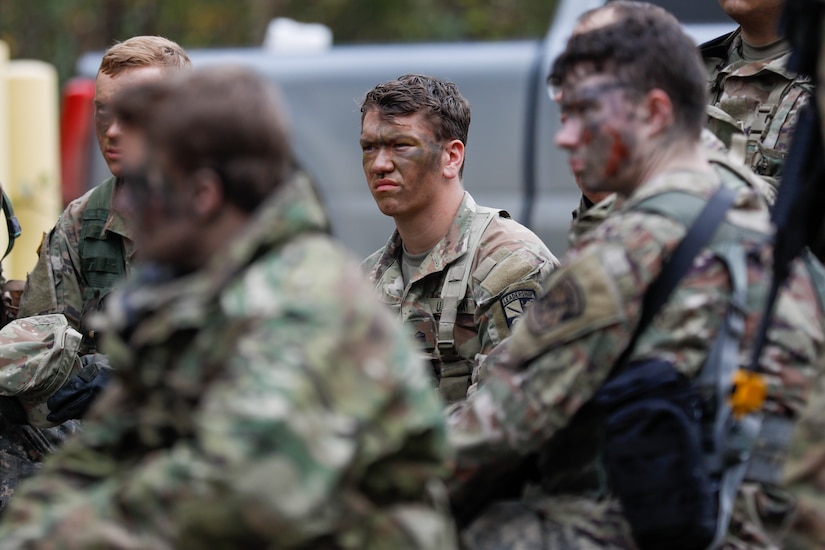
A group of soldiers wearing camouflage military uniforms and face paint, sits and listens to a person not pictured.

"I want to be a humble officer [who] can work together with [noncommissioned officers]," he said. "Overall, officers' knowledge complements NCOs' skills." 

That perspective guided him through the field training exercise as he leaned on lessons learned from the enlisted side of the Army. The exercise reminded Gravel that leadership is about teamwork, not individual achievement.

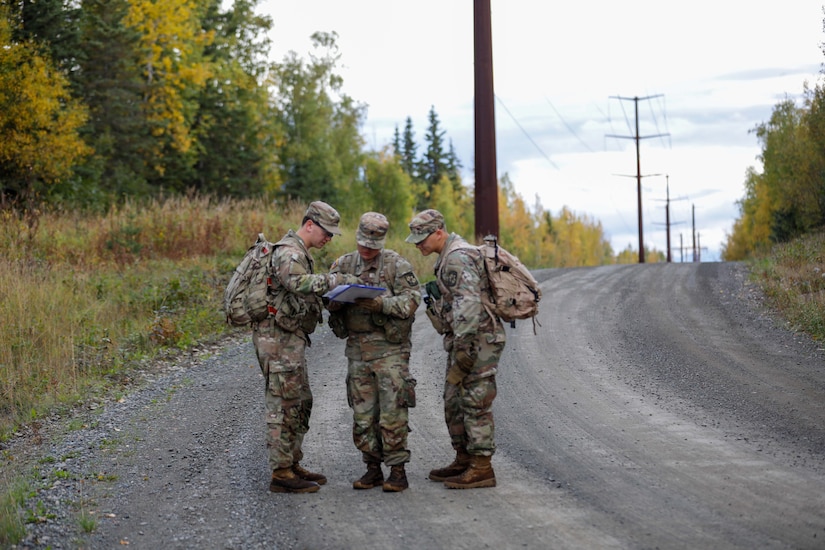
Three soldiers wearing camouflage military uniforms and backpacks stand on the side of a gravel road looking at a map attached to a clipboard.

"No matter how you think — it should end up with one common goal and you're all going to get it done together," he said. 

Gravel credits his peers for building his confidence, even when facing obstacles like the rope climb. 

"By the end of the [exercise], I was way more confident," he said. "Everybody trusted me more than I trusted myself." 

Looking back, Gravel said the experience reinforced both humility and resilience. He encourages other cadets to embrace the challenge. 

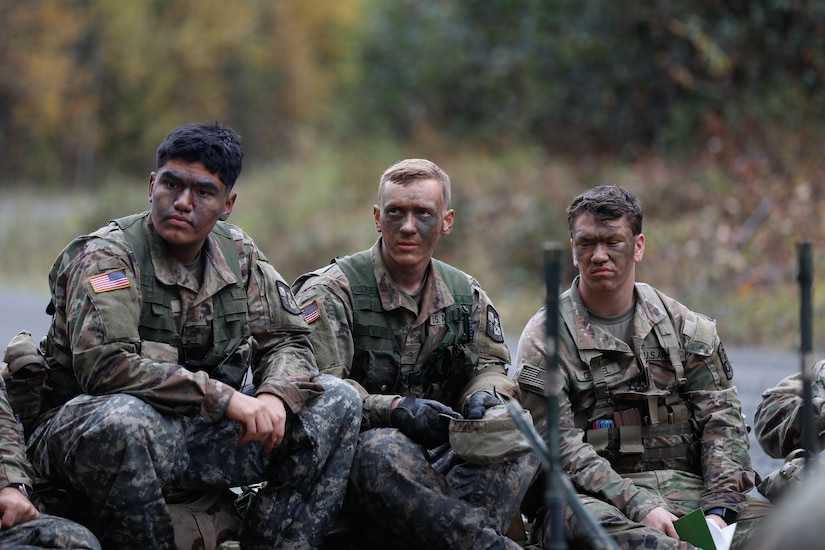
Three soldiers wearing camouflage military uniforms and face paint sit while looking to their left.

"Don't be afraid to embrace the suck," he said. "It might be raining, it might be 120 degrees, but the best thing is that you're doing it with other cadets next to you." 

Ultimately, for Gravel, the Green to Gold program is more than a path to a commission. It is a journey where lessons from enlisted service meet the challenges of officer training, shaping a leader who values trust, teamwork and courage. 

"They are going to rely on me, so I have to believe in myself to achieve the mission," he said. "No matter what, I'll always do what's necessary for both me and my battle buddies to accomplish our mission." 

Monday, October 09, 2023

Goochland Veterans Project

Mrs. Rachel Tate of the Goochland #Veterans Project will present to the Satellite #Rotary Club of #Military Family Support. Goochland Veterans Project connects 11th-grade history students with local veterans to inspire #leadership, civic #engagement, and a lifelong #respect for those who served. https://t.ly/VxQIk

Sunday, June 18, 2023

Bernard W. Robinson: Pioneering the Path to Equality in the US Navy

In a historic milestone for the United States Navy, Bernard W. Robinson made history by becoming the first Black ensign. His achievement shattered racial barriers and paved the way for greater diversity and inclusion within the military.

Born on September 15, 1918, in Washington, D.C., Bernard W. Robinson was no stranger to adversity. Growing up in a time when racial segregation was prevalent, he faced numerous challenges and obstacles. However, his determination, intelligence, and passion for service propelled him forward.

Robinson's journey began when he enrolled in Howard University, a historically Black college. It was during his time at Howard that he found his calling and decided to pursue a career in the military. In 1942, with World War II in full swing, Robinson joined the Naval Reserve Officers Training Corps (NROTC) program at Howard University.

Despite facing systemic racism and prejudice, Robinson excelled academically and demonstrated exceptional leadership qualities. His dedication and hard work did not go unnoticed, and in 1944, he earned his commission as an ensign in the United States Navy.

Robinson's commissioning as an ensign marked a significant moment in history. He broke through racial barriers that had long prevented Black individuals from attaining high-ranking positions within the Navy. Robinson's accomplishment not only symbolized progress but also opened doors for future generations of African Americans in the military.

As an ensign, Robinson faced additional challenges due to racial discrimination. However, he persevered and served with distinction. His dedication to duty and exceptional performance earned him respect among his peers and superiors. Robinson's groundbreaking achievement inspired others and challenged the prevailing prejudices of the time.

Throughout his career, Robinson demonstrated unwavering professionalism and a commitment to excellence. He served in various capacities, including on board USS Darke (APA-159) during the Battle of Okinawa and as the commanding officer of a Naval Reserve training center in Toledo, Ohio.

Robinson's contributions extended beyond his naval service. He actively worked towards promoting equality and social justice throughout his life. After retiring from the Navy in 1964, he continued to advocate for civil rights and equality, focusing on improving opportunities for African Americans in the military and civilian sectors.

Bernard W. Robinson's legacy is one of courage, resilience, and breaking down barriers. His historic achievement as the first Black ensign in the US Navy opened doors for future generations and set a precedent for equality and inclusion in the armed forces. His story serves as a reminder of the progress made in the fight against discrimination and the importance of individuals who pave the way for change.

Friday, October 23, 2015

CMAFS Airman takes on Capitol Hill

by Senior Airman Rose Gudex
21st Space Wing Public Affairs


10/21/2015 - PETERSON AIR FORCE BASE, Colo. -- According to an Airman from Cheyenne Mountain Air Force Station, the underground tunnels and subway system designed specifically for those working on Capitol Hill remind him of the different halls and buildings inside America's Fortress.

Senior Airman Christian Mejia, 721st Security Forces Squadron unit training manager, recently visited Washington D.C. with wing leadership, Col. Doug Schiess, 21st Space Wing commander, and Chief Master Sgt. Idalia Peele, 21st SW command chief, Oct. 7-8.

Mejia was selected because of his dedication to making sure his peers are up to date on training while also exemplifying excellence. He also recently aced the Pre-Ranger Assessment Course in July, finishing first amongst the participants.

Part of the trip included time for Mejia to discuss what he does as a defender and his role in making the mission happen.

"My priority focuses on ensuring all the security forces defenders are up to date on all their weapons and qualifications for duty positions," Mejia said. "Anything they need goes through our section. We have to make sure they're up to date so they can actually defend the base and work their positions."

The mission at Cheyenne Mountain and the North American Aerospace Defense Command is integral to homeland defense, so Mejia also explained how his team ensures the safety of the base and allows the mission to happen on a day-to-day basis.

Since the 21st SW has such a large number of geographically separated units working toward the same mission, both nationally and globally, Mejia, Schiess and Peele met with a variety of congressional representatives and senators from around the country to discuss the mission and several important topics.

A few of those topics included the cost of maintenance on 45-year-old space radars essential to the wing's mission, dual basic allowance for housing of military couples and the continuing resolution putting strains on how effectively the mission is completed.

"It felt good knowing our leadership is pushing for things we need," Mejia said. "It was great seeing both our leaders, Col. Schiess and Chief Peele, expressing different issues we have. ... They make a great team."

With all the people they met and topics discussed, he said the highlight of the jam-packed Capitol Hill visit was meeting the Secretary of the Air Force Deborah Lee James. But he didn't just meet her. He was coined and recognized in her speech at the Congressional Space Power Caucus breakfast for his extensive effort in supporting the mission at Cheyenne Mountain.

In addition to all that excitement, Mejia said the experience of seeing Air Force senior leaders in action was exhilarating. It was very fast paced and he said every minute of down time was spent preparing for the next meeting or event.

After seeing the political, decision making side of the Air Force, Mejia ended his first ever trip to Washington D.C. on a high note with a nighttime tour of a few national monuments before heading back to Colorado.

Taking it all in, the whole experience from political decision making to the underground tunnels at Capitol Hill to a little bit of sight-seeing, Mejia said he couldn't name just one thing that was his favorite part.

The experience gave him insight to part of the Air Force most junior enlisted don't see, which he can take back to his fellow defenders to continue pursuing and fostering excellence.

Thursday, October 01, 2015

Strengthening Our Path: A Call to the Future

by 2nd Lt Veronica Perez
90th Missile Wing Public Affairs


9/29/2015 - F.E. WARREN AIR FORCE BASE, Wyo. -- Sitting in a room filled with over 70 female Airmen is invigorating, inspiring and empowering. The inaugural 20th Air Force Women's Leadership Symposium wrapped up Wednesday, Sept. 16, 2015, at F.E. Warren Air Force Base, Wyoming. The symposium brought female Airmen (ranks E4 through E5 and O1through O3) within 20th Air Force together for professional development through networking and mentorship.

I was surrounded by single mothers who work 12-hour shifts and wives married to military members stationed across the country. I exchanged conversations with daughters of adoption, divorcees, cancer survivors, life-long civil servants, world-record breakers and entrepreneurs. I listened to a doctor's life of service, a pilot's view on leadership and an author dedicated to telling the story of heroes unheard. I learned of their passion to lead, their motivation to help others and their unwavering will to serve in spite of struggle.

During her opening remarks Tuesday, Sept. 15, 2015, the Director of Washington Headquarters Services, Patricia Young, challenged us to spread the ideas discussed here among our peers, our leadership and our Air Force.

"Coming back to the field and meeting truly the future leaders of the Air Force, is incredibly insightful and invigorating. There is so much energy here, and it's exciting for me," Young said. "For this event to be successful, participants have to take what they've learned and share it with others. I really want the participants to challenge themselves and I'm excited for them to have this opportunity."

Throughout the day, speakers discussed their experiences, painting pictures of success, failure and personal growth while we listened in awe of their transparency and genuine honesty.

"I think this event is very enlightening because I learned a lot of perspectives I never really considered," said 2nd Lt. Eunice Park, 90th Missile Wing intelligence officer. "There are people in the Air Force who really care and are really considerate of what we're doing, and I just never realized how we have so many role models, especially for women."

Almost all of the Airmen I spoke with mentioned similar leadership themes discussed by the speakers, such as seizing opportunities, being authentic, gaining trust and continuously trying to be better in everything we do.

"We got to hear a lot of different leadership perspectives, enlisted and officer, so we got to see what they have done in their careers and then take what works for us and build from that," said Staff Sgt. Amanda Buck 341st MW command post team member.

Some topics included balancing family and career, female standards and policies, commander and chief perspectives, the power of vulnerability and the desire to serve.

Chief Master Sgt. Felica Noil, 91st MW command chief master sergeant, entertained us as she shared her journey as a security forces Airmen and the lessons she learned during her 29 and a half years of service.

"Hopefully, at the very end of this journey, I will have helped someone not have to endure what I went through, to help them get through it, and to encourage them to stand up for the right to be an advocate, to be a voice and to make a difference," Noil said. "What I want to challenge you all to know is that everything you endure is not just for you."

There was an undeniable feeling of excitement in the room as we interacted with each other and the seeds of mentorship grew roots.

"It's good having a bunch of different women from different backgrounds coming and sharing their perspective on leadership and women in the Air Force," said Capt Melissa Crenshaw, 341st MW code controller. "It's been good for me having mentors, most are all male, but now that I have other female mentors [and] I'm hoping to share [what I've learned] here."

Col. Kristin Goodwin, 2nd Bomb Wing commander, Barksdale Air Force Base, Louisiana, spoke about leading with a purpose and expressed how we can create change in the future.

"We are Airmen," she said. "And we need to go out there and lead with courage, we need to inspire, we need to set the standard and we need to be proud of our units and our Air Force. This symposium is not just about women, it's about men and women, Airmen being better as a force and collectively moving forward and rising to a higher standard of excellence in everything we do."

Throughout the three days we were encouraged, motivated and challenged to create our own path as leaders in the United States Air Force in order to spread diversity of thought and character.

Major General Jack Weinstein, 20th Air Force and Task Force 214 commander, and Chief Master Sgt. Matthew Wells, 20th Air Force and Task Force 214 command chief master sergeant, addressed these ideas head on.

"What we're hoping for this leadership symposium is that you all remember why you came in, maybe find some other reasons for staying in, grow, broaden, learn and take that back to your units because we need people like you, and we need people who aren't like you to be leaders in our Air Force," said Wells.

Weinstein added, "At any level in the United States Air Force, you can be a leader. Leadership is not dictated by the amount of stripes you have on your sleeve or the metal on your shoulders.. Who you are and what you do for your Airmen is leadership."

Thursday, August 13, 2015

DESRON 7 Changes Command, Reflects on Nearly Three Years as part of 7th Fleet FDNF


By Lt. Lauryn Dempsey, DESRON 7 Public Affairs

SINGAPORE (NNS) -- Destroyer Squadron (DESRON) 7 held a change of command ceremony at Commander, Logistics Group Western Pacific in Singapore, Aug. 12.

Capt. Fred Kacher relinquished command of the DESRON to Capt. H.B. Le in a ceremony presided over by Rear Adm. Charlie Williams, commander, Task Force (CTF) 73.

"Commodore Kacher's leadership and vision, in both the professional and personal development of his Sailors, enabled DESRON 7 to achieve the highest levels of tactical excellence and operational success," said Williams. "The Kacher family has also been an integral part of the U.S. Navy community in Singapore and we wish them only the best in their next assignment."

Kacher arrived at DESRON 7 in October of 2012, first serving as the command's deputy commodore before assuming the role of commodore in July 2014. As deputy, Kacher helped execute DESRON 7's historic shift from San Diego to the Asia-Pacific, where the staff joined U.S. 7th Fleet's forward deployed naval forces in December 2012.

"As I look back on the better part of three years, I can't help thinking of DESRON 7 as the Navy's ultimate version of a Silicon Valley technology start-up," said Kacher. "We arrived in the region with a vision and tasking and a barebones office space, and over the course of the past few years, we've grown tremendously and worked tirelessly to make our mission a reality."

Just like a start-up, DESRON 7's growth was fast. Only three months in the region, the staff was tasked to execute tactical command of the first-ever deployment of a littoral combat ship, USS Freedom (LCS 1), which deployed from San Diego in March 2013.

"While a tough challenge at times, what we learned during Freedom's deployment set USS Fort Worth (LCS 3) up for success," continued Kacher. "In my 25 years in the Navy, I've never seen a more open and inclusive dialogue about what needed to be done better after that deployment. That process, combined with a lot of hard work from many, many stakeholders is a large reason why Fort Worth has hit every milestone and port visit on time, every time, throughout the past nine months of a 16-month long deployment."

One of the highlights of Fort Worth's current deployment was the ship's rapid response to the Indonesian-led search for AirAsia flight #QZ8501 in January 2015. With Fort Worth and the Arleigh Burke-class guided-missile destroyer USS Sampson (DDG 102) on scene in the Java Sea, DESRON 7 assumed tactical command of the mission, leading both ships in their search for the missing plane.

"The AirAsia search was a pivotal moment for DESRON 7," said Kacher. "The mission marked the first time our staff led U.S. Navy assets during a real world event that included a multinational response, showcasing the value of having two DESRONs forward deployed to 7th Fleet. We live and work in Southeast Asia, so the crash took on a personal note for many of us, and we were honored to have played a small role in helping bring closure to the families affected by the tragedy."

Another major line of effort for DESRON 7 since arriving in the Asia-Pacific in late 2012 has been executing Cooperation Afloat Readiness and Training (CARAT) exercises with nine partner nations on behalf of CTF 73. Now in its 21st year, CARAT is the U.S. Navy's premier naval engagement in South and Southeast Asia and includes bilateral exercises with Bangladesh, Brunei, Cambodia, Indonesia, Malaysia, the Philippines, Singapore, Thailand and Timor Leste.

CARAT is in direct support of the Navy's newly released maritime strategy, which stresses the importance of engaging allies and partners, specifically with many of the nations in South and Southeast Asia. DESRON 7 staff spends nearly 150 days of the year working with partner navies planning and executing the nine phases of CARAT, as well as with Vietnam during the annual naval engagement activity event.

"Over the past three years, DESRON 7 has been the familiar face for the partner navies we work with here," continued Kacher. "We've formed close connections with our counterparts, who we've seen year in and year out during planning conferences and exercises. And those close relationships will not only help strengthen the bonds between our countries, but will be invaluable should crises or challenges arise unexpectedly."

Kacher's ability to lead the forward deployed DESRON 7 staff from an idea to a reality did not go unnoticed. In May 2015, Kacher was announced as the 2015 recipient of the U.S. Navy League's John Paul Jones award for inspirational leadership. This past spring also saw a number of awards bestowed upon members of the DESRON 7 staff to include the 2015 Stephen Decatur award for operational competence; the 2015 junior officer recipient of the Captain Joy Bright Hancock leadership award; and the Thompson-Ravitz award presented to the 2014 junior public affairs officer of the year.

With his DESRON 7 chapter now closed, Kacher looks forward to his next chapter serving at U.S. Surface Forces in San Diego.

"I won't forget the DESRON 7 staff and families, both past and present, for their hard work, and incredible leaders like our task force commander, Adm. Charlie Williams, and my predecessor, Capt. Paul Schlise, who served as our first commodore in Southeast Asia. Because of their efforts, DESRON 7 is making an impact in this region on the rise, a region that may very likely define the next century," Kacher closed. "It's been a wonderful tour and I look forward to reading all about DESRON 7 doing 'even more, even better' under Commodore H.B. Le's extraordinary leadership."

Under Le, DESRON 7 will participate in even more exercises throughout U.S. 7th Fleet in 2016.

"I am incredibly fortunate to have served as Fred Kacher's deputy," said Le. "He truly is an inspirational and visionary leader, who has put DESRON 7 on the map and forged stronger relationships in the region. We wish him all the best and know that he's off to do great things for the surface fleet at SURFOR."

Le arrived at DESRON 7 in January 2015 following 17 months in the Pentagon as the junior military assistant to former Secretary of Defense Chuck Hagel. Le is no stranger to U.S. 7th Fleet operations. Previous tours saw Le serve as the commanding officer of USS Lassen (DDG 82) and executive officer of USS Curtis Wilbur (DDG 54)-both forward deployed destroyers, as well as executive assistant to two 7th Fleet commanders.

"With your new role as commodore, you now assume the great privilege and responsibility of leading a very talented squadron of officers and Sailors," Williams told Le during the ceremony. "Your vast experience operating in 7th Fleet and your stellar performance as the deputy commodore will serve you well as you take command today."

In his role as DESRON 7 deputy commodore, Le served as exercise commander during CARAT exercises in the Philippines, Timor Leste and Indonesia. He also was the senior naval officer present during April's Naval Engagement Activity Vietnam and was co-task group commander during the Guardian Sea exercise with the Royal Thai navy.

"Under Commodore Kacher's leadership, we've built a solid foundation in a short period of time in the region, and we look forward to continuing to flex our warfighting skills in future exercises and operations throughout the fleet," said Le.

Le is fresh off having led more than 1,000 U.S. Sailors and Marines during the execution of CARAT Indonesia Aug. 3-10. This year's exercise with the Indonesians was the most complex iteration of CARAT thus far and featured an LCS, DDG, an amphibious dock landing ship with embarked Marines, a P-3C Orion, a rescue and salvage ship with an embarked diving unit, Seabees and Coastal Riverine Group Sailors. The Indonesian navy brought more than 1,000 personnel dispersed across two frigates, one corvette, a dock landing ship with embarked Marines, a type 209 submarine and multiple fixed-wing maritime domain awareness aircraft.

The exercise spanned a wide array of naval warfare areas to include simultaneous amphibious landings and surface and anti-submarine warfare, visit, board, search and seizure (VBSS) demonstrations, mobile diving and salvage training, coastal riverine operations, maritime patrol and reconnaissance operations, a gunnery exercise, and an anti-air warfare missile live fire training exercise.

This year's CARAT with Indonesia also marked the first time a LCS has participated in the Indonesian phase of the 21-year old exercise series. With two LCSs slated to arrive in 2016, and four operating throughout the region later this decade, DESRON 7 has significant room to grow and will continue making operational contributions throughout U.S. 7th Fleet.

"The future is bright at DESRON 7," said Le. "We have a talented team of professionals here - from our most junior Sailor, to our most senior department head - each individual has been given an incredible amount of responsibility in this important region of the world. They're excelling and making a difference, and I am lucky to be part of such a great group of sailors."

Thursday, August 06, 2015

Gunfighter recognized as one of the Air Force's Outstanding Airmen

by Staff Sgt. Roy Lynch III
366th Fighter Wing Public Affairs


8/5/2015 - MOUNTAIN HOME AIR FORCE BASE, Idaho  -- Since its inception in 1956, the 12 Outstanding Airmen of the Year award has recognized superior Airmen for their leadership, job performance, community involvement and personal achievements.

This year Mountain Home Air Force Base has the pleasure of recognizing one of our own Airmen, Staff Sergeant Lindsey Fuentes, 366th Medical Support Squadron biomedical maintenance equipment technician.

Col. David Iverson, 366th Fighter Wing commander, lauded Fuentes' service to the nation.

"Because of the outstanding efforts of men and women like Staff Sgt. Fuentes, the 366th FW is successful at providing combat power to fight and win our Nation's wars," Iverson said.

Raised in Peachland, North Carolina, Fuentes enlisted in September 2008 to serve her country and to complete her education.

Fuentes was shocked when she heard the Air Force selected her as one of the 12 Outstanding Airmen for 2015.

Fuentes humbly remarked it was an award in itself just to be submitted.

"This award is a reflection of my co-workers, leadership, and the whole Medical Group," she said.

Col. Andrew Moore, 366th Medical Group commander, is proud of Fuentes' accomplishments as a Gunfighter.

"NCO's like Staff Sgt. Fuentes are what make the backbone of our Air Force," Moore said. "I couldn't be prouder to serve with her."

One specific accomplishment stuck out in Fuentes' mind--the ability to execute multiple roles in the shop during a time of decreased manning.

"I was constantly looking for ways to improve processes," Fuentes said, "because those [processes] lead to saving time, which proved to be very valuable [in times of reduced manning]."

Not only was Fuentes enhancing her work area, but she was applying her experiences to develop fellow Airmen as well.

"Opportunities such as Airmen Leadership School class leader and my volunteer efforts were challenging," Fuentes said. "But they really pushed me to improve in various facets of my life."

This leadership experience set her above her peers, earning her the John L. Levitow Award. This award is given to the student who displayed all the characteristics of an effective leader and fostered teamwork within the ALS class.

The John L. Levitow was not the only award she received in 2014.  She also earned the 12th Air Force Junior Enlisted Professional of the Year and the Air Combat Command Airman of the Year; and her efforts helped the 366th MG earn the ACC Best Hospital of the Year award.

Fuentes continued setting the example by completing 15 semester hours and obtaining her Bachelor of Science degree in Organizational Management.
She didn't stop there.

Fuentes completed her 7-level upgrade training eight months ahead of schedule while volunteering and leading multiple food drives both on and off base.

Now that she's received one of the Air Force's highest recognitions, is Fuentes' taking a break?  Not even close.

"I would definitely be interested in becoming a professional military education instructor," Fuentes said. "Also, I'm considering commissioning and starting my master's degree in business."

Fuentes is thankful to the many people who have guided her on the path to this honor.

"I couldn't do my job without the great people that I work with every day."

Friday, July 31, 2015

Carter Congratulates New Chairman, Vice Chairman of Joint Chiefs


DoD News, Defense Media Activity

WASHINGTON, July 31, 2015 – Defense Secretary Ash Carter offered his congratulations to Marine Corps Gen. Joseph F. Dunford and Air Force Gen. Paul J. Selva on their respective confirmations as the chairman and vice chairman of the Joint Chiefs of Staff.

“Both have proven their mettle throughout their careers -- from General Dunford's first years as an infantryman to his leadership both in Afghanistan and of the Marine Corps, and from General Selva's early days as a pilot to his leadership of our military's transportation command,” Carter said in a statement released today.

The defense secretary said he looks forward to working closely with the defense leaders in their new roles, adding, “President [Barack] Obama and I -- and our nation's security -- will benefit greatly from their sage counsel and strategic perspective gained over years of operational experience.”

Dunford will become the nation’s 19th chairman of the Joint Chiefs of Staff, succeeding Army Gen. Martin E. Dempsey, and Selva, who will succeed Navy Adm. James A. Winnefeld, will become the 10th vice chairman.

“We will pay full tribute to our current chairman and vice chairman in short order, but today, on behalf of this department and its men and women in uniform, I thank General Dempsey and Admiral Winnefeld for their decades of dedicated service to our country,” Carter said.

“They provided the president and me with sound advice and steadfast leadership, keeping the nation secure and helping make sure our military remains the finest fighting force the world has ever known,” he said. “For that, our nation is ever grateful.”