Showing posts with label coast guard. Show all posts

Wednesday, August 05, 2026

Coast Guard Participates in Panama Canal Counter-Threat Exercise

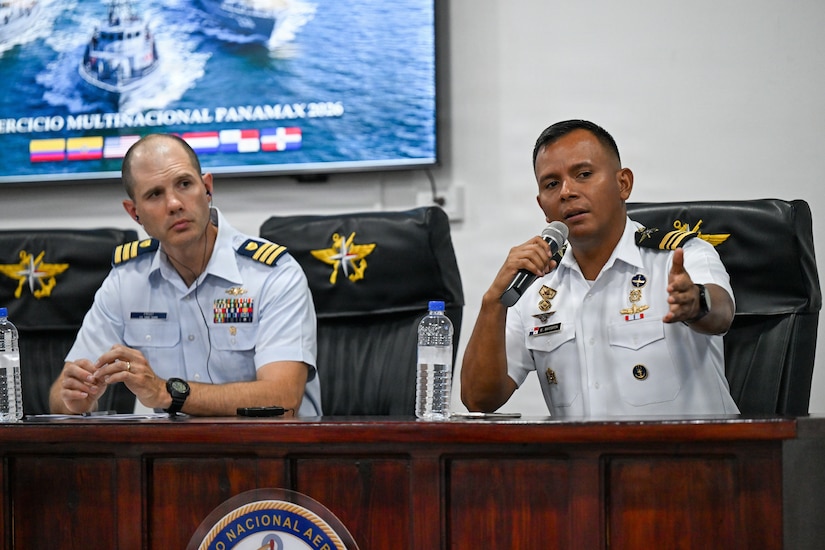
A man in a formal military uniform sits at a table and speaks into a microphone next to a man in similar attire.

Panama's National Aeronaval Service welcomed key leaders from Mexico, Ecuador, Colombia and the United States during the pre-sail conference for Exercise Panamax 2026, Aug. 3.

The biennial exercise is one of the largest military exercises in the Western Hemisphere. This year's iteration will continue until Aug. 13 and includes six maritime vessels operating in the Eastern Pacific region as part of the Pacific Task Force: the U.S. Coast Guard cutter Robert Ward, the Panamanian coastal patrol boat Panquiaco and coastal patrol boat Taboga, the Colombian navy coastal patrol vessel Isla Gorgona, the Ecuadorian navy missile corvette Bae Loja and the Mexican navy offshore patrol vessel Arm Jalisco.

"Major prerequisites to achieving this objective include practicing our ability to transit offshore in company, to communicate effectively to each other and shore command, and to perform complex missions in an integrated manner," said Coast Guard Cmdr. Patrick Frost, Coast Guard Southwest District deputy chief of enforcement.

Frost, who is serving as the Pacific Task Force commander, said Panamax 2026 includes 19 countries and is critical because it allows the partner nations to practice functions necessary to protect the canal.

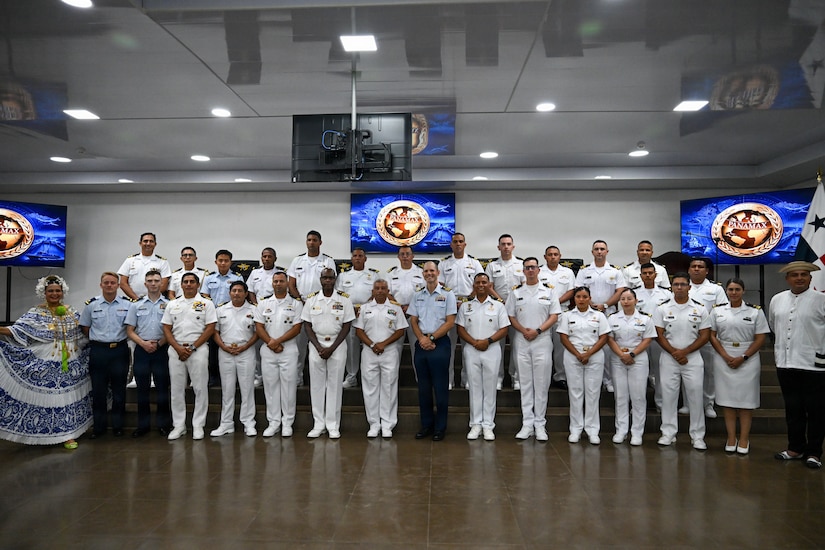
More than a dozen people in various formal military uniforms pose for a group photo in a conference room with monitors on the wall behind them.

To facilitate this proficiency, exercise participants will conduct various training scenarios designed to unite the coalition as they exercise joint communications, maneuvers and tactics.

During the pre-sail conference, Panamanian maritime officials welcomed the command teams of the four visiting ships.

"Today, in this 2026 edition of Panamax, we confirm our commitment to a broader and even more adapted vision of the threats that we have in the 21st century," said Panamanian Lt. Cmdr. Eduardo Batista, acting commander of Panama's National Aeronaval Service's naval command. "This exercise constitutes an opportunity, with great value, to strengthen the interoperability of our forces, to improve our operational procedures and to elevate our capacity to respond in the face of transnational threats and cyberspace challenges."

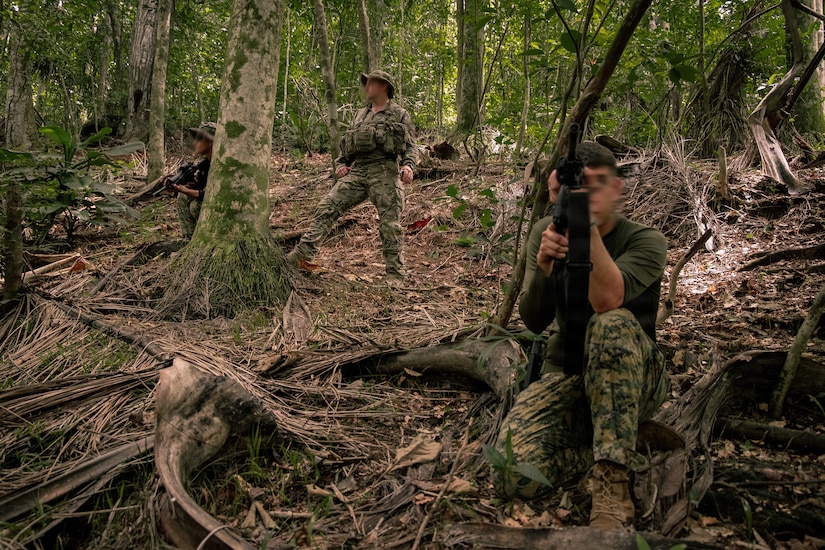
Three men in camouflage military uniforms and holding weapons stand and crouch in a wooded area facing opposite directions.
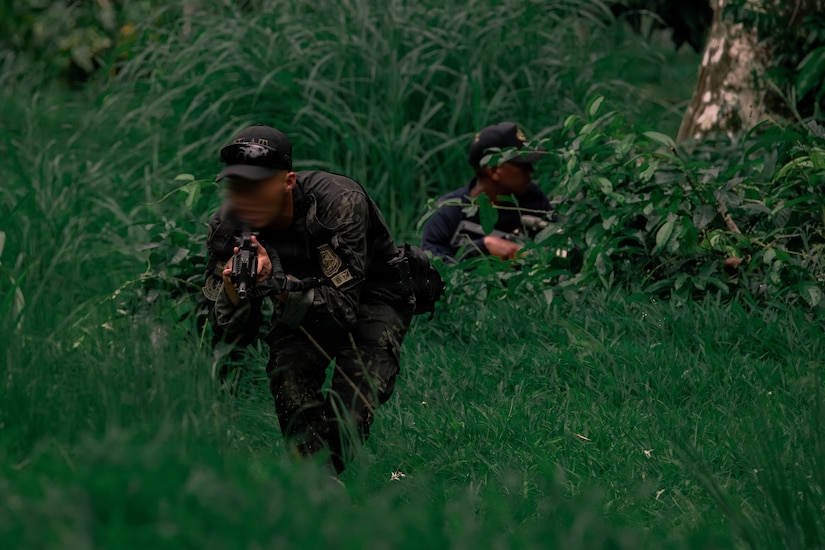
Two people in camouflage military uniforms and holding weapons crouch in a field with tall grass.
Frost highlighted the importance of the regional partners, as they are allies in the fight against cartels across the Western Hemisphere.

"These partner nations are clearly demonstrating a rock-solid commitment to this multinational concept, and the collaboration between the various country representatives is significant," he said.

Panamax began with three countries in 2003 to improve interoperability and strengthen collective capacity to conduct complex multinational and all-domain operations to ensure the free flow of commerce through the Panama Canal and maintain security and stability in the region.

Sunday, July 05, 2026

Guardians of the Deep: An Inside Look at the Elite Submarine Protection Coast Guard Unit

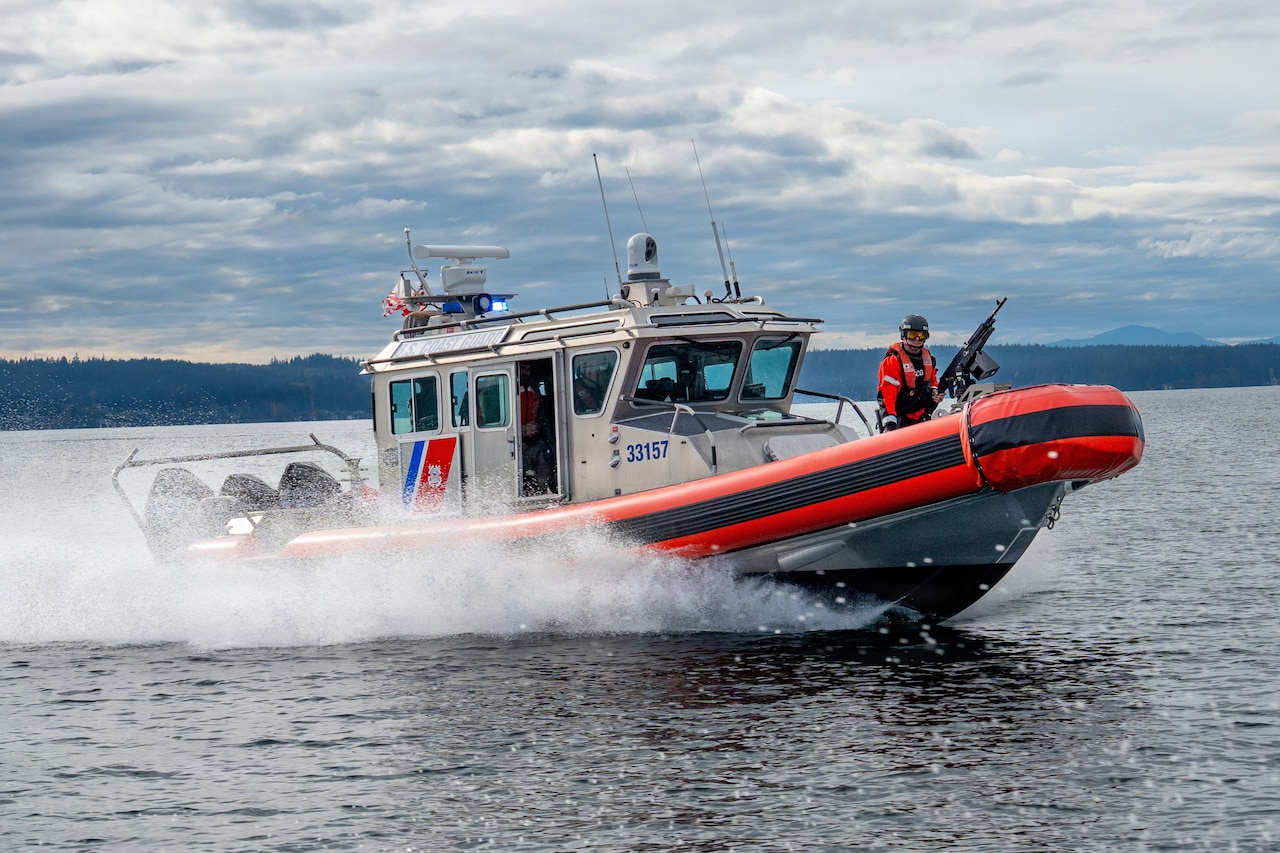
A coast guardsman wearing an orange jacket and helmet mans a machine gun on a gray boat with orange gunwhales cruises in the water on a cloudy day.

The Olympic Peninsula is home to one of the most unique ecosystems in the world, known for its extreme elevation changes — the landscape spans a portion of the Washington coastline to the snow-capped Olympic Mountains. 

It is home to the largest temperate rainforest in the continental U.S. and features species of wildlife and plants found nowhere else on Earth because of the region's geographic isolation. Continue north to where towering pine trees give way to the rocky coastline of the Salish Sea and one can even find a Coast Guard station that serves as an operational hub for the Maritime Force Protection Unit Bangor.

Established in 2007, the MFPU is a specialized single-mission unit dedicated to providing strategic in-transit security escorts for Navy ballistic missile submarines as they transit U.S. territorial waterways until they slip silently beneath the waves.

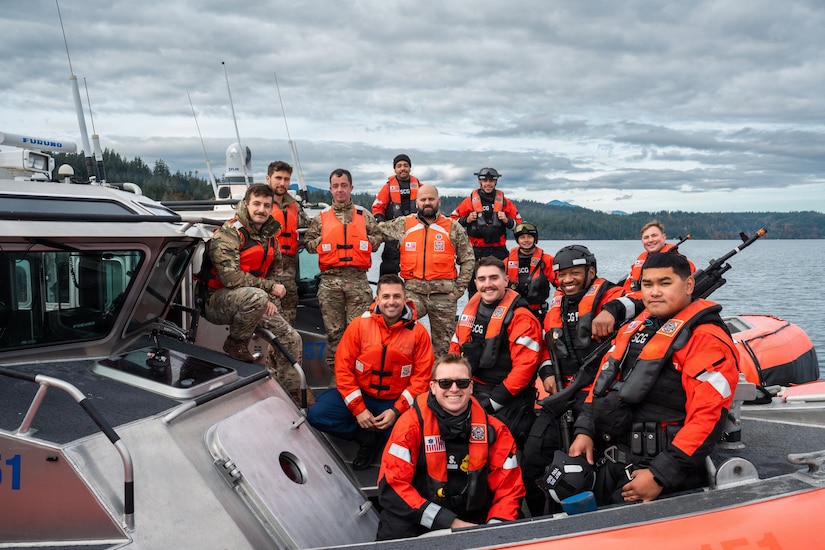
Thirteen men wearing military uniforms and life jackets pose for a photo while standing on two boats floating in the water; there are mountains in the background.

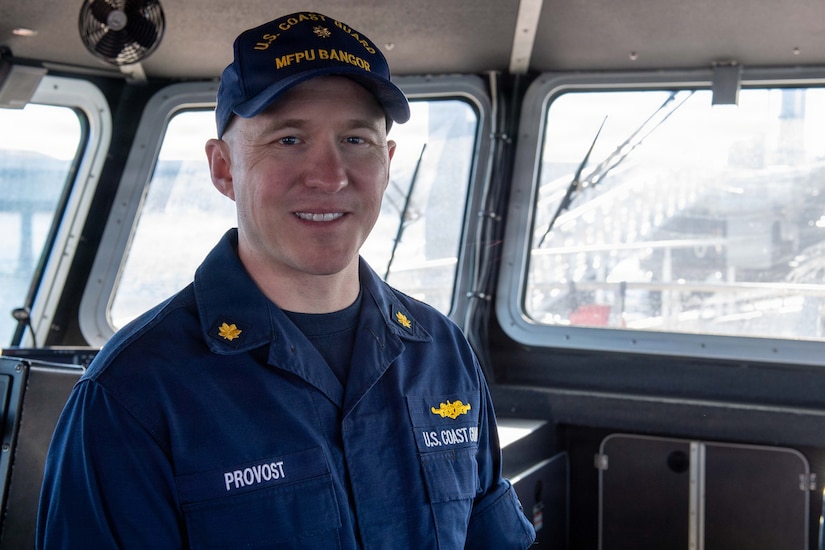
There are only two MFPUs in the U.S. — one at Naval Base Kitsap-Bangor, Washington, and the other at Naval Submarine Base Kings Bay in Georgia — to coincide with the two bases that support the Navy's fleet of ballistic missile submarines. For Coast Guard Lt. Cmdr. James Provost, operations officer and lead patrol commander of MFPU Bangor, mission success begins the day before an escort event with a rigorous review of potential risk and threat factors.

"I'm looking at the weather, looking at civilian traffic going to and from the major ports in the area like Vancouver, [Canada], Seattle, and Tacoma, [Washington]," he said.

A coast guardsman in a blue uniform smiles inside a vessel.

For Provost, it was the MFPU's unique mission and prospect of working closely with the Navy that drew him to his current role.

"The joint work with the Navy feels like a very important mission. It's gratifying when you have a busy day, you're working really hard to maintain the integrity of the security zone and clear a safe path for the submarine," he said. "For us, boring days are good days. We don't want exciting days."

When asked what the most difficult aspect of the job is from an operations perspective, Provost likens the mission to a chess match. The unit is responsible for ensuring submarines receive the best possible escort from homeport to dive point, or from dive point to homeport.


Comprising the pieces of the "chess board," the MFPU has small boats, ships and a mix of personnel to support the ceaseless operational tempo of Commander, Submarine Group 9's fleet of submarines.

The MFPU remains at the cutting edge of security operations because of its high standards and rigorous training. Their impeccable record of mission success is a testament to their expertise and something this unit of elite operators is extremely proud of.

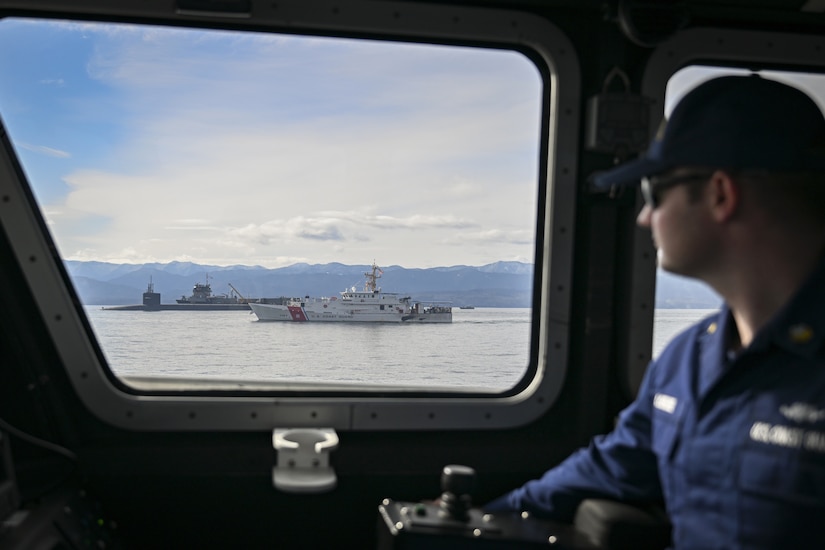
"Nothing can beat watching from the bridge when you have the full escort in place with blocking vessels, multiple screening vessels, all working in coordination with one another. Seeing the team executing the mission to keep the public away and screening all the recreational and fishing vessels is just very impressive," Provost said.

A man wearing a military uniform looks out the window of a boat at two other ships and a submarine sailing in the water with mountains in the background.

One thing that sets the MFPU apart from other Coast Guard units is the tremendous amount of responsibility granted to its members. While other Coast Guard units have to request permission from senior command elements to employ weapons, this isn't the case for the MFPU, where the ability to respond rapidly to a potential threat is critical to national security.

"Our [small-boat operators], a [petty officer third class], have weapons release authority," Provost said. "If they've demonstrated the proper judgment and maturity necessary, our commanding officer has designated weapons release authority down to them, which is very serious. To see a junior person like that succeed and grow into a seasoned tactical [operator] is incredibly satisfying."

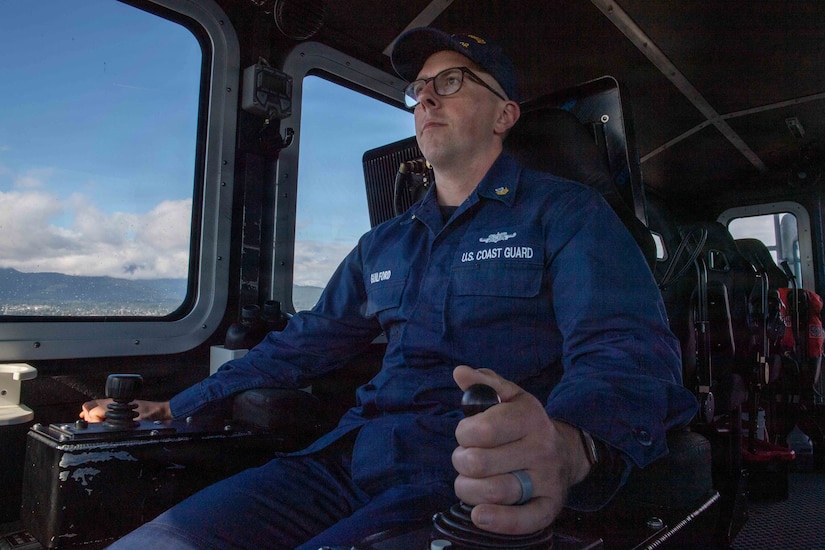
One of those service members is Coast Guard Petty Officer 1st Class Jacob Guilford, whose diverse career spans search and rescue operations in Galveston, Texas, drug interdiction operations in Charleston, South Carolina, and small-boat operations on Maryland's Eastern Shore.

A coast guardsman in a blue uniform sits at the controls of a boat.

For Guilford, the MFPU was an opportunity to further diversify his career.

"I had done pursuit at a couple of units, which are like offensive operations," Guilford said. "But I had never done tactics before, which is more defensive and the primary mission here."

Like Provost, the unit's joint aspect drew Guilford to the Pacific Northwest. Significantly, this tour was the first time Guilford worked closely with the Navy, and the first time he had ever seen a submarine.

"You hear about nuclear subs, and you see it in the movies, but seeing it in person and seeing the size of it and just knowing their capability — you could feel the importance of our mission," Guilford said. "Being up close to it added a weight to what we're doing. We're protecting them so that they can maintain stability in the world."

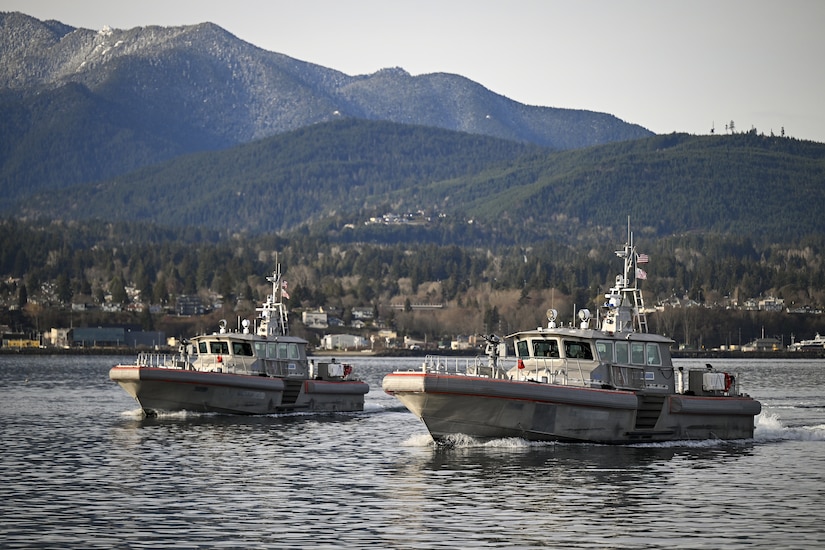
Two military boats sail in the water with houses and mountains in the background.

Because of the Coast Guard's unique authorities that do not exist anywhere else inside the U.S. armed forces, it was an ideal partner to provide the Navy with strategic domestic waterway security. Today, MFPU members work hand in hand with their Navy counterparts to ensure seamless integration between the partner sea services. 

That integration begins with daily communication with representatives from the submarine group, Submarine Squadron 17 and Submarine Readiness Squadron 31, regarding ship schedules, future events, logistics and intelligence sharing.

Additionally, MFPU boat crews fine-tune their skills at the Trident Training Facility Bangor and Kings Bay — state-of-the-art hubs that traditionally allow submariners to build proficiency and where every patrol commander, boat crew and gunner can train for a wide variety of scenarios that test judgment, reaction time and management of multiple threats.

This level of training is how the Coast Guard ensures personnel assigned to the force protection units are prepared to deter threats during submarine transit. The unique capabilities of the MFPU bolsters Navy and Coast Guard joint objectives for robust security of strategic assets.

The partnership between the unit and Bangor's submarine crews goes beyond the training facility. A deep appreciation for each other's roles is embedded in their culture, along with the understanding that synergy between the two is emblematic of joint force integration.

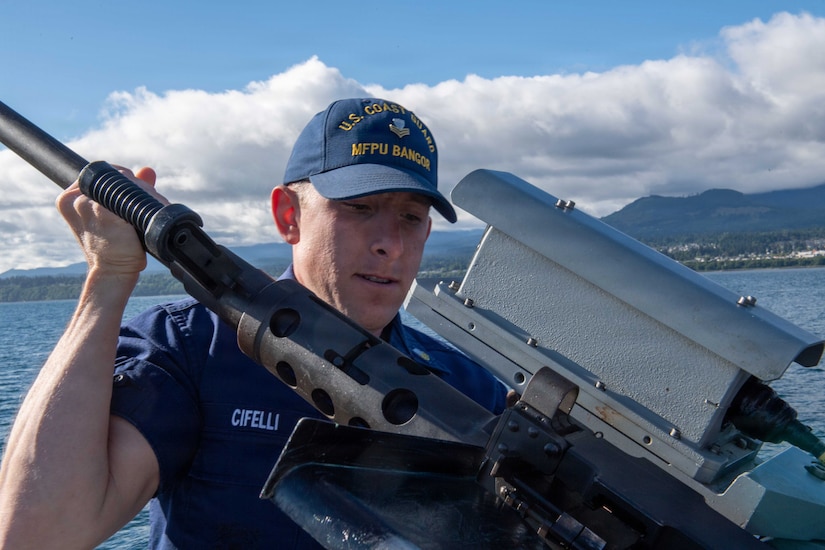
For Coast Guard Petty Officer 1st Class Nicholas Cifelli, MPFU Bangor unit member, seeing the inside of a submarine was an eye-opening experience. 

A man wearing a military uniform checks a large machine gun while on a boat in the water.

"It was amazing to go from seeing how large and looming the [submarine] is from the perspective we have during an escort, [to] then seeing the size of accommodations for the crew," he said. "To hear how many personnel work on those subs compared to the size of the galley is impressive."

As a weapons division lead petty officer, Cifelli is an expert in employing the unit's weapons systems to prevent a potential threat from entering the security zone.

For him, his experience at the MFPU has been an opportunity to develop his leadership skills. The large number of service members he leads is another example of the authority and responsibility granted to unit members.

Additionally, the MFPU mission has given Cifelli the chance to experience a wide variety of weapons systems within his rating, from small arms to the .50-caliber machine gun and even new systems designed to counter emerging threats.

Regardless of how future threats evolve, the MFPU will remain ready to protect the nation's "boomers" on their way to the deep.

And for Provost, another "boring" day is reward enough to keep him going, though a little recognition doesn't hurt.

"A few weeks ago, we got a chance to talk to a [commanding officer] of we had just escorted and he was like, 'You guys are awesome. The way your [escort vessels] came out and took position perfectly and intercepted two targets of interest — that was so cool.' Knowing we're seen and appreciated — that just feels good," he said.

Tuesday, December 02, 2025

Coast Guard Heavy Icebreaker Departs Seattle for Antarctic Deployment

The Coast Guard cutter Polar Star departed Seattle, Nov. 27, commencing its 29th deployment to Antarctica in support of Operation Deep Freeze.

The operation is an annual joint military mission to resupply the U.S. Antarctic stations in support of the National Science Foundation, the lead agency for the U.S. Antarctic Program. Historic investment in the "One Big Beautiful Bill" of nearly $25 billion includes $9 billion specifically for icebreakers and infrastructure in the Arctic and Antarctic. This massive investment in icebreakers will secure U.S. access, security and leadership in the polar regions.  

As the Coast Guard prepares to revitalize its icebreaking fleet, the Polar Star remains the only U.S. vessel capable of breaking a navigable channel through the ice to reach McMurdo Station, the largest Antarctic station and the logistics hub of the U.S. Antarctic Program.  

Each year, the cutter serves a vital role in ensuring surface access for fuel and supply ships through the Ross Sea to resupply U.S. Antarctic bases. The Polar Star's mission directly protects the security, freedom and prosperity for the U.S., our allies and partners.

"[The] Polar Star's crew does remarkable work maintaining and operating this ship," said Coast Guard Capt. Jeff Rasnake, commanding officer of the ship. "Each year brings unique challenges, and I'm proud to say this crew has risen to meet them all. The way we've come together over the course of maintenance, and our logistical preparations is exciting as we enter the operational phase of our annual deployment cycle."

Commissioned in 1976, the Polar Star is 399 feet long and weighs 13,500 tons with a 34-foot draft. Despite reaching nearly 50 years of age, it remains the world's most powerful nonnuclear icebreaker with the ability to produce up to 75,000 shaft horsepower.

The continuous effort the crew commits to maintaining the aging cutter ensures the nation's access to the continent and the economic, environmental and national security interests in the polar regions. The Polar Star will continue to support Operation Deep Freeze until new polar and Arctic security cutters enter service in the coming decade.

Since 1955, members of the Coast Guard, Air Force, Navy and Army have proudly supported the U.S. Antarctic Program by providing supplies to McMurdo Station. 

Friday, September 26, 2025

Maritime Medical Response: 129th Rescue Wing Stabilizes Mariner 700 Nautical Miles Offshore

Sept. 25, 2025 | By Air Force Master Sgt. Joseph Prouse, 129th Rescue Wing

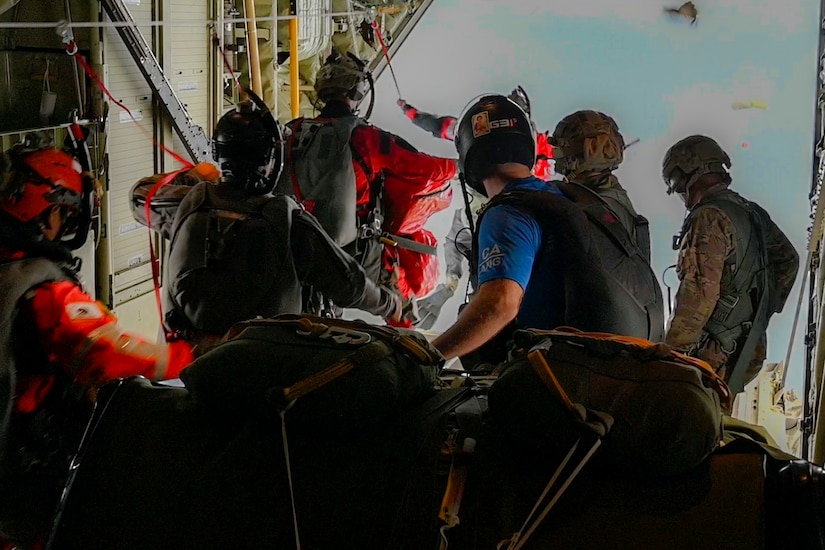
A Guardian Angel pararescue team assigned to the 129th Rescue Wing, California Air National Guard, stabilized a Filipino mariner aboard the Panamanian-flagged cargo ship Grand Vega after reports of stroke-like symptoms during a two-day search and rescue operation approximately 700 nautical miles off the California coast. 

Four people stand at the door of an open aircraft and prepare to jump.

U.S. Coast Guard District 11 relayed the alert in coordination with the Air Force Rescue Coordination Center. The Grand Vega was crewed primarily by Filipino mariners. 

The wing launched an HC-130J Combat King II on Sept. 18, carrying five Guardian Angel team members — pararescuemen and a combat rescue officer — to plan for various sea state contingencies and ensure the team could access the ship upon arrival. Pre-mission planning emphasized multiple insertion options for varying sea states to ensure patient care would not be delayed by conditions. 

Four pararescuemen conducted a maritime parachute insertion with a boat package, accessed the vessel, and moved below deck to assess and stabilize the patient for transfer. A follow-on recovery package launched from Moffett Air National Guard Base the next morning. The package included one HH-60G Pave Hawk and one HH-60W Jolly Green II, while an additional HC-130J provided command-and-control and air-to-air refueling support. 

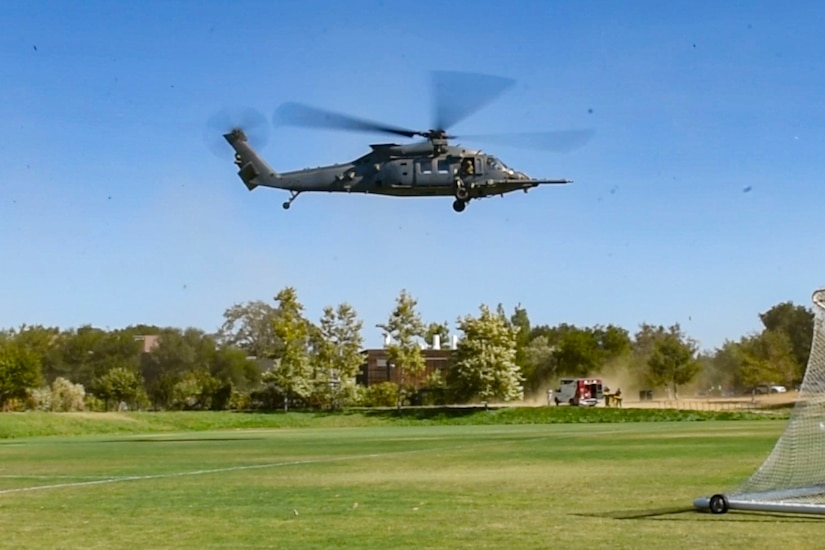
A helicopter hovers in a blue sky over a grassy field with trees in the background and a soccer goal in the foreground.

"This mission demonstrates disciplined planning, swift insertion and expert patient care at an extreme distance," said Air Force Maj. Coda Brown, 129th Operations Group. "Our Guardian Angel teams, rotary-wing crews and HC-130J aircrews integrate seamlessly with the U.S. Coast Guard to save lives when both minutes and miles matter."  

Brown noted that interagency cooperation is critical to maritime safety and security in the Pacific region. 

The patient was hoisted to a helicopter and transported to Stanford Hospital, where local paramedics were staged at the landing zone to complete the handoff for a higher level of care. Officials said the rapid transfer is expected to improve the patient's outcome. 

"I am incredibly grateful to be part of this mission, but most importantly, I am happy the patient received the care he needed, and all members returned home safely," said a pararescueman with the 131st Rescue Squadron. 

Unit officials said the operation is recorded as the wing's first life saved with the HH-60W and possibly the final life saved with the HH-60G, marking a conversion milestone for the 129th Rescue Wing. Unit leaders said this achievement underscores the wing's ongoing commitment to modernizing its fleet and maintaining high operational readiness, adding that the response reinforces the 129th Rescue Wing's enduring ties with key partner nations and allies, including the Philippines, and demonstrates the unit's commitment to saving lives. The mission's strategic effects build Pacific proficiency and validate the wing's vital role in the region. 

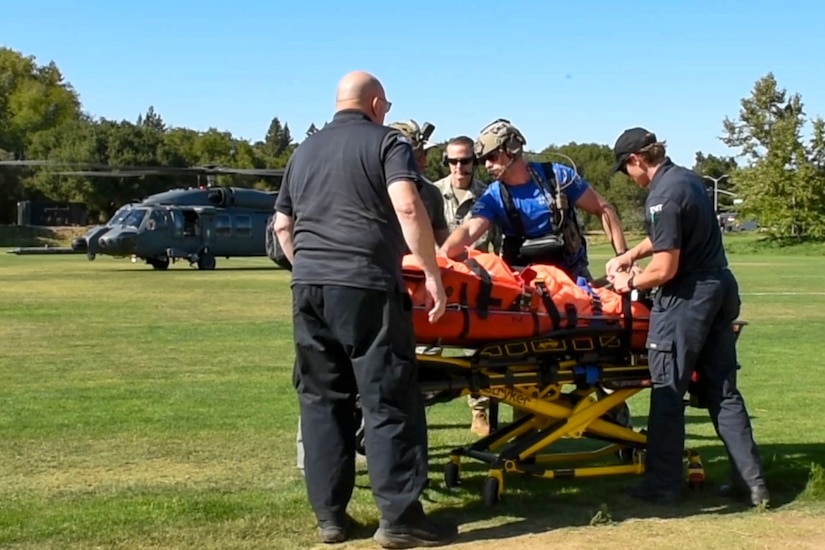
Five people secure a person to a medical transport stretcher in a grassy field with a helicopter behind them.

Behind the scenes, maintainers, weather and intelligence professionals, aircrew flight equipment specialists, logistics personnel, communications experts, command post staff and medical specialists enabled the response. 

The 129th Rescue Wing provides worldwide combat search and rescue, as well as civil search and rescue capabilities. The wing operates HH-60G/HH-60W helicopters, HC-130J aircraft and Guardian Angel teams in support of joint and interagency partners, including the Coast Guard. 

The mission marks the wing's 1,169th life saved.


Tuesday, July 01, 2025

Guardians of the Coast: Inside U.S. Coast Guard Operations

For more than two centuries, the United States Coast Guard has stood watch over America’s maritime interests, combining military readiness, law enforcement, search and rescue, and environmental protection into one unique and vital mission set. With over 95,000 miles of U.S. coastline and vast stretches of open water under their watch, Coast Guard personnel operate around the clock to safeguard lives, protect natural resources, and secure the nation’s maritime borders.

A Dual Mission: Military and Civilian Roles

Unlike other military branches, the Coast Guard operates under the Department of Homeland Security in peacetime but can be transferred to the Department of the Navy during wartime. This flexibility allows the Coast Guard to seamlessly balance both civilian and military responsibilities.

Their primary missions include:

  • Search and Rescue (SAR): Perhaps the most well-known mission, Coast Guard crews respond to thousands of distress calls every year, rescuing mariners from treacherous conditions, stranded vessels, and life-threatening situations.

  • Maritime Law Enforcement: From combating drug smuggling and illegal fishing to enforcing maritime laws, the Coast Guard patrols U.S. waters to ensure safety and compliance.

  • Port and Coastal Security: The Coast Guard plays a critical role in securing the nation's ports and waterways, preventing terrorist attacks, and safeguarding critical infrastructure.

  • Environmental Protection: Coast Guard units respond to oil spills, pollution incidents, and other environmental hazards, working to preserve fragile marine ecosystems.

  • Icebreaking and Arctic Operations: With growing interest in Arctic resources and shipping lanes, the Coast Guard’s fleet of icebreakers maintains year-round access to polar regions.

  • Aids to Navigation (ATON): The Coast Guard maintains over 50,000 navigational aids, including buoys and beacons, ensuring safe passage for commercial and recreational vessels.

Tools of the Trade: Coast Guard Assets

The Coast Guard operates a wide range of vessels and aircraft to support its diverse missions, including:

  • Cutters: Large ships capable of operating in open ocean and coastal environments.

  • Fast Response Cutters (FRCs): Highly maneuverable vessels used for law enforcement and SAR operations.

  • Response Boats: Smaller, agile boats ideal for rapid response close to shore.

  • Helicopters: Aircraft like the MH-60 Jayhawk and MH-65 Dolphin conduct SAR, surveillance, and interdiction missions.

  • Fixed-Wing Aircraft: Planes such as the HC-130 Hercules provide long-range surveillance and transport capabilities.

Everyday Heroes on the Water

From the icy waters off Alaska to hurricane-stricken coasts in the Gulf of Mexico, Coast Guard crews risk their lives daily to protect others. Their motto, "Semper Paratus"—Always Ready, reflects a culture of constant vigilance, rigorous training, and unwavering commitment.

Recent operations include:

  • Interdicting narcotics shipments in the Eastern Pacific.

  • Rescuing mariners from storms off the Atlantic coast.

  • Coordinating disaster response after hurricanes and floods.

  • Breaking ice to keep Arctic shipping lanes open.

Conclusion: The Quiet Force that Never Sleeps

While their actions often unfold far from public view, the men and women of the U.S. Coast Guard play a critical role in national security, public safety, and environmental protection. Whether braving stormy seas, patrolling for threats, or lending a hand to those in peril, the Coast Guard remains an indispensable guardian of America's maritime frontiers.

Friday, June 23, 2023

Semper Paratus: The Melody of Courage and Resilience in the U.S. Coast Guard

Music has always played a powerful role in unifying and uplifting the spirits of those who serve in the armed forces. In the United States Coast Guard, one particular song holds a special place as an anthem of strength and readiness: "Semper Paratus." This article delves into the captivating history of the Coast Guard's cherished song, exploring its origins, significance, and enduring impact on the men and women who safeguard our nation's shores.

The Birth of "Semper Paratus": 

In 1927, Captain Francis Saltus Van Boskerck, a former Coast Guard band director, penned the lyrics to "Semper Paratus" as a stirring tribute to the Coast Guard's commitment to duty. The Latin phrase, meaning "Always Ready," became the motto of the Coast Guard, embodying the organization's unwavering preparedness to safeguard the nation's maritime interests. Van Boskerck's lyrics captured the spirit of resilience, camaraderie, and valor that define the Coast Guard's ethos.

Musical Composition and Adoption: 

Van Boskerck collaborated with Lieutenant Charles A. Zimmerman, the Coast Guard Band's conductor, to compose the music for "Semper Paratus." The song's captivating melody, with its bold brass fanfare and rousing chorus, echoed the determination and courage displayed by Coast Guard personnel in the face of adversity. The Coast Guard officially adopted "Semper Paratus" as its official song in 1943, cementing its place as a cherished emblem of service and dedication.

Symbolism and Significance: 

"Semper Paratus" resonates with Coast Guard members and supporters alike, encapsulating the core values of honor, integrity, and preparedness. The song's lyrics depict the Coast Guard's readiness to face any challenge, whether it be rescuing those in peril at sea, safeguarding maritime borders, or preserving marine ecosystems. "Semper Paratus" serves as a rallying cry, reminding Coast Guardsmen of their crucial role as the nation's maritime guardians.

Honoring Tradition and Service: 

Throughout its history, "Semper Paratus" has been performed at Coast Guard ceremonies, graduations, and official events. It stands as a symbol of pride and unity for Coast Guard members and veterans, representing their dedication to protecting lives and ensuring maritime safety. The song's lyrics evoke a sense of purpose and inspire those who serve to carry out their duties with honor and resolve.

Popular Culture and Recognition: 

"Semper Paratus" has transcended the realm of military tradition to become a recognizable tune in popular culture. It has been featured in films, documentaries, and television shows, further spreading awareness of the Coast Guard's vital role. The song's enduring popularity and enduring presence serve as a testament to the Coast Guard's impact and the public's appreciation for their selfless service.

Conclusion: 

"Semper Paratus" stands as a melodious tribute to the U.S. Coast Guard's unwavering dedication and readiness to protect and serve. From its origins as a heartfelt anthem penned by Captain Francis Saltus Van Boskerck to its adoption as the Coast Guard's official song, "Semper Paratus" has become a cherished emblem of courage, resilience, and unity. It continues to inspire Coast Guard members and civilians alike, serving as a reminder of the sacrifices made in the name of maritime safety and security.

Saturday, June 17, 2023

Coast Guard Cutters: Safeguarding the Seas

The United States Coast Guard operates a diverse fleet of cutters that are purpose-built to carry out a wide range of missions. Among the various classes of cutters, several stand out for their unique capabilities and contributions to the Coast Guard's mission. In this article, we will explore some of these classes, including the Sentinel-class Fast Response Cutter (FRC), Famous-class cutter, Reliance-class cutter, Healy-class polar icebreaker, Legend-class cutter, Alamosa-class cutter, Treasury-class cutter, Casco-class cutter, and Edsall-class cutter.

The Sentinel-class Fast Response Cutter (FRC) class is a recent addition to the Coast Guard fleet, designed to replace the aging Island-class cutters. These highly capable and versatile vessels are agile, fast, and equipped with advanced technology for conducting a wide range of missions, including search and rescue, law enforcement, port security, and environmental protection. The FRCs are known for their speed, endurance, and enhanced seakeeping abilities, enabling them to operate effectively in various conditions. These cutters play a vital role in coastal operations and contribute significantly to the Coast Guard's maritime security efforts.

The Famous-class (378-foot) cutters have a long-standing history within the Coast Guard. These high endurance cutters were originally built for the U.S. Navy during World War II and later transferred to the Coast Guard. They have proven their capabilities over the years and continue to serve as workhorses of the fleet. Famous-class cutters are known for their extensive range, endurance, and versatile mission capabilities. These cutters have been involved in a wide range of operations, including law enforcement, search and rescue, and drug interdiction efforts.

The Reliance-class (210-foot) cutters are medium endurance cutters that have served the Coast Guard for several decades. These cutters are known for their reliability, versatility, and adaptability to a variety of missions. They have been deployed for law enforcement operations, search and rescue missions, fisheries enforcement, and homeland security tasks. The Reliance-class cutters have proven their effectiveness in performing a wide range of missions in both domestic and international waters.

The Coast Guard's polar operations are supported by the Healy-class polar icebreakers. These powerful vessels are specifically designed to operate in the challenging Arctic and Antarctic regions. With their reinforced hulls and advanced icebreaking capabilities, the Healy-class cutters enable access to ice-covered waters, support scientific research expeditions, and provide vital logistical assistance in remote polar regions.

The Legend-class cutters are the newest and most advanced multi-mission cutters in the Coast Guard fleet. These cutters are highly capable and equipped with state-of-the-art technology and systems. They have enhanced surveillance capabilities, improved communications systems, and increased operational range. The Legend-class cutters are designed for a wide range of missions, including maritime homeland security, law enforcement, search and rescue, and environmental protection.

Other notable classes of Coast Guard cutters include the Alamosa-class, Treasury-class, Casco-class, and Edsall-class. Each of these classes has played a significant role in the Coast Guard's history and has contributed to the protection of maritime interests and the safety of mariners.

In conclusion, the Coast Guard's diverse fleet of cutters includes various classes, each with its unique capabilities and contributions. From the Sentinel-class Fast Response Cutters and Famous-class cutters to the Reliance-class cutters, Healy-class polar icebreakers, Legend-class cutters, and others, these vessels demonstrate the Coast Guard's commitment to maintaining maritime security, conducting search and rescue operations, enforcing maritime laws, and protecting the nation's interests at sea. The dedication and bravery of the men and women serving aboard these cutters ensure that the Coast Guard is always ready to safeguard the seas.

Sunday, August 12, 2012

Association of Naval Services Officers' Convention Welcomes CNO

By Mass Communication Specialist 2nd Class (SW/AW) Byron C. Linder, Navy Public Affairs Support Element West San Diego

SAN DIEGO (NNS) -- Chief of Naval Operations (CNO) Adm. Jonathan Greenert addressed attendees of the Association of Naval Services Officers' (ANSO) 32nd annual convention at a luncheon, Aug. 9.

ANSO fosters the growth, advancement and recognition of Hispanic officer and enlisted personnel in the uniformed naval services, encompassing the Navy, Marine Corps and Coast Guard. Their annual convention focuses on leadership, professional development and training through a series of workshops.

Greenert took the stage and reflected on the history of Hispanic contributions to the naval services, noting former Secretary of the Navy and ANSO founder Edward Hidalgo and Adm. David Farragut, the first Hispanic admiral in the U.S. Navy.

"I need some ideas to be better in our ability to recruit and retain Hispanic officers and enlisted leaders," he said. "We need to continue to nurture and bring this along, and ANSO is a very good source for that. It's a very good institution."

Greenert emphasized the importance of diversity in the naval services, citing teamwork between the services as a key element to successfully accomplishing the nation's tasking.

"When all of us are out there as a team, that's when we're most effective. We need the imagination of a diverse force. It's a military necessity and a business necessity," he said. "The best are out there. It's about mining that wide range of people. It's not about quotas. A diverse team will always perform better than a group of similar thinkers from the same background."

Greenert proceeded to take questions on a variety of topics, ranging from perform to serve (PTS) to educational opportunities. ANSO president, retired Rear Adm. Will Rodriguez, presented Greenert with a package of ANSO coasters to bring the luncheon to conclusion.

Rodriguez noted the ANSO convention provided many unique opportunities for the attendees.

"The CNO understands what we need to do. He's dedicated to what we do and to the Sailors. We can't fight without the people, and that's his number one focus," said Rodriguez. "If you come to ANSO, you're going to get access to these key leaders and commercial leaders that can help you transition. You're going to get things like one-on-one flag mentoring that you wouldn't be able to otherwise."

The ANSO convention will conclude Aug. 10.

Tuesday, July 17, 2012

USS Nicholas Brings Home 4 Tons of Drugs from Operation Martillo


From U.S. Naval Forces Southern Command and U.S. 4th Fleet Public Affairs

MAYPORT, Fla. (NNS) -- Oliver Hazard Perry-class guided missile frigate USS Nicholas (FFG 47) delivered more than four tons of cocaine and marijuana to Naval Station Mayport, Fla., seized from drug interdictions conducted in support of Operation Martillo, July 17.

Crew members offloaded approximately 3,408 kilograms (7,500 pounds) of cocaine, and 109 kilograms (239 pounds) of marijuana, with an estimated wholesale value of more than $93 million. The amount of cocaine seized was enough for 7.2 million doses, each dose approximately the same size as a sugar packet.

USS Nicholas is returning to port after a 175-day deployment supporting counter illicit trafficking operations aimed at disrupting transnational organized crime and keeping drugs off the streets.

"With the help of some partners in the region we accomplished what we set out to do; disrupt the drug trade," said Cmdr. Stephen Fuller, USS Nicholas commanding officer. "Interdictions are challenging, but with the help of other naval units, U.S. Customs and Border Protection, and the partner nation navies, we executed a successful deployment."

During the deployment, Nicholas with embarked U.S. Coast Guard (USCG) Law Enforcement Detachment (LEDET) conducted a combination of six disruptions and interdictions while in the Caribbean Sea, and the Atlantic and Pacific coastal waters of South and Central America.

Also during the deployment, Nicholas transited the Panama Canal twice, conducted passing exercises and an officer exchange with the Colombian Navy, certified 22 pilots through Helicopter Anti Submarine Squadron Light (HSL) 42 Detachment 9, four underway replenishments with a Chilean oiler, celebrated the anniversary of the War of 1812, and a "Crossing the Line" ceremony when the ship crossed the equator.

U.S. Navy and Coast Guard vessels, U.S. military and patrol aircraft from the U.S. Customs and Border Protection agency, along with the support of allied and partner nation (PN) forces assisted with patrolling coastal regions from Colombia to Mexico to detect and monitor illicit traffic in order to cue and support PNs and U.S. interagency interdiction efforts.

Patrol airplanes from Carrier Airborne Early Warning Squadron 77 (VAW-77), Patrol Squadron Eight (VP-8) operating from El Salvador and U.S. Customs and Border Protection long range patrol aircraft operating from Jacksonville, Fla. And Corpus Christi, Tex., use sophisticated sensors to detect suspicious vessels and coordinate interdictions by the U.S. Navy, Coast Guard and partner nations patrolling the region.

More than 80 percent of the narcotics entering Central America and largely transiting through Mexico on their way to U.S. markets enter via maritime littoral routes, with the main conveyance being "go-fast" boats. By teaming up with regional partner nations and allied forces to scrutinize the littorals, transnational organized crime networks will be denied those routes.

LEDETs belong to Tactical Law Enforcement Team South or Pacific Tactical Law Enforcement Team and are an armed deployable specialized force under the USCG's Deployable Operations Group. They were created to support narcotics interdiction operations aboard U.S. Navy and allied ships and are capable of supporting DOD national defense operations. LEDETs provide specialized law enforcement capability and maritime security capabilities to enforce U.S. laws across a full spectrum of maritime response situations, maritime security augmentation and maritime interdiction anti-piracy operations.

Operation Martillo (Spanish for 'hammer') is a U.S., European, and Western Hemisphere partner nation effort targeting illicit trafficking routes in coastal waters along the Central American isthmus. This joint service, interagency, and multinational operation is being led by Joint Interagency Task Force South, the agency charged with detection, monitoring, and supporting the interdiction of illicit trafficking in a 42 million square mile area under the direction of U.S. Southern Command (USSOUTHCOM).

Operation Martillo is a component of the U.S. government's coordinated interagency regional security strategy in support of the White House strategy to combat transnational organized crime and the U.S. Central America Regional Security Initiative.

U.S. Naval Forces Southern Command and U.S. 4th Fleet (COMUSNAVSO/C4F) supports USSOUTHCOM joint and combined full-spectrum military operations by providing principally sea-based, forward presence to ensure freedom of maneuver in the maritime domain, to foster and sustain cooperative relationships with international partners and to fully exploit the sea as maneuver space in order to enhance regional security and promote peace, stability, and prosperity in the Caribbean, Central and South American regions.

Friday, June 22, 2012

Southcom, Partners Prepare to Respond to Natural Disasters


By Donna Miles
American Forces Press Service

MIAMI , June 22, 2012 – Putting lessons learned from the 2010 earthquake response in Haiti into practice, U.S. Southern Command has entered this year’s hurricane season ready to provide timely, effective aid should another disaster strike the region, command officials reported.

“We remain deliberately prepared,” Southcom commander Air Force Gen. Douglas M. Fraser reported to Congress in the lead-up to hurricane season, which kicked off this month.

“As we look at the hurricane season, we prepared for that, not only within our own headquarters, but with our partners in the region,” Fraser said.

Southcom’s area of responsibility, which includes Central and South America and the Caribbean, is no stranger to natural disasters. The largest earthquake recorded worldwide in the 20th century occurred in 1960 in Valdivia, Chile. Mount Pelee’s 1902 eruption in Martinique caused more than 30,000 deaths, and the 1985 Nevada del Ruiz eruption and mudslide in Colombia killed 25,000 people. Major flooding in northern Venezuela in 1999 left more than 20,000 dead.

Haiti has been tormented throughout its history with cyclones, hurricanes, tropical storms, torrential rains, floods and earthquakes. Haiti’s 7.0-magnitude earthquake in January 2010 left thousands dead and hundreds of thousands homeless. That disaster sparked the Southcom-led Operation Unified Response mission in support of the U.S. Agency for International Development’s Office of Foreign Disaster Relief.

At the peak of that mission, Joint Task Force-Haiti included 22,000 service members -- 7,000 land-based and the rest operating aboard 33 Navy and Coast Guard vessels, 262 fixed-wing aircraft and 57 helicopters. They reopened the heavily damaged international airport at Port-au-Prince, repaired port facilities and delivered 2.6 million bottles of water, 2.9 million food rations, 17 million pounds of bulk food and 149,000 pounds of medical supplies into Haiti.

The task force also provided one of the largest medical outreach efforts in history, with humanitarian and engineering support continuing long after the six-month disaster response in Haiti concluded.

The mission proved to be a “tremendous learning experience” for Southcom that underscored the importance of close interagency and non-governmental cooperation, Army Maj. Gen. Gerald W. Ketchum, Southcom’s director of theater engagement, told American Forces Press Service at the organization’s headquarters here.

The response effort led to revisions in the command’s disaster response plan, increases in its disaster-response capabilities and expanded disaster-preparedness outreach across the region, Ketchum reported.

Coincidentally, the Southcom headquarters was getting a demonstration of a new computer-networking tool to promote collaboration in the event of a natural disaster the very day Haiti’s earthquake hit. The All Partners Access Network, initially introduced at U.S. Pacific Command, provides a standardized platform for coordinating efforts between the various interagency, non-governmental organization, international and military responders. The scenario being used to demonstrate the APAN system was a notional hurricane hitting Haiti and taking out its emergency response command-and-control capabilities.

But based on real-life events, the Southcom staff quickly took the demonstration live and hundreds of organizations began using APAN to coordinate a faster and more efficient relief response that saved lives. Southcom is now using the system as part of an improved framework for military support to civilian-led disaster relief operations, Fraser noted in his command’s 2012 posture statement.

Meanwhile, Southcom is collaborating with regional partners to increase their ability to prepare for and respond to natural disasters. Fraser described a three-part effort through Southcom’s humanitarian assistance program, disaster preparedness projects and annual humanitarian assistance exercises.

Last year, those efforts included building disaster-response warehouses, wells, potable water systems and emergency operations centers, he said. In fiscal year 2011, Southcom also conducted 169 projects designed to increase disaster preparedness in Central America, South America and the Caribbean.

In addition, the command supports the Caribbean Disaster Emergency Management Agency, a regional effort to increase disaster resilience and response capabilities among the 18 Caribbean nations involved.

A new project Southcom sponsored in the wake of the Haiti earthquake involves forward-staged kits that provide disaster-response teams with essential services, including potable water, hybrid renewable power, communications and situational awareness.

“Past experience has demonstrated that one of the biggest challenges in providing an effective response is the ability to accurately assess the situation on the ground after communications go down and transportation infrastructure has been damaged or destroyed,” Fraser noted in his commander’s blog.

Pre-positioned Expeditionary Assistance Kits, or PEAKS, developed in partnership with the National Defense University, “enable decision makers to gain a better understanding of how best to deploy relief efforts,” he said.

The kits underwent a joint capability technology demonstration last year at Soto Cono Air Base in Honduras, less than a year after the program’s inception, Fraser noted. Joint Task Force Bravo in Honduras, Southcom’s main expeditionary organization, and members of Honduras’ military and civil-relief agencies, put the kits to the test under realistic field conditions.

Meanwhile, Fraser emphasized the importance of training to ensure the Southcom staff is prepared to support USAID, the lead federal agency for international disaster response, if called upon. This includes a joint operations course it hosts, with classes presented by USAID.

“This recurring training guarantees that when disaster strikes, U.S. Southern Command is ready to assist,” Fraser said.

And to ensure regional nations are as prepared as possible for disasters when they occur, many Southcom-sponsored exercises incorporate disaster-response scenarios or training activities that enhance capabilities and cooperation, Ambassador Carmen Martinez, Southcom’s civilian deputy to the commander, explained.

The Fuerzas Aliadas Humanitarias annual exercise series, sponsored by Southcom and executed by U.S. Army South, helps bring together regional militaries, civilian disaster management agencies and first responders to train in disaster relief and recovery efforts. The 2011 exercise, held in Trinidad and Tobago and Guatemala, included 640 participants from 27 nations to practice the national and international response to an imaginary earthquake.

Martinez credited these efforts with building partner-nation capability, noting that no U.S. military forces were called on during last year’s hurricane season to provide support.

“I think that is the direct result of the constant training and exercising and assisting of these nations, that they were able to take care of things themselves,” she said. “And I think that’s a real tribute to the host nations. But it is also a tribute to the programs that U.S. Southern Command has conducted in the region.”