Showing posts with label resilience. Show all posts

Monday, June 22, 2026

Team Army Competitor Brings 'Never Give Up' Spirit to Warrior Games

For Army Capt. Vanessa Munro, arriving at the 2026 Warrior Games already feels like a victory. Before the first event began and before scores were posted, Munro's presence with Team Army was a reminder of how far recovery can reach when determination, support and purpose come together.
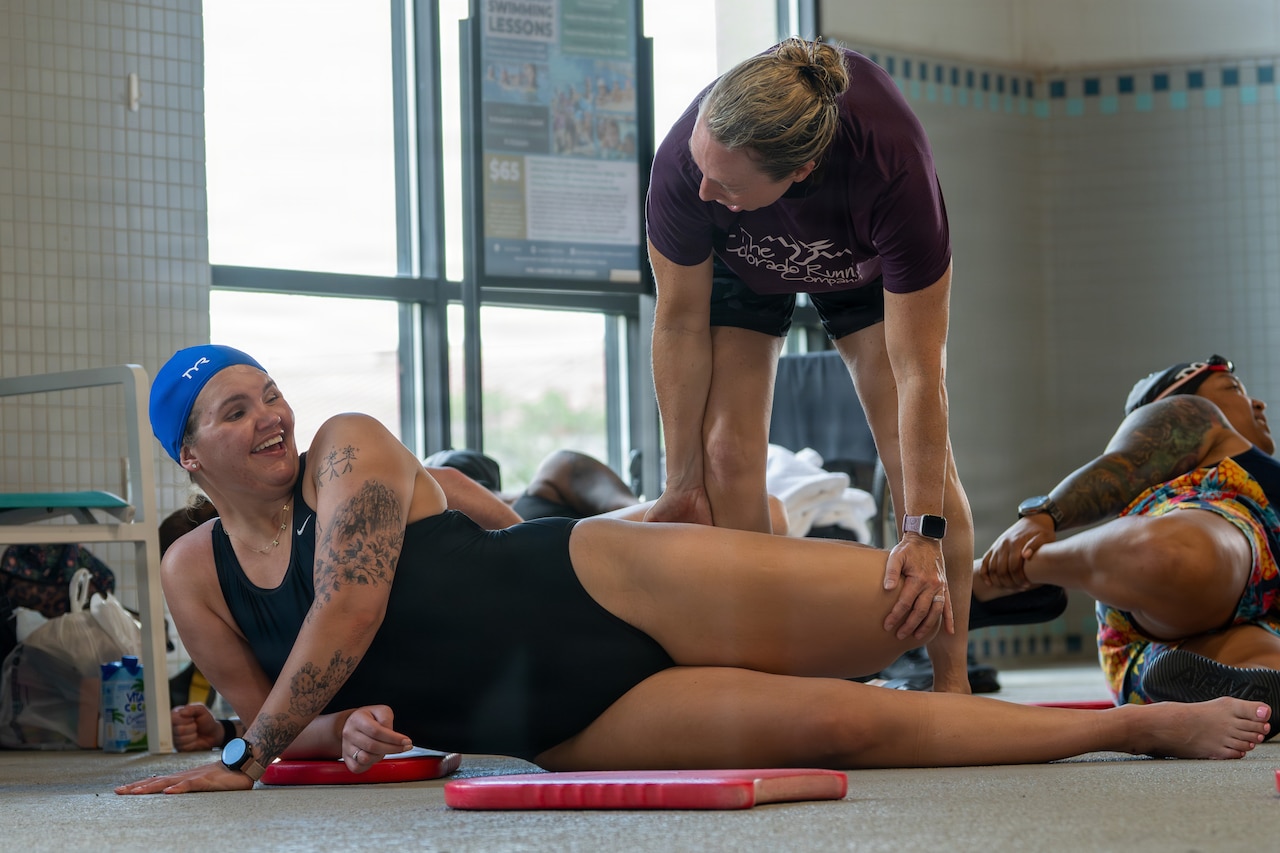
A woman wearing a black bathing suit and swim cap lies on a floor as she is being assisted by another woman in casual attire in an exercise that is lifting her left leg. There is a person also exercising to the right of the women.

Munro's victory is being part of a team again. After a tragic car accident in 2023 resulted in a severe traumatic brain injury, brain surgery and an extended coma, the road back has included months of hospitalization, intensive rehabilitation and daily work to regain strength, confidence and independence.

Now competing with Team Army, Munro is reconnecting with something she's missed: the camaraderie, joking, banter and shared support that come with being part of a team.

Munro's mother, Heidi, shared that the Warrior Games has given her daughter an opportunity to be surrounded by athletes and coaches who see her.

"She loves how everyone supports one another and how people treat her as capable, not disabled," Heidi said.

Munro was commissioned as a field artillery officer in 2018 after completing ROTC at the University of Washington. After four years in her branch, she was selected for the Army's Interservice Physician Assistant Program. Before the accident, she was also an elite athlete and Ironman competitor. Her soldiers often called her "The Iron Ma'am." After the accident, a new nickname emerged.

Heidi said as friends came in and out of Munro's inpatient room with Starbucks, sushi, cute clothes and colorful head coverings, they helped bring light into a difficult season. They bedazzled her wheelchair and walker, decorated her room and made sure her nails were painted. Before long, Munro became known as "The Bougie TBI Girl," a moniker she carries now that captures both parts of her story.

For Heidi and Kailee, Munro's childhood best friend and caregiver, that moniker is more than a phrase. It reflects how Munro has approached recovery from the beginning.

Even in a semiconscious state, Munro didn't want to be seen as disabled. Once she could walk, she refused to use the wheelchair. Then she refused the walker. About six months after the accident, she began walking a mile a day. The pace was slow, and the walks required breaks, but Munro kept asking to go.

On days when Heidi and Kailee were exhausted, Munro would look at them and say, "Outside time." From the beginning, they said, she refused to give up.
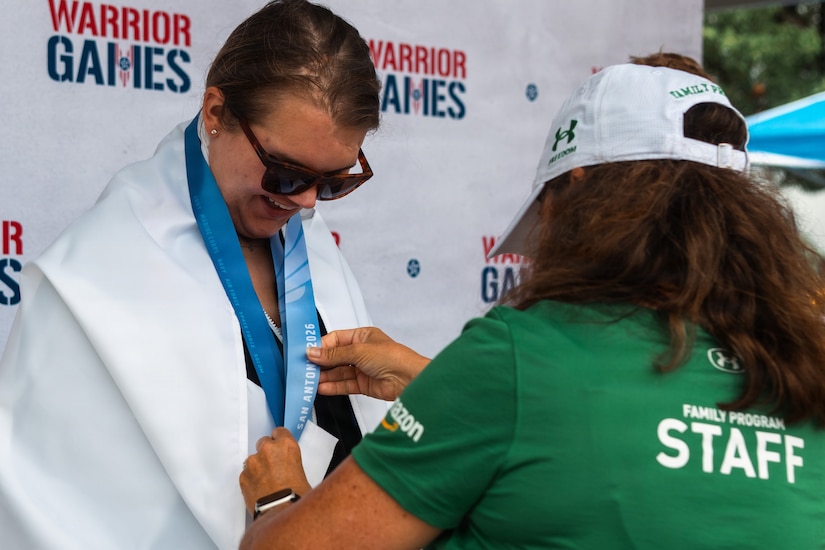
A woman wrapped in a white flag and wearing sunglasses receives a medal on a ribbon from another woman wearing casual attire.

Adaptive sports became another part of her recovery. Munro's first adaptive sport was skiing, which made her feel alive and free again. Her confidence grew after that first ski trip. Swimming came next, and once she connected with an adaptive swim coach, the pool became a place where she could focus on what she could do rather than what she couldn't do.

The adaptive triathlon later reintroduced Munro to competition, wearing a uniform, supporting others and being supported by a team.

Participation in various sports activities, plus the Warrior Games, has helped Munro reconnect with the athlete she was before her injury while continuing to discover who she is now.

Kailee said what people see during competition is only part of the story.

"What I've witnessed isn't just physical recovery; it's resilience," Kailee said. "I've watched Vanessa choose to keep showing up when it would have been easier not to. I've watched her rebuild pieces of herself one day at a time. The Warrior Games are incredible, but it's just the visible part of a recovery that's been happening every single day for years."

For Heidi, watching Munro compete has been deeply emotional. Two years ago, doctors told the family Munro would never walk or talk again. Seeing her at the Warrior Games just 30 months into recovery has filled her with hope.
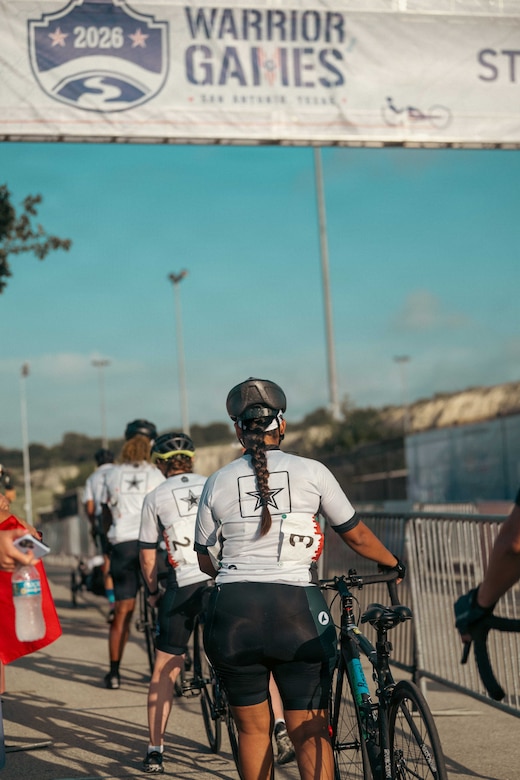
People wearing sports gear and helmets push their bikes to the starting line of a race.

"The real work has taken place in countless therapy sessions, difficult mornings, bouts of depression, setbacks and small victories that most people never see," Heidi said.

One of the most powerful moments came on the track.

"I cried at the track," Heidi said. "I watch her struggle to walk every day always afraid she'll trip over her own foot. I've never seen her run, so to watch her run the 200, with obvious difficulty and exhaustion, and to finish it to a standing ovation and the entire crowd cheering for her, that was the highlight of Warrior Games for me."

When Munro was shown videos of herself walking for the first time after her injury and asked what she thought about herself from the beginning of recovery until now, she chose three words: "Surprised. Excited. Inspired."

For Kailee, the hope is that Munro sees what those closest to her have seen all along.

"Recovery hasn't been about finding her way back to the exact person she was before," she said. "It's been about discovering who she is now, the same fierce, determined, funny, stubborn and compassionate person who inspired people before the accident."

Kailee said Munro's path looks different today, but her strength has never left her.

For Munro, her journey isn't about becoming less than she was before. It's about continuing to move forward, reclaiming pieces of herself and proving, one step and one competition at a time, that "never give up" is more than a motto.

It's how she got here.

Editor's note: Because Munro is still in recovery, some responses and additional context for this story were provided through her mother, Heidi, and her childhood best friend and caregiver, Kailee.

Tuesday, February 10, 2026

Airman Heads Back to Olympics to Compete in Skeleton

Air Force Staff Sgt. Kelly Curtis, a knowledge operations technician assigned to the 31st Fighter Wing Communications Squadron at Aviano Air Base, Italy, is preparing to represent Team USA on the world's biggest stage for the second time at the 2026 Milan Cortina Winter Olympics.

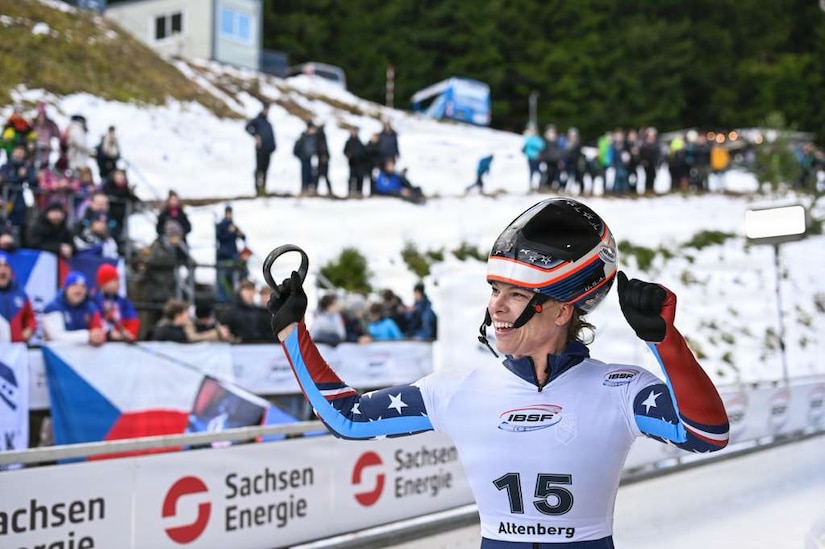
A woman wearing winter Olympic gear cheers in front of a crowd.

 
Qualifying for the Olympics is brutally competitive. Only 232 American athletes earned spots to represent the U.S. in Italy. The news station NBC Olympics reported that thousands of athletes competed through years of races, rankings and trials to qualify for the Games. For Curtis, this moment is the culmination of years of discipline, sacrifice and resilience, both as an athlete and as an airman. 
 
"When I first asked the Air Force [World Class Athlete Program] if I could be assigned to Aviano [Air Base], the goal was always these Olympic Games," Curtis said. "Four years ago, I qualified for my first Games in Beijing, but Milano Cortina was always the plan." 
 
Raised in a highly competitive household, Curtis grew up immersed in athletics. As the youngest of four siblings, she credits her upbringing and her father's experience as a former NFL player for shaping her drive. 

"I was always trying to keep up," Curtis said. "I competed in everything: wrestling, track and field, softball, baseball and basketball. I never specialized in a specific sport early, and I believe that helped me more than anything." 

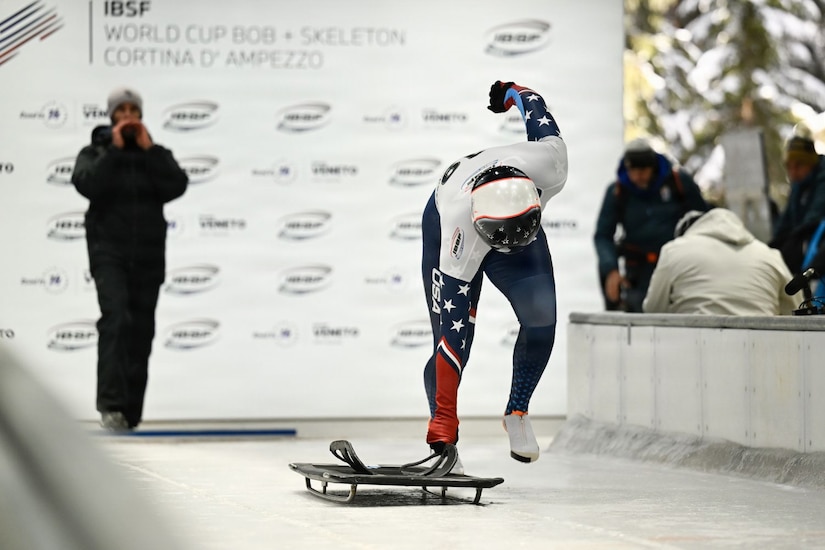
A woman dressed in winter Olympic sledding gear bends down toward a sled while on ice.

Her diverse athletic foundation eventually evolved from traditional collegiate sports to the bobsled, and ultimately the skeleton, an event that demands power, precision and fearlessness. 

Balancing Olympic-level training with military readiness wasn't always easy. As a mother, noncommissioned officer and world-class athlete, Curtis describes her daily routine as a careful balancing act, made possible by strong leaders and teamwork within the 31st Communications Squadron. 

"Staff Sgt. Curtis' ability to balance the demands of military service with world-class competition shows our airmen that anything is possible, so long as you're passionate, dedicated and driven to reach a goal," said Lt. Col Ryan Williams, 31st Communications Squadron commander.

While leaders point to her example, Curtis points back to her team, emphasizing that their confidence in her allows her to carry the same focus and discipline from the workplace to the world stage.  

"My leadership has been incredible," she said. "From my commander down to my supervisor, they've been extremely accommodating while still ensuring I'm fulfilling all my responsibilities as an airman. Their trust frees me to focus when it's time to perform."

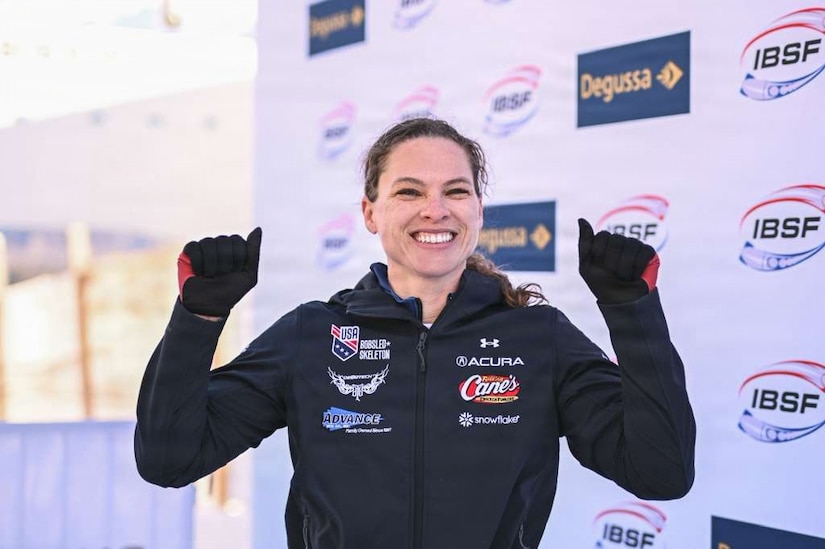
A smiling woman holds up closed fisted hands.

As the current points lead for skeleton on the U.S. team, Curtis prepares to carry more than her personal goals onto the frozen track. She also carries the weight of family legacy and of representing the Air Force. Despite the pressure, Curtis remains grounded in the values that brought her to this point: discipline and resilience. 

"After the Games, I'll be right back at Aviano Air Force Base doing my job," she said. "But for now, I have the privilege of representing the U.S. Air Force on the world stage, and I don't take that lightly. At the end of the day, all I can do is prepare the best I can and put it together when it matters." 

Curtis hopes her journey inspires other airmen to pursue their own athletic ambitions. 

"Reach out. Research Air Force sports and look into the Air Force World Class Athlete Program," she said. "There's more support out there than people realize, from intramural sports all the way to the Olympics."

Friday, December 05, 2025

Air Force Celebrates 75 Years of Honor Guard Drill Team Excellence

For 75 years, the U.S. Air Force Honor Guard Drill Team has represented the discipline, precision and professionalism of the service to audiences around the world. 
 
Founded in 1950 to perform ceremonial honors in the National Capital Region, today the drill team operates from Joint Base Anacostia-Bolling, Washington, and performs more than 100 exhibitions each year across the globe. 
 
The team's legacy of precision has been built by seven and a half decades of airmen who refined every crisp movement to reflect the Air Force's commitment to excellence.

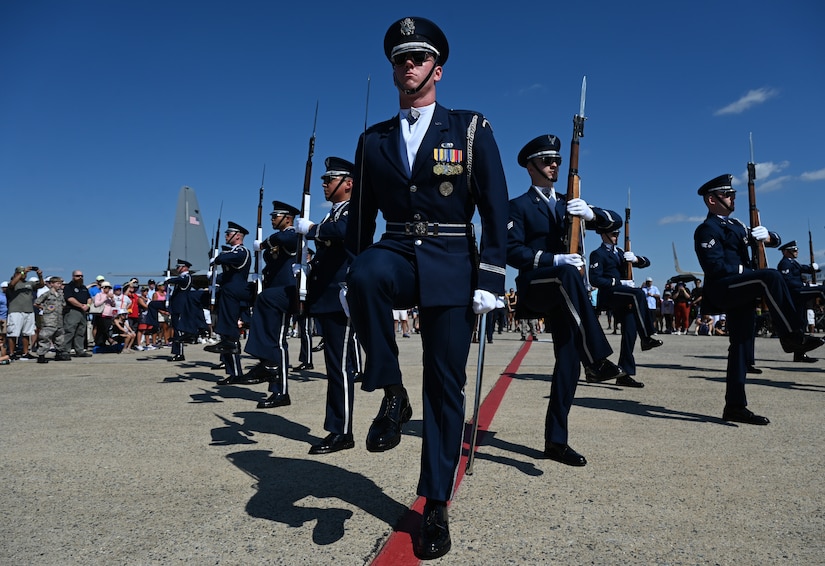
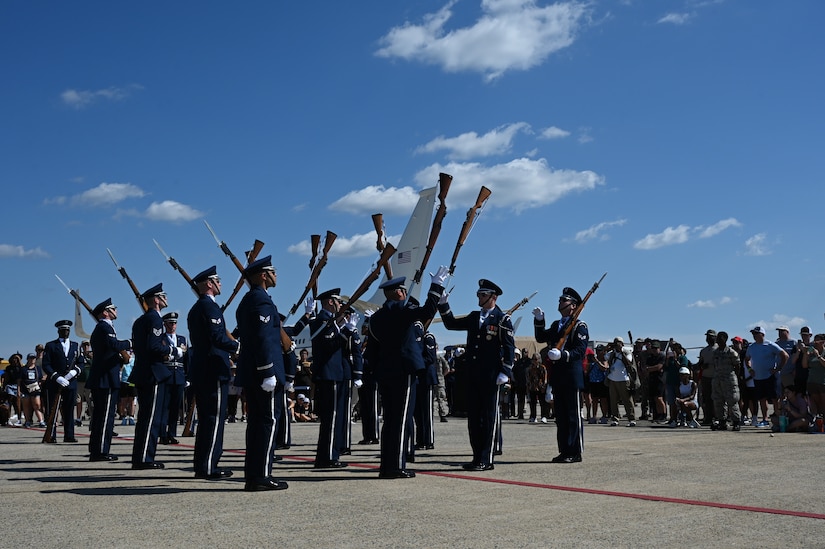
Airmen dressed in honor guard uniforms perform in a letter V formation. Several of the service members are holding rifles. There are people in casual attire observing in the background.

 
"We have been the living embodiment of that commitment," said Air Force Capt. Andrew Paquin, honor guard flight commander of ceremonial operations. "The core theme has been the same since the beginning. It's the relentless pursuit of perfection." 
 
Each member trains full time to master the team's seven-minute routine. Behind every public performance are thousands of hours of repetition and technical correction. 
 
"We break down every movement into its smallest components until the sequence becomes muscle memory," Paquin said. 
 
That dedication to excellence was evident during the 2025 Royal Edinburgh Military Tattoo in Scotland, where the team performed alongside international partners during driving rain and heavy winds. 
 
"Seeing the team perform in those conditions was a reminder of their resilience and ability to adapt and push through discomfort," Paquin said. "Being there on the ground with them created a bond built on mutual trust." 
 
That standard of excellence extends to mentorship and development within the team.  
 
"The main mission [of the honor guard] is to honor the individuals being buried at Arlington [National Cemetery]," said Air Force Senior Airman Richard Miles, honor guard drill team trainer. "Drill is the traveling component of that mission, the part that connects the public to who we are and what we represent." 
 
Miles wanted to join the unit after seeing a drill team performance during his time in Air Force technical training. After he was accepted, he spent more than a year working to become a trainer. 

Airmen dressed in honor guard uniforms pass their rifles to each other during a performance on a tarmac. There are people in casual attire observing in the background.

 
"I failed my first evaluation," he said. "I passed my second and from then on spent a lot of extra hours practicing by myself after group training ended." 
 
The extra hours he spent training paid off when he earned the position of drill team trainer and that perseverance now guides how he trains others. 
 
"We have a big-brother, big-sister program, where experienced drillers mentor new members," Miles said. "As a trainer, the best part is seeing people accomplish what they once thought they couldn't. It's about being a hands-on leader who sets the tone for excellence." 
 
The perfection that audiences see during drill team performances directly reflects the accountability and trust built in training. 
 
"We train to perform under fatigue, stress and pressure, because that's where excellence becomes habit," Paquin said. 
 
That high standard is recognized by symbols on each member's white ascot; the most advanced level of competency is represented by two stars. 
 
"The stars represent the best of the best," Miles said. "You can't earn them through just drills. You have to be the airman that leadership knows they can rely on, no matter what." 
 
While the uniforms, movements and routines have undergone changes during the 75-year history, the mission to represent the Air Force with honor remains steadfast. 

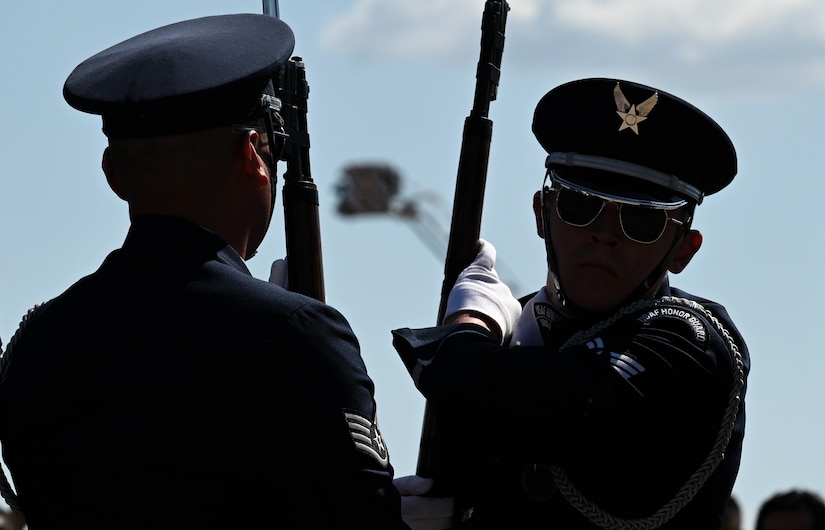
Two Airmen dressed in honor guard uniforms hold rifles while performing.

 
"When the team arrives at a performance, they're impressive, but the real magic happens afterward with the crowd interaction," Paquin said. "People see that the airmen behind the uniforms are young men and women from towns just like theirs. That's what builds trust with the American public." 
 
In an age of rapidly evolving technology, the human element is what continues to keep the drill team relevant. As the team looks ahead to its next major milestone, a centennial in 2050, Paquin said the focus will stay the same. 
 
"The Air Force Honor Guard Drill Team is needed now more than ever," he said. "It humanizes the Air Force mission, builds trust with the American public, and inspires future generations." 

Wednesday, July 26, 2023

The Bronze Star Medal: A Symbol of Valor and Sacrifice

The Bronze Star Medal is one of the highest military awards bestowed by the United States Armed Forces. It holds significant historical importance and is a symbol of valor, bravery, and selfless service. In this article, we delve into the origin, history, development, and use of the prestigious Bronze Star Medal. Additionally, we highlight five examples of service members who received this honor for their extraordinary contributions in various conflicts.

Origin and History:

The Bronze Star Medal traces its roots back to World War II. It was established on February 4, 1944, by Executive Order of President Franklin D. Roosevelt. Initially intended for awarding heroic or meritorious service in a combat zone, the criteria were later expanded to recognize exceptional achievements during peacetime as well.

Development and Criteria:

Over the years, the Bronze Star Medal's criteria have been refined to encompass a wide range of service and actions. Recipients must display valor, merit, or exceptional service while engaged in military operations involving conflict with an opposing force. The medal is awarded to members of all branches of the U.S. military, as well as foreign military personnel serving alongside U.S. forces.

Examples of Honored Service Members:

  1. Audie L. Murphy: Audie Murphy, a young Texan, earned the Bronze Star Medal during World War II for his exceptional heroism. He single-handedly held off an entire German company with his machine gun while wounded, allowing his company to safely retreat. Audie later became the most decorated soldier in American history, receiving numerous awards for his courageous actions.

  2. Chesty Puller: Lieutenant General Lewis "Chesty" Puller earned the Bronze Star Medal for his leadership and valor during the Korean War. Known for his remarkable battlefield prowess, Puller displayed extraordinary courage in several critical battles and is often regarded as one of the greatest combat leaders in Marine Corps history.

  3. Tammy Duckworth: Major Tammy Duckworth, an Army National Guard helicopter pilot, received the Bronze Star Medal for her service during the Iraq War. Despite losing both her legs when her helicopter was shot down, she continued to serve her country and later became a U.S. Senator, demonstrating incredible resilience and dedication.

  4. Michael P. Murphy: Lieutenant Michael P. Murphy posthumously received the Bronze Star Medal with Valor Device for his heroic actions during Operation Red Wings in Afghanistan. He selflessly exposed himself to enemy fire to transmit a distress signal, ultimately sacrificing his life to save his team members.

  5. Jessica Lynch: Private First Class Jessica Lynch was awarded the Bronze Star Medal for her courage and determination during her captivity in Iraq. After her unit was ambushed, Lynch was taken prisoner, and she endured significant challenges until her rescue by U.S. Special Forces, exemplifying resilience and bravery.

Conclusion:

The Bronze Star Medal remains a symbol of honor and valor, recognizing the extraordinary contributions of service members during times of conflict and peace. As a testament to their selfless service and bravery, the Bronze Star Medal celebrates the courageous actions and sacrifices made by men and women who go above and beyond in their commitment to their country and fellow service members. It stands as a lasting reminder of the profound impact that individual acts of heroism and dedication can have in shaping history and safeguarding the values of freedom and democracy.

Friday, June 23, 2023

Semper Paratus: The Melody of Courage and Resilience in the U.S. Coast Guard

Music has always played a powerful role in unifying and uplifting the spirits of those who serve in the armed forces. In the United States Coast Guard, one particular song holds a special place as an anthem of strength and readiness: "Semper Paratus." This article delves into the captivating history of the Coast Guard's cherished song, exploring its origins, significance, and enduring impact on the men and women who safeguard our nation's shores.

The Birth of "Semper Paratus": 

In 1927, Captain Francis Saltus Van Boskerck, a former Coast Guard band director, penned the lyrics to "Semper Paratus" as a stirring tribute to the Coast Guard's commitment to duty. The Latin phrase, meaning "Always Ready," became the motto of the Coast Guard, embodying the organization's unwavering preparedness to safeguard the nation's maritime interests. Van Boskerck's lyrics captured the spirit of resilience, camaraderie, and valor that define the Coast Guard's ethos.

Musical Composition and Adoption: 

Van Boskerck collaborated with Lieutenant Charles A. Zimmerman, the Coast Guard Band's conductor, to compose the music for "Semper Paratus." The song's captivating melody, with its bold brass fanfare and rousing chorus, echoed the determination and courage displayed by Coast Guard personnel in the face of adversity. The Coast Guard officially adopted "Semper Paratus" as its official song in 1943, cementing its place as a cherished emblem of service and dedication.

Symbolism and Significance: 

"Semper Paratus" resonates with Coast Guard members and supporters alike, encapsulating the core values of honor, integrity, and preparedness. The song's lyrics depict the Coast Guard's readiness to face any challenge, whether it be rescuing those in peril at sea, safeguarding maritime borders, or preserving marine ecosystems. "Semper Paratus" serves as a rallying cry, reminding Coast Guardsmen of their crucial role as the nation's maritime guardians.

Honoring Tradition and Service: 

Throughout its history, "Semper Paratus" has been performed at Coast Guard ceremonies, graduations, and official events. It stands as a symbol of pride and unity for Coast Guard members and veterans, representing their dedication to protecting lives and ensuring maritime safety. The song's lyrics evoke a sense of purpose and inspire those who serve to carry out their duties with honor and resolve.

Popular Culture and Recognition: 

"Semper Paratus" has transcended the realm of military tradition to become a recognizable tune in popular culture. It has been featured in films, documentaries, and television shows, further spreading awareness of the Coast Guard's vital role. The song's enduring popularity and enduring presence serve as a testament to the Coast Guard's impact and the public's appreciation for their selfless service.

Conclusion: 

"Semper Paratus" stands as a melodious tribute to the U.S. Coast Guard's unwavering dedication and readiness to protect and serve. From its origins as a heartfelt anthem penned by Captain Francis Saltus Van Boskerck to its adoption as the Coast Guard's official song, "Semper Paratus" has become a cherished emblem of courage, resilience, and unity. It continues to inspire Coast Guard members and civilians alike, serving as a reminder of the sacrifices made in the name of maritime safety and security.

Wednesday, June 07, 2023

Triumph and Resilience: The Inspiring Journey of the DOD Warrior Challenge Games

Marine Corps Staff Sgt. Pierre Sturgis

In the heart of the DOD Warrior Challenge Games, a remarkable event unfolds, showcasing the extraordinary abilities of military athletes. Each year, wounded, ill, and injured service members from various branches of the U.S. Department of Defense gather to compete in a display of sheer determination and unwavering spirit.

As the sun rises on the first day of the games, participants eagerly prepare themselves for the challenges ahead. Soldiers, sailors, airmen, and Marines, all with unique stories and backgrounds, come together with a shared purpose—to push their limits and redefine what is possible.

The games were born out of a vision to provide an inclusive platform for military athletes, regardless of their physical abilities. It is a testament to the belief that resilience knows no bounds and that the human spirit can triumph over any obstacle. From adaptive sports such as wheelchair basketball and seated volleyball to track and field events, the games offer a wide range of opportunities for athletes to showcase their skills and passion.

For many participants, the games represent more than just a chance to compete. They are a beacon of hope, a symbol of perseverance in the face of adversity. Adaptive sports have become a catalyst for their recovery, allowing them to reclaim their strength and rebuild their lives. From navigating the field in wheelchairs to defying gravity with prosthetic limbs, these athletes redefine the meaning of resilience with each step, jump, and throw.

Beyond the physical aspect, the games foster a sense of camaraderie and support among military communities. Participants find solace in the understanding eyes and knowing smiles of their fellow athletes. They forge bonds that transcend the boundaries of rank and branch, united by their shared experiences and a mutual commitment to overcome the odds.

Throughout the event, the air is electric with anticipation and excitement. The cheers of family members, friends, and fellow service members echo through the arena, spurring the athletes to new heights. Every victory is celebrated, every personal best is cherished, and every obstacle conquered becomes a stepping stone towards a brighter future.

As the games draw to a close, the legacy they leave behind is profound. The athletes return to their units, their communities, and their lives, forever transformed by the experience. They carry with them the lessons of perseverance, the memories of camaraderie, and the unshakable belief that anything is possible.

The DOD Warrior Challenge Games serve as a powerful reminder that the human spirit is unyielding, capable of achieving greatness even in the face of adversity. These games are a testament to the courage, determination, and unwavering resilience of the military athletes who embody the true essence of triumph.