Wednesday, June 08, 2011

This Day in Naval History - June 07

From the Navy News Service

1819 - Lt. John White on merchant ship Franklin, anchored off Vung Tau, is first U.S. naval officer to visit Vietnam.
1917 - U.S. subchasers arrive at Corfu for anti-submarine patrols.
1942 - Battle of Midway ends with loss of USS Yorktown (CV 5).
1944 - Construction of artificial harbors and sheltered anchorages begins off Normandy coast.
1991 - Joint Task Force Sea Angel ends relief operations in Bangladesh after Cyclone Marian.

Tuesday, June 07, 2011

Murder in the Land of Ojibwe

With the addition of Scott E. Becker, Military-Writers.com now lists 1253 US Military personnel who have authored 3964 books.

Scott E. Becker was commissioned a Second Lieutenant in the US Army Reserve after graduating with his BS from Central Michigan University. After leaving the U.S Army, Scott Becker worked in Michigan's Upper Peninsula's infamous, maximum security prison. He then spent twelve-years as a private investigator and security consultant. After a potentially fatal confrontation with members of organized crime in Detroit Michigan, he decided attending Cooley Law School wouldn't be all that bad an alternative. He taught martial arts and continued to work as an investigator to pay his way through law school. After graduation he was appointed as a prosecutor in northern Michigan. Scott E. Becker is the author of Murder in the Land of Ojibwe.


According to the book description of Murder in the Land of Ojibwe, “Tom Howard faces a moral dilemma; he has sworn as a prosecuting attorney to uphold the law. But when his best friend is shot and dies in his arms, he must decide whether he is going to act as an officer of the court or is he going to take a hand investigating the murder as he would have when he was a private investigator and bounty hunter; when the law was something to get around.”

One reader of Murder in the Land of Ojibwe said, “Becker has a highly developed sense of combining the real world with fiction that encourages his readers to use their minds. His clues are cleverly concealed keeping the reader on edge and wanting more. The dialogue is delivered in a homespun down to earth manner that makes it all that more effective and enjoyable. While expertly resolving all the major issues presented in his tale, that are based on real life events. Becker manages to leave his readers with just a touch of the mystical.”

One reader of Murder in the Land of Ojibwe said, “Becker, who was an accomplished, prosecutor, investigator, academic, adventurer, photographer and oil man before he made his writing debut, poses some interesting questions which are not easily answered in fiction or in the real the life drama on which the book is based, in A Dead Man's Tale but is always leaving you wanting more.”

Former Military Police Officer Publishes New Book

With the addition of Steve Dixon, Military-Writers.com now lists 1252 US Military Servicemembers and their 3963 books.

Former United States Army Staff Sergeant Steve Dixon began his law enforcement career as a military police officer. His entire career spanned 30 years and included retiring from the San Jose Police Department as a Sergeant of Police. Steve Dixon is the author of Police Stories: Making One Bit of Difference.


According to the book description of Police Stories: Making One Bit of Difference, “On April 22, 1977, Steve Dixon became a police officer in Northern California. It was one of the proudest moments of his life. He promised himself to work hard and become the best cop he could be. It was going to be a great career. Four years later he was ready to quit in disgust. Some of his best friends did quit. In his new book, Police Stories: Making One Bit of Difference, Steve will show you what a police career is really like. You'll see the good cops who race to violent calls and put their lives on the line to protect others. And you'll see the bad cops who out of cowardice or laziness will not put themselves at risk to help a citizen or even another cop. And unbelievably, you'll see that some police departments treat their bad cops better than the good ones. So many good cops either quit or just give up and stop doing any kind of proactive police work. But there are a dedicated few who, despite working with lousy teammates and under poor leadership, still go out each day and make a difference in their communities. This book is a tribute to them. Hopefully, after reading it, you will gain a better appreciation for the good cops in your community. As you'll see, it is much easier to be a bad cop than a good one.”

Missing Vietnam War Airman Identified

The Department of Defense POW/Missing Personnel Office (DPMO) announced today that the remains of a serviceman, missing in action from the Vietnam War, have been identified and will be returned to his family for burial with full military honors.

Air Force Capt. Darrell J. Spinler of Browns Valley, Minn., will be buried on June 18 near his hometown.  On June 21, 1967, Spinler was aboard an A-1E Skyraider aircraft attacking enemy targets along the Xekong River in Laos when villagers reported hearing an explosion before his aircraft crashed.  The pilot of another A-1E remained in the area for more than two hours but saw no sign of Spinler.

In 1993, a joint U.S.-Laos People’s Democratic Republic team, led by Joint POW/MIA Accounting Command (JPAC), interviewed villagers who witnessed the crash.  They claimed Spinler’s body was on the river bank after the crash but likely washed away during the ensuing rainy season.  The team surveyed the location and found wreckage consistent with Spinler’s aircraft.

In 1995, the U.S. government evaluated Spinler’s case and determined his remains unrecoverable based on witness statements and available evidence.  Teams working in the area revisited the location in 1999 and 2003 and confirmed Spinler’s remains had likely been carried away by the Xekong River.  However, in 2010, JPAC conducted a full excavation of the location and recovered aircraft wreckage, human remains, crew-related equipment and personal effects.

Among other forensic identification tools and circumstantial evidence, scientists from the Joint POW/MIA Accounting Command used dental x-rays in the identification of Spinler’s remains.

With the accounting of this airman, 1,689 service members still remain missing from the conflict.

For additional information on the Defense Department’s mission to account for missing Americans, call 703-699-1420 or visit the DPMO Website at dtic.mil/dpmo .

Peter Francisco - Hercules of the Revolutionary War

The June 9, 2011, episode of American Heroes Radio features a conversation with Travis Bowman, a 6th generation descendant of Peter Francisco, has written an historical novel about Peter's life entitled Hercules of the Revolution and produced a half-hour documentary The Peter Francisco Story: 10 Things You Never Knew About One of Our Nation’s Founding Fathers.

Program Date: June 9, 2011
Program Time: 1500 hours, PACIFIC
Topic: Peter Francisco - Hercules of the Revolutionary War
Listen Live
http://www.blogtalkradio.com/lawenforcement/2011/06/09/peter-francisco--hercules-of-the-revolutionary-war

About Peter Francisco
Peter Francisco isn’t often mentioned in modern history textbooks, yet he stands among famous people of the Revolutionary War and is considered one of America’s founding fathers. Few know of this Portuguese American’s legendary prowess during the American Revolution, in which he served three tours of duty, fought in five major battles, and was wounded six times, twice escaping death. Five monuments stand up and down the East Coast honoring Peter Francisco, the Hercules of the Revolution. George Washington called Peter Francisco his “One-Man Army” and even had a six-foot broadsword fashioned just for Peter on account of his giant stature.

About the Guest
Travis Bowman is a 6th generation descendant of Peter Francisco, and he is of similar stature standing 6’6” tall just like Peter. As an actor he enjoys telling Peter’s story through dramatic impersonations with a 6’ replica broadsword similar to the one George Washington had made for Peter. Travis’ family is originally from Virginia where Peter was raised and resided most of his life. Coincidently, Travis was born the day after Virginia declared March 15th, Peter Francisco Day.

Travis’s grandfather was stationed in London during WWII, and his father spent 40 years at the National Security Agency. He was born and raised in Baltimore, Maryland, lived in Europe as a kid for three years, and spent eight years in the beautiful Pacific Northwest. Today, he resides in Charlotte, North Carolina with his wife and two boys.

About the Watering Hole
The Watering Hole is police slang for a location cops go off-duty to blow off steam and talk about work and life. Sometimes funny; sometimes serious; but, always interesting.

About the Host
Lieutenant Raymond E. Foster was a sworn member of the Los Angeles Police Department for 24 years. He retired in 2003 at the rank of Lieutenant. He holds a bachelor’s from the Union Institute and University in Criminal Justice Management and a Master’s Degree in Public Financial Management from California State University, Fullerton; and, has completed his doctoral course work. Raymond E. Foster has been a part-time lecturer at California State University, Fullerton and Fresno; and is currently a Criminal Justice Department chair, faculty advisor and lecturer with the Union Institute and University. He has experience teaching upper division courses in law enforcement, public policy, law enforcement technology and leadership. Raymond is an experienced author who has published numerous articles in a wide range of venues including magazines such as Government Technology, Mobile Government, Airborne Law Enforcement Magazine, and Police One. He has appeared on the History Channel and radio programs in the United States and Europe as subject matter expert in technological applications in law enforcement.

Listen, call, join us at the Watering Hole:
http://www.blogtalkradio.com/lawenforcement/2011/06/09/peter-francisco--hercules-of-the-revolutionary-war

Listen from the Archive:
http://www.americanheroesradio.com/peter_francisco_hercules_revolutionary_war.html

Program Contact Information
Lieutenant Raymond E. Foster, LAPD (ret.), MPA
editor@police-writers.com
909.599.7530

Connect to Psychological Health Support with These DCoE Resources

Posted by Col. Chris Robinson, DCoE deputy director for psychological health on June 6, 2011
This blog post is republished from DoD Live.

As both a clinical health psychologist and as an airman who recently returned from deployment to Afghanistan, I know firsthand the importance of reaching out for support for psychological health. For many service members, returning from deployment and reintegrating back home can present some challenges.

It’s common for service members to experience an adjustment period after deployment, but there are resources available to help build resilience, facilitate recovery and support reintegration. The Defense Centers of Excellence for Psychological Health and Traumatic Brain Injury (DCoE) offers several programs to assist service members, veterans and military families with post-deployment concerns and encourage help-seeking behavior.

The Real Warriors Campaign promotes help-seeking behaviors among service members and veterans with invisible wounds. Together with military leaders and the services at large, the campaign is spreading the message that reaching out is a sign of strength. Warriors are not alone in coping with psychological health concerns – there is a vast network of support and resources throughout each of the services, Department of Defense, Department of Veterans Affairs and civilian communities. Realwarriors.net has more than 80 practical articles to support members of the military community throughout deployment and reintegration.

Service members and families can stay connected to others within the military community by following the campaign’s social media channels, including Facebook and Twitter; by engaging on the campaign’s message boards; or by sharing messages of support using the campaign’s e-cards and materials.

Another DCoE resource to assist with reintegration needs is afterdeployment.org, an online behavioral health resource supporting service members, their families and veterans with common post-deployment challenges. The site offers a wide spectrum of core features, including educational libraries spanning 18 topics, 29 self-assessments that provide users with immediate feedback, “hands-on” guidance with various self-management strategies, nearly 300 video-based interviews with service members and families, podcasts for “on-the-go” access, community forums, expert blogs, quick links to hotlines and partner sites, topical RSS feeds, and a provider portal supporting the clinical community. Next-generation development will add three new modules (pain, suicide, finances), bring on a user-centered dashboard, and expand the site’s social networking opportunities.

Additional resources like the DCoE Outreach Center are available 24/7 by phone at 866-966-1020, email and live chat. Anyone can reach out to the center to speak confidentially with health care professionals about psychological health or TBI concerns. DCoE also offers information and resources related to psychological health and traumatic brain injury on the DCoE Blog, Facebook and Twitter.

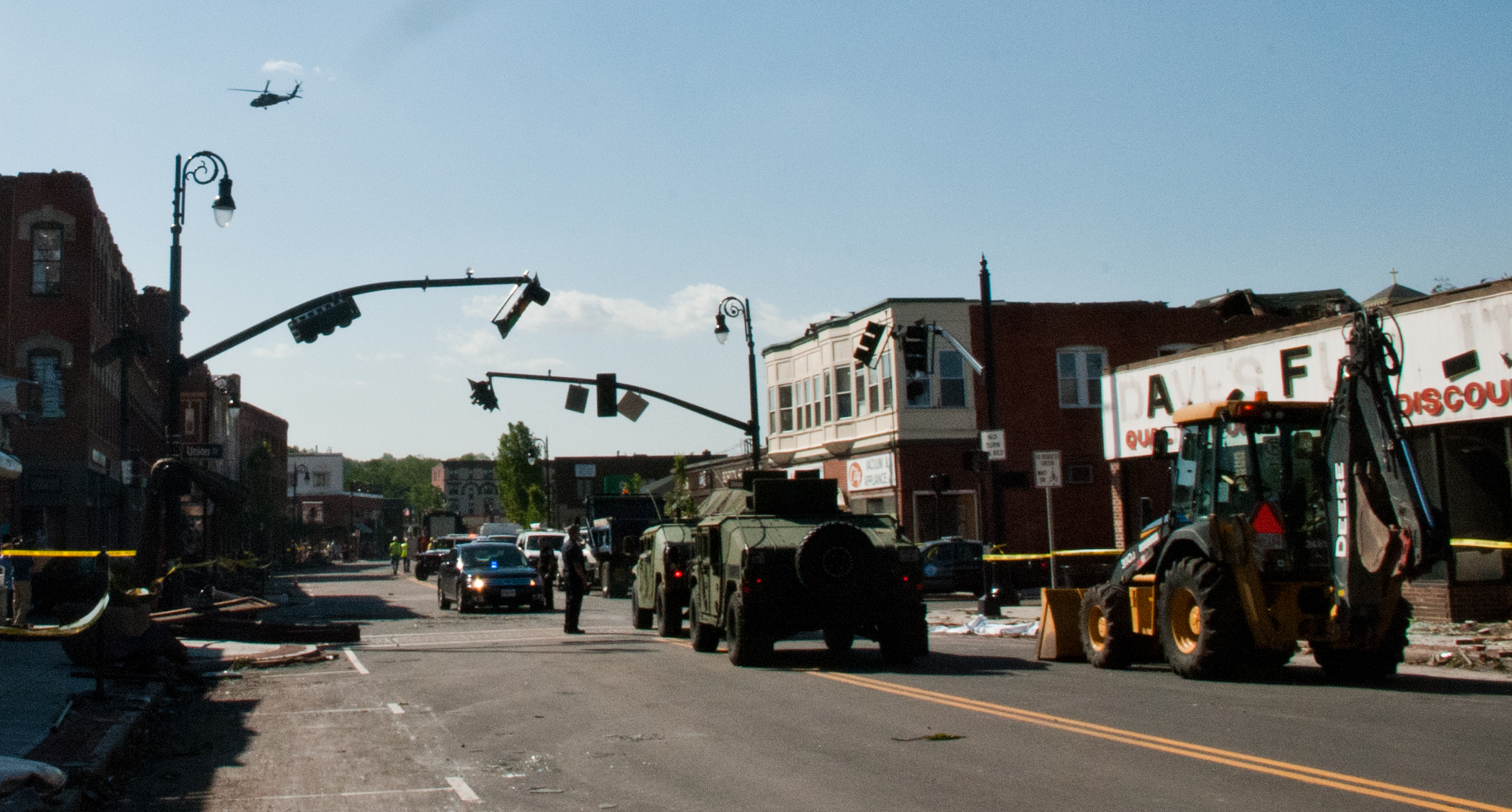
Massachusetts National Guard Tornado Response

Soldiers of the 747th MP Battalion of the Massachusetts national Guard, work with Springfield and State Police to secure Main Street of Springfield Massachusetts. A Mass. National Guard helicopter also fly's overhead surveying damage from the tornado on June 2nd 2011 a day after it hit Springfield. (Air Force Photo by Senior Airman Eric Kolesnikovas, Mass. National Guard Public Affairs)

Obama Cites Value of U.S.-German Alliance

By Donna Miles
American Forces Press Service

WASHINGTON, June 7, 2011 – President Barack Obama welcomed German Chancellor Angela Merkel to the White House today, calling Germany one of the United States’ strongest friends in a transatlantic alliance that’s the cornerstone of efforts to promote peace and prosperity around the world.

Speaking on the South Lawn of the White House, Obama said the generations-long U.S. relationship with Germany remains critical today.

“At a time when some have asked whether the rise of new global powers means the decline of others, this visit reaffirms an enduring truth,” he said. “Our alliances with nations like Germany are more important than ever. Indeed, they’re indispensible to global security and prosperity.”

Recognizing NATO, to which both nations belong, as “the most successful alliance in human history,” the president called its commitment to its members’ common defense a pillar of global security. This extends, he said, “from completing our mission in Afghanistan to preventing terrorist attacks to achieving our vision of a world without nuclear weapons.”

Merkel said the two countries’ solid foundation enables them to face current challenges together.

“Germany and the United States are partners, sharing responsibility for a peaceful and stable Afghanistan,” she said. “We are pulling in the same direction, trying to keep Iran from following its course of developing a nuclear forces capability. In North Africa, we support the struggle for freedom. And in the Middle East, we support efforts to fill the peace process with new life.”

In addition, Merkel said, both countries have confronted the global economic and financial crisis. Obama said their strong economies stand as a testament to what can be achieved when nations invest in their people and foster innovation.

“As people around the world imagine a different future, the story of Germany and our alliance in the 20th century shows what’s possible in the 21st,” Obama said. “Wars can end. Adversaries can become allies. Walls can come down. At long last, nations can be whole and can be free.”

Obama is slated to present Merkel the Presidential Medal of Freedom during a state dinner tonight.

“I see this as a gesture of appreciation for the whole of this united Germany,” she said of the honor. “It is also a testament of the very, very close ties that bind our two countries together.”

Paratroopers Commemorate D-Day Anniversary

By Donna Miles
American Forces Press Service

WASHINGTON, June 6, 2011 – About 300 U.S. soldiers, most of them combat veterans themselves, joined their British, French and German counterparts in Normandy, France, to honor the sacrifices of World War II veterans who conducted the D-Day invasion 67 years ago today.

The troops spent the last few days visiting key battle sites during the mission code-named Operation Overlord: the beaches 160,000 troops stormed on June 6, 1944, during the largest amphibious invasion in world history; and St. Mere Eglis, the first French village to be liberated by U.S. 82nd and 101st Airborne Division soldiers, among them.

Throughout the visit, where they received briefings about the history of the sites and got a firsthand look at the tactical challenges Allied forces faced, the troops participated in D-Day commemorative ceremonies and met veterans of the invasion.

Today, they took part in ceremonies at Ponte du Hoc, the formidable cliff-top perch west of Omaha Beach that U.S. Rangers assaulted; and Utah Beach, the westernmost of the five D-Day landing beaches.

“Getting the chance to be here has been an amazing opportunity,” Army Capt. Ted Jacobs, executive officer for the Army Reserve’s 345th Tactical Psychological Operations Company in Dallas said by phone as he waited for the Utah Beach ceremony to begin. “Seeing what these veterans had to go up against -- the terrain, the weather situation, … the wet, the cold, being in fear of their lives all the time -- it really does help you understand the challenges they had to deal with.”

Jacobs is among about 150 Army Reserve paratroopers with the U.S. Army Civil Affairs and Psychological Operations Command, with headquarters at Fort Bragg, N.C., participating in Operation Airborne Normandy, a mission that is bringing together U.S. and European forces for commemorations and interoperability training.

Other U.S. participants include active-duty soldiers from the 82nd Airborne Division at Fort Bragg; 173rd Airborne Brigade Combat Team at Vicenza, Italy; 101st Airborne Division at Fort Campbell, Ky.; and riggers from the Army Reserve’s 824th, 421st and 861st Quartermaster Companies and U.S. Army Europe’s 5th Quartermaster Detachment.

One planned event, a combined jump involving more than 700 U.S., British, German and French paratroopers, has been canceled twice due to bad weather. Participants are hoping the event may take place tomorrow, conditions permitting, to enable every paratrooper who jumps with another country’s jumpmaster to receive that country’s jump wings.

Meanwhile, the soldiers called the chance to meet with veterans of the D-Day invasion the highlight of the visit.

“I feel honored to have the opportunity to come out here and meet them face to face and shake their hands and say thank you,” said Army Sgt. Nathaniel Bier, a veteran of Operation Iraqi Freedom serving with the 301st Psychological Operations Company from San Diego. “That is one of the best things I will always remember about this trip.”

With two combat deployments in Afghanistan under his belt, Jacobs said, he gained a new appreciation for the odds the Allied forces -- including his own father -- faced during Operation Overlord.

Then-Sgt. Thomas Jacobs jumped into Normandy during the D-Day invasion, but has spoken little of the experience except to describe it as “godawful” until recent years. “We grew up basically with the understanding that we didn’t ask questions about that,” his son said. “He was one of those veterans who just wanted to forget.”

Bier shares Jacobs’ personal connection to the D-Day visit: his great-grandfather, who died before Bier was born, took part in the invasion. “My father really looked up to him,” Bier said of his great-grandfather. “So he was even more excited to hear that I was coming here than I was.”

Walking the beaches, seeing the formidable terrain and standing the ground his great-grandfather helped to liberate has given Bier a special appreciation of the magnitude of what happened in Normandy. Pausing to reflect on it, he admitted, “I had to stop myself from tearing up, because it’s so powerful just to be here.”

Bier said he’s been particularly struck by the courageous leadership the D-Day noncommissioned officers demonstrated in the face of adversity.

“I don’t know how some of those sergeants kept going, how they kept their people motivated as they were coming off the boats, and how they kept them moving forward,” he said. “My hat is really off to those sergeants.”

Jacobs said he, too, stands in awe of what the D-Day veterans accomplished, and declined to compare it with anything he has experienced in combat.

“I wouldn’t even dare to hold a candle to what those guys did,” he said. “Certainly, what we are doing in Afghanistan is at times very difficult and dangerous. But what these guys went through, there is no comparison. Ours is a counterterrorism fight, so there are brief moments of intensity, but nothing to even come close to the scale of events that happened here.”

Walking the hallowed grounds where many made the ultimate sacrifice “has given me a deeper appreciation for the legacy that has been left to us by the greatest generation by these soldiers who came over here and did what they did,” Jacobs said. “It further solidifies the fact that I do not ever want to betray that kind of legacy, and want to continue to build it and maintain what they have carved out for us.”

A high school math teacher in the Dallas public schools in his civilian life, Jacobs said he intends to share the experiences he’s gained at Normandy, like those from Afghanistan, with his students.

“All these values from the military are just common core good-citizenship skills and behaviors that these children desperately need, particularly those from the inner city,” he said. “So I incorporate everything I can from my experience in the military: what it means to serve instead of always looking out for yourself or putting yourself first, [and] thinking about putting others before yourself and service to the community and country,” he said. “That is just a core theme in my classroom.”

Today in the Department of Defense, Tuesday, June 07, 2011


Secretary of Defense Robert M. Gates is traveling.

Deputy Secretary of Defense William J. Lynn has no public or media events on his schedule.

Chief of Naval Operations Adm. Gary Roughead delivers remarks at 10 a.m. EDT at the Environmental Awards ceremony at the Navy Memorial, Washington, D.C.  Media interested in attending should contact Cmdr. Charlie Brown at 703-692-5307.

This Day in Naval History - June 06

From the Navy News Service

1944 - In Operation Overlord, Allied invasion fleet (more than 2,700 ships and craft) land troops on Normandy beaches, the largest amphibious landing in history.

Retired Naval Officer Publishes Children’s Book

With the addition of Captain Valerie Ormond, United States Navy (ret.), Military-Writers.com now lists 1251 servicemembers and the 3962 books their have published.

Captain Valerie Ormond, USN (ret.) “spent the majority of her adult life as a Naval Intelligence Officer. The daughter of two English majors, and an English major herself, she always had a great interest in books and writing. Just prior to her retirement from the Navy, someone suggested she turn an idea she had into a book, and from there her second career began.

A lifelong horse enthusiast, Valerie has enjoyed bringing horses into people’s lives who may not have otherwise been exposed to horses. She is happy to have put over 100 people on horses for the first times in their lives, ranging from ages one through seventy- one. She believes in the healing power of horses and is a member of numerous equine-related organizations including the Maryland Horse Council, Certified Horsemanship Association, American Society of Equine Appraisers, National Capital Adult Equestrian League, the Southern Maryland Horse Show Association, American Horse Publications, and the Equine Assisted Growth and Learning Association.

She was a mentor, counselor, and leader in the U.S. military for over twenty-five years. Her education includes a Master of Strategic Studies from the U.S. Army War College in Carlisle, Penn.; a Master of Strategic Intelligence, Defense Intelligence College, Washington, DC, and a dual Bachelor of Arts degree in English and Mass Communication from Towson University, Towson, Md. She is a lifetime member of the Disabled American Veterans and the Naval Intelligence Professionals. She is also a member of the Maryland Writers Association and the Society of Children's Book Writers and Illustrators.

She lives with her husband Jaime Navarro, a career Naval officer, in Bowie, Maryland. Jaime is the proud father of his son, Paul, and daughter, Stephanie, both college graduates and making it out in the world on their own. Jaime and Valerie enjoy the company of their wonderful families and friends, their three horses, and two dogs. Captain Valerie Ormond is the author of Believing In Horses.

According to the book description of Believing In Horses, “First, the move to Maryland. Then Dad's deployment to Afghanistan. Sadie is in trouble. Then she gets Lucky, a new young horse who proves to be a handful. But that's just the beginning. Together they encounter horse thieves, Maryland storms, and unwanted horses destined for auction and uncertain futures. Sadie makes it her personal mission to save them. Along the way she meets other people who are dedicated to rescuing horses. She also learns that some people in the horse industry are driven by greed. She's twelve. Can she save the horses in time...and herself?”

Monday, June 06, 2011

George Washington Begins Sea Trials

By Mass Communication Specialist Seaman Apprentice Erin Devenberg, USS George Washington Public Affairs

USS GEORGE WASHINGTON, at sea (NNS) -- The aircraft carrier USS George Washington (CVN 73) returned to sea, departing her forward-operating port of Commander, Fleet Activities Yokosuka to commence Sea Trials, June 5.

"Sea trials are where we put the past six months of maintenance to the test," said the ship's Commanding Officer, Capt. David Lausman. "The crew worked extremely hard to make this warship the best in the Navy and I have no doubt our Sea Trials will be a success."

Since December of last year, George Washington's crew completed approximately 20,000 maintenance jobs totaling more than 500,000 man hours of work.

"Sea Trials validate work has been completed properly and that systems are fully operational to meet mission requirements," said Lt. Cmdr. Andrew Serveas, George Washington's nuclear power limited duty officer (SWO).

Within the first hour of pulling out of port, George Washington's Air department was in the Sea Trials spotlight running drills after drill looking for the smallest deficiency.

On the flight deck and in the hangar bay, the ship's Countermeasure Wash Down Systems was tested. With a mixture of sea water and Aqueous Film Forming Foams (AFFF), the Countermeasure Wash Down System is used to remove chemical, radiological, and biological contaminants from the surface of the ship in the event of an attack.

"This sea trial period is mostly for topside work; combat systems, aircraft catapults, recovery systems, damage control systems," said Serveas. "These systems are being tested during this underway period because they could not be tested in port due to various limitations and restrictions."

Among the many systems being checked is the ship's arresting gear for incoming aircraft. If it's not operating properly, the result could be disastrous. But just as important as equipment, the crew is also getting additional training during Sea Trials.

"We have to anticipate the weight of an aircraft when it lands so that we can set the arresting gear for each aircraft's own weight," said Interior Communication Electrician Fireman Suzy Laughing from Ganado, Ariz. "It's to ensure the right amount of pressure as the aircraft lands to prevent any damage to the plane or injury to the crew."

"We are returning to sea with numerous upgrades to our capability, but it's our crew, the men and women who serve aboard this mighty warship; they are our real secret weapon. They are what make George Washington special," said Lausman.

George Washington's mission is to ensure security and stability in the Western Pacific and to be in position to work with our allies and regional partners to respond to any crisis across the operational spectrum as directed.

U.S. Army Bloggers Roundtable: Staff Sgt. Eddie Peoples

The U.S. Army hosted a Bloggers Roundtable on Monday, June 6, 2011 EDT, featuring Staff Sgt. Eddie Peoples, a heroic service member who recently foiled a bank robbery. While visiting family members in Sarasota, Fla., on leave, Staff Sgt. Eddie Peoples from the 386th Movement Control Team, detained a suspect who had allegedly just committed a bank robbery and held him until the police arrived. On the afternoon of May 31, Peoples and his two children stopped at a local bank in Sarasota. While he was there with his children, the suspect who has been charged with armed robbery and is being detained by local authorities, entered the bank, demanded money from bank employees and left with an undetermined amount of cash.

Peoples, who watched the whole situation transpire, said he knew he could not stand by. Staff Sgt. Peoples took matters into his own hands and single-handled taking down the bank robber. It was these selfless actions in the face of danger that resulted in a commendation medal from The Sarasota Police Department. Take advantage of an opportunity to talk to Staff Sgt. Peoples, a ten-year Army Veteran, about his deployments and current duties with the 386th Movement Control Team, 14th Transportation Battalion, 16th Sustainment Brigade, 21st Theater Sustainment Command, stationed in Vicenza, Italy.

Submarine Group 7 Changes Command

By Lt. Lara Bollinger, Submarine Group 7 Public Affairs

YOKOSUKA, Japan (NNS) -- Submarine Group Seven held a change of command ceremony on board Fleet Activities Yokosuka June 6.

During the ceremony, ceremony Capt., and rear admiral-select, Phillip G. Sawyer relieved Rear Adm. Robert L. Thomas, Jr. as commander of CSG 7, who also assumed responsibility as commander of Task Forces 74 and 54.

Vice Adm. Scott R. Van Buskirk, commander, U.S. Seventh Fleet, was the honored guest and key speaker during the ceremony.

In his speech, Van Buskirk commended Thomas for a job well-done in his capacities as CSG 7, CTF 74 and 54.

"Robert has taken all of these difficult jobs and made them look easy," Van Buskirk said. "With the largest area of operations of any in the submarine force, and responsibility for some of the most challenging and sensitive operations our nation's military conducts anywhere, Robert Thomas has excelled in leading his people to tremendous success."

Under Thomas' command CTF 74 and 54 achieved operational success of more than 30 submarine deployments and 45 special submarine missions. As the theater anti-submarine warfare commander for Seventh Fleet, Thomas brought tactical and operational expertise to bear across multiple warfare areas.

Through his leadership during Operation Tomodachi, CSG 7 enabled U.S. operations in an unprecedented radiological environment. Thomas' engagement with important regional allies greatly advanced the combined warfighting capability of the U.S. Navy and allied naval submarine forces.

Thomas expressed his gratitude to his counterparts and mentors in the Japan Maritime Self Defense Forces, and the Sailors, civilians, and families who are a part of what he fondly calls the "tribe".

"Thanks to the tribe - the 200 members of the CTF 74, 54, and Submarine Group Seven command. Our Sailors, our civilians, our families…what you do in the common defense of Japan, and for security in Asia is just not to be beat," Thomas said.

He stated that this change of command ceremony represents renewal.

"[Rear Adm.-select] Sawyer takes command, so we have the renewal of a fresh start today for CTF 74. It's also the renewal of the bright future that we have with our partnership; the U.S. Navy and the Kai Jo Jie Tei. And it's a renewal of the enduring friendships, as I see so many members of the Yokosuka community [here today] as we start out [Sawyer's] command tour," Thomas said.

Thomas will report as vice director for operations, on the joint staff in the Pentagon.

Sawyer, a 1983 graduate of the United States Naval Academy, recently served as vice commander, Naval Mine and Anti-Submarine Warfare Command since July 2010.

Pacific Partnership Representatives Attend Women's Empowerment Conference

By Airman 1st Class Haleigh Greer, Pacific Partnership 2011 Public Affairs

PORT MORESBY, Papua New Guinea (NNS) -- Three women from the Pacific Partnership 2011 team attended the Pacific Women's Empowerment Initiative held in Port Moresby, May 31, to support the movement for women's rights in the South Pacific.

The forum allowed female delegates from 12 different countries in the region to discuss women's issues in their respective countries. Over the course of 5 hours, the delegates talked about the challenges women face in their home nations.

"It was important for Pacific Partnership representatives to attend the conference to better understand female leaders' priorities," said Lt. Cmdr. Jennie Goldsmith, Pacific Partnership 2011 judge advocate general. "Each delegate provided a country synopsis that included their most pressing concerns. The conference was designed, at least in part, to give women of the region a voice, and it was a privilege to listen. Also, we were able to establish relationships that we may be able to build on."

Goldsmith was able to identify with the women who are striving for a better life in this region of the world.

"I really enjoyed the conference. I was impressed and inspired by the women there. I loved the different perspectives and hearing them discuss moving forward without losing the things that define them, like their community relationships. I was also moved by the needs and inspired to support in any way possible. I am eager to add some of their pressing concerns to our lessons learned and feedback for future Pacific Partnership missions," Goldsmith said.

Secretary of State Hillary Clinton visited women leaders of Papua New Guinea in November 2010, and saw a need for the United States' involvement concerning these issues.

The Pacific Women's Empowerment Initiative was founded that month with the help of U.S. government aid to allow the delegates to speak freely about reoccurring challenges presented to women in their societies.

"I want you to know that the United States will be your partner in these efforts to raise the status of women in your home countries, because we know that no society or economy can thrive unless women are given the tools they need to participate fully and contribute their energy, their vision and their talent," said Clinton.

Delegates from Vanuatu, Tuvalu, Tonga, Solomon Islands, Samoa, Papua New Guinea, Palau, Nauru, Micronesia, Marshall Islands, Kiribati, and Fiji were in attendance for this conference. And while these women are from different island nations, they experience similar issues.

Some of the discussion topics were domestic violence, gender equality, education, high partum mortality rates, and teenage pregnancy.

According to the organizers, the intent of the conference is establishing a productive dialogue to resolve those challenges through open discourse and public awareness.

"I am very pleased to have this policy dialogue, and I am very conscious of the fact that we can't achieve much in terms of concrete things in such a diverse region. But we can achieve much in terms of sharing, networking, learning about good experiences and good practices else where, and comparing where we all are in terms of our progress towards our millennium goals," said the Minister for Community Development in Papua New Guinea, Honorable Dame Carol Kidu.

The U.S. will continue to donate money and resources to non-governmental organizations (NGOs) like Coalition for Change, Vital Voices, and the International Foundation for Electoral Systems, so the foundation for progress towards gender equality in the South Pacific can be established.

"Here, we are getting ready to fund a mentoring program for young girls, target age 11 to 18, so they will begin to develop role model skills and work with women who are successful in Papua New Guinea, and so they can learn how to make better choices in life and also aspire to greatness," said U.S. Ambassador to Papua New Guinea, Vanuatu, and Solomon Islands, Teddy Taylor. "Another major program we are also going to have in the Solomon Islands and Papua New Guinea is the training of women to learn how to effectively participate in the political process."

The Pacific Partnership mission this year included similar discussion groups in Tonga, which discussed issues like women's health, teenage pregnancy, and the increased rate of Type II diabetes among women.

Since the first mission in 2006, Pacific Partnership has visited 15 countries, treated more than 230,000 patients and built over 150 engineering projects. During this year's mission, the Pacific Partnership team has treated more than 21,000 patients, participated in thousands of contact hours of formal subject matter expert exchanges, and built classrooms and water catchment systems in all three of its mission ports.

To date, Pacific Partnership has completed missions in Tonga, Vanuatu, and Papua New Guinea and will continue to Timor-Leste and the Federated States of Micronesia.

Navy, Guam Community Remember the Battle of Midway

By Anna-Victoria Crisostomo, U.S. Naval Forces, Marianas Public Affairs

SANTA RITA, Guam (NNS) -- Service members and special guests gathered at the World War II Memorial Park on board U.S. Naval Base Guam (NBG) June 3 to commemorate the 69th anniversary of the Battle of Midway.

NBG Commanding Officer Capt. Richard Wood opened the ceremony by reminding those in attendance that NBG would be the first naval base in the world to celebrate the anniversary that day because Guam is where "America's day begins." Wood also spoke of the significance of the event site and of Guam's role during the war.

"We are here today in commemoration of an incredible battle that took place 69 years ago on June 3, 1942," he said. "It was the turning point of the war in the Pacific and it is appropriate that we commemorate the battle and remember the sacrifices at sea made by many men who perished at Midway because it is an essential chapter in our naval heritage. Guam knows these chapters in the history of our Navy because Guam was caught right in the middle of the Great War. Today we are sitting in a park dedicated to those American servicemen and to the Chamorros who lost their lives on Guam and in the same war."

After his opening remarks, Wood called on Joint Region Marianas (JRM) Commander Rear Adm. Paul Bushong, who spoke about the key events leading up to the Battle of Midway.

He credited the strong hearts of America's service members as the driving force behind America's win at Midway.

"The actions taken by the individual Sailors who fought in this battle – the strength of their character and firmness of their resolve – is why this battle is significant in our history and why we commemorate it today," he said. "The Battle of Midway is the ultimate statement of our Navy ethos and character. This battle had many heroes."

Following his remarks, Bushong joined JRM Command Master Chief (SW/AW) Paul Kingsbury and special guest Manuel Diaz to place a wreath in honor of those who fought at Midway at the foot of the park's World War II monument.

Diaz is a local World War II veteran who was serving aboard USS West Virginia (BB 48) at Pearl Harbor during the attack by the Japanese Dec. 7, 1941. NBG Command Master Chief (SW/AW/SCW) John Lawry said he was glad Diaz was a part of the event.

"It's always our honor to host a World War II vet, especially somebody that survived Pearl Harbor," he said. "Having him here has made it even more poignant and purposeful for us because he lived that and I can't even imagine what he went through at a time of war in that era."

After the wreath was in place, the 721st U.S. Army Band, of the Guam Army National Guard, played "The Marines' Hymn" and "Anchors Aweigh" as service members stood for the songs.

After the ceremony, Japan Consul General of Guam Yoshiyuki Kimura said he was grateful for the chance to be a part of the event. Kimura also reflected on how the world has changed since the war.

"The Battle of Midway became a very critical turning point in the Pacific War and since then the course of the war changed," he said. "No matter what happened in that sea at that time, [the Japanese have] changed and we are different from that. [Japan and America] are friends now."

Kimura illustrated this sentiment by citing the recent efforts made by the United States in support of Operation Tomodachi. He took the opportunity to thank U.S. service members and the Guam community for their help and friendship.

Lawry said the event was a huge success and reflected on the importance of remembering the sacrifices of the past.

"As years go on, it's very easy to forget those that came before us and the Battle of Midway changed the world," he said.

Sunday, June 05, 2011

Today in the Department of Defense, Monday, June 06, 2011

Secretary of Defense Robert M. Gates is traveling.

Deputy Secretary of Defense William J. Lynn has no public or media events on his schedule.

Leyte Gulf Conducts Security Reaction Force Training

By Mass Communication Specialist 3rd Class (SW) Robert Guerra, USS Leyte Gulf Public Affairs

USS LEYTE GULF, At sea (NNS) -- Sailors aboard the guided-missile cruiser USS Leyte Gulf (CG 55) are taking part in specialized training designed to bolster the ships security force while underway in the U.S. 5th Fleet area of responsibility May 29.

Twenty-four Sailors from various departments on the ship are currently undergoing a Security Reaction Force-Basic (SRF-B)training class to learn protection fundamentals including Operational Risk Management (ORM), firearm safety, Anti-Terrorism Force Protection (ATFP), watch standing and the Use of Force continuum.

This is the third SRF-B class that the command has offered in its efforts to build upon the current ATFP manning. The class uses a "walk, crawl, run" approach with emphasis on self defense fundamentals and procedural awareness.

"Every operation, both on and off duty, requires some degree of decision making," said Chief Fire Controlman Nathan Rose, SRF-B course instructor. "ORM helps individuals manage that risk and enhances operational capability. Ship's security forces must make tough, complex decisions in a matter of minutes. It's necessary to anticipate and manage risk by planning because the acceptance of risk does not equate to the willingness to gamble."

Once Sailors master the principles of ORM, they move forward in classroom training to also learn about weapons capabilities and the varying degrees of force that may be used in given situations. During the second week of training, Sailors begin the practical implementation of self defense and tactical movement techniques.

"Training in non-lethal weapon capabilities provide the lesser means that can be considered prior to using deadly force," said Chief Master-at-Arms Donald Rollins, SRF-B course instructor. "Non-lethal weapon training provides a wider range of options that augment, but do not replace, traditional means of deadly force. It's vital to use only the proportional force necessary to eliminate the threat."

The course will come to completion when all Sailors participating in the training undergo Oleoresin Capsicum (OC), commonly known as pepper spray, that irritates the eyes while Sailors practice fighting against an aggressor.

"OC is an additional non-lethal option in the spectrum of the use of force continuum," said Rose. "Sailors are exposed to OC in order to build their confidence in the event they are cross-contaminated during an incident. It gives them the confidence to know they can fight through it."

Sailors who successfully complete the basic course aboard the ship will be qualified to continue their training with an additional two-week advanced course upon return to homeport.

Leyte Gulf is deployed as part of Enterprise Carrier Strike Group (CSG) in support of maritime security operations in the U.S. 5th Fleet area of responsibility.

Senior leaders visit Wisconsin National Guard's wounded warriors

By 1st Sgt. Vaughn R. Larson
Wisconsin National Guard Public Affairs Office

Following a line from the Warrior Ethos - "I will never leave a fallen comrade" - senior Wisconsin National Guard leaders visited a handful of their Soldiers in the Warriors in Transition program at Fort Knox, Ky., May 25.

The Wisconsin Army National Guard currently has 35 Soldiers in the Warriors in Transition program. Eight are assigned to the Warrior Transition Unit at Fort Knox, intended for injured or wounded Soldiers who require at least six months of complex medical management. The remaining 27 Soldiers are participating in the Community Based Warrior Transition Unit, which allows wounded or injured Soldiers to receive medical treatment from health care providers near their home. Soldiers remain on active duty status while in the program.

The Warrior Transition program is designed to provide a vast array of services, but no system is foolproof - any number of variables can impact a Soldier's progress, impeding his or her return to productive service as a Soldier, or as a veteran in the community. A member of the Wisconsin Guard command visits the Guardsmen quarterly to check on their recovery and ensure their needs are being met. The visits are, in part, one way to ensure their Soldiers are satisfactorily engaged in the transition from injured to recovered.

"We're here to support you," state Command Sgt. Maj. George Stopper told the six Wisconsin National Guard Soldiers present at the May 25 meeting. "We want you to know that we still really care about you."

"We're busy in the state, and we're busy overseas," said Brig. Gen. Mark Anderson, commander of the Wisconsin Army National Guard. "But in the midst of all that, we want you to know that you are not forgotten - you are not lost to the Wisconsin Army National Guard."

Brig. Gen. Don Dunbar, adjutant general of Wisconsin, agreed.

"Sometimes we can miss the obvious," he said. "It's important to me that you know your mission has not diminished - it's just changed. Your mission is to get well."

Dunbar invited the Soldiers to speak their minds about their time in the Warrior Transition program. Given the opportunity, many chose to air their frustrations. Some remarked about their extended stay - one Soldier had been at Fort Knox since June of 2009, and another since December of that year. Others raised concerns about the post transportation system and its impact on their ability to keep medical appointments. Inconsistent flow of information and perceptions about case managers and Warrior Transition staff were also raised. One Soldier said the only change he would like to see is a greater opportunity for family members to visit for extended periods of time, and others acknowledged the strain their stay at Fort Knox has put on relationships.

"These are some serious issues," Dunbar acknowledged. "I believe the Army and Fort Knox have our best interests at heart, but that doesn't mean these aren't real issues and we all have to continue to work together to resolve issues."

According to Maj. Gregory Majewski, executive officer for the Warrior Transition battalion at Fort Knox, the Warrior Transition program is not intended to be a hospice where the chief goal is relieving discomfort. The environment is modeled after a traditional Army "line" unit, with Army procedures and professional cadre providing a structured setting that allows a Soldier to focus on healing. Each Soldier is assigned a primary care manager, nurse case manager and squad leader to coordinate their care with other medical professionals.

"Our main focus and mission is to support the warfighter and the war effort," he said. "The rules are simple - go to formations for accountability. Make your appointments - that's a big deal because missed appointments cost us money. Do [physical training] within the limits of your profile. You're going to do some kind of job."

For example, Spc. Ryan Mantz, a member of Detachment 1, 32nd Military Police Company in Oconomowoc - who has spent nearly two years at Fort Knox - performs mail clerk duties for the Warrior Transition program.

"Engagement is crucial," Majewski continued. "Those that are engaged do the best, are the least stressed out, are the happiest."

Some of the additional opportunities available to Warrior Transition Soldiers at Fort Knox include job fairs, college courses, internships, and volunteer positions at the Veterans Administration hospital in Louisville.

Stopper said that the Warrior Transition system may never be perfect, but that Soldiers should not give up hope. Majewski agreed.

"This is a good program," he said, "and it's not going away. The Army is doing the best it can to take care of these guys."