Showing posts with label 82nd airborne division. Show all posts

Friday, September 12, 2025

Lieutenant Earns His Bars the Hard Way

 Sept. 12, 2025 |Pentagon News

The Army's newest officers pinned on gold bars at Fort Benning, Georgia, Sept. 4, as Officer Candidate School Class 501-25 crossed the stage during a graduation ceremony. Secretary of War Pete Hegseth was the guest speaker.  
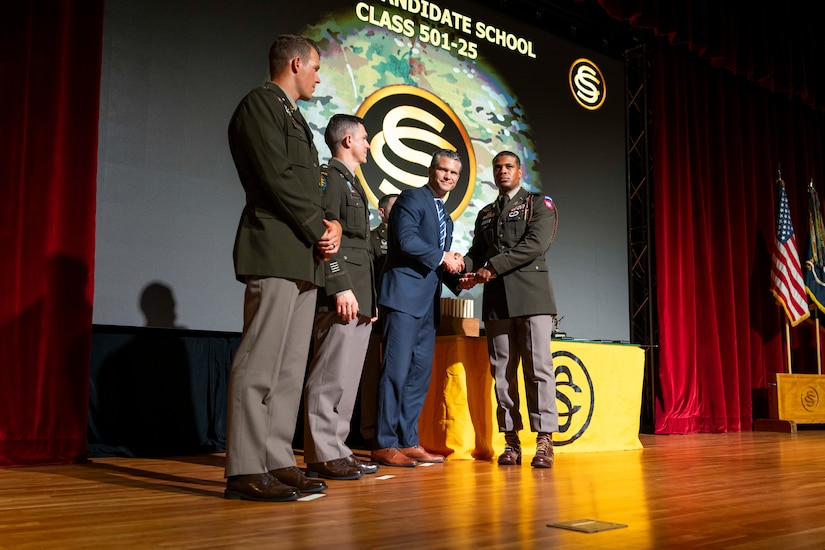
A person in a blue suit and tie hands an item to a soldier in a green uniform as two other soldiers look on.

Among the graduates was Army 2nd Lt. Darren Greene, a prior enlisted paratrooper, whose decade in uniform began in basic training and now turns toward leading soldiers. 

"I'm living the life right now," Greene said after the graduation. 

Greene called the ceremony "perfect," the culmination of a well-rehearsed week. In the days leading up to graduation, he said the class "rehearsed constantly, nonstop" from Monday through Thursday to make sure every movement landed on time and to standard. 
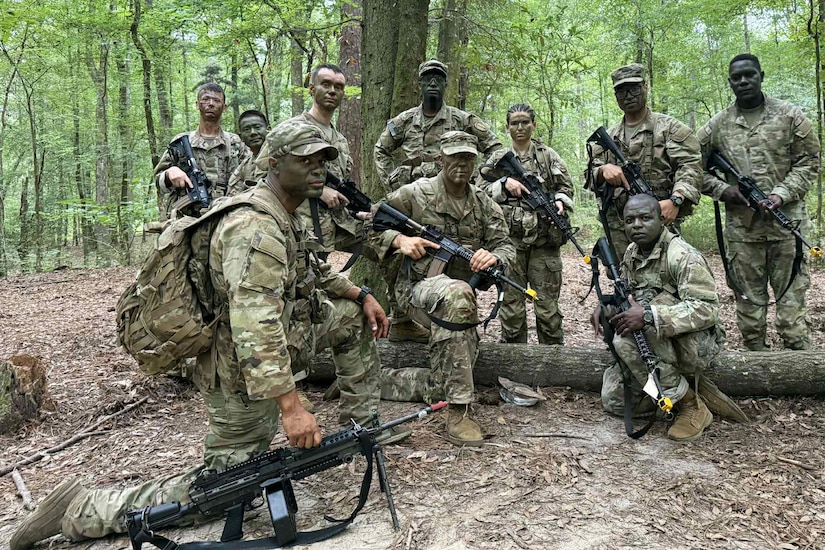
Soldiers in camouflage uniforms with guns mill about in the forest.

Greene's path to becoming a commissioned officer did not follow a straight line. He first entered military training as a college student at West Virginia University, where ROTC shared space with big campus distractions.  

"I kind of got sucked into the big party, school lifestyle, frat parties, house parties," he said.  

Greene left Morgantown without a commission, enlisted in 2014 and went to infantry training and Army Airborne School before reporting to the 82nd Airborne Division. 

From 2016 through 2017, Greene deployed to Iraq during Operation Inherent Resolve, supporting missions that moved from Baghdad northward. The experience cemented his decision to make the Army a career, and he began chipping away at the college credits he needed to finish his degree.  
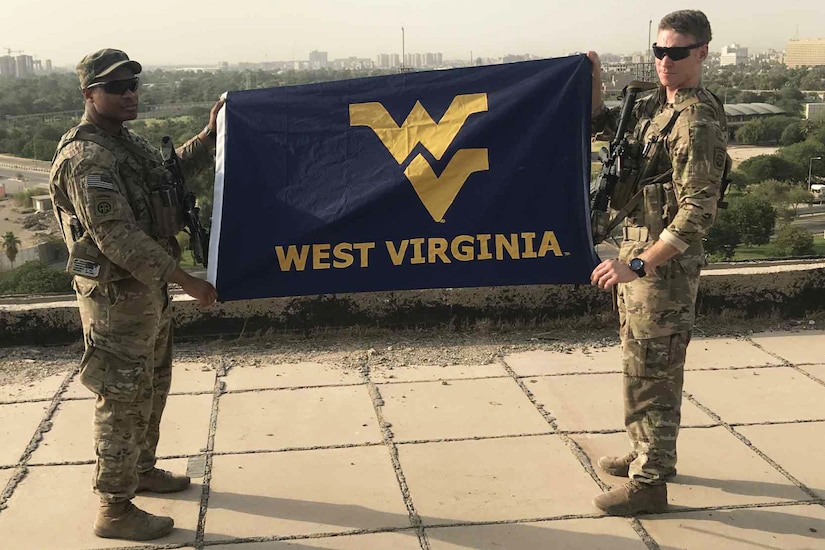
Soldiers in camouflage uniforms hold up a University of West Virginia flag.

"I took the long route to my college graduation, right?" he said, describing years of part-time coursework that ultimately led back to West Virginia University and a completed capstone in 2023. 

Greene advanced from private to sergeant and served overseas in Italy before returning to the 82nd Airborne Division, where familiar leaders noticed his trajectory. He credits mentors for hammering home expectations he intends to carry into his commission.  

"The two biggest things that you are responsible for are yourself and the reputation of your unit," Greene said. "If you're not the standard-bearer, you can't, like, you can't expect people to follow you." 
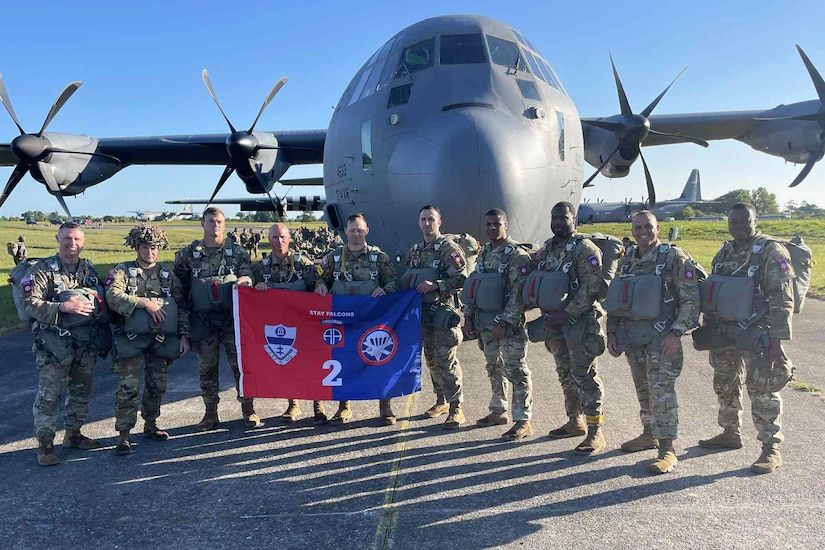
Soldiers stand in front of a four-propeller aircraft on a runway.

Hegseth's message to the class echoed that mindset and the school's motto.  

"It is great to be here at Fort Benning. And it is Fort Benning," he emphasized, before praising the OCS creed of "standards, no compromise."  

Hegseth urged graduates to anchor their leadership in fundamentals and preparation, invoking a battlefield lesson popularized by Army Lt. Gen. Hal Moore: "There's always one more thing you can do to increase your odds of success."
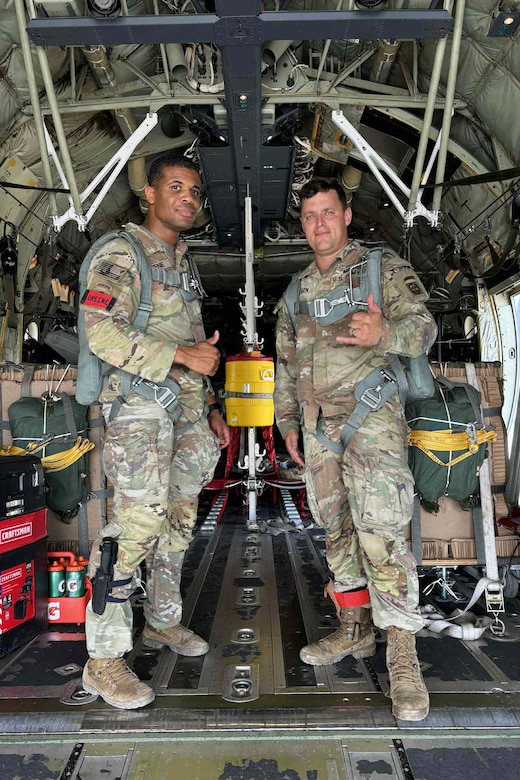
Two soldiers in camouflage uniforms stand in the back of an aircraft, each making a signal with one hand.

That preparation, he said, begins with knowing the mission, the terrain and the formation, then trusting and leveraging experienced noncommissioned officers. The secretary also emphasized decentralized decision-making in combat.  

"We're going to make sure that decisions are pushed down to the lowest possible level where they should be made," Hegseth said. 

OCS's 12-week crucible is designed to make those expectations real. The class's prior service population — including soldiers like Greene, who had already led squads and teams — brought practical experience to land navigation, small-unit tactics and troop-leading procedures. The transition now moves from OCS to the Basic Officer Leader Course, where lieutenants learn branch-specific skills before reporting to their first platoons. 

Greene understands that the work ahead will test his time-management skills as much as his tactics. He and his wife are raising two young sons, ages 3 and 1, and BOLC will mean months away from home. But he views the sacrifice as an investment in the soldiers he will soon lead and the noncommissioned officers he plans to rely on. 

Greene's deployment and subsequent years in airborne formations shaped a leadership philosophy that fits OCS's emphasis on standards and accountability. He talks about earning trust through preparation, showing up ready and listening hard to the NCOs who own the craft. Those habits — and his insistence that a leader's personal reputation is inseparable from the unit's — mirrored the ceremony's themes and the charge delivered from the lectern. 
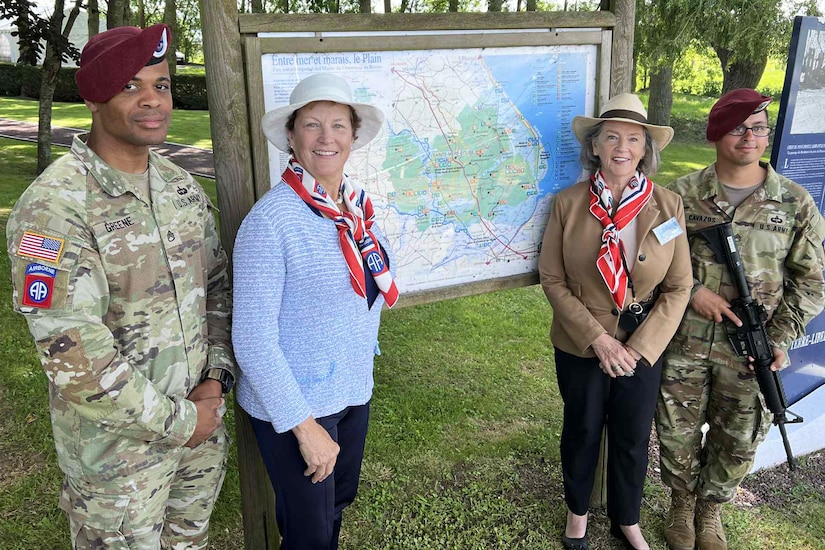
Two soldiers in camouflage uniforms, one holding a rifle, stand next two people dressed in civilian clothing near a map displayed in a grassy area, with trees in the background.

"You have been forged and now you will forge," Hegseth told the graduates.  

The line landed as both a compliment and a warning: the hard part starts next. The 12-mile rucks and field problems will give way to training calendars, maintenance meetings and the daily work of building lethal, disciplined teams that can execute under pressure. 

Greene, for his part, leaves OCS clear-eyed about that responsibility. The pride of crossing the stage quickly yields to the reality of a first platoon sergeant waiting on a new lieutenant to set a tone. Standards, he knows, flow from the front — and they are contagious.

Tuesday, September 11, 2012

Former Paratrooper Now Serves as Paralympian


By Army Sgt. 1st Class Tyrone C. Marshall Jr.
American Forces Press Service

LONDON - After serving her country for nearly 10 years as a paratrooper, Centra “Cece” Mazyck continues to answer the nation's call at the 2012 Paralympic Games here.

Mazyck, who served with the 82nd Airborne Division, based at Fort Bragg, N.C., is a javelin thrower for the 2012 U.S. Paralympic team.

“It's been a great, great journey [and] experience,” she said. “It's surreal. The crowd is phenomenal.”

Here for her first Paralympic Games, the Army veteran explained what goes through her mind as she prepares to compete.

“I try to stay focused and try to remember all the points,” Mazyck said. “Chest first – lead with your chest. [I try to] make sure I get that long stretch in the back with the javelin, and [then] just fire like a rubber band. “[I] just continuously run through that process in my head.”

Mazyck said she is so passionate about the javelin, she decided to forgo the other traditional track and field events.

“I think the javelin found me,” she said. “I really have a passion for it. It's a really technical sport. I just fell in love with it. I dropped everything else – shot put, discus – for the javelin. I love it.”

In the Army, Mazyck started off as an administrative specialist in the 82nd Combat Aviation Brigade at Fort Bragg jumping with the 82nd Airborne Division.

“And then I moved on to the Advanced Airborne Course Jump Master School,” she said, “where I became a jump master,” she said.

On a high-altitude jump in November 2003, Mazyck suffered a spinal cord injury.

“Unfortunately, on that cold November day, I got entangled with another jumper and I landed wrong, which caused me to become an incomplete paraplegic,” she said. “I retired in 2005.”

Mazyck credits her military career for helping her “adapt and overcome” – she calls that her sports motto -- and become a Paralympian.

“Being a paratrooper, and being in the military service, definitely helped me become a Paralympian,” she said. “With both of them, you have to stay focused and dedicated. And you have to serve your country with the utmost respect. So that's how the two are very parallel.”

Mazyck said she is grateful for the privilege of serving her country again, and looks forward to the 2016 Paralympic Games, set to take place in Rio de Janeiro.

“It is definitely an honor to serve my country – No. 1, as a veteran, and No. 2, as a Paralympian,” she said. “Words cannot express [my feelings]. I just think God gave me a second chance to serve my country. I will not let … any adversity stop me. I will proceed on. … Look out, Rio!”

Saturday, August 11, 2012

New DIA Director Expects Intensified Demands for Intelligence


By Cheryl Pellerin
American Forces Press Service

WASHINGTON  – The new director of the Defense Intelligence Agency is approaching his dream job with eyes wide open, valuing people over technology and expecting a future that holds more intense demands for intelligence.

Army Lt. Gen. Michael T. Flynn became DIA director July 24, as well as commander of the collocated joint functional component command for intelligence, surveillance and reconnaissance that is part of U.S. Strategic Command.

“If there’s a dream job for me, this is it,” Flynn said during an interview with American Forces Press Service.

His vision for the agency, the director added, “is to operationalize the capabilities that DIA brings to bear, for the defense community and specifically in support of our combatant commanders -- [the] commanders and organizations that are spread throughout the globe in support of our nation’s defense.”

DIA personnel are deployed in 139 countries around the world, with more than 500 serving combat forces in Afghanistan.

“People don’t always know that some of the men and women who are out there are even from DIA,” Flynn said. “They show up and they live and breathe with the units they’re [supporting], doing an intelligence analysis mission and helping commanders understand what’s happening in their environment.”

The general began his own career as a paratrooper with the 82nd Airborne Division at Fort Bragg, N.C. He has served in command and staff positions, with multiple tours in Iraq and Afghanistan, including as director of intelligence for U.S. Central Command and director of intelligence for the International Security Assistance Force in Afghanistan.

DIA, Flynn said, “has an enormous responsibility for defense in general and certainly for providing intelligence support to our war-fighting forces. It did quite a bit for me personally and certainly for the units that I was a part of over the last … couple of decades.”

In an open letter to the men and women of DIA, the director said DIA’s analysis must be timely, responsive and relevant to the needs of customers that include the military services, and increasingly international, domestic and private-sector partners.

“We must strengthen our human intelligence collection against strategic defense targets growing more difficult to penetrate, while fully incorporating counterintelligence. We must continue to integrate science and technology to enhance our operations,” he wrote.

Flynn is a graduate of, among other institutions, the U.S. Army Command and General Staff College and School of Advanced Military Studies, whose graduates are informally known as Jedi Knights, a reference to lightsaber-wielding members of the Jedi order featured in “Star Wars” films.

He’s also earned an honorary doctorate from the Institute of World Politics and three master’s degrees, including a Master of Business Administration degree in telecommunications. But people are his real focus.

“The best technology to invest in is the technology between the ears,” he said. “Regardless of what we have in terms of technology, we have to invest in the people … so we’re leading technology and technology is not pulling us along.”

Such an investment, Flynn added, has everything to do with innovation -- allowing people to take risks in thinking and in trying new ways to present information, to bring ideas forward, and to allow people freedom of action to try new things.

An innovator himself, Flynn is known in the intelligence community as one of three authors in January 2010 of a report published by the Center for a New American Security that was critical of intelligence in Afghanistan.

“Fixing Intel: A Blueprint for Making Intelligence Relevant in Afghanistan” by Flynn, who at the time was the senior intelligence officer in Afghanistan, Marine Corps Capt. Matt Pottinger, and DIA senior executive Paul D. Batchelor, was based on discussions with hundreds of people inside and outside the intel community.

The report recommended sweeping changes for the intel community, including moving from a focus on the enemy to a focus on the people and culture of Afghanistan, or any country where U.S. forces are deployed.

In the lead-up to writing the report, Flynn said, “what I began to realize is that we’re not seeing the … trees [for] the forest. We’re missing something here.”

What was missing for the intel community, he said, was a focus on the total environment rather than the threat alone.

“There was not a sound understanding of what the environment was like, so I think that in our cultural awareness, our language capabilities, our insight and training … prior to forces entering in this case Afghanistan, we were missing something in a big way,” Flynn said.

“The fact that we have brought laser focus to that issue has made us smarter, more aware, more tuned in” to a process that is also relevant to the pivotal events occurring now in North Africa, Syria, Yemen and in several African countries.

The intelligence community has also matured in other ways, Flynn said, and has come to see in itself a much greater role operationally.

The operational community sees this integration of intelligence and operations in a way that’s much different now from 10 years ago, Flynn said. As DIA goes forward, it will look hard at its integration with the operational community and with the combatant commanders, the general added.

“Intelligence at the edge is better than intelligence at the center. … We have to be in the field, [and] we’re already taking a hard look at how … we place ourselves in a much more operational footprint globally to be more responsive, to be more agile, to be more flexible in the kinds of needs that our nation [will have] here in the coming decade,” he said.

Thursday, December 22, 2011

Face of Defense: Toy Drop Becomes a Family Affair

By Army Staff Sgt. JaJuan S. Broadnax
49th Public Affairs Detachment

FORT BRAGG, N.C.  – Army Command Sgt. Maj. Paul Vallade and his son, Army Sgt. Joseph Vallade, spent a special day together Dec. 10, when both paratroopers participated in the annual charity toy drop near here.

The father-son duo jumped from an aircraft together for the first time – possibly the only time -- and earned Thai army jump wings in the process.

The junior Vallade arrived to the 82nd Airborne Division’s 4th Brigade Combat Team nearly three years ago. He’s a military policeman in the brigade’s Special Troops Battalion. His father took over responsibilities as the command sergeant major for the 82nd Sustainment Brigade’s Special Troops Battalion earlier this year. They’ve been trying to coordinate a jump together ever since.

The 14th annual Randy Oler Memorial Operation Toy Drop provided the opportunity. Participating paratroopers are supervised by a foreign jumpmaster from one of ten countries. This year, the Vallades’ jumpmaster was from Thailand.

“The odds of us jumping together are not the best in the world, so today was a very special day for us,” said the senior Vallade. “It will probably be the only jump that I will have with this young sergeant before he gets promoted again or I retire.”

“I was thinking that I would never get a chance to jump with him, but thank the Lord,” he added.

Vallade is in his 28th year of service, but his son has the edge on airborne operations, he said with pride, praising Sgt. Vallade for getting his twelfth jump that day. Command Sgt. Maj. Vallade has seven.

“That’s why he got to go in front of me today,” Vallade said of his son. “That doesn’t happen often.”

“The good thing about jumping side-by-side is that he was teasing me most of the day,” he added. “He gave me six cherry pies to put into my pocket. Needless to say, I did not jump with the cherry pies in my pocket.”

“Now I’m just waiting to [inspect his parachute],” said Sgt. Vallade, referring to his ambition to become a jumpmaster.

Command Sgt. Maj. Vallade said that along with having his battalion commander enlist his son into the military and being able to drop him for his first pushup, the chance to jump with him is something he always will remember. His son agreed.

“It’s awesome to have someone to look up to,” said Sgt. Vallade. “I’ve always wanted to be in the Army. It’s awesome to finally be here and be able to look directly up at my dad in uniform and out of uniform.”

“He’s most definitely my role model,” he added.

Command Sgt. Maj. Vallade is equally proud, as his son has developed a reputation for taking care of his soldiers.

“I love you, boy,” he said, as he patted him on the shoulder.

The jump may be the Vallades’ last opportunity as Joseph is about to embark on his second Afghanistan deployment. His father soon will retire from the Army.

Both are feeling the anxiety about the junior Vallade’s upcoming mission, they said. Command Sgt. Maj. Vallade explained that although he has five combat deployments under his belt, nothing can prepare a father to send his son off to war.

“When you’re the deployer, you don’t think about it,” Vallade said. “You train and you prepare, but when your son or your family member is gone downrange, you don’t get a break. You’ve been there, done that. You know what could happen.”

“But, I know that he is trained for it,” he added.

Vallade said the only thing that could top the pride he felt jumping with his son and watching him turn into the combat-proven soldier he’s become, is to jump with both of his sons. The third Vallade is an Army lieutenant.

“If I could get that to happen before I retire, I wouldn’t need a retirement gift,” he said. “That would be my gift.”

Friday, December 16, 2011

Face of Defense: Ballerinas Perform in ‘The Nutcracker’

By Army Sgt. Chris Harper
82nd Airborne Division Public Affairs Office

FORT BRAGG, N.C., Dec. 16, 2011 – Many of the 60 dancers who perform in a local production of “The Nutcracker” ballet are the daughters of service members stationed here.

The ballet, performed by the North Carolina State Ballet troupe, has in recent weeks entertained thousands at the Crown Center in nearby Fayetteville.

Ashley Watters, daughter of the 82nd Airborne Division’s chaplain, Army Lt. Col. Jeff Watters, who is now deployed to Afghanistan, has danced ballet for more than 11 years. This is her second seasonal appearance in the state ballet’s “Nutcracker” production.

Ashley began her dancing journey right here.

“I began dancing at a little place on-post at Tolson Youth Center,” Ashley said.

Erin Rafferty, 11, daughter of Lt. Col. John Rafferty, commander of the 1st Battalion, 319th Airborne Field Artillery Regiment, 3rd Brigade Combat Team, 82nd Airborne Division, has danced with the state ballet troupe for nearly two years.

Erin also played multiple roles in the “Nutcracker” production, including the head mouse, a child and as one of the clowns, which she admits was her favorite.

“I liked doing all of the cartwheels!” Erin said.

Erin’s father said he was impressed with the ballet troupe’s performance on Dec. 4.

“I got to be backstage tonight, and what I didn’t realize was how everything runs so precisely,” said Rafferty, noting he’d expected that backstage goings-on would be more hectic. But operations, he noted, went like clockwork, and the performers knew where to be, and when to change their costumes.

Also featured in “The Nutcracker” performance, which was directed and choreographed by Charlotte Blume, was Anne Talkington, 17, an 11-year member of the North Carolina State Ballet, and the daughter of Mark Talkington, a retired Army colonel.

“It was getting the opportunity to perform with the “Prince” from the Carolina Ballet in Raleigh,” Anne said about the evening’s highlight for her. “He’s professional.”

Sarah Middleton, 13, daughter of Lt. Col. Dan Middleton of the XVIII Airborne Corps based at Fort Bragg, danced the ‘Spanish Variation’ and the ‘Waltz of the Flowers’. Smiling following the opening show, Sarah said her dancing was enhanced by the adrenaline rush she received by performing in front of friends and family.

Paris Sullivan and Lauryn Meehl, both age 11, and Rebekah St. Cyr, 13, account for more than 18 years of dance experience between them. Each is the daughter of Fort Bragg soldiers and each danced to the delight of the audience.

Wednesday, September 14, 2011

Face of Defense: Amputee Earns 'Sergeant Airborne' Title

By Cheryl Rodewig
1st Infantry Division

FORT BENNING, Ga., Sept. 13, 2011 – Like thousands before him, Army Sgt. Joel Dulashanti donned an Airborne instructor black hat for the first time last month, signifying his completion of a detailed certification process with 1st Battalion, 507th Parachute Infantry Regiment.

Unlike those before him, he met the standard with a prosthetic leg, a partial knee replacement and the aftermath of internal injuries suffered during an ambush in Afghanistan. With his wounds, he could have taken a medical discharge from the Army, but the paratrooper chose to stay in -- and to remain Airborne all the way.

"It's still brand new," he said, "but it feels good to actually have my hat."

Dulashanti's determination in the face of adversity, evident at the unit, will be instrumental in training Airborne students, said Army Command Sgt. Maj. Chip Mezzaline, battalion command sergeant major. More than 17,000 students come through the battalion each year.

"He's had a traumatic injury and had the resilience to stay on active duty and serve as an instructor in a position that's high-risk," Mezzaline said. "It's in his character -- something you can't teach. It's something inside him that's going to drive him to be successful in whatever it is that he's doing. I don't think 'can't' is in his vocabulary.

“Being a ‘Sergeant Airborne’ -- a ‘black hat’ -- at the Basic Airborne Course will inspire numerous students coming through here," he added.

Mezzaline said Dulashanti completed the instructor certification program at a level "above the standard." He trained on the lateral-drift apparatus, the mock towers, the 250-foot tower, the swing-landing trainer and the spin harness, and memorized a block of instruction for the mock tower exit.

"He's a paratrooper," Mezzaline said. "He comes from the 82nd Airborne Division. That Airborne career he probably thought was cut short, but this is new life for him here at the Airborne school. I predict within the next year he'll be a jumpmaster, probably a senior-rated jumpmaster, and he'll be doing door checks, exiting students at 1,250 feet above Fryar Drop Zone.

"And with his level of motivation, he'll probably move on to that next mark and be a centurion, which is 100 exits out of an aircraft," he continued. "The sky's the limit for Sergeant Dulashanti here at the 507th."

Dulashanti said he wants to do everything he can -- from jumpmaster to centurion -- while stationed here. A six-year veteran, he arrived at the battalion in May. Four years earlier, he was deployed as a sniper attached to the 73rd Cavalry Regiment. He remembers the details vividly.

"We were chasing two guys -- they were on a mo-ped together and we were in Humvees," he said. "They took off in the field and the sniper team went out. It was about 110 degrees outside, over 6,000 feet above sea level, and with no humidity -- all you could smell was the earth and burnt grass. As we were walking in this knee-high grass, I started to smell body odor, so I stopped and turned to my right in the direction of the odor. They began to engage in contact.

"They had AK-47s and they were lying in the prone about 10 meters away," he continued. "I took two rounds to my right knee. As I was coming out of the sun, I was shot through my left knee. As I was falling, the next round that came through went under my arm, through my ribcage and, since I was parallel to the ground, it traversed my entire abdomen down to my pelvis. That round was the worst. We returned fire, and those guys were finished."

Two platoons donated plasma to him before he was evacuated to the United States. Once he arrived at Walter Reed Army Medical Center in Washington, D.C., it took him eight months to be comfortable walking.

"The recovery process started off slow, [but] I accelerated fast," he said. "Most of the stuff can be replaced. I have a partial knee replacement on my left side. I have an above-the-knee amputation on my right side. I'm missing half of my stomach and 90 percent of my intestines and gall bladder, and half of my abdominal wall is gone."

He chose to stay in the Army in part for the fellow soldier recuperating alongside him in the hospital, he said.

"I had to set that example for the rest of the Army, just based on the fact they couldn't do it and they wanted to," he said. "Maybe in the future, somebody else will have an easier time getting to do stuff like this because I've done it already."

Since then, Dulashanti completed the Warrior Leader Course and the Advanced Leaders Course, among others. But his goal was to be part of Fort Benning's Airborne battalion.

"Mentally, I knew I could exit an aircraft, and I knew I was able to instruct people on how to exit an aircraft and to land on the ground properly," he said. "When I called about the job, the only question was, 'Can you jump out of planes?' and even though I hadn't done it, the answer was 'yes,' without a doubt. I knew I wouldn't be a safety hazard, so the answer was 'yes.'"

"It was pretty intense," Dulashanti said of the studying it took to pass the certification program, but other instructors helped him along the way.

"I have to kind of be on my ‘A’ game all the time," he said. "But at the same time, I do have limitations, so I have to make sure I take care of myself to prevent injury."

His "limitations" aren't something he tells every class of students about, but occasionally he mentions it or they find out. "Sometimes people ask me why I have a limp," he said. "I tell them I don't have a leg, so it's not really a limp."

His advice to other wounded warriors is simple: choose whether or not to have a positive outlook.

"Make up your mind," he said. "Everybody has to go through their own coping mechanisms. Sometimes you're in a denial state; when you come out of that denial state, then deal with what it is you have to deal with. Seek counseling if you have to. I never gave negativity even an opportunity to invade my mind. There was only one route for me in the first place."

Wednesday, August 31, 2011

Soldier Saves Friend from Committing Suicide

By Stephenie Tatum
Fort Bragg Public Affairs

FORT BRAGG, N.C., Aug. 31, 2011 – On the outside, Army Spc. Josh Brown looks and acts like an average 22-year-old paratrooper serving in the 82nd Airborne Division here.

Brown’s dark hair is close-cropped against his skull, and he prides himself in the jump wings he’d earned. He also smiles often, revealing the sense of humor he’d often used to mask the growing, gnawing pain in his life.

Yet, no one knew what Brown, whose name is fictitious to protect his privacy, was feeling on the inside. Brown said that a multitude of things led him to want to kill himself. For the past six months, Brown said he was feeling unhappy with himself and the path his life was taking.

He suffered from family and financial issues, relationship problems, constant physical pain from a jump accident, insomnia and poor adjustment after arriving at a new duty station.

If that was not enough, Brown’s 1980 Chevrolet Camaro -- his most-prized possession -- had been vandalized and the process to get it fixed through his insurance company was not going well.

When Brown quit calling and making plans to socialize with his close friend, Army Spc. Christy Sawyer, she’d thought nothing of it and figured he just wanted to spend more time with his other friends.

Sawyer, a medic in 2nd Battalion, 508th Parachute Infantry Regiment, 4th Brigade Combat Team, 82nd Airborne Division, had no idea until the morning of Aug. 7 that Brown, also a medic in the 82nd Division, had been withdrawing and for the past two weeks was planning to commit suicide.

Brown said his issues caused him to become overwhelmed and feel like his world was caving in on him.

The night he decided to end his life had started out like many previous nights, Brown said.

“I went to the club and started drinking,” he recalled. “Part of my plan was to take the $100 I had, and drink as much as I could and then go wreck my car to make it look like an accident.”

After leaving the club and going to another bar, Brown ran into a friend who knew something was not right with him. After some time, she persuaded him to talk.

“I have things I need to do tonight and you’re not going to stop me,” Brown told the friend.

The friend then contacted Sawyer, a coworker and mutual friend, for help.

The eight missed phone calls and two text messages that night from Brown, and her conversation with their mutual friend told Sawyer that something was very wrong with Brown.

“I had just got back from block leave and had forgotten my phone in the barracks when I went to pick up some friends who were having car trouble,” Sawyer said. “He actually left me a message telling me goodbye. I still have not listened to it. I can’t do it.”

After speaking with her friend, Sawyer drove to the bar to get Brown. When she arrived, Brown was sitting in his car, distraught and unreasonable. Sawyer said she reached in and took the keys out of his ignition. They talked for a long time; Brown continued to tell her he was sticking to his plan to end his life that evening.

Sawyer said she tried to talk Brown out of taking his life.

“I tried to explain to him that I can’t live with that kind of guilt,” she said. “I just kept telling him, ‘It’s not going to happen.’ I was trying to wake him up.”

At one point during the evening, Brown decided to run. He threw himself over the hood of the car, but his friends caught him before he got very far. After the chase and multiple failed attempts to get Brown to calm down and listen to reason, his friends decided to contact the unit chaplain.

The 4th Brigade Combat Team chaplain called Brown’s unit, which then sent staff duty personnel to get him. Sawyer met the staff duty members at an elementary school parking lot in Fayetteville near here, where Brown once again tried to run away.

After being caught a second time, Brown was taken to the barracks and placed on a 24-hour, three-day suicide watch. He was referred to Womack Army Medical Center here for mental health evaluations.

Sawyer credits her concern for Brown for taking action to save him.

“I think mostly, for me, it was the fact that I care about him so much. He is like my baby brother,” she said. “There was no way I was leaving him. I would not have let him go regardless. I was ready to do whatever it took.”

Sawyer said she’d applied her suicide prevention training to save her friend.

“I see [suicide] a lot differently now,” she said. “I think suicide training is something soldiers need to have and it needs to be emphasized.”

Yet, Brown had attended suicide prevention training at his unit just three days before he’d threatened to kill himself.

“I understood the point of it and I saw the briefing, but I guess I just did not want anyone to stop me,” Brown said. “I was not looking for help.”

Brown said his turning point came the next night when the adrenaline wore off and he realized he was still alive.

“Once I got some sleep and woke up the next day, I felt depressed and empty,” Brown said. “Knowing I wasn’t supposed to be here felt weird. For about two days afterwards, everything felt so unnatural. I honestly didn’t expect to be where I was. It was like everything just hit restart.”

Today, Brown is receiving treatment as he continues to serve in the 82nd Division. Brown is thankful, he said, for the help and support he’s received from his fellow soldiers, noncommissioned officers and officers in his unit.

Sawyer said she finds herself getting upset whenever she thinks about the night Brown wanted to take his life and worries about what could have happened if she hadn’t been there.

“I want him and other people who are thinking about doing this to understand what you are doing to the people in your life -- your friends, your family and your spouses and your relationships,” Sawyer said. “This devastates people. I am still so upset.”

Tuesday, June 07, 2011

Paratroopers Commemorate D-Day Anniversary

By Donna Miles
American Forces Press Service

WASHINGTON, June 6, 2011 – About 300 U.S. soldiers, most of them combat veterans themselves, joined their British, French and German counterparts in Normandy, France, to honor the sacrifices of World War II veterans who conducted the D-Day invasion 67 years ago today.

The troops spent the last few days visiting key battle sites during the mission code-named Operation Overlord: the beaches 160,000 troops stormed on June 6, 1944, during the largest amphibious invasion in world history; and St. Mere Eglis, the first French village to be liberated by U.S. 82nd and 101st Airborne Division soldiers, among them.

Throughout the visit, where they received briefings about the history of the sites and got a firsthand look at the tactical challenges Allied forces faced, the troops participated in D-Day commemorative ceremonies and met veterans of the invasion.

Today, they took part in ceremonies at Ponte du Hoc, the formidable cliff-top perch west of Omaha Beach that U.S. Rangers assaulted; and Utah Beach, the westernmost of the five D-Day landing beaches.

“Getting the chance to be here has been an amazing opportunity,” Army Capt. Ted Jacobs, executive officer for the Army Reserve’s 345th Tactical Psychological Operations Company in Dallas said by phone as he waited for the Utah Beach ceremony to begin. “Seeing what these veterans had to go up against -- the terrain, the weather situation, … the wet, the cold, being in fear of their lives all the time -- it really does help you understand the challenges they had to deal with.”

Jacobs is among about 150 Army Reserve paratroopers with the U.S. Army Civil Affairs and Psychological Operations Command, with headquarters at Fort Bragg, N.C., participating in Operation Airborne Normandy, a mission that is bringing together U.S. and European forces for commemorations and interoperability training.

Other U.S. participants include active-duty soldiers from the 82nd Airborne Division at Fort Bragg; 173rd Airborne Brigade Combat Team at Vicenza, Italy; 101st Airborne Division at Fort Campbell, Ky.; and riggers from the Army Reserve’s 824th, 421st and 861st Quartermaster Companies and U.S. Army Europe’s 5th Quartermaster Detachment.

One planned event, a combined jump involving more than 700 U.S., British, German and French paratroopers, has been canceled twice due to bad weather. Participants are hoping the event may take place tomorrow, conditions permitting, to enable every paratrooper who jumps with another country’s jumpmaster to receive that country’s jump wings.

Meanwhile, the soldiers called the chance to meet with veterans of the D-Day invasion the highlight of the visit.

“I feel honored to have the opportunity to come out here and meet them face to face and shake their hands and say thank you,” said Army Sgt. Nathaniel Bier, a veteran of Operation Iraqi Freedom serving with the 301st Psychological Operations Company from San Diego. “That is one of the best things I will always remember about this trip.”

With two combat deployments in Afghanistan under his belt, Jacobs said, he gained a new appreciation for the odds the Allied forces -- including his own father -- faced during Operation Overlord.

Then-Sgt. Thomas Jacobs jumped into Normandy during the D-Day invasion, but has spoken little of the experience except to describe it as “godawful” until recent years. “We grew up basically with the understanding that we didn’t ask questions about that,” his son said. “He was one of those veterans who just wanted to forget.”

Bier shares Jacobs’ personal connection to the D-Day visit: his great-grandfather, who died before Bier was born, took part in the invasion. “My father really looked up to him,” Bier said of his great-grandfather. “So he was even more excited to hear that I was coming here than I was.”

Walking the beaches, seeing the formidable terrain and standing the ground his great-grandfather helped to liberate has given Bier a special appreciation of the magnitude of what happened in Normandy. Pausing to reflect on it, he admitted, “I had to stop myself from tearing up, because it’s so powerful just to be here.”

Bier said he’s been particularly struck by the courageous leadership the D-Day noncommissioned officers demonstrated in the face of adversity.

“I don’t know how some of those sergeants kept going, how they kept their people motivated as they were coming off the boats, and how they kept them moving forward,” he said. “My hat is really off to those sergeants.”

Jacobs said he, too, stands in awe of what the D-Day veterans accomplished, and declined to compare it with anything he has experienced in combat.

“I wouldn’t even dare to hold a candle to what those guys did,” he said. “Certainly, what we are doing in Afghanistan is at times very difficult and dangerous. But what these guys went through, there is no comparison. Ours is a counterterrorism fight, so there are brief moments of intensity, but nothing to even come close to the scale of events that happened here.”

Walking the hallowed grounds where many made the ultimate sacrifice “has given me a deeper appreciation for the legacy that has been left to us by the greatest generation by these soldiers who came over here and did what they did,” Jacobs said. “It further solidifies the fact that I do not ever want to betray that kind of legacy, and want to continue to build it and maintain what they have carved out for us.”

A high school math teacher in the Dallas public schools in his civilian life, Jacobs said he intends to share the experiences he’s gained at Normandy, like those from Afghanistan, with his students.

“All these values from the military are just common core good-citizenship skills and behaviors that these children desperately need, particularly those from the inner city,” he said. “So I incorporate everything I can from my experience in the military: what it means to serve instead of always looking out for yourself or putting yourself first, [and] thinking about putting others before yourself and service to the community and country,” he said. “That is just a core theme in my classroom.”

Monday, March 21, 2011

Face of Defense: Army Medic Builds Medical Career

By Army Sgt. Michael J. MacLeod
1st Brigade Combat Team, 82nd Airborne Division

FORT BRAGG, N.C., March 21, 2011 – From the ski slopes of Montana to the bomb-laced desert highways of western Iraq to the expert field medical badge course in the pine forests here, an 82nd Airborne Division medic is navigating his own path to a hands-on career in health care.

Army Pfc. Levi Meyer, one of 49 Army medics and health care providers with the division’s 1st Brigade Combat Team who worked to earn the mark of the expert field medic March 7-11, said the pathways and options open to soldiers are many, but he was choosing to take advantage of the military’s nationally recognized Interservice Physician Assistant Program, with the ultimate goal of possibly becoming a neurologist.

“I am applying to IPAP right now,” said the 20-year-old Billings, Mont., native while preparing to navigate the first of three scenario-based testing lanes for the expert field medical badge. As a medic attached to a company of combat engineers, Meyer recently spent a tour in Iraq, traveling the roads between Ramadi and Fallujah hunting for roadside bombs.

Army Capt. Jessica Larson, a physician assistant attached to Meyer’s brigade, said the Army’s PA program is an excellent choice. It rates consistently as one of the country’s top physician assistant programs, she said, and the financial support afforded in exchange for service takes a great burden off students.

“I went to a state school, so my expenses were a third of a normal PA program,” said Larson, a native of Chicago who left a lucrative career in aviation engineering when she was moved by amputees and other service members recovering from wounds received in Iraq and Afghanistan.

“My schooling, housing, books, food and other living expenses cost $106,000 for two and a half years,” she continued, “which included my rotation to Africa. However, without my scholarship, it would have cost around $134,000. PAs who attend private schools are typically coming out with over $200,000 in debt.”

Through the Army’s Health Profession Loan Repayment Program, civilian-trained PAs can have their student loans repaid up to $120,000 in exchange for a three-year additional duty service obligation, which is the route that Larson took. The downside, she said, is that students remain civilians during schooling, so they are not drawing Army pay.

“Meyer is saving a lot if he goes to [the Interservice Physician Assistant Program],” Larson said. “To come from that excellent background with no expenses, while drawing either lieutenant or Officer Candidate School pay for those two years, is a huge stress off the education process.

“However,” she added, “he is giving back with four years of service as an Army PA, and graduates deploy immediately. Being gone from your family for a year is a nonquantifiable cost, too.”

Becoming a physician assistant typically is not a stepping stone to becoming a medical doctor, Larson said, as much of the schooling is redundant. Soldiers considering one or the other should study both career fields and ask lots of questions, she added, because the Army uses physicians and physician assistants in very different ways.

For Meyer, who first treated injuries in Montana as a part-time ski patroller at Red Lodge Ski Resort during high school, a priority is to get more hands-on experience as a provider before committing to the long road into medical school. If Meyer decides to become a physician, he’ll use the Army’s Health Provider Scholarship Program to fund medical school, he said.

“I have had the full support of everyone in my chain of command, and they have been very helpful with writing letters of recommendation and allowing me the time to complete my packet,” Meyer said. “If all else fails, I can still exit the Army with a master’s degree and a useful skill.

“There are a lot of different routes that I can take to arrive at a point where I can start my [scholarship] packet,” he added, “but after doing a bit of research, I feel that [the physician assistant program] is best tuned to my goals.”