Showing posts with label guam. Show all posts

Saturday, July 25, 2026

Mission Marge Brings Legacy of America's 'Ace of Aces' to Guam Airmen

A recovered wingtip from "Marge," the legacy Lockheed P-38 Lightning fighter aircraft flown by Army Air Forces Maj. Richard Bong, America's World War II "Ace of Aces" and Medal of Honor recipient, touched down on U.S. soil for the first time in over 80 years at Andersen Air Force Base, Guam, July 13.  

The Wisconsin Air National Guard transported the historic artifact as part of Mission Marge, an effort to preserve a piece of World War II aviation history.
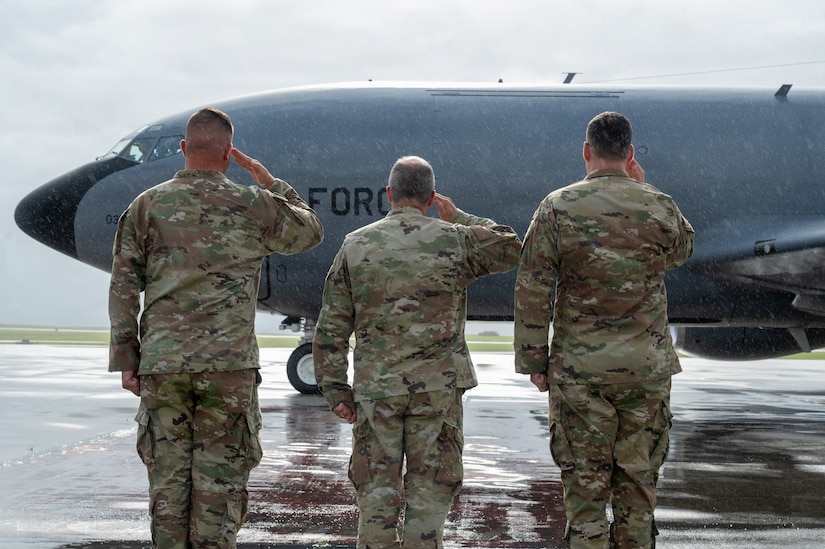
Three men wearing camouflage military uniforms salute a military aircraft.

"The leading World War II ace, Richard Bong, was born and raised in Poplar, Wisconsin," said Air Force Brig. Gen. Adria Zuccaro, the Wisconsin Air National Guard chief of staff-air. "The Wisconsin Air National Guard, who's a state partner, joined in on this really exciting historical moment."  

Zuccaro and the aircrew participated in the wingtip's recovery, transporting it aboard an existing mission returning from Papua New Guinea through the War Department National Guard Bureau State Partnership Program.  

The arrival marks a major milestone in Mission Marge, a collaborative preservation endeavor between the Richard I. Bong Veterans Historical Center and Pacific Wrecks.
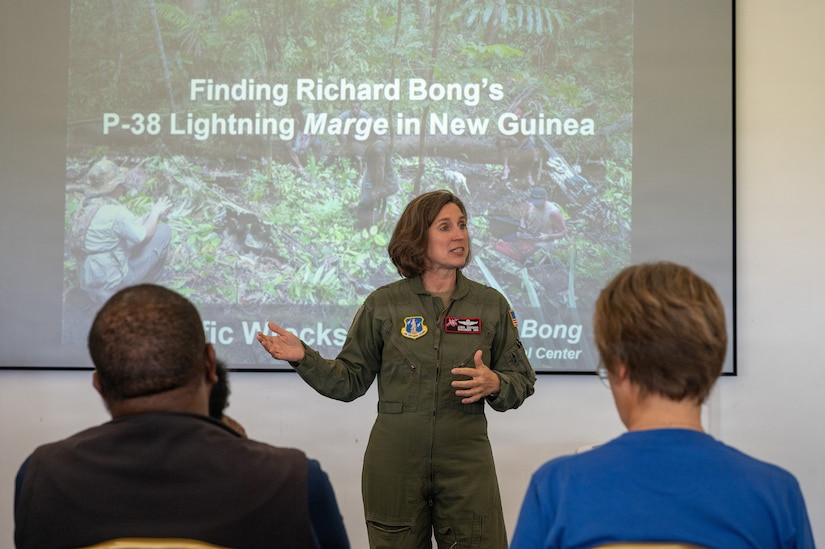
A woman dressed in an Air Force flight suit stands in front of a projector screen to address a group of seated people.

The plane, named after Bong's girlfriend and future wife — Marjorie Ann "Marge" Vattendahl — crashed in the jungles of Papua New Guinea in 1944 and remained undisturbed for decades. The return of this surviving segment bridges the legacy of America's "Ace of Aces" with the modern Air Force.  

The recovery effort brought together Bong's family, the Wisconsin Air National Guard, Pacific Wrecks, the Richard I. Bong Veterans Historical Center, the Papua New Guinea National Museum and Art Gallery and local communities, whose respective representatives made up the Mission Marge delegation that stopped by Andersen.  

Airmen gathered at the base's Sunrise Conference Center for a briefing led by Justin Taylan, founder of Pacific Wrecks, chronicling Bong's military legacy and the expedition that uncovered his aircraft.
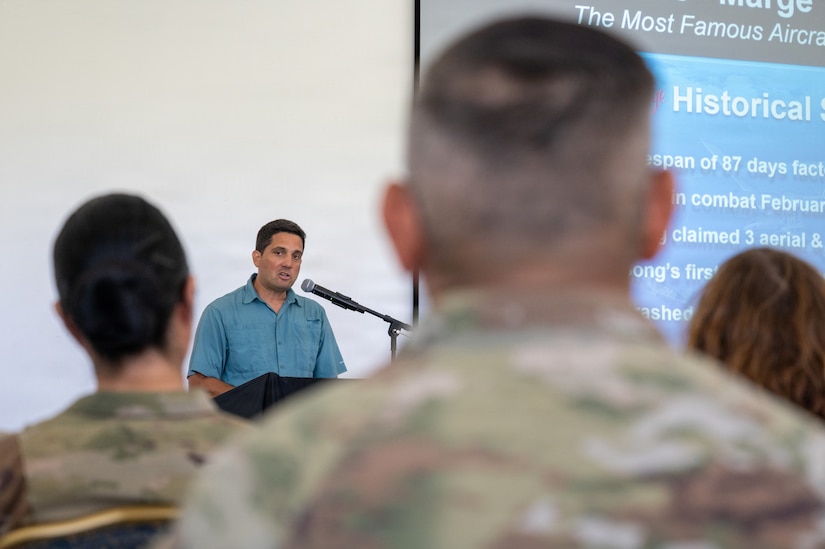
A man wearing a blue shirt stands at a lectern and addresses a crowd.

Taylan explained how historical records, archival research and an expedition to Papua New Guinea led investigators to the crash site in May 2024. The team documented thousands of images of the wreckage before identifying distinctive P-38 Lightning fighter aircraft components, which ultimately confirmed its identity.  

"Where the red paint had faded away, below it, was a black stenciled '993,'" he said. "Finding the serial number on that wreckage was the sign that we had waited for, that this is Richard Bong's plane."  

Mitchell Erickson, Bong's nephew, answered questions from attendees at the end of the brief, detailing the significance of the recovery to his family and Air Force history.
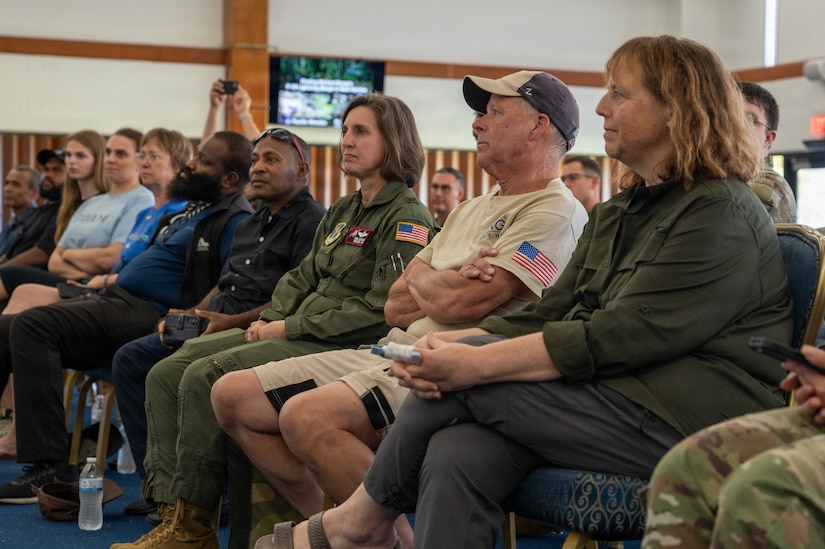
A group of people are seated in rows in a large room.

"Seeing a piece of your history come through, especially the aircraft of the 'Ace of Aces,' is significant for airmen today," Erickson said. 

Andersen Air Force Base served as the first stop for the historic wingtip after departing from Papua New Guinea, and it continued its journey to Hawaii before arriving at its final destination in Wisconsin.  

The wingtip was unveiled during the Experimental Aircraft Association AirVenture Oshkosh 2026 at Wittman Regional Airport in Oshkosh, Wisconsin, before becoming part of the Richard I. Bong Veterans Historical Center's collection in Superior, Wisconsin, where it will preserve Bong's legacy and educate future generations about one of the nation's most celebrated pilots.  

"For us [who] are currently serving, I hope what you take from this is that people do remember that our service is important, and it's not only important for those who serve, but it's important to your families," Zuccaro said. "You can take this as a demonstration that 82 years later, there is still family that this is incredibly important to."

Monday, July 06, 2026

Retired Submariner Commemorates Both Bicentennial, Semiquincentennial in Guam

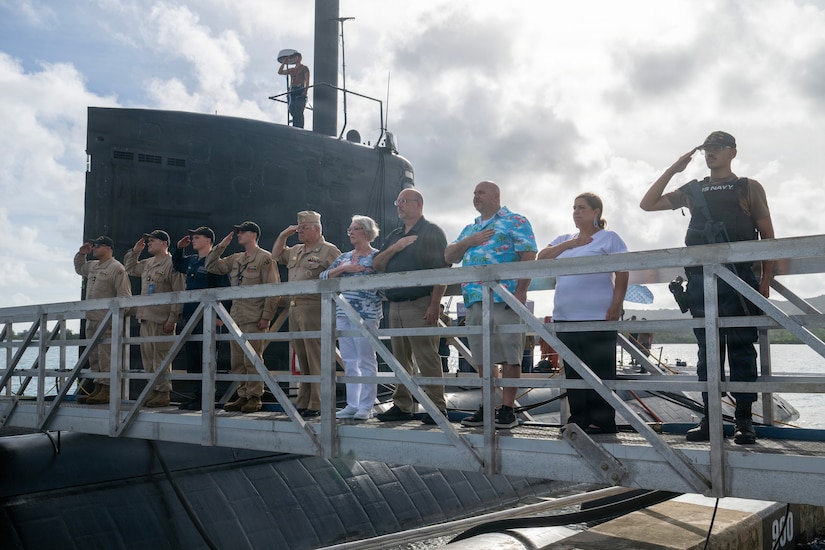
Fifty years after raising the national colors in Guam for America's bicentennial, retired Navy Cmdr. Allan Riggs returned to the island July 4 to commemorate the nation's 250th birthday alongside a new generation of submariners.

Nearly a dozen people wearing military and civilian attire salute while standing on the gangway of a submarine.

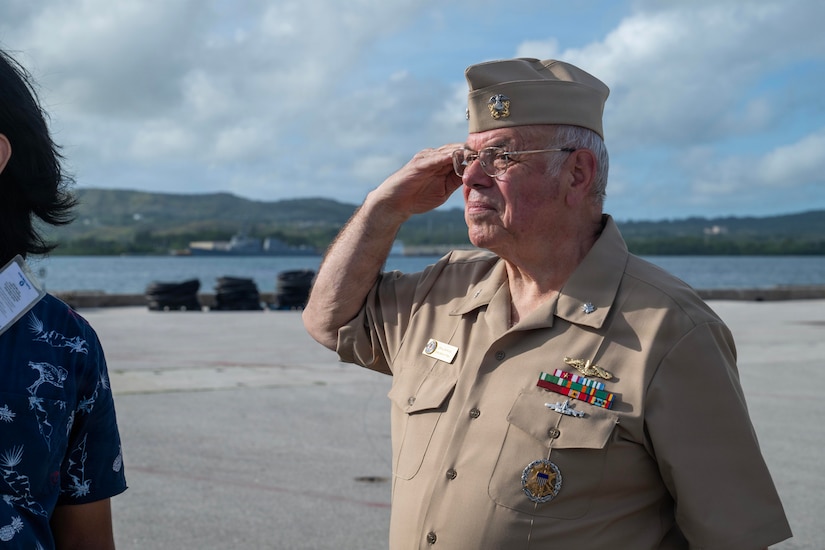
Riggs has now participated in morning colors from Guam during both America's 200th and 250th birthday celebrations, a distinction spanning half a century of submarine history.

Now 77, Riggs stood alongside the duty officer aboard the fast-attack submarine USS Annapolis as the national ensign was raised over the submarine.

"I served proudly for 27 years," Riggs said. "I'm proud of the country; I'm proud of where it's going, and I'm honored to be able to do this."

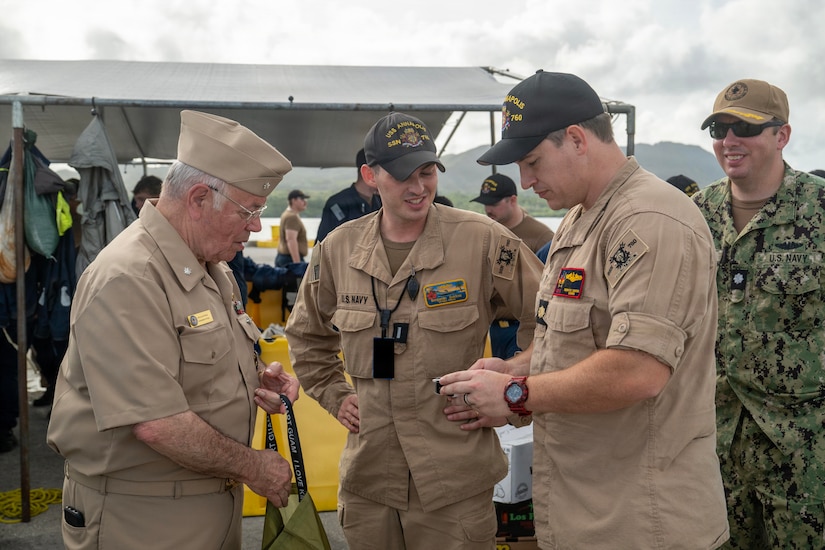
A man in a formal military uniform presents another man in similar attire with a gift while two others smile and watch.

On July 4, 1976, then-Navy Lt. j.g. Riggs was serving as the duty officer aboard the ballistic-missile submarine USS Theodore Roosevelt in Guam. That morning, he had the distinct honor of raising the national colors in recognition of America's bicentennial.

Serving in what he described as a symbolic location, the Roosevelt was the first submarine to raise the colors that historic morning in Guam, where America's day begins.

"It will remain one of the most profound privileges of my career to have executed morning colors on that historic morning in such a symbolically significant location," Riggs said.

Exactly 50 years later, Riggs returned to the same island to honor that moment and mark another milestone in the nation's history.

A man in a formal military uniform salutes an off-camera flag; mountains and water are in the distance.

When he approached Commander, Submarine Squadron 15, with the idea of returning to Guam for the historic anniversary, Navy Capt. Neil Steinhagen immediately recognized the significance of the occasion.

"Having Cmdr. Riggs as a guest aboard [the] Annapolis was an easy decision to support," Steinhagen said. "We often look back on our history and ask what has carried our nation and our Navy forward. Moments like this provide the answer. Morning colors is a tradition observed every day, but on the Fourth of July, the flag represents the freedom generations before us fought to secure and the promise today's sailors have volunteered to defend. By standing together aboard [the] Annapolis on America's 250th birthday, we united the legacy of those who came before us with the future leaders who will carry that fighting spirit forward."

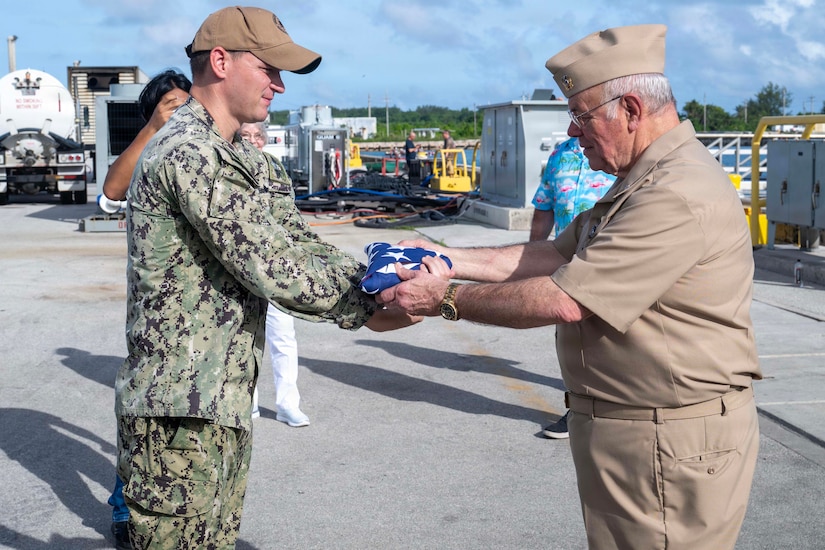
A man in a camouflage military uniform presents a folded American flag to a man in a formal military uniform; heavy equipment and transport containers are in the background.

For Riggs, returning to the place where he marked the nation's bicentennial offered an opportunity to connect two generations of submariners and reflect on a lifetime of service.

"This is a deeply meaningful opportunity to honor the enduring traditions of the submarine force, reflect on my service and pay tribute to the ongoing legacy of naval excellence in the Pacific," the Ohio native said.

Following morning colors, the color detail presented Riggs with the flag flown. Navy Lt. Cmdr. Derrick Simmons, the submarine's executive officer, also presented him with a commemorative flag certificate honoring the lasting example of his service.

The certificate stated that Riggs' presence served as a lasting reminder that while generations of submariners may change their devotion to duty, honor and country remain eternal.

The moment represented more than a celebration of the nation's birthday. It served as a reminder that the traditions of the submarine force are carried forward by the sailors who serve, the families who stand beside them and the generations who follow in their footsteps.

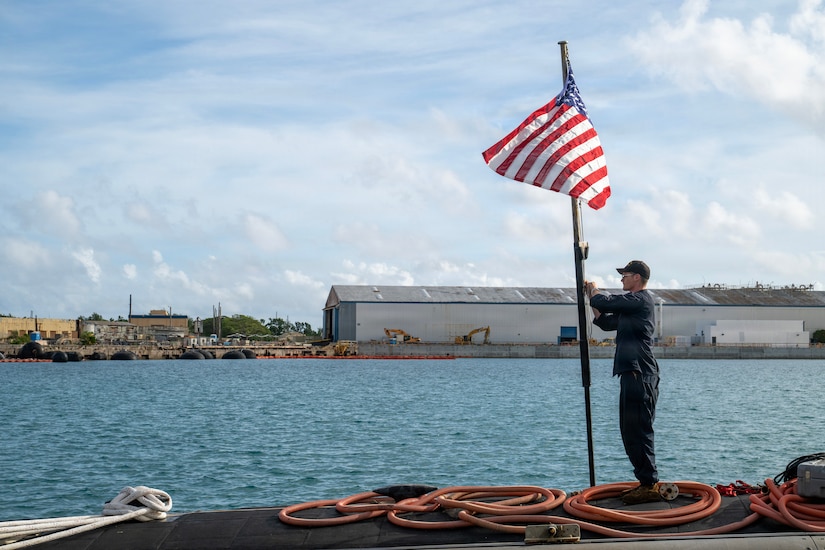
A man wearing a dark blue military uniform raises an American flag while standing on the deck of a submarine; water and buildings are in the distance.

For Riggs, the day also provided an opportunity to recognize those who made his return possible — and those who supported him throughout his 27 years of naval service.

"I want to thank the people who helped make this possible," he said. "My wife supported me throughout all my years of service, as did my sons and all the people here at Submarine Squadron 15. This is the finest military in the world. We're doing what needs to be done, and we're going where we need to go. Being here alongside [the] USS Annapolis, a superb U.S. Navy fast-attack submarine, is an honor."

Fifty years after raising the colors for America's bicentennial, Riggs once again stood beneath the flag he proudly served — this time alongside a new generation of submariners continuing the watch.

Friday, September 11, 2015

B-2 deployment to Guam: Teamwork, Sorties, Success

by Senior Airman Joseph A. Pagán Jr.
2nd Bomb Wing Public Affairs


9/11/2015 - ANDERSEN AIR FORCE BASE, Guam -- For nearly 30 days, Airmen from Whiteman Air Force Base, Missouri, showcased the capabilities and mission effectiveness of the B-2 Spirit while deployed to Andersen Air Force Base, Guam.

From Aug. 7 to Aug. 28, approximately 225 Airmen from the 509th Bomb Wing exercised their ability to conduct B-2 flight operations in an environment outside of the United States. The 13th BS completed more than 25 sorties and compiled approximately 300 flying hours, including integration with home station aircraft to support exercise operations during Red Flag-Alaska.

"Launching three B-2s from Andersen to participate in Red Flag-Alaska, while at the same time two B-2s launched from Whiteman AFB to do the same was the flying highlight of our deployment," said Lt. Col. Robert Makros, 13th Bomb Squadron commander. "This sortie was a 32-hour marathon that presented flyers with challenges similar to those they will experience during combat."

All five B-2s executed their mission and hit their target sets with precision and flawless timing, Makros continued.

Red Flag-Alaska is a Pacific Air Forces commander-directed field training exercise for U.S. Forces, providing large employment training in a simulated combat environment.

"The success of Red Flag and numerous other missions during the deployment were not because of any one individual," Makros said. "It was a direct result of our team busting their tails every single day. Every person on this trip played a vital role in our success."

This dedication was on display each day, resulting in a visit from the 36th Wing commander, Brig. Gen. Andrew Toth, who discussed the importance of Andersen's location.

"Bringing these assets (B-2s) to Andersen demonstrates our partnership and commitment in preserving peace and stability in the Pacific," Toth said.  "Should any conflicts arise, our strategic forward presence enables us to rapidly respond to any crises."

Markos said the Airmen who support, safeguard, generate and fly the B-2 ensure the continued operation of the most feared and revered bomber in the world.

"This team and the power projection they provide are why I sleep very well at night and why certain groups in far off places do not," Markos said.

Tuesday, August 11, 2015

FEMA Sends USS Ashland, Marines to Provide Typhoon Soudelor Relief to Saipan


From Joint Region Marianas Public Affairs

ASAN, Guam (NNS) -- Through the coordination of the Federal Emergency Management Agency, the amphibious dock landing ship USS Ashland (LSD 48) will depart Guam and arrive in Saipan Aug. 8 to provide relief in the aftermath of Typhoon Soudelor, which devastated the island
Aug. 2-3.

Agencies including the Government of Guam, American Red Cross, Ayuda Foundation and other non-profit/non-governmental organizations have provided drinking water, bed sheets, food, generators, power lines and other electrical restoration supplies to aid in the effort.

Upon arriving in Saipan, the supplies will be sent to distribution sites, shelters and schools around the island to provide the much needed supplies to local residents and government agencies.

"Ashland, as part of the Bonhomme Richard Amphibious Readiness Group, has been underway in the region conducting routine training and exercises. We have precisely the capabilities and capacity, at the right place and time to respond," said Ashland Commanding Officer Cmdr. Daniel Duhan. "Along with the 31st MEU [Marine Expeditionary Unit], we are just one part of Typhoon Soudelor relief efforts. With the collaboration between the Navy, Marines, local and federal government agencies, we hope to make significant contributions to the effort."

Ashland, homeported in Sasebo, Japan, is the eighth and last of the Whidbey Island-class ships to be commissioned and the second U.S. Navy ship to bear that name. She is on patrol in the U.S. 7th Fleet area of operations with her crew of more than 600 Sailors and Marines.

Friday, July 20, 2012

Carter: Guam Central to Asia-Pacific Strategy

By Karen Parrish
American Forces Press Service

ABOARD A MILITARY AIRCRAFT, July 20, 2012 – Deputy Defense Secretary Ashton B. Carter said after his meetings with Guamanian and military leaders over the past two days, he is more convinced than ever that Guam has a central role to play in the strategic rebalance to the Asia-Pacific region.

The deputy secretary left Guam today en route to Japan, the next stop on his 10-day Asia-Pacific tour that will continue with visits to Thailand, India and South Korea.

“The insights I was able to gather during this visit [to Guam] reinforce the department’s optimism that our plan is achievable and in line with our strategic priority of maintaining security and stability in the Asia-Pacific region,” Carter said.

A senior defense official traveling with the deputy secretary told American Forces Press Service on background that during the Guam visit Carter wanted to convey to Guamanian leaders his optimism that the planned Marine Corps relocation from Okinawa “is in a much better place than it was even six months ago.”

The processes involved in implementing the plan, including coordination with the Japanese government and Congressional authorization, “all seem to be coming together,” the official said.

Carter discussed a number of issues with Guamanian leaders including Governor Eddie Baza Calvo and Congresswoman Madeleine Bordallo. During those meetings, the official said, Carter spoke about the steps involved in the planned Marine Corps buildup on Guam.

Current plans call for moving roughly 4,800 Marines to the island, rather than the 8,000 originally projected, the official noted. About two-thirds of those who relocate to Guam will do so on a rotational basis, which means a smaller permanent-party presence and thus a smaller number of accompanying family members than earlier planned, he explained.

A smaller Marine presence means less military construction of community-support facilities such as schools and childcare centers will be needed on Guam, the official said.

The Marines will need land for cantonment, housing and training sites, including live-fire weapons training, the official said. Previous environmental impact studies have determined enough federally-owned land and undeveloped acreage is available on Guam to support training, housing and headquarters requirements, he added.

“The reason we have to do a supplemental environmental impact study, kind of counter-intuitively, is that because the footprint will be smaller, some areas that were not looked at with the bigger footprint have to be studied to see if they are possible,” the official said.

Carter took a helicopter tour of possible sites today. The official said defense leaders are working now to place Marine Corps facilities where they will cause the least possible inconvenience to the island’s residents.

“We don’t want to set up a situation where Marine cantonment is on the far end of the island, with the live-fire training on the opposite end of the island, therefore creating a lot of additional traffic on the local roads,” he added.

Sites for air combat element operations, waterfront operations, and non-live-fire training have already been identified in previous studies and won’t change, the official noted.

“The Marine aviation element is going to go on the north ramp at Andersen [Air Force Base], the waterfront operations will be at Apra Harbor [Naval Station], and Andersen south will be used for non-live-fire training,” he said.

“[Carter] also made the point that the Marine Corps buildup is only part of the story for the military on Guam,” the official said. “We have significant activities at Andersen Air Force Base and Apra Harbor [Naval Base] that also demonstrate the strategic nature of Guam.”

Guam is the westernmost part of the United States and also part of Asia, the official noted.

“[There is] a special strategic meaning to having American territory out here in Asia,” he added.

The official said that during meetings with Carter, Calvo and Bordallo raised topics including visa-waiver approval for Chinese tourists and National Guard funding.

The governor also expressed concern about the impact the Marine Corps relocation will have on Guam’s infrastructure, the official said.

“He made the point that the people of Guam are strongly supportive of this move,” the official added. “They’re patriotic Americans, but they are concerned that their infrastructure deficiencies are also addressed as part of this realignment.”

The governor specifically mentioned fresh water, waste water, and power supply and distribution as sensitive areas in the island’s infrastructure, the official said. He added that Calvo also noted positive developments in port improvements and defense access roads, both of which are largely federally funded.

In response to the governor’s concerns, the official said, Carter explained additional environmental studies are planned to determine what effect a smaller Marine force will have on the island, and what new sites for relocation might support the decreased “footprint” required to support those Marines. Those studies will “delay significant construction for a couple of years,” the official said.

The deputy secretary’s visit demonstrates U.S. leaders’ determination to develop strategic rhetoric into reality here in the Pacific, the official said.

“He’s here not only to convey that message, but to hear from the people out here, throughout his trip, on what the rebalance means to them, and make sure we do it right,” the official added.

Carter also met with U.S. military leaders on Guam during his visit, the official said, and listened to their concerns relating to the strategy shift.

Navy Rear Adm. Paul Bushong, Air Force Brig. Gen. Steve Garland, and other Navy, Marine Corps and Air Force leaders stationed on Guam shared their perspectives on service priorities there with the deputy secretary, the official said.

Thursday, July 19, 2012

Carter Arrives in Guam to Meet with Leaders


By Karen Parrish
American Forces Press Service

AGANA, Guam, July 19, 2012 – Deputy Defense Secretary Ashton B. Carter landed here today on the second leg of a 10-day Asia-Pacific tour that will also include stops in Japan, Thailand, India and South Korea.

“Guam has become an important strategic hub for the U.S military in the Western Pacific,” Carter told American Forces Press Service.

During his stay in Guam, which is 14 hours ahead of Eastern Standard Time, the deputy secretary is scheduled to attend a dinner at Government House, the governor’s official residence, with Governor Eddie Baza Calvo and Congresswoman Madeleine Bordallo.

While in Guam, the deputy secretary is also scheduled to meet with other Guamanian leaders, tour U.S. military facilities, and discuss progress on new military construction.

During his Asia-Pacific tour, Carter told troops in Hawaii earlier today that he will follow the course set by President Barack Obama, Defense Secretary Leon E. Panetta, and Secretary of State Hillary Rodham Clinton on previous visits to the region.

That course, he added, involves the United States working to build military capability in partner nations that will serve to enhance stability in the region. The security of the United States and other Asia-Pacific nations rests on the partnerships, alliances and friendships that link those nations, he added.