Showing posts with label peru. Show all posts

Wednesday, September 16, 2026

Southern Vanguard 2026 Turns Peruvian Jungle Into a Classroom

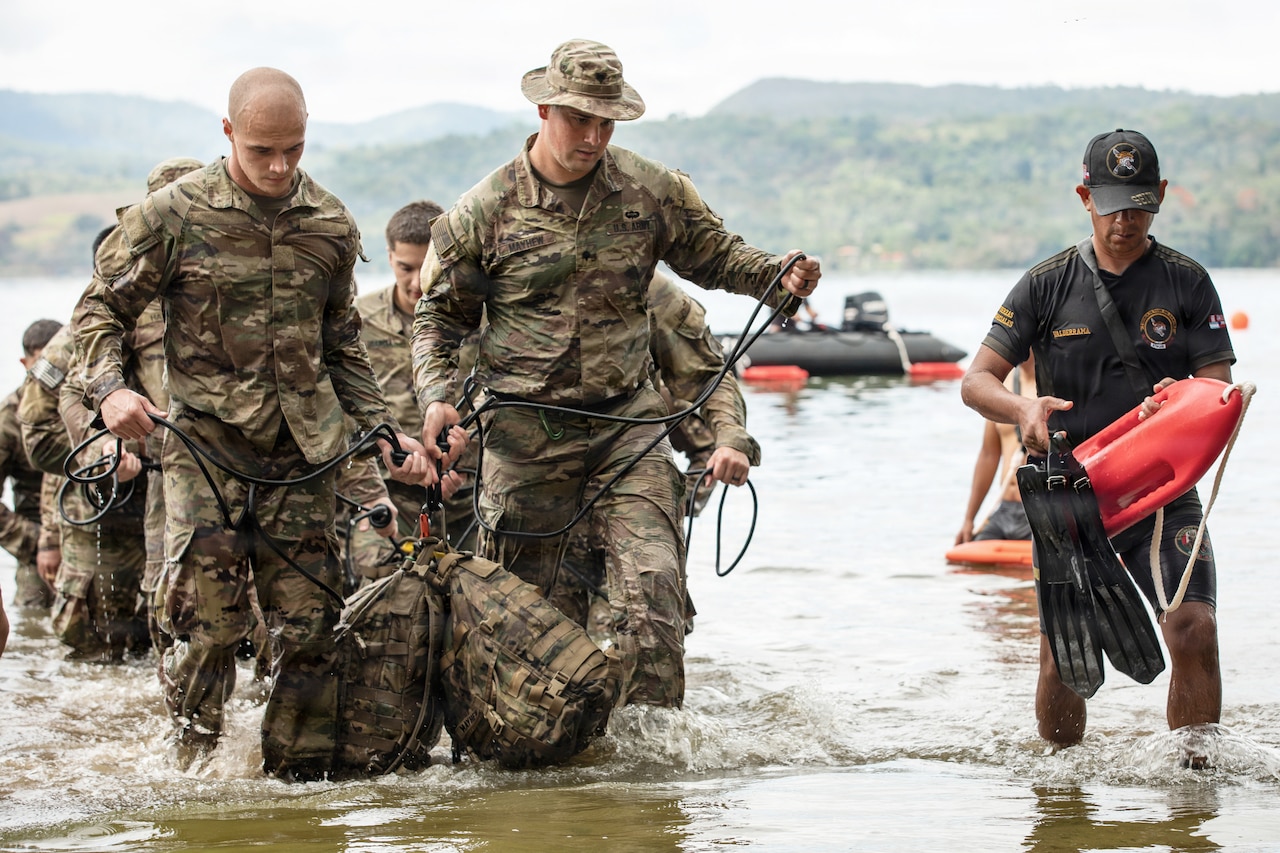
Nearly a dozen people in camouflage military uniforms walk through a body of water as a man in a black uniform walks next to them carrying a flotation device.

Movement slows. Equipment gets heavier. Water becomes an obstacle instead of a landmark. The environment quietly strips away assumptions about how quickly a formation should move or how easily a soldier can accomplish a familiar task.

For U.S. soldiers training alongside Peruvian and Chilean forces during Exercise Southern Vanguard 26, that friction is exactly the point.

In the hills surrounding Sauce, Peru, soldiers are learning to move, survive and operate in terrain where their Peruvian counterparts have spent years developing expertise. During the opening days of jungle warfare training, multinational formations started at various lanes, including amphibious movement, survival skills and small-unit tactics designed for an environment that can punish even routine movement.

A man wearing a camouflage military uniform and sunglasses poses for a photo in a jungle environment.

"Multiply fatigue by 10," Army Capt. Jared Fonzi, an operations planner assigned to the 551st Infantry Regiment, U.S. Army Western Hemisphere Command, said while describing the physical effects of jungle operations. "The climate, the terrain, the physical exhaustion that everyone here goes through — pictures do not justify the stress and the physical fatigue."

Southern Vanguard 26 is a multinational exercise hosted by the Peruvian Army and designed to strengthen interoperability among participating forces while building proficiency in jungle mobility, survivability and tactical operations. For American soldiers, participation offers something difficult to replicate at home: The opportunity to become students of a partner force operating in a terrain it understands intimately.

Fonzi, a graduate of the Jungle Operations Training Course-Panama, Ranger School and an infantry officer proficient with conventional U.S. tactics, said jungle warfare changes the scale at which soldiers must think and maneuver.

"The size of the maneuvering element is far smaller," he said. "You don't really maneuver as a platoon, which is usually the bread and butter of U.S. operations. Here, with smaller elements — team size, squad size — you need to rely more on individual survival techniques and minimal equipment."

That emphasis places greater importance on survival, fieldcraft and understanding the environment itself. Humidity, elevation, water obstacles, rainfall and dense vegetation are not simply background conditions.

"These climate differences and natural elements are what affect the fight," Fonzi said. 

That reality is also driving U.S. soldiers to look outward for expertise.

Fonzi said U.S. forces are relying heavily on jungle warfare specialists from countries such as Peru, Colombia and Panama to understand how forces accustomed to the environment operate and which techniques might improve U.S. tactics, techniques and procedures.

The dynamic is visible throughout Southern Vanguard 26.

Peruvian instructors are leading much of the jungle training, while U.S. instructors work alongside them and help translate techniques for American formations. Fonzi described the Peruvian approach as aggressive and immediate, often moving soldiers quickly from instruction into practical application.

"There's really no crawl phase here," he said. "They'll give a brief instruction, and then they just throw them in the water or whatever training environment they go into."

The approach may differ from how many American soldiers are accustomed to training, but adapting to unfamiliar methods is part of the exercise itself.

Interoperability is often discussed in terms of radios, procedures and whether two formations can communicate on a battlefield. But before any of that works, soldiers have to understand how their partners think, move and solve problems.

Sometimes that begins with something as unremarkable as getting everyone across a body of water. That process requires a certain humility.

The U.S. military brings considerable capability nearly anywhere it goes. The jungle offers a useful reminder that capability and expertise are not the same thing. Sometimes readiness means arriving prepared to teach. Other times, it means recognizing when someone else has something to teach you. Southern Vanguard creates room for both.
For soldiers operating beneath the jungle canopy, the lessons are as physical as they are tactical. 

"Being wet 24/7, fighting through brush, crossing water — these little things have a huge impact on how you fight," Fonzi said.

Over the course of the exercise, those small hardships become part of a larger test: whether multinational formations can adapt together in an environment that does not care how experienced, capable or well-equipped they were before entering it.

That may ultimately be the most valuable lesson hidden beneath the canopy. Partnerships become meaningful when soldiers learn to depend on one another before circumstances require them to.

Wednesday, March 28, 2012

Panetta, Peru’s Defense Minister Discuss Defense Cooperation


By Army Sgt. 1st Class Tyrone C. Marshall Jr.
American Forces Press Service

WASHINGTON, March 28, 2012 – Defense Secretary Leon E. Panetta welcomed Peruvian Defense Minister Luis Alberto Otárola Penaranda to the Pentagon today to discuss transnational organized crime, terrorism and a defense cooperation agreement.

Pentagon spokesman Navy Capt. John Kirby said the secretary also commended Peru for its contributions to the United Nations stabilization mission in Haiti and congratulated Penaranda for the recent capture of the Shining Path terrorist group leader known as Artemio.

“Both leaders pledged to continue to deepen defense cooperation, and look forward to advancing those goals at the upcoming Conference of Defense Ministers of the Americas in October,” Kirby said.

Created in 1995, the conference provides Western Hemisphere defense leaders with a venue to discuss topics of mutual concern, such as security-building measures, peace-support operations, civil-military relations and emerging threats.

Sunday, May 15, 2011

Seabees Complete Peruvian School Renovation

By Air Force SSgt. Alesia D. Goosic, Continuing Promise 2011 Public Affairs

LA HUACA, Peru (NNS) -- Seabees from Naval Mobile Construction Battalion 28 (NMCB 28) and Marines from 8th Engineer Support Battalion held a ribbon-cutting ceremony May 8, to mark the end of a nine-day renovation project at Cruz Maria Miñan Quezada School in La Huaca, Peru.

The 13-member team, embarked aboard USNS Comfort (T-AH 20), contributed more than 860 man-hours to the renovation project, which was conducted as part of Continuing Promise 2011 (CP '11).

In addition to many other tasks, the team reconstructed an existing classroom, added new light fixtures and ceiling fans to all the classrooms, and returned running water to restrooms via plumbing repairs.

"We are very pleased that the kids are going to be able to study in better conditions with an improved environment," said school administrator Teddy Guzmán.

The ceremony gave CP '11 leaders and school officials an opportunity to address the crowd of mothers and children who will benefit from the renovations.

"This deployment for us is one of humanitarian assistance, but one of the big things we do is build relationships," said Commodore Brian Nickerson, CP '11 mission commander. "It's the relationships that we build on a personal level that are truly important. There has been a great relationship between our two countries over the years and I look to the boys and girls here to continue that relationship."

Nickerson said that the time spent playing soccer, answering questions, laughing and taking pictures with the children of La Huaca are memories that everyone involved will always cherish.

"We get just as much out of these projects as the kids do," said NMCB 28 Officer-In-Charge Ensign Tres Moreno of the time he and his team spent with the children at the school.

Moreno said he feels that the work they did at Cruz Maria Miñan Quezada will positively impact the education of the children of La Huaca, as well as the relationship between the United States and Peru.

"Better schools equal better education, which equals better opportunities," said Moreno. "We hope that the improvements to their school give them a chance to make a difference in the world and also plants a positive image of Americans with the people of Peru."

COMUSNAVSO/COMFOURTHFLT supports U.S. Southern Command joint and combined full-spectrum military operations by providing principally sea-based, forward presence to ensure freedom of maneuver in the maritime domain, to foster and sustain cooperative relationships with international partners and to fully exploit the sea as maneuver space in order to enhance regional security and promote peace, stability, and prosperity in the Caribbean, Central and South American regions.

Wednesday, May 04, 2011

Continuing Promise 2011 Arrives in Peru

By Mass Communication Specialist 2nd Class Eric Tretter, Continuing Promise 2011 Public Affairs

PAITA, Peru (NNS) -- Military Sealift Command hospital ship USNS Comfort (T-AH 20) arrived in Paita, Peru, for her second stop of Continuing Promise 2011 (CP11) April 30.

Following Comfort's initial humanitarian assistance visit in Kingston, Jamaica, the ship's crew of military and non-governmental organization doctors and nurses now face more diverse conditions and a language barrier in a different country, continent and hemisphere.

"One of the things we need to be aware of is every country we go to, you want to look at life from the perspective of patients that we're seeing," said Capt. William Todd, director for surgical services. "We need to take the time out from the job that we're doing here to try and enjoy their life from their perspective; and it only takes a couple of minutes per patient to do that."

Comfort's deployment to the region exemplifies the U.S. commitment to cooperative partnerships in the Caribbean, Central and South America.

Comfort's hospital, the Medical Treatment Facility (MTF), is configured with specialized medical teams of military and civilian health care providers. These caregivers provide a range of services ashore, as well as on board the ship for approximately 250 patients.

Combined with the overall medical screenings comes regional and area-specific ailments that team Comfort can expect to encounter while in Peru.

"It's really the diseases of poverty that we see here; like everywhere else," said Capt. Gregory Martin, who spent three years stationed at a Navy lab in Lima, Peru. "There's a lot of chronic skin disease, mild malnutrition, infection diseases, respiratory ailments … it's also so hot and sunny here that a lot of people develop pterygium, an eye condition common among peoples living near the equator."

Helping to bridge the language barrier between CP11 staff and patients is a team of 12 U.S. Air Force and Navy linguists, who are serving as interpreters for the final eight countries of the mission.

Along with providing translators for the variety of medical and civil service teams, the linguists have translated medical documents and command information packets, and have welcomed Peruvian dignitaries, doctors and media.

"Translating a document takes time, it's not just five or ten minutes, it takes hours," said Information Systems Technician 2nd Class Manuel Guzman.

Aside from medical capabilities, U.S. Navy Seabees and Marines from Navy Mobile Construction Battalion (NMCB) 26 will continue CP11's work during civic engineering projects where they will revamp and repair schools throughout the community.

COMUSNAVSO/C4F supports U.S. Southern Command joint and combined full-spectrum military operations by providing principally sea-based, forward presence to ensure freedom of maneuver in the maritime domain, to foster and sustain cooperative relationships with international partners and to fully exploit the sea as maneuver space in order to enhance regional security and promote peace, stability, and prosperity in the Caribbean, Central and South American regions.

Monday, April 11, 2011

International Surface Warfare Officers School Fosters International Relations

By Surface Warfare Officer School Public Affairs

NEWPORT, R.I. (NNS) -- Fifteen naval officers graduated from the three-week Combat Information Center Watch Officer (CICWO) course during a ceremony at the International Surface Warfare Officers School (ISWOS) on board Naval Station Newport, R.I., April 1.

The officers were from Colombia, Peru, Saudi Arabia, Turkey, Tunisia, Trinidad-Tobago, and Uruguay. More than 150 allied nations send military students through selected courses at training centers and schools throughout the Naval Education and Training Command domain.

"The mission of ISWOS is simple; create the foundation for building trust through knowledge sharing for the purposes of international partnership and global security," said Lt. Cmdr. Jody Mandeville, director of the Surface Warfare Officer School International program. "The program is designed to foster international cooperation and prepare officers to serve at sea through professional education and knowledge sharing, and falls in line with the chief of naval operations' guidance for 2011, of establishing international relationships to increase security and achieve common interests in the maritime domain."

During their stay, students were immersed in the school's mission of preparing officers to serve at sea. The course emphasizes multi-threat warfare, combat information center equipment, special maneuvering, and navigation.

Students were taught how to plan, coordinate, and manage the supervision of all combat information center operations and training during routine peacetime steaming.

The school's high-tech conning officer virtual environment (COVE) and full mission bridge simulators gave the students a greater understanding of ship handling.

The students shared the same facilities and instructors with American students, and like their American counterparts, used the same modern classrooms and high-tech virtual reality trainers. The technology, along with hands on training, is used to broaden the scope of the students surface warfare knowledge, and ranges from basic seamanship to complex maritime operations.

Social and cultural events are included in the curriculum. Each student was assigned a sponsor to introduce them to American culture and foster personal relationships. During their free time the sponsors hosted students in their homes, took them to movies and gave them opportunities to experience American culture in an informal setting.

Students also participated in field service programs designed to promote an understanding of American society, its institutions, ideals and overarching commitment to basic principles of human rights. Trips included lectures at Salve Regina University, social gatherings with international students attending the U.S. Naval War College, and a Newport history and mansions tour.

Friday, January 21, 2011

SECNAV Concludes 10-Day Trip to Colombia, Peru, Argentina, Brazil

From Mass Communication Specialist 2nd Class Kevin O'Brien, Secretary of the Navy Public Affairs

MANAUS, Brazil (NNS) -- The secretary of the Navy (SECNAV) concluded a 10-day trip from Jan. 10-19 of engagement and partnership building in South America, which included visits to Colombia, Peru, Argentina and Brazil.

SECNAV Ray Mabus began his tour with a two-day stop in Bogota, Colombia.

There he met with U.S. Ambassador to Colombia Michael McKinley and discussed U.S.-Colombian relations, including military-to-military relations and shared efforts to counter drug trafficking in the region. Following his meeting with the embassy team, Mabus met with the Marine Security Force Detachment and re-enlisted two Marines.

While in Bogota, Secretary Mabus met with senior Colombian naval and government officials, to include Chief of Navy Adm. Alvaro Echandia Duran; Minister of Defense Rodrigo Ribera Salazar; Chief of Defense Edgar Augusto Cely Nunez; Minister of Foreign Affairs Maria Angela Holguin Cuellar; and Colombian President Juan Manuel Santos.

During his meeting with Santos, Mabus discussed the importance of strong U.S.-Colombian relations.

"We greatly appreciate the strong partnership that the U.S. and Colombia share," Mabus said. "We appreciate the broad access and operational cooperation Colombia provides the U.S. military, which enhances security throughout the region."

Following his visit to Colombia, Mabus traveled to Lima, Peru, where he met with U.S Ambassador to Peru Rose Likins and received briefings from her staff. Additionally, Mabus met with the military personnel attached to the embassy and thanked them for their service.

Mabus met with several Peruvian naval and government officials during his visit, to include Chief of Navy, Adm. Jorge de la Puente Ribeyro; Chief of Defense Gen. Luis Howell Ballena; Minister of Defense Jaime Thorne Leon; and representatives from the Minister of Foreign Affairs.

Mabus expressed his appreciation for the Peruvian navy's contributions to regional security during his office call with Ribeyro.

"Your Navy's participation and leadership in exercises such as UNITAS and SIFOREX (Silent Force Exercise) are greatly appreciated," Mabus said. "These exercises are crucial contributors to our navies' readiness and strong ties."

Mabus also congratulated Peruvian officials on the 100-year anniversary of their submarine force.

While in Lima, Mabus also officiated at a christening ceremony for the Naval Medical Research Center Unit (NMRU) 6 building, where he made brief remarks and unveiled a plaque commemorating the unit's establishment. NMRU 6 partners with the Peruvian Army and Navy to conduct research on a wide range of infectious diseases that threaten the population in the region.

"The work you do here has great benefit to Peru, South America and all of America," said Mabus, during the ceremony. "Your work has the opportunity to change the world and effect they way we understand diseases that have plagued mankind for centuries."

On his final day in Peru, Mabus traveled to Iquitos, Peru, in the Amazon River basin. There he got underway with a Peruvian navy riverine squadron, receiving a first-hand look at how it conducts operations against drug trafficking along the Amazon River.

Following his productive visit to Peru, Mabus traveled to Buenos Aires, Argentina, where he met with the U.S. Ambassador to Argentina Vilma Martinez and members of the Marine Corps Security Force.

His visit also included engagements with Argentine Chief of Navy Adm. Jorge Omar Godoy and Minister of Defense Arturo Puricelli. In meetings with Argentine officials, Mabus expressed thanks for Argentina's continued contributions in Haiti, and for hosting the multination exercise UNITAS LANT in 2010 and discussed ways to increase mutually beneficial training opportunities between the U.S. and Argentine navies.

"We deeply value Argentina's leadership in region and appreciate our strong military-to-military ties," said Mabus. "We look forward to strengthening those ties based on shared values and common interests."

The last stop on Mabus' South American trip was a two-day visit to Brasilia and Manaus, Brazil. While in Brasilia, he met with U.S. Ambassador to Brazil Thomas Shannon and his embassy team to discuss U.S.-Brazil relations. He also visited with Brazil's Chief of Defense Gen. Jose Carlos de Nardi and Adm. Julio Soares de Moura Neto, commander of the Brazilian navy.

Moura Neto presented Mabus with the prestigious Order of Naval Merit Award at the close of their meeting. This award is granted to individuals who have served Brazil in a significant way or have distinguished themselves during the performance of their naval duties.

Following the award ceremony, Mabus expressed his gratitude for the award and the strong relationship between the two nations.

"It is truly an honor to receive this award," Mabus said. "I accept this on behalf of all our Sailors and Marines. The U.S. appreciates our close relationship with Brazil; your leadership provides a valuable contribution to regional stability, relations and economic growth."

On his final day, Mabus traveled to Manaus to observe a riverine battalion at Naval Station Rio Negro. During his visit he received full military honors, took an aerial tour of the Amazon River Basin in a Brazilian Eurocopter and landed aboard the Brazilian hospital ship Oswald Cruz (U18) for a tour of the ship's facilities.

"This has been a great trip," said Mabus. "The relationships we have with our partners in South America are so important to the security of the United States. I was pleased to be able to go to express our desire to strengthen and expand our common ties."

For more news from Secretary of the Navy, visit www.navy.mil/local/secnav/.

Wednesday, August 22, 2007

Joint Task Force Bravo Treats 1,300 Patients in Peru

By Senior Airman Shaun Emery, USAF
Special to American Forces Press Service

Aug. 21, 2007 - Members of Joint Task Force Bravo's medical disaster relief task force, deployed from Soto Cano Air Base, Honduras, continue to assist citizens here following a magnitude 8 earthquake that struck the region Aug. 15. Over the past two days, medical team members have treated more than 1,300 patients with a wide variety of conditions. Most patients required medicines for gastro-intestinal illnesses, respiratory illnesses, minor wounds, and aches and pains.

In addition to basic medicines and medical care, members of the field team diagnosed a case of appendicitis in the field and quickly had the patient transported to a mobile surgical team stationed at the airport.

"When the patient arrived, she approached the front of the line with her mother," said
Air Force Capt. William Ingram, an emergency medicine physician's assistant. "We listened to her story, and she had three days of worsening abdominal pain. We laid her down to do an evaluation and determined that she needed to be taken away immediately."

News of the American medical team's presence traveled quickly through the town and to other agencies providing assistance. When other agencies arrived to help, members of Joint Task Force Bravo's medical team were able to pack up and move to another location to provide more care.

"Once more agencies arrived, we realized we would be able to move locations and provide help to more people," said
Air Force Master Sgt. Deborah Davis, the task force's noncommissioned officer in charge. "There are so many people in need. I'm glad we could offer our services to so many people."

As the mission wrapped up, many of the medical team members reflected on the time they spent in Peru.

"The fact that we executed within 20 hours of notification and were the first American contingent speaks volumes of our capability," said
Air Force Maj. Paul Valdez, medical operations officer in charge. "It just goes to show that our military is capable of providing humanitarian assistance anytime anywhere in the world."

(
Air Force Senior Airman Shaun Emery is assigned to Joint Task Force Bravo Public Affairs.)

Sunday, August 19, 2007

Quake Relief Task Force Treats 200 Patients in First Three Hours

By Senior Airman Shaun Emery, USAF
Special to American Forces Press Service

Aug. 19, 2007 - Medical personnel from Joint Task Force Bravo deployed here from Soto Cano Air Base in Honduras saw more than 200 patients during their first three hours of operation yesterday and expect to see many more in the next week. The medical team deployed from Soto Cano the morning of Aug. 17 to provide humanitarian relief following an Aug. 15 magnitude 8.0 earthquake. The team is scheduled to remain in Peru treating the displaced, hungry and sick for seven days.

In a small stadium in the middle of town, the medical personnel set up to provide basic medications and medical care.

The Soto Cano servicemembers brought a mobile surgical team to treat possible traumas, but the trauma cases have been few and far between.

"We saw a lot of respiratory illness and bruises the first day," said
Air Force Tech. Sgt. Melissa Walker, an independent duty medical technician deployed to Soto Cano from Eglin Air Force Base, Fla. "We thought we might see worse, but luckily these are the majority of cases we diagnosed."

Each day the team arrives with enough medicine to treat up to 350 people.

"We are trying to see as many people as possible each day," said Army Maj. (Dr.) Richard Malish, a flight surgeon from Soto Cano. "Right now, we haven't seen any traumas, so our goal is to get the people medicine for their aches and pains to make them more comfortable day to day."

(
Air Force Senior Airman Shaun Emery is assigned to Joint Task Force-Bravo Public Affairs.)

Saturday, August 18, 2007

Soto Cano Task Force Responds to Peru Earthquake

By Tech. Sgt. Sonny Cohrs
Special to American Forces Press Service

Aug. 17, 2007 - A task force composed of about 30
U.S. Army and Air Force personnel departed here today to support of relief efforts near Lima, Peru, following a devastating Aug. 15 earthquake that reportedly killed more than 500 people and left more than 1,500 injured. The task force, composed of a Mobile Surgery Team, communications specialists and a small security detail, departed the base aboard a C-130J assigned to the Maryland Air National Guard. The aircraft was the first of two scheduled to fly relief missions from Soto Cano.

"They said, 'an earthquake happened and we need you in Peru,'" said
Air Force Tech. Sgt. Will Morales, a loadmaster assigned to Maryland Air National Guard's 135th Airlift Squadron, based in Baltimore.

Morales and the rest of his crew were in the theater making supply runs from Puerto Rico to Honduras when their mission was diverted to support the relief effort.

Medics from Soto Cano's Medical Element deployed with a Mobile Surgery Team capable of setting up within a few hours of arriving in Peru. The surgery team brings with it all necessary equipment and personnel to conduct up to seven surgeries back to back upon arrival.

"We can get our equipment set up in an hour and a half to two hours, and two hours after we arrive, we can see our first patient," said
Air Force Tech. Sgt. Shelby Hatch, a scrub technician deployed to Soto Cano from Eglin Air Force Base, Fla.

Air Force Maj. Paul Valdez, deployed here from Keesler Air Force Base, Miss., said the valuable training the military has provided throughout his career has prepared him for events such as this.

"We're here so we can support our host nations with our expertise and our capabilities," he said. "This is what I've trained for my whole career (and) I'm very excited to be a part of this."

Army Lt. Col. Robert Rush, deployed from Madigan Army Medical Center on Fort Lewis, Wash., has had similar experience in Bosnia and Afghanistan, but said this will be his first disaster relief mission.

"Our team is designed to do life and limb-saving operations," he said. "We can't do very specialized surgeries, but we can stabilize patients so they can be treated later. This is what we're here for."

The task force is slated to be on the ground for approximately three days, although their stay may be extended by U.S. Southern Command. Members of the team said it's an unfortunate situation in Peru, and they are glad to help any way they can.

"You're not fully prepared for something like this until you're in the middle of it," said Army Lt. Col. Ed Zarzabal, commander of the deployed task force. "To be able to help someone in need like this is priceless."

The Medical Element's primary mission is to provide health service support and mobile surgical teams to U.S. Forces deployed in the U.S. Southern Command area of responsibility. As the only continuous
U.S. Military Health presence in Central America, the Medical Element also provides emergency and routine medical treatment and support for all Defense Department health care beneficiaries in the area.

The medical element also supports all humanitarian and civic assistance, disaster relief, and personnel recovery missions in the region and reinforces regional international cooperation through U.S. Southern Command missions.

"As the only forward-deployed task force in Central America, we are uniquely positioned to respond to contingencies in Central and South America," said Air Force Lt. Col. Howard Jones, Joint Task Force-Bravo deputy commander. "This earthquake was a tragedy, but Joint Task Force-Bravo is ready and willing to help with recovery efforts however we are needed."

Soto Cano Air Base is home to Joint Task Force-Bravo, which supports U.S. interests in Central America by building regional cooperative security, developing military roles and missions, supporting the National Counterdrug Strategy, and exercising combined forces.

Soto Cano is located near the city of Comayagua, Honduras, and is co-located with the Honduran air force's Palmerola Air Base.

(
U.S. Air Force Tech. Sgt. Sonny Cohrs is assigned to Joint Task Force-Bravo Public Affairs.)

USNS Comfort Officials to Make 'Needs Assessment' in Peru

By John J. Kruzel
American Forces Press Service

Aug. 17, 2007 - Two
military medical officials onboard the USNS Comfort will join a U.S. military mobile surgical team in Lima, Peru, to assist victims recovering from a magnitude 8 earthquake that struck the country Aug. 15 and claimed at least 500 lives. Dr. S. Ward Casscells, assistant secretary of defense for health affairs, said he and Navy Rear Adm. David J. Smith, the Joint Staff surgeon, will fly to the Peruvian capital tonight or tomorrow, depending on when an aircraft becomes available. They will depart USNS Comfort, a ship that provides humanitarian relief and currently is docked off Ecuador's coast, roughly 800 miles from where doctors will arrive and make a "needs assessment."

"A group of us are heading over to do needs assessment, to thank the people involved, to be sure that all of our people are safe and to see what we can do to assist," Casscells said.

"The point of getting there early, for my team, is to say that we care about this, that humanitarian relief counts, that we will set aside other things to go there, that the United States cares about Peru, that we thank them for looking after our students and citizens who are down there," he said.

Casscells said those affected by the earthquake need clean water, water treatment materials, food and blankets. Others may require surgery, immunizations or vitamins, he said.

U.S. Southern Command has not ordered USNS Comfort to deploy to Peru. But officials onboard said it would take two to two and a half days to reach the country's affected areas if ordered there.

SOUTHCOM announced today that it will deploy a joint U.S. military mobile surgical team from Joint Task Force Bravo, based at Soto Cano Air Base in Honduras, to aid relief efforts.

The 30-member
U.S. Army and Air Force surgical team will include a general surgeon, anesthesiologist, general practitioner, physician's assistant, nurses and medical technicians, and will partner with the U.S. Embassy, as well as Peruvian defense and health officials, to provide specialized medical services to area residents.

U.S. Southern Command Alerts Additional Medics for Peru Mission

American Forces Press Service

Aug. 17, 2007 - A
U.S. Air Force medical team consisting of six doctors, a physician's assistant, a pharmacist and six medical technicians will deploy Aug. 18 from Goodfellow Air Force Base, Texas, to Ica, Perú, to assist residents affected by an 8.0 magnitude earthquake Aug. 15. The medical readiness team will travel by commercial air and is scheduled to arrive in Ica on Sunday. The deployment will augment other U.S. military medical personnel providing assistance to the South American nation.

Earlier today, SOUTHCOM deployed a 30-man mobile surgical team from Joint Task Force, Bravo, based at Soto Cano Air Base in Honduras, to Peru to provide specialized medical care to communities affected by the disaster.

The deployments follow a disaster declaration issued Thursday by U.S. Ambassador to Perú, Peter Michael McKinley, paving the way for U.S. government aid.

In addition to deploying medical assistance teams, U.S. Southern Command is purchasing $50,000 in needed medical supplies to be donated to the Peruvian Ministry of Health to assist the country with its ongoing relief efforts.

(Based on a U.S. Southern Command press release.)

Soto Cano Task Force Arrives in Peru

By Senior Airman Shaun Emery, USAF
Special to American Forces Press Service

Aug. 18, 2007 - A team of airmen and soldiers from Joint Task Force Bravo at Soto Cano Air Base, Honduras, arrived here yesterday to provide medical care to those suffering in the aftermath of a magnitude 8.0 earthquake that devastated the region Aug. 15. The task force is the first American force to touch down in Pisco, joining other relief personnel from all over the world. Members of the Soto Cano Medical Element are equipped to treat up to 500 people without resupply.

"We will be able to provide basic medications, treat minor wounds, as well as perform a few minor or major surgeries," said Lt. Col. (Dr.) Robert Rush, the medical element's chief of surgery.

As citizens of Pisco begin the tedious process of reconstruction, there is a chance for additional injuries, officials said.

"If we need to treat additional traumas as people sift through rubble and debris, we will be able to take on those cases as well," Rush said.

In an area where basic medical care is in short supply, members of Joint Task Force Bravo are ready to provide everything they can.

"This is an opportunity for the
United States military to use its medical care capabilities in an austere environment," said Air Force Tech. Sgt. Jesus Antillon, assistant noncommissioned officer medical technician charge for the element. "This is what we train for. It is the reason we conduct exercises for all different scenarios -- so we can support other nations in times of need."

The Soto Cano task force, which comprises about 30
U.S. military personnel, includes a mobile surgery team, communications specialists and a small security detail.

(
Air Force Senior Airman Shaun Emery is assigned to Joint Task Force Bravo Public Affairs.)

U.S. Military Medics to Respond in Peru Quake-Relief Efforts

American Forces Press Service

Aug. 17, 2007 - A joint
U.S. military mobile surgical team from Joint Task Force Bravo, based at Soto Cano Air Base in Honduras, will deploy to Peru today as part of U.S. Southern Command's response to an 8.0 magnitude earthquake that struck the South American nation Aug. 15. The deployment follows a disaster declaration issued yesterday by U.S. Ambassador to Peru Peter Michael McKinley.

The 30-member
U.S. Army and Air Force surgical team will include a general surgeon, anesthesiologist, general practitioner, physician's assistant, nurses and medical technicians and will partner with the U.S. Embassy, as well as Peruvian defense and health officials to provide specialized medical services to area residents, SOUTHCOM officials said.

"We want to extend our deepest sympathies to the people of Peru and the families affected by this tragic earthquake,"
Navy Adm. James G. Stavridis, commander of U.S. Southern Command, said. "Any time there is disaster of this magnitude, there is dramatic increase in the medical needs of those communities affected. As a partner nation and close friend of Peru, we stand ready to assist with those resources and capabilities at our disposal."

A
U.S. Air Force C-130 from 156th Airlift Wing, based in Puerto Rico, will airlift the surgical team to Peru.

U.S. Southern Command military planners continue to work with interagency partners and Peruvian counterparts to assess recovery needs in the affected areas and identify additional U.S. military units that may be able to provide assistance, officials said.

JTF Bravo, the only U.S. Southern Command component with permanently assigned U.S. military personnel, is a first responder to crises in the region and routinely conducts humanitarian assistance, disaster relief, search-and-rescue, personnel-recovery and non-combatant medical evacuation operations.

(From a U.S. Southern Command news release.)