Showing posts with label humanitarian mission. Show all posts

Monday, July 13, 2026

USS San Antonio Assumes Relief Mission in Venezuela

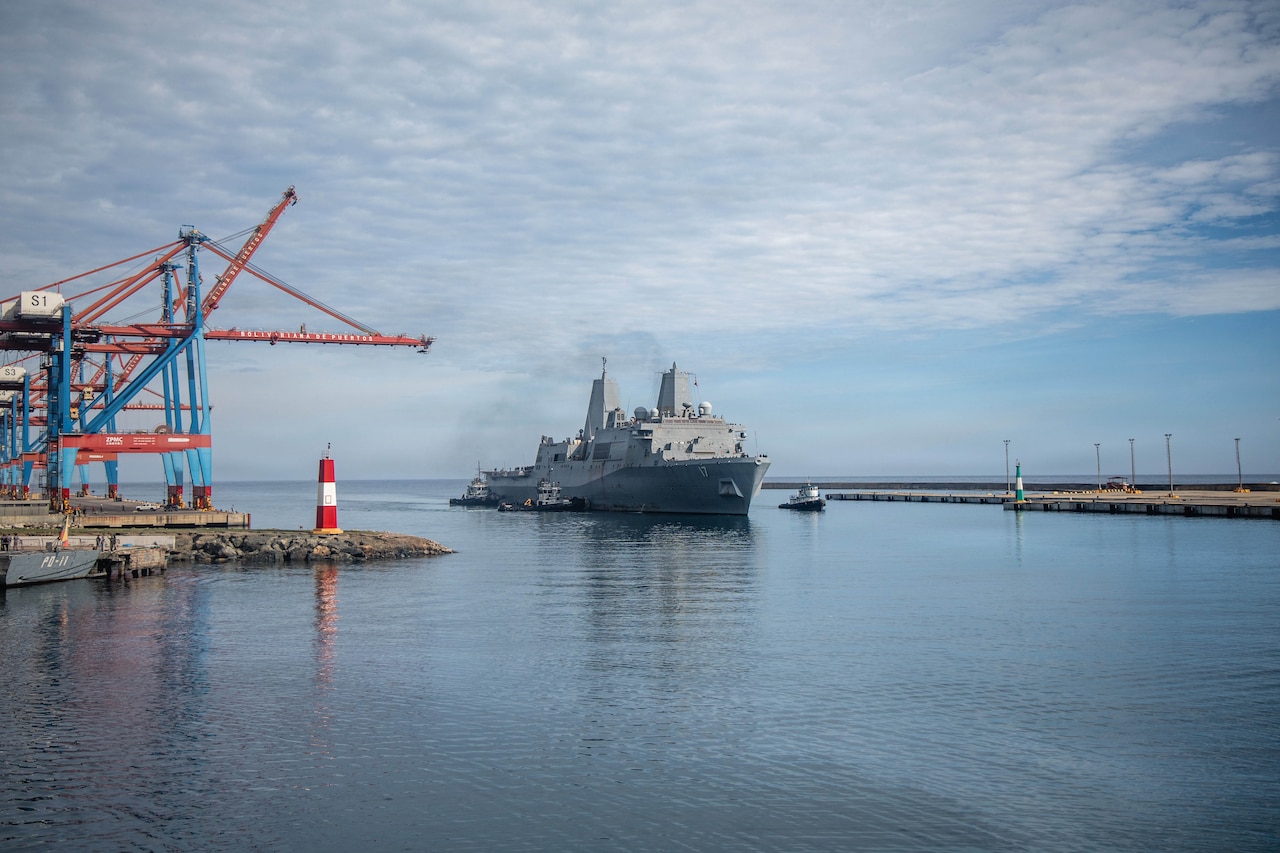
A large military ship sails in a harbor while being guided by three tugboats.

Supporting ongoing disaster relief efforts, the amphibious transport dock USS San Antonio arrived at the port in La Guaira, Venezuela, July 9, relieving the USS Fort Lauderdale as the primary maritime component of the State Department-led humanitarian assistance mission following the devastating June 24 earthquakes. 

After the Fort Lauderdale's historic arrival June 28 — the first Navy port call to Venezuela in decades — the San Antonio will now take over as the primary afloat coordination hub and continue sustained recovery efforts. The ship's robust command-and-control infrastructure enables U.S. Southern Command to work seamlessly with the State Department, interagency partners and Venezuelan authorities to distribute resources and direct rapid relief operations across the affected areas. 
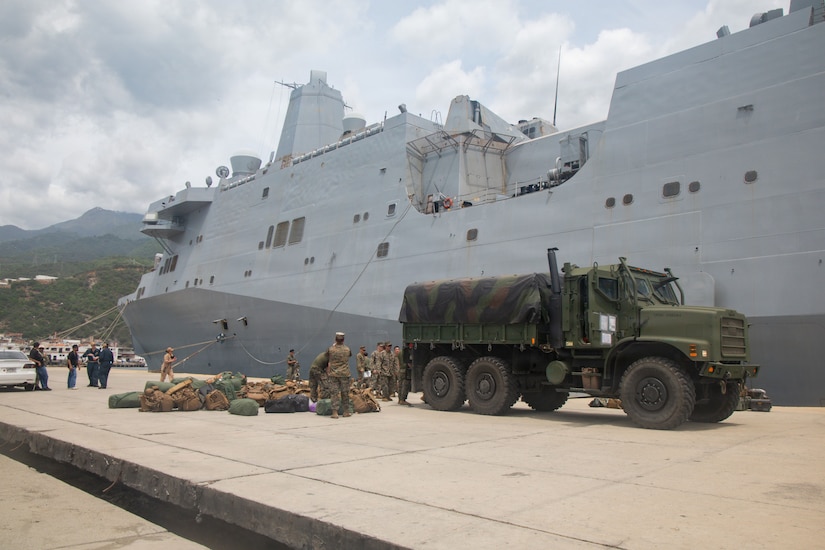
A small group of people in camouflage military uniforms take equipment off the back of a military vehicle parked on a pier; there is a large ship docked in the background.

"The sailors and Marines of [the] USS Fort Lauderdale and Littoral Combat Force 24 have worked tirelessly to deliver humanitarian assistance to the people of Venezuela," said Navy Capt. Jiwan Mack, USS Fort Lauderdale commanding officer. "Our Navy-Marine Corps team remains ready to respond rapidly to emerging crisis." 
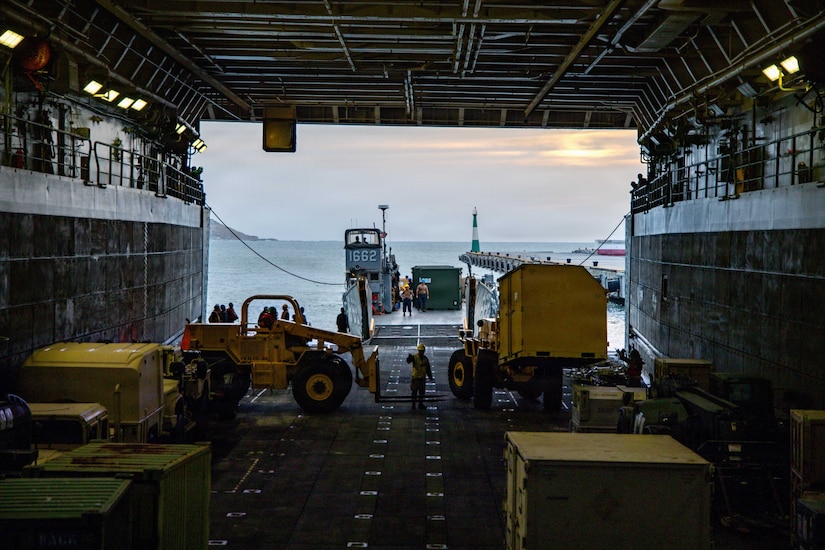
A dozen people in military uniforms and hard hats use forklifts to transport containers from the cargo bay of a large military ship onto another transport dock ship.
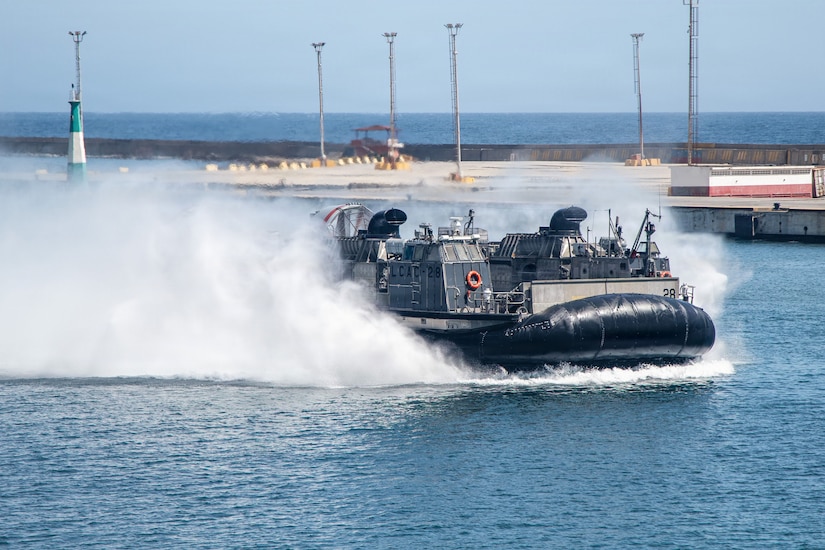
A landing craft sprays water in the air as it sails in the water.
The continuous presence of a San Antonio-class amphibious transport dock in port is a critical force multiplier for the interagency relief operation. Designed for extended, self-sustaining operations, the ship requires minimal local security, logistical support or port resources. This approach ensures that all local Venezuelan assets can remain entirely focused on domestic recovery rather than supporting the U.S. presence. 

Beyond serving as a communication hub, the San Antonio brings advanced onboard medical facilities, an expansive flight deck to support ongoing rotary-wing search and rescue operations, and a well deck capable of launching amphibious landing craft to deliver heavy cargo and vital supplies directly to damaged coastal infrastructure. 

"We are prepared to continue the vital mission that [the] USS Fort Lauderdale began," said Navy Capt. Tom Uhl, USS San Antonio commanding officer. "The presence of [the] USS San Antonio and Littoral Combat Force 24 in La Guaira represents more than just a transition of ships; it demonstrates the resolve and inherent capabilities of the Navy-Marine Corps team in supporting Department of State-led disaster response efforts to bring relief to the Venezuelan people."

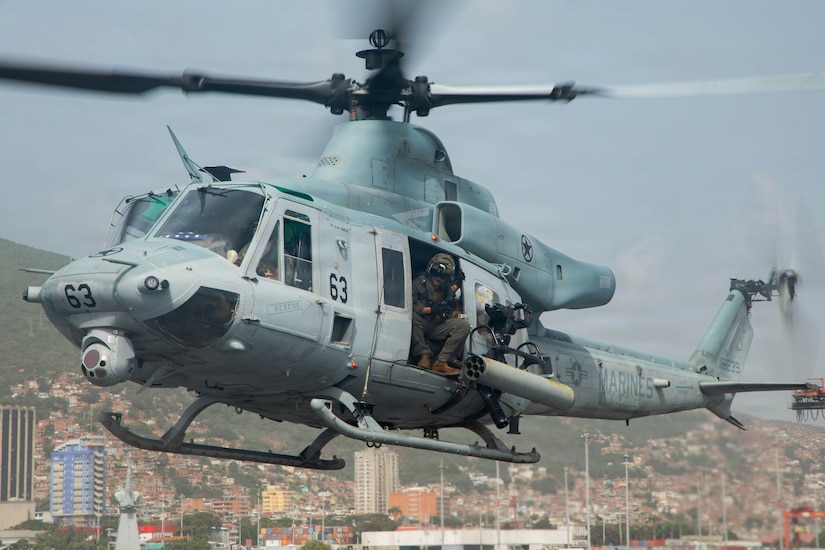
The transition between the two Navy vessels was executed safely and efficiently, with the San Antonio immediately integrating with U.S. aviation assets already operating in the region, including elements of Helicopter Maritime Strike Squadron 48 and Marine Medium Tiltrotor Squadron 365.
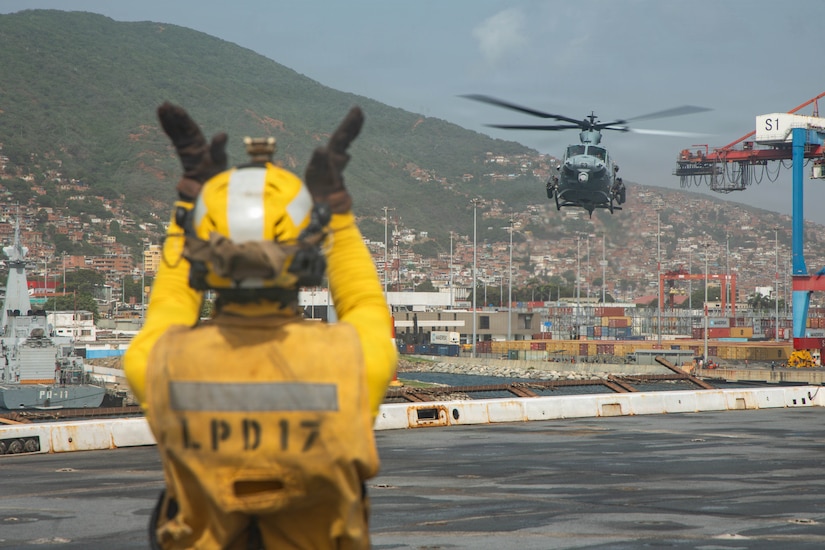
A person in a military flight deck uniform gives hand signals to helicopter pilots as they prepare to land on the deck of a ship in the water.
A person in a flight suit looks out the door of a military helicopter as it prepares to land on the deck of a ship in the water.
At the direction of Southcom, assigned U.S. military forces are supporting State Department-led U.S. disaster assistance to the people of Venezuela. Planning for continued U.S. military support remains ongoing in close coordination with the State Department, the Venezuelan government and international partners contributing to the relief effort. 

The U.S. military forces supporting Venezuela are built for rapid, short-term response to stabilize a crisis, minimize immediate suffering and save lives. This presence is temporary, remaining active for as long as requested, ready to transition relief tasks to nongovernmental organizations, international aid groups and local authorities as soon as the immediate crisis is stabilized.

Monday, October 01, 2012

Wisconsin Airmen assist state non-profits with humanitarian missions


By Tech. Sgt. Jon LaDue
115th Fighter Wing Public Affairs

The 115th Fighter Wing doesn't have an aerial port squadron or its own cargo aircraft - but that didn't stop some of Wisconsin's Airmen from helping to deliver more than 19 tons of humanitarian supplies to two foreign countries.

About 10 Wing Airmen, specializing in logistics and traffic management, assisted two Wisconsin volunteer organizations by palletizing and coordinating transport of educational and medical supplies aboard an Air Force C-130 Hercules destined for Charleston Air Force Base, S.C., Sept. 21.

"Some people who are in need are going to get help," said Carol Dombroski. "My heart is just melting."

Carol and her husband, Bob Dombroski, are members of the Madison Rotary Club which collected more than 15,000 elementary-level text and reading books to benefit nearly 3,500 children in Afghanistan.

"It takes education to get people out of poverty," she said. "And this is a culmination of several months of getting the ball rolling - to see it come to fruition like this is just very inspiring."

Chuck and Peg MacCarthy, of Good News Project, are attempting to ease the burden of underequipped clinics and hospitals in the Commonwealth of Dominica by providing about 26 pallets worth of medical equipment, furniture and supplies to the country's healthcare providers.

Although there are many worthwhile organizations that collect supplies for countless charities across the globe, often times shipping costs are high for non-profit and private organizations. Many of these organizations look to the military for transport but there are very stringent rules regarding the utilization of government resources for transporting non-governmental goods.

This is the first time the Madison Rotary Club has attempted to ship supplies overseas. In the past, Good News Project humanitarian supplies found a ride aboard C-130s from the then Milwaukee-based 440th Airlift Wing. When the 440th relocated, the GNP was forced to use another economically-friendly organization but high transportation costs have made it difficult to keep a consistent shipment of their collected goods headed toward the people in need.

Fortunately for the Wisconsin volunteer organizations, a provision of Title 10 of the United States Code, under the Denton Humanitarian Assistance Program, allows humanitarian supplies to be shipped on a space-available basis at no or little charge. The MacCarthy's, who have been doing philanthropy work in the Caribbean Islands since the early 80s, began shipping goods to the islands, including St. Lucia, St. Vincent and Grenada since before the Gulf War. This was made possible by the Denton program. They have since been inspired by the program's creator.

"We had the great honor of meeting Admiral Jeremiah A. Denton at a luncheon in his honor in Washington D.C. quite a while ago," Peg said.

They also had to chance to meet the pilots who would be transporting their latest shipment.

Capt. Aaron Webb, C-130 pilot for the 317th Airlift Group, Dyess Air Force Base, Texas, made note of the distinct looking farmland as he was on approach to land. Carol was among the first to greet Webb and his crew after landing.

"We were flying at 4,000 feet. We're looking down and we see all these red barns and I said, 'We're in dairy country, aren't we?' ... so it's pretty funny that [Peg] gave us cheese curds," he joked.

All kidding aside, coupling military missions with philanthropic opportunities is worth the pit-stop, Webb said.

"Our training mission is important to stay sharp but when you get to do something like this ... it kind of makes the big picture come into view," he added.

The humanitarian assistance also provided training to 115th Airmen who worked late to accommodate the flight. Senior Master Sgt. Jason Walker, 115th Logistics Readiness Squadron, said he was happy to be a part of the Wing's unusual role that also provided an opportunity to two of the unit's newest Airmen.

"I think it's good training for building up cargo and it allows us to load real aircraft," Walker said. "And If we can help in that aspect, I think it's good to do and worth the extra effort"

Walker said that Master Sgt. William Kennedy, 115th LRS, was a key player in coordinating with the Denton Program to find a cargo aircraft for the supplies.

"I don't' believe we've had any humanitarian mission here ... at least in the last decade or so," Walker said. "It's a little extra coordination, but it really isn't that difficult to put some pallets on an aircraft. Our Airmen were more than willing to volunteer."

Carol and Bob, and Peg and Chuck all watched from the flight line as the C-130 took off with all of their hard work and good will.

Both couples said they were grateful for the 115th Fighter Wing's contribution to their cause. But perhaps Carol said it best as she walked off the flight line and read the welcome sign in front of base operations.

"'Dedicated to Excellence' ... that says it all," she proclaimed.

Thursday, July 05, 2012

Africom Promotes Humanitarian Response Readiness in Africa


By Donna Miles
American Forces Press Service

STUTTGART, Germany, July 5, 2012 – As the worst drought in six decades grips the Horn of Africa, displacing millions of people and creating a severe humanitarian crisis, the United States has stepped up its emergency assistance.

An additional $120 million in emergency aid announced in April brings to $1.1 billion the U.S. contribution in drought and famine relief since the crisis began last year, White House officials said, with funding provided by the U.S. Agency for International Development and the State Department.

Army Gen. Carter F. Ham, commander of U.S. Africa Command, understands all too well the security implications of a fragile humanitarian situation that has left millions of people in Somalia, Ethiopia and Kenya in need of urgent assistance.

“The linkage between security and humanitarian efforts in Africa is very clear to me,” he told the House Armed Services Committee in February.

Ham expressed concern that looming budget cuts, particularly at the State Department and U.S. Agency for International Development, could affect the United States’ ability to assist during this and other humanitarian crises on the continent.

“I do worry overall that if there is a significant decline in the State Department’s security assistance or in USAID’s ability to provide developmental or humanitarian assistance, those will have security consequences,” he said.

Since its inception five years ago, Africom has stood ready to support U.S. government humanitarian and disaster relief operations, said Michael Casciaro, the command’s division chief for security cooperation programs.

“The military brings unique capabilities that are used for humanitarian assistance,” he said. “And that ranges from developing long-range projects like … building clinics and schools and providing furniture and equipment for them.”

It also includes helping African partners to build capability -- from training them how to conduct humanitarian response operations, to helping them promote HIV/AIDS prevention programs -- so they can conduct these missions themselves.

Africom also works with partner nations to help them develop national humanitarian response plans that include their militaries, Casciaro said. “We then focus on those tasks that were assigned to the military, and help them understand what capabilities are required to be able to do that, and how they need to train to do that,” he said.

In support of this effort, Africom is emphasizing disaster response as well as traditional military skills through its robust exercise program on the continent. This year alone, the command and its service components are conducting 16 exercises involving about 30 African nations, all to include a component related to environmental disaster, Ham told the Senate Armed Services Committee in March. The scenarios will run the gamut, he said, but most will involve floods or drought.

These exercises help partner nations formulate and practice plans for responding to natural as well as manmade disasters within their borders, explained Marine Corps Lt. Col. Sam Cook, Africom’s joint combined exercise branch chief. “It increases their ability and capability and capacity to conduct these operations themselves,” he said.

Ham said African nations are “very accepting” of this training, and understand the security effects of humanitarian assistance and disaster response preparedness. He expressed concern, however, that Africom is finding “less traction on the preventive steps than we are on responses.”

The general credited the interagency makeup of Africom, which includes about 30 representatives from more than a dozen U.S. agencies and departments, which he said gives it the capabilities needed to help address challenges requiring “nothing short of a whole-of-government approach.”

“No one element of the government has all the resources, authorities or capabilities to address the impacts on security of environmental change,” Ham said.

That, he said, demands that Africom work closely with chiefs of mission in Africa who have the responsibility to pull together that whole-of-government approach, as well as with various bureaus in the State Department and the U.S. Agency for International Development to coordinate and synchronize efforts.

That, Ham said, will help achieve the desired end state: “assisting the African countries deal with an increasingly serious security matter that ultimately contributes to our security by them being more secure.”

Monday, July 02, 2012

Guard Responds to Weather Damage, Wildfires


By Army Sgt. Darron Salzer
National Guard Bureau

ARLINGTON, Va., July 2, 2012 – National Guard soldiers and airmen are responding to damage left behind by severe weather and destructive wildfires in several states across the U.S. today.

Along the East Coast and in parts of the Midwest, high temperatures and severe thunderstorms caused power outages for millions over the weekend.

More than 750 Guard members from the District of Columbia, Ohio, Virginia and West Virginia responded to provide traffic control points, door-to-door health and wellness checks and debris removal.

West Virginia National Guard members have cleared more than 920 truckloads of debris from the storm and have helped with refueling of backup generators at hospitals and nursing homes, officials said.

In Florida, where heavy rains from Tropical Storm Debby lingered for several days, about 70 Florida National Guard members are continuing flood support missions. Florida Gov. Rick Scott and Air Force Maj. Gen. Emmett R. Titshaw Jr., state’s adjutant general, visited residents in the affected areas June 29.

“Talking to some of the people, it was very gratifying to hear when they told me they were rescued by the Florida National Guard,” Titshaw said. “It’s the reason we do what we do.”

In the western states, Guard members from Colorado continue to battle wildfires there that have burned more than 100,000 acres of woodlands and either destroyed or damaged personal property. National Guard reports said that as of yesterday, the High Park wildfire was 100 percent contained and the Waldo Canyon wildfire was 45 percent contained.

Guard members also are responding to wildfires in Montana, Nebraska and Wyoming, where operations include setting up checkpoints and providing UH-60 Black Hawk helicopters equipped with buckets for aerial fire support.

Saturday, June 30, 2012

Face of Defense: Guard Members Aid Flood-stricken Floridians


By Army Sgt. 1st Class Blair Heusdens
Florida National Guard

LIVE OAK, Fla. – The Florida National Guard is supporting relief efforts in several counties affected by widespread flooding after Tropical Storm Debby dumped large amounts of rain during its slow journey across the state.

Florida Gov. Rick Scott, Adjutant General Air Force Maj. Gen. Emmett R. Titshaw Jr. and several other senior state officials journeyed to Wakulla, Suwannee and Pasco counties to survey the flood damage and to talk to residents.

“We just left the shelter here that has the citizens of Live Oak who lost their homes, who essentially lost everything,” Titshaw said. “Talking to some of the people, it was very gratifying to hear when they told me they were rescued by the Florida National Guard. It’s the reason we do what we do.”

The Florida National Guard participated in several rescues of residents from the flood waters in Columbia and Suwannee counties.

“The National Guard pulled up in a truck and I was like, ‘Thank God,’” said Michaela Solomon, a resident of Live Oak who, along with her children, was rescued from her home by soldiers from the Florida National Guard. “It was such a relief to know we were going to somewhere safe. It was just a blessing that the National Guard came to where we were.”

As of June 29, more than 70 Florida National Guard members have been called to duty in support of relief efforts, officials said. Due to rising flood waters, Guard members are providing high-water tactical vehicles to assist with rescues, evacuations and damage assessments in Suwannee and Columbia counties, officials said.

In addition to the high-water vehicles, officials said, the Florida National Guard is also assisting with communications in Suwannee County, providing an emergency response vehicle to provide internet and phone capabilities to the county’s Emergency Operations Center.

For soldiers from the 868th Engineer Company, Guard officials said, the flooding hit close to home, affecting many local soldiers in the tight-knit Live Oak-based unit. Officials said approximately half of the unit resides in the area and several of the full-time unit support staff members were affected by the storm.

The Florida National Guard is continuing to provide support as requested by the State Emergency Response Team, officials said, noting that Florida’s citizen-soldiers and airmen are trained and equipped for a wide range of life support, security and public safety missions, and can mobilize approximately 9,000 personnel if needed to protect lives and property during disasters.