Showing posts with label poland. Show all posts

Wednesday, August 19, 2026

Learning With Every Launch: Inside Exercise Cold Raptor

After more than 50 micro-high-altitude balloon launches over the past year, a specialized team of soldiers assigned to the Multi-Domain Command – Europe learned no two flights are exactly alike, though every launch provides lessons the team can apply to the next one.
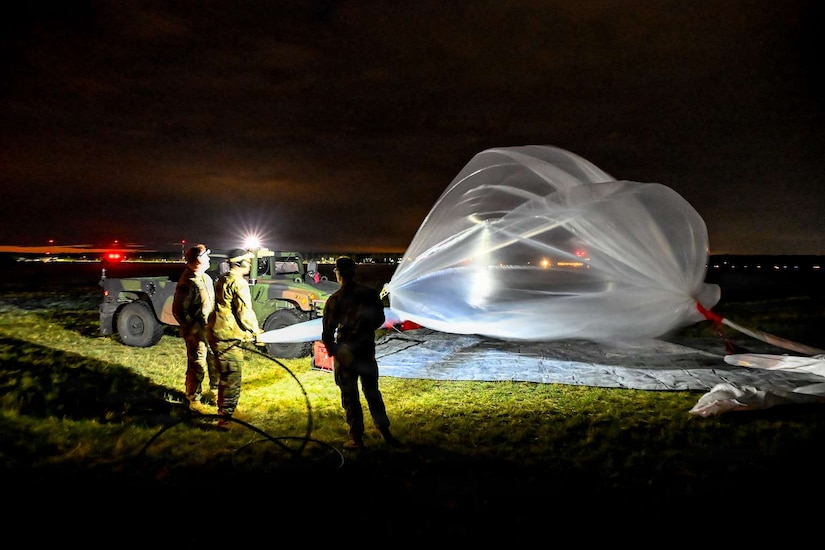
Three men wearing camouflage military uniforms control a large balloon at night in an open field.

The team recently conducted a week of balloon launches in Poland during Exercise Cold Raptor. The training supported NATO's Eastern Flank Deterrence Initiative, a NATO-led regional initiative supported by U.S. Army Europe and Africa that integrates emerging technologies to strengthen deterrence and readiness along NATO's eastern flank.

Cold Raptor gave soldiers hands-on experience launching, tracking and operating tactical balloons in a European environment while refining the procedures they will use during future missions.  

Decentralized Operations and Multidomain Readiness  

Soldiers assigned to the Extended Range Sensing and Effects Company, 2nd Multi-Domain Effects Battalion, conducted the training. Many on the team are qualified satellite communication systems operator-maintainers and are applying their signal expertise to emerging high-altitude systems.  

Army Sgt. Eric Atwater Jr., a signal sergeant, said the exercise tested the team's ability to operate from separate locations.  

"The purpose of Cold Raptor was to see how our launch team and our pilot team can operate from decentralized points," Atwater said. "We wanted to maintain communications while balloons go up in one location, while the flight trajectory is managed and monitored by another team off-site."  

For Army Sgt. Shakir Claxton, a fellow high-altitude balloon operator, improvement comes from repetition.  

"The biggest thing is getting us out in the field, setting everything up, making sure we have a solid timeframe we can work within and doing as many launches as we can," Claxton said. "The more repetitions we get, the better we get at the job."
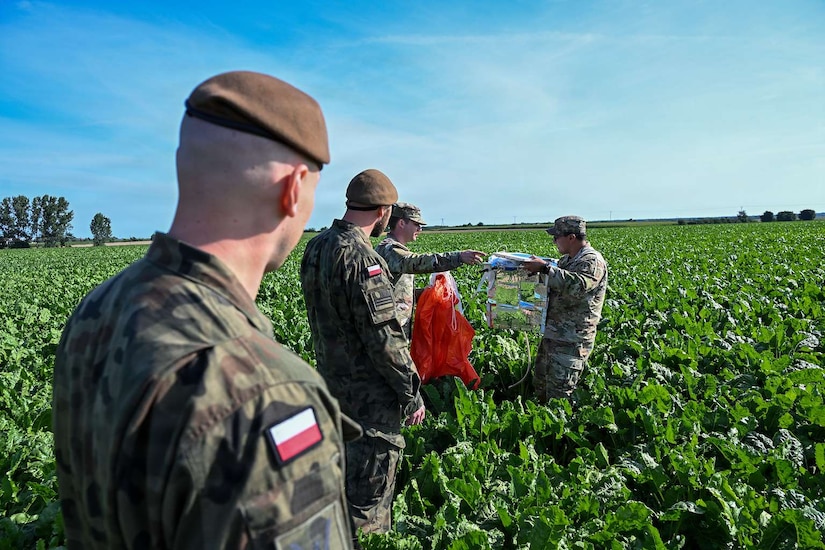
Men wearing camouflage military uniforms retrieve a military balloon from an open field.

The training also supported the company's broader multidomain mission. Claxton compared their capabilities to the three prongs of a trident, each contributing to the sensing mission.  

"We put up the balloons to give a certain kind of view of an area, while other parts of our company, like [unmanned aircraft systems] and [electronic warfare], work hand in hand on the sensing aspect," he said.  

Adapting to Changing Conditions  

During the exercise, the team conducted launches from Powidz, Poland. Some of the balloons ascended into the stratosphere, reaching altitudes between 60,000 and 70,000 feet — approximately 18,300 to 21,400 meters — while carrying experimental payloads designed to extend communications and improve domain awareness.  

Operating in the stratosphere requires precision. Teams must account for changing weather conditions while meeting strict aviation schedules.  

"We have specific windows when these balloons need to go up to meet mission requirements," Atwater said. "Whenever we're contacting airspace control, they're expecting these terminals to be in the air at specific times. If something goes wrong, you have to think quickly on your feet, troubleshoot and find the cause in a timely manner."  

Micro-high-altitude balloon technology continues to evolve and operating the experimental equipment throughout the week presented the team with real-world challenges. By troubleshooting problems as they occurred, soldiers successfully completed flights throughout the exercise and collected data to support continued experimentation.  

The lessons learned during Exercise Cold Raptor also contribute to a broader effort to strengthen deterrence along NATO's eastern flank. The Eastern Flank Deterrence Initiative is not a single unit or location, but a distributed system of capabilities operating across domains and nations. The concept aligns land forces with NATO's regional defense plans and connects mission command systems, networks and data so allied forces can share a common operating picture and make decisions faster. Exercises like this help determine how emerging technologies can contribute to the larger effort.
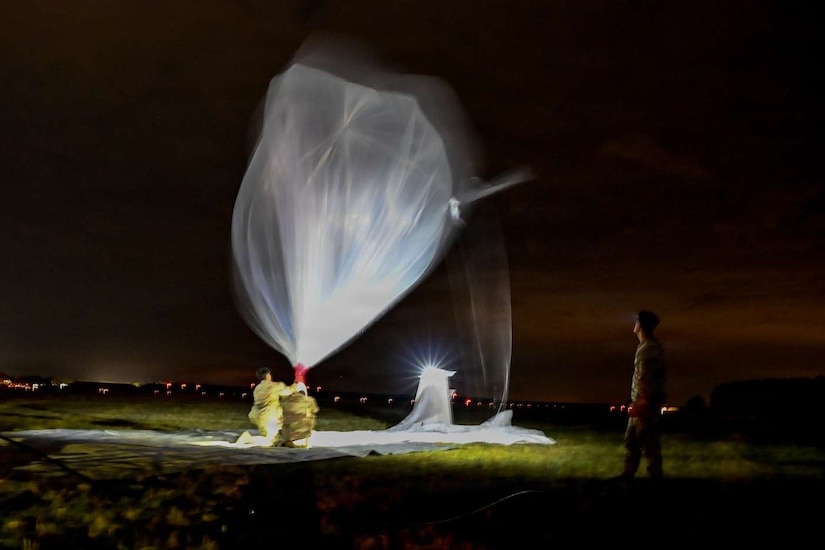
At night in an open field a person wearing a yellow safety suit holds onto a large balloon. Another person in a camouflage military uniform stands by to watch.

"The Eastern Flank Deterrence Initiative operationalizes all-domain deterrence for NATO through a data-enabled posture that harnesses the changes in the character of war," said Army Brig. Gen. Steven P. Carpenter, commanding general of Multi-Domain Command – Europe. "Experimentation with emerging technologies allows us to better understand the operational environment, refine how we integrate capabilities across domains and strengthen our ability to deter aggression alongside our NATO allies."  

Allied Interoperability and Airspace Coordination  

Launching from Poland required more than preparing the balloons and monitoring their flights. The team also coordinated closely with Polish authorities to ensure each launch met host nation airspace requirements.  

"Airspace coordination is a major priority with this kind of mission," Claxton said. "We have an excellent communication pipeline and a strong working relationship with our Polish partners."  

That coordination extended to the flight line, where the launches drew interest from Polish partner forces. Because Polish forces had not previously worked with this type of platform in Poland, U.S. soldiers provided hands-on demonstrations of the equipment and launch process. The demonstrations allowed Polish soldiers to see the technology up close and build a shared understanding of the capability.  

For the soldiers on the ground, helping develop the emerging capability carries responsibility and opportunity.  

"Initially trained as a 25 Sierra [satellite communication systems operator-maintainer], the Army already entrusted me to support established communications equipment," Atwater said. "Being introduced to something new and experimental is an honor. What feels like growing pains for us right now will end up being the foundation that future soldiers rely on."  

For him, the mission also connects to a childhood dream.  

"When I was a kid, I wanted to be an astronaut," Atwater said. "What I would say to my younger self is: you might not be the one going up to the stars, but you'll be the reason everyone looks to the sky and knows you sent something up to the very edge of space. They'll feel safer knowing you put it there."  

Tuesday, September 01, 2015

Polish, US demonstrate 'Stronger Together' at Lask

by Staff Sgt. Joe W. McFadden
52nd Fighter Wing Public Affairs


9/1/2015 - LASK AIR BASE, Poland  -- Four U.S. Air Force F-16 Fighting Falcon fighter aircraft, two F-22 Raptors and one C-130 Hercules cargo aircraft arrived at Łask Air Base, Poland, Aug. 31, 2015.

The Airmen and aircraft are in Poland for separate flying training events with allies to demonstrate the countries' shared commitment to the collective security of NATO and enduring peace and stability of the region.

"Our friendship and partnership as allies through NATO afford us the ability to train every day as we improve the interoperability between all of our forces," said U.S. Air Force Maj. Gen. Christopher Bence, 3rd Air Force and 17th Expeditionary Air Force vice commander, during a media event held at Łask alongside Robert Kupiecki, Polish Deputy Minister of National Defence.

Detachment 1, 52nd Operations Group

The Aviation Detachment, stationed at Łask Air Base, supported the aircraft and its Airmen and has previously hosted rotations of F-16s, A-10s, KC-135s, and C-130s from deployed active-duty, Air National Guard, and U.S. Air Force Reserve units to conduct bilateral training with the Polish air force since 2011, operating under the squadron's credo of "Razem Silniejsi -- Stronger Together."

"Of course, it all starts with partnerships, and it starts here with our Aviation Detachment led by Lieutenant Colonel Jack Harman as we continue forge our relationship as allies and, most importantly, as friends," the general said.

F-16 Fighting Falcons -- 480th Fighter Squadron, Spangdahlem Air Base, Germany, and 176th Fighter Squadron, Wisconsin Air National Guard

The F-16s, from the 480th Fighter Squadron, Spangdahlem Air Base, Germany, will participate in the Aviation Detachment Rotation 15-4. The unit will later be joined by the 606th Air Control Squadron, also at Spangdahlem, and additional F-16s from the 176th Fighter Squadron, Wisconsin Air National Guard.

The upcoming rotation, which is projected to be one of the largest since the Av-Det's creation, will focus on maintaining joint readiness and building interoperability capabilities between the Polish and U.S. Air Forces.

"This is our 19th rotation in the last two and a half years," Harman said. "The relationship with our Polish allies is strong and growing."

F-22 Raptors -- 95th Fighter Squadron, Tyndall Air Force Base, Florida

While not part of the Av-Det rotation, the F-22s and their respective operations, maintenance and mission support Airmen from the 95th Fighter Squadron at Tyndall Air Force Base, Florida, briefly visited Łask for familiarization within European airspace. 

This forward deployment of the Raptors to Spangdahlem Air Base Aug. 28 serves as part of the inaugural F-22 training deployment to Europe and is funded by the European Reassurance Initiative, which provides support to bolster the security of our NATO Allies and partners in Europe while demonstrating our commitment to regional and global security.

"This is the first deployment of the F-22 as we continue to build our partnership and train and work together to improve us as allies and as a nation on how we will ultimately fight if we had to," Bence said.

The general said that the 95th FS Airmen will continue to train side-by-side with allies to be able to prove how the U.S. Air Force can operate a fifth-generation fighter in Europe.

"We continually rotate U.S. forces from the United States into Europe, and this is a part of the training rotation," he added. "We look forward to continue to prove that fifth-generation aircraft can operate in Europe as we set the foundation for the future of the F-35 coming to Europe in just the next few years."

The F-22s later returned to Spangdahlem to continue their training deployment.

"It is no surprise that the first allied base the F-22 has arrived is here at Łask, Poland," Bence said.

Friday, July 24, 2015

US, Poland strengthen interoperability through combat control

by Airman 1st Class Luke Kitterman
52nd Fighter Wing Public Affairs


7/24/2015 - SPANGDAHLEM AIR BASE, Germany  -- U.S. Air Force combat controllers from the 321st Special Tactics Squadron continued their four-day austere landing training with 354th Expeditionary Fighter Squadron A-10C Thunderbolt II pilots at Nowe Miasto, Poland, July 22, 2015.

The austere landing training not only qualified the pilots to land on unimproved surfaces simulating possible deployment conditions but also allowed members of the Polish Special Forces to learn from the 321st STS's combat controllers.

"Combat controllers are specially trained U.S. Special Operations Forces whose training includes becoming a fully qualified Federal Aviation Administration air traffic controller," said U.S. Air Force Lt. Col. Ryan Hayde, 354th EFS commander. "Their skill set allows them to jump into austere locations and measure the ground density to make sure it can handle the weight of certain aircraft."

These particular capabilities, including marking runways and controlling both aircraft landings and takeoffs, brought out the Polish Special Forces to observe and practice them as well, Hayde said.

"As Poland looks to create their version of a combat controller, integrating them with the 321st STS provides some hands-on experience as they're doing real-world austere landings in the middle of Poland with our special tactics teams and the A-10s," said U.S. Air Force Capt. Ryan Allen, 354th EFS chief of weapons and tactics, and an A-10 pilot participating in the training.

The combat controllers, along with the Polish forces, inspected the rugged surface of the runway to ensure it was safe for the A-10s to land. They then set up brightly colored markers along the way as visual references for the pilots as the runway was devoid of such markings.

"Without them, we wouldn't be able to perform these landings and get that currency and that training out of it," Allen said. "It opens up not just airfields we have assigned to us but also allows us to go into fields such as old rundown airfields, dirt strips or grass fields as well."

As the A-10s landed, the Polish Special Forces took their turn at marshalling the aircraft to the proper location on the runway after learning the hand signals from the combat controllers.

"I think it's definitely a force multiplier to make sure we've got NATO partners who are training with us and can also relate to any future operations we have where we might need combat controllers from a different nation as well," Allen said.

Many of the combat controllers also serve as qualified joint terminal air controllers, which allows them to identify targets, relay its coordinates to the supporting aircraft and make decisions on how to proceed.

"We're helping the Polish out with close air support controls to make sure they're maintaining their currency, and they're helping us out, too," Allen said. "They're vital to this entire operation so we can end up getting control in to those austere fields and make sure the airfield is in fact safe for us to land our aircraft."

The austere landing training at Nowe Miasto not only increased the combined capabilities of the A-10 pilots and combat controllers but also supported the continuing European Theater Security Package's mission of reassuring NATO allies and partner nations of the U.S. commitment to the continent's security and stability.

Wednesday, March 12, 2008

Bush, Polish Prime Minister Discuss Missile Defense Proposals

By Donna Miles
American Forces Press Service

March 10, 2008 - President Bush today thanked Poland's prime minister for his country's support in Iraq and Afghanistan and promised that, as the United States and Poland explore plans for a proposed missile defense system, the U.S. will help Poland modernize its
military. Bush sat alongside Prime Minister Donald Tusk following a far-ranging White House meeting the president said included discussions about "the significant threat to the 21st century" -- the potential launch of a missile with dangerous materials in its warhead.

"Technologies are developing that will enable the free world to be able to defend itself from blackmail and/or strife from these ... types of launches," Bush said. "And we're in discussions with Poland about how we can help the mutual
security of the region."

The president said he assured Tusk that the system, part of it to be emplaced in Poland, would reflect Poland's sovereignty and not subject its people to undue
security risks. Bush also underscored that the system would not be aimed at Russia.

"This system is designed for the threats of the 21st century," he said. "The system is necessary to deal with the realities of the threats."

There's still a lot of work left in moving the concept from a strategy on paper to a detailed plan that can be implemented, the president said. "And so our experts are working through a system to make sure that the people of Poland are comfortable with the idea," he said.

Pentagon Press Secretary Geoff Morrell today told reporters the United States is working with the Poles "to allay whatever concerns they have about basing part of the missile defense system within their territory."

The president acknowledged Poland's stated need to modernize its forces and said the United States will help. "The first part of a response, of course, is to take inventory of needs," Bush said. "And Mr. Prime Minister, before my watch is over, we will have assessed those needs and come up with a modernization plan that's concrete and tangible."

Poland approached the United States several months ago expressing a desire to modernize its air defenses if it is to take on what it perceives as additional risks associated with hosting missile interceptors, Morrell said.

"And so we have agreed to conduct talks with them, not only on missile defense, but simultaneously about modernizing their air defenses," Morrell said. "So these are two separate and yet related negotiations that are taking place, but (they are) not at the agreement point yet."

Tusk said today's talks confirmed that the United States and Poland can count on each other as friends and can work cooperatively toward developing a missile defense system and in modernizing Poland's
military.

"Our joint intention is to cooperate in all aspects of global security, American
security and Polish security," Tusk said. "And an element of the security is the missile defense system."

Bush opened today's press availability praising Poland for its role in operations Iraqi Freedom and Enduring Freedom.

"I want to thank you for your nation's contributions to the liberation of people in Iraq and Afghanistan," Bush told Tusk. "Your troops have performed brilliantly, and they'll be coming home based upon success."

The president thanked the Polish people for sacrifices they've made in both countries and noted that they're helping the citizens of Afghanistan and Iraq realize the liberty and peace Poland has come to enjoy.

"The people of Poland stand as an example of freedom and liberty," Bush said. "This is a nation ... that has resisted tyranny and now lives as an example of a free society."

Tuesday, October 23, 2007

Gates Expresses Confidence Polish Elections Won't Stop Defense Cooperation

By Donna Miles
American Forces Press Service

Oct. 22, 2007 - Defense Secretary Robert M. Gates expressed confidence today that the reversal of power in Poland following yesterday's elections won't upset U.S.-Polish defense cooperation. Poland's Conservative Civic Platform party won yesterday's general election on a platform that included redeploying the country's 900 troops in Iraq. The election promise, if fulfilled, would reverse strong support Polish President Lech Kaczynski and his brother, Prime Minister Jaroslaw Kaczynski, have maintained for the Iraq mission since winning the 2005 election.

Gates is attending the Southeast Europe Defense Ministerial conference here.

He pointed to the close, longstanding relationship Poland and the United States have shared and said he doesn't expect the election results to change that. "Regardless of the composition of the government, I expect that cooperation to continue," he told reporters.

"We clearly are hopeful the kind of cooperation we have enjoyed recently in both Iraq and Afghanistan on one hand and in moving toward negotiations and an agreement on missile defense will continue as before," he said.

Poland has been a coalition leader in the
war on terror. In addition to its 900 troops in Iraq, about 1,200 Poles serve in Afghanistan as part of the NATO-led International Security Assistance Force.

In addition, the United States has been negotiating with Poland to place interceptors there as part of a missile defense system. The plan also seeks to base a radar station in the Czech Republic to shield the United States and Europe against rogue states such as Iran and North Korea.