Showing posts with label military technology. Show all posts

Tuesday, August 18, 2026

One War Department Unit Takes Next Step in Legacy of Innovation

Seven months ago, Secretary of War Pete Hegseth stood before a large crowd of Lockheed Martin employees in Texas, during the third stop of his nascent Arsenal of Freedom tour, to show his appreciation for the people behind the defense industrial base.
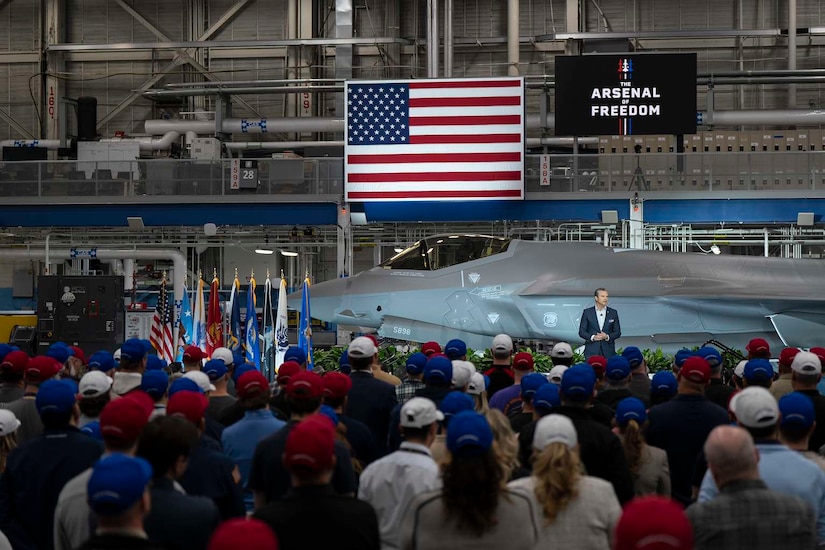
A man in business attire stands on a stage in a hangar and speaks to a large crowd of people in casual attire and baseball caps; behind him is a military aircraft, an American flag and a banner that reads, “Arsenal of Freedom.”

During his remarks, Hegseth made clear that supercharging the defense industrial base, which is one of the four lines of effort in the 2026 National Defense Strategy, is something the current administration and the War Department want to see happen at a rapid clip.

"We've got to go fast. The warfighters need it; they deserve it. We've got near-peer adversaries that are building at record speed," Hegseth said. "[This] Arsenal of Freedom tour is meant to speak to you and your peers, and to tell you to keep going."   

To facilitate that need "to go fast," the War Innovation Unit — formerly the Defense Innovation Unit and still abbreviated as DIU for contractual purposes — is working to cut through red tape with the defense industrial base.  

Founded in 2015, DIU is purpose-built to accelerate the War Department's adoption of commercial technology at speed and scale to lower cost and increase combat power. Since January, it has been working to answer Hegseth's call for the expedited acquisition of commercial capabilities across the services in several ways. 

Its latest initiative is the Bridge Program.   

Conceived and developed over the past year by Sarah Pearson — a former Navy officer, technology executive and current chief of strategic initiatives at DIU — the Bridge Program was created to drive long-term, systemic reform across the War Department.

A woman in business attire poses for a portrait; behind her are the American flag and the U.S. Navy flag.

Throughout her career, Pearson has witnessed firsthand the hurdles nontraditional companies face when attempting to sell and scale commercial solutions for the military. 

Under her direction, the Bridge Program is now executing a targeted strategy to eliminate critical bottlenecks — specifically around security clearances, access to classified spaces, technology accreditations and testing.  

By dismantling these operational barriers, the program seeks to broaden the War Department's commercial engagement aperture, mitigate risks, accelerate capability development and maximize adoption rates to deliver best-in-class commercial technologies directly to the warfighter. 

The program's first line of effort focuses on evolving the model for classified space design, construction, accreditation and operation.  

By blending commercial technologies, process improvements, rapid contracting, policy and Congressional support, the department is jointly addressing each aspect of the value chain around classified infrastructure.  

"When successful, we will have demonstrated a new model, a model where classified infrastructure is resourced based upon usage and becomes operational within months — not years — of the need arising," Pearson said.  

Furthermore, she emphasized the critical importance of continued close collaboration within the War Department.  

"Our partners within three offices — the offices of the undersecretary of war for intelligence and security; acquisition and sustainment; and research and engineering — as well as the Defense Intelligence Agency, the Defense Counterintelligence Security Agency and the armed services have been the single greatest unlock in achieving the early success we've seen so far," Pearson said. 

DIU's Bridge Program, and the broader working group across the aforementioned organizations, had its first major contracting announcement last month, when President Donald J. Trump announced a $10 billion investment in Pennsylvania's defense industry July 16.  

The announcement included investment in four shared commercial classified facilities, one of which will be built in Pittsburgh — using the joint funding model that the Bridge Program is prototyping.  

Beyond Pittsburgh, the Bridge Program has contracted for nine additional commercially owned and operated sites across the U.S., including Austin, Texas; San Francisco; Boston; Charleston, South Carolina; Chicago; Cleveland; Louisville, Kentucky; and New York. 

Additional locations will be announced in the coming weeks.

The Bridge Program's second line of effort focuses on establishing the fastest and most trusted accreditation portfolio within the department — something Pearson said can't be accomplished without deep cybersecurity expertise — a thoughtful approach to risk and incorporation of the world's best artificial intelligence capabilities.

By using technology to enhance and accelerate DIU's authorization process, the Bridge Program team will condense timelines and enable greater throughput with fewer resources.

"We plan to shift the risk management framework process to the left in prototype development and build cybersecure solutions that the services can more easily field. Indexing toward accreditations for every program and sooner in development are critical to adoption," Pearson explained.

The third line of effort — test and evaluation — draws on DIU's core competency, prototyping commercially derived technologies inside the department's developmental and operational test infrastructure.

Through partnership, technology and new approaches, Pearson said DIU is building an end-to-end test approach for portfolio companies entering the prototype pipeline, with testing opportunities throughout the contract lifecycle.

The result is a process that stitches capability development together with existing and emerging test infrastructure, for both physical and digital applications.

As DIU continues to expand and implement the Bridge Program in support of Hegseth's call to revamp and expedite the acquisition process, Pearson said it will continue to lean on unprecedented partnership across the department, its history of pioneering new approaches and its deep conviction that the warfighters deserve the best capabilities available.

Friday, August 14, 2026

Centcom Launches First-Ever Multinational Attack Drone Task Force

U.S. Central Command announced efforts to establish the first multidomain, multinational attack drone task force yesterday.

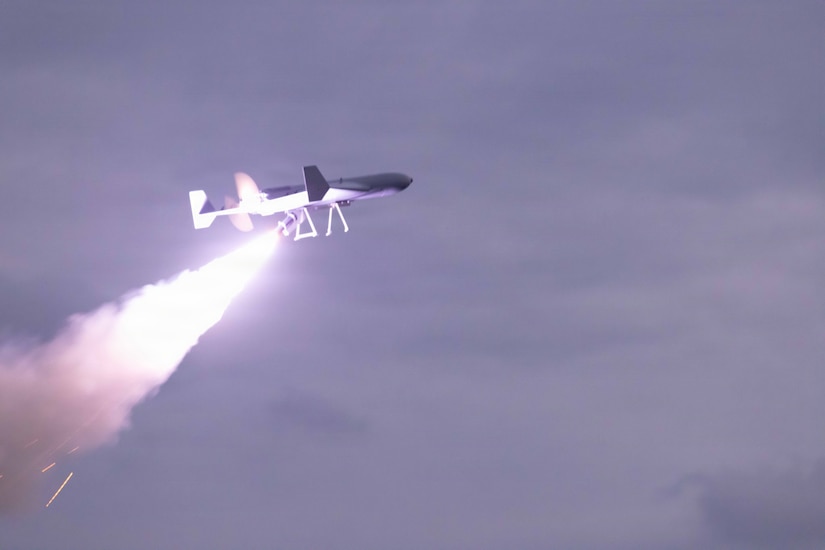
A drone takes off from the deck of a ship at sea.

The unit, called Task Force Falcon Strike, will employ one-way attack drones consisting of unmanned systems from above, on and below the sea, operated by military support staff from the United States and regional partners.

Falcon Strike's launch occurs nine months after Centcom established Task Force Scorpion Strike, the U.S. military's first dedicated one-way attack drone squadron in the Middle East.

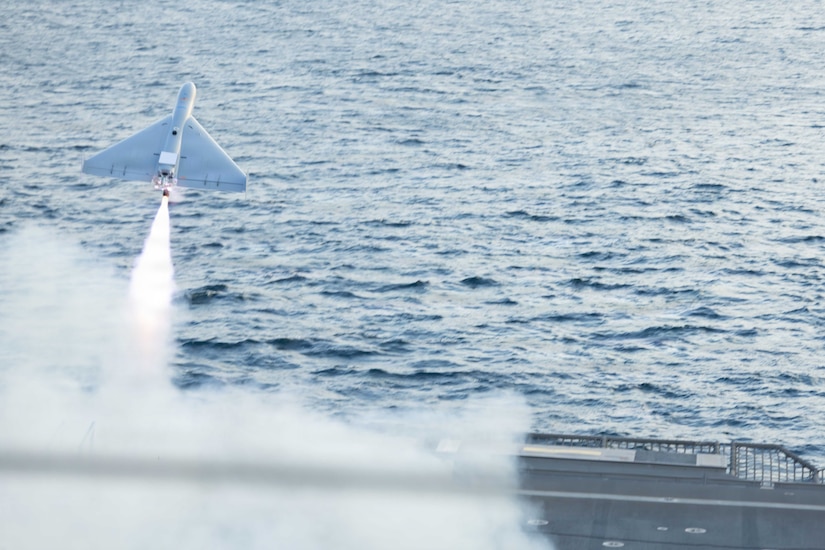
Scorpion Strike rapidly achieved key operational milestones, including the first launch of an aerial attack drone from a Navy warship last December. The squadron also employed one-way unmanned aerial systems during Operation Epic Fury and during strikes on Iranian port facilities in July using unmanned attack vessels at sea.

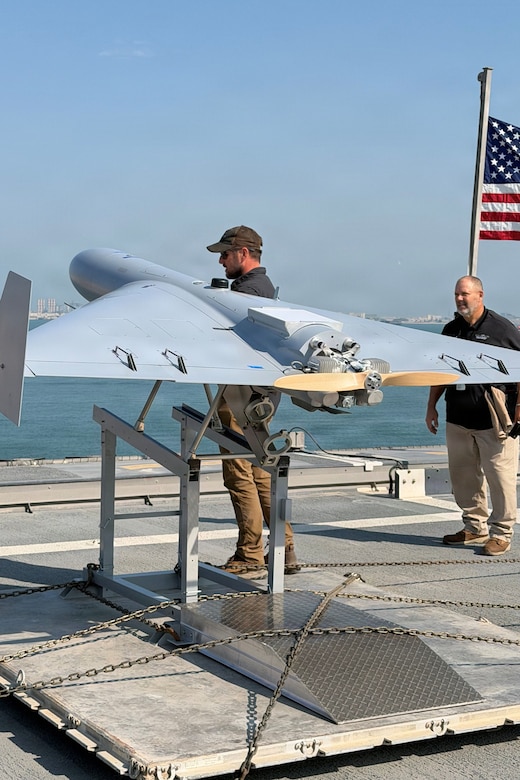
A man wearing casual attire, a baseball cap and sunglasses works on a drone as another man in similar attire looks on. They are both standing on the deck of a ship at sea.

"Task Force Falcon Strike will expand on Scorpion Strike's success given the tremendous innovation happening among our regional allies and partners," said Navy Adm. Brad Cooper, Centcom commander. "Integrating and deploying our new capabilities together will help us rapidly realize the new possibilities that are on the horizon."

Centcom has initiated consultations with official invitations to regional partners. As regional partners formally join, Task Force Falcon Strike will scale attack drone capabilities across the Middle East into a unified multidomain, multinational deterrent.

"The United States military has a lot of strong partnerships and friends in the region," Cooper said. "We are collectively stronger when we integrate and deploy new capabilities together."

Personnel from U.S. Special Operations Command Central, which launched Scorpion Strike, will lead Falcon Strike's staff of U.S. and regional representatives.

A drone takes off from the deck of a ship at sea.

Thursday, August 25, 2011

China Report Notes Military Modernization

By Jim Garamone
American Forces Press Service

WASHINGTON, Aug. 24, 2011 – China’s military is modernizing, but the Chinese government needs to be more forthcoming on why it needs these new capabilities, according to a Defense Department report delivered to Congress today.

Michael Schiffer, deputy assistant secretary of defense for East Asia, briefed Pentagon reporters on the report.

“The United States welcomes a strong, prosperous and successful China that contributes to international rules and norms and enhances security and peace both in the Asia-Pacific region and around the globe,” Schiffer said.

The United States is working to engage China in economic, peacekeeping and humanitarian areas, among others, Schiffer said. A good military-to-military relationship is one part of that engagement, he added, noting that China is working with the international community, for example, to counter piracy off the coast of Somalia and in the Gulf of Aden. The Chinese military also has contributed to earthquake relief in Pakistan and played a role in delivering humanitarian aid to Haiti, he said.

“However,” he added, “the pace and scope of China's sustained military investment have allowed China to pursue capabilities that we believe are potentially destabilizing to regional military balances, increase the risk of misunderstanding and miscalculation, and may contribute to regional tensions and anxieties.”

The capabilities could pose a temptation for the Chinese government to use military force “to gain diplomatic advantage, advance its interests, or resolve … disputes in its favor,” Schiffer said. This danger, he told reporters, re-emphasizes the need for a sustained and reliable military-to-military dialogue between the United States and China.

China’s army is on track to realize its goal of building a modern, regionally focused military by 2020, the report says. But China’s ability to sustain military power at a distance today remains limited.

This may change shortly, Schiffer said. This month, China has conducted sea trials of a Kuznetsov-class aircraft carrier it purchased from Ukraine and refurbished.

“The aircraft carrier could become operationally available to China’s navy by the end of 2012, we assess, but without aircraft,” Schiffer said. “It will take a number of additional years for an air group to achieve the sort of minimal level of combat capability aboard the carrier that will be necessary for them to start to operate from the carrier itself.”

The Chinese continue to invest in submarines, and China’s navy is investing in new surface combatants designed for anti-surface and anti-air warfare, Schiffer said, and construction of a major naval base on Hainan Island is complete. “And this base, we assess, is large enough to accommodate a mix of ballistic missiles, submarines and large surface combatants, including aircraft carriers,” he added.

China is also investing in aircraft and missiles. In January, the Chinese air force flight-tested its next-generation fighter prototype. The aircraft includes stealth attributes, advanced avionics and supercruise-capable engines, Schiffer said.

Space also is a focus of China’s military modernization, with a record 15 launches in 2010.

While relations with Taiwan and China have improved markedly in most areas, Schiffer said, the Chinese military still focuses on a cross-strait contingency. China also seems to be stressing maritime territorial claims in the South China Sea – an area where roughly 50 percent of the world’s trade travels.

The Chinese military also has demonstrated in recent years the capability to conduct limited peacetime deployments of modern forces outside Asia.

“This includes multiple counterpiracy deployments to the Gulf of Aden and increasing participation in international humanitarian and disaster … relief efforts,” Schiffer said. “Investments in large amphibious ships, a new hospital ship, long-range transport aircraft and improved logistics have made these sorts of missions a practical reality.” These peacetime operations provide China’s military with a valuable operational experience and also serve the government’s diplomatic objectives, he added.

The modernization shows no sign of slowing, the report says, as the Chinese military received a 12.7 percent budget increase this year. The report acknowledges the difficulty in figuring how much China spends on its military, but estimates it at around $165 billion. “That continues more than two decades of sustained budgetary growth,” Schiffer told reporters.

The Chinese have made some incremental improvements in transparency in recent years, he said, but a number of uncertainties remain.

“We will continue, and we do continue, to encourage China to improve transparency and openness, to act in ways that support and strengthen common political, economic and diplomatic interests of the region and of the international community,” Schiffer said.

In the past, the Chinese have objected to the release of the report. Schiffer said he hopes the Chinese government and military will look at it differently this year.

“The report can best be read not simply as a piece of analysis, but really as the sets of questions and issues that we would like to be able to engage in dialogue and discussion with our Chinese counterparts about,” he said. “These are the questions and the issues that we think that it's important for us to be able to understand.

“We know our Chinese friends have questions for and about us,” he continued, “and that's the sort of dialogue and discussion that we welcome and that we think contributes to regional and global security and stability.”

Sunday, February 20, 2011

CNO Attends BEYA

By Mass Communication Specialist 1st Class Petty Officer Stephen Watterworth
Chief of Naval Operations Public Affairs

WASHINGTON (NNS) -- Chief of Naval Operations (CNO) attended the Black Engineer of the Year Awards (BEYA) Stars and Stripes dinner, Feb. 18 in Washington, D.C.

CNO, Adm. Gary Roughead honored John H. James, Jr., Rear Adm. Arthur J. Johnson, and many others as recipients of the 2011 Stars and Stripes Award during the 2011 BEYA Science, Technology, Engineering and Math (STEM) Global Competitiveness Conference.

While speaking at the dinner, CNO expressed the importance of STEM in the Navy and how organizations like BEYA contribute to the success of the Navy.

"Navy participates with BEYA and other activities that stress STEM and diversity because we really believe that as a Navy, we will be a better Navy if we represent all of America," he said.

Roughead said it's key for the Navy to team up with BEYA and to look for opportunities to reach out and mentor the young men and women throughout the country and inform them of the benefits of the Navy.

"We are a technological Navy," he said. "We operate at the very high end of technology. We operate in every domain of the planet whether its under the sea, on the sea or above the sea, and now more than ever in cyberspace and the sailors and the young men and women who come into our Navy if they have that STEM background, they are going to be much more natural fits for who we are and the world in which we are going to operate."

"There are just a variety of activities that we participate in and we are always looking for new opportunities to be able to present what the Navy does to the young men and women of America," Roughead continued. "We have programs, for example, StarBase Atlantis and we have a STEM academy at the Naval Academy."

The BEYA conference and award program recognized young men and women from around the country who demonstrate outstanding performance in a technical field and show great potential for shaping the future course of engineering, science, math and technology.

Monday, November 03, 2008

Slowing Military Change

The author looks at the development of military technology in recent years. He examines three major platforms: fighter aircraft, tanks, and cruisers, examining the gaps between generations as well as the capability gains of each succeeding type. While development has slowed, at the same time capability increases have also slowed: it takes longer to get new equipment, and that new equipment is less of an improvement over its predecessor than its predecessor was over its predecessor. Only in electronics and computer technology was that shown to be somewhat untrue, but even there military technology has lagged significantly behind commercial advances. This relative military stasis, in technology at least, has a range of causes: the end of the Cold War, bureaucratic changes, political cultures, scientific limits, cost inflation, a focus on new characteristics that cannot be so easily measured. The author also looks at the strategic environment to see whether that has evolved rapidly while technology has proven more dormant.

READ ON

http://www.strategicstudiesinstitute.army.mil/pubs/display.cfm?PubID=878