Showing posts with label defense innovation. Show all posts

Saturday, September 19, 2026

Hegseth Addresses Team Who Built Sea Drone Used to Rescue Downed Apache Crew

Sept. 18, 2026 | By C. Todd Lopez, Pentagon News |

In early June, an Army AH-64 Apache helicopter patrolling regional waters went down off the coast of Oman, leaving two crew members in need of rescue. An autonomous surface vessel — a U.S. Navy Corsair operated by the 5th Fleet's Task Force 59 — rescued the soldiers.

The autonomous seafaring vessel — manufactured by Texas-based Saronic — picked up the crew members and transported them to another location on the water where they were then hoisted into a helicopter for further transport.

Saronic builds a variety of autonomous vehicles for the U.S. military and Secretary of War Pete Hegseth visited the company and workforce today to see how they make hardware that enables the joint force. He thanked them for the work they are doing now and will do in the future as part of the Arsenal of Freedom tour.

"Having had a chance to tour this facility firsthand just a few moments ago, the scale, investment and precision of your projects [are] truly impressive," Hegseth told Saronic employees gathered at the company headquarters in Austin, Texas. "You are on the front lines of American industry, and that's the entire purpose of the Arsenal of Freedom tour. I had a chance to shake some hands along the assembly line ... the point ... of this tour is to look patriots in the eye and thank you for the work that you've done and for the work that you're doing."

Saronic makes three autonomous ocean-going vessels: the Corsair, the Mirage and the Marauder. Hegseth said vessels like these are destined to be at the heart of the U.S. military.

"What Saronic demonstrates is the future of American naval power, delivering over 300 combat-proven Corsairs; rapidly fueling the 52-foot Mirage and scaling blue water reach with the 180-foot Marauder, all built in under a year," he said. "In our building, we're used to timelines of seven, eight years. One year is not a thing ... I came to see and it's real. That's the kind of scale and speed that our department needs. The kind of competition our building needs, [and] the bureaucracy needs to realize that it can be done."

Warfare has always involved troops on the ground, but now it demands autonomy as well, and the War Department is leaning heavily into it with its Drone Dominance initiative. But autonomy doesn't just mean drones in the air — surface-level vehicles are also critical, he said, including those like the Corsair that rescued the Apache crew.

"Those pilots are alive today because of the incredible innovation under this very roof," he said. "You should be ... incredibly proud of that feat."

The secretary also told Saronic employees that the Corsair had done additional operational work beyond rescuing pilots.

In July, U.S. Central Command "employed the Corsair to strike a submarine and ship maintenance facility at Bandar Abbas Naval Base," he said. "The operation degraded Iran's ability to continue attacking commercial shipping and marked the first operational employment of sea drones in U.S. military combat operations."

To maintain the most powerful military in the world, Hegseth said, the War Department is reaching out to companies like Saronic and unleashing their potential to build the best equipment possible, and to do it without constraints, roadblocks or bureaucracy.

"The Department of War ... has been kicking the door wide open for commercial disruptors, nontraditional innovators and venture-backed builders; we are actively creating the next generation of defense primes, firms like Saronic," he said. "Our Arsenal of Freedom tour showcases how modern deterrence requires commercial speed."

The secretary said that under Emil Michael, undersecretary of war for research and engineering and chief technology officer for the War Department, the department has unified its innovation ecosystem under one roof to make decisions faster than past bureaucracies allowed. And with the leadership of Mike Duffey, undersecretary of war for acquisition and sustainment, the department is reforming acquisition to empower program executives and deploying multiyear procurement contracts.

Hegseth also lauded Saronic employees and executives for playing a big role in revitalizing the American shipbuilding industry. In Texas and Louisiana, he said, Saronic is building ships, creating jobs and strengthening the defense industrial base all at the same time.

"At the Port of Brownsville [in Texas], Port Alpha ... delivers a $3 billion investment, up to 10,000 high-paying jobs, over $160 billion in regional impact for Cameron County, [Texas,] and 150,000 ... gross tons of new shipbuilding capacity," he said. "This industrial muscle here will double domestic shipbuilding and ensure absolute dominance."

Saronic is also investing some $300 million in Louisiana, including at the Gulf Craft shipyard in Franklin, Louisiana, to build autonomous surface vessels.

"This effort creates over 1,500 high-paying maritime careers," Hegseth said. "Together, Franklin and New Orleans prove that combining historic craft with robotics creates an unbeatable industrial edge."

The secretary said Saronic and companies like it are the future of American shipbuilding, and at the heart of the rebirth of the American defense industrial base.

"All the strategies from the Pentagon are meaningless without the people on this floor: the technicians, the machinists, the fabricators and the engineers," he said. "Every platform you weld, wire and assemble gives our warfighters the decisive edge to win and return home. Never forget that direct line from your hands to the success of our warfighters."

The secretary implored Saronic workers to keep doing what they've been doing, and to do even more.

"Today I say to you: build faster, scale larger and deliver more," he said. "We need you like never before, because when America is unleashed, we win."


Tuesday, August 18, 2026

One War Department Unit Takes Next Step in Legacy of Innovation

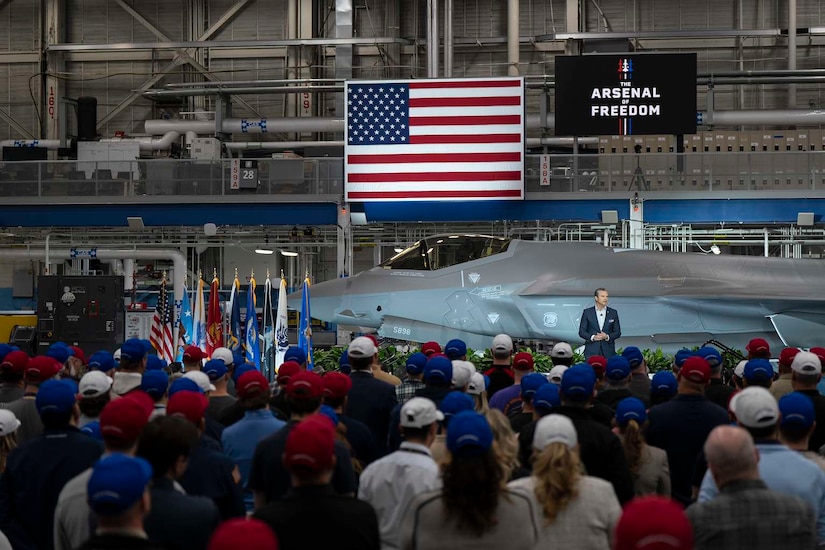
Seven months ago, Secretary of War Pete Hegseth stood before a large crowd of Lockheed Martin employees in Texas, during the third stop of his nascent Arsenal of Freedom tour, to show his appreciation for the people behind the defense industrial base.

A man in business attire stands on a stage in a hangar and speaks to a large crowd of people in casual attire and baseball caps; behind him is a military aircraft, an American flag and a banner that reads, “Arsenal of Freedom.”

During his remarks, Hegseth made clear that supercharging the defense industrial base, which is one of the four lines of effort in the 2026 National Defense Strategy, is something the current administration and the War Department want to see happen at a rapid clip.

"We've got to go fast. The warfighters need it; they deserve it. We've got near-peer adversaries that are building at record speed," Hegseth said. "[This] Arsenal of Freedom tour is meant to speak to you and your peers, and to tell you to keep going."   

To facilitate that need "to go fast," the War Innovation Unit — formerly the Defense Innovation Unit and still abbreviated as DIU for contractual purposes — is working to cut through red tape with the defense industrial base.  

Founded in 2015, DIU is purpose-built to accelerate the War Department's adoption of commercial technology at speed and scale to lower cost and increase combat power. Since January, it has been working to answer Hegseth's call for the expedited acquisition of commercial capabilities across the services in several ways. 

Its latest initiative is the Bridge Program.   

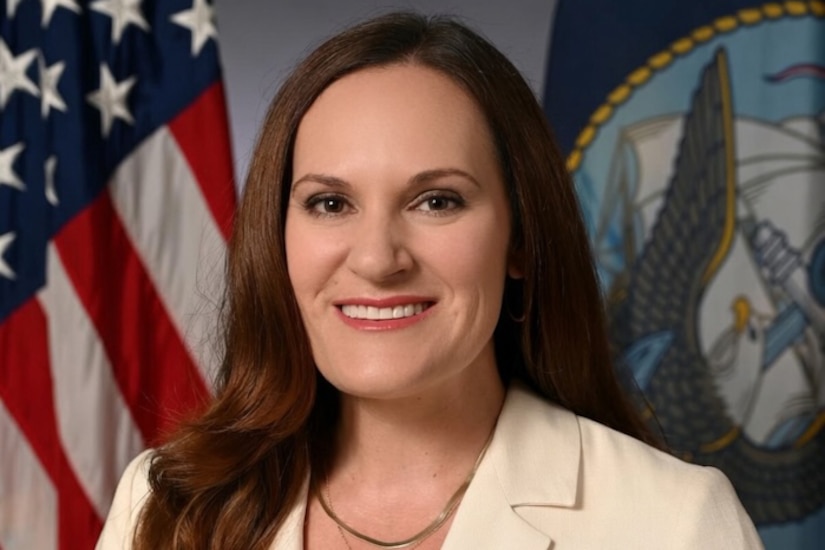
Conceived and developed over the past year by Sarah Pearson — a former Navy officer, technology executive and current chief of strategic initiatives at DIU — the Bridge Program was created to drive long-term, systemic reform across the War Department.

A woman in business attire poses for a portrait; behind her are the American flag and the U.S. Navy flag.

Throughout her career, Pearson has witnessed firsthand the hurdles nontraditional companies face when attempting to sell and scale commercial solutions for the military. 

Under her direction, the Bridge Program is now executing a targeted strategy to eliminate critical bottlenecks — specifically around security clearances, access to classified spaces, technology accreditations and testing.  

By dismantling these operational barriers, the program seeks to broaden the War Department's commercial engagement aperture, mitigate risks, accelerate capability development and maximize adoption rates to deliver best-in-class commercial technologies directly to the warfighter. 

The program's first line of effort focuses on evolving the model for classified space design, construction, accreditation and operation.  

By blending commercial technologies, process improvements, rapid contracting, policy and Congressional support, the department is jointly addressing each aspect of the value chain around classified infrastructure.  

"When successful, we will have demonstrated a new model, a model where classified infrastructure is resourced based upon usage and becomes operational within months — not years — of the need arising," Pearson said.  

Furthermore, she emphasized the critical importance of continued close collaboration within the War Department.  

"Our partners within three offices — the offices of the undersecretary of war for intelligence and security; acquisition and sustainment; and research and engineering — as well as the Defense Intelligence Agency, the Defense Counterintelligence Security Agency and the armed services have been the single greatest unlock in achieving the early success we've seen so far," Pearson said. 

DIU's Bridge Program, and the broader working group across the aforementioned organizations, had its first major contracting announcement last month, when President Donald J. Trump announced a $10 billion investment in Pennsylvania's defense industry July 16.  

The announcement included investment in four shared commercial classified facilities, one of which will be built in Pittsburgh — using the joint funding model that the Bridge Program is prototyping.  

Beyond Pittsburgh, the Bridge Program has contracted for nine additional commercially owned and operated sites across the U.S., including Austin, Texas; San Francisco; Boston; Charleston, South Carolina; Chicago; Cleveland; Louisville, Kentucky; and New York. 

Additional locations will be announced in the coming weeks.

The Bridge Program's second line of effort focuses on establishing the fastest and most trusted accreditation portfolio within the department — something Pearson said can't be accomplished without deep cybersecurity expertise — a thoughtful approach to risk and incorporation of the world's best artificial intelligence capabilities.

By using technology to enhance and accelerate DIU's authorization process, the Bridge Program team will condense timelines and enable greater throughput with fewer resources.

"We plan to shift the risk management framework process to the left in prototype development and build cybersecure solutions that the services can more easily field. Indexing toward accreditations for every program and sooner in development are critical to adoption," Pearson explained.

The third line of effort — test and evaluation — draws on DIU's core competency, prototyping commercially derived technologies inside the department's developmental and operational test infrastructure.

Through partnership, technology and new approaches, Pearson said DIU is building an end-to-end test approach for portfolio companies entering the prototype pipeline, with testing opportunities throughout the contract lifecycle.

The result is a process that stitches capability development together with existing and emerging test infrastructure, for both physical and digital applications.

As DIU continues to expand and implement the Bridge Program in support of Hegseth's call to revamp and expedite the acquisition process, Pearson said it will continue to lean on unprecedented partnership across the department, its history of pioneering new approaches and its deep conviction that the warfighters deserve the best capabilities available.

Saturday, July 04, 2026

Department of War Establishes Direct Reporting Portfolio Manager for Unmanned Systems to Ensure American Drone Dominance

The Department of War today announced the comprehensive consolidation of all Unmanned and Autonomous Systems (UxS) under a newly established, direct-report position to the Deputy Secretary of War. This strategic priority aims to rapidly accelerate the development, procurement, and fielding at scale of autonomous capabilities, which are essential to maintaining the United States' decisive military advantage.

"This structural reorganization directly implements a series of decisive actions taken by the administration. Drones and autonomous systems represent the most consequential battlefield innovation of this generation," said Chief Pentagon Spokesman Sean Parnell. "Adversaries collectively produce millions of unmanned systems each year across all domains. While global military production has skyrocketed over the last three years, the United States must move at the speed this moment demands to field these capabilities at scale and secure our tactical and strategic edge."

Last year, President Donald J. Trump signed Executive Orders directing the reform of the Department's acquisition processes to ensure the United States Military possesses the most lethal warfighting capabilities in the world, "Unleashing American Drone Dominance," which directed the DoW to procure, integrate, and train using low-cost, high-performing drones manufactured in the United States, and "Restoring American Airspace Sovereignty," establishing critical authorities to counter growing adversary unmanned threats. Following these directives, Secretary Hegseth issued an implementing memorandum on July 10, 2025, committing the Department to bolstering the domestic drone manufacturing base, arming combat units with low-cost unmanned systems, and training the joint force to fight and win with these capabilities.

To establish an immediate operational baseline and consolidate specialized expertise, the DRPM- UxS will provide direct oversight and direction for all unmanned activities, functions, and associated programmatic funding lines currently assigned to the Department of War to include Services Components, Joint Interagency Task Force 401, the Defense Innovation Unit, and the Defense Autonomous Warfare Group.

The Secretary of War's memorandum can be found here.

Thursday, June 18, 2026

Drone Dominance Program Receives First Order, Gauntlet II Gets Underway

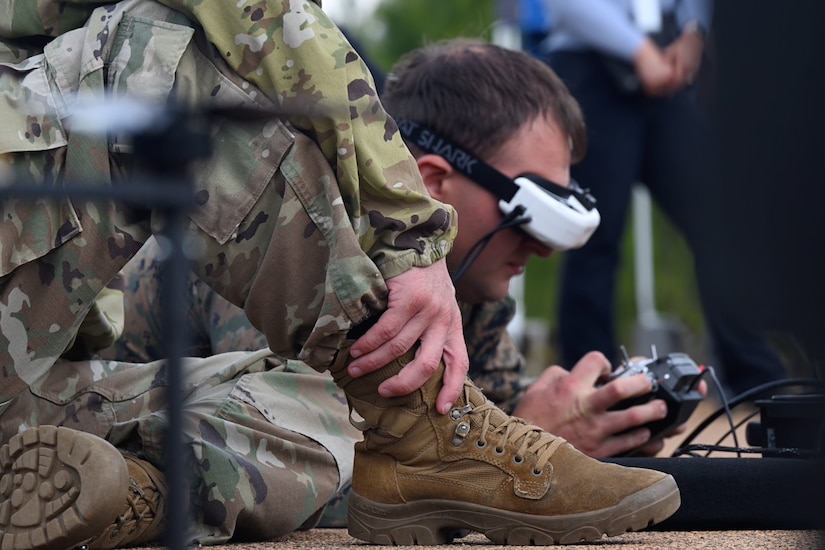
Drone Dominance Program Gauntlet Phase II qualifiers conclude this week at Camp Grayling, Michigan. This high-stakes test pits 49 companies and 79 unique unmanned aerial systems against rigorous mission scenarios, including long-range strikes and close-quarters tactical assaults. Each company brought 20 drones to take on the challenge. 

The qualifier event is a critical test for a battlefield that is evolving at an unprecedented pace and showcased how the War Department is answering the call with radical innovation. 

The Drone Dominance Program is a $1.1 billion, two-year effort to execute President Donald J. Trump's Executive Order 14307, which articulated the urgent need for the department to procure, integrate and train with low-cost, high-performing drones manufactured in the U.S.  

A man lies on his stomach while wearing a headset and holding a remote control. People in similar attire sit next to him.

The goal of the program is to rapidly arm combat units with a massive, scalable fleet of low-cost, expendable one-way attack drones. The effort is also expected to increase the flow of private capital into the U.S. industrial base, while simultaneously driving down costs. 

Sponsored by the Office of the Secretary of War and jointly administered by the Defense Innovation Unit and Test Resource Management Center, the Drone Dominance Program is at the forefront of the department's pivot to a challenge-based acquisition approach. It also means shifting from slow, multiyear cycles to agile, six-month sprints.   

The program is putting technology to the test in a series of four gauntlet phases — demanding, realistic challenges designed to identify the most resilient and effective drone platforms.  

At the conclusion of each phase, selected drone technologies are fast-tracked for large-scale production, ensuring warfighters are equipped with a decisive advantage on the modern battlefield. 

"This is an urgent matter," said Owen West, DIU director. "Our adversaries are scaling their UAS technology, tactics and industries at an alarming rate. Following Secretary of War [Pete] Hegseth's orders, we are acting decisively to develop new defensive and offensive capabilities to match these threats." 

West noted that the department is already seeing results.  

The first batch of drones was accepted, with nearly 2,000 additional units shipped to the services and thousands more ramping up for fulfillment.  

Following a highly successful Phase I, which saw the purchase of 30,000 drones, the department is gearing up for the next major milestone. 

"As directed by President Trump and Secretary Hegseth, we have begun to equip our warfighters with the best drones in the world," said Travis Metz, DIU deputy director. "We have ordered 30,000, which are being delivered now and will be ordering 60,000 more in September, all based on competitive events and moving supply chains to the United States as we progress." 

By fostering fierce commercial competition via a public leaderboard, the department aims to scale production from 30,000 to 150,000 units per phase, ultimately dropping the target unit cost from $5,000 to approximately $3,000. By 2027, the Drone Dominance Program intends to field more than 200,000 lethal, artificial intelligence-enabled drones, ensuring the U.S. military executes a technological leapfrog to secure an enduring edge over our adversaries. 

Gauntlet II will kick off later this summer, during which entrants must bring 120 drones as the competition expands into night operations and more complex urban and confined environments.