Showing posts with label centcom. Show all posts

Friday, August 14, 2026

Centcom Launches First-Ever Multinational Attack Drone Task Force

U.S. Central Command announced efforts to establish the first multidomain, multinational attack drone task force yesterday.
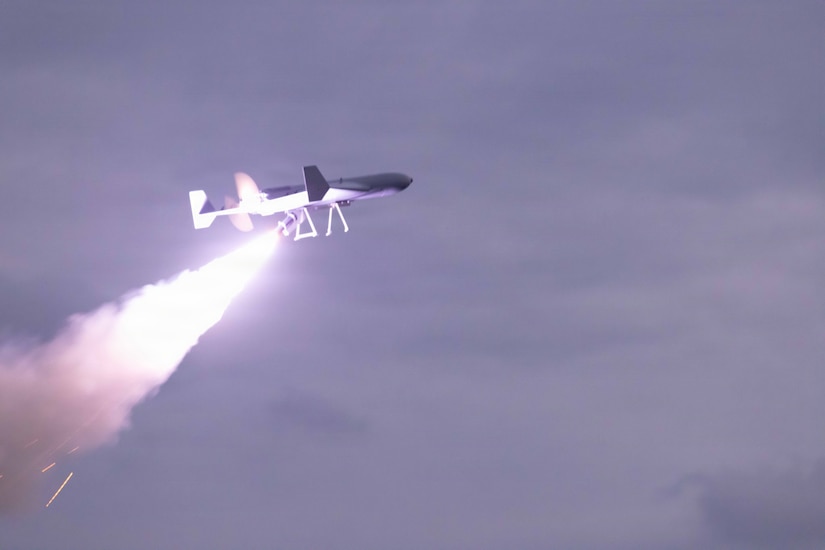
A drone takes off from the deck of a ship at sea.

The unit, called Task Force Falcon Strike, will employ one-way attack drones consisting of unmanned systems from above, on and below the sea, operated by military support staff from the United States and regional partners.

Falcon Strike's launch occurs nine months after Centcom established Task Force Scorpion Strike, the U.S. military's first dedicated one-way attack drone squadron in the Middle East.

Scorpion Strike rapidly achieved key operational milestones, including the first launch of an aerial attack drone from a Navy warship last December. The squadron also employed one-way unmanned aerial systems during Operation Epic Fury and during strikes on Iranian port facilities in July using unmanned attack vessels at sea.
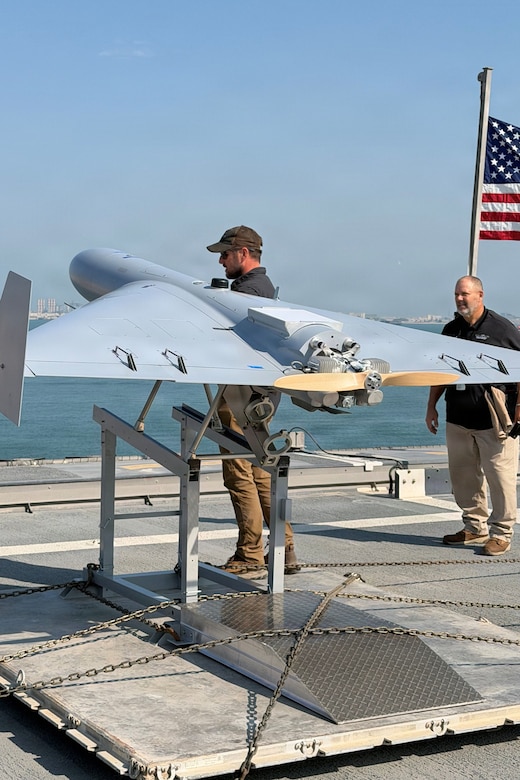
A man wearing casual attire, a baseball cap and sunglasses works on a drone as another man in similar attire looks on. They are both standing on the deck of a ship at sea.

"Task Force Falcon Strike will expand on Scorpion Strike's success given the tremendous innovation happening among our regional allies and partners," said Navy Adm. Brad Cooper, Centcom commander. "Integrating and deploying our new capabilities together will help us rapidly realize the new possibilities that are on the horizon."

Centcom has initiated consultations with official invitations to regional partners. As regional partners formally join, Task Force Falcon Strike will scale attack drone capabilities across the Middle East into a unified multidomain, multinational deterrent.

"The United States military has a lot of strong partnerships and friends in the region," Cooper said. "We are collectively stronger when we integrate and deploy new capabilities together."

Personnel from U.S. Special Operations Command Central, which launched Scorpion Strike, will lead Falcon Strike's staff of U.S. and regional representatives.
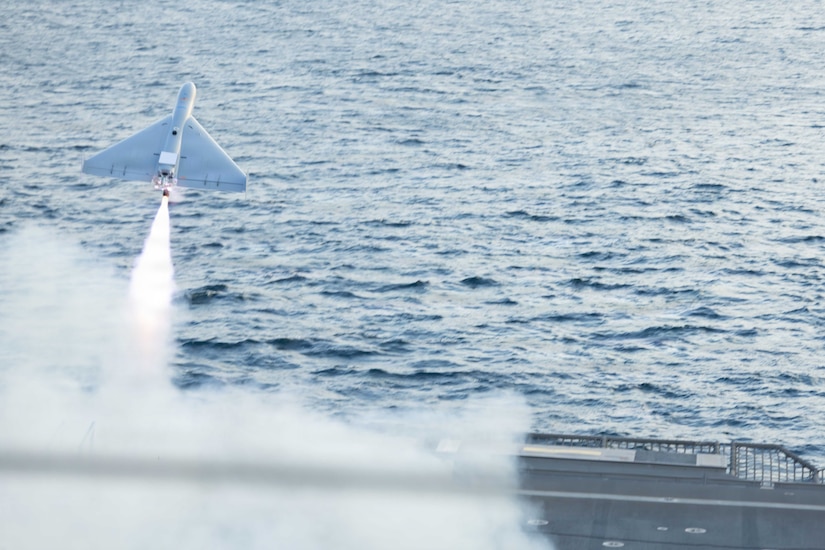
A drone takes off from the deck of a ship at sea.

Saturday, March 17, 2007

CENTCOM Coordination Center Represents Strong Coalition

By Sgt. Sara Wood, USA
American Forces Press Service

March 16, 2007 – In a nondescript building at U.S. Central Command headquarters here, officers from 64 countries work together daily to ensure the coalition fighting terrorism in the Middle East remains strong and well organized. Despite inevitable debate about the conflicts in Iraq and Afghanistan, this coalition coordination center demonstrates the strong international will in the struggle against terrorism, the center's deputy director said in an interview yesterday.

"I think the state of support for the
war on terror is still good," Marine Col. David Greco said. "We are talking to countries every day. We talk to the 64 that are resident here, and many others that don't have a senior national representative here, we talk to them via the State Department and via our attache system, where we have defense attaches throughout the world, helping those coalition partners."

The countries represented here support the
war on terror in various ways, Greco said. Some provide troops directly to the fight, some provide air assets, others provide access basing and overflight for coalition forces, and still others offer capital support. Japan, for example, has an oiler ship deployed to the CENTCOM region to refuel coalition ships, he said.

The United States and a few key allies formed the coalition coordination center right after the terrorist attacks of Sept. 11, 2001. From there, more countries joined the coalition and therefore sent representatives to CENTCOM, Greco said. "It's a pretty dynamic coalition, in that there's countries involved from the Pacific region, the Americas, the Middle East, and European countries," he said.

Many officers in the coalition coordination center are connected to the senior levels of their home governments and can ease communication among the coalition countries, Greco said. Also, the officers represent countries that have forces working together in specific regions of Iraq and Afghanistan, so deployment planning is made easier. This camaraderie and interaction strengthens the coalition and translates to effectiveness on the battlefield, he said.

Every country in the coalition recognizes that the solutions in Iraq and Afghanistan will not be military force, but political and economic effort, Greco said. The Middle East has what leaders call a "youth bulge," where the majority of the population is young people. Many of these young people are unemployed or underemployed, so economic development is especially important, he said.

CENTCOM also has a security cooperation division, which works to help coalition partners help themselves, whether through
training military police or border guards, participation in military exercises, or help with funding and reform, Greco said. CENTCOM works closely with the State Department, the Defense Department and the Joint Staff to encourage increased engagement from international countries in the war on terror, he said.

"We have all recognized that the solutions in both Iraq and Afghanistan are not going to be solved with military power," Greco said. "It is a pretty recognized and pretty well understood concept that there are diplomatic, economic,
military and informational concepts that need to be talked about in those countries, and all that needs to be brought to bear."

Provincial reconstruction teams are important in the rebuilding of Iraqi and Afghan society, Greco said, and CENTCOM is working to encourage coalition partners to contribute civilian experts to these teams.

"What we're doing is working on coming up with the requirements of what kinds of job skills we need," he said. "And we're going to our coalition partners and we're saying, 'We're not looking for military guys; we're not looking for people to kick in doors and search for bad guys. We're looking for people that can help rebuild the Iraqi and even the Afghan infrastructure.'"

There will always be debate within the government about the U.S. involvement in Iraq and Afghanistan, Greco acknowledged, but countries in the coalition recognize political cycles and aren't discouraged by criticism within the United States. The rest of the world looks to the United States as an example of government and policy, but the internal debate isn't damaging to the international will in the Middle East, he said.

"While we debate, the rest of the world watches how the United States does business, and we all recognize that, but I don't think it's going to cause any problems in our coalition," he said.

This article is sponsored by
criminal justice online leadership as well as police and military personnel who have authored books.

Fallon Takes Reins of Central Command

By Sgt. Sara Wood, USA
American Forces Press Service

March 16, 2007 – For the first time since the United States created a combatant command with responsibility for the Middle East, Northern Africa and Southwest and Central Asia, a naval officer took over the helm of U.S. Central Command here today.
Navy Adm. William J. Fallon, a naval aviator with almost 40 years of service, assumed duties as commander of CENTCOM from Army Gen. John P. Abizaid, who is retiring after leading CENTCOM for more than three years.

Fallon comes from commanding U.S. Pacific Command, the largest geographical command in the military, where he worked to improve
military ties with China.

Defense Secretary Robert M. Gates presided over today's ceremony. He praised Abizaid for the work he did in the Middle East while commanding CENTCOM. Abizaid studied the region's culture extensively, becoming an expert and forging important relationships with the people, Gates said. Abizaid took over the command early in the Iraq conflict, at a time when there was much work to be done, he noted.

"He accepted enormous responsibility at a crucial time in history," Gates said of Abizaid.

Under Abizaid's
leadership, CENTCOM helped Iraq conduct three elections, form a new government and constitution, and grow the Iraqi security forces threefold, Gates said. In Afghanistan, he noted, thanks in large part to Abizaid's efforts, NATO countries have stepped up and taken responsibility for the security of the country, in partnership with Afghan security forces.

Gates said he is confident that Fallon will build on Abizaid's good work, noting that the admiral brings decades of experience and a record of success to the command. He praised Fallon as one of the
military's top strategic thinkers, who built important relationships with other nations during his time in Pacific Command.

After relinquishing command to Fallon, Abizaid thanked the members of the coalition for the work they do with CENTCOM. He also thanked the officers under his command, who he said do so much to fight the
war on terror, provide humanitarian assistance, and strengthen partnerships around the world.

"Never has a commander been so blessed by a team of capable and heroic leaders," Abizaid said.

Abizaid noted that war is never easy, and the
war on terror will be long and will require "courage and time." Victory against terror will require not only military effort, but also political and diplomatic work, he said.

"This conflict is greater than the sum of Iraq and Afghanistan," Abizaid said.

Upon taking command, Fallon thanked Abizaid for the legacy he left and pledged to strengthen and nurture relationships with members of his command and other nations. Fallon acknowledged that much work lies ahead of CENTCOM in the months ahead, and that Iraq and Afghanistan are both at critical points. However, he said, the troops and commanders of CENTCOM and allied countries are capable and dedicated, and can help the people of the Middle East achieve what most people in the world want: peace, security and stability.

"In concert with our allies, if we put our minds to it, there's very little we can't accomplish," Fallon said.

CENTCOM was created in 1983 and is responsible for U.S. military activity in a 27-country region in the area between U.S. European Command and Pacific Command. CENTCOM is responsible for the conflicts in Iraq and Afghanistan, focused on defeating terrorism, strengthening regional stability, building the capacity of partner nations, and protecting U.S. interests in the region.

This article was sponsored by
criminal justice online leadership; and, police and military personnel who have authored books.

Tuesday, January 30, 2007

CENTCOM Nominee Touts Diplomacy in Iraq Approach

By Sgt. Sara Wood, USA
American Forces Press Service

Jan. 30, 2007 – Cooperation and assistance from U.S. allies in the Middle East are essential to promoting security and stability in Iraq, the president's nominee to lead U.S. Central Command said here today.
Navy Adm. William J. Fallon, whom President Bush nominated to take over for Army Gen. John Abizaid, told the Senate Armed Services Committee that, if confirmed, he would draw on his diplomatic experience as the commander of U.S. Pacific Command, where he has served since February 2005. In Pacific Command, Fallon said, he engages countries in the region for advice and opinions in security operations. He would like to bring this same approach to the Middle East, he said.

"It seems to me that we make progress when we are willing to be open and to use every means at our disposal to try to achieve the ends. But this, of course, requires reciprocal actions from the other parties," Fallon said. "And so I don't know the extent to which those endeavors have been undertaken in the Middle East, but I am very anxious to find out and to try to play a constructive role in that."

If confirmed, Fallon will be the first
Navy officer to head Central Command. He acknowledged today that a new way forward is needed in Iraq, with more emphasis on securing the Iraqi population. He said that Army Lt. Gen. David H. Petraeus, who was confirmed Jan. 26 to command Multinational Force Iraq, will be in charge of operations on the ground, while he will focus on the broader issues.

"It seems to me that there's an expectation that I'd be working outside the borders of Iraq to try to get the neighborhood, for example, to help us, and to continue to work these other issues like Afghanistan," Fallon said. "So I'd be looking to work in a complementary manner."

Right now, Fallon said, he sees a lot of inaction on the part of Middle Eastern countries. He is eager to work with the U.S. Department of State in engaging these countries and working toward stability, he said.

In Iraq, political and economic progress must take place, or security improvements will mean nothing, Fallon said. The Iraqi government must act on the objectives it set out to give the people confidence and hope, he said.

"If this endeavor of a pluralistic democratic entity in Baghdad is going to survive, it's going to require political courage and leadership, I believe, to stand up and make decisions that can be helpful to people," he said.

The United States must make clear to the Iraqi government that U.S. forces are not in an open-ended commitment, and progress is expected, Fallon said. However, now is not the time to give the Iraqis strict deadlines without flexibility, he said.

Diplomacy also will be important in dealing with Iran, Fallon said. The government there is trying to deny U.S. involvement in the region, but is also a threat to U.S. allies, he noted. The U.S. must work with these allies and pay close attention to Iran's actions, he said.

"There are many things that ought to be considered as we approach our engagement in the region, and I'll be very anxious to particularly consult with the Gulf region nations to see what's new, what's learned, because it's been a number of years since I actually engaged in this area," Fallon said.

Article sponsored by
Criminal Justice Leadership; and, police and military personnel who have authored books, blogs and websites.