Showing posts with label camp grayling. Show all posts

Thursday, June 18, 2026

Drone Dominance Program Receives First Order, Gauntlet II Gets Underway

Drone Dominance Program Gauntlet Phase II qualifiers conclude this week at Camp Grayling, Michigan. This high-stakes test pits 49 companies and 79 unique unmanned aerial systems against rigorous mission scenarios, including long-range strikes and close-quarters tactical assaults. Each company brought 20 drones to take on the challenge. 

The qualifier event is a critical test for a battlefield that is evolving at an unprecedented pace and showcased how the War Department is answering the call with radical innovation. 

The Drone Dominance Program is a $1.1 billion, two-year effort to execute President Donald J. Trump's Executive Order 14307, which articulated the urgent need for the department to procure, integrate and train with low-cost, high-performing drones manufactured in the U.S.  
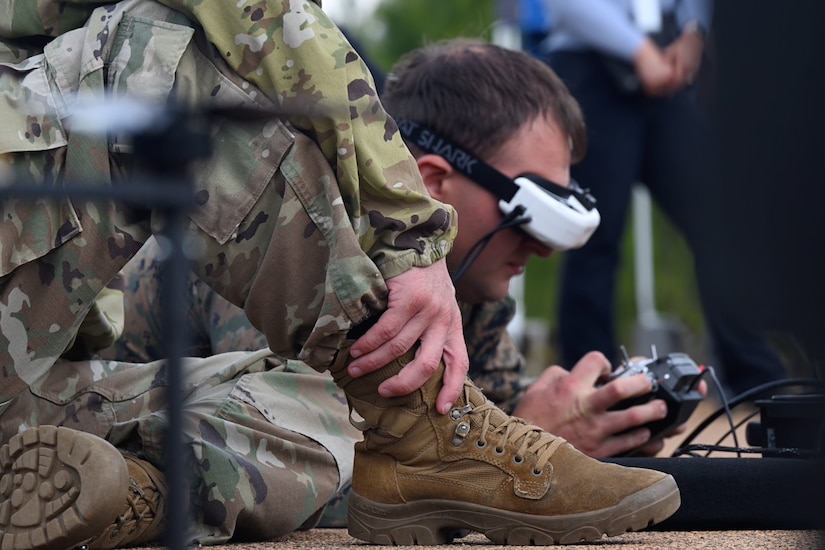
A man lies on his stomach while wearing a headset and holding a remote control. People in similar attire sit next to him.

The goal of the program is to rapidly arm combat units with a massive, scalable fleet of low-cost, expendable one-way attack drones. The effort is also expected to increase the flow of private capital into the U.S. industrial base, while simultaneously driving down costs. 

Sponsored by the Office of the Secretary of War and jointly administered by the Defense Innovation Unit and Test Resource Management Center, the Drone Dominance Program is at the forefront of the department's pivot to a challenge-based acquisition approach. It also means shifting from slow, multiyear cycles to agile, six-month sprints.   

The program is putting technology to the test in a series of four gauntlet phases — demanding, realistic challenges designed to identify the most resilient and effective drone platforms.  

At the conclusion of each phase, selected drone technologies are fast-tracked for large-scale production, ensuring warfighters are equipped with a decisive advantage on the modern battlefield. 

"This is an urgent matter," said Owen West, DIU director. "Our adversaries are scaling their UAS technology, tactics and industries at an alarming rate. Following Secretary of War [Pete] Hegseth's orders, we are acting decisively to develop new defensive and offensive capabilities to match these threats." 

West noted that the department is already seeing results.  

The first batch of drones was accepted, with nearly 2,000 additional units shipped to the services and thousands more ramping up for fulfillment.  

Following a highly successful Phase I, which saw the purchase of 30,000 drones, the department is gearing up for the next major milestone. 

"As directed by President Trump and Secretary Hegseth, we have begun to equip our warfighters with the best drones in the world," said Travis Metz, DIU deputy director. "We have ordered 30,000, which are being delivered now and will be ordering 60,000 more in September, all based on competitive events and moving supply chains to the United States as we progress." 

By fostering fierce commercial competition via a public leaderboard, the department aims to scale production from 30,000 to 150,000 units per phase, ultimately dropping the target unit cost from $5,000 to approximately $3,000. By 2027, the Drone Dominance Program intends to field more than 200,000 lethal, artificial intelligence-enabled drones, ensuring the U.S. military executes a technological leapfrog to secure an enduring edge over our adversaries. 

Gauntlet II will kick off later this summer, during which entrants must bring 120 drones as the competition expands into night operations and more complex urban and confined environments.

Friday, June 12, 2026

Michigan Army National Guard Uses UAS to Train for Tomorrow's Battlefield

Nine soldiers assigned to the 3rd Battalion, 126th Infantry Regiment, Michigan Army National Guard, participated in a two-week unmanned aerial system program that began May 31, 2026, as the Michigan National Guard expands its UAS training initiative.

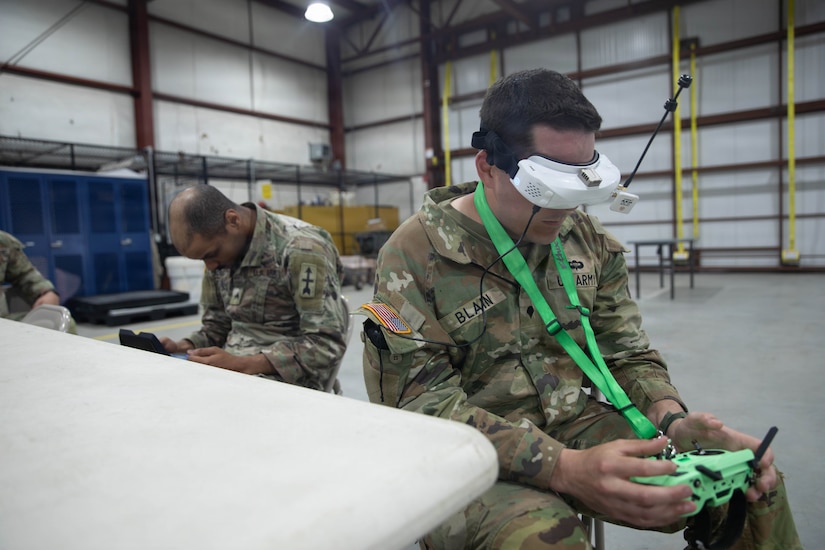
A man in a camouflage military uniform wears a headset and holds a remote control while seated in a warehouse. Another man in similar attire sits near him, holding a remote control.

The Michigan National Guard's UAS program provides service members with no prior experience the training needed to understand regulations, develop flight proficiency and safely operate unmanned aerial systems in support of unit missions. Once certified, operators can utilize and integrate UAS into their units. The training can also tailor instruction to specific unit capabilities, including drone-strike simulations.

"The goal of this training is to expose [service members] to the challenges and opportunities provided by a piece of equipment like that," said Army Maj. Brandon Shortner, the battalion's executive officer. "That's making such an impact on the modern battlefield."

Students began in the classroom for an overview of regulations and systems before moving to flight simulators. Once proficient, they transitioned to field training with a level one UAS, the smallest drone class, maneuvering through an obstacle course that replicates real-world conditions. Instructors adapted the course difficulty based on mission requirements and individual skills.

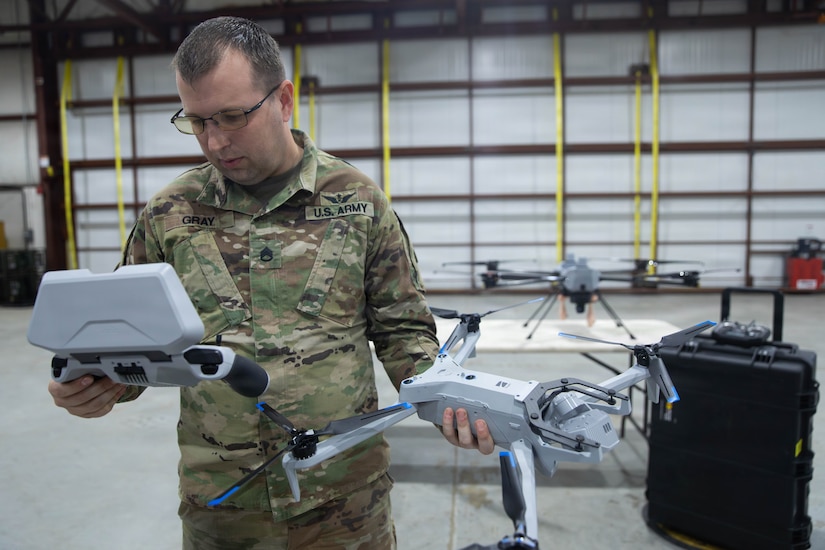
A man in a camouflage military uniform holds a drone in one hand and looks at a controller in the other.

"Every unit has a different mission set, and every mission set will require a different platform," said Army Chief Warrant Officer 2 Aric Petersen, UAS Training Center supervisor for the Michigan National Guard.

After demonstrating competence on the level one drone, the soldiers will progress to live-fire training to learn demolitions and how to arm the platforms.

In February, the War Department designated the Michigan National Guard's Camp Grayling as the nation's first national range for deep uncrewed aerial systems training, resulting in an increased emphasis on UAS training and capability development across the force. Camp Grayling is the largest National Guard training facility in the U.S.

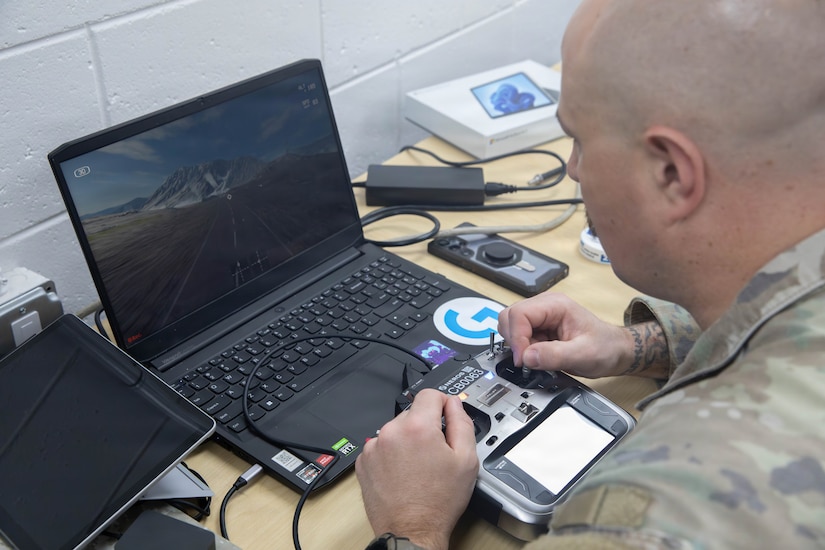
A man in a camouflage military uniform looks at a drone simulator on a laptop.

"It's an incredible honor to be part of a small group of individuals selected to do this," said Army Spc. Aleksandr Blain, an infantry team leader assigned to the 3rd Battalion, 126th Infantry Regiment. "We are looking forward to developing these skills."

Blain was the first of the trained 126th Infantry Regiment drone pilots to execute a drone strike using a first-person view drone June 10. Army Sgt. 1st Class David Burr, an infantry platoon sergeant assigned to the battalion, assisted Blain with the strike as the drone navigator. The navigator role is critical to ensuring UASs reach targets accurately and safely.

The strike was completed using a two-drone hunter-killer team composed of an intelligence, surveillance and reconnaissance platform used to crosstalk with the pilots to confirm targets prior to the strike and a first-person-view system equipped with a fixed-angle camera, giving operators a real-time view from the aircraft's perspective.

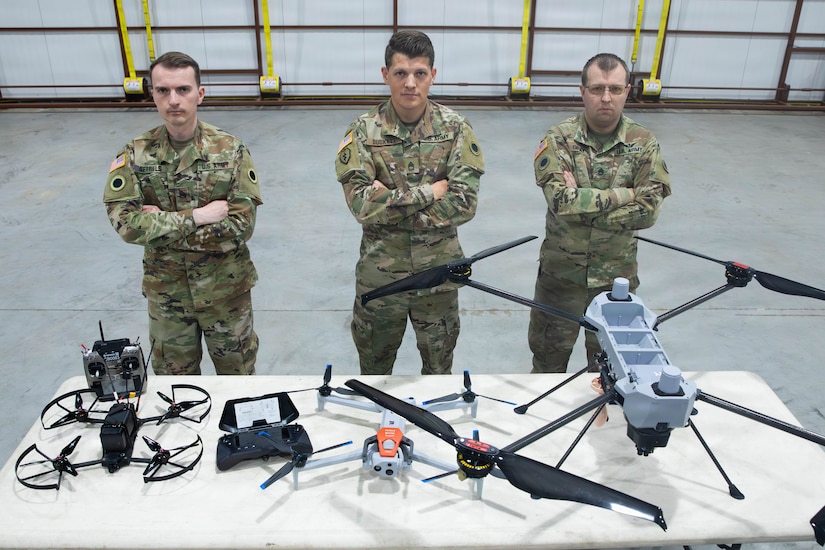
Three men in camouflage military uniforms stand and pose with arms folded behind a table filled with military drones.

The drone is flown entirely by the pilot, enabling precise maneuverability and continued operation in contested environments where GPS may be unavailable or degraded.

The first-person-view drones are piloted completely by manual control, so they find what is called acrobatic mode, which means the pilot has full control over the drone; it doesn't hover.

The two-week training course not only enhanced the unit's tactical performance but also boosted morale among the small group of participants.

"Being on the cusp of innovation is always fun," Blain said. "It's uncharted territory."

Wednesday, April 25, 2012

Wisconsin National Guard names Soldier, NCO of Year


By Spc. Eric Liesse
112th Mobile Public Affairs Detachment

FORT McCOY, Wis. - After a grueling three-day competition, the Wisconsin Army National Guard announced its 2012 State Soldier and Noncommissioned Officer of the Year Sunday (April 22). Both Soldiers now advance to next month's Region 4 Soldier and NCO of the Year competition at Camp Grayling, Mich.

Sgt. Jeremy Smith, a Watertown, Wis., native with the Madison-based 54th Civil Support Team, beat out five fellow Soldiers to be named the State Soldier of the Year. Sgt. Darren Habermehl, a Muskego, Wis., native from Troop C, 1st Battalion, 105th Cavalry Regiment out of Reedsburg, Wis., won over seven other NCOs to take the State NCO of the Year title.

"It's been quite a competitive weekend, for sure," Smith said soon after winning the Minute Man statue. "A lot of the competitors are very good at what they do."

"I'm not going to lie - everybody wants to win, and I probably have a competitive streak as big or bigger than most," Habermehl said. "I was really hoping that my scores... would put me on the top. And thankfully, it fell in my favor this time."

The state-level Soldier of the Year competition is usually headed by State Command Sgt. Maj. George Stopper, Wisconsin National Guard's senior enlisted leader. However, this year he was part of a Wisconsin National Guard delegation visiting troops in Kosovo, so the competition was directed by Command Sgt. Maj. Ralph Rosemore, the state Recruiting and Retention sergeant major.

"Command Sgt. Maj. Stopper has a favorite saying that he uses every year," said Staff Sgt. Jason Walters, the competition's administrative NCO and chief scorekeeper. "He says if you see him or any other [sergeant major] walking around with a big grin on their face, it's not because they enjoy watching you suffer. It's because they enjoy watching the top 10 percent that the Wisconsin National Guard has to offer."

Though Smith and Habermehl will advance to the regionals, they were not far ahead of their fellow competitors.

"This year, like every year, [the scores were] very tight," Walters said. "It always comes down to the last few events. Sometimes, halfway though, you have one or two people jump ahead of the rest. But once everyone gets that working rhythm and that initial adrenalin wears out, it's just a matter of endurance after that."

"I think it's been fairly close," Smith said. "We were going over bonus points earlier with some of the other people trying to figure out who might be up. There's still some things that you don't know when they read the names. It was a great feeling. It's definitely a great experience and something I'm never going to forget."

The competition started late Thursday night at the Wisconsin Army National Guard's Wisconsin Military Academy, with Rosemore briefing Soldiers and NCOs on scores, expectations and support.

Competitors endured a grueling gauntlet of events: physical fitness test, a combatives tournament, a virtual firing range programmed with "shoot-don't shoot" scenarios, life-fire pistol and rifle ranges, day and night land navigation courses, a written exam, combat water survival assessment, Soldier skill proficiency demonstrations, a confidence and obstacle course, a formal appearance board before senior noncommissioned officers, and a 9-mile road march.

Habermehl and Smith finished first in the combatives tournament in the NCO and Soldier categories, respectively. Habermehl was the first to finish the road march with a time of 1:44:57, and Smith was tied for second with a time of 1:47:13.

"[I] did some marching and some training for that definitely, 'cause that's not something you just want to pick up and do," Smith said about the road march. "I started to dabble with the whole cross-fit thing - who knows if that is going to pay off."

Now that this weekend's events are over, Habermehl and Smith are already looking to the next level - the regional competition in Michigan.

"I'm not sure what's in store for the Regionals," Smith said, "but hopefully they give us a heads up on some of the events or at least what we should be expecting. "

Smith was confident in his training thus far. "Maybe see I can get my hands on an obstacle course somewhere," he said, "but pretty much just keep up with what I have been doing."

"There will be some definite adjustments to the training," Habermehl said of his preparation for next month. "[I'll put] much longer ruck marches in. My guess is they'll probably throw it up to... that Army-standard, 12-mile ruck march. I'm going to try to get some more time on the range, something that I definitely need to improve on."

As the weekend closes and the 13 remaining competitors head home, both Soldiers realized their time for extra preparation is short.

"We actually were just talking about trying to coordinate our efforts both at our level and at the unit level to make sure that we maximize the little bit of time that we have before the regional," Habermehl said.