Showing posts with label naval warfare. Show all posts

Saturday, September 19, 2026

Hegseth Addresses Team Who Built Sea Drone Used to Rescue Downed Apache Crew

Sept. 18, 2026 | By C. Todd Lopez, Pentagon News |

In early June, an Army AH-64 Apache helicopter patrolling regional waters went down off the coast of Oman, leaving two crew members in need of rescue. An autonomous surface vessel — a U.S. Navy Corsair operated by the 5th Fleet's Task Force 59 — rescued the soldiers.

The autonomous seafaring vessel — manufactured by Texas-based Saronic — picked up the crew members and transported them to another location on the water where they were then hoisted into a helicopter for further transport.

Saronic builds a variety of autonomous vehicles for the U.S. military and Secretary of War Pete Hegseth visited the company and workforce today to see how they make hardware that enables the joint force. He thanked them for the work they are doing now and will do in the future as part of the Arsenal of Freedom tour.

"Having had a chance to tour this facility firsthand just a few moments ago, the scale, investment and precision of your projects [are] truly impressive," Hegseth told Saronic employees gathered at the company headquarters in Austin, Texas. "You are on the front lines of American industry, and that's the entire purpose of the Arsenal of Freedom tour. I had a chance to shake some hands along the assembly line ... the point ... of this tour is to look patriots in the eye and thank you for the work that you've done and for the work that you're doing."

Saronic makes three autonomous ocean-going vessels: the Corsair, the Mirage and the Marauder. Hegseth said vessels like these are destined to be at the heart of the U.S. military.

"What Saronic demonstrates is the future of American naval power, delivering over 300 combat-proven Corsairs; rapidly fueling the 52-foot Mirage and scaling blue water reach with the 180-foot Marauder, all built in under a year," he said. "In our building, we're used to timelines of seven, eight years. One year is not a thing ... I came to see and it's real. That's the kind of scale and speed that our department needs. The kind of competition our building needs, [and] the bureaucracy needs to realize that it can be done."

Warfare has always involved troops on the ground, but now it demands autonomy as well, and the War Department is leaning heavily into it with its Drone Dominance initiative. But autonomy doesn't just mean drones in the air — surface-level vehicles are also critical, he said, including those like the Corsair that rescued the Apache crew.

"Those pilots are alive today because of the incredible innovation under this very roof," he said. "You should be ... incredibly proud of that feat."

The secretary also told Saronic employees that the Corsair had done additional operational work beyond rescuing pilots.

In July, U.S. Central Command "employed the Corsair to strike a submarine and ship maintenance facility at Bandar Abbas Naval Base," he said. "The operation degraded Iran's ability to continue attacking commercial shipping and marked the first operational employment of sea drones in U.S. military combat operations."

To maintain the most powerful military in the world, Hegseth said, the War Department is reaching out to companies like Saronic and unleashing their potential to build the best equipment possible, and to do it without constraints, roadblocks or bureaucracy.

"The Department of War ... has been kicking the door wide open for commercial disruptors, nontraditional innovators and venture-backed builders; we are actively creating the next generation of defense primes, firms like Saronic," he said. "Our Arsenal of Freedom tour showcases how modern deterrence requires commercial speed."

The secretary said that under Emil Michael, undersecretary of war for research and engineering and chief technology officer for the War Department, the department has unified its innovation ecosystem under one roof to make decisions faster than past bureaucracies allowed. And with the leadership of Mike Duffey, undersecretary of war for acquisition and sustainment, the department is reforming acquisition to empower program executives and deploying multiyear procurement contracts.

Hegseth also lauded Saronic employees and executives for playing a big role in revitalizing the American shipbuilding industry. In Texas and Louisiana, he said, Saronic is building ships, creating jobs and strengthening the defense industrial base all at the same time.

"At the Port of Brownsville [in Texas], Port Alpha ... delivers a $3 billion investment, up to 10,000 high-paying jobs, over $160 billion in regional impact for Cameron County, [Texas,] and 150,000 ... gross tons of new shipbuilding capacity," he said. "This industrial muscle here will double domestic shipbuilding and ensure absolute dominance."

Saronic is also investing some $300 million in Louisiana, including at the Gulf Craft shipyard in Franklin, Louisiana, to build autonomous surface vessels.

"This effort creates over 1,500 high-paying maritime careers," Hegseth said. "Together, Franklin and New Orleans prove that combining historic craft with robotics creates an unbeatable industrial edge."

The secretary said Saronic and companies like it are the future of American shipbuilding, and at the heart of the rebirth of the American defense industrial base.

"All the strategies from the Pentagon are meaningless without the people on this floor: the technicians, the machinists, the fabricators and the engineers," he said. "Every platform you weld, wire and assemble gives our warfighters the decisive edge to win and return home. Never forget that direct line from your hands to the success of our warfighters."

The secretary implored Saronic workers to keep doing what they've been doing, and to do even more.

"Today I say to you: build faster, scale larger and deliver more," he said. "We need you like never before, because when America is unleashed, we win."


Friday, September 04, 2026

Naval Warfare Center Showcases Unmanned Refueling at Sea

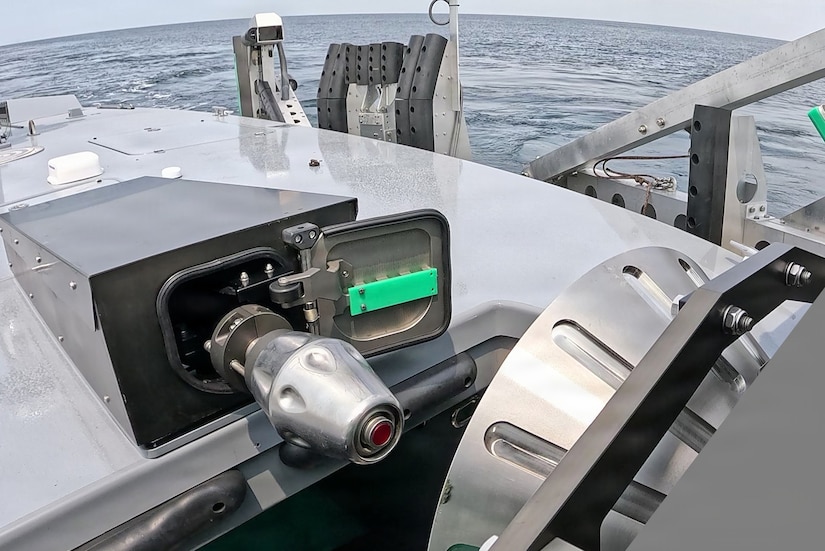
The Navy took a major step toward enabling persistent, unmanned operations last month when the Naval Air Warfare Center Weapons Division led a demonstration off the coast of Virginia using a robotic towed connector to repeatedly capture, refuel and release an unmanned surface vessel at sea.

Two pieces of equipment are lined up next to each other on an unmanned vessel sailing in the water.

In seven months, a Navy-industry team moved from concept to real-world testing using the T38, a Navy-owned remotely controlled USV built by industry partners, and a towable capture and connection refueling system. 
 
The contracting partnership also helped the warfare center's Blue Water Instrumentation program address a broader operational challenge: keeping USVs and their sensors on station longer during critical capabilities testing without increasing reliance on crewed support. 
 
"At [Naval Air Warfare Center Weapons Division], our immediate focus is supporting hypersonic and precision long-range fires testing, where flight profiles can extend thousands of miles beyond fixed-range boundaries and require data-collection assets to be distributed across a vast area," said Spencer Holloway, director of the program's future capabilities office. "But the underlying challenge applies more broadly — every time an unmanned vessel must return to port for fuel, we lose persistence, reduce coverage and redundancy, and interrupt the mission." 
 
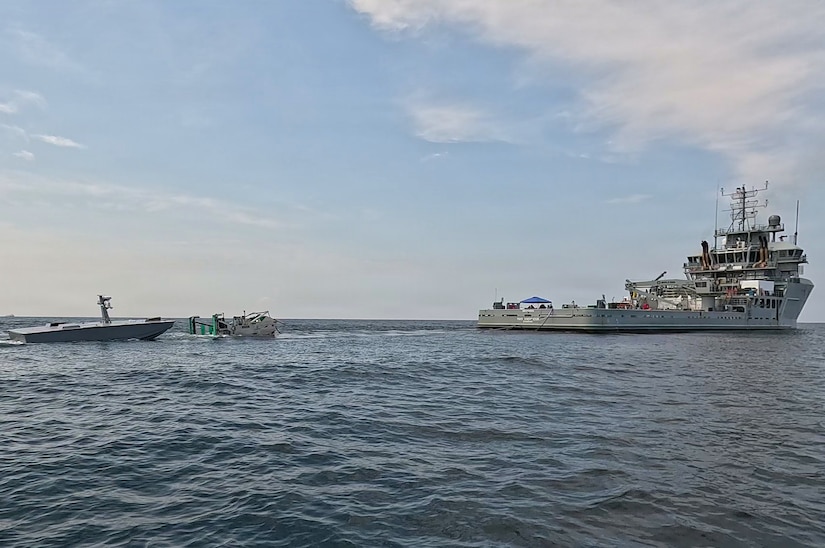
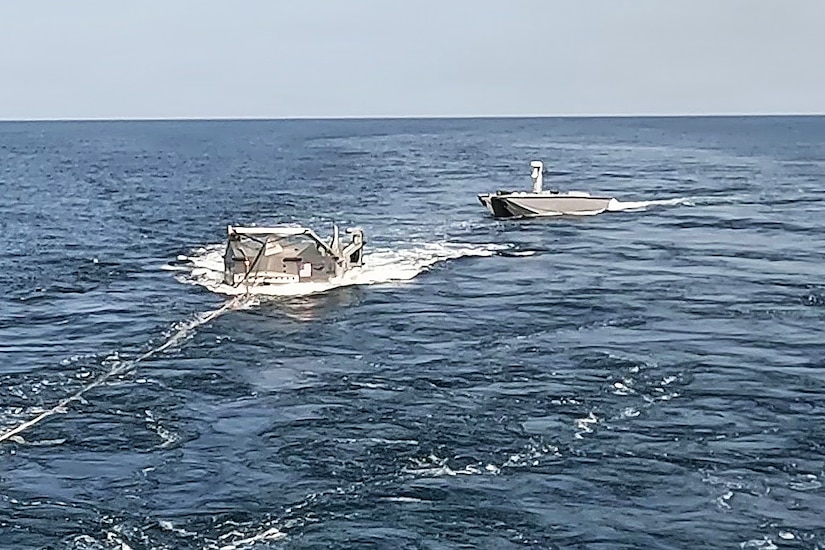
During the demonstration, the team ran dozens of full-cycle exercises at sea, in addition to pier-side demonstrations. The training support vessel USNS Vindicator towed the refueling system and transferred a total of 400 gallons of fuel to the T38 during the event. 
 
In total, the refueling system completed about 100 connection cycles over the course of a few days leading up to and including the event.

A large ship deploys a refueling rig using a cable toward an unmanned vessel sailing in water.

Ronald Raymer, branch head for capability, innovation, science and technology integration at U.S. Fleet Forces Command, also took part in the refueling demonstration. He said unmanned refueling can strengthen fleet readiness. 
 
"This will allow us to have greater reliance on unmanned vessels ... and we can push the USV into higher threat areas without risking manned vessels and personnel," he said. "It will also allow us to distribute greater capability into an area without having to invest in large, expensive manned vessels, and the refueling supports that." 
 
The event took place in the waters off Joint Expeditionary Base Little Creek-Fort Story, Virginia, and was sponsored by U.S. Fleet Forces Command, Naval Surface Warfare Center Dahlgren Division and Naval Surface Warfare Center Carderock Division. 
 
The milestone also brought together the Blue Water Instrumentation program team, fleet management team and industry partners. Together, they executed an underway refueling demonstration designed for USVs. 
 
The Littoral Combat Ship Mission Modules Program Office and the Navy's Portfolio Acquisition Executive for Robotics and Autonomous Systems also provided contracting support that enabled BWI to partner with industry and to run the demonstration.

A refueling system is deployed in the water toward an unmanned vessel.

Holloway said the short timeline from inception of the refueling system to on-water demonstrations came from the collaboration between government and industry, which allowed the team to respond quickly to changes when needed. 
 
"Working directly with our industry partners allowed us to bring the platform, control systems, operators and engineers together as one integrated team," he said. "We could make changes, test them on the water and iterate quickly based on what we observed." 
 
The demonstration showed the role of government-industry collaboration in moving the refueling system from concept to testing in seven months.

BWI's next milestone is an end-to-end autonomous refueling demonstration that will test vessel rendezvous and approach, capture, fuel transfer, disconnection and return to mission as a single evolution.

Wednesday, July 29, 2026

Navy to Decommission Littoral Combat Ship Fort Worth

The U.S. Navy will decommission Freedom-variant littoral combat ship, USS Fort Worth (LCS 3) during a ceremony held July 29 at 10 a.m. PDT at Naval Base San Diego.

As an operational unit and test platform, Fort Worth and its crew played an important role in the defense of our nation and maritime freedom. Fort Worth and its Sailors were key to determining the operational configuration and deployment capabilities of today's LCS platform.

The honorable Gordon England, former Secretary of the Navy, will deliver the decommissioning ceremony's principal address. Remarks will also be provided by U.S. Navy Rear Adm. Matthew Kawas, the ship's sponsor's proxy, Ms. Jill J.R. Labbe, and U.S. Navy Capt. (ret.) Warren Cupps.

The ceremony will honor the service and legacy of Fort Worth, as well as the professionalism and dedication of its Sailors and their families.

LCS' are fast, optimally manned, mission-tailored surface combatants that operate in near-shore and open-ocean environments, winning against 21st-century coastal threats. LCS integrates with joint, combined, manned, and unmanned teams to support forward presence, maritime security, sea control, and deterrence missions around the globe.

The LCS class consists of two variants, Freedom and Independence, designed and built by two industry teams. USS Fort Worth is a Freedom-class LCS, built in Marinette, Wisconsin. Austal USA leads the Independence-variant team in Mobile, Alabama, for LCS 6 and the subsequent even-numbered hulls.

By retiring early-hull test platforms like Fort Worth, the Navy redirects investments toward upgrading the remaining LCS inventory with enhanced capabilities. This strategy sustains the LCS program and underscores the Navy's commitment to building America's Fleet of the Future, ensuring the active ships remain relevant, combat-credible, and reliable throughout their service lives.

For 250 years, American naval power has projected strength globally, operating forward 24/7, 365 days a year. This operational tempo demands continuous capability, and the Fleet of the Future is our answer.

Join the ceremony live stream. https://youtube.com/live/-a-bWFo-Re8?feature=share

Media may direct queries to the Navy Office of Information at (703) 697-5342.