Showing posts with label gi bill. Show all posts

Wednesday, September 09, 2026

President Trump’s Executive Order Aims to Speed Veterans’ Access to VA Healthcare and Benefits

WASHINGTON – President Donald J. Trump signed an executive order today designed to cut weeks from the average time Veterans wait to receive Department of Veterans Affairs benefits.

The executive order, “Accelerating Access to Veterans’ Benefits and Employment Opportunities,” directs VA and the Department of War to work together so that service members’ Military Personnel Files and Service Treatment Records are available to VA beginning on the day they enter military service.

Providing VA with immediate access to these records is intended to help Veterans receive the benefits they have earned more quickly after leaving the military, including healthcare, disability compensation, GI Bill education benefits and VA home loan benefits.

During the second Trump Administration, VA reports that the average processing time for disability benefit claims has fallen 46%, from 141.5 days to 76.1 days. The department estimates that improved sharing of military records between DoW and VA could reduce processing times for recently separated service members by an additional 20 to 30 days on average.

The executive order also directs VA and DoW to modernize related information technology systems to support the sharing of these records. It calls for the use of artificial intelligence to make the benefits process more convenient for Veterans and directs the departments to adjust related technology contracts as necessary to accomplish the order’s goals.

In addition, VA and the Department of Labor are directed to work with DoW as it updates the Transition Assistance Program and other programs intended to help service members find employment more quickly as they transition to Veteran status.

“President Trump understands the importance of putting Veterans First like no other commander in chief, and this executive order will make it faster and more convenient for Veterans to get the benefits they’ve earned,” said VA Secretary Doug Collins. “Giving VA continuous access to warfighters’ military records will eliminate weeks of waiting for Veterans applying for VA healthcare and financial benefits. We want to make the transition from military to Veteran status as seamless as possible, and we look forward to working with President Trump and Department of War Secretary Pete Hegseth to do just that.”

The executive order follows a series of developments the VA highlights from President Trump’s second administration. According to the department, VA has:

Thursday, July 30, 2026

Freedom Haulers Initiative to Help Veterans Get Commercial Driver's Licenses, Better Jobs

 July 30, 2026 | By C. Todd Lopez, Pentagon News

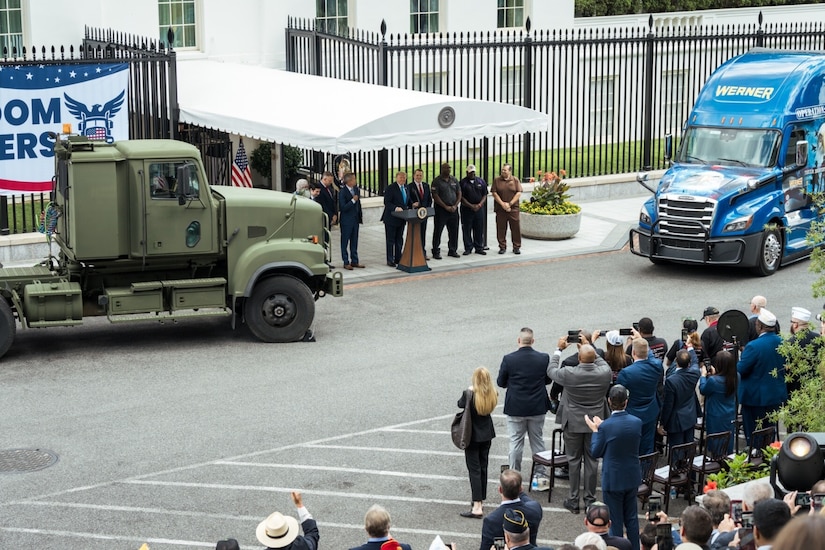
At the White House today, President Donald J. Trump announced the kickoff of the Freedom Haulers campaign, a new effort to help military veterans find good-paying jobs as commercial drivers following their military service by establishing a military-to-commercial driver's license pipeline.

"Under our brand-new ... Freedom Haulers initiative, any American who has driven a heavy truck for our military will automatically be eligible for a commercial driver's license — and it's good-paying jobs too," Trump said. "Any veteran with heavy vehicle experience from the military will now be eligible to skip redundant road tests to obtain a commercial driver's license."

A convoy of military trucks in motion along a dirt highway during daytime.

The president said the initiative also helps military personnel with no truck driving experience get trained and licensed to drive commercial vehicles.

One element of Freedom Haulers is that drivers with two years of experience safely operating heavy military vehicles can obtain a commercial driver's license without taking the driving test. Previously, that option was available for only 12 months after leaving a qualifying military job. But now the window to take advantage of the waiver has been extended to 24 months. All states participate in this program, and more than 40,000 veterans have used this waiver.

Also, part of the Freedom Haulers campaign is the "Even Exchange" program, which exempts qualified military drivers from the knowledge test required to obtain a commercial driver's license. This program applies to Army motor transport operators, fuelers and Patriot launching station operators; Marine Corps motor vehicle operators; Navy equipment operators; and Air Force vehicle operators, fuelers, and pavement and construction equipment operators. Right now, 34 states participate in the initiative, but Trump said he thinks more states will soon follow.

"This is a big deal; we believe that all 50 states and Washington, D.C., should join us in supporting these great veterans. ... I think they're all going to be signing up," Trump said.

A man stands behind a lectern and is flanked on his left and right by several men and two large vehicles. In the rear is an entrance to the White House.

The White House, along with the departments of War, Labor, Transportation and Veterans Affairs, are involved in the effort.

Transportation Secretary Sean Duffy explained how, under Freedom Haulers, military veterans will be exposed to great opportunities to find good-paying jobs following their military service.

"These are great-paying jobs; they're anywhere from $80 to $100,000-plus a year," Duffy said.

Without a program like Freedom Haulers, Duffy said, military veterans with the skills to do the work would have to retrain for a job they already performed for years in service to the nation.

"If Secretary [of War] Pete Hegseth thinks that you can drive a vehicle like this," Duffy said, pointing to a military combat vehicle on display at the White House, "[President] Donald Trump and Sean Duffy think that you can drive a vehicle like that," he said, pointing at a commercial big rig.

The aim of Freedom Haulers is to get veterans into good jobs and increase the number of veteran commercial drivers, Veterans Affairs Secretary Doug Collins said.

"I can't think of anything else that says freedom more in our country than an open road truck and a veteran," Collins said. "Veterans [have] said one thing: when they raised their right hand, they pledged what others would not do. They said, 'I will go and do what others will not do.'"

Now, Collins said, the VA is putting veterans first by helping them get into the driver's seat with great after-service jobs.

"Let's put veterans in the seats, making jobs safer and better for all Americans as we go along," he said. "Veterans ... you proved once you can do it. I know for a fact you can do it every single day."

Collins said the GI Bill will cover up to 100% of commercial driver's license tuition at state- and agency-approved schools. And for veterans with service-connected disabilities, the Veterans Readiness and Employment program also fully funds training and assists with job placement.

"One in 10 of our truck drivers across the country are veterans already — one in 10," Collins said. "Why don't we make it two in 10? Why don't we get three in 10?"

Saturday, August 11, 2012

Post-9/11 GI Bill Celebrates Start of Fourth Year


From a Department of Veterans Affairs News Release

WASHINGTON  – August marks the third anniversary of the Post-9/11 GI Bill, and since it was implemented, the Department of Veterans Affairs has provided educational benefits to 773,000 veterans and their family members, according to a Department of Veterans Affairs news release.

“This is one of the most important programs helping our Iraq and Afghanistan veterans reach their educational goals,” Secretary of Veterans Affairs Eric K. Shinseki said. “We’re proud this important benefit is making such a big difference in the lives of so many veterans.”

The Post-9/11 GI Bill pays tuition and fees on behalf of veterans or eligible dependents to the school in which they are enrolled. Eligible participants also receive a monthly housing allowance and up to $1,000 annually for books and supplies. The program also allows eligible service members to transfer their benefits to their spouses and children.

The program provides a wide range of educational options, including undergraduate and graduate degrees, vocational/technical training, on-the-job training, flight training, correspondence training, licensing and national testing programs, entrepreneurship training, and tutorial assistance.

“For over 68 years, GI Bill programs have shaped and changed the lives of service members, veterans, their families and survivors by helping them reach their educational goals,” said Allison A. Hickey, Veterans Affairs Undersecretary for Benefits. “Benefits provided under the Post-9/11 GI Bill will continue to shape and change the lives of veterans by helping them build a stronger foundation for their careers.”

The Post-9/11 GI Bill is the most extensive educational assistance program since the original GI Bill was signed into law in 1944. VA has since paid more than $20 billion in benefits to veterans and their family members.
For the 2012-2013 academic year, 1,770 colleges and universities are supplementing Post-9/11 GI Bill benefits by participating in the Yellow Ribbon Program.

Under the Yellow Ribbon Program, degree-granting institutions make additional funds available for a veteran’s educational program without an additional charge to their GI Bill entitlement. To make up the difference for those students whose tuition and fees exceed what the Post-9/11 GI Bill covers, institutions can voluntarily enter into a Yellow Ribbon Agreement with VA to designate an additional amount of funding, and VA will match that amount.

VA is seeking legal authority to trademark the term GI Bill. President Barack Obama signed an executive order on April 26, 2012, directing VA and the Department of Defense to undertake a number of measures to “stop deceptive and misleading” promotional efforts that target the GI Bill educational benefits of service members, veterans, and eligible family members and survivors.

In June, the attorneys general of several states gave VA the rights to the GIBill.com website after the original owners agreed to give up the internet site to settle a lawsuit by the states.

Sunday, July 15, 2012

Which GI Bill do I use?


By Capt. Michelle Baer
Wisconsin Army National Guard

At age 20, I enlisted in the Wisconsin Army National Guard for the education benefits. At the time I knew that the National Guard paid my college tuition and gave me money towards books and housing. I learned the requirements to receive benefits and I was off to the races.

Twelve years later, I returned to the Wisconsin Army National Guard after completing a six year tour on active duty and a 15-month deployment. I am now ready to complete my Master of Business Administration, but I was confused on my education benefits.

I knew there were new education benefits such as the Post 9/11 GI Bill and Wisconsin GI Bill. I was unsure on which GI Bill chapter I had already used, or even the difference between a tuition grant and the GI Bill.

After talking with Capt. Dustin Cebula, the Wisconsin Army National Guard education service officer, I learned there are four programs that pay for tuition and four programs that pay a monthly stipend while attending school.

 The four tuition programs include:
 •Wisconsin Tuition Grant pays up to the UW-Madison rate for eight semesters of full-time study for currently serving service members.
 •Federal Tuition Assistance pays $250 per semester credit ($4,500 max per fiscal year), limited to 130 credits for undergraduate and 39 for graduate degrees for currently serving service members.
 •Wisconsin Tuition Remission (GI Bill) reimburses qualifying veterans 100 percent tuition for eight semesters or 128 credits at UW System or Wisconsin technical schools and can be used after separation from military.
 •GI Bill Post 9/11 payment is based on total days of qualifying Title 10 active duty and Title 32 AGR service on or after Sept. 11, 2001. Benefits include: tuition and fees payment, housing and books stipend. In addition, benefits can be transferred to a spouse or children.

 The four stipend programs include:
 •Chapter 33 GI Bill Post 9/11 is the only program that pays tuition and stipend.
 •Chapter 1606 GI Bill Selected Reserve pays $345/month for full-time study.
 •Chapter 30 GI Bill Active Duty enroll while in the regular Army or AGR program.
 •Chapter 1607 GI Bill REAP where payment is based on continuous days of active duty.

 In order to find out how many months I had left of my GI Bill benefits I called 1-888-442-4551. I could have also gone to www.gibill.va.gov in order to find out the payment rates and months of eligibility.

The rule is that you can use a maximum of 36 months of one GI Bill but no more than a total of 48 months of combined GI Bill benefits if eligible for more than one.

Capt. Cebula helped me decide the best course of action on how to maximize my benefits. I have decided to attend a private university, so I will be using my Federal Tuition Assistance and then I will transfer my GI Bill 9/11 benefits to my son. In addition, I plan to contact the veteran certifying official at the college if I have any other questions.

I learned that everyone has a different military experience and is eligible for different military benefits. In order to fully utilize your education benefits you should contact the Wisconsin Army National Guard Education Service Office at 608-242-3447 or your battalion career counselor.

Friday, December 31, 2010

Is The “New” Post-9/11 GI Bill Really A “Win” For Vets?

By Daniel Caldwell

Towards the end of the lame-duck session of Congress, the House and Senate passed a bill that will enact major changes to the Post-9/11 Bill, which will most certainly be signed by President Obama. The bill, entitled the “Post-9/11 Veterans Educational Assistance Improvements Act of 2010,” was universally praised by veterans’ organizations. Iraq and Afghanistan Veterans of America considered it a victory for veterans along with the American Legion, which had its legislative director, Tim Tetz, present at a ceremony celebrating the passage of the bill. However, these groups along with many in the media having not been highlighting some of the changes in the “Post-9/11 Veterans Educational Assistance Improvements Act of 2010″ that will negatively impact thousands of veterans currently using the Post 9/11 GI Bill. These groups who claim to advocate for veterans (and in some cases collect dues from said veterans) on Capitol Hill have been disingenuous in praising this legislation without highlighting the obvious problems with it. Overall, while there are clearly some positive reforms that will be made to the GI Bill as a result of this legislation, this is by no means a huge win for veterans and will potentially force many veterans to change their educational plans.

Probably the biggest change that will hurt many veterans in several states is the new national cap on yearly tuition and fees of $17,500, which replaces the current state-by-state cap. In states like Massachusetts were fees and tuition exceeds $20,000 at most schools for resident students who attend classes year-round, the student veteran will be forced to make up the difference either through utilizing the Yellow Ribbon Program, applying for a scholarship, or worse, taking out a student loan. While this might simplify the process for paying schools and save money, the change in the tuition and fees cap will negatively effect the ability of veterans in certain states to pay for their education.

The legislation also changes how the BAH stipend is paid. Right now, as long as you taking one credit more than a half load (in the case of my school, Arizona State, seven credits out of twelve) you received the full BAH stipend for your school. However, beginning in August 2011, the BAH stipend will be prorated based on the number of credits a veteran is taking. This might seem like a logical and “fair” thing to do, but considering that many veterans do not take a full credit load in order to work or do an internship (which are often unpaid) and considering the fact that many veterans rely on the BAH stipend to survive, this amounts to a pay cut for thousands (if not tens of thousands) veterans in 2011. For me personally, this will negatively impact me since I will most likely not need to take more than three classes (or nine credits) my last semester and I was planning on doing an internship in order to beef up my resume. However, due to the impending changes to the GI Bill, I will most likely be forced to revaluate these plans.

The bill will also add BAH benefits for distance-learning (aka online) students; however the amount will only be half the national average. I was always under the impression (and I could be wrong) that the reason why the post-9/11 GI Bill didn’t have BAH benefits for distance-learning students was to discourage veterans from attending shady online for-profit universities. However, online programs are more flexible, especially for veterans with families and jobs and many state schools offer online degree programs that are cheaper than traditional programs. If anything, the VA should be encouraging certain veterans to enroll in online programs.

It would not be fair if I didn’t point out some of the positive changes the Post-9/11 Veterans Educational Assistance Improvements Act of 2010 makes the post-9/11 GI Bill. The legislation expands GI Bill eligibility to over 85,000 National Guardsmen and enables active duty troops currently using the GI Bill to receive the annual book allowance. In addition, wounded veterans currently going through vocational rehab will receive increased allowances. However, in order to pay for these changes, the cuts listed above were made. This bill literally robs one group of veterans to pay another.

If in the original Post 9/11 GI Bill, BAH stipends would have been prorated and there would have been a national cap on tuition and fees, veterans would have been able to properly plan their education. However, veterans were led to believe that they would be receiving a certain level of compensation and now beginning in 2011 tens of thousands of veterans will be receiving less if changes are not made. To quote Representative Steven Buyer, a veteran and one of the few people to openly criticize this bill, parts of the bill “[are] nothing but a lump of coal for veterans.”

Daniel Caldwell served four years as an infantryman in the U.S. Marine Corps. For the first two years, he was part of the Presidential Support Program. During his last two years, he served with the 2nd Battalion, 1st Marines and deployed to Iraq in 2009.  He uses the Post-9/11 GI Bill to attend Arizona State University

Friday, October 01, 2010

Post 9/11 GI Bill Proves Popular

By Mass Communication Specialist 1st Class (AW) LaTunya Howard, Navy Personnel Command Public Affairs

MILLINGTON, Tenn. (NNS) -- Since its introduction in 2009, the Post 9/11 GI Bill benefit has proven popular with transferability being one of the most-valued features for Sailors interested in paying for their family member's college education.

"I did everything online for my wife," said Navy Diver 1st Class (DSW) Jad Graves, Navy Experimental Diving Unit, Panama City, Fla. "I didn't have any problems what so ever. The biggest delay was waiting on a voucher from the Veterans' Administration."

According to NAVADMIN 203/09, while a Sailor may be eligible for education benefits provided by the Post 9/11 GI Bill, generally the option to transfer benefits to an eligible family member requires an additional service commitment in the Armed Forces.

Qualified Sailors may elect to transfer all or a portion of their benefits to a spouse or child enrolled in Defense Eligibility Enrollment System and eligible for benefits. For transferability, Sailors must have served at least six years in the Armed Forces and agree to serve an additional four years, in most cases.

"It's extremely valuable to the service member, but I'm glad my wife can use mine," said Graves. "If I were able to attend school full-time, I'd receive the housing allowance also. That would be taking full advantage of this benefit."

"I give the Post 9/11 GI Bill a definite 'A+'," said Chief Warrant Officer David Williams, Southeast Regional Maintenance Center, Mayport, Fla. "The process was extremely easy. I transferred my benefits to my daughter who has graduated from Virginia State with her bachelor's degree, and she was able to continue her education. She was accepted into Saint Joseph University to finish her master's degree with the use of this benefit. I was really grateful to be able to do that for her."

Sailors can apply to use the Post 9/11 G.I. Bill at the Veteran's Administration website, https://vabenefits.vba.va.gov/vonapp/main.asp or apply for transferability of benefits at www.dmdc.osd.mil/TEB/ however Sailors should ensure their service obligation is reflected in their Electronic Service Record at https://nsips.nmci.navy.mil/.

According to the Records Management and Benefits Division, the number one reason for rejected applications is the lack of sufficient obligated service or Page 13 not reflected in a Sailor's Electronic Service Record (ESR). Sailors should verify the information is there before applying for transferability. Self-validation of ESR is required by NAVADMIN 203/09.

Additionally Sailors should transfer their Post 9/11 GI Bill benefits before going on terminal leave. Benefits must be transferred prior to leaving active duty.

The Navy has approved more than 24,000 requests for transferability since the program's inception, processing approximately 250 applications weekly.

For additional information visit the Navy Personnel Command (NPC) Website at http://www.npc.navy.mil/CareerInfo/Education/GIBill/ or call the NPC Customer Service Center at 1-866-U-ASK-NPC.

Sunday, October 21, 2007

Possible Changes Eyed for Guard, Reserve Montgomery GI Bill

By Donna Miles
American Forces Press Service

Oct. 19, 2007 - Defense
leaders joined the Minnesota National Guard's adjutant general yesterday in urging Congress to revise the Montgomery GI Bill to improve coverage for reserve-component troops, although they didn't necessarily agree on the best way to accomplish that. Army Maj. Gen. Larry W. Shellito told the House Veterans Affairs Committee that the bill, as currently written, shortchanges National Guard and Reserve troops.

He noted that nearly half the
Minnesota National Guard's 1st Brigade Combat Team, 34th Infantry Division, found they weren't eligible for full education benefits under the bill, despite being one of the longest-serving units in Iraq. The unit returned home from a 22-month mobilization that included 16 months in combat as part of the surge force in Iraq.

All the returning "Red Bull" troops were eligible for Montgomery GI Bill benefits, but many fell short of the service time required to receive full benefits.

Among them was
Army Sgt. Benjamin Hattan, a two-time Purple Heart recipient who was denied education benefits because his deployment orders were written for up to 729 days. The Montgomery GI Bill requires 730 days of service to quality for full benefits, Hattan explained to the committee.

The
Army is working to amend the unit's orders and sent a team to Minnesota to help the Guardsmen wade through paperwork required to apply for benefits. Officials said the Army goal is to complete amendments so the soldiers can receive their benefits for the 2008 spring term.

"The decision to grant these men and women their earned benefits needs to occur quickly in order for them to make important life decisions," Shellito told the committee. "As a key tool in building and maintaining a total
Army force, we as well as military leaders also need this to occur, as it is fundamental to sustaining a ready and capable reserve-component force."

Defense Department officials agreed yesterday that changes are needed to the Montgomery GI Bill for the Selected Reserve, as well as the Reserve Educational Assistance Program.

However, both Thomas L. Bush, acting deputy assistant secretary of defense for reserve affairs, and Curtis L. Gilroy, the Pentagon's director for accession policy, said such a measure doesn't fit the program's purpose: to recruit and retain members.

They said they believe the Defense Department can actually be too generous in granting GI Bill benefits. "We have a delicate balance we have to maintain in order to ensure a strong and ready
military for America," Gilroy stated previously. "And it is actually possible to upset that balance and hurt our retention by being too generous with some of our recruiting incentives."

Gilroy and Bush said yesterday they disagree with the idea of consolidating the active- and reserve-component education plans into a single "Total Force GI Bill."

"The calls for a single program simply view military service as the pathway to an education benefit, not a program to retain members," they said in a joint statement released to the committee.

Both praised the Montgomery GI Bill for the support it lends to recruiting and retention efforts. "As we move through the 21st century, we must continue to build upon the remarkable legacy of the visionaries who crafted preceding versions and improvements in the GI Bill," they said.

The original GI Bill was enacted in 1944 to provide education benefits for troops returning from World War II. More than 2 million veterans have attended college using GI Bill benefits.