Showing posts with label army. Show all posts

Friday, September 19, 2025

Army Enhances Border Security Through Partnership, Unique Capabilities

 Sept. 19, 2025 | By Army Capt. Samuel DeWerth-Jaffe, Joint Task Force Southern Border

Joint Task Force Southern Border demonstrates an unprecedented level of interoperability with partner agencies as part of their whole-of-government approach to secure the southern border. 

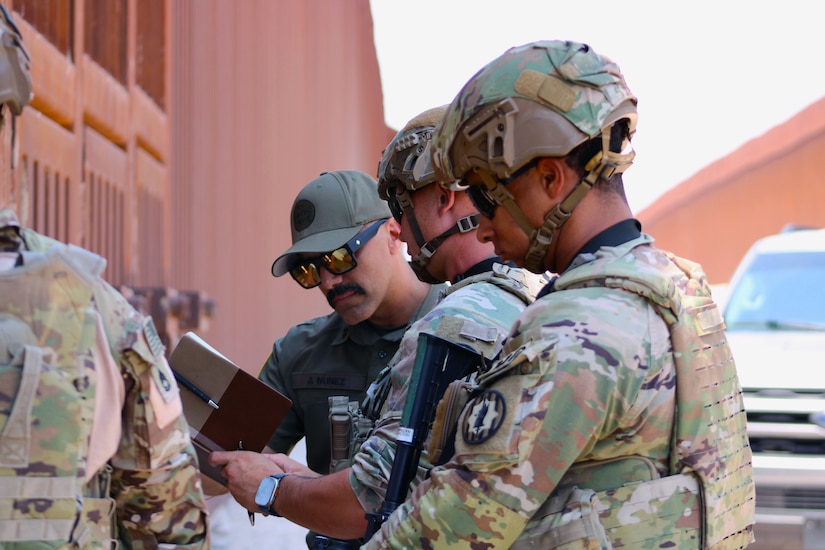
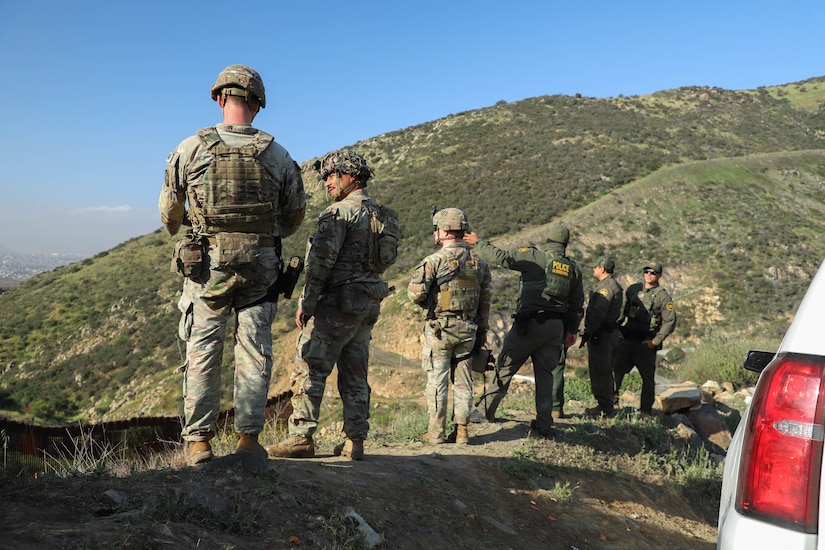
From the headquarters down to squad-sized elements directly on the border, task force personnel are working alongside U.S. Border Patrol every day, ensuring synchronized efforts to deter illicit activities. 

Two soldiers speak to a person in a baseball cap outside, with a large structure and vehicle in the background and another person nearby.

"My experiences in past deployments and working in Europe have reinforced the importance of partner collaboration — a principle directly applicable to our current mission with Border Patrol," said Army Lt. Col. Cris Gasperini, commander of the 1st Battalion, 41st Infantry Regiment, 2nd Stryker Brigade Combat Team, 4th Infantry Division, assigned to JTF-SB. "The integration of our organic assets with those of Border Patrol has been exceptionally effective, demonstrating the necessity of a whole-of-government approach to border security." 

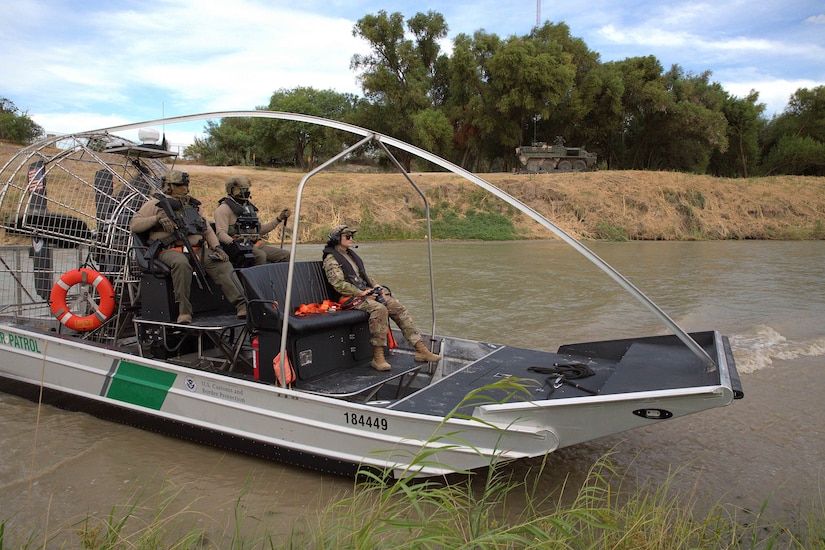
The task force's integration has proven critical to operations across the southern border's diverse terrain. Along the 1,954 miles of the border lie cities, deserts, thick vegetation, rivers and rural communities. 

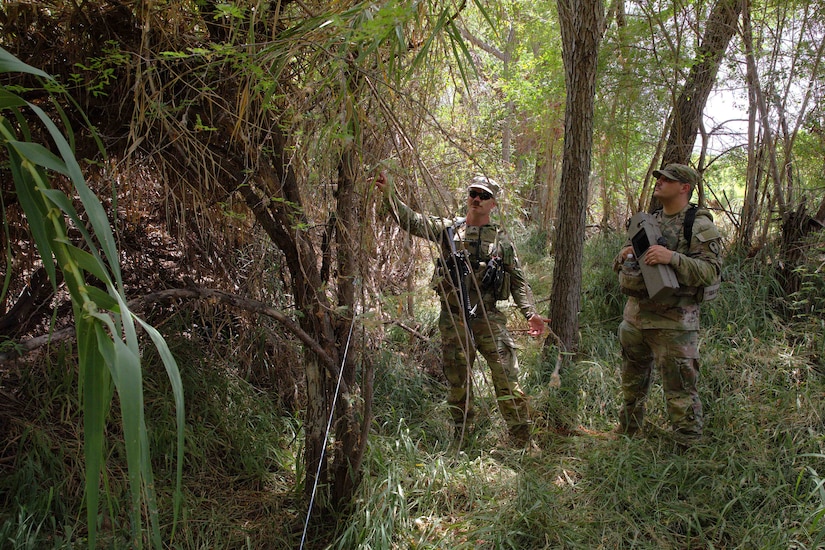
The varied terrain along the border presents distinct security challenges. These are addressed through both the organic assets of JTF-SB and the complementary capabilities of interagency partners. 

Two soldiers wearing camouflage military uniforms look at a brush covered area while standing in a forest.

The AN/MPQ-64 Sentinel radar is one of the unique capabilities that the task force uses to address these security challenges at the border and enable U.S. Border Patrol's law enforcement role while also providing defensive capabilities against small unmanned aerial systems. 

The U.S. Border Patrol El Paso Sector, which oversees 268 miles of the southern border in Texas and New Mexico, is one of nine sectors that has seen the benefits of an integrated approach with the task force. 

Three people sit in a metal boat on a small body of water under blue skies with trees and tall grass in the background.
Three soldiers wearing camouflage military uniforms stand on a hill next to three other people in green police uniforms. One of the men is pointing toward the valley below.
"The Border Patrol in El Paso focuses on collaboration with various agencies and the Department of War's JTF-SB to enhance border security to target hostile drones and the challenges they pose," said Walter N. Slosar, chief patrol agent with the El Paso Sector. "Enhanced detection capabilities between JTF-SB and U.S. Border Patrol give us full spectrum capabilities to track, identify and mitigate aerial threats." 

JTF-SB and U.S. Border Patrol remain committed to strengthening this vital partnership and continued innovation in the face of evolving threats with a broad range of capabilities. This collaboration serves as a model for future interagency cooperation and underscores the importance of a unified approach to national security. 

Tuesday, July 28, 2015

Face of Defense: Army Sergeant Major Pursues Her Dreams


By Whitney Katz
Joint Enabling Capabilities Command

MACDILL AIR FORCE BASE, Fla., July 28, 2015 – Army Sgt. Maj. Kristie Brady said she knew from a young age that she wanted to serve in the military like her father had.

Brady was raised in Ethan, South Dakota, a farming town with a population of 300.

“I wanted to be a part of something larger than myself,” Brady said. “I wanted to travel and gain experiences that would not be possible in my hometown.”

Brady found that life-changing opportunity in 1992, when she entered the Army’s Delayed Entry Program at age 17. Since then, Brady has continued to broaden her horizons and exceed expectations as an information technology specialist and an airborne-qualified jumpmaster.

Her commitment and dedication to service have led to an historical event, as she was recently chosen as the next command sergeant major of the 112th Special Operations Signal Battalion (Airborne) based at Fort Bragg, North Carolina. Brady will be the first female in the elite organization’s history to serve in this position.

“The 112th Special Operations Signal Battalion is an extremely prestigious unit with a great reputation across the Army,” Brady said. “It is an incredible opportunity to serve in the 112th Signal Battalion and to do so as their command sergeant major is an extreme honor.”

Information Technology Career Field

Brady had the foresight when joining the Army to realize that the information technology career field would be an important specialty both within the Army and in the civilian world.

“At the time I enlisted, computers and information technology were fairly new,” Brady said. “I wanted to do something that would translate into good job prospects while serving and also following my military service.”

Throughout numerous assignments across the globe, Brady honed her skills and steadily moved up the enlisted ranks serving in a number of key leader positions. She served as the first female squadron sergeant major for the 3rd Joint Communications Squadron of the Joint Communications Support Element in Tampa in Florida before becoming the unit’s Brigade Operations Sergeant Major.

“JCSE has been an integral assignment for me as it has provided me broader experiences enabling me to reach this next milestone in my career,” Brady said.

She added, “My experience at JCSE has definitely left me better prepared for the 112th Signal Battalion as their missions are somewhat similar. Both organizations provide rapidly deployable, early entry and scalable communications to the commanders they serve.”

Each unit also provides their service members experience in operating and maintaining an array of unique equipment not normally used by conventional joint service counterparts, Brady said.

In addition, both JCSE and the 112th Signal Battalion are airborne units, bringing a unique and valuable benefit to joint force commanders, she said. There are very few airborne units in the U.S. military that provide communications support to special operations forces, making JCSE Signal Brigade and the 112th Signal Battalion part of an elite group.

Brady attended airborne school in 1997 and serves as a jumpmaster at JCSE which has effectively prepared her for the transition to the 112th Signal Battalion.

“It’s an honor to be able to stay in an airborne unit -- especially one with such a significant history like the 112th Signal Battalion,” she said.

Gender Not a Factor

Brady’s selection as the command sergeant major of the 112th Signal Battalion was conducted through the Army’s centralized selection board, which identifies the most qualified senior noncommissioned officers for forecasted positions in the next fiscal year.

“When I competed on last fall’s Command Select Board, I was excited to see the 112th Signal Battalion as an option,” Brady said. “I very quickly identified the 112th Signal Battalion as my first choice if selected as a primary on the Command Select List.”

Brady was excited to learn just a few months later that she had received her first choice.

“I am extremely honored and privileged to be selected to serve as a command sergeant major but especially fortunate for the opportunity to be the 112th Signal Battalion’s command sergeant major,” Brady said. “I believe that selection for this position, as with others across the Army, was made by determining who best met the needs of the organization based on their training and experience level regardless of race, creed, color or gender.”

Tuesday, October 02, 2012

Wisconsin Guard goes to great lengths to improve state partnership skills


By Staff Sgt. Tiffany Addair
112th Mobile Public Affairs Detachment

The Wisconsin Army National Guard Military Engagement Team members journeyed to San Juan, Puerto Rico for a two-week language immersion program at Institute for Second Language Acquisition, Inc., (I.S.L.A.) Sept. 9.

The MET - a 12-person rotational team of subject matter experts - went to learn Spanish for future trips to Nicaragua, as part of the National Guard Bureau's State Partnership Program. Those visits will begin with fact gathering, and progress to making recommendations to the Nicaraguan military regarding natural and manmade disaster response efforts.

The State Partnership Program just celebrated its 20th year of building civil-military relationships through partnerships between U.S. states, territories, the District of Columbia and foreign countries. Currently 48 U.S. states, two territories and the District of Columbia are partnered with 62 countries around the world, to include the Wisconsin-Nicaraguan partnership.

In 2003 the Wisconsin National Guard formally partnered with the Republic of Nicaragua in the SPP, and every year about eight to 10 meetings in both Wisconsin and Nicaragua take place, expanding Nicaragua's capabilities in several critical areas.

I.S.L.A., Inc. focuses on conversational Spanish. When the Soldiers arrived at the school they were individually evaluated to see how much Spanish they knew so they could be put into the correct class level.

"We give them an oral evaluation to see where there are at and if they understand what I am asking them, if they can respond and how comprehensive or complete and so forth," said Sacha Delgado, director of I.S.L.A., Inc. "Then based on their responses we place them in one of the six levels that we work with and each level has a set definition in terms of what it covers."

The Soldiers attended daytime classes at I.S.L.A., Inc., located outside of the tourism area to maximize their learning experience and expose them to more Spanish. In addition to the structured classes and cultural experiences, the school coordinates with local host families to house students during their course.

"We are the only language school in Puerto Rico that offers an immersion program, where students come in from abroad and stay with host families," Delgado said. "It maximizes [students'] learning experiences because they have to think and study Spanish in the classroom, do homework and communicate with their family."

The schoolhouse provided the Soldiers with basic knowledge and conversational aspects of learning Spanish, but being in Puerto Rico and experiencing the day-to-day cultural greatly enhanced the training experience for the MET.

"Being exposed to the language and the cultural all the time helps you pick it up more," said Sgt. 1st Class Culley J. Popma, 64th Troop Command readiness non-commissioned officer. "It will be helpful to us when we go down to Nicaragua for the rest of our mission."

Popma plans to use Rosetta Stone to build off of what he learned in Puerto Rico so he can become more fluent by the time the team visits Nicaragua.

Maj. Robert J. Buettner, MET officer-in-charge, said this training is a great opportunity and will enhance opportunities to deepen the relationship between the Wisconsin Army National Guard and the Nicaraguan military members with whom they will closely work.

"It is important for us to gain as much information and knowledge on the language and culture so that when we do go to Nicaragua and start working with our counterparts and the senior leaders we show them respect by speaking their language in their own country," Buettner said. "The MET team will be evolving every year depending on the wants and needs of the Nicaraguan government so we will need to continue language training as the team evolves to progress our skills and continue to build our relationship with Nicaragua."

Thursday, September 27, 2012

Army Surgeon Shares PTSD Struggles to Help Others


By Lisa Daniel
American Forces Press Service

WASHINGTON, Sept. 27, 2012 – As the Army conducts a worldwide stand-down today to draw attention to preventing suicide within the force, those who have survived attempts to take their own lives may take notice. One is Dr. Tara Dixon.

Army leaders and military officials, overall, say there are multiple reasons why service members commit or attempt suicide. Some are combat-related, but at least half are not. Many involve personal problems with love, money and the law, some that simmered for years before they even entered the military. The problems are complicated by each person’s coping abilities, or resilience, and other factors, they say.

Dixon’s story is less complicated; it is the story of one soldier’s struggle with post-traumatic stress disorder that eventually left her feeling so hopeless that death seemed the only way out.

Dixon, 38, of Georgia, was in her medical residency to become a trauma surgeon when she enlisted in the Army Reserve in 2004 after hearing that the military needed surgeons in the wars in Iraq and Afghanistan. She deployed as a trauma and critical-care surgeon to Iraq with forward-deployed units in 2008 and 2010 -- “me and some guys in a tent,” she said as part of a Sept. 13 panel discussion at the annual Warrior-Family Symposium, sponsored by the Military Officers Association of America and the National Defense Industrial Association.

“We got bombed routinely,” she said. “This was not a Geneva Convention war. We had to take the big red cross off the top of our tent because that’s where [insurgents] aimed.”

Dixon described the stress of treating “the guy I had breakfast with that morning” for critical injuries, and of having to make split-second decisions about whether to amputate a limb or risk transporting a soldier hours away to a Baghdad hospital. Then there were the abused Iraqi children brought in as decoys for insurgent attacks on the unit and the female soldiers who needed treatment for sexual assaults -- crimes she was legally bound not to report at the victims’ request, she said.

Dixon said she coped with the stress through the only outlet she had: running, sometimes 80 miles each week.

Still, she said, “It messes with your mind a bit.” And even though she felt the strain of post-traumatic stress from her first deployment, she soon returned for a second one.

Dixon returned to the United States in the fall of 2010, but the war was still with her. Among the many problems, she said, was returning as a reservist to a city without a military base and no means of support. “I was very much an outcast, and I felt very much alone,” she said.

She described the frustration and embarrassment of post-traumatic stress, of dropping her bags and running to pick up patients at the sound of a helicopter, only to realize she was at her local grocery store.

“It was very embarrassing and frustrating to me that I was nervous in crowds, that helicopters bothered me,” she said. “When you get back to a normal place, somehow your body and your brain don’t shut off” from the survival instincts of war.

“If we didn’t hit the ground when we were in Iraq, if we didn’t duck when someone shoots at us, we would be dead,” she said.

Even when she was fully aware of being thousands of miles from the war, Dixon said, she couldn’t stop from reacting instinctively. “If someone drops the communion plate in church and you hit the ground, that one part of your brain knows you’re in church, but you’re still going to react,” she said.

Dixon said she sought counseling, but her problems seemed only to get worse. Six months after returning from Iraq, she tried to end her life with an overdose of pills.

“I felt lost,” she said. “I was without hope.”

After struggling to find an inpatient facility through TRICARE and the Department of Veterans Affairs, Dixon said her family found a private treatment center where she would spend the next nine months recovering from PTSD. “They gave me my life back,” she said. “They gave me hope back.”

Today, Dixon says she is much improved. She has learned to understand PTSD as “a normal reaction to an abnormal situation.” And she has learned important tactics in treating flashbacks, skills known as “dissociation” and “reorienting.”

“In treatment, they teach you to look around,” she said in an interview with American Forces Press Service from Ocala, Fla. “Here in Florida there are big, beautiful oak trees. There are no oak trees or anything lush in Iraq.” Similarly, she said, “If you hit the ground and you look around and see Starbucks, you know you’re not in Iraq.”

Dixon is processing out of the reserves, and is using some of her medical skills as a veterans service liaison for The Refuge -- A Healing Place, in Florida, where she works with veterans and their families and helps them find treatment. She gets lots of calls for help, she said, including Vietnam War veterans who still struggle with flashbacks and nightmares and even a World War II veteran whose post-traumatic stress surfaced more than 60 years after he left the battlefield.

“Sometimes it helps knowing others have been through the same thing,” she said.

Dixon said she hopes her work will prevent the 9/11 generation of war fighters to not repeat the hard times so many Vietnam War veterans have had with post-traumatic stress.

As for her own struggles, Dixon said, “I’d like to say it’s curable and it’s done and it’s fine,” but she said she doesn’t know when she might stop reacting to things like fireworks.
“I know it’s a lot better,” she said.

Dixon is proud of her work in combat. “I never lost a coalition force in two tours,” she said. But the PTSD has made her career as a surgeon uncertain.

“I really enjoyed what I did,” she said. “It’s something I was very good at. That part is sad to let go. We’ll just have to see how time progresses.”