Friday, November 27, 2026

Military Compensation Evolved During, After Revolutionary War

During the Revolutionary War, 1775 to 1783, troops were compensated in several ways, including basic pay, enlistment bonuses, food, uniforms and, for sailors, Marines and privateers at sea, prize money for capturing enemy vessels.
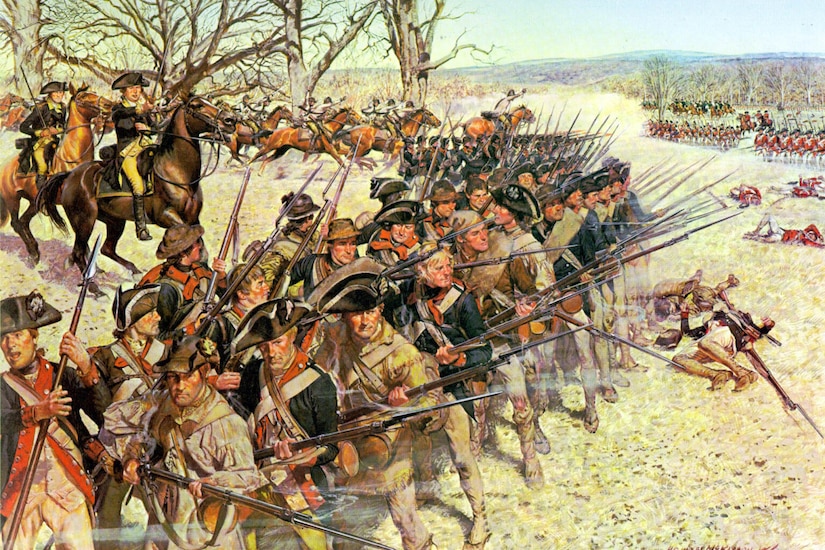
Men in a variety of Revolutionary War-era military uniforms wield muskets with the bayonets attached as other people in similar attire ride into battle on horses with dead or wounded people lying on the ground.

Continental currency, which depreciated over the course of the war, was paid by paymasters, as set by the Continental Congress, if funds were available, which they often were not. A frequent saying at the time was "it's not worth a Continental." 

The militia were paid under a monetary policy that varied by state, as there was no national income tax. 
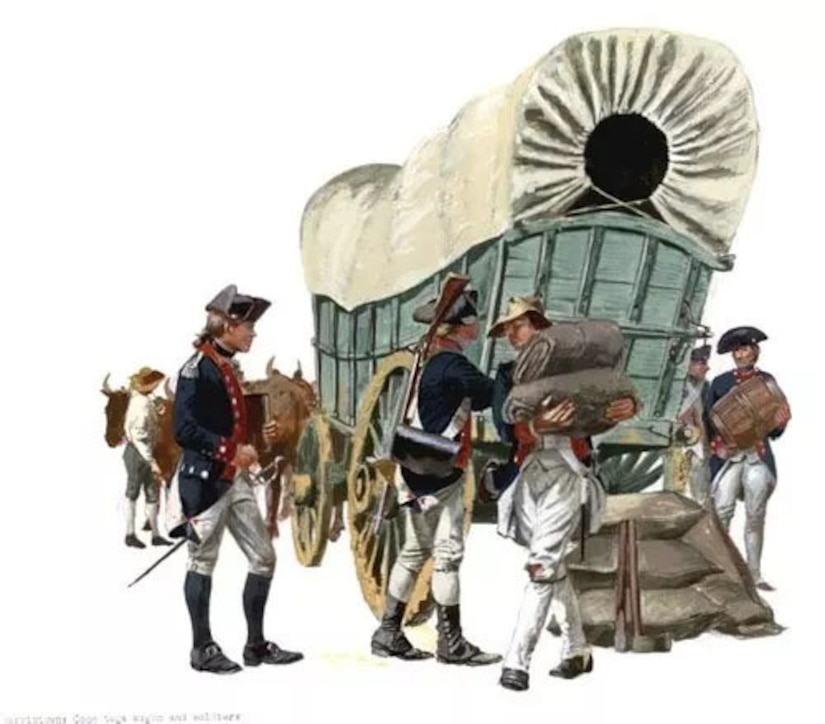
A painting of men in Revolutionary War era military uniforms unloading supplies from a wagon is shown.
Two other approaches to compensation were the promise of land and, for some, a pension. 

Privates were promised 100 acres of land. Ranks equivalent to Army and Marine colonels and Navy captains today were entitled to 500 acres. Ranks between those ranged between those two figures. The promise of land was important because the American economy at the time was almost entirely agriculture-based. 

For those severely disabled as a result of the war, the Continental Congress offered a monthly lifetime pension equal to half of the salary while they served. 

While not a lifetime pension, officers who served for the war's duration received a pension of full pay for five years after the war, and enlisted service members were promised a one-time payment of $80. 
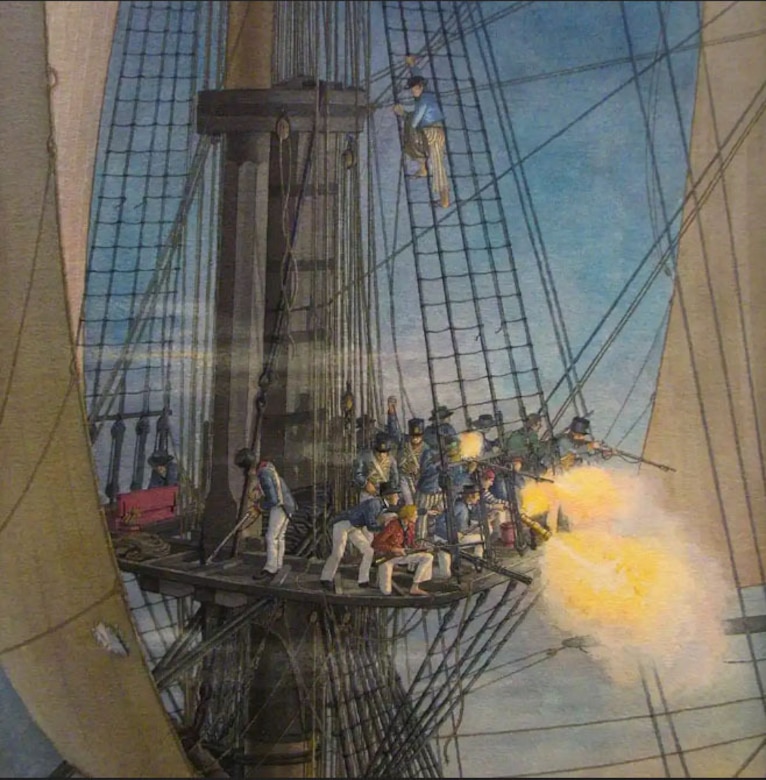
People in Revolutionary War-era military uniforms fire long guns from a platform at another ship.
After the war, Congress passed legislation extending pensions to those who had served. 

Beginning in 1818, Congress broadened the qualifications for a Revolutionary War pension, allowing those in poverty but not disabled to qualify. 

In 1924, Congress passed the World War Adjusted Compensation Act, more commonly called the Bonus Act, promising World War I veterans a bonus to be paid in 1945. 

Then in 1929, the Great Depression started. In May 1932, unemployed World War I veterans traveled to Washington to get their bonuses now, when they needed them most, instead of waiting until 1945. Tens of thousands of veterans set up camps in tents and shanties all over the city.

An old, yellow, faded document contains signatures.

In late July 1932, Army troops removed the protesters and took down their tents and shanties. In 1936, Congress authorized their bonus payments. 

The next big compensation milestone occurred June 22, 1944, when President Franklin D. Roosevelt signed the Servicemen's Readjustment Act, better known as the G.I. Bill. 

Millions of World War II veterans received education subsidies, enabling them to pay tuition for trade schools and colleges and, upon graduation, hopefully earn good incomes in the careers of their choice. 

Over time, the G.I. Bill endured, with many revisions. The G.I. Bill is still available today for those who honorably serve. Those who stay in the military often attend college in their off time, funded through tuition assistance, and save their G.I. Bill for after they separate. 

The next major compensation milestone came with the 1973 enactment of the All-Volunteer Force, which ended the draft and provided a significant pay boost that enticed some to serve.

For much of the 20th century, troops were paid in cash by a paymaster. With the advent of the computer, checks were printed and distributed. That was replaced with direct deposit, with funds going directly to banks or credit unions. 

Today, active-duty troops receive basic pay, the amount determined by rank and time in grade and service, as published in the War Department pay table. In addition to basic pay, they receive clothing allowances, cost-of-living allowances, hazardous duty pay, basic allowance for subsistence and basic allowance for quarters, among others.

Overseas Service Members Get Taste of Home During Thanksgiving Lunch

The night before Caserma Ederle's annual Thanksgiving lunch in Vicenza, Italy, Nov. 18, the kitchen at the Curry Warrior Restaurant was a waltz of trays, knives and cooks in hats, hustling to get everything ready.  

In the middle of the organized chaos was Army Sgt. Mark Rodarte, a first and second shift leader at the dining facility. 

"This is basically our Super Bowl," he said. 

Two men in military dress uniforms laugh while serving food to another man in a camouflage military uniform waiting behind a counter.

He'd know. Rodarte got to Italy in 2022 and is now serving his fifth Thanksgiving dinner on base. During his first rodeo as a rookie private, he handled eight pigs and two steamship rounds.  

"I was so lost in the sauce," he recalled. 

He said his noncommissioned officers got him through the tough times. Now, he is an NCO ordering volunteers to prepare for the hungry soldiers coming the next day. He knows what a private away from home needs because he was once in their boots. 

"I want them to feel welcome," he said. 

On game day, the line wrapped through and out of the dining facility. Officers, command sergeants major and first sergeants stood behind the counter serving. For one meal, the people who usually give the orders were taking them.  

Listening to the chatter around the dining facility, one would think it was about the mouthwatering turkey, gravy and bacon mashed potatoes. Instead, it was mostly about home. 

Army Sgt. William Thompson was waiting in line, far from home in Washington, D.C., where his family goes all out for the holiday. 

Mom's empanadas are unmatched, he said. There weren't any empanadas on the menu, but they did serve the sweet potatoes, the kind with the little marshmallows. You can't have Thanksgiving without that. 

A man in a military dress uniform hands a plate of food to a person out of frame.

Thompson said being stationed in Italy is great. However, it's easy to get wrapped up being overseas.  

"It's hard [not to] remember that it's isolating," he said. "Something like this, it really brings us back to [being] home." 

The annual event gave installation teammates a chance to gather and enjoy an American tradition. 

For Francesco Depinto, an Italian information technology coordinator assigned to the 509th Signal Battalion, this was his 15th time experiencing Thanksgiving. 

"For us, it's a big honor to embrace [American] traditions," he said. "We always enjoy these multicultural traditions." 

Partnership usually gets talked about in big terms, like trade or defense deals. Sometimes partnership simply looks like a plate of ham and turkey. 

On the other side of the food lines was a raucous dining room filled with soldiers and civilians alike. They laughed, ate and chatted during the festivities. Rodarte, the former private who was once lost in the sauce, now serves it with confidence, and makes sure nobody feels lost on Thanksgiving. 

"At the end of the day, this is Thanksgiving," he said. And Rodarte wanted everyone to enjoy themselves.

A Promise Kept: Marine Corps Mustang Carves His Own Path

When Marine Corps 1st Lt. Tyler Thomas, III Marine Expeditionary Force media engagement officer, was preparing to graduate high school in 2012, college was not on his radar. 

"All my friends were applying for college and I had zero aspirations," Thomas said, noting that he wanted a break from the classroom environment. 

Two men in camouflage military uniforms load ammunition into a magazine while standing under a canopy in the desert; there are three rocket launchers, two magazine cases and several helmets sitting on a table in front of them.

Thomas watched his older cousin graduate from Marine Corps recruit training in 2012. He was astounded by the transition, noting that his cousin's strict military bearing, sharp discipline and newfound pride solidified his own choice.  

After graduating, Thomas enlisted in the Marine Corps as an infantryman. 

He spent his first four years adapting to the operational tempo of workups and deployments, adjusting to fleet life and starting a family. That time away from formal schooling gave him an asset high school had not: perspective and maturity. 

"You mature a little bit and then you realize that it's OK if college is not for you right after high school," Thomas said. "I feel like there are a lot of young people in that boat, where they graduate and feel obligated to go to college right away. But there is nothing written in stone that says you have to go right now." 

A man in a camouflage military uniform poses for a photo in a field at night while holding a young girl.

By 2016, Thomas felt pulled toward higher education and becoming an officer. His motivation became deeply personal following the loss of his mentor, Marine Corps Capt. Jason Back.  

Back's mother gave Thomas her son's rank insignia and urged him to wear them one day. This transformed Thomas' ambition into a greater mission. 

"You have to have your reminder of why you started," he explained. "If you have a solid 'why,' that's going to keep you calibrated. It makes all the hard work worth it at the end of the day, and you have something to look forward to." 

Balancing the responsibilities of being a father, husband, Marine, leader and student proved to be demanding. It required late nights, dedication to submitting assignments and occasionally posting to academic discussion forums via smartphone while deployed in field environments. When times got tough, Thomas focused on his "why" to help him keep moving forward. 

Thomas began his academic journey gradually by enrolling in just one course at a time. He enrolled in American Military University using the tuition assistance program.

The institution provides active-duty service members with flexible scheduling and accommodations to account for unpredictable military workloads. Starting with a foundational course on navigating virtual learning environments, Thomas steadily built momentum, eventually earning a bachelor's degree in military history. 

Since earning his degree, Thomas commissioned as a communications strategy and operations officer. Ten years after starting his higher education journey, he is working toward a dual master's degree in emergency management and homeland security. He has also been selected for promotion to captain in 2027, when he will finally wear the rank insignia gifted to him by his mentor's mother. 

Thomas now mentors junior Marines experiencing the same doubts he once faced. The most common hurdle he encounters is predictable: a perceived lack of time. 

To counter this misconception, Thomas conducts a quick exercise. He has them check their phone's screen time. 

"Usually, by early afternoon, they already have four or five hours logged," he said. "I tell them: 'You have the time. It's just not a priority for you yet.' I have never had to sit behind a computer for four or five hours straight for a single assignment." 

Despite the unpredictability inherent to military service, Thomas emphasizes that online coursework provides consistent, weekly predictability. He said the key to success is front-loading assignments and using daily downtime effectively. He reminds his Marines that they do not have to walk the path alone. 

As Thomas prepares to pin on his new rank, it represents more than just a promotion. It is a physical reminder of a promise kept, a mentor honored, and a ten-year journey from an enlisted infantryman to an officer. For Thomas, the hard work is already done; now, it is time to lead.