Showing posts with label pacific command. Show all posts

Monday, June 22, 2026

Allies Come Together in the Indo-Pacific for Exercise Valiant Shield 26

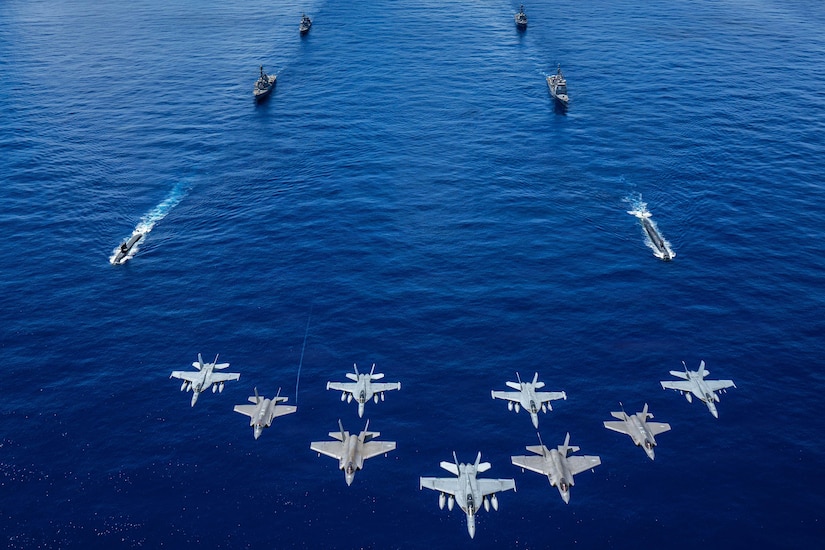
Nine military fighter jets fly in formation while two submarines and four large military ships sail in two rows in the ocean.

U.S. Pacific Command joint forces, along with allied and partner forces, kicked off Exercise Valiant Shield 2026 today in the Indo-Pacific region. 

The training exercise will run until July 1 and take place in the Northern Mariana Islands, Guam, Japan and at sea around the Mariana Islands Range Complex. 

Valiant Shield 26 is a multinational, biennial field training exercise focused on integrating interoperability training in a multidomain environment. This training builds real-world proficiency in sustaining joint forces through detecting, locating, tracking and engaging units at sea, in the air, in space, on land and in cyberspace. 

Exercises such as VS26 enable all U.S. forces and allies across the Indo-Pacific region to integrate and train in precise, lethal and overwhelming scenarios that demonstrate the strength and versatility of the joint and combined force.  

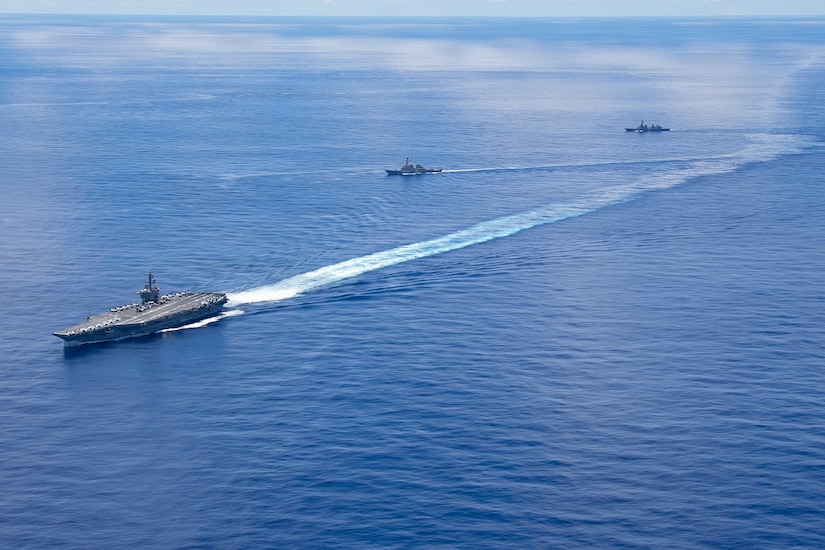
Three large military ships sail in the ocean.

With the involvement of U.S. Space Command and U.S. Transportation Command, VS26 is expanding the multidomain, cross-combatant command collaboration required for any large-scale exercise or operation. The exercise prepares the joint and combined force to rapidly respond to crises and contingencies across the spectrum of operations — from humanitarian assistance and disaster response to armed conflict. 

"Valiant Shield demonstrates our enduring commitment to a free and open Indo-Pacific," said Navy Adm. Steve Koehler, commander of U.S. Pacific Fleet. "Exercising advanced multidomain capabilities with our allies ensures we continue to seamlessly innovate and operate together, project combat power together and prevail over any challenge — together." 

The exercise assists U.S., allied and partner forces in developing regional and global power projection capabilities. Integrated training provides a full range of options to succeed in the defense of U.S. interests and those of like-minded nations around the world. 

This year marks the 11th iteration of Exercise Valiant Shield, which began in 2006. It is also the second time the Japan Self-Defense Forces has been heavily integrated in the planning and execution.   

Since 2024, Valiant Shield has become a multilateral joint field training exercise, further integrating allies and partners into the multidomain environment. While it started as a unilateral U.S. exercise, it has evolved to meet the demands of the security environment, incorporating new technologies and strategies.

Wednesday, July 22, 2015

US 3rd Fleet Participates in Talisman Sabre 2015


From Commander, U.S. 3rd Fleet Public Affairs

SAN DIEGO (NNS) -- Commander, U.S. 3rd Fleet concluded participation in Talisman Sabre 2015, a two-week biennial joint-training exercise let by U.S. Pacific Command and the Australian Defence Force (ADF), July 18.

More than 33,000 U.S. and Australian personnel, 21 ships, three submarines and 200 aircraft participated in the evolution, making it the world's second largest maritime exercise. Military assets from both nations conducted various types of training at sea, ashore and in the air off the Australian coast and in the United States 7th and 3rd Fleet areas of responsibility.

"Talisman Sabre 2015 provided a great opportunity for our 3rd Fleet team to work together with the Royal Australian Navy to train in a high-end, mid-intensity warfighting scenario to improve joint combat training, readiness and interoperability," said Vice Adm. Kenny Floyd, commander, U.S. 3rd Fleet. "This exercise improves both nations' ability to work together, preparing U.S. and Australian service members to work together to provide security in the region and around the world."

U.S. 3rd Fleet served as Combined Force Maritime Component Commander (CFMCC) for the exercise. In the joint task force construct, CFMCC is one of four functional components which include Combined Forces Maritime Component Commander, Combined Forces Air Component Commander, Combined Forces Land Component Commander and Combined Forces Special Operations Component Commander.

U.S. 3rd Fleet staff managed a combined force of geographically dispersed Australian and U.S. ships, demonstrating the fleet's ability to manage multinational assets from 3rd Fleet headquarters in San Diego, which added to the realistic, relevant training that is necessary for an effective global Navy.

Joint interagency and international relationships strengthen U.S. 3rd Fleet's ability to respond to crises and protect the collective maritime interest of the U.S. and its allies and partners.

Thursday, September 13, 2012

USNS Mercy Heads Home From Pacific Partnership Mission


By Donna Miles
American Forces Press Service

WASHINGTON, Sept. 13, 2012 – When the crew of USNS Mercy arrives tomorrow morning at their home port of San Diego after their five-month Pacific Partnership mission, some might be tempted to let the numbers alone speak for the success of the largest annual humanitarian civic assistance mission in the Asia-Pacific region.

With the Military Sealift Command hospital ship as their lead platform during visits to Indonesia, the Philippines, Vietnam and Cambodia, they conducted more than 900 surgeries, evaluated and treated more than 49,000 people and provided more than 7,000 veterinary services.

Traveling more than 20,000 nautical miles -- the equivalent of a trip around the equator -- they built or refurbished 13 schools and health clinics. They participated in more than 100 community service projects, including delivery of almost 140,000 pounds of supplies requested by the host nations.

But Navy Capt James Morgan, the mission commander, said numbers alone fail to capture the magnitude of what the 1,200-member crew, with representatives from the U.S. military, four U.S. agencies, 13 partner nations and 28 nongovernmental organizations, accomplished during Pacific Partnership 2012.

“What stands out the most for me is just how well so many people came together to accomplish this mission over four different ports -- from the planning to the execution to the wrap-up,” Morgan told American Forces Press Service as Mercy transited home from its final port call in Hawaii.

“This mission demonstrated the ability of all those people to work together, not just on a planned mission, but if anything ever happens that would require us to work together again,” he said. “We have built those relationships, and I think everybody takes away a clear understanding of how much we can get done, working together toward common goals.”

U.S. Pacific Command, operating through U.S. Pacific Fleet, launched the Pacific Partnership initiative in 2006 after a devastating tsunami struck the region in December 2004. Since then, the annual mission has focused on reinforcing relationships formed through the tsunami response and laying groundwork to ensure future preparedness.

The idea, Morgan explained, is to “prepare in calm to respond in crisis,” building trust and establishing the relationships that would enhance the ability of the United States, host nations, partner nations and NGOs to respond together to natural disasters or other crises.

So the real success of this year’s mission, he said, can best be gauged through what’s been left behind, particularly through subject-matter expert exchanges between governments, militaries and NGOs in areas of public health, civil engineering and humanitarian assistance and disaster relief.

Morgan recognized the highlights of the two-week visits to each host nation.

In Indonesia, for example, the crew fanned out to provide services not only in Manado, but also on the remote islands of Sangihe, Talaud and Siau.

“If we were to actually respond to a no-kidding situation under those kinds of conditions, that is exactly how we would operate. We would move among the islands and we would bring the same people together,” Morgan said. “So my biggest takeaway was how well we came together under very complex situations, with very complex maneuvering among four different islands over 15 days to accomplish what we did.”

In the Philippines, Morgan said, he was impressed by how much the host nation embraced the opportunity to improve its humanitarian assistance and disaster relief response capabilities and readiness. While reinforcing their ability to respond to crises in their own country -- from torrential rains and flooding to the recent earthquake -- they also strengthened their ability to help regional neighbors, if needed.

As a demonstration of that willingness, Filipino doctors joined the Pacific Partnership crew during subsequent visits to Vietnam and Cambodia.

Mercy’s visit to Vietnam featured an exciting first for the mission as medical teams operated off the ship, side by side with their Vietnamese counterparts, Morgan said.

And in Cambodia, the crew fanned out from the port at Sihanoukville, providing medical and dental care in remote and underserved parts of the Phnom Penh, Koh Kang and Kampot provinces. “We were able to push out, well away from where the Mercy was, to areas that we had never reached before,” Morgan said. “What we were able to accomplish, so far away from Mercy, I thought was pretty standard-setting.”

Navy Capt. (Dr.) Timothy Hinman, commanding officer of Mercy’s medical treatment facility, called the medical subject-matter exchanges a highlight of the mission. With more than 60,000 contact hours -- from larger-scale symposiums and conferences to more individualized hands-on training -- the Pacific Partnership medical crew helped the host nations increase their own medical and disaster-response capacity, he said.

As the U.S., partner-nation, NGO and host-nation medical teams came together to provide medical services in remote and underserved areas, they gained better understanding of and appreciation for what each other bring to the table, he said.

“We talk about ‘health diplomacy,’ and I think this is an example of it, because the language of medicine transcends our cultural differences and barriers,” Hinman said. “That made it an enriching and rewarding mission for everybody who participated.”

Particularly memorable during the mission, he said, was the opportunity for Pacific Partnership’s medical teams to perform operations ashore, alongside their counterparts from Indonesia, Vietnam and Cambodia. “This is a major step for us,” Hinman said. “The ability for our surgeons to work side-by-side, collaboratively with the host-nation surgeons gives you a totally different aspect of building a relationship.”

Dr. Helle Hydeskov, a veterinarian from Denmark, served as team lead for the World Vets, an organization that worked with Army veterinarians and tailored their treatments and training to what the host nation requested.

The focus -- whether in helping a country get a rabies problem under control or deal with a livestock issue -- was to leave behind something enduring. “Because of the short time that we were in a country, the best thing we could do was to teach them how to handle it themselves when we leave,” she said.

Hydeskov, who served aboard Mercy’s sister ship, USNS Comfort, during U.S. Southern Command’s Continuing Promise mission last year, said she jumped at the chance to participate in Pacific Partnership 2012.

“Even though the military plans these missions, everybody works together as equals, so it is a great opportunity for the volunteers to take part in,” she said. “Nowhere else in the world can you get anything close to this experience -- to get to travel the world and see the different cultures and work as a veterinarian at the same time.”

Anticipating Mercy’s arrival tomorrow in San Diego, where its crew will participate in Fleet Week activities, Morgan said Pacific Partnership stands as a testament to the U.S. commitment to the Asia-Pacific region.

“It emphasizes the importance of not only our military ties, but also our humanitarian civic-action ties that bring us all together,” he said. “It demonstrates a commitment to the region, a commitment to partnership-building and a commitment to working together toward common goals.”
Sunday, August 26, 2012

USS Columbus Completes Deployment to Western Pacific Region


By Mass Communication Specialist 1st Class Ronald Gutridge, Commander, Submarine Force, U.S. Pacific Fleet Public Affairs

PEARL HARBOR, Hawaii (NNS) -- Friends and families of the crew from USS Columbus (SSN 762) gathered at the submarine piers to welcome back the Los Angeles-class submarine as it returned to Joint Base Pearl Harbor-Hickam after completing a six-month deployment to the Western Pacific region, Aug. 23.

While deployed, Columbus executed a wide range of operations in support of Commander, U.S. 7th Fleet. In addition, the crew conducted several training exercises, contributing to the nation's strategic posture in the Western Pacific region.

"Columbus' 2012 deployment was very successful," said Cmdr. David Youtt, Columbus commanding officer. "We executed fleet and national tasking as well as numerous exercises and theater cooperation with our regional allies. Our crew gained extensive experience operating in vastly different environments and engaging with different cultures. We are a better ship and crew as a result and are better prepared to face future operations.

"The crew performed superbly through deployment," said Youtt. "Each Sailor faced everyday with enthusiasm and professionalism that was second to none."

 During the deployment, 28 Sailors qualified in submarines and are now entitled to wear the submarine warfare insignia, also referred to as "Dolphins", after completing a rigorous qualification process that included in-depth understanding of submarine construction and operations, and also practical assessments of the Sailor's ability to combat a wide range of casualties that could be encountered while on board the submarine. A majority of the crew also completed advanced qualifications, including engineering watch supervisor, diving officer of the watch and chief of the watch. These qualifications provide greater watch bill flexibility and help ensure that Columbus' performance will remain strong.

 "This deployment offered significant experience and training for the young Sailors that will be the leaders of our Navy," said Youtt. "More than half the crew deployed for the first time and are now experienced future deployers."

 Despite steaming more than 40,000 nautical miles in support of the nation's defense, the crew enjoyed several memorable port visits which included Guam, South Korea and, Japan.

Columbus also conducted a time-honored ceremony of "Crossing the Line" where 100 Sailors earned the title of "Shellback" for crossing the equator for the first time.

 "I really learned allot about submarines and my job on this deployment, but the best part is when I became submarine qualified and got my Dolphins," said Electronics Technician Seaman (SS) Jonathan Diquattro from Columbus, Ga. "The experience I gained and the places we visited makes my first deployment something I will never forget."

 Columbus is the 51st Los Angeles-class submarine and the twelfth improved version of this class, which includes a vertical launch system for Tomahawk cruise missiles and an improved hull design for under-ice operations. It completed a post shipyard availability in June 1994 in Groton, Conn. after initial construction and shakedown operations. In September 1994, the ship conducted an inter-fleet transfer to Pearl Harbor, Hawaii, and joined the U.S. Pacific Fleet Submarine Force.

Saturday, August 25, 2012

Amos: Asia-Pacific Shift Won’t Overlook Other Regions


By Jim Garamone
American Forces Press Service

WASHINGTON – Enemies of the United States would be making a mistake if they conclude the U.S. shift in defense strategy toward the Asia Pacific means less focus on other important regions, the commandant of the Marine Corps said today.

Gen. James F. Amos told reporters the strategy shift should not be taken to mean the U.S. military at large won’t remain engaged with the rest of the world. “We have the capability to do our nation’s bidding (elsewhere) while we’re doing (the Pacific strategy),” he said. “This doesn’t have to be a singular focus for the Marine Corps.”

Marines have a long and distinguished history in Asia and he honored part of that legacy by participating in the 70th anniversary of the Marine landing at Guadalcanal on August 7.

For today’s young Marines, Gen. Amos said the wars in Iraq and Afghanistan have been the proving ground the same way Khe Sanh or Da Nang in Vietnam were for their fathers. “For all the young kids who joined the Marine Corps in the past 10 years, I go out and visit them in Afghanistan and ask how many of you have been in the western Pacific?” he said. “The only ones who raise their hands are the old master gunnery sergeants, the sergeant major and the battalion commander. All the others have never been there before.”