Showing posts with label joint exercise. Show all posts

Monday, June 22, 2026

Allies Come Together in the Indo-Pacific for Exercise Valiant Shield 26

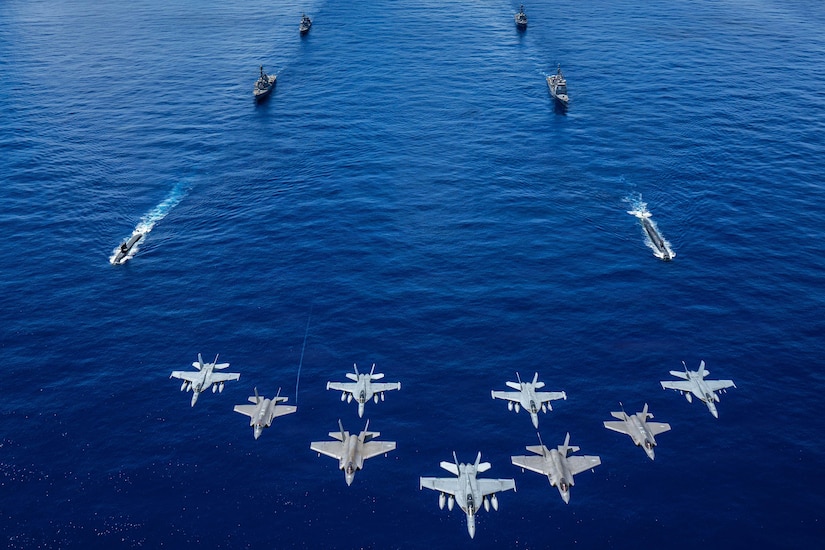
Nine military fighter jets fly in formation while two submarines and four large military ships sail in two rows in the ocean.

U.S. Pacific Command joint forces, along with allied and partner forces, kicked off Exercise Valiant Shield 2026 today in the Indo-Pacific region. 

The training exercise will run until July 1 and take place in the Northern Mariana Islands, Guam, Japan and at sea around the Mariana Islands Range Complex. 

Valiant Shield 26 is a multinational, biennial field training exercise focused on integrating interoperability training in a multidomain environment. This training builds real-world proficiency in sustaining joint forces through detecting, locating, tracking and engaging units at sea, in the air, in space, on land and in cyberspace. 

Exercises such as VS26 enable all U.S. forces and allies across the Indo-Pacific region to integrate and train in precise, lethal and overwhelming scenarios that demonstrate the strength and versatility of the joint and combined force.  
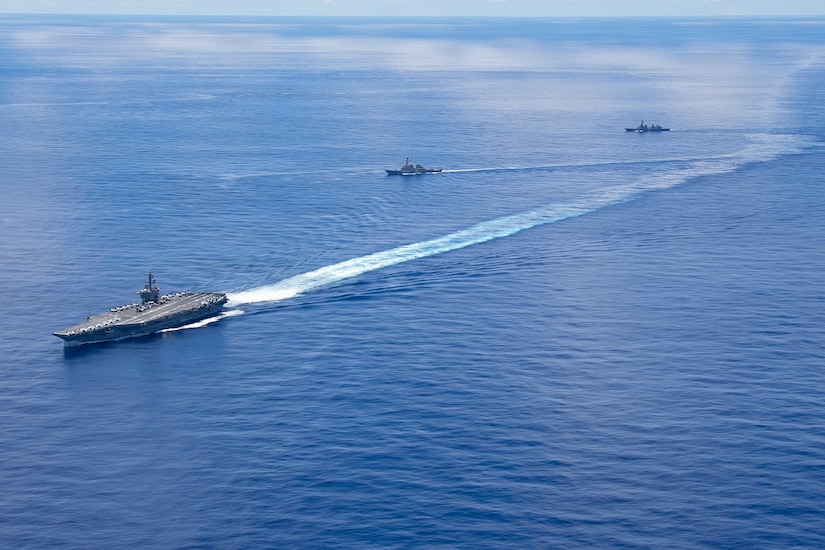
Three large military ships sail in the ocean.

With the involvement of U.S. Space Command and U.S. Transportation Command, VS26 is expanding the multidomain, cross-combatant command collaboration required for any large-scale exercise or operation. The exercise prepares the joint and combined force to rapidly respond to crises and contingencies across the spectrum of operations — from humanitarian assistance and disaster response to armed conflict. 

"Valiant Shield demonstrates our enduring commitment to a free and open Indo-Pacific," said Navy Adm. Steve Koehler, commander of U.S. Pacific Fleet. "Exercising advanced multidomain capabilities with our allies ensures we continue to seamlessly innovate and operate together, project combat power together and prevail over any challenge — together." 

The exercise assists U.S., allied and partner forces in developing regional and global power projection capabilities. Integrated training provides a full range of options to succeed in the defense of U.S. interests and those of like-minded nations around the world. 

This year marks the 11th iteration of Exercise Valiant Shield, which began in 2006. It is also the second time the Japan Self-Defense Forces has been heavily integrated in the planning and execution.   

Since 2024, Valiant Shield has become a multilateral joint field training exercise, further integrating allies and partners into the multidomain environment. While it started as a unilateral U.S. exercise, it has evolved to meet the demands of the security environment, incorporating new technologies and strategies.

Friday, March 13, 2026

Navy Explosive Ordnance Techs Strengthen Homeland Defense During Arctic Edge 2026

Navy explosive ordnance disposal technicians assigned to Explosive Ordnance Disposal Mobile Unit 11 participated in Arctic Edge 2026, Feb. 23 to March 5. 

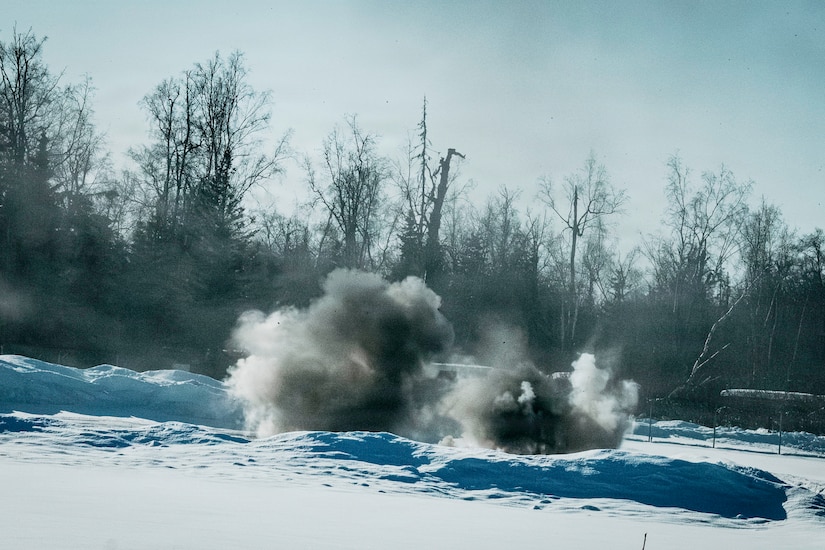
Two clouds of smoke rise from a snow-covered ground.

Arctic Edge 2026, led by the North American Aerospace Defense Command and U.S. Northern Command, is a homeland defense exercise focused on improving readiness, demonstrating capabilities and strengthening joint and allied forces interoperability in the Arctic. 

"This year, our primary objective was to integrate with other EOD entities in new environments," said Navy Chief Petty Officer Quinn Gaubatz, chief explosive ordnance disposal technician. "Subject matter expert exchanges help us better our tactics, techniques and procedures through collaboration of our strengths, especially in the challenging conditions that [Arctic Edge] provided." 

Throughout the exercise, EODMU-11 operated alongside joint EOD forces and other military units on Kodiak Island, Alaska, and at Joint Base Elmendorf-Richardson in Anchorage, Alaska. 

A man wearing a camouflage winter military uniform lays wire onto a snow-covered ground.

On Kodiak Island, EODMU-11 technicians conducted remote operated vehicle operations during a force protection drill, partnering with 1st EOD Company, 7th Engineer Support Battalion, 1st Marine Logistics Group, Unmanned Undersea Vehicles Squadron 1, Naval Information Warfare Center personnel, and U.S. Coast Guard elements assigned to the island to assess, neutralize and recover simulated underwater threats. 

"Demanding environments such as Kodiak create great opportunities to stress test our gear," said Navy Petty Officer 2nd Class Luke Rebeor, an EOD technician. "Operating our ROV systems in training alongside joint counterparts helped us accomplish homeland defense objectives together." 

During the drill, ROV operations expanded and supported joint EOD capabilities by providing an essential standoff area in underwater environments in a potentially high-risk reconnaissance and ordnance disposal mission. 

At JBER, EODMU-11 conducted joint airfield clearance and unexploded ordnance disposal drills with Air Force EOD technicians assigned to the 673rd Expeditionary Civil Engineer Squadron, simulating threats to critical infrastructure under extreme cold weather conditions. 

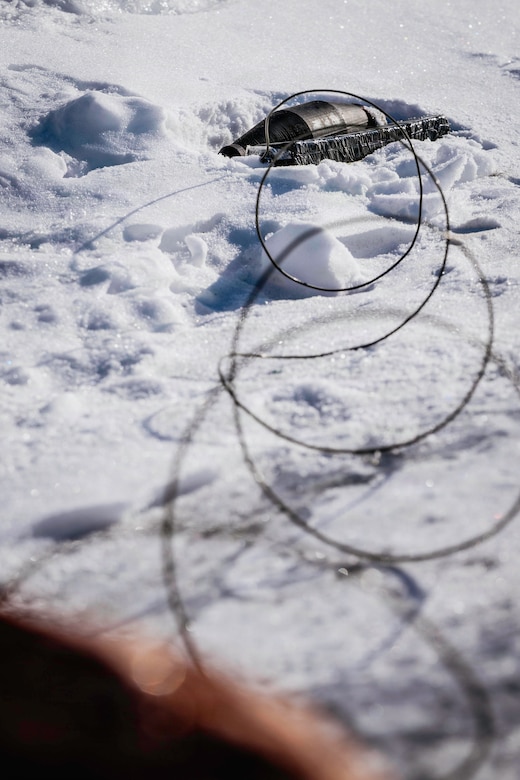
A military warhead sits on a snow-covered ground next to a block of a military explosive.
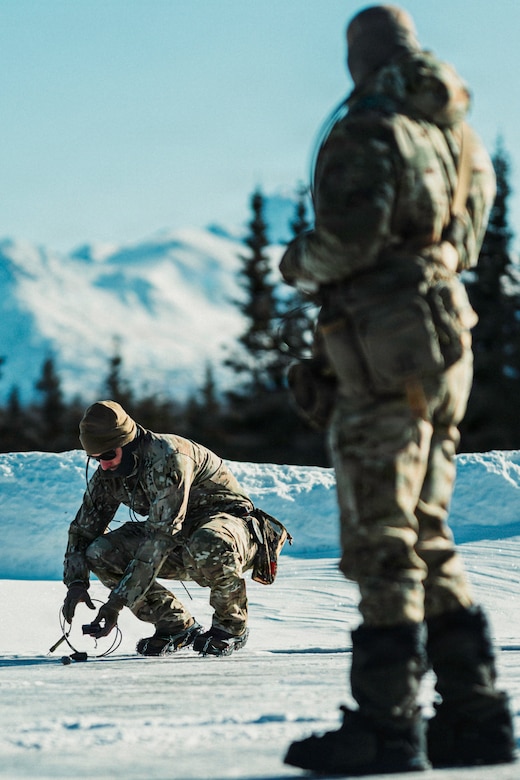
A man wearing a winter camouflage military uniform lays wire onto a snow-covered ground. Another man in similar attire stands and watches.
  

"Operating in the Arctic requires some adaptation," Gaubatz said. "Standard explosives and techniques work differently in colder climates, so practicing our skills and techniques in Alaska provided an extremely valuable training opportunity." 

Defending the U.S. is inherently linked to the joint force's ability to operate effectively across the entire Northcom area of responsibility — including the Arctic. Navy EOD's presence in Alaska during Arctic Edge ensured expeditionary competence in support of homeland defense as the strategic importance of the Arctic domain expands.