Showing posts with label southern border. Show all posts

Thursday, September 17, 2026

Joint Task Force Southern Border Soldiers Innovate to Reinforce Barriers

Five people wearing camouflage military uniforms, helmets and gloves stand on a concrete wall and hang coiled wire along the top of it, while three people in similar attire stand on the ground and guide the wire up to them outside in a desert terrain.

Soldiers with the 62nd Engineer Battalion, 36th Engineer Brigade, assigned to Joint Task Force Southern Border in support of Operation Ardent Vanguard, recently reinforced a challenging section of the southern border barrier. 

The soldiers emplaced two strands of concertina wire and one strand of razor wire atop 7-foot Hesco barriers in National Defense Area 2 near Fort Hancock, Texas. The reinforced barriers disrupt climbing attempts and enhance persistent detection, monitoring and rapid response along high-risk border corridors.

"Barrier reinforcement operations represent more than physical infrastructure; they showcase the technical ingenuity and skill of our service members," said Army Maj. Gen. Curtis Taylor, commander of Joint Task Force Southern Border and the 1st Armored Division and Fort Bliss, Texas. "For the last 14 weeks, our great soldiers have been out here day and night developing innovative solutions to stop human trafficking in our own territory."

In May, the Navy and U.S. Army Corps of Engineers began installing 10 miles of barriers under orders from the War Department and U.S. Northern Command. Within about 30 days, they constructed 10 miles of barriers, including site preparation, mobilization, environmental clearance, receiving barrier sections from overseas, and transporting more than 90,000 cubic yards of fill material.

On average, constructing 10 miles of Hesco barriers takes approximately 28 days when crews work 12-hour shifts. However, this timeline does not include mobilization, land clearing or compaction.

During the recent reinforcement operation, soldiers assigned to the 591st Combat Engineer Company-Infantry, 62nd Engineer Battalion, maintained a demanding pace as they reinforced barriers from Santa Teresa, New Mexico, to Fort Hancock, Texas.

"When we work on border reinforcement operations, we typically start in the morning, and then we work until around midafternoon," said Army 2nd Lt. Jonah Posada, a Sapper platoon leader with the 591st. "And then, we'll return to Fort Bliss and prepare for the next day; we try to continue at that pace for the whole week."

To address site conditions and avoid the Texas summer heat, the company adopted an offset work schedule: one platoon began work in the early evening; another relieved it and worked until late morning.

The elevated work surface and limited workspace made installing razor wire on the Hesco barriers difficult. Additionally, the soldiers could not use metal stakes, which are generally used for support, because they would place compressive stress on the barriers. Instead, they used boom lifts as work platforms to emplace razor wire atop the concertina wire.

The final 300-meter section presented another significant challenge: soft, uneven terrain prevented the boom lifts from reaching the area and attempts to move the equipment left them stuck. Rather than leave the section unfinished, the 591st soldiers developed a solution using equipment already available.

"We devised a plan using tent poles and rope that we had in our high-angle mountaineering kit," Posada said. "Using those ropes, we stretched [the section of wire] out and kept tension on the razor wire."

Soldiers on the ground used camouflage-net poles to lift the razor wire while teams atop the barrier secured it in place. A carabiner attached to a rope helped lift the wire from the ground, enabling the soldiers to complete the final section without relying on boom lifts.

The solution was the latest in a series of adaptations soldiers developed as they transitioned between traditional barrier work and reinforcing Hesco barriers.

The Hesco barriers introduced additional challenges because the razor wire configuration was not standard for the engineers.

"The actual obstacle that we emplaced on top of the Hesco [barriers] is not normal," Posada said. "We had to figure out how to best overcome that. The terrain by the Hesco was a big hindrance on the mission as well."

The company also developed techniques to prevent injuries. In one method, the soldiers attached a wooden post to a boom lift and used it to position the wire across the barrier.

The completed work reinforces the barrier with additional obstacles intended to deter unauthorized crossings and support the broader border-security mission. Posada said the U.S. Customs and Border Protection agents appreciated the efforts and noted that the additional barriers helped limit crossings.

The operation underscores the role of combat engineers in providing practical solutions when terrain, equipment and mission requirements intersect.

For the soldiers conducting the work, the operation demonstrated the importance of adapting established engineering practices to conditions on the ground. Posada said he shared the techniques that his platoon developed with other platoon leaders in the company so they could apply the lessons learned to similar missions.
 

Wednesday, September 16, 2026

USS St. Louis Assumes U.S. Northern Command Mission at Southern Border

A large military ship sits in a body of water near a grassy field.

The littoral combat ship USS St. Louis departed Naval Station Mayport, Florida, in support of U.S. Northern Command's mission to secure the southern border of the United States, Sept. 13. 

The St. Louis assumes duties previously executed by the USS Cooperstown in support of Northcom's border security objectives. The command is working together with the Department of Homeland Security to augment U.S. Customs and Border Protection along the southern border to disrupt illicit drug trafficking and protect the homeland. 

"Our crew has trained relentlessly for this deployment, and they stand ready for whatever challenges lie ahead. I could not be more proud to lead these sailors," said Navy Cmdr. Lester Shewmake, commanding officer of the USS St. Louis. "To our families and the Mayport community — thank you for your unwavering support as we head to sea." 

Navy assets are deployed under Northcom's maritime homeland defense authorities to enable maritime interdiction missions to prevent the flow of illegal drugs or other illegal activity.

The St. Louis is assigned to the Littoral Combat Ship Squadron 2 and homeported in Mayport. The littoral combat ship is a fast, agile, mission-focused warship designed to operate in near-shore environments to counter 21st century threats. It is a class of small surface combatants armed with capabilities to defeat challenges in the world's littorals. These ships can operate independently or in high-threat scenarios as part of a networked battle force that includes larger, multimission surface combatants such as cruisers and destroyers.

It is the 22nd littoral combat ship delivered to the Navy, the 10th Freedom-variant to join the fleet and the seventh ship to bear the name. The first St. Louis, a sloop of war, was launched in 1828. It spent most of its service patrolling the coasts of the Americas to protect interests and trade.

Tuesday, July 21, 2026

Army Contracting Support Enables Marine Operations Along Southern Border

Contracting officers assigned to the U.S. Army Mission and Installation Contracting Command Southern Border Contract Team provided contract support to Marines assigned to Company A, 1st Battalion, 7th Marine Regiment supporting Operation Ardent Vanguard. 

The MICC Southern Border Contracting Team is part of the Forward Contracting Element – West, Theatre Contracting Center – Americas, 410th Contracting Support Brigade, aligned under the MICC.

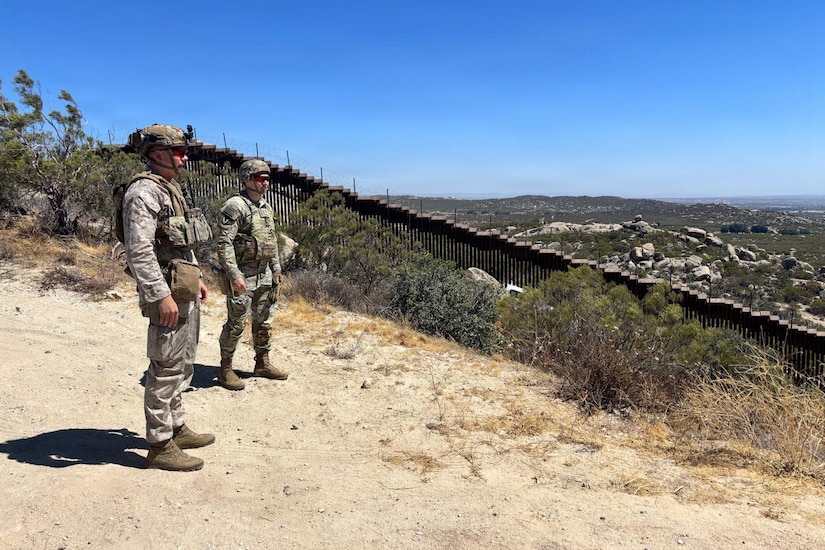
Two men wearing camouflage military uniforms, helmets and sunglasses survey a border fence in the desert.

For the southern border mission and area of operation, the Marines do not have organic contracting units, making Army contracting support essential to their mission success.

The Army and Marine Corps maintain fluid communication channels and continuously reach out for mutual support in joint operations. With just under 100 service members maintaining patrols around the clock across demanding terrain, Company A depends on a steady stream of support services to stay in the fight.

"The Army contracting team has been instrumental to our mission success along the southern border," said Marine Corps Gunnery Sgt. Martin Hlinovsky III, a maintenance chief assigned to 1st Battalion, 7th Marine Regiment. "Their responsiveness in securing hotel arrangements that meet force protection requirements while reducing commute times has directly enhanced our operational readiness. We are extremely grateful for their contracting expertise and partnership in enabling our mission." 

The MICC Southern Border Contracting Team does not operate from a fixed Army post or camp. Instead, the contracting team deploys along the southern border and commutes to different locations to conduct site visits and reconnaissance for potential contracting needs. This mobile approach allows the team to be responsive to the dynamic operational environment. 

During the visit to Company A's operating location — a repurposed facility that presents unique support challenges — the team conducted a full review of the unit's basic life support services to assess where contracting is delivered and where gaps remain.

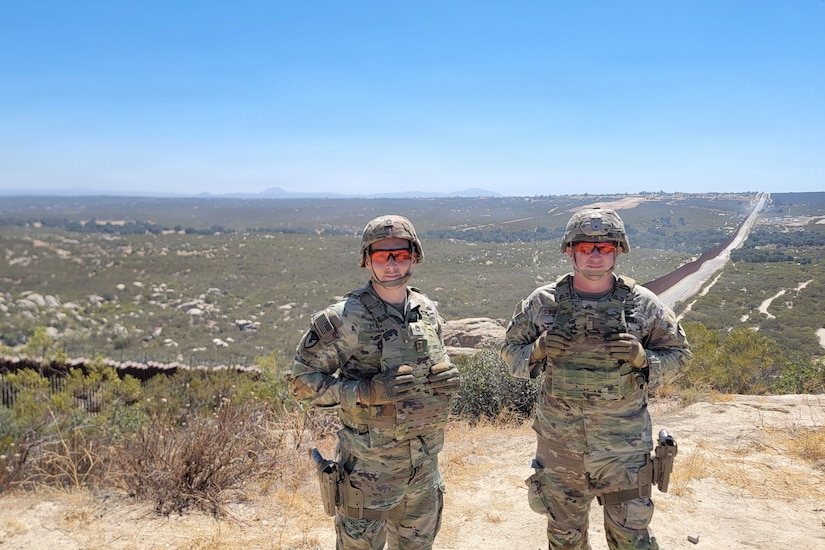
Two men wearing camouflage military uniforms, helmets and sunglasses smile as they pose for a photo in the desert.

A key part of the visit was educating the Marines on the acquisition process and the proper channels available to resolve ongoing support challenges. The MICC team walked leaders through the fundamentals of contracting support and how they become actionable contract solutions. 

While these Marine-driven solutions speak to the unit's resourcefulness, they also highlight an opportunity for contracting to step in earlier so that Marines can invest their energy in the mission rather than in building makeshift solutions. Identifying these gaps is exactly why the MICC Southern Border team walks the ground. 

The MICC's greatest contributions have been relocating service members to hotels that meet force protection standards, reducing commute time and lessening the demand to stay for long durations in centralized or isolated locations.

Specific contracting support for the southern border includes lodging and conference rooms for Task Force Leviathan across San Diego; Yuma, Arizona; El Centro, California; and Marine Corps Air Station Miramar, California. The support also includes sanitation services for Task Forces Forge, Mustang, Strike and the Army Reserve's 489th Engineer Battalion, as well as the Army National Guard's 168th Military Police Battalion and 941st Military Police Battalion units across Arizona and Texas locations. Infrastructure support includes portable office buildings, equipment rentals, wireless communications and battalion aid stations. Additionally, multilocation operations span the Rio Grande Valley, Del Rio, Brownsville and McAllen in Texas; and Nogales and Naco in Arizona.

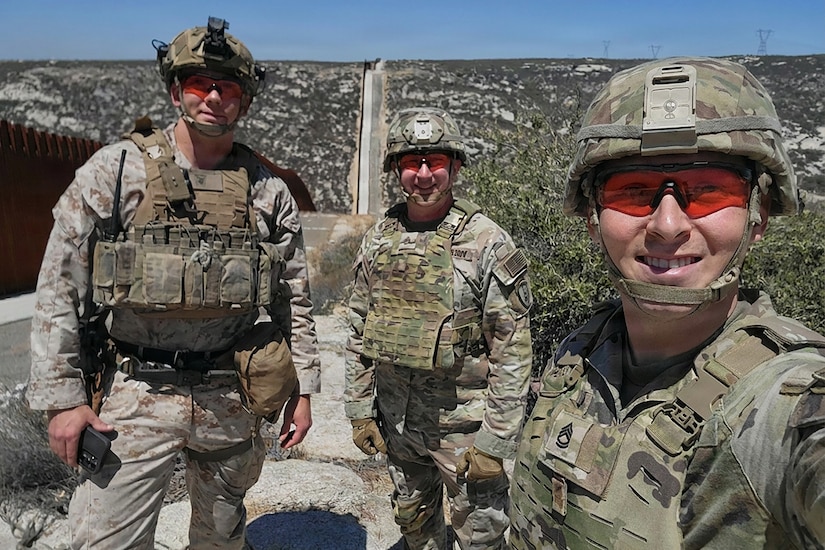
Three men wearing camouflage military uniforms, helmets and sunglasses smile as they pose for a photo in the desert.

Currently, the MICC Southern Border Contracting Team manages 19 active contracts valued at approximately $56 million in support of southern border operations. Through strategic contracting practices and effective negotiation, they have achieved $960,000 in cost savings in the past 30 days alone. 

Going forward, the MICC team is committed to anticipating requirements by staying engaged with the units on the ground rather than waiting for problems to surface, streamlining support for life-sustainment needs while empowering units with a working knowledge of the contracting process and the proper channels to use, and scaling infrastructure and support services to match the operational tempo and terrain. 

By walking the ground alongside the warfighters, the MICC team is better positioned to deliver the right capabilities, at the right time, in the right place.