Showing posts with label Border Security. Show all posts

Tuesday, July 21, 2026

Army Contracting Support Enables Marine Operations Along Southern Border

Contracting officers assigned to the U.S. Army Mission and Installation Contracting Command Southern Border Contract Team provided contract support to Marines assigned to Company A, 1st Battalion, 7th Marine Regiment supporting Operation Ardent Vanguard. 

The MICC Southern Border Contracting Team is part of the Forward Contracting Element – West, Theatre Contracting Center – Americas, 410th Contracting Support Brigade, aligned under the MICC.

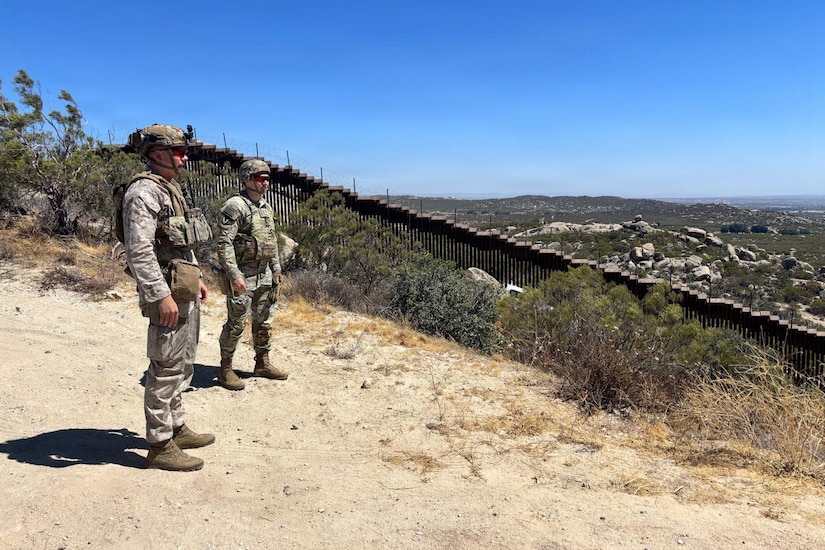
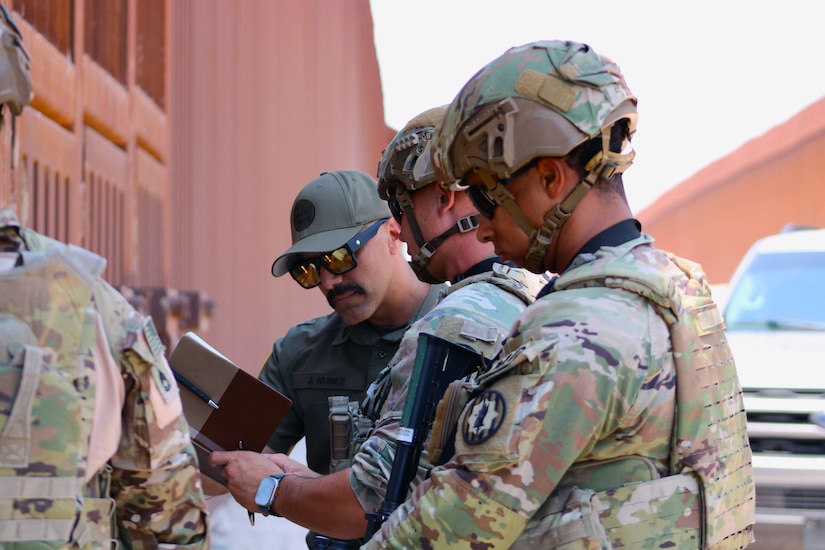
Two men wearing camouflage military uniforms, helmets and sunglasses survey a border fence in the desert.

For the southern border mission and area of operation, the Marines do not have organic contracting units, making Army contracting support essential to their mission success.

The Army and Marine Corps maintain fluid communication channels and continuously reach out for mutual support in joint operations. With just under 100 service members maintaining patrols around the clock across demanding terrain, Company A depends on a steady stream of support services to stay in the fight.

"The Army contracting team has been instrumental to our mission success along the southern border," said Marine Corps Gunnery Sgt. Martin Hlinovsky III, a maintenance chief assigned to 1st Battalion, 7th Marine Regiment. "Their responsiveness in securing hotel arrangements that meet force protection requirements while reducing commute times has directly enhanced our operational readiness. We are extremely grateful for their contracting expertise and partnership in enabling our mission." 

The MICC Southern Border Contracting Team does not operate from a fixed Army post or camp. Instead, the contracting team deploys along the southern border and commutes to different locations to conduct site visits and reconnaissance for potential contracting needs. This mobile approach allows the team to be responsive to the dynamic operational environment. 

During the visit to Company A's operating location — a repurposed facility that presents unique support challenges — the team conducted a full review of the unit's basic life support services to assess where contracting is delivered and where gaps remain.

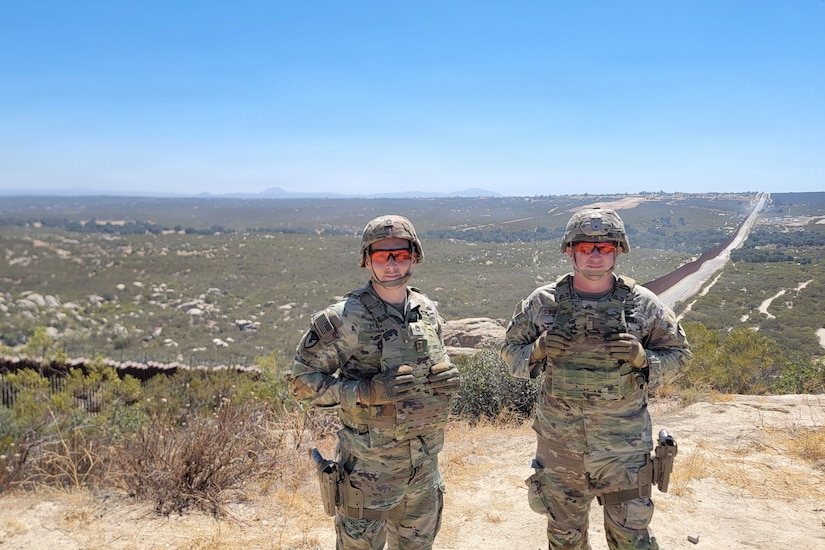
Two men wearing camouflage military uniforms, helmets and sunglasses smile as they pose for a photo in the desert.

A key part of the visit was educating the Marines on the acquisition process and the proper channels available to resolve ongoing support challenges. The MICC team walked leaders through the fundamentals of contracting support and how they become actionable contract solutions. 

While these Marine-driven solutions speak to the unit's resourcefulness, they also highlight an opportunity for contracting to step in earlier so that Marines can invest their energy in the mission rather than in building makeshift solutions. Identifying these gaps is exactly why the MICC Southern Border team walks the ground. 

The MICC's greatest contributions have been relocating service members to hotels that meet force protection standards, reducing commute time and lessening the demand to stay for long durations in centralized or isolated locations.

Specific contracting support for the southern border includes lodging and conference rooms for Task Force Leviathan across San Diego; Yuma, Arizona; El Centro, California; and Marine Corps Air Station Miramar, California. The support also includes sanitation services for Task Forces Forge, Mustang, Strike and the Army Reserve's 489th Engineer Battalion, as well as the Army National Guard's 168th Military Police Battalion and 941st Military Police Battalion units across Arizona and Texas locations. Infrastructure support includes portable office buildings, equipment rentals, wireless communications and battalion aid stations. Additionally, multilocation operations span the Rio Grande Valley, Del Rio, Brownsville and McAllen in Texas; and Nogales and Naco in Arizona.

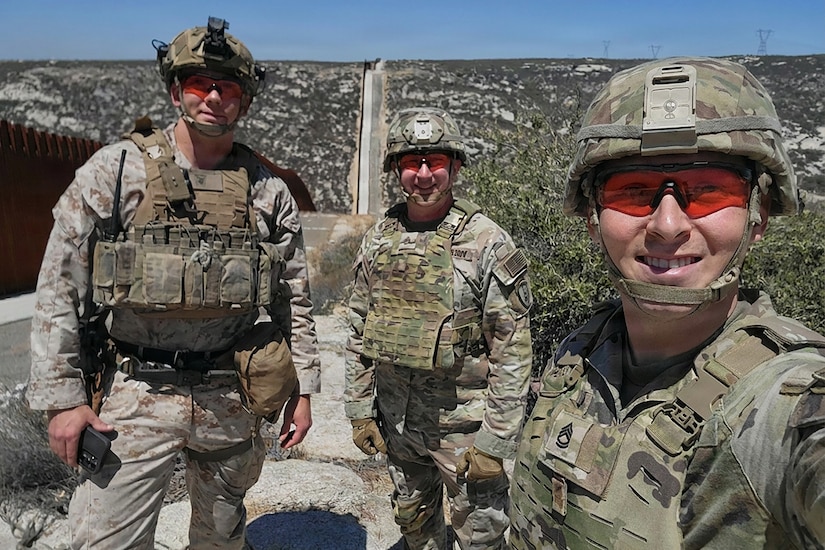
Three men wearing camouflage military uniforms, helmets and sunglasses smile as they pose for a photo in the desert.

Currently, the MICC Southern Border Contracting Team manages 19 active contracts valued at approximately $56 million in support of southern border operations. Through strategic contracting practices and effective negotiation, they have achieved $960,000 in cost savings in the past 30 days alone. 

Going forward, the MICC team is committed to anticipating requirements by staying engaged with the units on the ground rather than waiting for problems to surface, streamlining support for life-sustainment needs while empowering units with a working knowledge of the contracting process and the proper channels to use, and scaling infrastructure and support services to match the operational tempo and terrain. 

By walking the ground alongside the warfighters, the MICC team is better positioned to deliver the right capabilities, at the right time, in the right place.

Monday, March 16, 2026

Joint Task Force Southern Border Marks One Year of Success, Bolstering Southern Border Security Through Integrated Operations

Joint Task Force Southern Border reached its one-year anniversary, March 14, underscoring a year of agile, full-scale and partner-focused missions supporting the Department of Homeland Security's southern border mission.

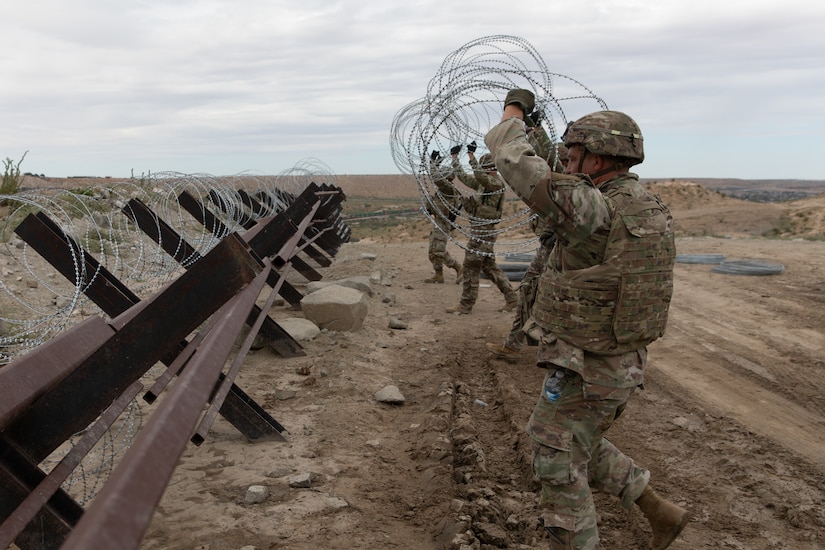
People wearing military camouflage uniforms move concertina wire over a barrier fence in a desert terrain.

Soldiers assigned to the 10th Mountain Division in Fort Drum, New York, deployed to Fort Huachuca, Arizona, to establish the new task force, March 14, 2025, under the authority of U.S. Northern Command. The 101st Airborne Division from Fort Campbell, Kentucky, assumed control of the JTF-SB mission following a transfer of authority from the 10th Mountain Division, Oct. 10, 2025.

JTF-SB's mission is to safeguard U.S. territorial integrity and protect the American people. The task force achieves this by increasing situational awareness along the southern border, accelerating response capabilities and supporting federal law enforcement partners so they can focus on frontline duties.

One Year of Impact: Unified Operations, Measurable Results

Over the past year, JTF-SB service members provided consistent watch across 1,954 miles of the U.S.-Mexico border, conducting remote and mobile detections spanning from river crossings to high-traffic urban corridors. Through synchronized planning, rapid mobility and persistent presence, JTF-SB has enhanced southern border security by expanding detection and monitoring, improving data sharing that enabled U.S. law enforcement partners to increase apprehensions while also improving the warfighting readiness of assigned units.

Key accomplishments and operational highlights from the past year include:

  • JTF-SB has assisted DHS in achieving historically low levels of individuals attempting to illegally cross our southern border and an equally historic effectiveness in arresting or turning back those that do.
  • More than 20,000 service members have honorably served under JTF-SB since its establishment.
  • Approximately 22,000 enhanced detection and monitoring missions were conducted, enabling greater awareness of illegal crossings from Mexico into the United States. Of these, almost 3,000 were joint patrols alongside U.S. Customs and Border Protection agents, and over 800 were mirrored patrols on both sides of the southern border with CBP and the Mexican Secretariat of National Defense.
  • More than 84,000 security site missions were conducted, providing continuous detection and monitoring across key areas of the southern border. These missions leveraged advanced sensor-borne technology, including fixed and mobile ground sensors and long-range systems, to deliver greater situational awareness.
  • Aviation assets have executed nearly 1,600 aerial observation flight missions and 220 unmanned aerial missions, monitoring areas of interest and providing overwatch for personnel on the ground.
  • Nearly 6,000 signs and 2,000 buoys have been installed along 656 miles of the southern border to clearly demarcate the five recently created national defense areas.
  • Over 51,000 rolls of concertina wire were delivered and are actively being emplaced into key areas in conjunction with CBP. This supports barrier reinforcement along the southern border, the largest of its kind in U.S. history, adding a layer of deterrence in areas most needed to deter and deny illegal crossings.
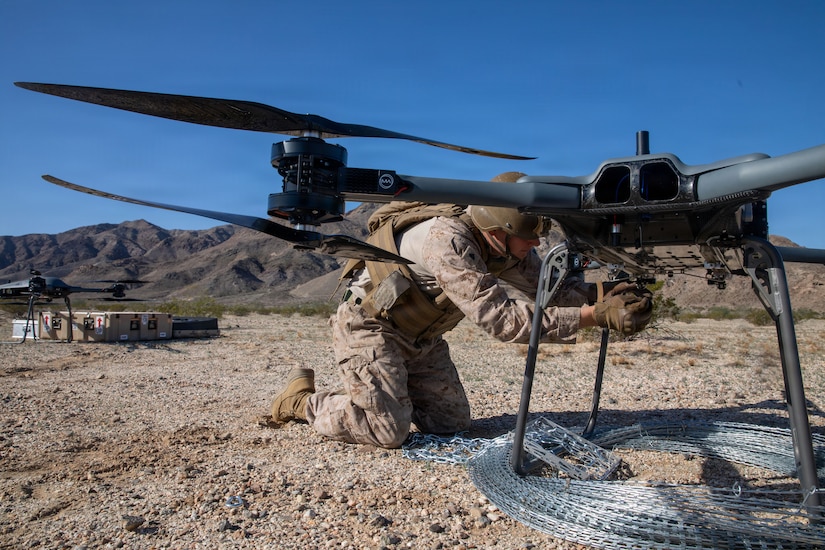
  • Units are conducting real-world testing of new equipment and technology, including the TRV-150C tactical resupply vehicle; the infantry squad vehicle that Marines trained on for the first time in an operational environment; an unmanned surface vessel and solar-powered maritime detection device; and various kinetic and nonkinetic counter-unmanned aerial systems.

These results reflect a year of disciplined execution and unified effort across federal, state and local partners.

A man wearing a camouflage military uniform works on a drone in mountainous desert terrain.

"During this first year, Joint Task Force-Southern Border and partners have proven what a whole-of-government approach to our nation's southern border can accomplish," said Army Maj. Gen. David Gardner, commanding general of the JTF-SB and 101st Airborne Division. "Our joint teammates and partners have strengthened border security through unity of effort, accelerated decision-making and enhanced detection capability. While the environment is complex, our mission is clear: to secure the homeland with precision, professionalism and respect for the rule of law."

Entering its second year, JTF-SB remains dedicated to its mission, strengthening integration, advancing data-driven operations and supporting CBP and partner agencies with professionalism and adaptability.

"Our mission continues and our commitment is unwavering," Gardner said. "We will keep evolving, supporting our partners and protecting the American people."

Friday, September 19, 2025

Army Enhances Border Security Through Partnership, Unique Capabilities

 Sept. 19, 2025 | By Army Capt. Samuel DeWerth-Jaffe, Joint Task Force Southern Border

Joint Task Force Southern Border demonstrates an unprecedented level of interoperability with partner agencies as part of their whole-of-government approach to secure the southern border. 

From the headquarters down to squad-sized elements directly on the border, task force personnel are working alongside U.S. Border Patrol every day, ensuring synchronized efforts to deter illicit activities. 

Two soldiers speak to a person in a baseball cap outside, with a large structure and vehicle in the background and another person nearby.

"My experiences in past deployments and working in Europe have reinforced the importance of partner collaboration — a principle directly applicable to our current mission with Border Patrol," said Army Lt. Col. Cris Gasperini, commander of the 1st Battalion, 41st Infantry Regiment, 2nd Stryker Brigade Combat Team, 4th Infantry Division, assigned to JTF-SB. "The integration of our organic assets with those of Border Patrol has been exceptionally effective, demonstrating the necessity of a whole-of-government approach to border security." 

The task force's integration has proven critical to operations across the southern border's diverse terrain. Along the 1,954 miles of the border lie cities, deserts, thick vegetation, rivers and rural communities. 

The varied terrain along the border presents distinct security challenges. These are addressed through both the organic assets of JTF-SB and the complementary capabilities of interagency partners. 

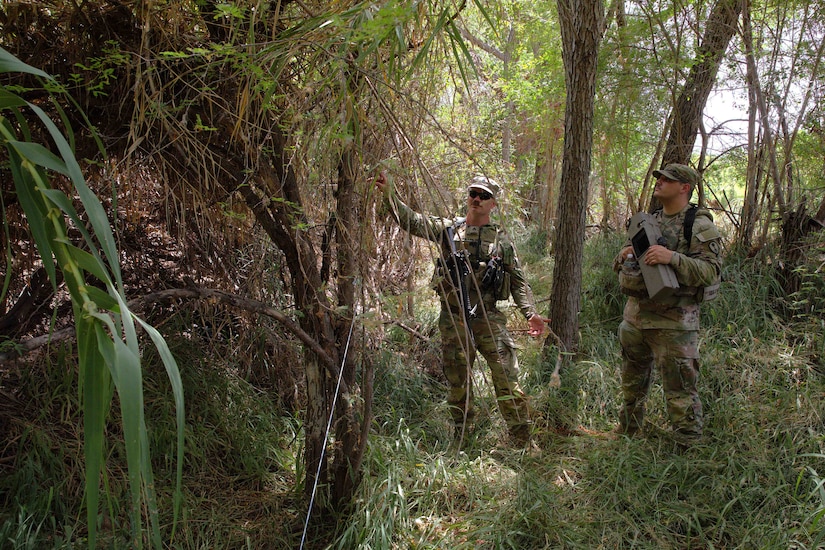
Two soldiers wearing camouflage military uniforms look at a brush covered area while standing in a forest.

The AN/MPQ-64 Sentinel radar is one of the unique capabilities that the task force uses to address these security challenges at the border and enable U.S. Border Patrol's law enforcement role while also providing defensive capabilities against small unmanned aerial systems. 

The U.S. Border Patrol El Paso Sector, which oversees 268 miles of the southern border in Texas and New Mexico, is one of nine sectors that has seen the benefits of an integrated approach with the task force. 

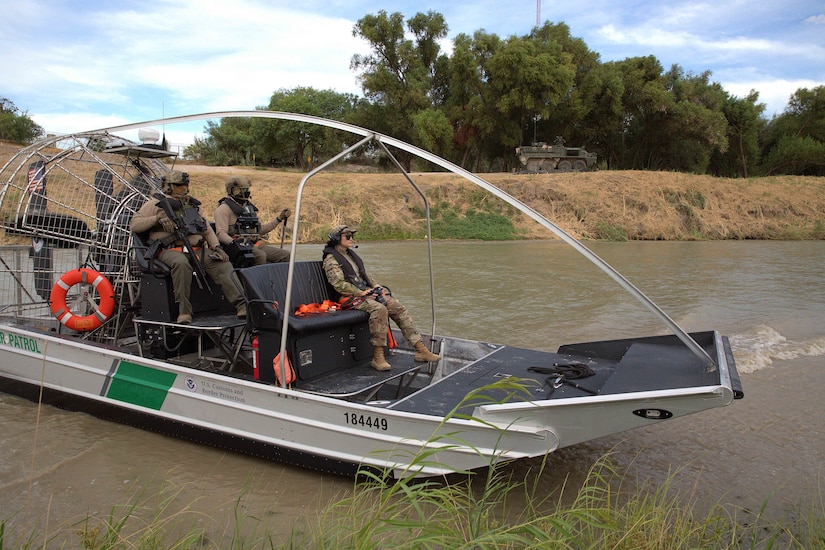
Three people sit in a metal boat on a small body of water under blue skies with trees and tall grass in the background.
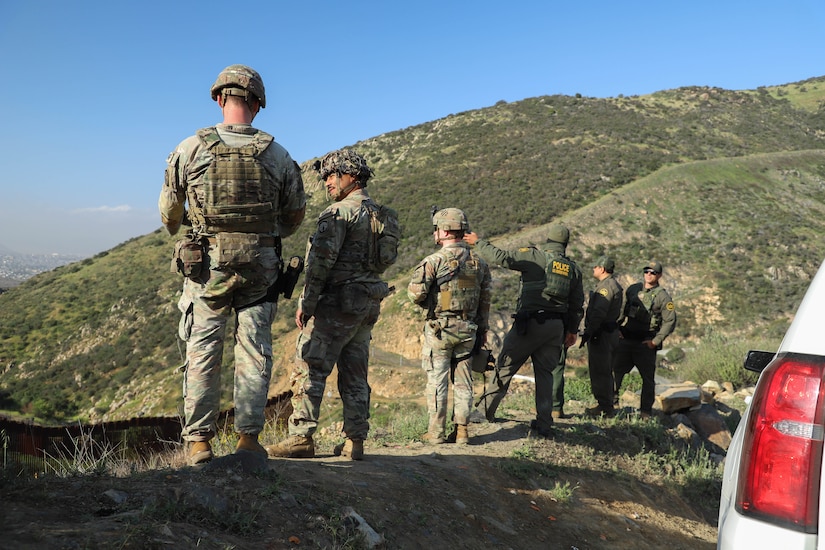
Three soldiers wearing camouflage military uniforms stand on a hill next to three other people in green police uniforms. One of the men is pointing toward the valley below.
"The Border Patrol in El Paso focuses on collaboration with various agencies and the Department of War's JTF-SB to enhance border security to target hostile drones and the challenges they pose," said Walter N. Slosar, chief patrol agent with the El Paso Sector. "Enhanced detection capabilities between JTF-SB and U.S. Border Patrol give us full spectrum capabilities to track, identify and mitigate aerial threats." 

JTF-SB and U.S. Border Patrol remain committed to strengthening this vital partnership and continued innovation in the face of evolving threats with a broad range of capabilities. This collaboration serves as a model for future interagency cooperation and underscores the importance of a unified approach to national security.