Showing posts with label Joint Task Force. Show all posts

Saturday, June 27, 2026

Joint Task Force Southern Border Conducts Medevac in Arizona Mountains

Service members assigned to Joint Task Force Southern Border conducted an aeromedical evacuation after receiving a request to assist a civilian who was experiencing a medical emergency while supporting border barrier construction in a remote mountainous area of southern Arizona, June 17. 
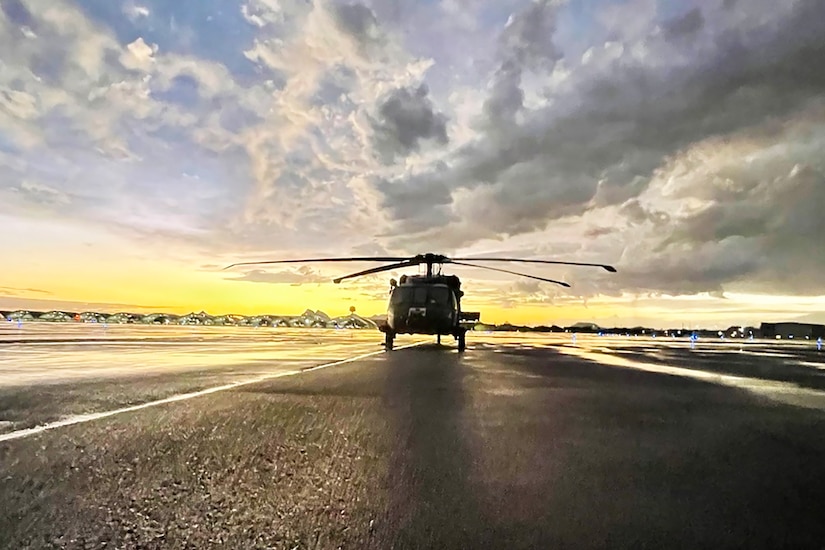
A military helicopter sits on a flight line under a blue sky with clouds at dusk.

This medevac highlights the unique military capabilities that Joint Task Force Southern Border brings in support of U.S. Customs and Border Protection as a part of Operation Ardent Vanguard. 

The task force received the request in the early afternoon, when officials reported that a civilian contractor required urgent medical assistance while in a mountainous terrain inaccessible to conventional emergency response vehicles. 

The service members coordinated with CBP personnel and approved the launch of a War Department medical evacuation aircraft. Initial reports indicated that first responders were hiking to the patient's location while working to determine an exact position. 

"JTF-SB responded to this mission, preserving the life of the civilian upon request of the CBP," said Army Master Sgt. Andrew VanMeter, the chief medical noncommissioned officer for the task force. 

VanMeter said that, although the remote location was inaccessible to civilian aeromedical and ground teams, the Joint Task Force Southern Border was uniquely qualified for the mission because of the patient's remote location and the lack of landing zones. 

The medical evacuation aircraft arrived on station, established visual contact with personnel on the ground and then conducted hoist operations. Aircrews successfully recovered the patient from the mountainside and began transport toward definitive medical care. 

During the flight, adverse weather conditions in Tucson, Arizona, required adjustments to the patient transfer plan. The aircraft landed at an alternate location, where the patient was transferred to civilian emergency medical services for continued transportation to a local hospital. 
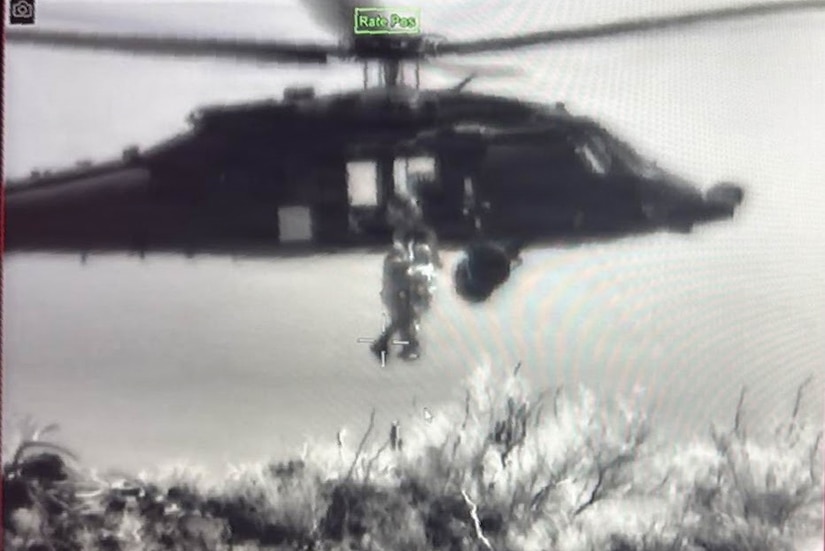
A grainy, black-and-white image of a helicopter hovering over water with two people dangling from it and a third person assisting as they are hoisted into the aircraft.

Army Sgt. 1st Class Christian Castillo, a flight medic assigned to Foxtrot Company, 3rd Battalion, 501st Assault Helicopter Battalion, said hoist rescues require a significantly different approach than traditional medical evacuation operations. 

"Unlike a standard medevac call, where we can land the aircraft, and I can access all my gear, a hoist requires inserting with minimal equipment," Castillo said. "Because of that limitation, my mindset immediately shifts to executing the foundational knowledge of tactical combat casualty care." 

Castillo said successful hoist operations depend on extensive preparation before an emergency happens. 

"Executing a 160-foot hoist mission requires a layered approach to training, well before the actual mission occurs," he said. "It involves consistently practicing hoist operations during routine training flights and conducting integrated training with the ground forces."

The team also conducted a thorough analysis of the operational area beforehand to anticipate the environmental and tactical conditions it could encounter on scene. 

The most unique aspect of this mission was the crew dynamic; this was the first operational flight for the crew's junior pilot after completing his training with the unit. As for the personnel in the back of the aircraft, Castillo and Army Spc. Kierstann Knowles, the crew chief, had previously executed a hoist rescue together. They said that shared experience was critical.

The mission highlights Joint Task Force Southern Border's ability to rapidly integrate with federal, state and local partners, its readiness, aviation capabilities, and its commitment to preserving life and enabling mission success along the southern border.

Monday, January 26, 2026

Steady in the Storm: Guardsmen Support D.C. Through Winter Weather

Snow fell steadily as a military Humvee eased through Washington's streets with tires crunching over packed ice and traffic lights reflected off slush-covered pavement. Inside the vehicle, Army Col. Larry Doane, commander of Joint Task Force District of Columbia, scanned a digital map, tracking patrols spread across the city as a winter storm tightened its grip.

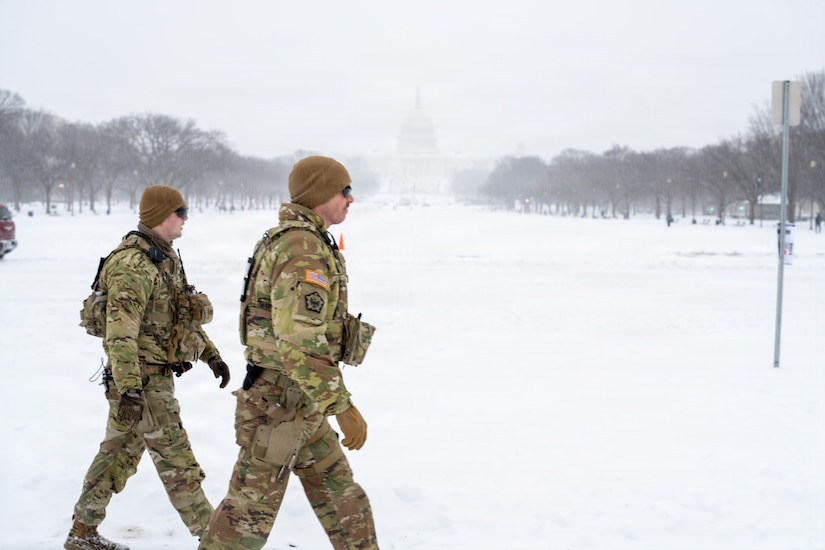
Two people in camouflage military uniforms walk along a snow-covered sidewalk in front of the U.S. Capitol.

"Slow and steady," Doane said, watching a civilian vehicle struggle for traction nearby. "Interesting driving choices out there today." 

The storm transformed the mission almost instantly. What began as routine presence patrols in support of the D.C. Safe and Beautiful mission shifted toward life-safety priorities — mobility, visibility and helping people navigate a city slowed by snow and ice. 

Across the district, National Guard soldiers and airmen moved deliberately through metro stations, neighborhoods and key corridors. Some checked on patrol teams braving long shifts in freezing temperatures. Others used high-mobility vehicles to assist first responders, transport personnel and help stranded motorists clear snowbanks and regain traction. 

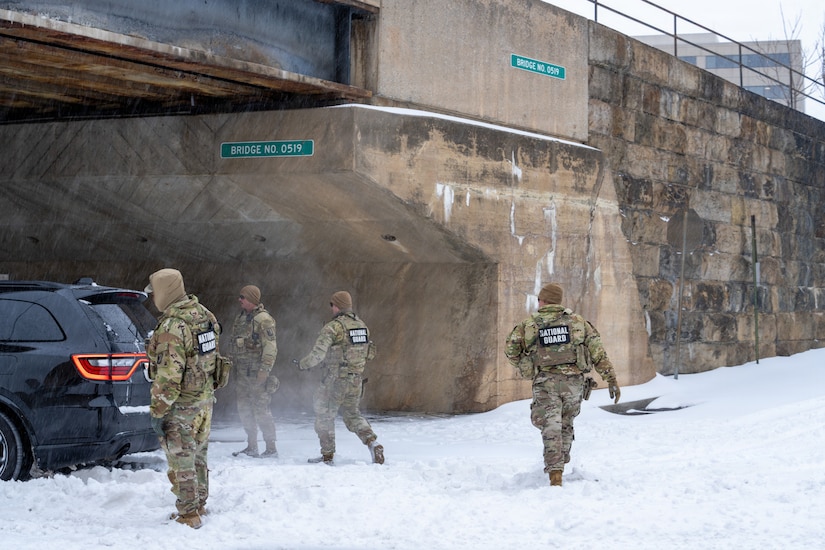
Four people in camouflage military uniforms stand outside in the snow, inspecting a black vehicle under a bridge.

"This is where the Guard fits naturally," Doane said, as the Humvee turned toward Union Station. "When conditions get tough, we bring mobility, manpower and discipline to support our partners and the community." 

Throughout the ride-along, Doane stopped repeatedly to speak with guardsmen on post — asking about their gear, their feet, their food and their radios. He reminded leaders to rotate personnel inside warming areas, keep one soldier alert at all times and watch for signs of cold-weather injuries.

"Those basic leadership things still work," he said. "Feet, hands, communication — take care of each other — and the mission takes care of itself." 

Outside, the storm revealed a different side of the mission. Guardsmen pushed vehicles out of snowbanks, guided pedestrians through icy intersections and checked on individuals waiting in the cold. In several cases, teams coordinated with district partners to escort people to warming shelters or help them reach safe transportation. 

"We're providing a lot of mobility today," Doane explained. "That's really what our partners need — getting officers, firefighters and medical personnel where they need to be, and helping civilians move safely through the city." 

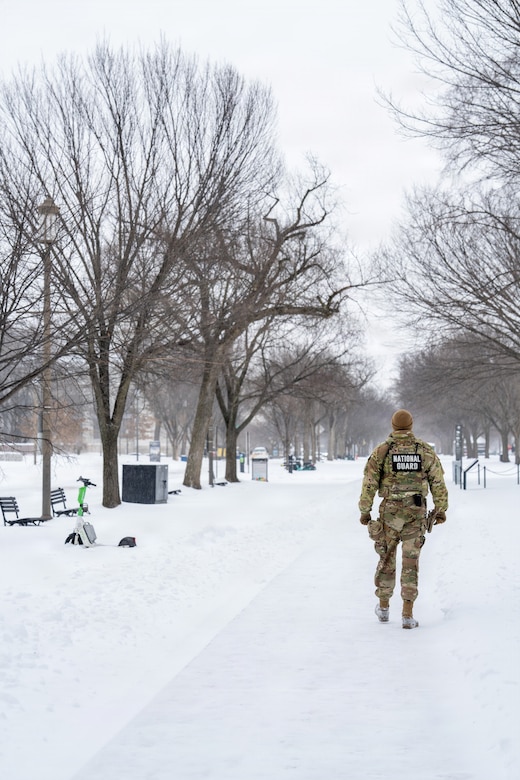
A person in a camouflage military uniform walks along a snow-covered street with rows of trees on either side.

Inside a metro station, Doane paused to observe soldiers standing watch near the turnstiles. Trains continued running despite the weather, and commuters moved through what one passerby called "the safest metro station in America right now." The guardsmen nodded, adjusted their posture and continued scanning the space — visible, calm and unintrusive. 

"That presence matters," Doane said. "Just being here brings the temperature down. People feel reassured." 

The winter storm did more than slow traffic; it tested systems, patience and readiness. Snow and ice complicated response times, narrowed streets and forced constant reassessment of risk. Guardsmen adapted quickly, shifting patrol routes, coordinating with law enforcement partners and prioritizing safety over speed. 

"Safety is No. 1," Doane reminded a team sheltering near a metro entrance. "No reason to stand out here and freeze. We'll get back to normal patrols when conditions allow." 

Despite the conditions, morale remained steady. Guardsmen shared hot drinks, swapped stories and laughed about snowball fights that never materialized. Civilians waved as the Humvee passed, some offering thanks, others simply relieved to see help nearby. 

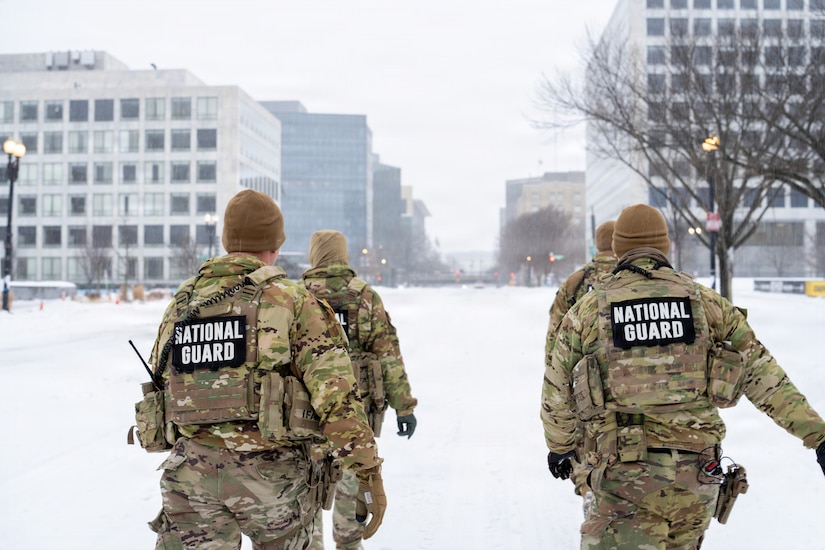
Four people in camouflage military uniforms walk along a snow-covered city street.

"I've gotten more waves today than I have in a long time," Doane said. "People remember what the Guard does during storms like this." 

As the night wore on, the mission continued, quietly, steadily and without ceremony. Patrols remained in place. Vehicles stayed ready. And across the city, guardsmen stood watch while Washington dug itself out. 

"What we do is important," Doane said as the Humvee rolled back into traffic. "But how we do it matters more. The way our soldiers carry themselves, the way they treat people — that's what builds trust." 

In a city shaped by movement and unpredictability, the storm underscored the Guard's enduring role: ready when conditions worsen, visible when reassurance is needed and committed to serving the community — no matter the weather.